

Skin tags are among the most common benign skin growths seen in clinical practice, yet many people are unsure whether what they have is actually a skin tag or something else entirely. Understanding what skin tags look like — their typical size, colour, texture, shape, and preferred locations on the body — can help you decide whether a professional assessment is worthwhile and what your options might be.
Key Takeaways
- Skin tags are small, soft, benign growths that hang from the skin on a narrow stalk, most commonly appearing in areas where skin rubs together.
- They typically range from 1 mm to around 5 mm in diameter, though some can grow larger over time.
- Skin tags are usually flesh-coloured or slightly darker than the surrounding skin, smooth or slightly wrinkled, and painless unless irritated.
- Several other skin conditions can resemble skin tags, so professional assessment is recommended before any removal attempt.
- Safe, effective removal options are available at aesthetic and dermatology clinics if a skin tag is causing discomfort or cosmetic concern.
What Is a Skin Tag?
A skin tag — known medically as an acrochordon — is a small, benign outgrowth of skin. It consists of a core of loose connective tissue and small blood vessels covered by a thin layer of skin. Unlike warts or moles, skin tags are not caused by a virus and are not considered precancerous. They are extremely common: research suggests that roughly half of all adults will develop at least one skin tag during their lifetime, with prevalence increasing with age.
Skin tags are not dangerous in themselves, but they can become irritated when they catch on clothing, jewellery, or skin folds. Some people choose to have them removed for cosmetic reasons or because of persistent friction and discomfort. Before considering removal, it is important to confirm that the growth is indeed a skin tag rather than another type of lesion that may require different management.
What Do Skin Tags Look Like? Key Visual Characteristics
Identifying a skin tag usually comes down to a combination of features: the way it is attached to the skin, its overall shape, its surface texture, its colour, and its size. Most skin tags share a recognisable set of characteristics, though there is natural variation between individuals.
Shape and Structure
The most distinctive feature of a skin tag is its pedunculated structure — meaning it hangs from the skin on a narrow, flexible stalk rather than sitting flat against the surface. The body of the tag is typically rounded or oval, sometimes resembling a small grain of rice or a tiny deflated balloon. The stalk can be very thin and thread-like, or slightly broader depending on the size of the tag. When you gently move a skin tag, it will shift freely because it is attached only at the base of the stalk.
Smaller skin tags may appear almost flat or slightly raised at first, making them harder to distinguish from other minor skin changes. As they grow, the characteristic hanging appearance becomes more obvious. Occasionally, a skin tag may become twisted on its stalk, which can temporarily reduce blood flow and cause the tag to darken or become tender.
Size
Most skin tags are small, typically measuring between 1 mm and 5 mm in diameter — roughly the size of a sesame seed to a small pea. However, some skin tags can grow considerably larger, reaching 1 cm or more, particularly in areas subject to repeated friction. Very large skin tags are less common but do occur, especially in skin folds such as the groin or under the breasts. Size alone does not determine whether a growth is a skin tag; the overall combination of features matters more.
Colour
Skin tags are most often flesh-coloured, meaning they closely match the surrounding skin tone. In people with lighter skin, they may appear pale pink or beige. In people with medium or darker skin tones, skin tags can appear brown or slightly hyperpigmented. The colour is generally uniform across the tag, without the irregular pigmentation or multiple shades that might raise concern about a mole or other pigmented lesion.
A skin tag that has become twisted on its stalk may temporarily turn dark red, purple, or even black as blood supply is reduced. This is called torsion and can cause the tag to become tender. A darkened skin tag that has not been twisted should be assessed by a qualified practitioner to rule out other causes of colour change.
Texture and Surface
The surface of a skin tag is usually smooth or very slightly wrinkled, and it feels soft to the touch. Unlike warts, skin tags do not have a rough, cauliflower-like surface or visible black dots (which are thrombosed capillaries characteristic of verrucae). Unlike sebaceous cysts, skin tags do not feel firm or contain a palpable lump beneath the skin. The softness and flexibility of a skin tag is one of its most reliable distinguishing features.
Where Do Skin Tags Typically Appear?
Skin tags tend to develop in areas where skin repeatedly rubs against skin or against clothing. The friction and warmth in these locations appear to encourage their formation, though the exact mechanism is not fully understood. Common locations include:
- Neck: One of the most frequent sites, particularly along the sides and back of the neck where collars and jewellery create friction.
- Armpits (axillae): The warm, moist environment and repeated movement make the underarms a very common location.
- Groin and inner thighs: Skin-on-skin contact in this area, especially during walking, contributes to tag formation.
- Under the breasts: The skin fold beneath the breast is a frequent site, particularly in women with larger bust sizes.
- Eyelids: Skin tags on the eyelids are less common but do occur, and they require particularly careful assessment and removal due to the sensitivity of the area.
- Under the arms and along the torso: Anywhere that clothing or skin creates repeated contact can be affected.
Skin tags can occasionally appear in less typical locations, including the face, back, or scalp. Their presence in an unusual location does not necessarily indicate a problem, but it does make professional assessment more important to confirm the diagnosis.
How Skin Tags Differ From Similar Skin Conditions
Several other benign skin conditions can look similar to skin tags, and distinguishing between them matters before any treatment is considered. A qualified practitioner — typically a dermatologist, GP, or experienced aesthetic clinician — can usually differentiate these conditions through visual examination, and in some cases a dermoscopy assessment or biopsy may be recommended.
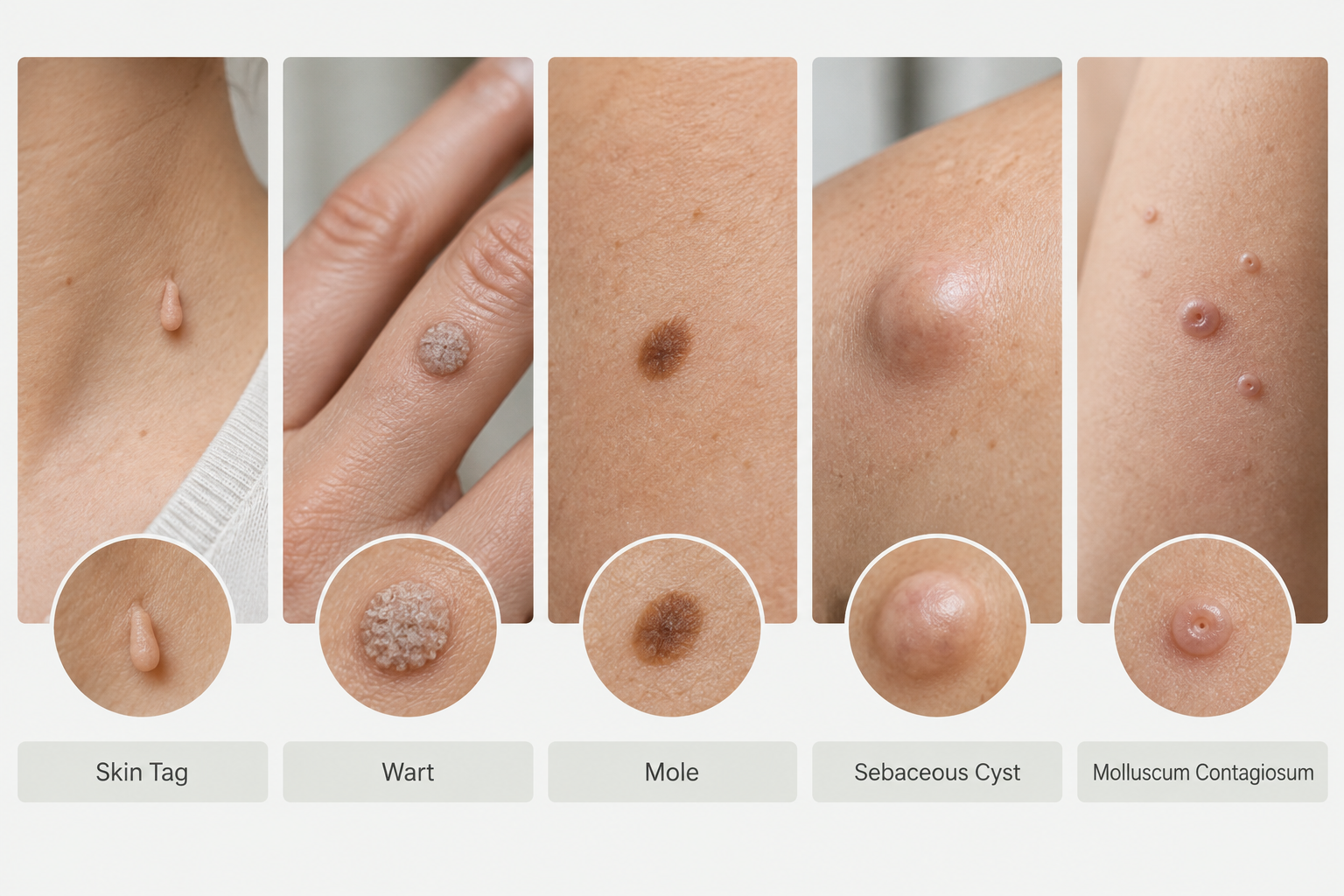
Skin Tags vs Warts
Common warts (verrucae vulgaris) are caused by the human papillomavirus (HPV) and have a rough, raised, irregular surface that is quite different from the smooth texture of a skin tag. Warts may also display small black dots on their surface, which are thrombosed capillaries. Unlike skin tags, warts are not pedunculated — they grow directly from the skin surface without a stalk. Warts can spread to other areas of the body or to other people, whereas skin tags are not contagious.
Skin Tags vs Moles
Moles (melanocytic naevi) are flat or raised pigmented lesions that sit directly on the skin surface. They are caused by clusters of melanocytes (pigment-producing cells) and can range from light brown to very dark. Unlike skin tags, moles do not hang on a stalk and are generally firmer to the touch. Any mole that changes in size, shape, colour, or border, or that bleeds or itches, should be assessed promptly by a qualified practitioner using the ABCDE criteria (Asymmetry, Border, Colour, Diameter, Evolution) to rule out melanoma.
Skin Tags vs Sebaceous Cysts
Sebaceous cysts are enclosed sacs beneath the skin surface that contain keratin or sebum. They feel firm or rubbery and have a visible central punctum (a small dark opening) in many cases. Sebaceous cysts do not hang from a stalk and are generally larger and more defined than skin tags. They can become inflamed or infected, which requires different management.
Skin Tags vs Dermatofibromas
Dermatofibromas are firm, slightly raised nodules that are typically found on the legs. They are usually brownish and feel hard compared to the soft, pliable texture of a skin tag. When pinched from the sides, a dermatofibroma characteristically dimples inward — a feature not seen with skin tags.
Skin Tags vs Molluscum Contagiosum
Molluscum contagiosum is a viral skin infection that produces small, dome-shaped papules with a characteristic central dimple. These lesions are contagious and can spread across the body. They may superficially resemble very small skin tags but lack the pedunculated stalk and are firmer in texture.
What Causes Skin Tags to Form?
The precise cause of skin tag formation is not fully established, but several factors appear to increase the likelihood of developing them. Friction between skin surfaces or between skin and clothing is widely considered a primary contributing factor, which explains why skin tags cluster in body folds and areas of repeated movement.
Hormonal changes may also play a role. Skin tags are more common during pregnancy, possibly due to elevated levels of oestrogen and progesterone. People with type 2 diabetes or insulin resistance have a higher prevalence of skin tags, and some research suggests a possible association between multiple skin tags and metabolic syndrome, though this relationship is not fully understood and skin tags alone are not diagnostic of any underlying condition. Obesity increases the likelihood of skin tags, partly because it creates more skin folds and friction surfaces. There also appears to be a genetic component, as skin tags can run in families.
Age is a consistent risk factor: skin tags become more common from middle age onward, and they are relatively rare in children and young adults.
When Should a Skin Tag Be Assessed by a Professional?
Most skin tags are harmless and require no medical treatment. However, professional assessment is advisable in certain situations. You should seek a clinical opinion if:
- You are not certain whether the growth is a skin tag or another type of lesion.
- The growth has changed in size, shape, or colour.
- The growth bleeds without obvious cause, such as catching on clothing.
- The growth is painful, itchy, or inflamed without a clear reason such as friction.
- The growth is located on the eyelid or near the eye, where self-treatment carries significant risk.
- You have multiple new growths appearing in a short period.
- You have a personal or family history of skin cancer and are uncertain about any new lesion.
A qualified practitioner can confirm the diagnosis and advise on whether removal is appropriate, which method is most suitable, and what to expect from the procedure.
Skin Tag Removal Options
If a skin tag has been confirmed by a professional and removal is desired — whether for cosmetic reasons or because the tag is causing irritation — several clinical methods are available. The right approach depends on the size and location of the tag, the patient’s skin type, and the practitioner’s assessment.
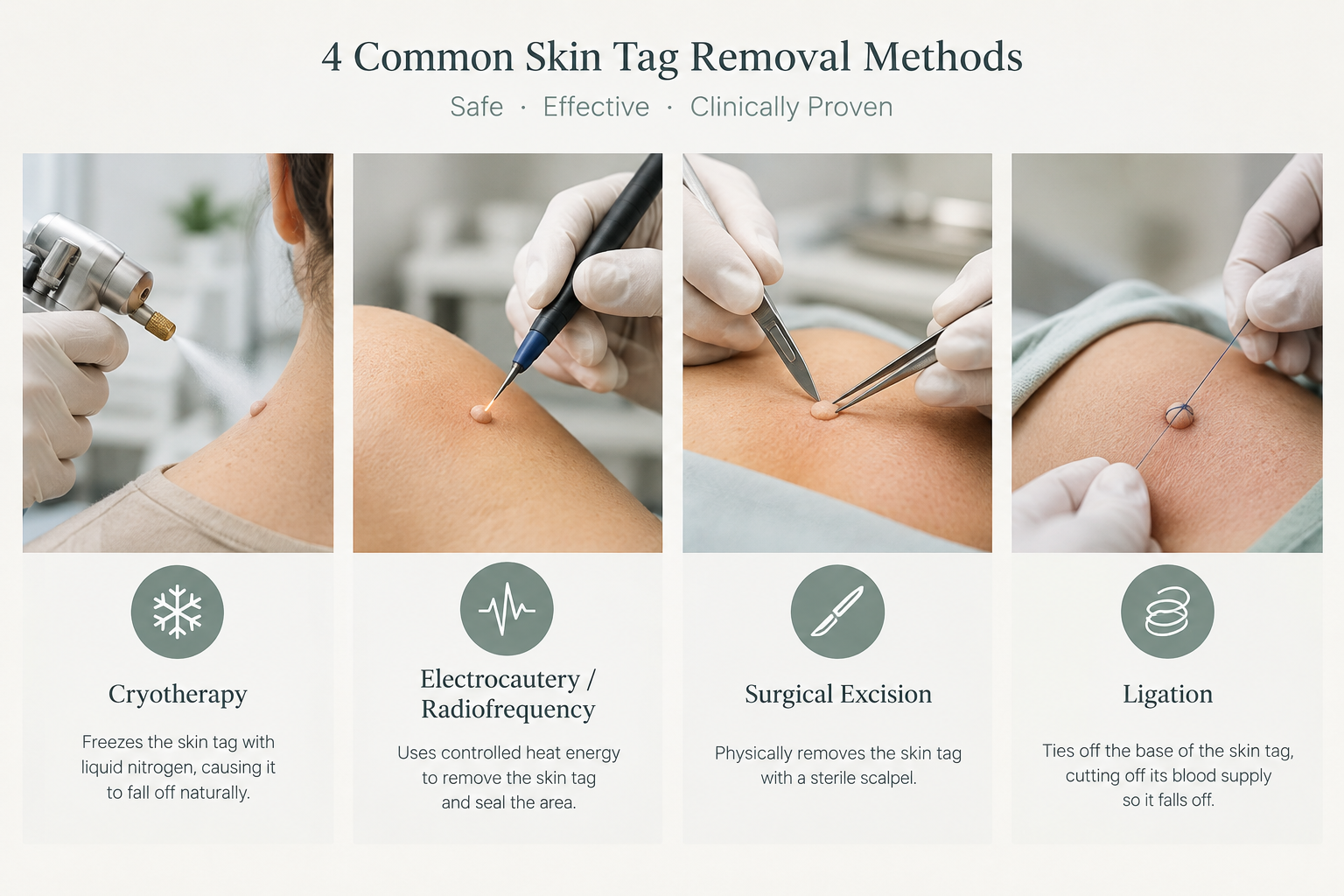
Cryotherapy
Cryotherapy involves applying liquid nitrogen to the skin tag to freeze and destroy the tissue. The tag typically falls off within one to two weeks. Cryotherapy is a well-established method suitable for many skin tags, though it may cause temporary redness, blistering, or mild discomfort. There is a small risk of pigmentation change, particularly in people with darker skin tones.
Electrocautery and Radiofrequency
Electrocautery uses an electrical current to burn and remove the skin tag, while radiofrequency devices use high-frequency energy to achieve a similar effect with potentially less thermal spread to surrounding tissue. Both methods are performed under local anaesthetic and are effective for skin tags of varying sizes. Mild redness and scabbing are expected during healing.
Surgical Excision
For larger skin tags or those in sensitive locations, a practitioner may use a sterile blade or scissors to remove the tag at its stalk under local anaesthetic. This is a straightforward procedure with a low risk of complications when performed by a trained clinician. A small wound will heal over several days.
Ligation
Ligation involves tying a fine thread or suture around the base of the stalk to cut off the blood supply. The tag gradually shrinks and falls away over several days. This method is sometimes used for pedunculated tags with a clearly defined stalk.
Home removal methods — including over-the-counter freezing kits, tying thread around tags at home, or cutting with scissors — carry meaningful risks of infection, scarring, and incomplete removal, and are not recommended by most clinical guidelines. They also carry the risk of attempting to remove a lesion that is not actually a skin tag.
Frequently Asked Questions
Can a skin tag fall off on its own?
Skin tags occasionally fall off without intervention, particularly if they become twisted on their stalk and lose their blood supply. However, most skin tags persist indefinitely once they have formed. Spontaneous resolution is not reliable, and waiting for a tag to fall off is not a recommended strategy if it is causing discomfort or cosmetic concern.
Are skin tags the same as warts?
No. Skin tags and warts are distinct conditions. Warts are caused by the human papillomavirus and have a rough, irregular surface without a stalk. Skin tags are benign overgrowths of skin tissue, are not caused by a virus, and are not contagious. Treatment approaches differ between the two conditions.
Do skin tags grow back after removal?
A skin tag that has been fully removed at its base is unlikely to regrow at the same site. However, new skin tags may develop elsewhere on the body, particularly if the underlying contributing factors — such as friction, weight, or hormonal changes — remain present.
Can I remove a skin tag at home?
Home removal is not recommended by most clinicians. The main risks include infection, scarring, incomplete removal, and the possibility of treating a lesion that is not actually a skin tag. Professional removal is safer, more reliable, and allows for proper diagnosis before any treatment is carried out.
Do skin tags indicate a health problem?
In most cases, skin tags are simply a benign cosmetic concern with no underlying health significance. However, a high number of skin tags, particularly if they appear rapidly, has been associated in some research with insulin resistance and metabolic syndrome. This association does not mean that skin tags diagnose any condition, but it may be worth discussing with your GP if you are developing many new tags alongside other health concerns.
Are skin tags painful?
Skin tags are generally painless. They may become sore or tender if they are repeatedly caught on clothing or jewellery, or if they undergo torsion (twisting on the stalk). A skin tag that is persistently painful without an obvious mechanical cause should be assessed by a practitioner.
What does a skin tag look like when it is dying?
A skin tag that has lost its blood supply — either through natural torsion or following a clinical procedure such as ligation or cryotherapy — will typically darken in colour, turning red, purple, or black. It may become slightly firm and will gradually shrink before detaching from the skin. This process can take several days to two weeks depending on the method used.
When to Seek Removal and What to Expect
Skin tags do not require removal from a medical standpoint unless they are causing significant irritation or discomfort. The decision to have a skin tag removed is most often a personal one, driven by cosmetic preference or the practical inconvenience of a tag that repeatedly catches on clothing or jewellery. A consultation with a qualified aesthetic clinician or dermatologist is the appropriate starting point.
During a consultation, the practitioner will visually examine the growth — and may use a dermoscope for a closer assessment — to confirm that it is a skin tag rather than another type of lesion. They will discuss the most appropriate removal method based on the tag’s size, location, and your skin type, and will explain what to expect during and after the procedure, including any downtime, healing time, and potential risks such as temporary redness, scabbing, or pigmentation change.
Most skin tag removal procedures are quick, well-tolerated, and associated with minimal downtime. Results are generally reliable when the procedure is performed by a trained clinician using appropriate equipment. If you are uncertain about a growth on your skin, seeking a professional opinion is always the safest course of action rather than attempting self-diagnosis or home treatment.