

Dark circles under the eyes are one of the most common cosmetic concerns seen in clinical practice, yet they are frequently misunderstood. Many people assume tiredness is the sole cause, but periorbital darkness can result from several distinct biological mechanisms — and identifying the correct cause is essential before considering any treatment. This article explains the main reasons dark circles develop, how each type differs, and what options may be worth discussing with a qualified practitioner.
Key Takeaways
- Dark circles under the eyes have multiple distinct causes, including pigmentation, visible blood vessels, volume loss, and structural shadows — and these often overlap in the same person.
- Genetics, skin tone, age, lifestyle factors, and anatomy all influence how pronounced periorbital darkness appears.
- Effective management depends on correctly identifying the underlying cause; no single treatment addresses every type of dark circle.
- A clinical assessment by a qualified practitioner is the most reliable way to determine which factors are contributing and which approaches may be appropriate.
Why Dark Circles Are Not One Single Problem
The term “dark circles” is used loosely to describe any darkening of the skin beneath or around the eyes, but clinically this covers several different phenomena. Periorbital hyperpigmentation refers to excess melanin deposited in the skin itself. Vascular dark circles occur when blood vessels close to the surface show through thin or translucent skin. Structural or shadow-based darkness results from hollowness, volume loss, or the anatomical shape of the orbital area. In many patients, two or more of these mechanisms are present simultaneously, which is why a single product or treatment rarely resolves the concern completely.
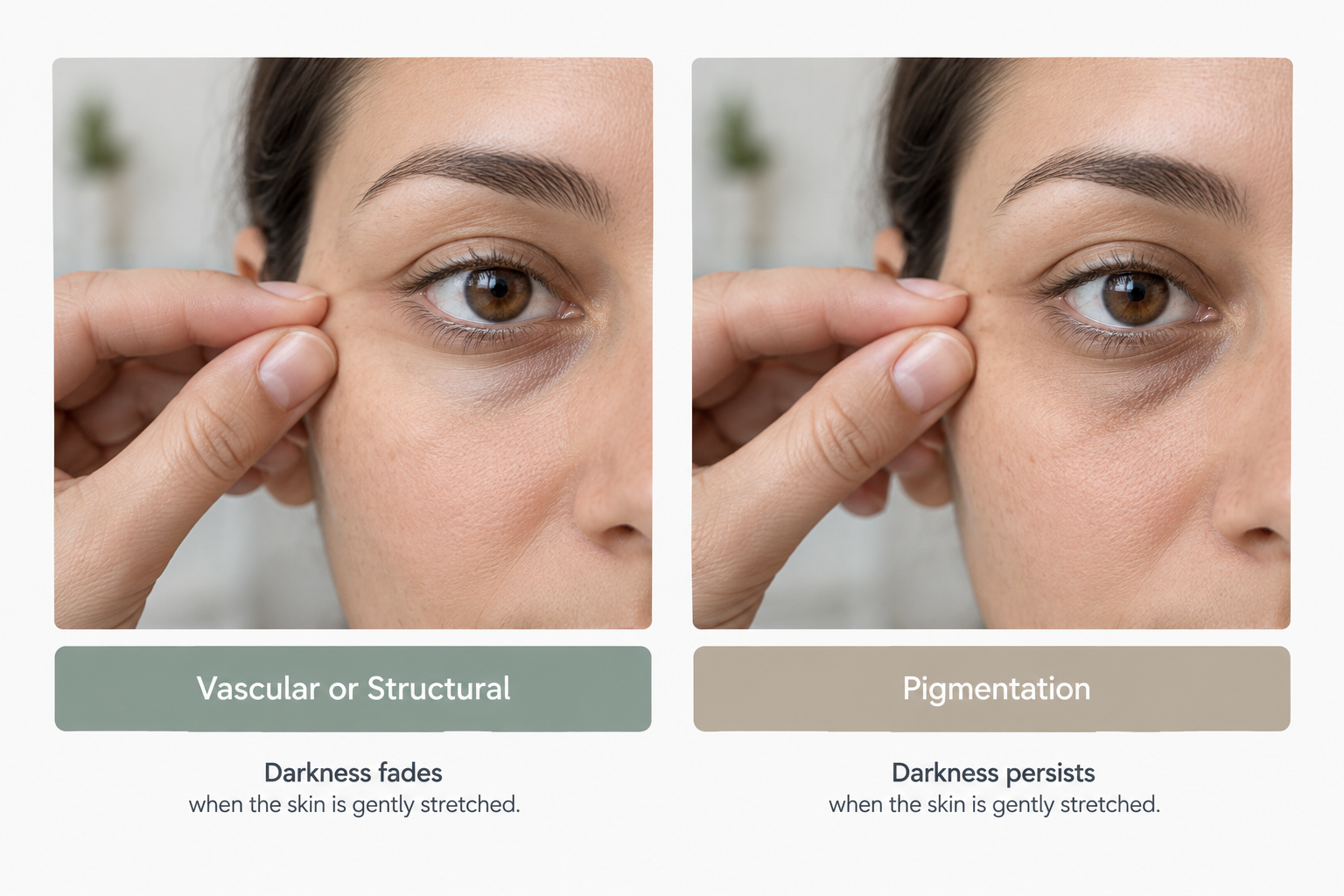
Understanding which type — or combination of types — is responsible for periorbital darkness in a given individual is the starting point for any meaningful treatment plan. Practitioners often assess this by gently stretching the skin: if the darkness fades, a vascular or structural component is likely; if it persists, pigmentation is more probably involved.
Pigmentation as a Cause of Periorbital Darkness
Periorbital hyperpigmentation is one of the most frequently identified causes of dark circles, particularly in people with medium to darker skin tones. Melanin — the pigment responsible for skin colour — can be produced in excess in the delicate skin around the eyes, resulting in a brown, grey, or blue-brown discolouration that is present regardless of sleep quality or hydration levels.
Several factors can trigger or worsen periorbital pigmentation. Post-inflammatory hyperpigmentation may develop after repeated rubbing of the eyes, allergic reactions, or eczema affecting the eyelid skin. Sun exposure stimulates melanin production in the periorbital area just as it does elsewhere on the face, making consistent sun protection relevant even for this small area. Hormonal changes, including those associated with pregnancy or oral contraceptive use, can also increase pigmentation around the eyes in susceptible individuals.
Pigmentation-related dark circles tend to appear as a consistent brown or greyish tone and are not significantly affected by posture or the time of day. They are generally more resistant to simple lifestyle changes and may require targeted treatments such as topical depigmenting agents, chemical peels, or laser-based interventions — though results vary and multiple sessions are often needed. Skin tone and the depth of pigmentation influence which approaches are appropriate and safe.
Vascular Visibility and Thin Skin
The skin beneath the eyes is among the thinnest on the entire body, typically measuring less than one millimetre in depth. When the underlying blood vessels — particularly the small venules and capillaries of the periorbital plexus — are visible through this thin skin, they create a bluish, purplish, or reddish tint that is commonly described as dark circles.
Vascular dark circles are particularly common in people with naturally fair or translucent skin, where there is less melanin to obscure the underlying vasculature. They may also become more noticeable with age, as the skin progressively loses collagen and becomes thinner over time. Fatigue, alcohol consumption, and dehydration can cause blood vessels to dilate, temporarily intensifying the appearance of vascular periorbital darkness — which is why tiredness is so strongly associated with this type of dark circle even though it is not the root cause.
Nasal congestion and allergies can also contribute to vascular dark circles. When nasal passages are congested, blood drainage from the periorbital veins may be impaired, causing pooling and a more pronounced bluish discolouration beneath the eyes. This is sometimes referred to as the allergic shiner. Addressing underlying allergies can reduce this component, though it rarely eliminates the concern entirely if structural or pigmentation factors are also present.
Volume Loss, Hollowness, and the Tear Trough
One of the most significant and often underappreciated causes of periorbital darkness is volume loss in the mid-face and under-eye area. The tear trough is the groove that runs from the inner corner of the eye downward and outward along the junction between the lower eyelid and the cheek. As the face ages, fat compartments in this region diminish, the overlying skin loses support, and a shadow is cast in the concavity — creating the appearance of darkness even when the skin itself has no excess pigmentation.
This structural or shadow-based dark circle is strongly influenced by lighting and viewing angle. It tends to appear more pronounced in direct overhead lighting and may be less visible in diffuse or frontal light. Unlike pigmentation-related darkness, it does not respond to topical treatments targeting melanin. Volume restoration using hyaluronic acid dermal fillers in the tear trough area is a commonly used approach for this type of periorbital concern, though the tear trough is a technically demanding area that requires careful patient selection and an experienced injector to minimise the risk of complications such as the Tyndall effect — a bluish discolouration that can occur if filler is placed too superficially.
Volume loss is a natural consequence of ageing, but it can also occur in younger individuals who have a naturally deep tear trough due to their facial anatomy. In these cases, the concern may be present from early adulthood and is not necessarily a sign of premature ageing.
Genetics and Inherited Anatomy
Genetics play a substantial role in determining whether a person is predisposed to dark circles under the eyes. Inherited factors influence skin thickness, melanin distribution, the depth of the orbital socket, the prominence of the bony orbital rim, and the natural fat distribution of the mid-face — all of which affect how the periorbital area appears.
People who observe that dark circles have been present since childhood, or that other family members share the same concern, are likely experiencing a genetically influenced pattern. In these individuals, lifestyle modifications such as improved sleep or increased hydration may have limited impact because the underlying anatomy is the primary driver. This does not mean treatment is impossible, but it does mean that expectations should be realistic and that approaches targeting the specific anatomical factor — whether pigmentation, vascular visibility, or structural hollowness — are more likely to be useful than general wellness advice.
Ethnicity also influences the pattern of periorbital darkness. Periorbital hyperpigmentation is reported more frequently in individuals of South Asian, Middle Eastern, African, and East Asian descent, while vascular dark circles may be more prominent in those with lighter, thinner skin. These patterns reflect differences in melanin biology, skin structure, and facial anatomy across populations.
The Role of Ageing in Periorbital Darkness
Ageing affects the periorbital area through several simultaneous mechanisms, which is why dark circles often become more noticeable with advancing age even in people who were not significantly affected when younger. Collagen and elastin fibres in the skin gradually break down, reducing skin thickness and allowing underlying blood vessels to become more visible. Fat compartments in the mid-face and lower eyelid area diminish and descend, deepening the tear trough and creating structural shadows. Bone resorption in the orbital rim can further alter the contour of the eye socket, contributing to a hollowed appearance.
Skin laxity — the loosening of skin that accompanies collagen loss — can also cause the lower eyelid skin to become crepey or to develop fine lines, which interact with light to create the impression of darkness even when pigmentation is not significantly increased. The combination of these age-related changes means that older patients often present with a mixed picture involving vascular, structural, and sometimes pigmentation components simultaneously.
Lifestyle Factors That Worsen Dark Circles
While lifestyle factors are rarely the sole cause of persistent dark circles, several behaviours can worsen an existing tendency toward periorbital darkness. Understanding these factors is useful both for managing expectations and for identifying modifiable contributors.
- Sleep deprivation: Insufficient sleep causes pallor of the skin, which makes underlying blood vessels more visible, and can cause mild puffiness that casts shadows beneath the eyes. However, sleep deprivation alone does not cause dark circles in people who are not otherwise predisposed to them.
- Dehydration: When the body is dehydrated, the skin beneath the eyes can appear more sunken and dull, accentuating structural shadows and vascular discolouration.
- Alcohol and smoking: Alcohol causes vasodilation and can worsen vascular dark circles temporarily. Smoking accelerates collagen breakdown and impairs skin quality over time, contributing to thinning of the periorbital skin.
- Excessive sun exposure: Ultraviolet radiation stimulates melanin production and accelerates collagen degradation, worsening both pigmentation-related and age-related periorbital darkness.
- Eye rubbing: Habitual rubbing of the eyes — often associated with allergies or contact lens wear — can cause post-inflammatory hyperpigmentation and may contribute to skin laxity over time.
- Screen time and eye strain: Prolonged screen use can cause blood vessels around the eyes to dilate, temporarily intensifying vascular dark circles, though the long-term structural impact is less clearly established.
Medical Conditions That May Contribute
In some cases, periorbital darkness may be associated with an underlying medical condition rather than purely cosmetic or lifestyle factors. Allergic rhinitis and other forms of chronic allergy are among the most common medical contributors, as described above. Thyroid disorders, particularly hypothyroidism, can cause puffiness and changes in skin quality around the eyes. Iron deficiency anaemia may cause pallor that makes vascular dark circles more apparent. Certain medications, including some used for glaucoma, have been associated with periorbital pigmentation as a side effect.
Chronic kidney or liver conditions can occasionally cause changes in skin tone that affect the periorbital area, though these are typically accompanied by other systemic signs. Eczema and contact dermatitis affecting the eyelid skin can cause post-inflammatory hyperpigmentation that persists long after the active inflammation has resolved. If dark circles appear suddenly, worsen rapidly, or are accompanied by other symptoms such as swelling, pain, or systemic changes, a medical evaluation is appropriate before pursuing cosmetic treatment.
Puffiness, Malar Bags, and Their Relationship to Dark Circles
Lower eyelid puffiness and dark circles are distinct concerns, but they frequently coexist and can each make the other appear more pronounced. Under-eye puffiness may result from fluid retention, fat prolapse through a weakened orbital septum, or malar mounds — collections of fluid or fat in the mid-cheek area that create a visible bulge. The shadow cast by a puffy lower eyelid can create the impression of darkness immediately below it, even when the skin itself has no excess pigmentation.
Malar bags, which are persistent fluid-filled swellings in the mid-cheek area, are a distinct anatomical entity from simple under-eye puffiness and are generally more difficult to treat. They tend to worsen with fluid retention, heat, and alcohol, and are influenced by genetics and ageing. Understanding whether puffiness is contributing to the appearance of dark circles is important because treatments targeting pigmentation or volume loss will not address a structural puffiness component.
Treatment Approaches and Their Relevance to Cause
Because dark circles under the eyes have multiple distinct causes, no single treatment is universally effective. The most appropriate approach depends on which mechanism — or combination of mechanisms — is responsible in a given individual.
Topical skincare containing ingredients such as vitamin C, retinoids, niacinamide, kojic acid, or azelaic acid may help reduce pigmentation-related dark circles over time, though results are gradual and require consistent use. Broad-spectrum sun protection is relevant for all types of periorbital darkness, as UV exposure worsens both pigmentation and collagen loss.
Dermal fillers in the tear trough area may improve structural or shadow-based dark circles caused by volume loss and hollowness. Hyaluronic acid fillers are the most commonly used option in this area. Results are not permanent and typically last from several months to around a year or more depending on the product used, the individual’s metabolism, and the amount placed. The tear trough is a technically sensitive area, and the risk of complications — including the Tyndall effect, bruising, and vascular occlusion — underscores the importance of choosing an experienced, medically qualified injector.
Polynucleotides (PDRN or PN-based injectables) are an emerging option for improving skin quality, hydration, and fine lines in the periorbital area. They work by stimulating fibroblast activity and supporting tissue regeneration rather than adding volume. Evidence for their use in dark circles is still developing, and they are generally considered more useful for skin quality and mild vascular visibility than for significant pigmentation or structural hollowness.
Chemical peels and laser treatments may be appropriate for pigmentation-related dark circles, though the periorbital area requires careful selection of peel depth and laser parameters to avoid adverse effects. Superficial peels using glycolic or lactic acid are generally considered lower risk in this area. Laser treatments targeting melanin or vascular components can be effective but carry a risk of post-inflammatory hyperpigmentation, particularly in darker skin tones, and should only be performed by practitioners with appropriate training and experience in periorbital treatments.
Platelet-rich plasma (PRP) injections have been used in the periorbital area with the aim of improving skin quality and reducing the appearance of dark circles, though the evidence base remains limited and results are variable. PRP is thought to stimulate collagen production and improve local tissue quality rather than directly targeting pigmentation or volume.
Surgical options such as lower blepharoplasty — surgical reshaping of the lower eyelid — may be considered for significant fat prolapse, skin laxity, or structural concerns that do not respond adequately to non-surgical approaches. Surgery carries greater risks and recovery time than non-surgical treatments and is typically considered when non-surgical options have been insufficient or are not appropriate for the degree of concern.
Frequently Asked Questions
Can dark circles be permanently removed?
Permanent removal is not reliably achievable for most types of dark circles. Pigmentation-related dark circles may improve significantly with appropriate treatment but can recur with sun exposure or hormonal changes. Volume-related dark circles treated with dermal fillers require maintenance as the filler gradually breaks down. Structural concerns related to bone anatomy are not reversible without surgery. Managing expectations realistically is an important part of any treatment discussion.
Do eye creams actually work for dark circles?
Some topical ingredients — including vitamin C, retinoids, caffeine, and niacinamide — have evidence supporting modest improvements in periorbital pigmentation, skin quality, and mild puffiness. However, topical products cannot address volume loss, deep structural shadows, or significant vascular visibility. Results from eye creams are generally subtle and require consistent long-term use.
Why are my dark circles worse in the morning?
Dark circles that are more pronounced in the morning often have a vascular or fluid-retention component. Lying flat during sleep can cause fluid to accumulate in the periorbital tissues, and blood may pool in the small vessels beneath the eyes. Elevating the head slightly during sleep and allowing time for fluid to redistribute after waking can reduce this morning worsening. If puffiness is also present, this pattern is particularly suggestive of a vascular or fluid-related cause.
Are dark circles a sign of a health problem?
In most cases, dark circles are a cosmetic concern rather than a sign of serious illness. However, they can occasionally be associated with conditions such as allergic rhinitis, anaemia, thyroid disorders, or chronic sleep disturbance. If dark circles appear suddenly, are accompanied by other symptoms, or seem disproportionate to lifestyle factors, it is reasonable to discuss this with a GP before pursuing cosmetic treatment.
Can dark circles be caused by allergies?
Yes. Allergic rhinitis and other forms of chronic allergy can contribute to periorbital darkness through two mechanisms: nasal congestion impairs venous drainage from the periorbital area, causing blood to pool and creating a bluish discolouration; and repeated eye rubbing due to itching can cause post-inflammatory hyperpigmentation. Managing the underlying allergy may reduce the vascular component, though it is unlikely to resolve dark circles entirely if other factors are also present.
At what age do dark circles typically appear?
This varies considerably depending on the cause. Genetically influenced dark circles may be present from childhood or early adulthood. Age-related dark circles caused by volume loss and skin thinning typically become more noticeable from the mid-thirties onward, though the timeline varies with genetics, lifestyle, and sun exposure history. Lifestyle-related dark circles can appear at any age when contributing factors such as sleep deprivation or dehydration are present.
Understanding Your Dark Circles Before Seeking Treatment
Dark circles under the eyes are a genuinely complex concern, and the most important step before pursuing any treatment is understanding which type — or combination of types — is present. Pigmentation, vascular visibility, volume loss, structural anatomy, and lifestyle factors each require a different approach, and treatments that are effective for one cause may have little impact on another. A thorough clinical assessment by a qualified practitioner who examines the periorbital area carefully, considers your medical history, and discusses realistic outcomes is the most reliable foundation for any treatment plan.
If you are considering treatment for periorbital darkness, look for a practitioner with specific experience in the periorbital area, as this is one of the most anatomically sensitive regions of the face. Ask about which type of dark circle they believe is present, what treatment they are recommending and why, what realistic improvement looks like, and what the risks and limitations are. A practitioner who takes time to explain the cause before recommending a solution is more likely to deliver a result that genuinely addresses your concern.