

Testosterone replacement therapy (TRT) uses several different forms of testosterone, and understanding which type is prescribed — and why — can help you have a more informed conversation with your doctor. The form of testosterone used in TRT affects how it is administered, how quickly levels rise, how stable those levels remain, and what side effects or monitoring requirements may apply. This article explains the main testosterone types used in TRT, how each works, their practical differences, and the factors that typically guide prescribing decisions.
Key Takeaways
- TRT uses bioidentical testosterone in several delivery forms, including injections, gels, patches, and pellets — each with distinct pharmacokinetic profiles.
- No single testosterone type is universally superior; the best option depends on individual health factors, lifestyle, preference, and clinical assessment.
- All forms of TRT carry potential risks and require ongoing monitoring by a qualified healthcare provider.
- Testosterone used in TRT is the same hormone the body produces naturally, but the ester, carrier, or delivery method determines how it behaves once administered.
- TRT is a medical treatment for diagnosed testosterone deficiency, not a general wellness supplement or performance-enhancement strategy.
What Is Testosterone Replacement Therapy?
Testosterone replacement therapy is a medically supervised treatment for hypogonadism — a condition in which the body produces insufficient testosterone. Hypogonadism may be primary (originating in the testes) or secondary (originating in the hypothalamic-pituitary axis), and diagnosis typically requires both clinical symptoms and confirmed low serum testosterone on at least two separate blood tests. Symptoms that may prompt investigation include persistent fatigue, reduced libido, erectile dysfunction, loss of muscle mass, increased body fat, low mood, and reduced bone density, though these symptoms are non-specific and can have many causes.
TRT does not introduce a foreign hormone. The testosterone used in all approved TRT formulations is structurally identical to the testosterone the human body produces endogenously. What differs between formulations is the chemical modification (ester), the delivery vehicle (oil, gel, patch, or pellet), and the route of administration. These differences determine how quickly testosterone enters the bloodstream, how long levels remain elevated, and how consistently they are maintained between doses.
The Main Forms of Testosterone Used in TRT
Several distinct testosterone formulations are used in clinical practice. Each has a different pharmacokinetic profile — meaning the pattern of absorption, peak concentration, and clearance from the body differs. Understanding these differences helps explain why one person may be prescribed weekly injections while another uses a daily gel.
Testosterone Cypionate
Testosterone cypionate is one of the most widely prescribed injectable testosterone esters, particularly in North America. It is administered by intramuscular or subcutaneous injection and is typically given every one to two weeks, though some clinicians prefer more frequent smaller doses to reduce the peaks and troughs associated with longer injection intervals. Testosterone cypionate has a half-life of approximately eight days, meaning blood levels rise after injection and then gradually decline before the next dose. This fluctuation can sometimes be noticeable, with some patients reporting higher energy and libido shortly after injection and lower levels toward the end of the dosing interval.
Testosterone cypionate is suspended in cottonseed oil, which contributes to its slow release from the injection site. It is generally well tolerated, and its long history of clinical use means prescribers have substantial experience with its dosing and monitoring requirements.
Testosterone Enanthate
Testosterone enanthate is pharmacologically very similar to testosterone cypionate and is the more commonly used injectable ester in Europe and many other parts of the world. Its half-life is approximately four to five days, which is slightly shorter than cypionate, though in clinical practice the two are often considered interchangeable and are typically administered on similar schedules — every one to two weeks, or more frequently in divided doses. Testosterone enanthate is suspended in sesame oil or other carrier oils depending on the formulation.
Both cypionate and enanthate are long-acting esters that allow for infrequent dosing, which many patients find convenient. The trade-off is that blood testosterone levels are not perfectly stable throughout the dosing interval, and some individuals are more sensitive to these fluctuations than others.
Testosterone Undecanoate
Testosterone undecanoate is available in two distinct forms: an injectable formulation and an oral capsule. The injectable version (available under brand names such as Nebido in many countries) has an exceptionally long half-life and is typically administered every ten to fourteen weeks after an initial loading phase. This makes it one of the most convenient injectable options in terms of injection frequency, and it produces relatively stable testosterone levels compared to shorter-acting esters. However, the long interval between injections means that if a patient experiences side effects or the dose needs adjustment, changes take longer to take effect.
Oral testosterone undecanoate (available as Jatenzo and Tlando in the United States, and Andriol in some other countries) is absorbed via the lymphatic system rather than the portal circulation, which reduces the hepatotoxicity risk associated with older oral androgens such as methyltestosterone. Oral testosterone undecanoate requires twice-daily dosing with food and produces more variable blood levels than injectable forms, which can make dose optimization more challenging. It may be suitable for patients who prefer to avoid injections and patches.
Testosterone Propionate
Testosterone propionate is a short-acting ester with a half-life of approximately two to three days. Because of its rapid clearance, it requires injection every two to three days to maintain stable blood levels, which many patients find inconvenient for long-term use. Testosterone propionate is less commonly prescribed for TRT today compared to longer-acting esters, though it may be used in specific clinical situations where rapid dose adjustment is needed or where a shorter-acting formulation is preferred for medical reasons.
Testosterone Gels and Topical Solutions
Transdermal testosterone gels and solutions are applied daily to the skin — typically the shoulders, upper arms, or abdomen — and testosterone is absorbed through the skin into the bloodstream. Brand names include AndroGel, Testim, Vogelxo, and Axiron, among others, though availability varies by country. Gels provide relatively stable daily testosterone levels without the peaks and troughs associated with injectable esters, which some patients find more comfortable in terms of mood and energy consistency.
A significant practical consideration with testosterone gels is the risk of transference — inadvertent transfer of testosterone to a partner, child, or other person through skin contact. This can cause virilization in women and children and requires careful attention to application site coverage and handwashing. Gels are generally not suitable for patients with skin conditions affecting the application area, and absorption can vary between individuals, sometimes making dose optimization more complex.
Testosterone Patches
Transdermal testosterone patches (such as Androderm) are applied to the skin once daily and deliver testosterone continuously over 24 hours. Like gels, patches produce relatively stable blood levels and avoid the injection-related peaks and troughs. The main limitation of patches is local skin irritation at the application site, which is reported by a meaningful proportion of users and can lead to discontinuation. Patches are rotated to different sites to reduce irritation, but this remains a common reason patients switch to an alternative formulation.
Testosterone Pellets
Subcutaneous testosterone pellets (such as Testopel) are small implants inserted under the skin — typically in the buttock or hip area — by a healthcare provider during a minor in-office procedure. Each pellet slowly releases testosterone over three to six months, providing a long-acting, low-maintenance option that eliminates the need for daily application or regular injections. Pellets may appeal to patients who prefer not to manage a daily or weekly regimen.
The limitations of pellets include the need for a minor surgical procedure for insertion and removal, the inability to rapidly adjust the dose once pellets are implanted, and a small risk of pellet extrusion or infection at the insertion site. Because the dose cannot be easily changed after implantation, careful pre-treatment assessment is important.
Testosterone Nasal Gel
Natesto is a testosterone nasal gel applied inside the nostrils three times daily. It is absorbed through the nasal mucosa and produces testosterone levels that peak and decline relatively quickly, more closely mimicking the natural diurnal rhythm of testosterone secretion. Some research suggests that nasal testosterone may have less suppressive effect on sperm production compared to other TRT forms, which may make it a consideration for men who wish to preserve fertility while receiving testosterone therapy. However, it requires three-times-daily dosing and may cause nasal irritation or discomfort.
How Testosterone Esters Work: The Pharmacokinetic Principle
The concept of a testosterone ester is central to understanding why different injectable forms behave differently. An ester is a chemical group attached to the testosterone molecule that makes it more lipophilic (fat-soluble), slowing its release from the oil-based injection depot into the bloodstream. Once in the bloodstream, enzymes cleave the ester group, releasing free testosterone. A longer ester chain — as in cypionate or undecanoate — results in slower release and a longer half-life. A shorter ester chain — as in propionate — results in faster release and a shorter half-life. The testosterone molecule itself is identical in all cases; only the release kinetics differ.
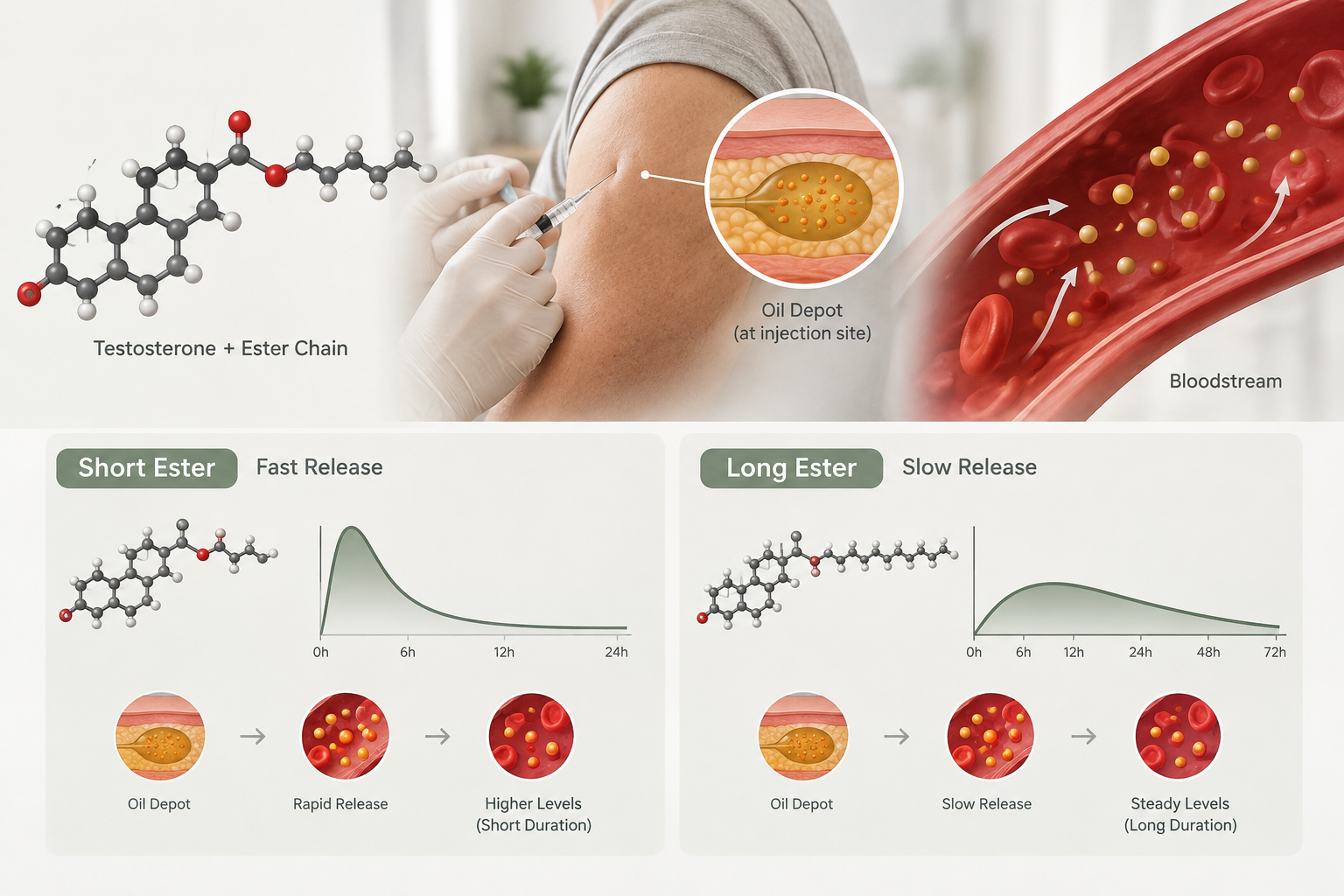
This principle explains why testosterone cypionate and enanthate can be dosed weekly or biweekly, while testosterone propionate requires dosing every two to three days. It also explains why injectable testosterone undecanoate can be administered as infrequently as every ten to fourteen weeks. Understanding this helps patients appreciate that the dosing schedule is not arbitrary — it is determined by the pharmacology of the specific formulation.
Comparing TRT Testosterone Types: Key Characteristics
| Testosterone Type | Route | Dosing Frequency | Level Stability | Key Consideration |
|---|---|---|---|---|
| Testosterone Cypionate | Injection (IM/SC) | Every 1–2 weeks (or more frequently) | Moderate (peaks and troughs) | Widely used; long clinical history |
| Testosterone Enanthate | Injection (IM/SC) | Every 1–2 weeks (or more frequently) | Moderate (peaks and troughs) | Common in Europe; similar to cypionate |
| Testosterone Undecanoate (injectable) | Injection (IM) | Every 10–14 weeks | Good (stable long-term) | Infrequent dosing; slow dose adjustment |
| Testosterone Undecanoate (oral) | Oral capsule | Twice daily with food | Variable | No injections; variable absorption |
| Testosterone Propionate | Injection (IM/SC) | Every 2–3 days | Good if dosed frequently | Frequent injections; less commonly used for TRT |
| Testosterone Gel/Solution | Topical (skin) | Daily | Good (stable daily levels) | Transference risk; variable skin absorption |
| Testosterone Patch | Transdermal | Daily | Good (continuous release) | Skin irritation common |
| Testosterone Pellets | Subcutaneous implant | Every 3–6 months | Good (slow sustained release) | Minor procedure; dose not easily adjusted |
| Testosterone Nasal Gel | Intranasal | Three times daily | Mimics natural rhythm | May preserve fertility; nasal irritation possible |
Factors That Influence Which Testosterone Type Is Prescribed
The choice of testosterone formulation in TRT is not simply a matter of patient preference. A qualified prescriber will consider multiple clinical and practical factors before recommending a specific type.

- Diagnosis and severity: The underlying cause and degree of testosterone deficiency may influence formulation choice, particularly if rapid correction is needed.
- Fertility considerations: Most TRT formulations suppress the hypothalamic-pituitary-gonadal axis, reducing sperm production. Men who wish to preserve fertility may need alternative approaches, such as human chorionic gonadotropin (hCG) therapy or nasal testosterone, rather than standard TRT.
- Lifestyle and adherence: A patient who travels frequently may prefer a long-acting injectable or pellets over a daily gel. Someone who dislikes injections may prefer a transdermal option.
- Household contacts: Patients with young children or female partners may need to avoid topical formulations due to transference risk.
- Skin conditions: Eczema or other skin conditions at potential application sites may make gels or patches unsuitable.
- Cardiovascular and haematological risk: TRT can increase red blood cell production (erythrocytosis), which raises haematocrit and may increase cardiovascular risk in susceptible individuals. This requires monitoring regardless of formulation.
- Cost and availability: Formulation availability and cost vary significantly between countries and healthcare systems, which may influence prescribing decisions in practice.
- Monitoring requirements: All TRT formulations require regular blood monitoring, but the timing of blood tests relative to dosing differs between formulations and must be accounted for to obtain accurate results.
Risks and Side Effects of TRT
All forms of testosterone replacement therapy carry potential risks, and these should be discussed thoroughly with a prescribing clinician before starting treatment. The risks are not unique to one formulation — they are associated with testosterone therapy broadly, though the magnitude of certain effects may vary with the formulation and dosing schedule.
Common side effects include acne, oily skin, increased body hair, fluid retention, and mood changes. Erythrocytosis — an increase in red blood cell mass — is a well-recognized effect of TRT that requires monitoring through regular haematocrit checks, as elevated haematocrit increases the risk of blood clots. Testicular atrophy and reduced sperm production occur because exogenous testosterone suppresses the body’s own hormonal signalling to the testes.
Testosterone can be converted to oestradiol (a form of oestrogen) by the enzyme aromatase, and elevated oestradiol levels may contribute to gynaecomastia (breast tissue development in men), fluid retention, and mood changes in some individuals. Aromatase inhibitors are sometimes used alongside TRT to manage this, though their routine use is not universally recommended and requires careful clinical judgement.
The relationship between TRT and cardiovascular risk has been an area of ongoing research and some debate. A large randomized trial published in 2023 (the TRAVERSE trial) found that testosterone therapy in middle-aged and older men with hypogonadism and pre-existing cardiovascular risk factors did not significantly increase the rate of major adverse cardiovascular events compared to placebo, though it was associated with higher rates of atrial fibrillation, pulmonary embolism, and acute kidney injury. These findings underscore the importance of individualized risk assessment before initiating TRT.
TRT is generally contraindicated in men with prostate cancer or breast cancer, those with untreated severe obstructive sleep apnoea, men with haematocrit above a certain threshold, and those with uncontrolled heart failure. A thorough medical history and baseline investigations are essential before starting any form of testosterone therapy.
What TRT Is Not
Testosterone replacement therapy is a treatment for clinically diagnosed testosterone deficiency, not a general anti-ageing strategy, a performance-enhancement tool, or a substitute for lifestyle interventions such as improved sleep, exercise, and nutrition. Testosterone levels naturally decline with age, but age-related decline alone does not constitute hypogonadism requiring treatment in the absence of clinical symptoms and confirmed low levels on standardized testing.
The use of testosterone without a medical diagnosis and appropriate supervision carries significant risks, including suppression of natural testosterone production, infertility, cardiovascular effects, and psychological dependence. Anabolic steroids used in bodybuilding contexts are often synthetic androgens or supraphysiological doses of testosterone that are distinct from medically supervised TRT and carry substantially greater risks.
Monitoring During TRT
Regardless of which testosterone formulation is used, ongoing monitoring is an essential component of safe TRT. Monitoring typically includes regular measurement of serum testosterone (timed appropriately relative to the dosing schedule), haematocrit, haemoglobin, prostate-specific antigen (PSA), liver function, lipid profile, and blood pressure. The frequency of monitoring is generally higher in the first year of treatment and may be reduced once stable levels and a clear safety profile are established.
The timing of blood tests relative to the last dose matters considerably for injectable formulations. Testing at the trough (just before the next injection) gives the lowest level in the cycle, while testing at the peak gives the highest. Clinicians use this information to assess whether the dose and interval are appropriate and to detect any concerning trends in haematocrit or PSA.
Frequently Asked Questions
Is one form of TRT testosterone more effective than another?
Effectiveness depends on achieving and maintaining testosterone levels within the therapeutic range appropriate for the individual patient. All approved TRT formulations can achieve this goal when prescribed and monitored correctly. The differences between formulations relate primarily to convenience, level stability, route of administration, and side effect profile rather than inherent potency of the testosterone molecule itself.
Can I switch between testosterone types during TRT?
Switching between formulations is possible and sometimes clinically appropriate — for example, if a patient experiences persistent skin irritation from a patch or finds daily gel application impractical. Any switch should be managed by the prescribing clinician, who will adjust dosing and monitoring accordingly during the transition period.
Does the type of testosterone used in TRT affect fertility?
Most TRT formulations suppress sperm production by reducing the hormonal signals from the brain to the testes. This effect is generally reversible after stopping TRT, but recovery time varies and is not guaranteed. Men who wish to father children should discuss fertility preservation options with their doctor before starting TRT. Nasal testosterone gel may have a less suppressive effect on sperm production, though it is not considered a fertility-preserving treatment in the same way as hCG-based protocols.
How long does it take to feel the effects of TRT?
Some effects of TRT, such as improved energy and mood, may become noticeable within a few weeks. Other effects, such as changes in body composition, bone density, and sexual function, typically take several months to become apparent. Individual response varies, and it is important to have realistic expectations and to allow adequate time before assessing whether a formulation and dose are working appropriately.
Are testosterone gels as effective as injections for TRT?
Testosterone gels can be equally effective at raising and maintaining testosterone levels within the therapeutic range, provided absorption is adequate and the patient applies the gel consistently and correctly. Some individuals absorb transdermal testosterone less efficiently than others, which can make dose optimization more challenging with gels compared to injections. Regular blood monitoring helps identify whether a gel formulation is achieving the intended therapeutic effect.
Is TRT safe long-term?
Long-term safety data for TRT continues to accumulate. Current evidence suggests that TRT can be used safely in appropriately selected and monitored patients, but it is not without risk. The TRAVERSE trial and other studies have provided useful data on cardiovascular outcomes, though ongoing monitoring and individualized risk assessment remain essential. Long-term TRT should be reviewed regularly by a qualified clinician.
Do I need a prescription for TRT testosterone?
Yes. All approved testosterone formulations used in TRT are prescription-only medicines in most countries. Obtaining testosterone without a prescription and medical supervision is not only potentially illegal but also carries significant health risks due to the absence of appropriate diagnosis, dosing, and monitoring.
Choosing the Right Testosterone Type for TRT: What to Discuss with Your Doctor
The question of what testosterone is used for TRT does not have a single answer — it depends on the individual patient’s clinical situation, preferences, lifestyle, and the formulations available in their country. Testosterone cypionate and enanthate remain the most widely used injectable options due to their long clinical track record and practical dosing schedules. Testosterone gels offer a needle-free alternative with stable daily levels, while long-acting injectable undecanoate and subcutaneous pellets suit patients who prefer infrequent dosing. Oral testosterone undecanoate provides another injection-free option, and nasal testosterone gel may be considered where fertility preservation is a priority.
What matters most is that TRT is initiated only after a confirmed diagnosis of testosterone deficiency, prescribed by a qualified clinician, and monitored regularly throughout treatment. If you are experiencing symptoms that may suggest low testosterone, the appropriate first step is a consultation with a doctor who can arrange the necessary blood tests, review your full medical history, and discuss whether TRT is appropriate for you — and if so, which formulation may best suit your individual circumstances.