

A threading face lift — also called a thread lift or PDO thread lift — is a minimally invasive procedure designed to lift and reposition sagging facial tissue without the need for surgical incisions. It has grown in popularity as an alternative to traditional facelift surgery, particularly among patients who want visible improvement with less downtime. Understanding what thread lifting can and cannot achieve is essential before deciding whether it is worth exploring further.
Key Takeaways
- A threading face lift uses dissolvable sutures inserted beneath the skin to physically lift sagging tissue and stimulate collagen production.
- Results are typically visible immediately after treatment, with further improvement developing over several weeks as collagen remodelling occurs.
- Thread lift outcomes are generally more subtle than surgical facelift results, and longevity varies — most patients see effects lasting between one and three years depending on thread type and individual factors.
- The procedure carries a meaningful risk profile including thread migration, asymmetry, and infection; these risks should be discussed thoroughly with a qualified practitioner.
- Thread lifting may be most suitable for patients with mild to moderate skin laxity who are not yet ready for, or are not suitable candidates for, surgical intervention.
What Is a Threading Face Lift?
A threading face lift is a non-surgical or minimally invasive cosmetic procedure in which fine sutures — most commonly made from polydioxanone (PDO), polylactic acid (PLLA), or polycaprolactone (PCL) — are inserted beneath the surface of the skin using a fine needle or cannula. These threads are anchored at specific points and then gently tensioned to reposition descended facial tissue, creating a lifting effect in areas such as the mid-face, jowls, brow, and neck. Unlike a surgical facelift, no skin is excised and no general anaesthesia is typically required.
The procedure works through two complementary mechanisms. The first is a mechanical lift: the barbed or coned structure of the thread physically grips the subcutaneous tissue and holds it in a more elevated position. The second is a biological response: as the body recognises the thread as a foreign material, it initiates a controlled healing reaction that stimulates the production of new collagen and elastin around the thread. This neocollagenesis — the formation of new collagen — is thought to contribute to longer-lasting skin quality improvements even after the thread itself has dissolved.
Thread lift procedures are performed in a clinical setting, usually under local anaesthetic, and typically take between 45 minutes and 90 minutes depending on the number of threads used and the areas being treated. The procedure is sometimes combined with other aesthetic treatments such as dermal fillers or botulinum toxin injections to address volume loss or dynamic lines that threads alone cannot correct.
How Effective Is a Threading Face Lift?
The effectiveness of a threading face lift depends on several factors: the degree of skin laxity present, the type and number of threads used, the skill and experience of the practitioner, and the patient’s individual tissue characteristics and healing response. Clinical evidence suggests that thread lifts can produce a meaningful but generally moderate degree of facial lifting, particularly in patients with mild to moderate skin sagging.
Published studies and clinical reviews indicate that PDO thread lifts can produce statistically significant improvements in facial contour, particularly in the mid-face and lower face. However, the evidence base is still developing. Many published studies involve small patient numbers, short follow-up periods, or lack standardised outcome measures, which makes it difficult to draw firm conclusions about long-term effectiveness across all patient groups. Systematic reviews have noted that while patient satisfaction rates are often reported as high in the short term, the durability of results is more variable than surgical alternatives.
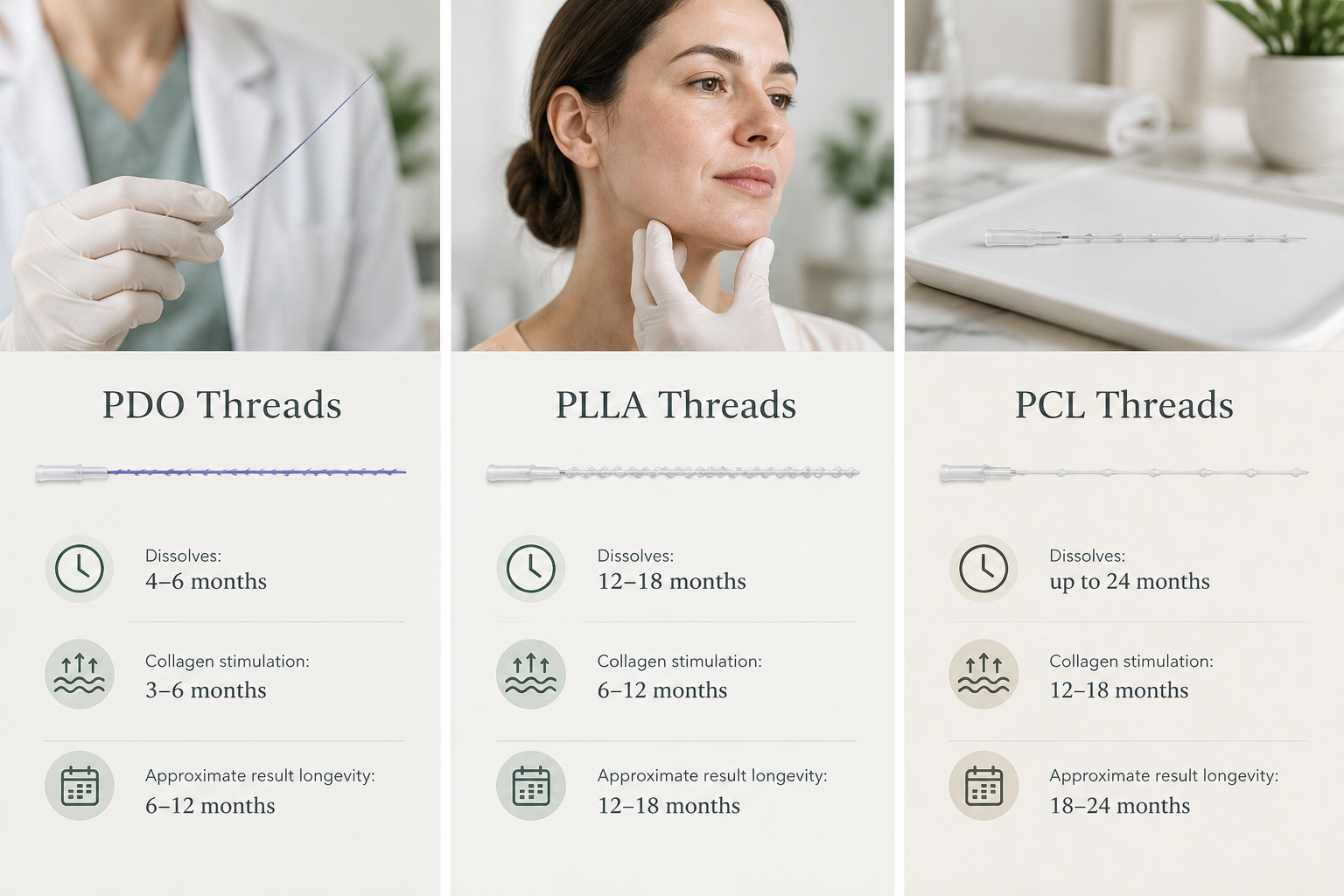
PLLA and PCL threads are considered by some practitioners to offer longer-lasting collagen stimulation than PDO threads due to their slower absorption rates. PCL threads, for example, may take up to two years to fully dissolve, potentially sustaining the collagen-stimulating effect for a longer period. However, comparative clinical data between thread types remains limited, and individual results vary considerably.
It is important to set realistic expectations. A threading face lift is not a replacement for surgical facelift surgery in patients with significant skin excess or deep structural descent. The degree of lift achievable with threads is inherently limited by the tensile strength of the sutures and the quality of the surrounding tissue. Patients with very thin, fragile, or heavily sun-damaged skin may find that threads do not grip tissue effectively, reducing the predictability of the outcome.
What Areas Can Thread Lifting Treat?
Thread lifting can be applied to several areas of the face and neck where tissue descent or skin laxity is a concern. Common treatment areas include:
- Mid-face and cheeks: Lifting descended cheek tissue to restore a more youthful contour and reduce the appearance of nasolabial folds.
- Jowls and lower face: Repositioning jowl tissue to improve jawline definition.
- Brow: Elevating a descended brow to open the eye area and reduce hooding.
- Neck: Improving mild neck laxity and early platysmal banding.
- Nose: Some practitioners use fine threads for non-surgical nose reshaping, though evidence for this application is more limited.
Smooth threads — which lack barbs — are sometimes used not for lifting but for skin quality improvement, targeting fine lines, skin texture, and hydration through their collagen-stimulating properties. These are a distinct application from the lifting threads used in a threading face lift and should not be conflated with the mechanical lifting procedure.
How Long Do Thread Lift Results Last?
The longevity of thread lift results is one of the most commonly asked questions and one of the most important factors in assessing whether the procedure represents good value for a given patient. Most practitioners and published literature suggest that the visible lifting effect from a threading face lift lasts between one and three years, though this range is broad and individual variation is significant.
PDO threads typically dissolve within four to six months. The mechanical lift they provide may diminish as the thread absorbs, but the collagen stimulation they trigger can sustain some degree of improvement beyond this point. PLLA threads dissolve more slowly, over approximately 12 to 18 months, while PCL threads may persist for up to 24 months. The longer the thread remains intact, the longer the mechanical support is maintained — though this does not guarantee a proportionally longer visible result in every patient.
Factors that influence how long results last include the patient’s age, skin quality, degree of initial laxity, lifestyle factors such as sun exposure and smoking, and whether complementary treatments are used to maintain skin quality. Patients who continue to lose facial volume or experience progressive skin laxity may find that results appear to diminish more quickly than in patients whose overall facial ageing is slower.
Repeat thread lift procedures are possible and are sometimes performed to maintain results. However, the presence of scar tissue from previous threads can affect how subsequent threads are placed and how they perform, which is a practical consideration for long-term treatment planning.
What to Expect During and After Treatment
Before a threading face lift, a thorough consultation with a qualified practitioner is essential. This should include a detailed assessment of facial anatomy, skin quality, degree of laxity, medical history, and a discussion of realistic outcomes. Patients should disclose any medications — particularly blood thinners — as well as any history of autoimmune conditions, previous facial surgery, or implanted devices, as these may affect suitability.
On the day of treatment, the skin is cleaned and local anaesthetic is administered to the treatment areas. The practitioner then inserts the threads using a fine needle or blunt-tipped cannula, positions them according to the planned lift vector, and anchors or tensions them to achieve the desired repositioning. The number of threads used varies depending on the area being treated and the degree of correction required.
Immediately after the procedure, patients typically notice an initial lifting effect, though some swelling and bruising are common and may temporarily obscure the final result. Most patients can return to light daily activities within a few days, though strenuous exercise, facial massage, and sleeping on the treated side are usually advised against for one to two weeks. Visible bruising and swelling generally resolve within one to two weeks, though this varies between individuals.
The collagen-stimulating effect of the threads develops gradually over the weeks and months following treatment. Many patients report that their results continue to improve for up to three months after the procedure as new collagen forms around the threads. The final result is therefore not fully apparent immediately after treatment.
Risks and Side Effects of Thread Lifting
A threading face lift carries a meaningful risk profile that patients should understand before proceeding. While serious complications are uncommon when the procedure is performed by an experienced practitioner in an appropriate clinical setting, they are not negligible.
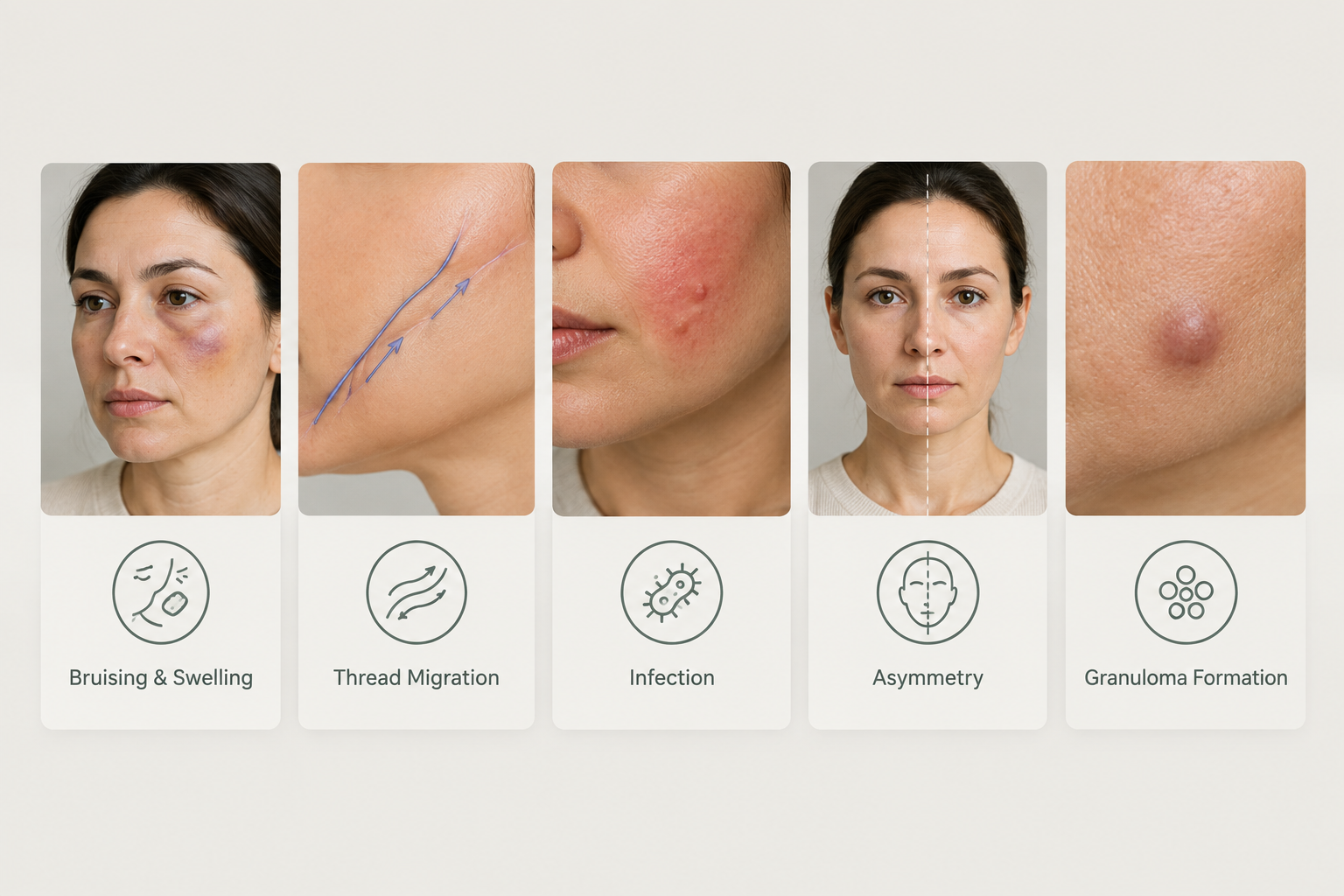
Common side effects include bruising, swelling, tenderness, and temporary asymmetry in the days following treatment. These typically resolve within one to two weeks. Some patients experience a puckering or dimpling of the skin at the thread entry points, which usually settles as swelling subsides but can occasionally persist.
More significant complications include:
- Thread migration or extrusion: A thread may shift from its intended position or, in rare cases, become visible or palpable beneath the skin, or protrude through the skin surface.
- Infection: As with any procedure involving needle insertion, there is a risk of localised infection, which requires prompt medical attention.
- Asymmetry: Uneven lifting or thread placement can result in facial asymmetry that may require correction.
- Nerve or vascular injury: Although uncommon, inadvertent injury to facial nerves or blood vessels is a recognised risk, particularly in areas with complex anatomy such as the temporal region.
- Granuloma formation: The body’s response to the thread material can occasionally result in the formation of a granuloma — a small inflammatory nodule — at the thread site.
- Salivary gland injury: In lower face treatments, proximity to the parotid gland requires careful technique.
The risk of complications is influenced by practitioner experience, the quality of the threads used, the patient’s anatomy, and adherence to aftercare instructions. Patients should ensure that any practitioner performing a threading face lift has appropriate training, qualifications, and experience in facial anatomy and thread lift techniques.
Who May Be a Suitable Candidate?
Thread lifting tends to produce the most predictable and satisfying results in patients who have mild to moderate facial skin laxity and good underlying tissue quality. Suitable candidates are often in their late thirties to mid-fifties, though age alone is not the determining factor — skin quality, degree of descent, and overall facial anatomy are more relevant considerations.
Patients who may be well suited to a threading face lift include those who:
- Have early to moderate jowling, mid-face descent, or brow ptosis that is not severe enough to warrant surgical correction;
- Are seeking a visible improvement with minimal downtime and without the recovery associated with facelift surgery;
- Have realistic expectations about the degree of improvement achievable;
- Are in good general health with no active skin infections or inflammatory conditions in the treatment area;
- Are not pregnant or breastfeeding.
Thread lifting is generally less suitable for patients with significant skin excess, very thin or fragile skin, a history of keloid scarring, active acne or skin infection in the treatment area, or those taking anticoagulant medications that cannot be safely paused. Patients with very advanced facial ageing who require substantial structural correction are more likely to achieve their goals through surgical facelift surgery, and this should be discussed openly during consultation.
Thread Lift vs Surgical Facelift: Understanding the Difference
The most important distinction to understand is that a threading face lift and a surgical facelift are fundamentally different procedures with different capabilities, recovery profiles, and risk profiles. A surgical facelift — rhytidectomy — involves the removal of excess skin and repositioning of deeper facial structures including the SMAS (superficial musculoaponeurotic system) layer. It can address significant skin laxity and structural descent that threads cannot correct, and its results typically last five to ten years or longer.
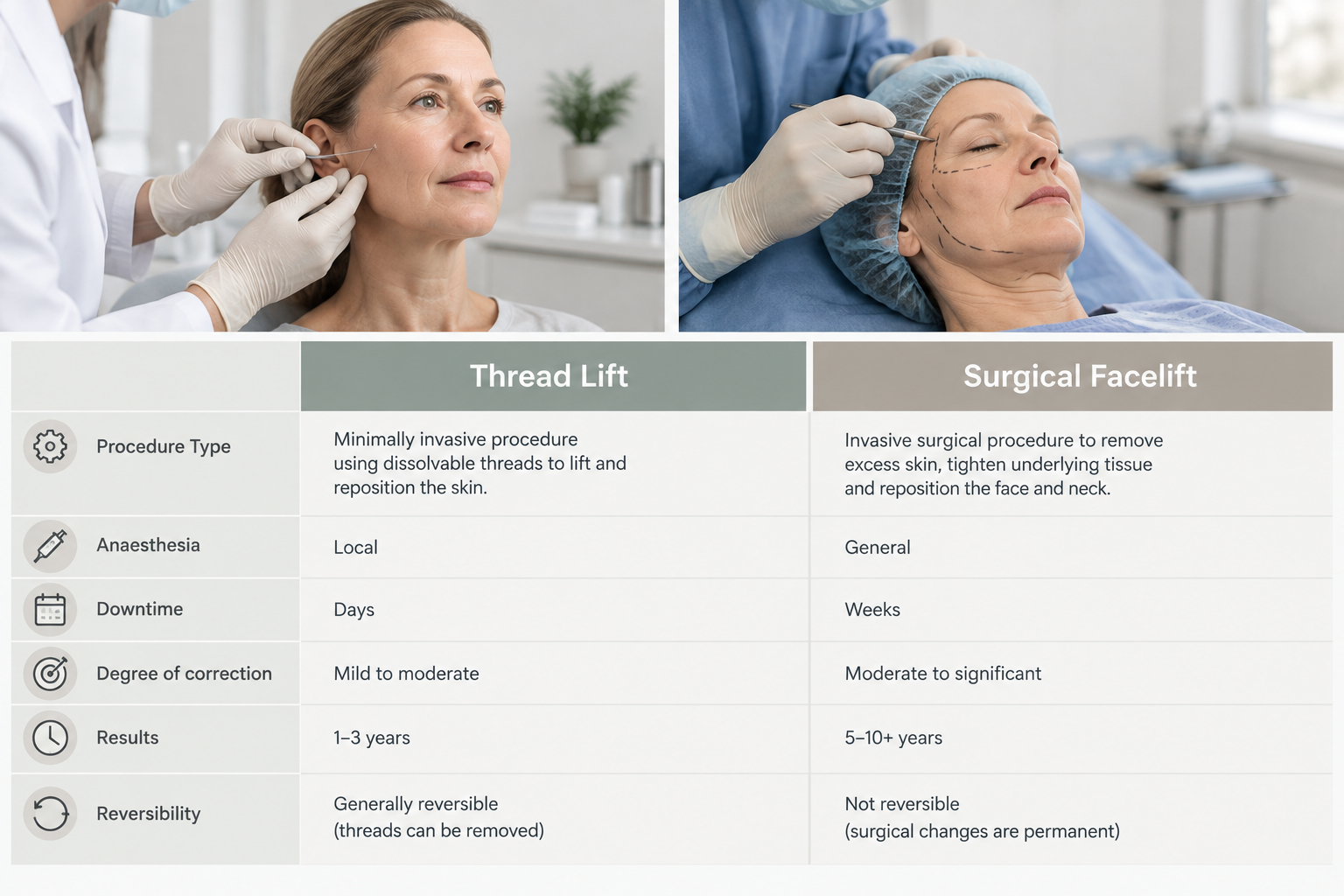
A threading face lift offers a less dramatic but more accessible option: shorter procedure time, local rather than general anaesthesia in most cases, faster recovery, and lower immediate cost. However, the degree of correction is more limited, results are less durable, and repeat treatments may be needed to maintain the effect. For patients with mild laxity who are not ready for surgery, thread lifting may represent a reasonable intermediate option. For patients with moderate to severe laxity, a surgical consultation is likely to provide a more honest assessment of what is achievable.
Neither option is universally superior. The right choice depends on the individual patient’s anatomy, goals, health status, tolerance for downtime, and expectations — all of which should be explored in a thorough consultation with a qualified practitioner.
Alternatives to a Threading Face Lift
Several non-surgical and minimally invasive alternatives exist for patients seeking facial lifting or skin tightening without surgery. Understanding these options helps patients make a more informed decision about which approach may best suit their goals.
- High-intensity focused ultrasound (HIFU): Delivers focused ultrasound energy to the SMAS layer and deeper dermis to stimulate collagen production and produce a gradual lifting effect. Results develop over two to three months and may last one to two years. HIFU does not provide the immediate mechanical lift of threads but avoids the risks associated with needle insertion.
- Radiofrequency skin tightening: Uses radiofrequency energy to heat the dermis and stimulate collagen remodelling. Devices such as monopolar, bipolar, and microneedling radiofrequency platforms are used for skin tightening and mild lifting. Results are typically gradual and may require multiple sessions.
- Dermal fillers: Hyaluronic acid or biostimulator fillers can restore lost facial volume and improve contour, which may indirectly reduce the appearance of sagging. Fillers do not mechanically lift tissue in the same way as threads but can complement thread lifting or serve as a standalone treatment for volume-related concerns.
- Botulinum toxin: Can be used to relax muscles that contribute to facial descent, such as the depressor anguli oris or platysmal bands, producing a subtle lifting effect in specific areas. This is not a substitute for a thread lift but may be used as part of a combined treatment approach.
- Surgical facelift: For patients with significant skin laxity or structural descent, surgical facelift surgery remains the most effective and durable option. It carries a longer recovery period and higher immediate cost but typically produces more substantial and longer-lasting results.
Frequently Asked Questions
Does a thread lift hurt?
Most patients find the procedure tolerable under local anaesthetic. Some discomfort may be felt during the injection of anaesthetic and during thread placement, particularly in sensitive areas. Post-procedure soreness, tightness, and tenderness are common for several days after treatment.
How soon will I see results after a threading face lift?
An initial lifting effect is usually visible immediately after treatment, though swelling and bruising may temporarily affect the appearance. The final result, including the collagen-stimulating benefit, typically becomes apparent over six to twelve weeks as tissue settles and new collagen forms.
Can thread lift results be reversed?
Unlike hyaluronic acid fillers, thread lifts cannot be dissolved with an enzyme. If a thread migrates or causes an undesirable result, management options are limited and may include thread removal, which carries its own procedural risks. This is one reason why choosing an experienced practitioner is particularly important.
How many threads are typically used?
The number of threads varies depending on the treatment area, the degree of laxity, and the practitioner’s technique. A full-face threading procedure may involve anywhere from a few threads to several dozen, depending on the approach used. Your practitioner should explain their planned approach during consultation.
Can I combine a thread lift with other treatments?
Thread lifting is frequently combined with dermal fillers, botulinum toxin, or skin quality treatments to address multiple aspects of facial ageing simultaneously. However, combining treatments increases complexity and cost, and the timing of combined procedures should be planned carefully with your practitioner.
Is a thread lift suitable for all skin types?
Thread lifting can be performed across a range of skin types, but skin quality, thickness, and degree of laxity are more relevant factors than skin type alone. A clinical assessment is required to determine individual suitability.
What happens when the threads dissolve?
As the threads dissolve, the mechanical lift they provide gradually diminishes. However, the collagen stimulated by the threads may sustain some degree of skin quality improvement beyond the point of full dissolution. The rate at which the visible result fades varies between patients.
Is a Threading Face Lift Worth Considering for You?
A threading face lift can be an effective option for carefully selected patients who have mild to moderate facial laxity, realistic expectations, and a preference for a minimally invasive approach. The procedure offers a visible lifting effect with relatively limited downtime compared to surgical alternatives, and the collagen-stimulating properties of dissolvable threads may contribute to gradual skin quality improvements over time.
However, thread lifting is not a substitute for surgical facelift surgery in patients with significant skin excess or advanced facial descent, and its results are less durable than surgical correction. The procedure carries a meaningful risk profile, and outcomes are highly dependent on practitioner skill, patient selection, and individual tissue response. Evidence supporting long-term effectiveness is still developing, and patients should approach published claims about longevity and degree of improvement with appropriate caution.
If you are considering a threading face lift, a thorough consultation with a qualified and experienced practitioner — ideally one with a background in facial anatomy and aesthetic medicine — is the most important first step. A good consultation will assess your anatomy, discuss realistic outcomes, explain the risks, and help you determine whether thread lifting, an alternative non-surgical treatment, or a surgical referral is the most appropriate path for your individual goals.