

Quick Comparison
| Feature | Thermage FLX | Ultherapy Prime |
|---|---|---|
| Technology | Monopolar radiofrequency (RF) energy | Micro-focused ultrasound (MFU) |
| Mechanism | Bulk heating of the dermis and deeper tissue | Focal heating at precise tissue depths |
| Depth of penetration | Approximately 1.5–3 mm | Approximately 1.5–4.5 mm (reaches SMAS layer) |
| Real-time imaging | No | Yes — DeepSEE™ visualization |
| FDA clearance | Yes | Yes |
| Primary treatment areas | Face, neck, eyelids, body (abdomen, thighs, arms, buttocks) | Face, neck, décolletage, brow, arms, abdomen (Prime) |
| Sessions typically needed | One (maintenance annually) | One (repeat at 12–18 months) |
| Results onset | Gradual; visible improvement from 2–6 months | Gradual; visible from 2–3 months, full at ~6 months |
| Longevity | Approximately 1–2 years | Approximately 12–18+ months |
| Comfort | Generally well tolerated; built-in cooling and vibration | Warming and tingling sensation; topical numbing used |
| Downtime | Minimal to none | Minimal to none |
| Approximate cost (US) | ~$911–$1,948 per session | ~$1,500–$5,500 per session |
| Best suited for | Skin texture, surface tightening, body laxity | Deeper facial lifting, brow lift, SMAS-level tightening |
Thermage and Ultherapy are both well-established, non-surgical treatments designed to address skin laxity and stimulate collagen production — but they use fundamentally different technologies and reach different tissue depths. Understanding those differences is the most useful starting point when deciding which option to discuss with a qualified practitioner.
How Thermage Works
Thermage uses monopolar radiofrequency energy to heat the deeper layers of the skin. The current generation device, the Thermage FLX, delivers this energy through a single treatment tip that simultaneously cools the skin surface, making the session more comfortable than earlier versions. The heating mechanism is described as bulk heating — meaning radiofrequency energy is distributed across a broad volume of tissue rather than concentrated at a single focal point.
This thermal energy causes two effects. First, existing collagen fibers contract immediately, which can produce a subtle tightening effect during or shortly after the session. Second, the controlled heat triggers a wound-healing response in the dermis that stimulates ongoing collagen remodeling and new collagen induction over the following months. The Thermage FLX tip also incorporates a vibration element that helps manage discomfort during treatment, and the device’s AccuREP technology adjusts energy delivery in real time based on tissue response.
Thermage reaches tissue depths of approximately 1.5 to 3 mm, targeting the dermis and the layer just beneath it. This makes it particularly effective for improving skin texture, surface firmness, and mild to moderate skin laxity across both the face and body. Thermage has long-standing FDA clearance for non-invasive treatment of wrinkles and is one of the few radiofrequency devices with established clearance for body areas including the abdomen, thighs, and buttocks.
How Ultherapy Works
Ultherapy uses micro-focused ultrasound (MFU) to deliver precise thermal energy to targeted depths within the skin and underlying tissue. Unlike radiofrequency, which heats tissue broadly, Ultherapy concentrates ultrasound energy at specific focal points — a process referred to as focal heating. At each focal point, the temperature rises rapidly enough to stimulate collagen induction without damaging the surrounding tissue.
A key clinical distinction is depth of penetration. Ultherapy can reach approximately 1.5 to 4.5 mm below the skin surface, which means it can target the SMAS layer — the Superficial Muscular Aponeurotic System. The SMAS is the same fibromuscular layer that surgeons address during a traditional facelift. Stimulating collagen remodeling at this depth can produce a more pronounced lifting effect, particularly along the jawline, jowls, and brow.
The current generation device, Ultherapy Prime, released in 2025, includes an upgraded display and delivers treatments approximately 20% faster than its predecessor. It also received FDA clearance for additional body areas including the arms and abdomen. A clinically significant feature of Ultherapy is DeepSEE™ visualization — real-time ultrasound imaging that allows the practitioner to see the tissue layers being treated before and during energy delivery. This imaging capability helps ensure energy is placed accurately and avoids structures such as bone or nerves, which adds a meaningful safety and precision dimension that generic HIFU devices do not offer.
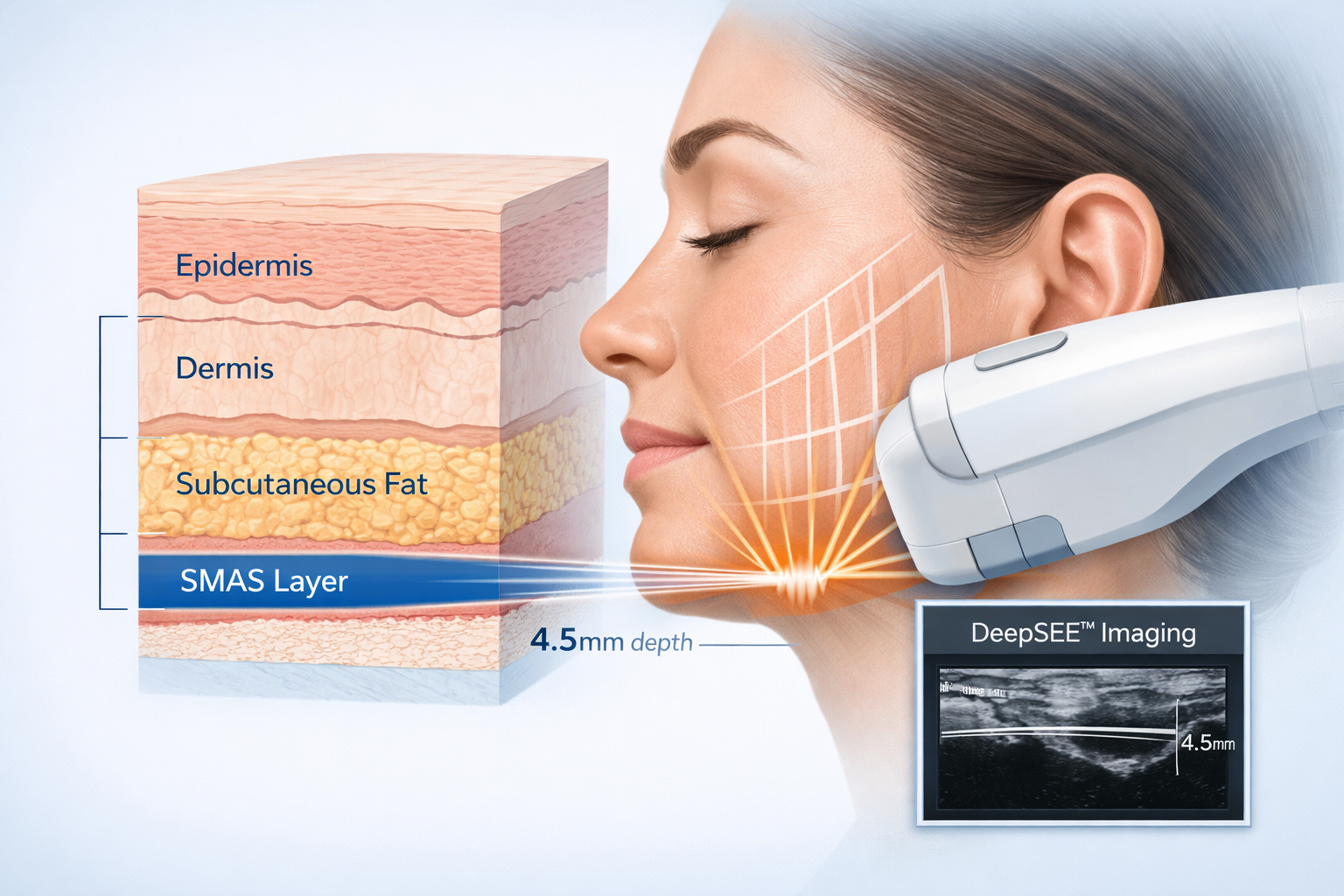
Ultherapy is FDA-cleared for lifting the brow, chin, and neck, and for improving lines and wrinkles on the décolletage. Results develop gradually as new collagen forms, typically becoming visible within 2 to 3 months and reaching their full extent around 6 months after treatment.
Depth of Penetration: Why It Matters
The difference in depth of penetration between Thermage and Ultherapy is one of the most clinically meaningful distinctions between the two treatments. Thermage FLX targets the dermis at roughly 1.5 to 3 mm — the layer responsible for skin texture, firmness, and surface quality. Ultherapy reaches up to 4.5 mm, accessing the SMAS layer that sits beneath the subcutaneous fat.
In practical terms, this means Ultherapy may be better positioned to address structural facial sagging — the kind of descent that affects the jawline, jowls, and brow position. Thermage, by contrast, may be more effective at improving overall skin quality, reducing crepey texture, and tightening skin across larger surface areas including the body. Neither treatment is a substitute for surgical intervention in cases of significant skin laxity, but they address different aspects of the ageing process and can complement each other when used together.
Treatment Areas: What Each Device Can Address
Thermage FLX Treatment Areas
- Face: cheeks, jawline, jowls, lower face, forehead
- Eyes: upper and lower eyelids, undereye area
- Neck and submental area (double chin)
- Body: abdomen, thighs, arms, buttocks
- Décolletage and chest
Thermage’s body clearance is a notable advantage for patients seeking skin tightening on the abdomen after weight loss or pregnancy, or on the thighs and arms where crepey skin is a common concern. The device’s ability to treat larger surface areas in a single session makes it practical for body applications.
Ultherapy Prime Treatment Areas
- Face: brow, forehead, cheeks, jawline, jowls, lower face
- Neck and chin
- Décolletage and chest
- Arms and abdomen (Ultherapy Prime, 2025 FDA clearance)
Ultherapy Prime’s expanded body clearance narrows the gap between the two devices for body applications, though Thermage retains a longer track record for body treatments. For facial lifting — particularly brow elevation and jawline definition — Ultherapy’s SMAS-level reach gives it a structural advantage.
Results: What to Expect and When
Neither Thermage nor Ultherapy produces immediate dramatic results in the way that surgical procedures do. Both treatments work by stimulating the body’s own collagen production, which is a gradual biological process. Patients should approach both treatments with realistic expectations and an understanding that results vary depending on age, skin condition, lifestyle, and individual biology.
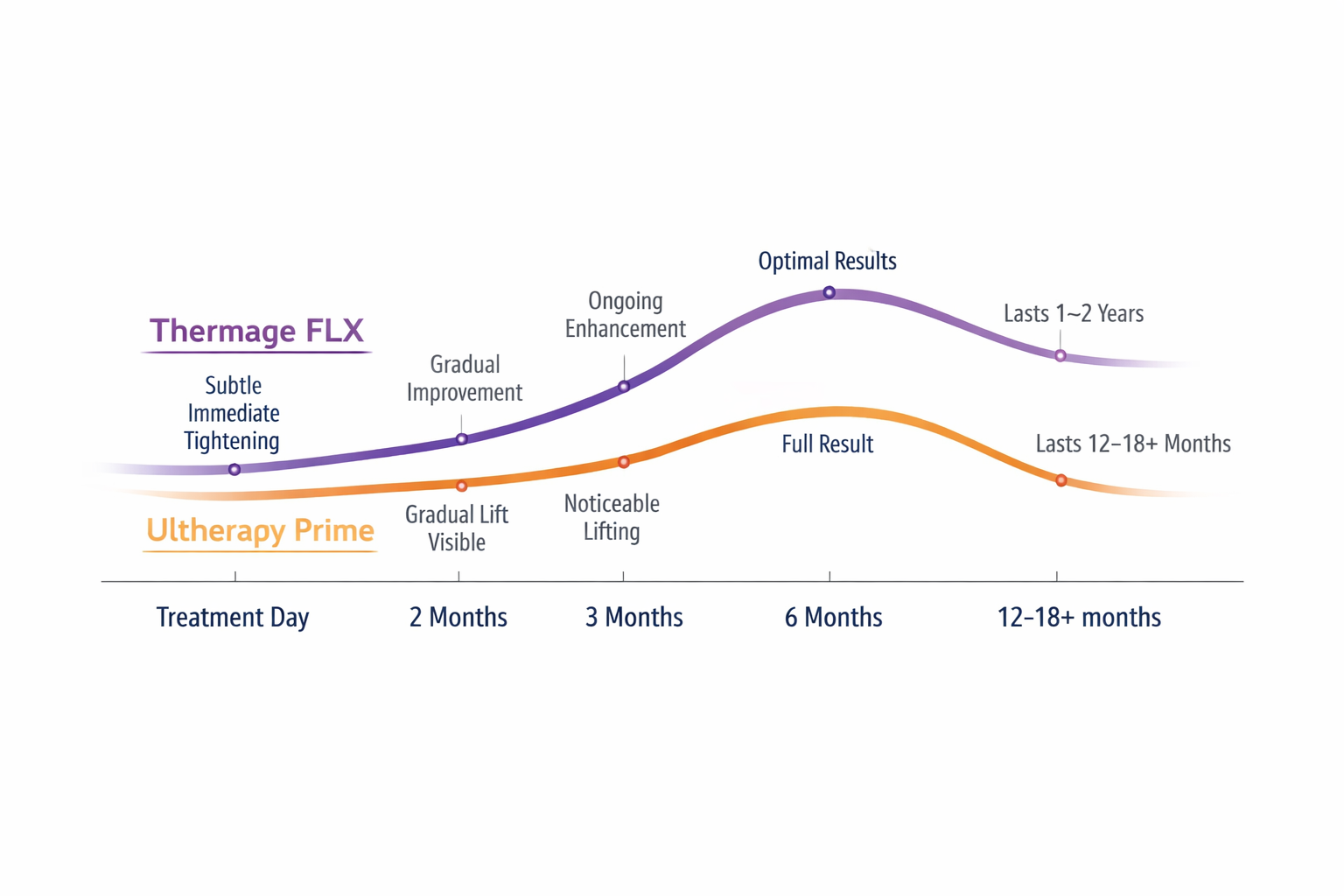
With Thermage FLX, some patients notice an immediate subtle tightening effect due to collagen fiber contraction during heating. More meaningful improvement typically becomes visible over 2 to 6 months as new collagen forms and matures. Results may last approximately 1 to 2 years, after which a maintenance session is generally recommended.
With Ultherapy, results develop more gradually. Visible improvement is typically noticeable at 2 to 3 months, with the full effect appearing around 6 months post-treatment. Longevity is generally cited as 12 to 18 months or longer, depending on the individual. Annual repeat treatments are commonly recommended to maintain the lifting effect as the natural ageing process continues.
It is worth noting that neither treatment stops the ageing process. Ongoing collagen loss due to ageing, sun exposure, and lifestyle factors will continue after treatment, which is why maintenance sessions are a routine part of both treatment plans.
Comfort, Pain, and Downtime
Both treatments are non-invasive and require no surgical incisions, general anaesthesia, or significant recovery period. However, the comfort experience differs between the two devices.
Thermage FLX is generally considered more comfortable than earlier Thermage versions, largely due to the integrated cooling system and vibration technology built into the treatment tip. Most patients describe the sensation as a brief deep warmth followed by a cooling effect. Topical numbing cream is not always required, though it may be offered depending on the treatment area and individual pain tolerance.
Ultherapy tends to involve more noticeable discomfort during treatment. Patients commonly describe a warming sensation, tingling, or brief sharp feelings as the ultrasound energy is delivered to deeper tissue layers. Topical numbing cream is routinely applied before Ultherapy sessions, and some clinics offer additional pain management options such as oral analgesics or, in some cases, local anaesthetic. The discomfort is generally manageable and temporary, resolving once the session ends.
Downtime for both treatments is minimal. Temporary redness, mild swelling, and tenderness in the treated area are the most common side effects and typically resolve within a few hours to a few days. Bruising is uncommon but can occur, particularly with Ultherapy. Neither treatment requires time off work for most patients, though individual responses vary.
Cost Comparison
Cost is a meaningful practical consideration, and both treatments represent a significant investment. Pricing varies considerably depending on the treatment area, the provider’s experience and location, and the device generation being used.
Thermage FLX sessions in the United States are reported at a national average of approximately $1,207, with a typical range of $911 to $1,948 per session based on CareCredit data. Full-face treatments tend to fall toward the higher end of this range.
Ultherapy costs more on average. A full face and neck session in the US typically ranges from approximately $2,300 to $5,500, with individual area treatments available at lower price points. The higher cost reflects the device’s real-time imaging capability, the precision of focal energy delivery, and the clinical training required to operate it effectively.
When evaluating cost over time, it is worth considering treatment longevity. If Thermage requires an annual maintenance session and Ultherapy lasts 12 to 18 months or longer, the annual cost difference may be smaller than the per-session price suggests. A board-certified dermatologist or plastic surgeon can help assess which treatment offers better value relative to your specific goals and starting point.
Who May Be a Suitable Candidate
Both Thermage and Ultherapy are generally best suited to adults with mild to moderate skin laxity who are not ready for or interested in surgical intervention. The ideal candidate is typically someone who has noticed early signs of facial sagging, loss of jawline definition, or skin looseness on the neck or body, but whose skin still has enough structural integrity to respond to collagen stimulation.
Thermage may be particularly worth considering for patients who:
- Want to improve skin texture and surface firmness across the face or body
- Are seeking treatment for crepey skin on the abdomen, thighs, or arms
- Prefer a treatment with a generally more comfortable experience
- Have a lower pain tolerance
- Want to address eyelid laxity (Thermage has specific eye tip clearance)
Ultherapy may be particularly worth considering for patients who:
- Want a more pronounced lifting effect along the jawline, jowls, or brow
- Are seeking a non-surgical facelift alternative that addresses deeper structural tissue
- Are comfortable with a higher level of treatment discomfort in exchange for deeper tissue targeting
- Want the reassurance of real-time imaging during treatment
- Have visible brow descent or significant jowl development
Patients with severe skin laxity — significant sagging that has substantially altered facial contours — are generally better served by a surgical consultation, as neither treatment can replicate the results of a facelift in advanced cases.
Contraindications and Who Should Avoid These Treatments
Both treatments have contraindications that should be discussed thoroughly during a pre-treatment consultation. The following factors may affect treatment candidacy for one or both devices:
- Pregnancy or breastfeeding
- Active skin infections, open wounds, or inflammatory skin conditions in the treatment area
- Implanted electrical devices such as pacemakers or defibrillators (particularly relevant for Thermage, which uses radiofrequency energy)
- Metal implants or permanent fillers in the treatment area
- Certain medications that affect healing or increase photosensitivity
- History of keloid scarring
- Cystic acne or active breakouts in the treatment area
- Recent surgical procedures or significant trauma to the treatment area
A thorough medical history review by a qualified practitioner is essential before either treatment. This list is not exhaustive, and individual circumstances will determine suitability.
Can Thermage and Ultherapy Be Combined?
Combining Thermage and Ultherapy is an approach some practitioners recommend for patients seeking comprehensive facial rejuvenation. The rationale is that the two treatments address different tissue depths and mechanisms: Ultherapy targets the deeper SMAS layer for structural lifting, while Thermage addresses the dermis for surface tightening and texture improvement. Used together, they may offer a more complete result than either treatment alone.
When a combination treatment is planned, sessions are typically spaced several months apart rather than performed on the same day, allowing the tissue to recover and the collagen remodeling process from the first treatment to progress. The sequencing and timing of a combined approach should be guided by a practitioner experienced with both devices, as individual tissue response and treatment goals will influence the protocol.
Combining either treatment with complementary procedures such as botulinum toxin, dermal fillers, or laser resurfacing is also common in clinical practice. These combinations can address different aspects of facial ageing simultaneously — for example, using injectables to restore volume while Ultherapy addresses structural lift.
Alternatives Worth Knowing About
Thermage and Ultherapy are not the only non-surgical skin tightening options available. Patients who are not suitable candidates for either treatment, or who want to explore the full range of options, may wish to discuss the following with their practitioner:
- Morpheus8: A fractional radiofrequency microneedling device that combines skin resurfacing with deeper RF energy delivery. It may be particularly useful for patients with both skin texture concerns and mild laxity.
- Sofwave: A newer ultrasound-based device that uses synchronous ultrasound parallel beam technology to target the mid-dermis. It is generally considered more comfortable than Ultherapy and may suit patients with milder laxity.
- Generic HIFU devices: High-intensity focused ultrasound devices that use a similar principle to Ultherapy but without the DeepSEE™ real-time imaging system. Results and safety profiles vary significantly between devices and operators, and they lack Ultherapy’s FDA-cleared status for specific indications.
- Surgical facelift: For patients with significant skin laxity, a surgical consultation remains the most effective option for substantial and long-lasting structural improvement.
Frequently Asked Questions
Is Thermage or Ultherapy more painful?
Most patients find Ultherapy more uncomfortable than Thermage FLX. Ultherapy delivers concentrated energy to deeper tissue layers, which can produce a noticeable warming or sharp sensation. Thermage FLX’s built-in cooling and vibration technology makes it generally more tolerable, though individual pain tolerance varies. Topical numbing cream is routinely used before Ultherapy and is available for Thermage if needed.
Can you have Thermage and Ultherapy done at the same time?
Most practitioners recommend spacing the two treatments several months apart rather than performing them in the same session. This allows each treatment’s collagen remodeling process to progress and reduces the cumulative stress on the tissue. Your practitioner can advise on the most appropriate sequencing based on your goals and skin condition.
How many sessions of each treatment are needed?
Both Thermage and Ultherapy are typically performed as a single session, with results developing gradually over several months. Maintenance sessions are generally recommended annually for Thermage and every 12 to 18 months for Ultherapy, depending on individual response and the natural progression of ageing.
Which treatment is better for the neck?
Both treatments are used for neck skin laxity. Ultherapy may offer a more pronounced lifting effect on the neck due to its deeper tissue penetration and SMAS-level targeting. Thermage can improve skin texture and surface tightness on the neck effectively. The better option depends on the degree of laxity and the specific concern — a practitioner assessment is the most reliable way to determine this.
Are results from Thermage or Ultherapy permanent?
Neither treatment produces permanent results. Both stimulate collagen production, but the natural ageing process continues after treatment. Results from Thermage typically last 1 to 2 years; Ultherapy results are generally cited at 12 to 18 months or longer. Maintenance sessions help sustain improvement over time.
Which treatment is better for body skin tightening?
Thermage FLX has a longer established track record for body areas including the abdomen, thighs, and buttocks. Ultherapy Prime received FDA clearance for the arms and abdomen in 2025, expanding its body applications. For most body concerns, Thermage remains the more widely used option, though both may be appropriate depending on the area and degree of laxity.
Thermage or Ultherapy: Matching the Treatment to Your Goals
There is no universal answer to which treatment is better — the right choice depends on what you are trying to address, your anatomy, your pain tolerance, and your budget. Thermage FLX and Ultherapy Prime are both clinically established, FDA-cleared treatments that can produce meaningful improvement in skin laxity and collagen quality, but they work differently and suit different presentations.
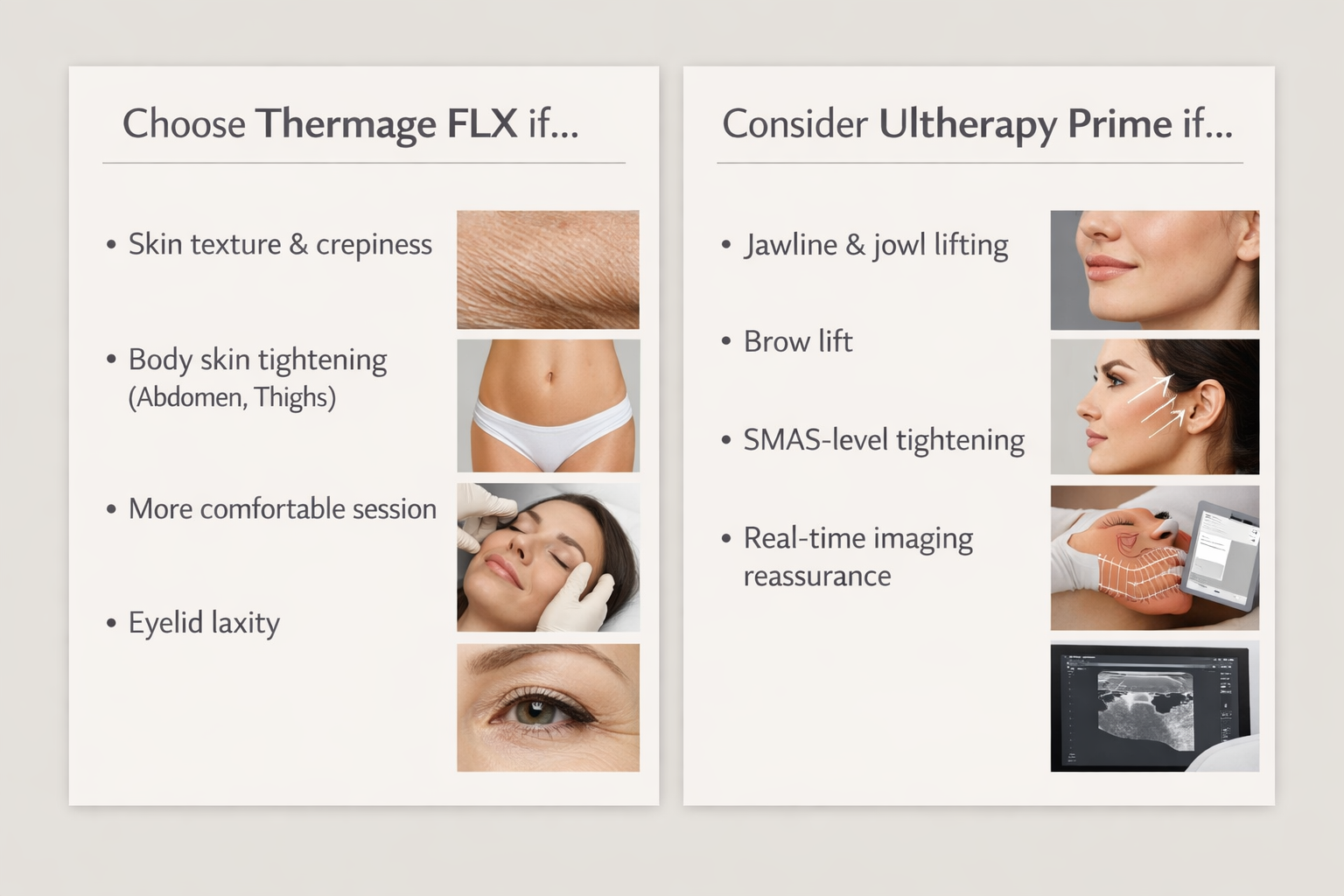
If your primary concern is surface skin quality, texture, or crepiness — particularly on the body — Thermage FLX’s bulk heating approach and broad body clearance make it a practical option. If you are more focused on structural facial lifting, particularly along the jawline, jowls, or brow, Ultherapy’s ability to reach the SMAS layer through focal heating gives it a meaningful advantage for those goals. For patients with both concerns, a combination treatment protocol may offer the most comprehensive outcome.
Both treatments work best for mild to moderate skin laxity. If you have significant sagging that has substantially changed your facial contours, a consultation with a board-certified dermatologist or plastic surgeon who can discuss both non-surgical and surgical options will give you the most complete picture of what is realistically achievable. A thorough in-person assessment remains the most reliable way to determine which treatment — or combination of treatments — is most likely to match your individual goals.