

Hollowness beneath the eyes — often described as a sunken or shadowed appearance — is one of the most common aesthetic concerns that brings patients to a clinic. Tear trough fillers, which use hyaluronic acid to restore volume in the under-eye area, have become one of the most requested non-surgical treatments for this concern. However, the tear trough is also one of the most technically demanding areas to treat, and understanding what the procedure can and cannot achieve is essential before booking a consultation.
Key Takeaways
- Tear trough fillers use hyaluronic acid gel to address volume loss and hollowness beneath the eyes, which can reduce the appearance of shadows and a tired look.
- Results are not permanent; hyaluronic acid in this area typically lasts between nine and eighteen months, though individual variation is significant.
- The tear trough is a high-risk injection zone — complications, while uncommon when performed by an experienced practitioner, can be serious and include vascular injury.
- Not everyone with under-eye concerns is a suitable candidate; dark circles caused by pigmentation or visible blood vessels may not respond to filler.
- A thorough clinical assessment is essential to determine whether tear trough filler is appropriate or whether an alternative approach may produce better results.
What Is the Tear Trough and Why Does It Hollow?
The tear trough is the groove that runs from the inner corner of the eye downward and outward along the junction between the lower eyelid and the cheek. In youth, this transition is typically smooth and well-supported by underlying fat compartments and soft tissue. With age, several changes occur simultaneously: the orbital fat that cushions the eye can shift forward or downward, the ligaments supporting the lower eyelid weaken, and the mid-face loses volume. Together, these changes create a visible depression — the tear trough deformity — that casts a shadow and contributes to a fatigued or aged appearance.
Genetics also play a meaningful role. Some individuals develop tear trough hollowing in their twenties or even earlier, well before significant age-related volume loss would be expected. In these cases, the anatomy of the orbital rim and the distribution of periorbital fat are often contributing factors rather than ageing alone. Understanding the underlying cause matters because it influences whether filler is likely to be helpful, and whether other treatments might be more appropriate.
How Hyaluronic Acid Tear Trough Fillers Work
Hyaluronic acid is a naturally occurring polysaccharide found throughout the body, including in skin, connective tissue, and the fluid surrounding the eyes. In aesthetic medicine, hyaluronic acid is cross-linked into a gel and injected to add volume, support tissue, and improve the appearance of depressions or folds. When placed carefully in the tear trough region, the filler physically lifts the overlying skin, reduces the depth of the hollow, and softens the shadow that creates the tired appearance.
The specific hyaluronic acid product chosen for tear trough treatment matters considerably. This area requires a soft, low-viscosity filler with a low risk of the Tyndall effect — a bluish discolouration that can occur when certain fillers are placed too superficially beneath thin skin. Products formulated for delicate areas, such as those with a lower G-prime (a measure of gel stiffness), are generally preferred. The practitioner’s choice of product, injection depth, and technique all influence the outcome and the risk profile.
Hyaluronic acid fillers are also reversible. If a complication occurs or the result is unsatisfactory, the enzyme hyaluronidase can be injected to dissolve the filler relatively quickly. This reversibility is one reason hyaluronic acid remains the preferred filler material for the periorbital area, where precision is critical and the consequences of misplacement can be significant.
What Tear Trough Filler Can and Cannot Treat
Tear trough filler is most likely to be beneficial when the primary concern is genuine hollowness or volume loss beneath the eye. When the depression is filled, the shadow it creates diminishes, and the transition between the lower eyelid and cheek becomes smoother. Patients with a well-defined tear trough hollow and relatively good skin quality in the periorbital area tend to see the most satisfying results.
However, under-eye concerns are not all the same, and filler addresses only one of several possible causes. Dark circles, for example, can result from multiple distinct factors:
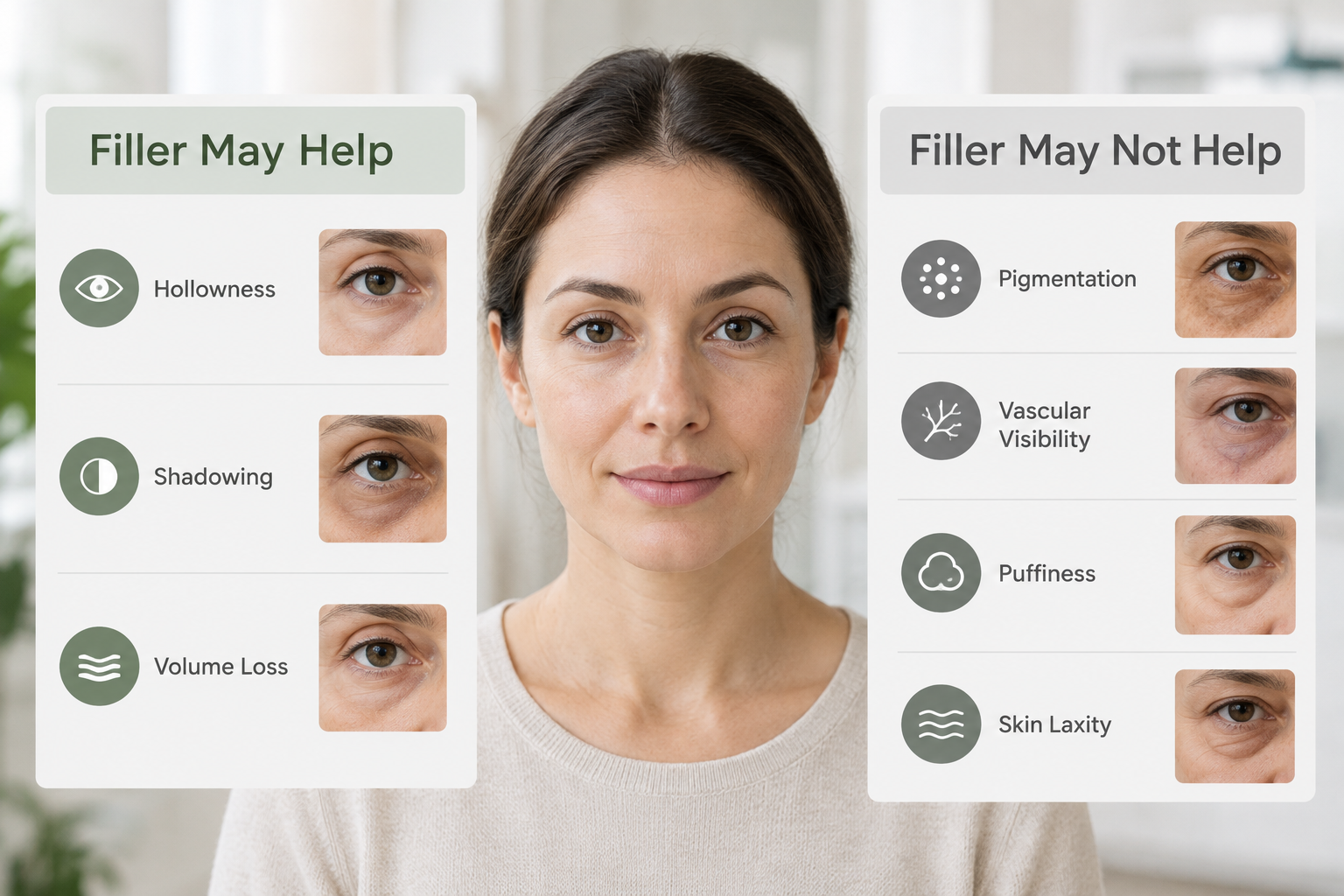
- Hollowness and shadowing — this is the concern that tear trough filler directly addresses.
- Pigmentation — excess melanin in the skin beneath the eye does not respond to filler and may require topical treatments, chemical peels, or laser therapy.
- Vascular visibility — thin skin that allows underlying blood vessels to show through creates a bluish or purplish discolouration that filler may not significantly improve.
- Puffiness or festoons — prominent fat pads or fluid accumulation beneath the eye can actually be made more noticeable by filler if the treatment is not carefully planned.
- Skin laxity and fine lines — loose or crepey skin in the lower eyelid area is not corrected by volume replacement alone.
A practitioner experienced in periorbital assessment will evaluate which of these factors is dominant before recommending treatment. In some cases, a combination approach — or a different treatment entirely — may be more appropriate than filler alone.
Who May Be Suitable for Tear Trough Filler
Suitable candidates for tear trough filler are generally adults who have a clearly visible hollow or depression beneath the eye that contributes to a tired or aged appearance, and who have realistic expectations about what the treatment can achieve. Good skin quality in the periorbital area, without significant excess skin or prominent fat pads, tends to be associated with more predictable outcomes.
Patients who may not be suitable, or who require particularly careful assessment, include those with:
- Significant lower eyelid fat prolapse (prominent bags), as filler may accentuate rather than improve the appearance.
- Very thin or translucent skin beneath the eye, which increases the risk of the Tyndall effect.
- A history of previous filler in the area, particularly if the outcome or product used is unknown.
- Active skin infection, inflammation, or cold sores near the treatment area.
- Bleeding disorders or use of anticoagulant medications, which increase bruising risk.
- Pregnancy or breastfeeding, during which elective aesthetic procedures are generally not recommended.
- Certain autoimmune conditions or a history of severe allergic reactions.
- Unrealistic expectations or a primary concern that is not related to hollowness.
Age is not a strict criterion, but younger patients with tear trough hollowing related to anatomy rather than volume loss should be counselled carefully, as the long-term implications of repeated filler in this area are not fully established.
The Treatment Experience: What to Expect at Your Appointment
A tear trough filler appointment typically begins with a detailed consultation, during which the practitioner assesses the anatomy of the periorbital area, discusses the patient’s concerns and goals, reviews medical history, and explains the procedure, expected outcomes, and risks. Photographs are usually taken before treatment.
The skin is cleaned and a topical anaesthetic cream may be applied to reduce discomfort, though many hyaluronic acid fillers used in this area also contain lidocaine, a local anaesthetic, within the gel itself. The practitioner may use a fine needle or a blunt-tipped cannula to deliver the filler. Cannulas are often preferred in the tear trough because they may reduce the risk of bruising and vascular injury compared with needles, though technique preference varies between practitioners and both approaches can be performed safely by experienced clinicians.
The injection process itself is usually brief, often taking ten to twenty minutes once the anaesthetic has taken effect. Patients typically experience mild pressure or a stinging sensation during injection. Immediately after treatment, the area may appear slightly swollen or uneven, which is normal and usually settles within a few days. Most patients can return to normal activities the same day, though strenuous exercise and alcohol are generally advised against for twenty-four to forty-eight hours.
Recovery, Downtime, and When Results Appear
The tear trough area is particularly prone to bruising and swelling after filler injection because the skin is thin, the tissue is delicate, and the region has a rich blood supply. Bruising, if it occurs, may take one to two weeks to resolve fully. Swelling is common in the first few days and can temporarily make the result appear uneven or overfilled. For this reason, many practitioners advise patients to wait at least two weeks before assessing the final result.
Sleeping with the head slightly elevated in the first few nights after treatment may help reduce swelling. Applying a cold compress gently to the area can also be helpful in the first twenty-four hours. Patients should avoid pressing or massaging the treated area unless specifically instructed to do so by their practitioner.
Once swelling has resolved, the improvement in the tear trough hollow is usually visible and, in well-selected patients, can look natural and refreshing. The result is not instantaneous in the sense that the final appearance takes time to settle, but the volume correction is present from the moment of injection.
How Long Do Tear Trough Filler Results Last?
Hyaluronic acid filler in the tear trough area is generally reported to last between nine and eighteen months, though individual variation is considerable. Several factors influence longevity, including the specific product used, the volume injected, the patient’s metabolism, and the degree of movement in the area. The periorbital region is relatively dynamic — the muscles around the eye are in near-constant use — which may contribute to filler breakdown over time.
Some patients find that results in the tear trough last longer than in more mobile areas such as the lips, while others notice a gradual return of hollowness within a year. Maintenance treatments are typically required to sustain the result. It is worth noting that repeated injections of hyaluronic acid filler in the same area over many years may, in some cases, lead to tissue changes or filler accumulation, which is one reason why ongoing clinical review is important rather than simply repeating treatment indefinitely.
Risks and Side Effects of Tear Trough Filler
The tear trough is widely regarded as one of the highest-risk areas for dermal filler injection, and patients should be fully informed of the potential complications before proceeding. Common and generally temporary side effects include bruising, swelling, tenderness, and mild asymmetry in the days following treatment. These typically resolve without intervention.
More significant risks include:
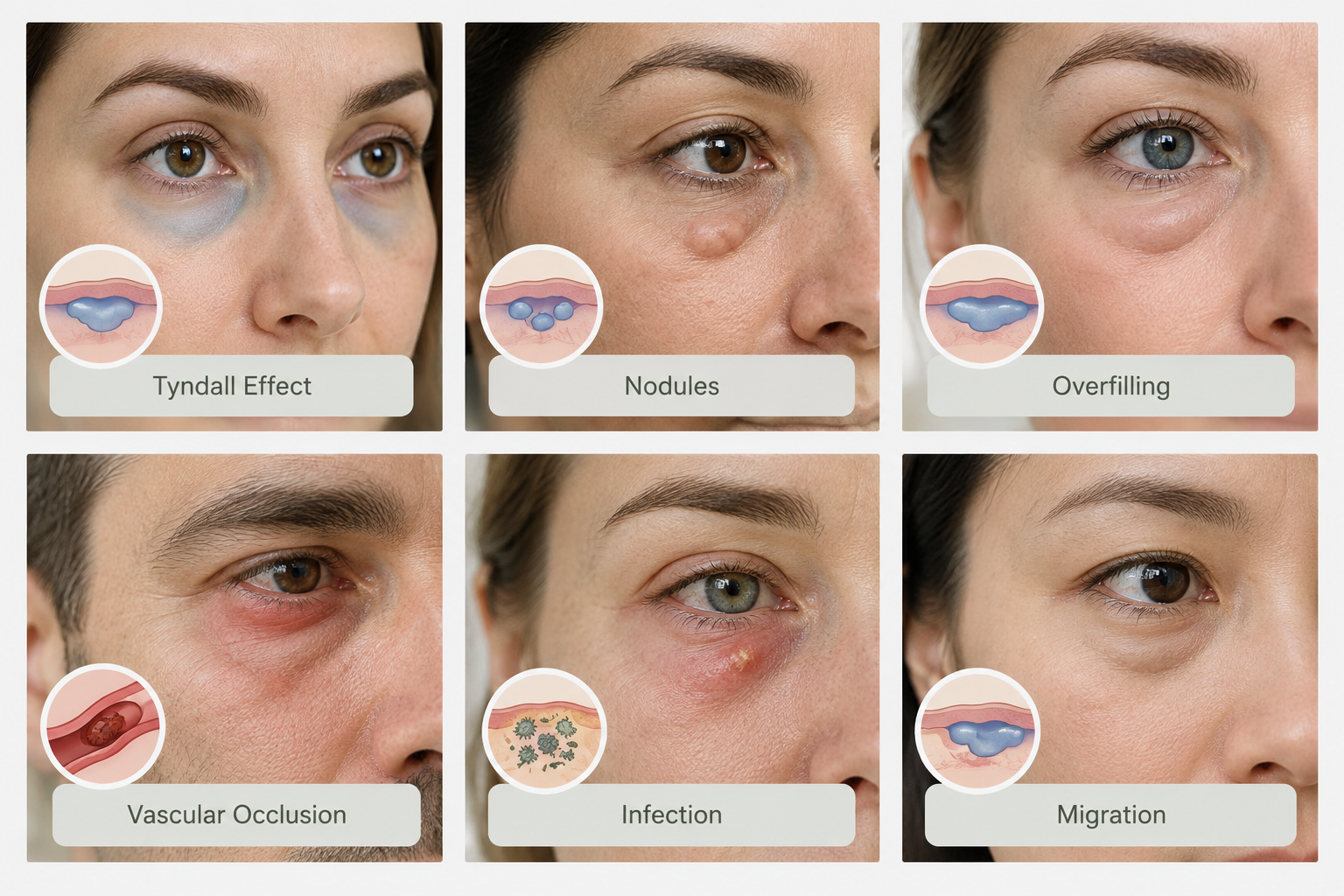
- Tyndall effect — a bluish discolouration caused by superficial filler placement beneath thin skin. This can persist for months but is treatable with hyaluronidase.
- Nodules or irregularities — lumps beneath the skin that may be visible or palpable, particularly if the filler is placed too superficially or if the product is not well-suited to the area.
- Overfilling — excessive volume can create a puffy or unnatural appearance, sometimes described as a pillow-like look beneath the eye.
- Vascular occlusion — one of the most serious potential complications of any filler injection. If filler is inadvertently injected into or compresses a blood vessel, it can restrict blood flow to surrounding tissue. In the periorbital area, this carries a risk of skin necrosis or, in rare cases, vision changes or blindness. This complication is rare but has been reported, and it underscores the importance of treatment by a highly experienced practitioner in an appropriate clinical setting with access to hyaluronidase.
- Infection — uncommon but possible with any injectable procedure.
- Migration — filler can occasionally move from the intended placement area over time.
Patients should ensure their practitioner is trained and experienced specifically in periorbital filler, understands the relevant anatomy, and has hyaluronidase immediately available. The risk of serious complications is substantially reduced — though not eliminated — when treatment is performed by a qualified and experienced clinician.
Alternatives to Tear Trough Filler
For patients who are not suitable candidates for tear trough filler, or who prefer to explore other options, several alternatives may be worth discussing with a practitioner:
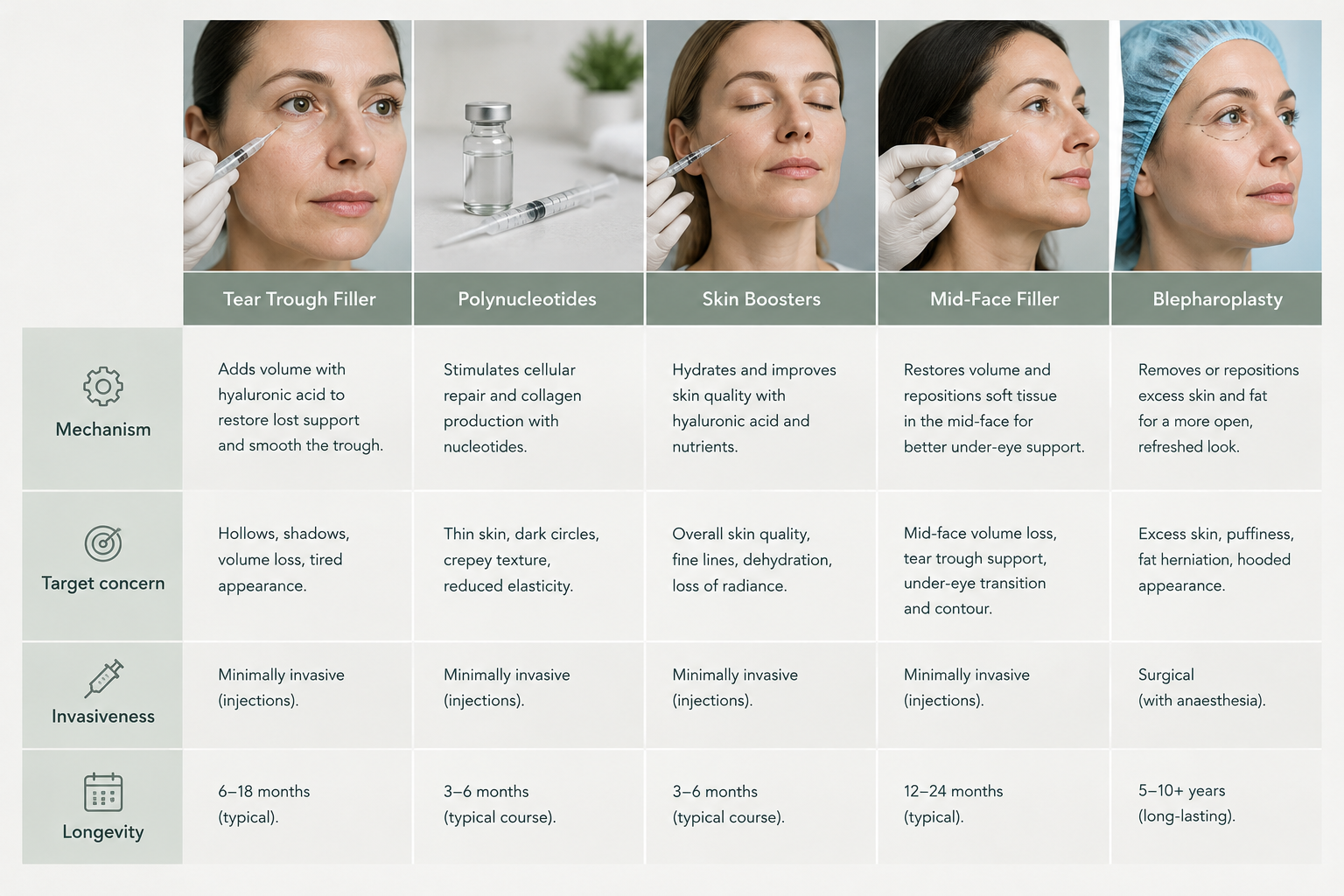
- Polynucleotides (PDRN) — injectable treatments derived from purified DNA fragments that may improve skin quality, hydration, and fine lines in the periorbital area. Polynucleotides work differently from fillers and do not add significant volume, but they may be useful for patients whose primary concern is skin quality rather than hollowness, or as a complementary treatment alongside filler.
- Profhilo or skin boosters — highly fluid hyaluronic acid preparations that spread through tissue to improve hydration and skin quality rather than adding structural volume. These may benefit patients with crepey or dehydrated under-eye skin.
- Lower blepharoplasty — a surgical procedure that addresses excess skin, fat prolapse, and structural changes in the lower eyelid. For patients with significant skin laxity or prominent fat bags, surgery may produce results that non-surgical treatments cannot replicate.
- Topical treatments — retinoids, vitamin C, and certain peptide formulations may improve skin quality and reduce the appearance of fine lines over time, though they do not address volume loss.
- Laser and energy-based treatments — certain laser therapies may improve pigmentation-related dark circles or stimulate collagen production in the periorbital skin.
- Mid-face filler — in some patients, restoring volume to the cheek and mid-face area indirectly improves the appearance of the tear trough by providing better structural support, without placing filler directly in the delicate under-eye zone.
Frequently Asked Questions
Does tear trough filler hurt?
Most patients describe the procedure as mildly uncomfortable rather than painful. Topical anaesthetic cream is usually applied beforehand, and many fillers used in this area contain lidocaine to reduce discomfort during injection. The sensation is often described as a brief stinging or pressure. Individual pain tolerance varies, and the practitioner can adjust the approach if needed.
Can tear trough filler make dark circles worse?
If dark circles are caused by pigmentation or visible blood vessels rather than hollowness, filler is unlikely to improve them and may not change their appearance at all. In some cases, if filler is placed too superficially, the Tyndall effect can create a bluish tint that worsens the appearance. This is one reason why accurate diagnosis of the cause of dark circles before treatment is important.
How much filler is typically used in the tear trough?
The volume used varies depending on the degree of hollowness and the patient’s anatomy, but tear trough treatment generally requires relatively small amounts — often less than one millilitre per side. Experienced practitioners tend to favour a conservative approach, particularly at a first treatment, as it is easier to add more filler at a follow-up than to manage overfilling.
Can tear trough filler be dissolved if I am unhappy with the result?
Yes. Hyaluronic acid filler can be dissolved using hyaluronidase, an enzyme that breaks down hyaluronic acid. This is one of the key advantages of using hyaluronic acid rather than other filler materials in a sensitive area like the tear trough. Dissolution is generally effective, though it may require more than one treatment session and should be performed by an experienced practitioner.
How soon after treatment can I wear makeup?
Most practitioners advise avoiding makeup on the treated area for at least twenty-four hours after injection to reduce the risk of infection. After this period, makeup can usually be applied gently, taking care not to press firmly on the treated area.
Is there an age limit for tear trough filler?
There is no strict upper age limit, but suitability depends on the individual’s anatomy, skin quality, and the nature of their concern rather than age alone. Older patients with significant skin laxity or prominent fat bags may find that surgical options produce better results. Younger patients should be assessed carefully to ensure that filler is genuinely the most appropriate solution for their specific concern.
Is Tear Trough Filler the Right Choice for Your Under-Eye Concerns?
Tear trough filler with hyaluronic acid can be a genuinely effective treatment for the right patient — specifically, someone whose primary concern is a well-defined hollow beneath the eye that creates shadowing and a fatigued appearance. When performed by an experienced practitioner using an appropriate product and technique, the results can look natural and refreshing, with relatively minimal downtime.
However, the tear trough is not a straightforward area to treat. The risks are real, the anatomy is complex, and the range of under-eye concerns that patients present with is broader than filler alone can address. Patients whose dark circles are driven by pigmentation, vascular visibility, or skin laxity may see little benefit from filler, and those with prominent fat pads may find their appearance worsened rather than improved.
The most important step before proceeding is a thorough consultation with a practitioner who has specific experience in periorbital assessment and tear trough treatment. A good consultation will identify the underlying cause of your concern, explain whether filler is likely to help, discuss the realistic extent of improvement, and present alternatives where relevant. If you are considering tear trough filler, seeking out a clinician with demonstrable expertise in this area — and ensuring that hyaluronidase is available on-site — is not optional; it is essential.