

Tear trough filler is one of the most technically demanding injectable treatments available, and when it goes wrong the results can be distressing and difficult to correct. Understanding what complications look like, why they occur, and what options exist for managing them is essential for anyone considering this treatment or already experiencing an unwanted outcome.
Key Takeaways
- The tear trough is a high-risk area for dermal filler due to thin skin, complex anatomy, and proximity to important blood vessels.
- Common complications include the Tyndall effect, filler migration, persistent swelling, lumpiness, and in rare but serious cases, vascular occlusion.
- Many complications can be partially or fully corrected with hyaluronidase, an enzyme that dissolves hyaluronic acid filler.
- Practitioner experience, correct product selection, and thorough patient assessment are the most important factors in reducing complication risk.
- Not every patient is a suitable candidate for tear trough filler; alternatives such as polynucleotides or surgical options may be more appropriate in some cases.
Why the Tear Trough Is a High-Risk Treatment Area
The tear trough is the hollow groove that runs from the inner corner of the eye diagonally toward the cheek. Volume loss, ligament laxity, and changes in fat distribution in this area can create a shadowed, tired appearance that many patients want to address. However, the anatomy of the periorbital region — the area surrounding the eye — makes filler placement here considerably more complex than in areas such as the lips or nasolabial folds.
The skin overlying the tear trough is among the thinnest on the face, often measuring less than one millimetre. Beneath it lies a network of small blood vessels, lymphatic channels, and the orbicularis oculi muscle. The infraorbital artery, a branch of the ophthalmic artery, runs through this region and connects to the circulation supplying the eye itself. Injecting filler in the wrong plane, at the wrong depth, or with the wrong product can displace tissue, compress lymphatic drainage, or in the most serious cases, block arterial blood flow.
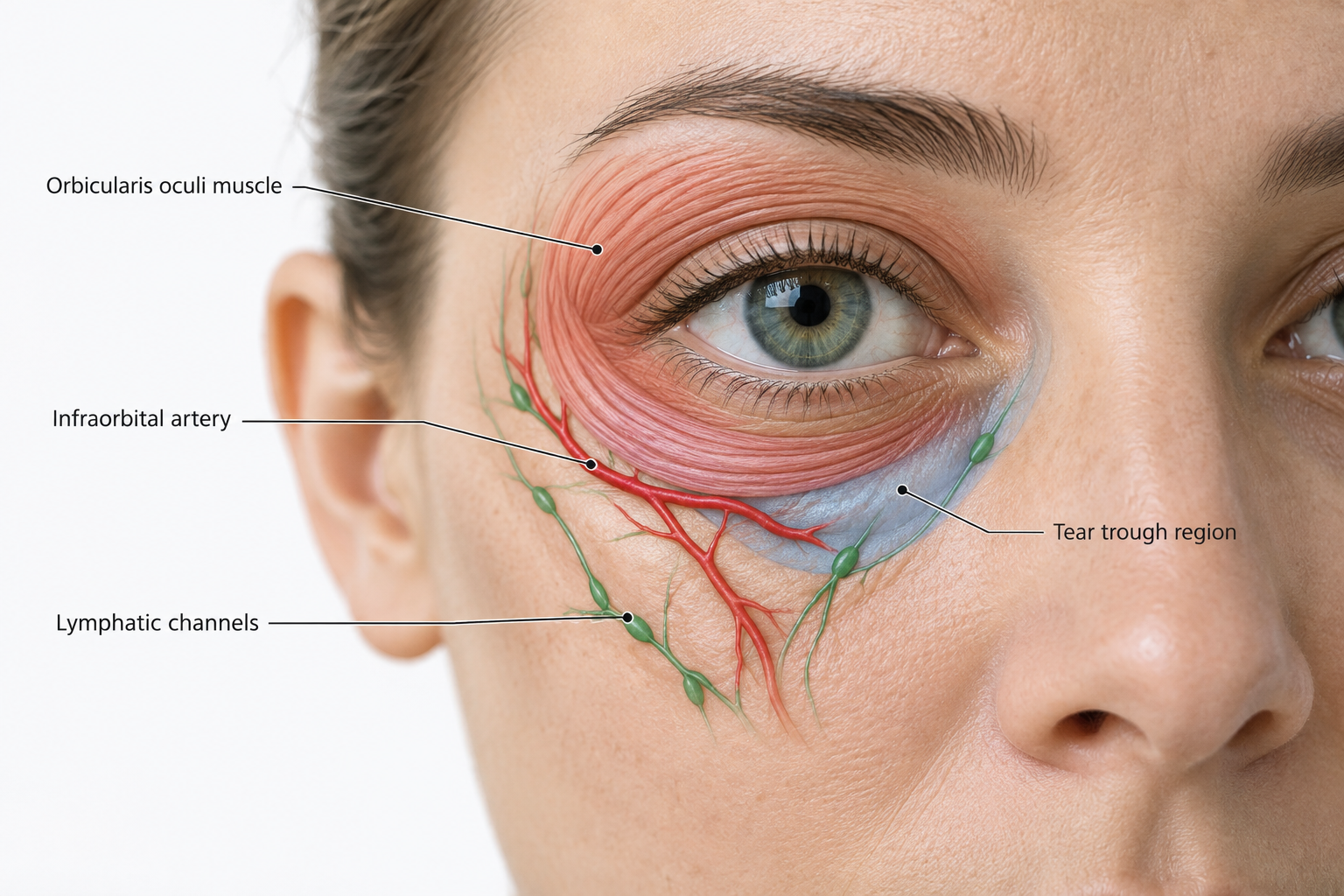
These anatomical factors mean that even experienced injectors approach the tear trough with particular caution. For less experienced practitioners, or those using inappropriate products or techniques, the margin for error is narrow.
Common Tear Trough Filler Complications
Complications after tear trough filler range from mild and temporary to persistent and medically significant. Recognising each type helps patients understand what they are experiencing and what intervention may be appropriate.
The Tyndall Effect
The Tyndall effect is one of the most frequently reported complications specific to the tear trough area. It appears as a bluish or greyish discolouration beneath the skin and is caused by light scattering through hyaluronic acid filler that has been placed too superficially — too close to the skin surface. Because the skin in this area is so thin, even a small amount of filler placed in the wrong plane can become visible as a persistent blue tint rather than a natural correction. The Tyndall effect does not resolve on its own and typically requires treatment with hyaluronidase to dissolve the misplaced filler.
Persistent Swelling and Oedema
Some degree of swelling is expected immediately after any injectable treatment, but persistent swelling lasting weeks or months after tear trough filler is a recognised complication. Hyaluronic acid is hydrophilic, meaning it attracts and retains water. In the delicate periorbital tissue, where lymphatic drainage is already limited, filler can draw in fluid and create or worsen puffiness. Patients who already have a tendency toward under-eye bags or fluid retention may be particularly susceptible. This type of swelling can be difficult to distinguish from natural puffiness and may fluctuate with salt intake, alcohol consumption, sleep position, and hormonal changes.
Filler Migration
Filler migration occurs when the injected product moves from its intended location to an adjacent area. In the tear trough, migration can cause visible lumps, asymmetry, or an unnatural fullness that extends beyond the hollow being treated. Migration may happen immediately after injection or develop gradually over weeks as the filler shifts within the tissue. It is more likely when a high-viscosity or cohesive filler product intended for deeper facial areas is used in the delicate periorbital region, or when too much product is injected in a single session.
Lumpiness and Nodule Formation
Palpable or visible lumps beneath the skin are another common complaint after tear trough filler. These can result from uneven product distribution, incorrect depth of placement, or the formation of inflammatory nodules. Inflammatory nodules — sometimes called delayed inflammatory reactions — can appear weeks or even months after treatment and may be associated with biofilm formation, a thin layer of bacteria that can develop around an implanted material. These nodules may be tender, red, or fluctuant and require medical assessment to determine whether they represent a simple product irregularity or an infection requiring treatment.
Asymmetry
Asymmetry after tear trough filler can arise from uneven product placement, differences in the underlying anatomy between the two sides, or asymmetric swelling during the healing period. Some degree of facial asymmetry is natural and pre-existing, but asymmetry introduced or worsened by filler treatment can be distressing. In many cases, asymmetry can be partially corrected by dissolving filler on the fuller side or adding a small amount to the less-treated side, though this requires careful clinical assessment.
Vascular Occlusion: The Most Serious Risk
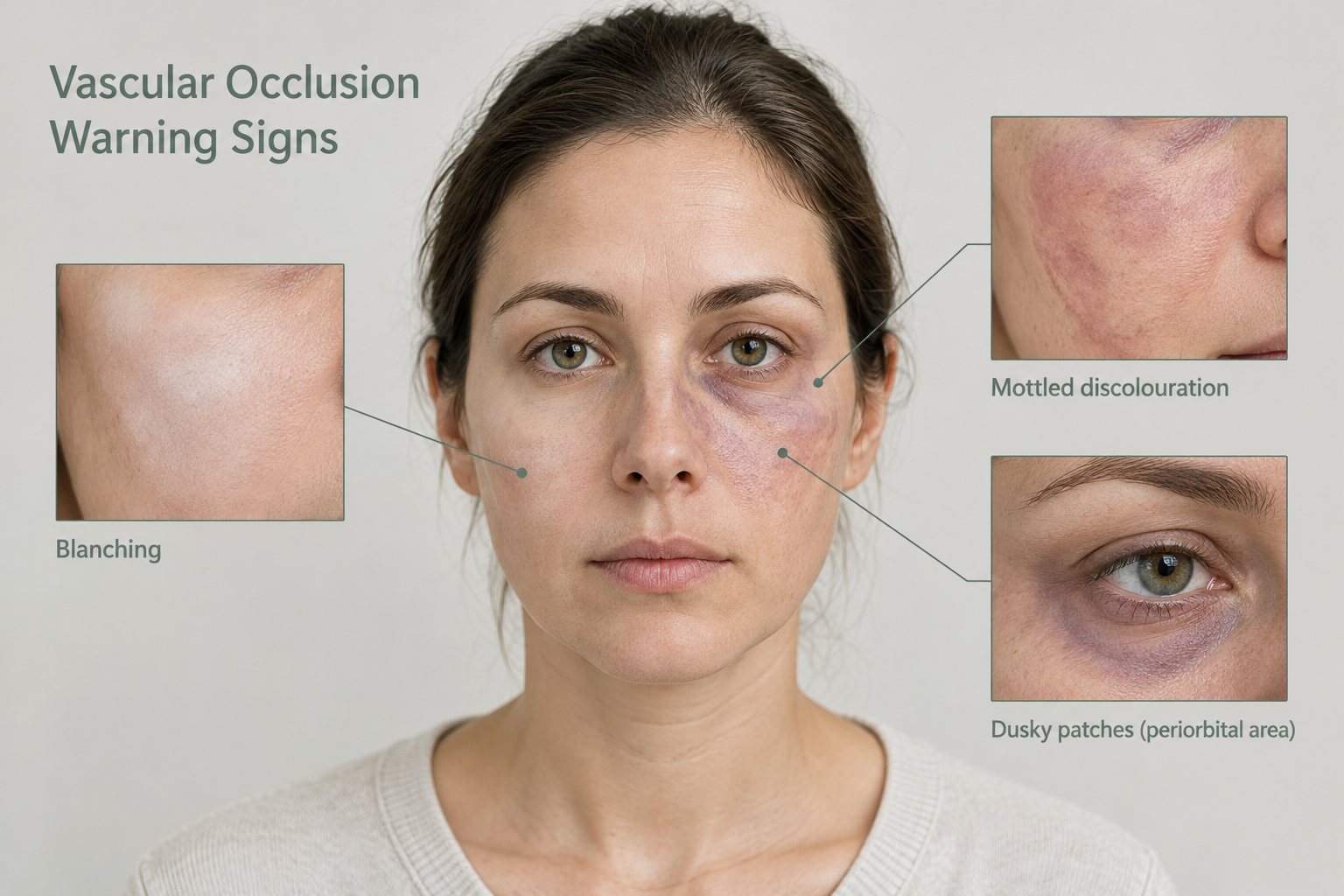
Vascular occlusion — the blockage of a blood vessel by injected filler — is the most serious complication associated with any facial filler treatment, and the periorbital region carries a particularly high risk due to its vascular anatomy. If filler enters or compresses the infraorbital artery or its branches, blood supply to surrounding tissue can be interrupted, potentially causing tissue necrosis (death of skin tissue). In the most severe and rare cases, filler can travel retrogradely through connected vessels toward the ophthalmic artery, with the potential to cause vision impairment or blindness.
Warning signs of vascular occlusion include immediate or rapidly developing blanching (whitening) of the skin, severe pain disproportionate to the procedure, a mottled or dusky discolouration, and changes in vision. These signs represent a medical emergency. Prompt treatment with high-dose hyaluronidase, administered by a qualified practitioner, is the primary intervention for hyaluronic acid filler occlusion. Time is critical: the longer treatment is delayed, the greater the risk of permanent tissue damage. Any patient experiencing these symptoms after filler injection should seek urgent medical attention immediately.
Why Tear Trough Filler Goes Wrong
Understanding the causes of complications helps patients make more informed decisions when choosing a practitioner and treatment approach.
Inappropriate Product Selection
Not all hyaluronic acid fillers are suitable for the tear trough. Products designed for volumising deeper facial structures tend to be denser and more cohesive. When used in the thin-skinned periorbital area, these products are more likely to cause visible lumps, the Tyndall effect, and persistent swelling. Tear trough treatment generally requires a softer, more fluid hyaluronic acid product placed at the correct anatomical depth. Using the wrong product is a common contributor to poor outcomes.
Incorrect Injection Depth or Technique
Filler placed too superficially risks the Tyndall effect and visible lumping. Filler placed too deeply or in the wrong anatomical plane risks vascular injury or migration. The tear trough requires precise placement, typically in the suborbicularis plane or along the periosteum (the surface of the bone), depending on the individual’s anatomy and the practitioner’s technique. Cannula-based injection, which uses a blunt-tipped flexible needle, is often preferred over sharp needles in this area because it may reduce the risk of direct vessel puncture, though both techniques carry risks and require appropriate training.
Overfilling
Injecting too much product in a single session is a frequent cause of an unnatural result. The tear trough area requires conservative volumes; small amounts of filler can produce a significant change in this delicate region. Overfilling can cause a puffy, pillow-like appearance, worsen under-eye bags, and increase the risk of migration and prolonged swelling. A staged approach — treating conservatively and reviewing the result before adding more — is generally considered safer practice.
Poor Patient Selection
Tear trough filler is not appropriate for every patient presenting with under-eye concerns. Patients with significant lower eyelid laxity, prominent fat pads, very thin or crepey skin, or a history of chronic under-eye puffiness may not be suitable candidates. In these individuals, filler can worsen the appearance rather than improve it. A thorough pre-treatment assessment should identify patients for whom filler is unlikely to produce a satisfactory result or carries an elevated risk of complications.
Lack of Practitioner Experience
The tear trough is widely regarded as one of the most technically challenging areas for filler injection. Practitioners without specific training and experience in periorbital anatomy are at greater risk of causing complications. The growth of aesthetic medicine as a commercial sector has led to a wide variation in practitioner training standards, and patients may not always be aware of the qualifications or experience level of the person treating them.
How Tear Trough Filler Complications Are Treated
Hyaluronidase Dissolution
Hyaluronidase is an enzyme that breaks down hyaluronic acid filler and is the primary treatment for most complications involving hyaluronic acid-based products. It can be used to dissolve misplaced filler causing the Tyndall effect, to reduce overfilled or migrated product, and as an emergency intervention in cases of vascular occlusion. Hyaluronidase works relatively quickly, with visible improvement often apparent within 24 to 48 hours, though multiple treatment sessions may be needed for complete dissolution. It is important to note that hyaluronidase also affects the body’s own naturally occurring hyaluronic acid, which means the treated area may temporarily appear more hollow than before treatment.
Managing Inflammatory Nodules
Delayed inflammatory nodules may require a different approach depending on their cause. If a simple product irregularity is suspected, hyaluronidase may be sufficient. If biofilm or infection is involved, antibiotic treatment may be necessary before or alongside dissolution. Steroid injections are sometimes used to reduce inflammation in persistent nodules, though this approach requires careful clinical judgement. Patients should not attempt to manage nodules at home and should seek assessment from a qualified medical practitioner.
Waiting and Monitoring
Some mild complications, such as minor bruising, temporary swelling, and small asymmetries in the early post-treatment period, may resolve without intervention as swelling subsides and the filler settles. Practitioners typically advise patients to wait at least two weeks before assessing the final result and deciding whether any correction is needed. However, any signs of vascular compromise, worsening discolouration, or severe pain should never be managed with a wait-and-see approach.
Reducing the Risk Before Treatment
While no treatment is entirely without risk, several practical steps can meaningfully reduce the likelihood of a poor outcome from tear trough filler.
- Choose a qualified, experienced practitioner: Look for a medical professional — such as a doctor, dentist, or nurse prescriber — with specific training and demonstrable experience in periorbital filler treatment. Ask about their training, how many tear trough procedures they perform, and how they manage complications.
- Ask about emergency protocols: A responsible practitioner should have hyaluronidase available at every appointment and should be trained in recognising and managing vascular occlusion.
- Ensure a thorough consultation: A proper assessment should evaluate your anatomy, skin quality, medical history, and suitability for the treatment. Be cautious of practitioners who offer minimal consultation time or who do not discuss risks.
- Discuss product choice: Ask which filler product will be used and why it is appropriate for the tear trough area specifically.
- Consider a conservative first treatment: Starting with a small volume and reviewing the result before adding more is a safer approach than attempting full correction in a single session.
- Disclose your full medical history: Certain medications, including blood thinners and some supplements, can increase bruising risk. A history of cold sores, autoimmune conditions, or previous filler complications is relevant to your assessment.

Alternatives to Tear Trough Filler
For patients who are not suitable candidates for tear trough filler, or who have experienced complications and are reluctant to repeat the treatment, several alternatives may be worth discussing with a qualified practitioner.
Polynucleotides
Polynucleotide injections — sometimes referred to by brand names such as Lumi Eyes or PDRN treatments — use fragments of purified DNA to stimulate collagen production and improve skin quality in the periorbital area. Unlike hyaluronic acid filler, polynucleotides do not add volume directly; instead, they work by improving skin hydration, texture, and thickness over a course of treatments. They may be a more appropriate option for patients whose under-eye concerns are primarily related to skin quality, fine lines, or mild hollowness rather than significant volume loss. The risk profile of polynucleotide injections in this area is generally considered lower than that of volumising filler, though they are not without their own potential side effects.
Skin Quality Treatments
Treatments such as medical-grade skincare, chemical peels, and laser or radiofrequency-based skin tightening may help address pigmentation, fine lines, and mild skin laxity around the eyes. These approaches do not replace lost volume but may improve the overall appearance of the under-eye area with a different risk profile.
Surgical Options
For patients with significant lower eyelid fat prolapse, skin laxity, or structural changes that cannot be adequately addressed with injectables, surgical options such as lower blepharoplasty (eyelid surgery) may produce more reliable and longer-lasting results. Surgery carries its own risks and recovery requirements and should be discussed with a qualified oculoplastic or plastic surgeon.
Addressing Lifestyle Factors
Under-eye concerns are not always structural. Dehydration, poor sleep, high salt intake, alcohol consumption, and allergies can all contribute to puffiness and dark circles. Addressing these factors may improve the appearance of the under-eye area without any procedural intervention.
Frequently Asked Questions
Can tear trough filler complications be fully reversed?
Many complications involving hyaluronic acid filler — including the Tyndall effect, migration, and overfilling — can be significantly improved or fully resolved with hyaluronidase. However, the outcome depends on the nature and severity of the complication, how long it has been present, and the individual’s tissue response. Vascular occlusion, if not treated promptly, can cause permanent tissue damage that may not be fully reversible.
How long does it take for dissolved filler to settle?
After hyaluronidase treatment, the area may appear more hollow than before the original filler was placed, as the enzyme also affects naturally occurring hyaluronic acid in the tissue. This temporary hollowness usually improves over several weeks as the body replenishes its own hyaluronic acid. Most practitioners recommend waiting at least four to six weeks before considering any re-treatment.
Is the Tyndall effect permanent?
The Tyndall effect is not permanent if treated appropriately. Dissolving the superficially placed filler with hyaluronidase typically resolves the bluish discolouration, though the number of sessions required depends on how much product is present and how superficially it was placed.
What should I do if I think I have a vascular occlusion after filler?
If you experience sudden blanching, severe pain, mottled skin discolouration, or any change in vision after filler injection, seek emergency medical attention immediately. Contact the practitioner who treated you if they are reachable, but do not delay seeking help if they are not. Vascular occlusion is a time-sensitive emergency where prompt treatment significantly affects the outcome.
How do I know if my practitioner is qualified to treat the tear trough?
Look for a practitioner who holds a recognised medical qualification — such as a doctor, dentist, or registered nurse with prescribing authority — and who has completed specific training in facial anatomy and advanced injectable techniques. Ask directly about their experience with tear trough treatments, how they handle complications, and whether they carry hyaluronidase at every appointment. Membership of a professional aesthetic medicine organisation may also indicate a commitment to ongoing training and standards, though it does not guarantee competence in every procedure.
Can tear trough filler make under-eye bags worse?
Yes. In patients with pre-existing lower eyelid fat pads or a tendency toward fluid retention, tear trough filler can worsen the appearance of under-eye bags rather than improve it. This is one of the reasons why thorough patient selection and assessment before treatment is so important. Patients with prominent fat pads are often better served by surgical consultation than by injectable filler.
What to Consider If Tear Trough Filler Has Gone Wrong for You
If you are experiencing an unwanted outcome after tear trough filler, the most important first step is to seek assessment from a qualified medical practitioner — ideally one with specific experience in managing filler complications. Do not attempt to massage or manipulate the area yourself, as this can worsen migration or cause further tissue disruption. Avoid returning to a practitioner who dismisses your concerns or who does not have hyaluronidase available.
For most hyaluronic acid filler complications, dissolution with hyaluronidase offers a meaningful path to improvement, and many patients achieve a satisfactory resolution. For those considering tear trough filler in the future, the evidence consistently points to practitioner experience, appropriate product selection, conservative volumes, and thorough pre-treatment assessment as the most important factors in achieving a safe and natural-looking result. A consultation with a practitioner who takes the time to assess your anatomy honestly — including advising you if filler is not the right option — is the most valuable starting point.