

Salmon sperm injections — more precisely, treatments containing polydeoxyribonucleotide (PDRN) derived from salmon DNA — have attracted growing interest as a skin regeneration approach in aesthetic medicine. The name is striking, but the science behind PDRN is more established than the terminology might suggest. This article explains what PDRN is, how it works at a cellular level, what the treatment involves, what results may realistically be expected, and who may or may not be a suitable candidate.
Key Takeaways
- PDRN (polydeoxyribonucleotide) is a purified compound extracted from salmon sperm DNA and used in injectable skin treatments to support tissue repair and regeneration.
- PDRN works primarily by activating adenosine A2A receptors and providing nucleotide building blocks that may support collagen synthesis and cellular repair.
- Clinical evidence for PDRN in aesthetic medicine is developing and shows promise, particularly for skin quality, hydration, and fine lines, though results vary between individuals.
- A course of treatments is typically required, and maintenance sessions may be needed to sustain results over time.
- PDRN injections are generally well tolerated, but suitability depends on individual medical history and should be assessed by a qualified practitioner.
What Is PDRN and Where Does It Come From?
Polydeoxyribonucleotide, abbreviated as PDRN, is a purified fragment of DNA extracted from the sperm cells of Oncorhynchus mykiss (rainbow trout) or Oncorhynchus keta (chum salmon). The extraction process isolates short chains of deoxyribonucleotides — the structural units that make up DNA — and removes proteins and other biological material that could trigger an immune response. The result is a highly purified compound that shares structural similarities with human DNA fragments, which is relevant to how the body processes and responds to it.
PDRN has been used in wound healing and tissue repair research for several decades, particularly in the context of diabetic ulcers, post-surgical recovery, and burn treatment. Its application in aesthetic medicine — specifically as an injectable skin booster — is a more recent development, driven by interest in its potential to support collagen production, improve skin hydration, and promote cellular regeneration. The term “salmon sperm injections” is colloquial and refers to this same PDRN-based treatment.
How PDRN Works: The Mechanism of Skin Regeneration
PDRN is understood to act through two primary mechanisms that together may support skin repair and regeneration. Understanding these mechanisms helps explain why PDRN is considered distinct from other injectable skin treatments such as hyaluronic acid skin boosters or polynucleotides (PNs), though there is meaningful overlap in the latter category.
Adenosine A2A Receptor Activation
One of the key mechanisms attributed to PDRN is the activation of adenosine A2A receptors on the surface of cells. Adenosine is a naturally occurring molecule involved in cellular energy transfer and signalling. When PDRN binds to A2A receptors, it may trigger a cascade of cellular responses that include reduced inflammation, promotion of new blood vessel formation (angiogenesis), and stimulation of fibroblast activity. Fibroblasts are the cells responsible for producing collagen and elastin — the structural proteins that give skin its firmness and elasticity. By encouraging fibroblast proliferation and activity, PDRN may support the skin’s natural repair processes.
Nucleotide Salvage Pathway
The second mechanism involves the nucleotide salvage pathway. When PDRN is broken down in tissue, it releases deoxyribonucleotide fragments that cells can use as raw material to synthesise new DNA. This is particularly relevant in tissues undergoing repair, where cells are dividing rapidly and require nucleotide building blocks. By supplying these precursors, PDRN may support faster and more efficient cellular regeneration in damaged or aged skin. This dual mechanism — receptor activation combined with direct nucleotide supply — is what distinguishes PDRN from simpler hydrating injectables.
PDRN vs Polynucleotides: Understanding the Difference
PDRN and polynucleotides (PNs) are closely related and are sometimes used interchangeably in marketing, which can cause confusion. Both are derived from salmon DNA and both contain chains of nucleotides, but there are meaningful differences in molecular weight and chain length. PDRN typically refers to shorter-chain DNA fragments, while polynucleotide preparations may contain longer chains. Some formulations marketed as polynucleotide treatments — such as those used in products like Rejuran or certain PDRN-based skin boosters — contain a mixture of chain lengths.
In practice, the distinction matters because molecular weight can influence how the compound behaves in tissue, how quickly it is broken down, and which cellular receptors it interacts with most effectively. However, from a patient perspective, both PDRN and PN treatments are broadly aimed at supporting skin regeneration, improving skin quality, and stimulating collagen synthesis. A qualified practitioner can advise on which specific formulation may be most appropriate for individual concerns.
What Skin Concerns May PDRN Injections Address?
PDRN-based injections are used in aesthetic practice for a range of skin quality concerns. It is important to note that PDRN is not a volumising filler and does not add structural support in the way that hyaluronic acid dermal fillers do. Its primary role is to support the skin’s own regenerative capacity rather than to replace lost volume.
Concerns that PDRN treatment may help address include:
- Fine lines and early wrinkles — by supporting collagen and elastin production, PDRN may help improve the appearance of superficial lines over a course of treatments.
- Skin texture and tone — patients often report improvements in overall skin smoothness and a more even complexion following a treatment course.
- Skin hydration and radiance — PDRN may support the skin’s moisture-retaining capacity, contributing to a more hydrated and luminous appearance.
- Dull or fatigued-looking skin — the regenerative and anti-inflammatory properties of PDRN may help revitalise skin that appears tired or lacks vitality.
- Post-acne scarring — some clinical evidence suggests PDRN may support tissue remodelling in acne-scarred skin, though results depend on scar type and severity.
- Sun-damaged skin — photoaged skin characterised by uneven pigmentation, loss of elasticity, and rough texture may benefit from PDRN’s regenerative effects.
- Under-eye skin quality — PDRN is sometimes used in the periorbital area to improve skin thinness, fine lines, and crepiness, though it is important to understand that under-eye concerns have multiple causes including pigmentation, vascular visibility, hollowness, and volume loss, and PDRN alone may not address all of these.
What Does the Evidence Say?
The clinical evidence base for PDRN in wound healing and tissue repair is relatively well established, with a number of peer-reviewed studies supporting its use in medical contexts such as diabetic foot ulcers and post-surgical tissue repair. The evidence specifically for aesthetic applications — skin rejuvenation, anti-ageing, and cosmetic skin quality improvement — is more limited but growing.
Several clinical studies and case series have reported improvements in skin hydration, elasticity, and collagen density following PDRN injection courses. Some studies using objective measurement tools such as cutometry and ultrasound imaging have shown measurable changes in dermal thickness and skin biomechanical properties. However, many aesthetic studies involve small sample sizes, lack placebo controls, or are funded by manufacturers of PDRN products, which limits the strength of conclusions that can be drawn.
Overall, the evidence for PDRN in aesthetic skin regeneration is promising but still developing. It is reasonable to describe PDRN as a biologically plausible treatment with a growing body of supportive clinical data, while acknowledging that large-scale, independent, randomised controlled trials are limited. Patients should approach claims of dramatic or guaranteed results with appropriate caution.
The Treatment Experience: What to Expect
Before the Appointment
A consultation with a qualified aesthetic practitioner should precede any PDRN treatment. During this consultation, the practitioner will assess skin concerns, review medical history, discuss medications, and determine whether PDRN injections are appropriate. Patients are typically advised to avoid blood-thinning medications and supplements such as aspirin, ibuprofen, fish oil, and vitamin E in the days before treatment, as these may increase bruising risk. Alcohol should also be avoided in the 24 to 48 hours before the appointment.
During the Appointment
PDRN is administered via fine-needle injections into the dermis — the deeper layer of the skin — using a technique that may involve multiple small injections across the treatment area, or in some cases a cannula. The face is the most common treatment area, though PDRN can also be used on the neck, décolletage, and hands. A topical anaesthetic cream is usually applied before treatment to minimise discomfort. Most patients describe the sensation as mild to moderate, similar to other injectable skin booster treatments. A typical appointment lasts between 30 and 60 minutes depending on the area being treated.
After the Appointment
Immediately after PDRN injections, it is common to experience redness, mild swelling, and small raised bumps at injection sites. These effects are generally temporary and typically resolve within 24 to 72 hours. Bruising is possible, particularly in areas with delicate skin such as around the eyes. Most patients are able to return to normal daily activities relatively quickly, though strenuous exercise, heat exposure, and makeup application are usually advised against for the first 24 hours. Sun protection is important in the days following treatment.
How Many Sessions Are Needed and How Long Do Results Last?
PDRN skin regeneration is not a single-session treatment. A typical initial course involves three to four sessions spaced approximately two to four weeks apart, though protocols vary between practitioners and products. The rationale for a course of treatments is that PDRN works by stimulating the skin’s own biological processes, which take time to produce visible changes. Collagen remodelling, in particular, is a gradual process that continues for weeks after each session.
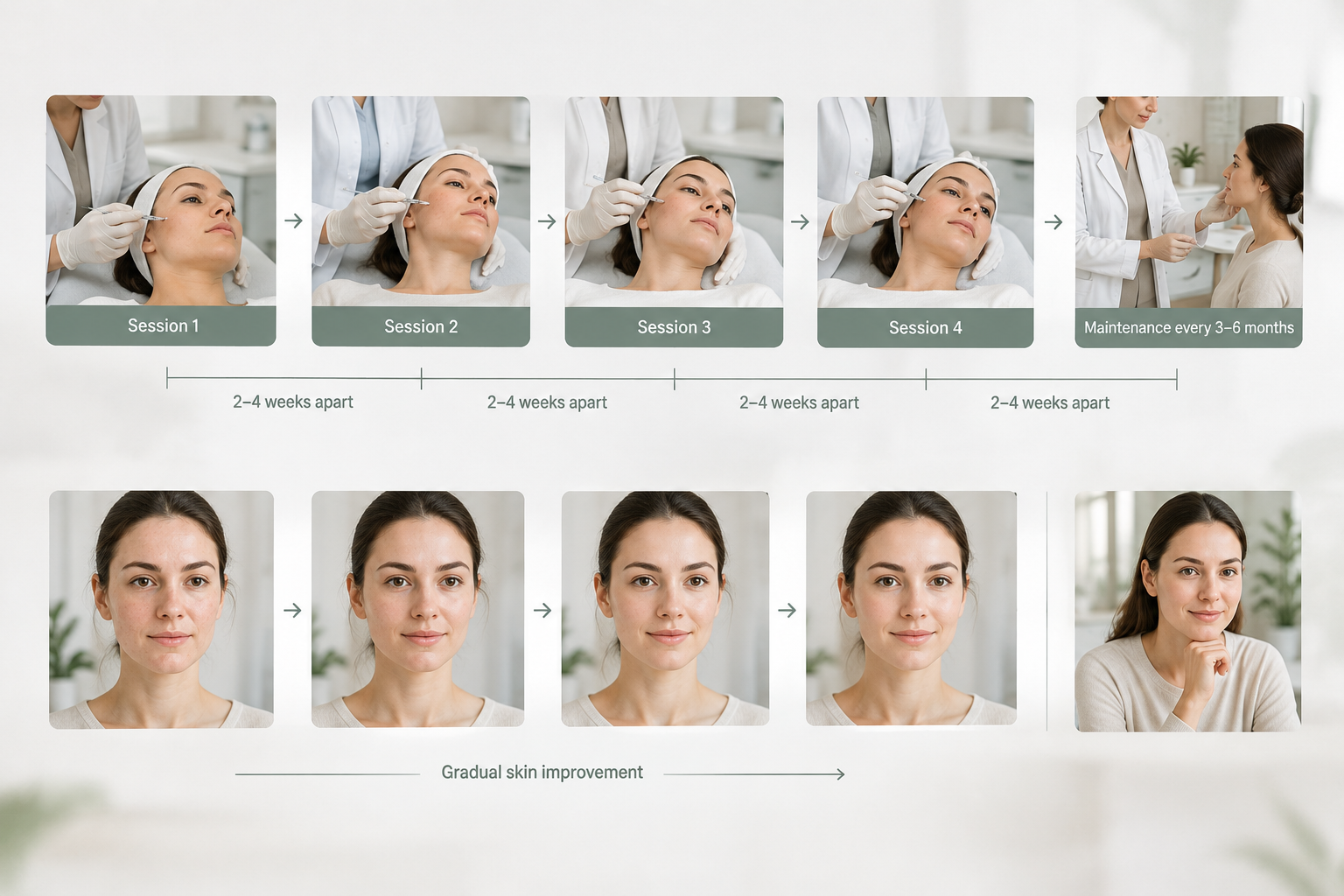
Visible improvements in skin quality, hydration, and texture are often reported after the second or third session of an initial course. The full benefit of a treatment course may become more apparent over the weeks following the final session as collagen synthesis continues. Results are not permanent. The skin continues to age, and the regenerative effects of PDRN are not indefinite. Maintenance sessions — typically every three to six months — are often recommended to sustain improvements, though individual response varies considerably.
Risks and Side Effects
PDRN injections are generally considered well tolerated when administered by a trained practitioner using appropriate technique and sterile conditions. However, as with any injectable treatment, risks and side effects exist and should be understood before proceeding.
Common and expected side effects include:
- Redness and mild swelling at injection sites, typically resolving within one to three days
- Small raised papules or bumps at injection points, usually temporary
- Bruising, particularly in areas with thin or delicate skin
- Mild tenderness or sensitivity in the treated area
Less common but possible concerns include:
- Infection at injection sites if sterile technique is not maintained
- Allergic or hypersensitivity reactions, though these are considered uncommon given the purification process used to produce PDRN
- Uneven distribution of product if technique is suboptimal
- Prolonged swelling or bruising in some individuals
Serious complications are rare but possible with any injectable procedure. Choosing a qualified and experienced practitioner working in a clinical environment significantly reduces procedural risk. Patients with a known allergy to fish or fish products should discuss this with their practitioner before treatment, as PDRN is derived from salmon.
Who May Be Suitable for PDRN Treatment?
PDRN injections may be worth discussing with a qualified practitioner for adults who are experiencing early to moderate signs of skin ageing, reduced skin quality, or specific concerns such as post-acne scarring or sun damage. Patients who prefer a biologically based approach to skin regeneration — rather than volumising fillers or more aggressive resurfacing procedures — may find PDRN a relevant option to explore.
PDRN may be particularly relevant for individuals who:
- Notice reduced skin radiance, hydration, or elasticity
- Have fine lines or early textural changes they wish to address
- Are looking for a treatment that works with the skin’s own repair mechanisms
- Want a relatively low-downtime injectable option
- Are seeking to complement other aesthetic treatments as part of a broader skin health plan
Who May Not Be Suitable
PDRN treatment is not appropriate for everyone. A clinical assessment is required to determine individual suitability. PDRN injections are generally not recommended for:
- Individuals who are pregnant or breastfeeding
- Those with a known allergy to fish or salmon-derived products
- Patients with active skin infections, inflammation, or open wounds in the treatment area
- Individuals with autoimmune conditions or those taking immunosuppressive medications, where the clinical picture should be carefully assessed
- Those with a history of keloid scarring, where any injectable treatment requires careful consideration
- Patients with certain blood disorders or those taking anticoagulant medications, depending on clinical assessment
This list is not exhaustive. A thorough consultation with a qualified practitioner is the appropriate way to assess individual suitability and identify any contraindications relevant to a specific patient’s circumstances.
Alternatives to PDRN Skin Regeneration
PDRN is one of several approaches available for skin regeneration and quality improvement. Understanding the alternatives helps patients make informed decisions about which treatment — or combination of treatments — may best suit their goals.
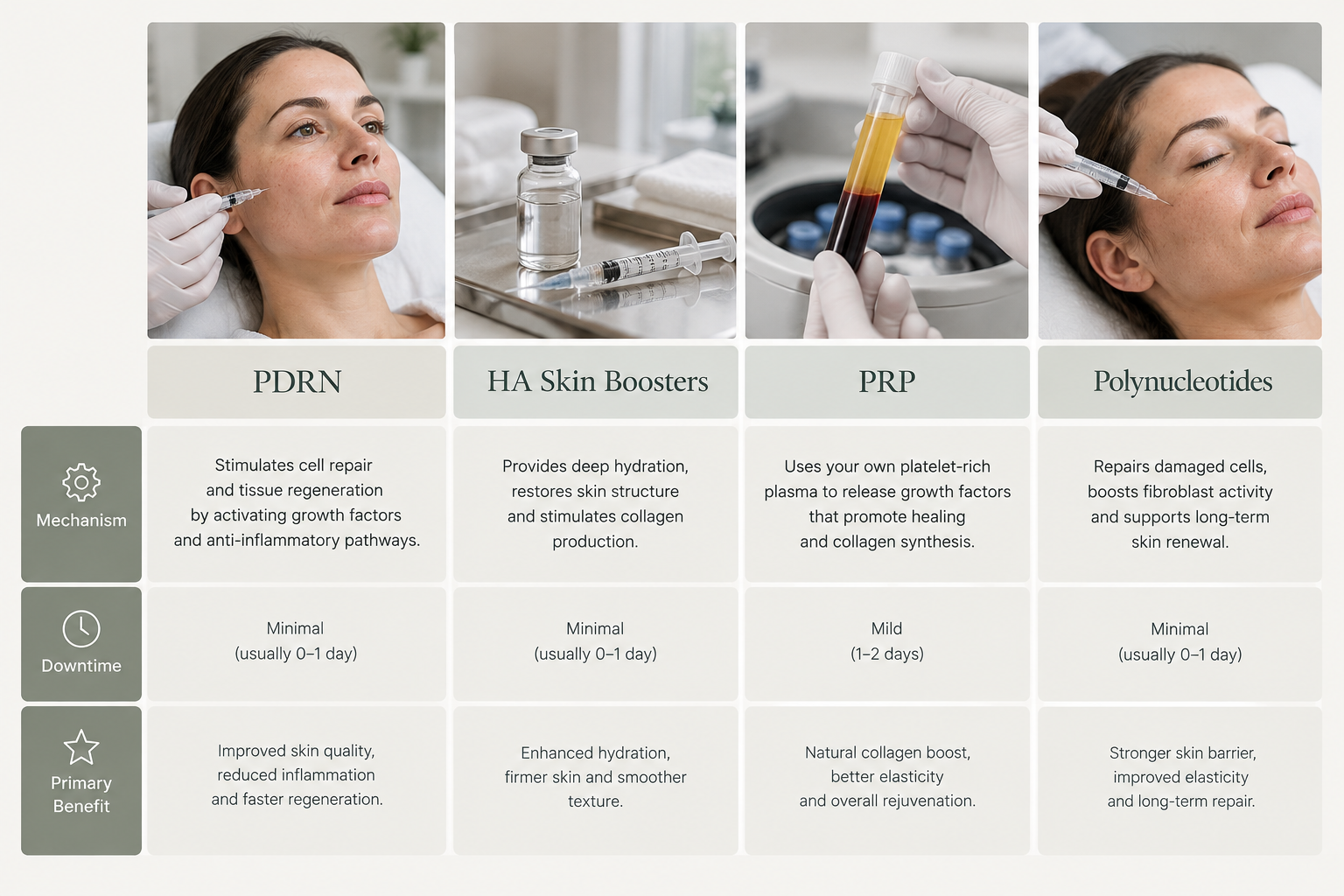
- Hyaluronic acid skin boosters (such as Profhilo or Juvederm Hydrate) — injectable treatments that primarily improve skin hydration and laxity through hyaluronic acid rather than cellular regeneration. They work differently from PDRN but address some overlapping concerns.
- Polynucleotide (PN) treatments — closely related to PDRN and sometimes used interchangeably, PN treatments such as Rejuran or Lumi Eyes are also derived from salmon DNA and share a similar regenerative mechanism. The distinction between PDRN and PN products is primarily molecular, and both are used for skin quality improvement.
- Platelet-rich plasma (PRP) — a treatment using the patient’s own blood, processed to concentrate growth factors, which are then injected to stimulate tissue repair and collagen production. PRP is autologous (derived from the patient), which eliminates allergy risk from external biological sources.
- Microneedling — a device-based treatment that creates controlled micro-injuries in the skin to stimulate collagen production. It can be combined with topical serums or PRP for enhanced effect.
- Chemical peels — exfoliating treatments that remove the outer layers of skin to encourage cell turnover and improve texture, tone, and pigmentation. Depth and strength vary considerably.
- Laser and energy-based treatments — devices such as fractional lasers, radiofrequency, and intense pulsed light (IPL) can address skin texture, pigmentation, and collagen loss, often with more immediate visible results but potentially more downtime.
The most appropriate treatment depends on individual skin concerns, skin type, medical history, tolerance for downtime, and treatment goals. Many patients benefit from a combination approach rather than a single modality.
Frequently Asked Questions
Is PDRN the same as salmon sperm?
PDRN is extracted from salmon sperm cells, but it is not injected as raw biological material. The extraction and purification process isolates specific DNA fragments — polydeoxyribonucleotides — and removes proteins and other components. The final product is a highly purified pharmaceutical-grade compound, not unprocessed salmon sperm.
How soon will I see results from PDRN injections?
Some patients notice improvements in skin hydration and radiance relatively early in a treatment course, sometimes after the first or second session. More significant changes in skin texture, fine lines, and collagen density typically develop gradually over the course of treatment and in the weeks following the final session, as collagen remodelling takes time. Individual response varies.
Can PDRN be combined with other treatments?
PDRN is often used alongside other aesthetic treatments as part of a broader skin health plan. It is commonly combined with treatments such as botulinum toxin, hyaluronic acid fillers, or energy-based devices, though the timing and sequencing of combination treatments should be guided by a qualified practitioner to ensure safety and optimise outcomes.
Is PDRN treatment painful?
Most patients find PDRN injections tolerable, particularly when topical anaesthetic cream is applied beforehand. Discomfort is generally described as mild to moderate and comparable to other injectable skin booster treatments. Sensitivity varies between individuals and treatment areas.
How long do the results of PDRN injections last?
Results are not permanent. Following an initial treatment course, improvements in skin quality may be maintained for several months. Maintenance sessions every three to six months are commonly recommended, though the appropriate interval depends on individual response and the specific concerns being addressed.
Is PDRN safe for all skin types?
PDRN has been used across a range of skin types, and its mechanism of action does not inherently target pigmentation in a way that would make it unsuitable for darker skin tones. However, individual suitability always depends on a full clinical assessment. Patients with specific skin conditions, allergies, or medical histories should discuss these with their practitioner before treatment.
What is the difference between PDRN and PRP?
Both PDRN and platelet-rich plasma (PRP) aim to support skin regeneration, but they work differently and come from different sources. PRP is derived from the patient’s own blood and delivers concentrated growth factors. PDRN is a purified salmon-derived compound that activates specific cellular receptors and supplies nucleotide building blocks. PRP is autologous, meaning there is no risk of allergy to an external biological source, while PDRN is an externally derived product that has been purified to minimise immunogenic risk.
Is PDRN Treatment Worth Considering for Skin Regeneration?
PDRN-based skin regeneration represents a biologically grounded approach to improving skin quality, supported by a plausible mechanism and a growing body of clinical evidence. For patients seeking a relatively low-downtime injectable treatment that works with the skin’s own repair processes — rather than adding volume or aggressively resurfacing — PDRN may be a reasonable option to explore with a qualified practitioner.
Realistic expectations are important. PDRN is not a replacement for more structural treatments when significant volume loss or deep wrinkles are the primary concern, and it is not a one-session solution. A course of treatments is required, results develop gradually, and maintenance is likely needed to sustain improvements. The evidence base, while promising, is still developing, and individual responses vary.
Patients who are curious about salmon sperm injections or PDRN skin boosters are best served by a thorough consultation with a practitioner who can assess their specific skin concerns, review their medical history, and recommend a treatment plan — whether that involves PDRN alone or as part of a broader approach to skin health.