

Rhinoplasty healing time is one of the most common concerns for anyone considering nose surgery. The honest answer is that recovery unfolds in distinct stages: most visible swelling and bruising resolve within two to three weeks, but the nose continues to refine for twelve months or longer, depending on the technique used, your skin type, and the extent of the procedure. Understanding each stage in advance helps you plan time off, set realistic expectations, and recognise what is normal versus what warrants a call to your surgeon.
Key Takeaways
- Most patients can return to work and social activities within two to three weeks, though the nose will not look fully refined at that point.
- Approximately two-thirds of post-operative swelling resolves within the first month; around 80–90% has settled by three months, and close to 95% by six months.
- Nasal tip swelling is the last to resolve and may take twelve to eighteen months — or longer in patients with thick nasal skin.
- Open rhinoplasty generally involves a longer swelling phase than closed rhinoplasty, and revision rhinoplasty typically takes longer still.
- Factors such as skin thickness, smoking, the extent of surgery, and individual healing response all influence how quickly final rhinoplasty results emerge.
How Long Does Rhinoplasty Take to Heal? An Overview
Rhinoplasty recovery does not follow a single fixed timeline. It is more accurate to think of it in two overlapping phases: an acute recovery phase lasting roughly two to three weeks, during which swelling, bruising, and discomfort are most noticeable; and a refinement phase lasting several months to a year or more, during which residual swelling gradually subsides and the final shape of the nose becomes apparent. Most patients are comfortable being seen in public by the end of week two or three — a milestone often called social recovery — but the nose continues to change in subtle ways long after that point.
The procedure itself typically takes one to three hours under general anaesthesia and is usually performed as day surgery. Whether your surgeon uses an open or closed approach, the internal structures — cartilage, bone, and soft tissue — require time to heal at a cellular level that no aftercare routine can significantly accelerate. What good aftercare does is reduce the risk of complications and support the most comfortable, predictable recovery possible.
Rhinoplasty Recovery Timeline: Week by Week
Days 1–3: Peak Discomfort and Building Swelling
The first three days after rhinoplasty are typically the most uncomfortable. Swelling builds progressively rather than peaking immediately, and periorbital bruising — the dark discolouration beneath the eyes — often appears during this window. Most patients experience a sensation of nasal congestion similar to a severe head cold, caused by internal swelling rather than mucus. Pain is usually manageable with prescribed pain medication, and most patients describe the discomfort as pressure rather than sharp pain. Sleeping with your head elevated on two or three pillows is essential during this period to reduce fluid accumulation in the face. Cold compresses applied gently to the cheeks (not directly to the nose) can help limit swelling in the first 48 hours.
Days 4–7: Peak Swelling and the Splint Phase
Swelling and bruising typically reach their peak around days three to five. The nose may look significantly larger than expected, and the shape will bear little resemblance to the anticipated result — this is entirely normal and a source of anxiety for many patients. A nasal splint or cast is worn during this period to protect the reshaped structures and support healing. Most patients feel well enough to move around the house comfortably by day four or five, though bending forward, heavy lifting, and any activity that raises blood pressure should be avoided. Blowing the nose is not recommended for at least two to three weeks.
Week 1: Splint Removal and the First Glimpse
Splint removal usually occurs between days seven and ten at a follow-up appointment with your surgeon. This is an emotionally significant milestone, but it is important to manage expectations: the nose will still be swollen, and the shape you see at this stage is not the final result. Periorbital bruising typically begins to fade noticeably during week one, often shifting from dark purple to yellow-green as the blood pigment breaks down. Many patients feel well enough to work from home by the end of week one, provided their role does not involve physical exertion.
Weeks 2–3: Social Recovery and Return to Work
By weeks two and three, most visible bruising has resolved and swelling has reduced enough that most patients feel comfortable returning to work in a non-physical role and resuming social activities. This is the social recovery window that surgeons commonly reference. The nose will still appear somewhat swollen, particularly at the tip, and some patients notice that the nose looks slightly different in the morning compared to the evening — morning swelling is common and tends to reduce as the day progresses. Makeup can generally be applied carefully around the nose from week two onward, though direct pressure on the bridge should be avoided.
Weeks 3–6: Gradual Improvement and Light Activity
Swelling continues to decrease steadily through weeks three to six. Light cardiovascular exercise such as walking is usually permitted from around week three to four, but strenuous exercise, contact sports, and activities with a risk of impact to the face should be avoided for at least six to eight weeks. Patients who wear glasses face a specific restriction during this phase: glasses must not rest on the nasal bridge for approximately six weeks after surgery, as the weight can distort healing cartilage. Sunglasses present the same problem. Patients who need vision correction during this period may need to use contact lenses or tape their glasses to their forehead.
Months 1–2: Major Swelling Resolves
Research using three-dimensional volumetric imaging suggests that approximately two-thirds of post-operative oedema resolves within the first month after rhinoplasty. By the end of month two, most patients see a result that is recognisably close to the intended outcome, though the nose is still not fully settled. The bridge typically refines more quickly than the tip, so patients who had hump reduction may notice their bridge result earlier than those who had significant tip work. Strenuous exercise is usually fully permitted by six to eight weeks, and most activity restrictions have been lifted by this point.
Months 3–6: The Bridge Refines, the Tip Settles
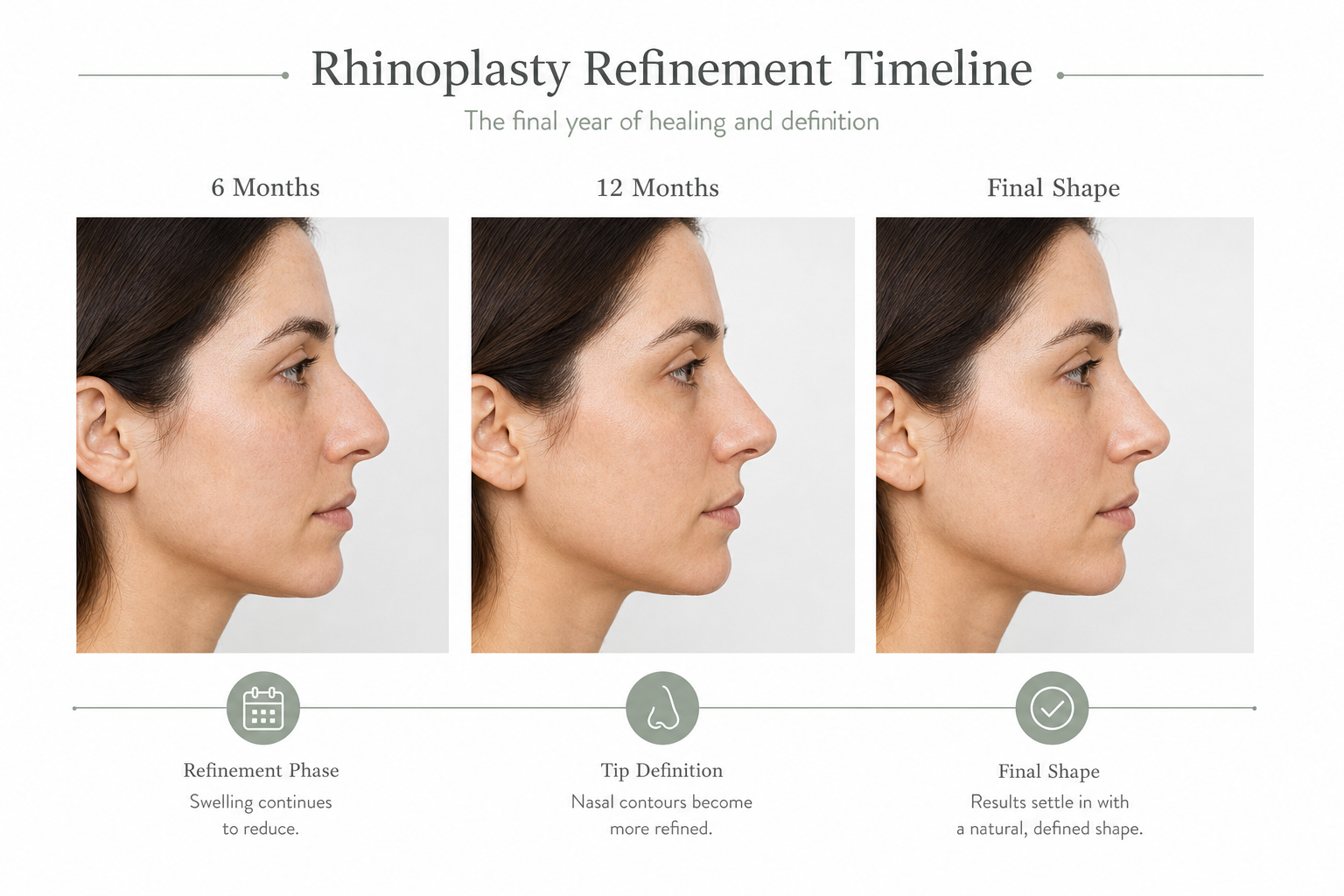
Between three and six months, the nose undergoes the most visible phase of nasal tip refinement. Swelling in the tip area — which is the last region to resolve — decreases substantially during this window. Studies suggest that around 80–90% of total swelling has resolved by the three-month mark, rising to approximately 95% by six months. Patients often notice that the tip appears to lift slightly and become more defined as the underlying oedema subsides. This is also the period when asymmetrical healing — where one side of the nose appears slightly different from the other — becomes less pronounced, though minor asymmetry during healing is normal and does not necessarily indicate a complication.
6–12 Months: Final Shape Emerges
For most patients who had primary rhinoplasty with a closed technique and average skin thickness, the final rhinoplasty results are largely apparent between six and twelve months. The nose continues to refine in subtle ways throughout this period, and patients often notice gradual improvements they had not anticipated. It is generally recommended that patients wait a full twelve months before evaluating whether a revision rhinoplasty is needed, as what appears to be an imperfection at six months may resolve naturally by twelve.
12–18 Months and Beyond: Thick Skin and Open Rhinoplasty
Patients with thick nasal skin — particularly those with sebaceous or oily skin texture — should expect a longer refinement phase. Thick skin retains fluid more readily and takes longer to contract around the reshaped cartilage framework beneath it. In these patients, the final shape may not be fully apparent until eighteen to twenty-four months after surgery. Open rhinoplasty recovery also tends to involve a longer swelling phase than closed rhinoplasty, partly because the columellar incision requires additional healing and the more extensive tissue dissection involved in the open approach takes longer to fully resolve.
What Affects Rhinoplasty Healing Time?
Several factors influence how quickly — or slowly — a patient moves through the nose job healing stages. Understanding these variables helps set realistic expectations before surgery.
- Skin thickness: Thin skin shows results more quickly but may also reveal minor irregularities. Thick or sebaceous skin conceals early results and takes significantly longer to contract, extending the refinement phase to eighteen months or more.
- Open vs. closed rhinoplasty: Open rhinoplasty involves a small incision across the columella (the strip of tissue between the nostrils) and more extensive tissue elevation, which generally results in more swelling and a longer resolution period. Closed rhinoplasty, performed entirely through the nostrils, typically involves less post-operative oedema.
- Extent of surgery: A straightforward hump reduction involves less tissue disruption than complex tip work or combined septoplasty. More extensive procedures generally mean more swelling and a longer recovery arc.
- Primary vs. revision rhinoplasty: Revision rhinoplasty recovery is consistently longer and less predictable than primary rhinoplasty. Scar tissue from the original procedure affects blood supply and tissue pliability, and the final result may not be fully apparent for twelve to eighteen months or longer.
- Smoking and nicotine: Nicotine constricts blood vessels and impairs wound healing. Surgeons typically advise stopping smoking for at least four to six weeks before and after surgery. Continuing to smoke significantly increases the risk of poor healing, infection, and unsatisfactory results.
- Age and individual healing response: Younger patients generally heal more quickly, though individual variation is substantial. Pre-existing conditions such as diabetes or immune system disorders can slow healing and increase complication risk.
- Surgeon technique: The degree of tissue dissection, the methods used to reshape cartilage and bone, and the precision of wound closure all influence how the tissues heal and how quickly swelling resolves.
Why Does Rhinoplasty Swelling Fluctuate?
One aspect of rhinoplasty healing that surprises many patients is that swelling does not decrease in a straight line. It fluctuates — sometimes noticeably — throughout the recovery period, and understanding why can reduce unnecessary anxiety. Several factors cause day-to-day variation in nasal swelling even months after surgery.
Sodium intake is one of the most significant contributors. A high-salt meal causes the body to retain water, which can temporarily increase facial and nasal swelling the following morning. Heat — whether from exercise, hot showers, or warm weather — causes blood vessels to dilate and can produce a temporary increase in swelling. Alcohol has a similar vasodilatory effect and is best avoided during the early recovery period. Hormonal fluctuations, particularly in women, can also cause cyclical changes in swelling. Morning swelling is common throughout the first several months because fluid accumulates in the tissues overnight when the head is horizontal; it typically reduces as the day progresses and gravity assists drainage. Patients who understand these patterns are less likely to interpret a temporary increase in swelling as a sign that something has gone wrong.

Open vs. Closed Rhinoplasty: Recovery Differences
| Factor | Open Rhinoplasty | Closed Rhinoplasty |
|---|---|---|
| Incision location | Columellar incision plus internal incisions | Internal incisions only |
| Tissue disruption | More extensive | Less extensive |
| Initial swelling | Generally more pronounced | Generally less pronounced |
| Tip swelling resolution | 12–18 months typical | 9–12 months typical |
| Scar visibility | Small columellar scar (usually fades well) | No external scar |
| Surgical access | Greater visibility for complex work | Limited to less complex cases |
| Social recovery | Approximately 2–3 weeks | Approximately 1–2 weeks |
Rhinoplasty Aftercare: Practical Dos and Don’ts
Following your surgeon’s aftercare instructions carefully is one of the most important things you can do to support a smooth recovery. The guidance below reflects commonly recommended principles; always defer to the specific instructions provided by your own board-certified plastic surgeon or facial plastic surgeon, as recommendations may vary based on your procedure.
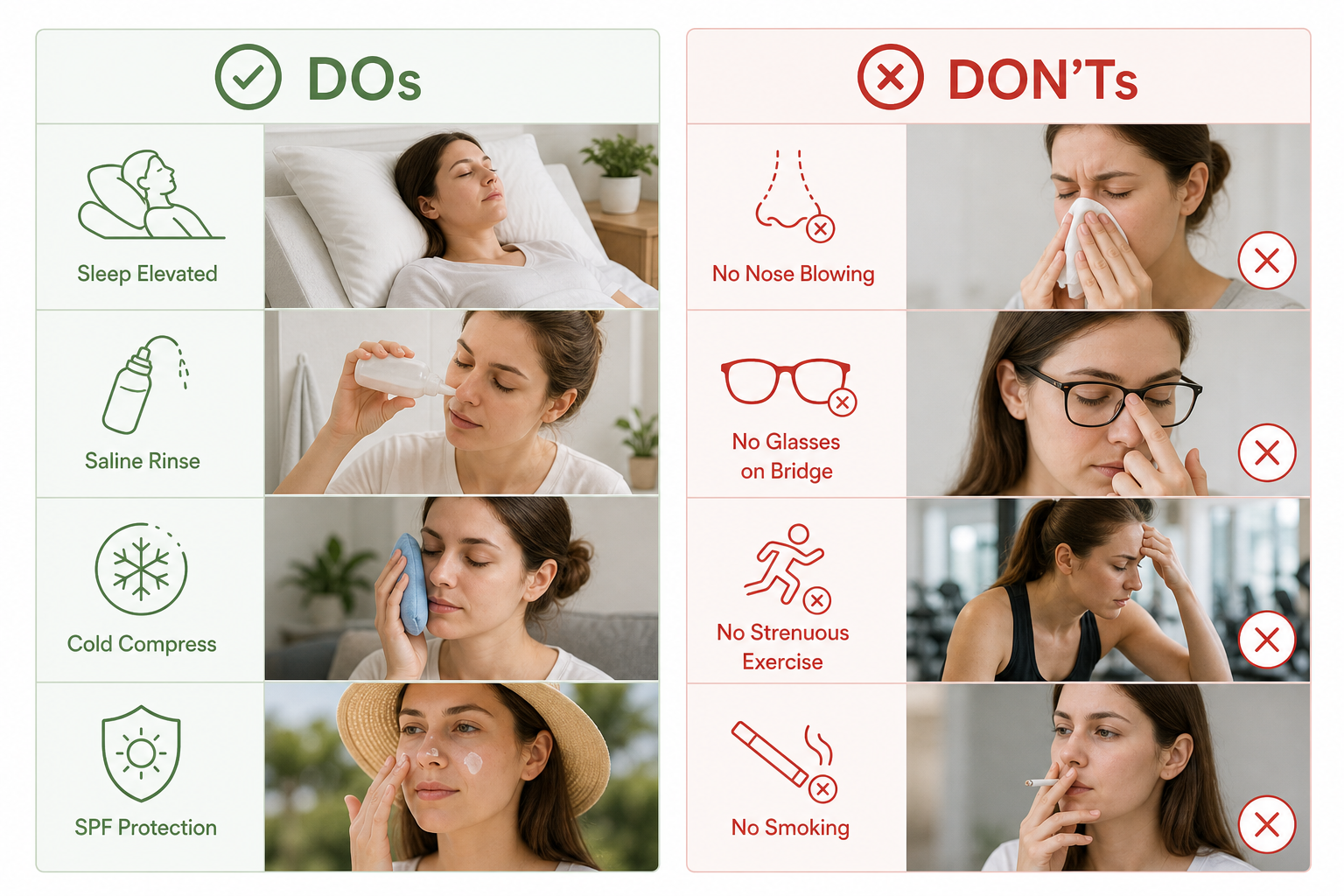
- Do sleep on your back with your head elevated for at least two to four weeks to reduce swelling.
- Do use saline nasal rinses as directed to keep the nasal passages moist and clear of crusting.
- Do apply cold compresses gently to the cheeks (not the nose) during the first 48 hours.
- Do wear front-fastening clothing to avoid pulling garments over your face.
- Do apply SPF 30 or higher sunscreen to the nose once the skin has healed, as sun exposure can worsen swelling and affect scar quality.
- Don’t blow your nose for at least two to three weeks after surgery.
- Don’t wear glasses or sunglasses that rest on the nasal bridge for approximately six weeks.
- Don’t engage in strenuous exercise or contact sports for six to eight weeks.
- Don’t bend forward or lift heavy objects for at least two weeks.
- Don’t take aspirin, ibuprofen, or other anti-inflammatory medications unless specifically approved by your surgeon, as these can increase bleeding risk.
- Don’t smoke or use nicotine products during the recovery period.
- Don’t consume alcohol during the early recovery phase.
Normal vs. Not Normal: A Symptom Guide
Asymmetrical healing, numbness, and fluctuating swelling are common sources of concern during rhinoplasty recovery. The table below outlines which symptoms are generally expected and which warrant prompt contact with your surgical team.
| Symptom | Usually Normal | Contact Your Surgeon |
|---|---|---|
| Swelling that is worse in the morning | Yes — resolves as the day progresses | If sudden and severe worsening occurs |
| Asymmetrical swelling between sides | Yes — asymmetrical healing is common | If one side is dramatically more swollen or painful |
| Numbness or altered sensation at the tip | Yes — nerves recover over weeks to months | If numbness is spreading or worsening after week 4 |
| Mild nasal congestion | Yes — internal swelling causes this | If breathing difficulty is severe or worsening |
| Light spotting or minor oozing | Yes — in the first 24–48 hours | If heavy or uncontrolled bleeding occurs |
| Swelling that fluctuates with diet or heat | Yes — normal throughout recovery | If swelling is rapidly increasing without explanation |
| Fever above 38°C / 100.4°F | No | Yes — may indicate infection |
| Yellow or green discharge | No | Yes — possible sign of infection |
| Severe pain not relieved by medication | No | Yes — seek prompt assessment |
Revision Rhinoplasty Recovery: What Is Different?
Revision rhinoplasty — surgery performed to correct or refine the result of a previous nose procedure — involves a longer and less predictable recovery than primary rhinoplasty. Scar tissue from the original operation alters the tissue planes, reduces blood supply to certain areas, and makes the tissues less pliable. These factors mean that post-operative swelling after revision rhinoplasty tends to be more pronounced and takes longer to resolve. Patients should generally expect the refinement phase to extend to twelve to eighteen months, and in some cases longer, before the final result can be fairly assessed. Most surgeons recommend waiting a minimum of twelve months after a primary rhinoplasty before proceeding with revision surgery, both to allow full healing and to ensure that any perceived imperfections are not simply residual swelling.
The Emotional Side of Rhinoplasty Recovery
The psychological experience of rhinoplasty recovery is rarely discussed in detail, yet it is a meaningful part of the process for many patients. In the first week or two, when swelling is at its peak and the nose looks very different from the anticipated result, it is common to feel anxious or even regretful. Surgeons often describe this as the “nose looks worse before better” phase, and it is a normal part of healing rather than a sign that something has gone wrong.
Asymmetrical healing — where one side of the nose appears to be healing differently from the other — is another common source of concern. In most cases, this resolves as swelling subsides unevenly, which is a natural biological process. Patients who understand this in advance are better equipped to manage the uncertainty of the long refinement phase. It is worth noting that the appropriate time to evaluate whether a revision is needed is not before twelve months have passed, and ideally only after a thorough discussion with a board-certified plastic surgeon who can assess the result objectively.
Preparing for Recovery Before Surgery Day
Setting up your home environment before surgery can make the first week significantly more comfortable. Consider arranging the following in advance:
- A comfortable sleeping area with extra pillows or a wedge pillow to keep your head elevated
- Prescribed medications collected and ready, including pain relief and any antibiotics
- Saline nasal spray as recommended by your surgeon
- Loose, front-fastening clothing that does not need to be pulled over the head
- Soft, easy-to-prepare foods for the first few days when bending and exertion should be minimised
- Entertainment and activities that can be enjoyed while resting — reading, streaming, audiobooks
- Arrangements for someone to drive you home and stay with you for the first 24 hours
- Contact lenses if you normally wear glasses, to avoid resting frames on the bridge during the six-week restriction period
Frequently Asked Questions
When can I return to work after rhinoplasty?
Most patients can return to a desk-based or remote working role within one to two weeks. If your work involves physical activity, heavy lifting, or a high-risk environment for facial impact, a longer absence of four to six weeks is typically recommended. Discuss your specific role with your surgeon before surgery so you can plan appropriately.
When does rhinoplasty swelling go down?
The majority of visible swelling resolves within the first month, but the nose continues to refine for much longer. Research suggests approximately 80–90% of swelling has resolved by three months and around 95% by six months. The nasal tip is the last area to fully settle, and in patients with thick nasal skin, this process may take eighteen months or more.
Can I wear glasses after rhinoplasty?
Glasses that rest on the nasal bridge should be avoided for approximately six weeks after surgery. The weight of frames can distort healing cartilage during this critical period. Patients who need vision correction should use contact lenses during this time, or ask their surgeon about taping lightweight frames to the forehead as a temporary measure.
Is asymmetrical healing after rhinoplasty normal?
Yes. It is very common for the two sides of the nose to swell and resolve at slightly different rates. This asymmetrical healing is a normal biological variation and does not necessarily indicate a complication or an asymmetrical surgical result. In most cases, the appearance evens out as residual swelling continues to resolve over the following months.
How is revision rhinoplasty recovery different?
Revision rhinoplasty typically involves a longer and more variable recovery than primary surgery. Scar tissue from the original procedure affects tissue healing, and swelling tends to be more persistent. Most surgeons advise patients to allow twelve to eighteen months — sometimes longer — before the final result of a revision can be accurately assessed.
Does smoking affect rhinoplasty healing?
Yes, significantly. Nicotine constricts blood vessels and reduces oxygen delivery to healing tissues, which impairs wound healing, increases infection risk, and can lead to poor scarring. Most surgeons require patients to stop smoking for a minimum of four to six weeks before and after rhinoplasty. Continuing to smoke during recovery can compromise both the safety and the aesthetic outcome of the procedure.
When can I exercise after rhinoplasty?
Light walking is generally permitted from around week three to four. More vigorous cardiovascular exercise and resistance training are typically cleared at six to eight weeks. Contact sports or any activity with a meaningful risk of impact to the face should be avoided for at least three months, and some surgeons recommend longer. Always follow the specific guidance provided by your own surgical team.
Planning Your Rhinoplasty Recovery Realistically
Rhinoplasty is one of the more demanding cosmetic procedures in terms of recovery duration, not because the acute phase is particularly severe, but because the refinement phase is genuinely long. Patients who go into surgery with a clear understanding of the nose job healing stages — and who appreciate that the final shape may not be fully visible for a year or more — tend to have a more positive experience than those who expect rapid results.
The most important practical steps are to choose a qualified board-certified plastic surgeon or facial plastic surgeon with specific rhinoplasty experience, follow aftercare instructions carefully, avoid the behaviours most likely to slow healing (smoking, alcohol, strenuous activity too soon), and resist the urge to evaluate the final result before the twelve-month mark. If you have concerns at any point during recovery — particularly about warning signs such as fever, heavy bleeding, or severe pain — contact your surgical team promptly rather than waiting.
A consultation with an experienced rhinoplasty surgeon is the best starting point for understanding how the recovery timeline may apply to your specific anatomy, skin type, and surgical goals.