

Quick Comparison
| Feature | Profhilo | Sculptra |
|---|---|---|
| Active ingredient | Hyaluronic acid (HA) | Poly-L-lactic acid (PLLA) |
| Treatment category | Bio-remodelling / skin booster | Collagen biostimulator / volumiser |
| Primary goal | Skin quality, hydration, early laxity | Volume restoration, structural support |
| Mechanism | Diffuses through skin, stimulates collagen and elastin via fibroblasts | PLLA microparticles trigger gradual collagen synthesis in deep dermis |
| Sessions required | 2 sessions, 4 weeks apart | 3–4 sessions, 4–6 weeks apart |
| Onset of results | Visible glow within 2–4 weeks | Gradual improvement over 6–12 weeks |
| Longevity | 6–12 months | Up to 2 years |
| Downtime | Minimal (bumps resolve in 24–48 hours) | Minimal (swelling, bruising possible) |
| Post-treatment massage | Not required | Required (5-5-5 rule) |
| Common treatment areas | Face, neck, décolletage, hands, upper arms | Face, hands, décolletage, knees, buttocks |
| Ideal candidate | Dull, dehydrated, or crepey skin; early ageing signs | Moderate-to-severe volume loss; structural facial ageing |
| Can they be combined? | Yes — staged approach recommended (Sculptra first, Profhilo 4–6 weeks later) | |
What Is Profhilo?
Profhilo is a bio-remodelling treatment made from a high concentration of pure hyaluronic acid (HA). Unlike conventional dermal fillers, Profhilo contains no cross-linking agents, which means it does not add structural volume or hold a fixed shape. Instead, it spreads evenly through the skin’s layers, delivering deep hydration while stimulating the production of collagen and elastin through fibroblast activity. The result is an improvement in skin quality, texture, and tone rather than a change in facial contour.
Profhilo uses a patented NAHYCO® Hybrid Technology that combines high-molecular-weight and low-molecular-weight HA in a thermally bonded complex. This formulation allows the product to remain stable in tissue without cross-linking chemicals, while still releasing HA slowly to support the skin’s natural repair processes. It is administered using the BAP (Bio Aesthetic Points) protocol — five specific injection points on each side of the face — which minimises the number of entry points while ensuring even distribution.
The treatment is particularly well suited to patients experiencing dull, dehydrated, or crepey skin, early skin laxity, or a general loss of radiance. It is not designed to replace lost volume or lift significantly sagging tissue.
What Is Sculptra?
Sculptra is an injectable collagen biostimulator made from poly-L-lactic acid (PLLA), a biodegradable synthetic polymer with a long safety record in medicine — it has been used in dissolvable sutures for decades. When injected into the deep dermis or subcutaneous tissue, PLLA microparticles trigger a controlled inflammatory response that stimulates fibroblasts to produce new collagen. This gradual collagen stimulation rebuilds the skin’s structural framework over several weeks, restoring volume and improving skin thickness from within.
Because Sculptra works by encouraging the body’s own collagen production rather than adding an immediate filler substance, results develop slowly. Most patients notice meaningful improvement after two to three sessions, with the full effect becoming visible over six to twelve weeks following the final treatment. The longevity of results — up to two years in many patients — reflects the durability of newly formed collagen rather than the persistence of an injected material.
Sculptra is primarily used for volume restoration in areas such as the cheeks, temples, and jawline, where age-related fat loss and collagen depletion create a hollowed or deflated appearance. It can also be used on the hands, décolletage, knees, upper arms, and buttocks in appropriate candidates.
How Each Treatment Works: A Closer Look at the Mechanism
Understanding the mechanism of each treatment helps clarify why they suit different concerns. Profhilo acts primarily at the level of skin quality. The HA it contains does not sit in one place; it diffuses through the dermis and hypodermis, attracting water molecules and creating an environment that supports fibroblast activity. Fibroblasts — the cells responsible for producing collagen and elastin — respond to this environment by increasing their output, which gradually improves skin firmness, elasticity, and hydration. The effect is a visible improvement in skin quality and a natural-looking radiance rather than a structural change.
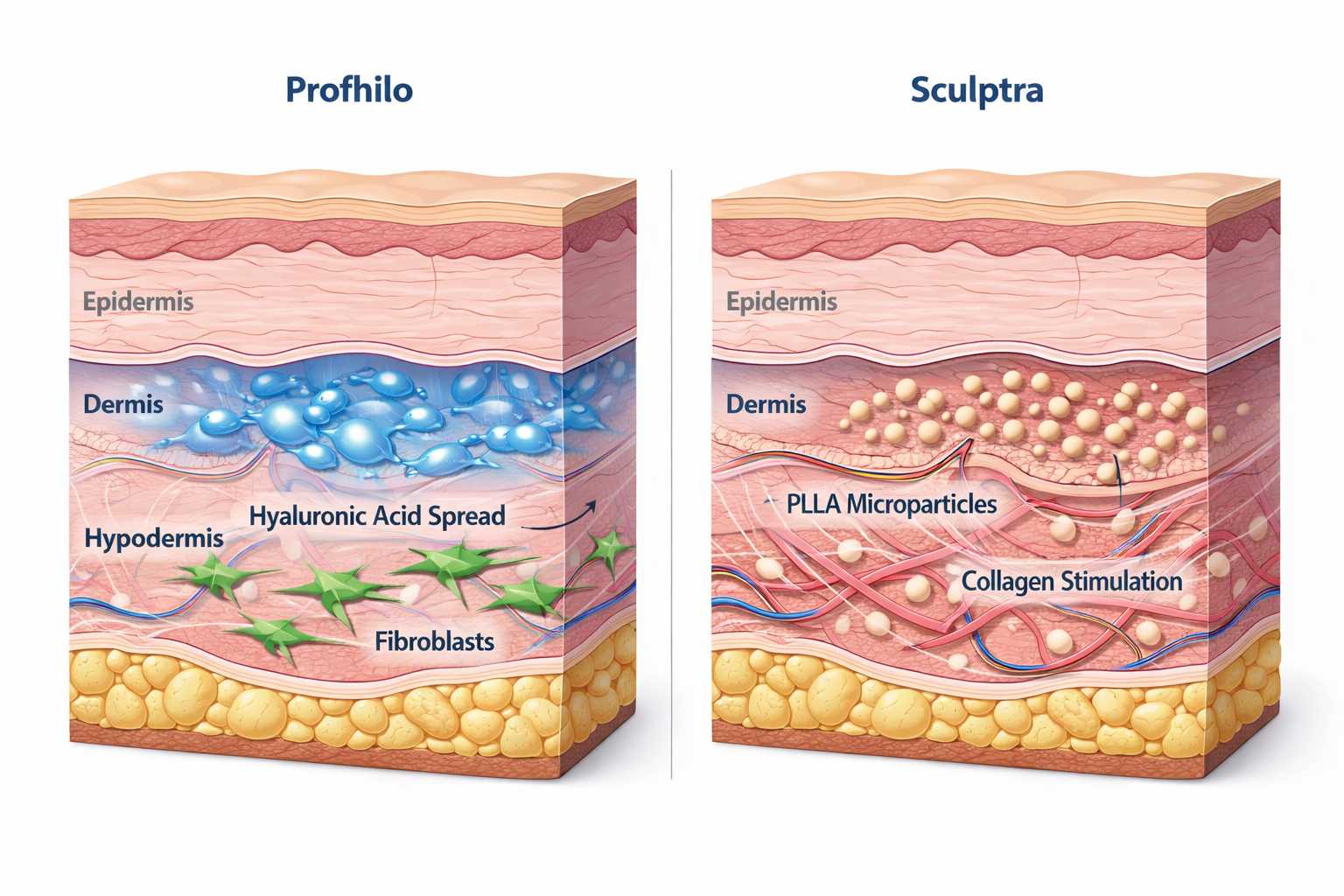
Sculptra’s mechanism is fundamentally different. PLLA microparticles are injected into deeper tissue planes, where they act as a scaffold that provokes a mild, controlled tissue response. As the body gradually absorbs the PLLA over several months, it replaces the microparticles with newly synthesised collagen fibres. This process rebuilds the collagen framework that supports facial volume and structure. The treatment addresses the root cause of structural ageing — collagen loss — rather than simply masking it with a filler substance.
Both treatments stimulate collagen, but they do so at different depths, through different mechanisms, and with different primary outcomes. Profhilo improves the surface quality of skin; Sculptra rebuilds the deeper structural support.
Treatment Areas
Profhilo is approved for use on the face, neck, décolletage, hands, and upper arms. Its ability to spread evenly through tissue makes it particularly effective for areas where skin quality is the primary concern — improving texture, hydration, and early skin laxity without adding bulk. It is a popular choice for the neck and décolletage, where traditional fillers are rarely appropriate.
Sculptra has a broader range of structural applications. On the face, it is most commonly used in the cheeks, temples, and along the jawline to address hollow cheeks, sunken temples, and the loss of mid-face volume that contributes to nasolabial folds and marionette lines. Beyond the face, Sculptra is used on the hands, décolletage, knees, upper arms, and in some cases the buttocks for non-surgical contouring. Its ability to rebuild collagen in deeper tissue planes makes it suitable for areas where structural support — rather than surface hydration — is the primary need.
Who Is Each Treatment Best Suited To?
Patient selection is one of the most important factors in achieving satisfying results with either treatment. A thorough assessment by a qualified aesthetic practitioner is essential before proceeding with either option.
Profhilo may be suitable if you:
- Are in your late 20s to early 50s and noticing dull, dehydrated, or crepey skin
- Have early signs of skin laxity but have not yet experienced significant volume loss
- Want to improve overall skin quality, radiance, and texture
- Are looking for a preventive approach to skin ageing
- Have concerns about the neck, décolletage, or hands as well as the face
- Prefer a shorter treatment course with minimal aftercare requirements
Sculptra may be suitable if you:
- Are in your mid-30s to 60s and have noticed meaningful volume loss in the cheeks or temples
- Have hollow cheeks, sunken temples, or a loss of facial contour
- Are experiencing moderate-to-severe structural facial ageing
- Want longer-lasting results and are comfortable with a gradual improvement timeline
- Are looking for non-surgical facial rejuvenation that addresses the underlying cause of volume loss
- Do not have a history of keloid scarring or autoimmune conditions that may affect healing
Age as a guide (not a rule)
In general terms, patients in their late 20s and 30s with good facial volume but declining skin quality tend to respond well to Profhilo. Patients in their 40s and 50s who have experienced noticeable volume loss alongside skin quality changes may benefit more from Sculptra, or from a combination of both treatments delivered in a staged approach. These are broad patterns, not fixed rules — individual anatomy, lifestyle, and treatment goals always take precedence over age alone.
Profhilo Structura: A Middle-Ground Option
A newer addition to the Profhilo range, Profhilo Structura, is worth understanding as a potential middle-ground option between standard Profhilo and Sculptra. Profhilo Structura contains a higher concentration of high-molecular-weight HA and is designed to provide a degree of lift and structural support in addition to the skin quality improvements associated with standard Profhilo. It is injected into the superficial fat compartments of the face rather than the dermis, making it more suitable for patients who need some structural improvement but do not have the degree of volume loss that would typically indicate Sculptra.
Profhilo Structura is not a replacement for Sculptra in patients with significant volume loss, but it may be an appropriate option for those who are not yet ready for a collagen biostimulator or who want a treatment that bridges the gap between skin quality improvement and mild structural support. A qualified aesthetic practitioner can advise whether this option is relevant to your specific concerns.
Treatment Experience and Aftercare
Both treatments are administered as in-clinic injectable procedures, typically taking between 15 and 30 minutes. Neither requires general anaesthesia, and most patients tolerate the injections well. Sculptra formulations often contain lidocaine, a local anaesthetic, to improve comfort during the procedure.
After Profhilo treatment, small raised bumps may appear at the five injection points on each side of the face. These generally resolve within 24 to 48 hours without any specific aftercare. No massage is required, and most patients can return to normal activities the same day. Redness, minor swelling, or bruising at injection sites is possible but usually short-lived.
Sculptra aftercare requires more active patient participation. Following each session, patients are advised to follow the 5-5-5 rule: massage the treated area for five minutes, five times a day, for five days after treatment. This massage protocol is important because it helps distribute the PLLA microparticles evenly through the tissue, reducing the risk of nodule formation — a known complication when Sculptra is not massaged correctly. Swelling after Sculptra can temporarily make results appear more dramatic than the final outcome, so patients should be aware that the initial appearance will settle as swelling subsides.
Results: Onset, Duration, and Realistic Expectations
Profhilo typically produces a visible improvement in skin radiance and hydration within two to four weeks of the first session. After the second session at four weeks, patients often describe a noticeable improvement in skin texture, firmness, and a natural-looking glow. Results generally last between six and twelve months, after which a maintenance session is usually recommended to sustain the improvement.
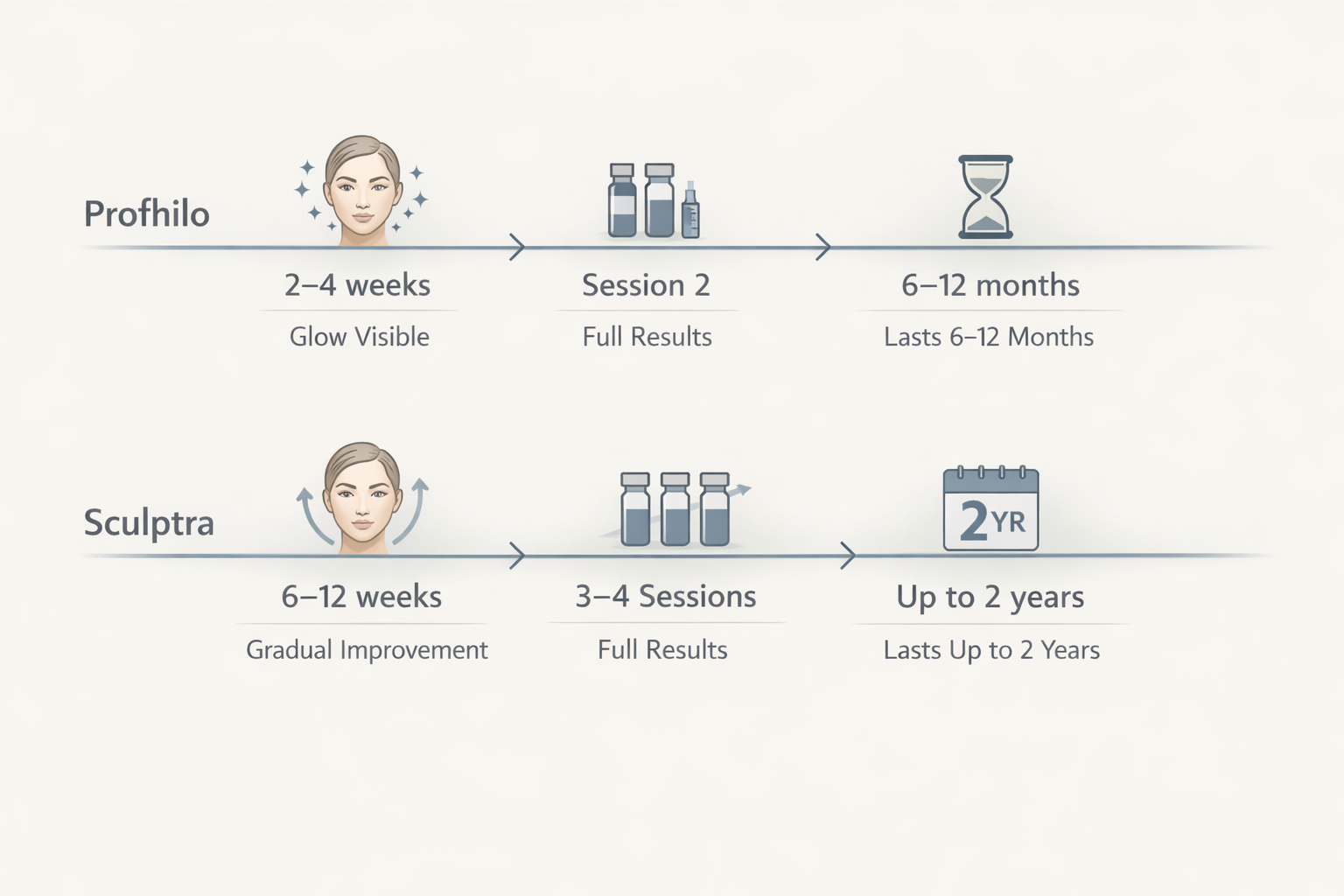
Sculptra results develop more gradually. Because the treatment works by stimulating the body’s own collagen production, meaningful changes typically become visible over six to twelve weeks following each session. The full effect of a complete treatment course — usually three to four sessions — may not be apparent until several months after the final appointment. This gradual timeline can be a disadvantage for patients who want faster visible change, but the results, once established, may last up to two years in many patients.
It is important to have realistic expectations for both treatments. Profhilo will not restore significant facial volume or lift substantially sagging tissue. Sculptra will not hydrate the skin or improve surface texture in the way that a hyaluronic acid skin booster does. Neither treatment is a substitute for surgical intervention in patients with advanced skin laxity or significant structural changes.
Risks, Side Effects, and Who Should Avoid Each Treatment
Both Profhilo and Sculptra are generally well tolerated when administered by a qualified aesthetic practitioner, but neither is without risk. Common side effects for both treatments include temporary redness, swelling, bruising, and tenderness at injection sites. These effects typically resolve within a few days.
Sculptra carries a specific risk of nodule or lump formation beneath the skin if the PLLA microparticles are not distributed evenly. This risk is significantly reduced by correct injection technique and adherence to the post-treatment massage protocol. Nodules are more likely when Sculptra is injected too superficially or when aftercare instructions are not followed. Choosing an experienced practitioner with specific training in Sculptra administration is important.
Both treatments are generally contraindicated during pregnancy and breastfeeding, in the presence of active skin infection at the treatment site, and in patients with certain autoimmune conditions. Sculptra is typically avoided in patients with a history of keloid scarring due to the risk of an exaggerated tissue response. Patients taking blood-thinning medications may have an increased risk of bruising. A full medical history should always be taken before treatment.
Cost and Long-Term Value
Profhilo typically has a lower upfront cost per session than Sculptra, but because results last six to twelve months, maintenance sessions are needed more frequently — usually once or twice a year. Sculptra involves a higher initial investment across three to four sessions, but results that last up to two years may make it more cost-effective over time for patients who are committed to maintaining their results.
A rough comparison: if Profhilo requires two sessions per year to maintain results, the annual cost accumulates steadily. Sculptra’s higher upfront cost may be offset by a longer interval before retreatment is needed. The most cost-effective choice depends on the individual’s treatment goals, the areas being addressed, and how their skin responds. A personalised treatment plan developed with a qualified practitioner will give a clearer picture of the likely investment involved.
Can Profhilo and Sculptra Be Combined?
Combining Profhilo and Sculptra is a recognised approach in aesthetic medicine, and for some patients it may offer complementary benefits that neither treatment achieves alone. Sculptra addresses the deeper structural layer — rebuilding the collagen framework and restoring facial volume — while Profhilo improves the surface quality of the skin above it. Together, they can provide both structural support and skin quality improvement in a staged approach.
The recommended sequence is to complete the Sculptra course first, then introduce Profhilo approximately four to six weeks after the final Sculptra session. This timing allows the initial swelling from Sculptra to resolve and gives the collagen stimulation process time to begin before the surface treatment is added. Administering both treatments at the same appointment or in the same area on the same day is generally not recommended, as it can complicate assessment of results and increase the risk of adverse effects.
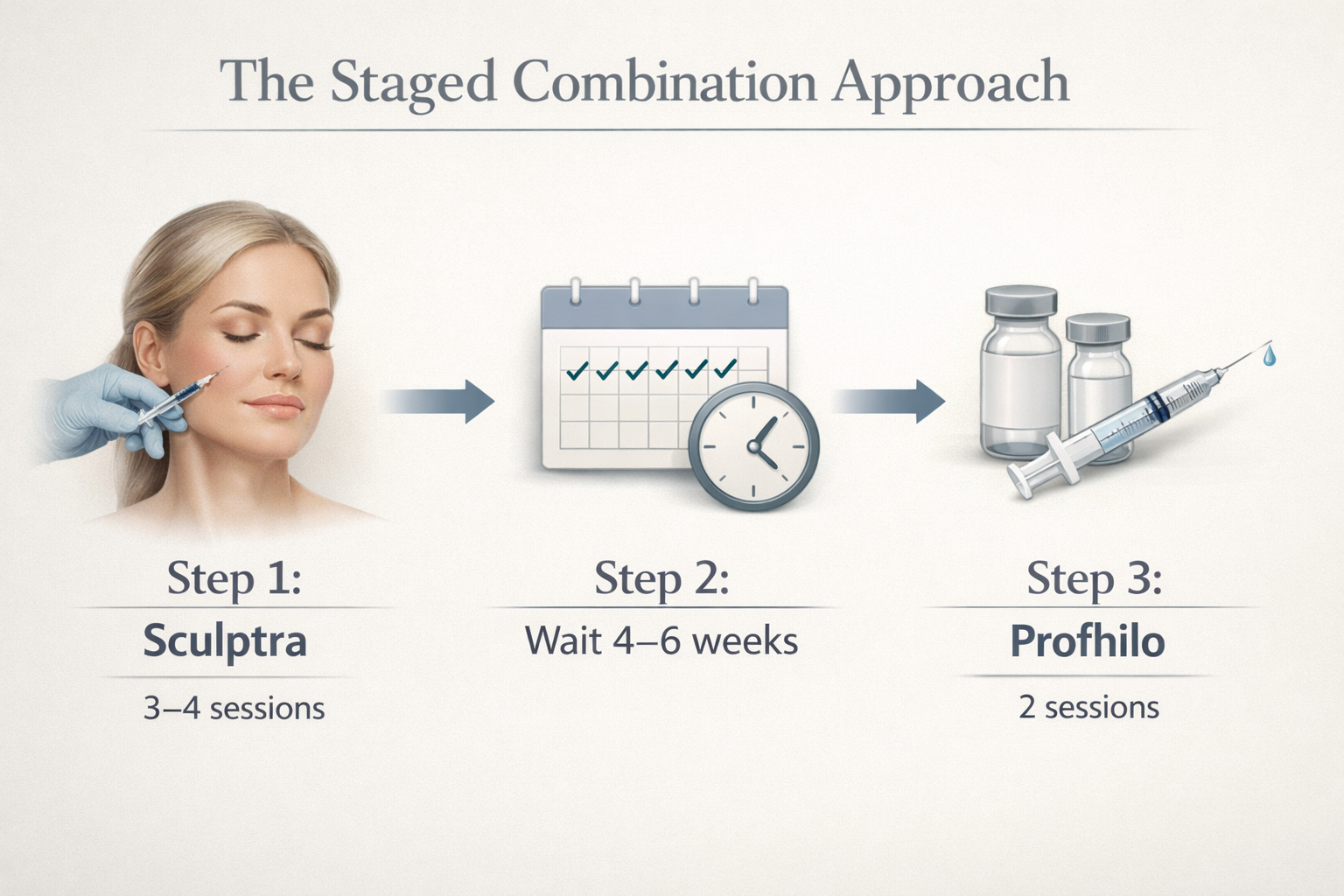
Not every patient needs or benefits from both treatments. A staged approach is most appropriate for patients who have both meaningful volume loss and a decline in skin quality. Patients with only one of these concerns may achieve their goals with a single treatment. Clinical assessment is required to determine whether a combination approach is appropriate.
How Profhilo and Sculptra Compare to Other Biostimulators
Profhilo and Sculptra are the most widely recognised injectable biostimulators, but they are not the only options. Radiesse, which contains calcium hydroxylapatite microspheres, is another collagen biostimulator that also provides immediate volumising effects — making it a closer functional comparison to Sculptra than to Profhilo. Nucleofill and similar polynucleotide-based skin boosters occupy a similar space to Profhilo in terms of skin quality improvement, though their mechanism differs. Lanluma is a PLLA-based product similar to Sculptra that is used for body contouring applications.
Understanding where each product sits in the treatment landscape helps practitioners and patients make more informed decisions. Profhilo is best understood as a bio-remodelling treatment focused on skin quality; Sculptra is best understood as a structural collagen biostimulator focused on volume restoration. Other products may be more appropriate depending on the specific concern, treatment area, and patient profile.
Frequently Asked Questions
Are Profhilo and Sculptra the same type of treatment?
No. Profhilo is a hyaluronic acid skin booster that improves skin quality and hydration through bio-remodelling. Sculptra is a poly-L-lactic acid collagen biostimulator that rebuilds structural volume by stimulating the body’s own collagen production. They work through different mechanisms and address different concerns.
Which treatment shows results faster?
Profhilo typically produces visible skin quality improvements within two to four weeks of the first session. Sculptra results develop gradually over six to twelve weeks following each session, with the full effect of a complete course becoming apparent several months after the final treatment.
Which lasts longer — Profhilo or Sculptra?
Sculptra generally lasts longer. Results from Sculptra may persist for up to two years in many patients. Profhilo results typically last six to twelve months, after which maintenance treatment is usually recommended.
Can Profhilo and Sculptra be done at the same appointment?
This is generally not recommended. A staged approach — completing the Sculptra course first, then introducing Profhilo four to six weeks later — is the approach most commonly recommended by experienced practitioners. Combining both at the same appointment can complicate result assessment and may increase the risk of side effects.
Is Sculptra safe for all skin types?
Sculptra is generally considered biocompatible and biodegradable, but it is not appropriate for everyone. Patients with a history of keloid scarring, certain autoimmune conditions, or active skin infections at the treatment site are typically not suitable candidates. A thorough consultation with a qualified aesthetic practitioner is essential to assess individual suitability.
What is the 5-5-5 rule for Sculptra?
The 5-5-5 rule is a post-treatment massage protocol recommended after Sculptra injections. Patients are advised to massage the treated area for five minutes, five times a day, for five days following each session. This helps distribute the PLLA microparticles evenly and reduces the risk of nodule formation beneath the skin.
Does Profhilo add volume to the face?
Profhilo does not add structural volume in the way that a traditional dermal filler or Sculptra does. It improves skin quality, hydration, and early skin laxity, and may create a subtle plumping effect through deep hydration, but it is not designed to restore significant facial volume or lift substantially sagging tissue.
Profhilo or Sculptra: Matching the Treatment to Your Concern
Choosing between Profhilo and Sculptra is not a matter of one being better than the other — it is a matter of matching the right treatment to the right concern. Profhilo is the more appropriate choice when the primary issue is skin quality: dehydration, dullness, crepey texture, or early skin laxity without significant volume loss. It suits patients who want a skin quality improvement and a natural-looking radiance, with a straightforward two-session protocol and minimal aftercare.
Sculptra is the more appropriate choice when structural volume loss is the dominant concern — hollow cheeks, sunken temples, or a loss of facial contour that skin hydration alone cannot address. It suits patients who are comfortable with a gradual improvement timeline and a longer treatment course, and who want results that may last up to two years. For patients with both concerns, a staged approach combining Sculptra for structural support and Profhilo for skin quality improvement may offer the most comprehensive outcome.
Neither treatment is a substitute for a thorough clinical assessment. The most important step is a consultation with a qualified aesthetic practitioner who can evaluate your skin, discuss your goals, and recommend a personalised treatment plan based on your individual anatomy and concerns — rather than a one-size-fits-all approach.