

Key Takeaways
- Nose to mouth lines, also called nasolabial folds or smile lines, deepen with age due to collagen and elastin loss, fat pad descent, and reduced bone support.
- Hyaluronic acid dermal fillers are the most widely used non-surgical treatment, but cheek filler, thread lifts, Profhilo, and energy-based devices may also be appropriate depending on the underlying cause.
- Treating the cheeks indirectly can lift nasolabial folds by restoring the midface support structure that holds overlying tissue in place.
- Skincare alone cannot eliminate established folds, but a consistent routine using retinoids and SPF may slow their progression.
- A personalised treatment plan based on fold severity, skin quality, and individual anatomy tends to produce the most natural-looking results.
What Are Nose to Mouth Lines?
Nose to mouth lines are the creases that run from the sides of the nostrils down to the corners of the mouth. Clinically, they are called nasolabial folds — a term derived from the Latin words for nose (nasus) and lip (labium). They are also commonly referred to as smile lines or laugh lines, because they become more visible when the face is animated. In younger skin, these lines appear only during expression and fade when the face is at rest. As the skin ages and loses structural support, they become static lines — meaning they are visible even without smiling.
Nasolabial folds are a normal part of facial anatomy at every age. The concern for most people is not their existence but their depth, which can create a tired or aged appearance that does not reflect how they feel. Understanding what drives that deepening is the first step toward choosing an appropriate response.
What Causes Nose to Mouth Lines to Deepen?
Several overlapping mechanisms contribute to the deepening of nasolabial folds over time. No single factor acts alone, which is why effective treatment often needs to address more than one cause.
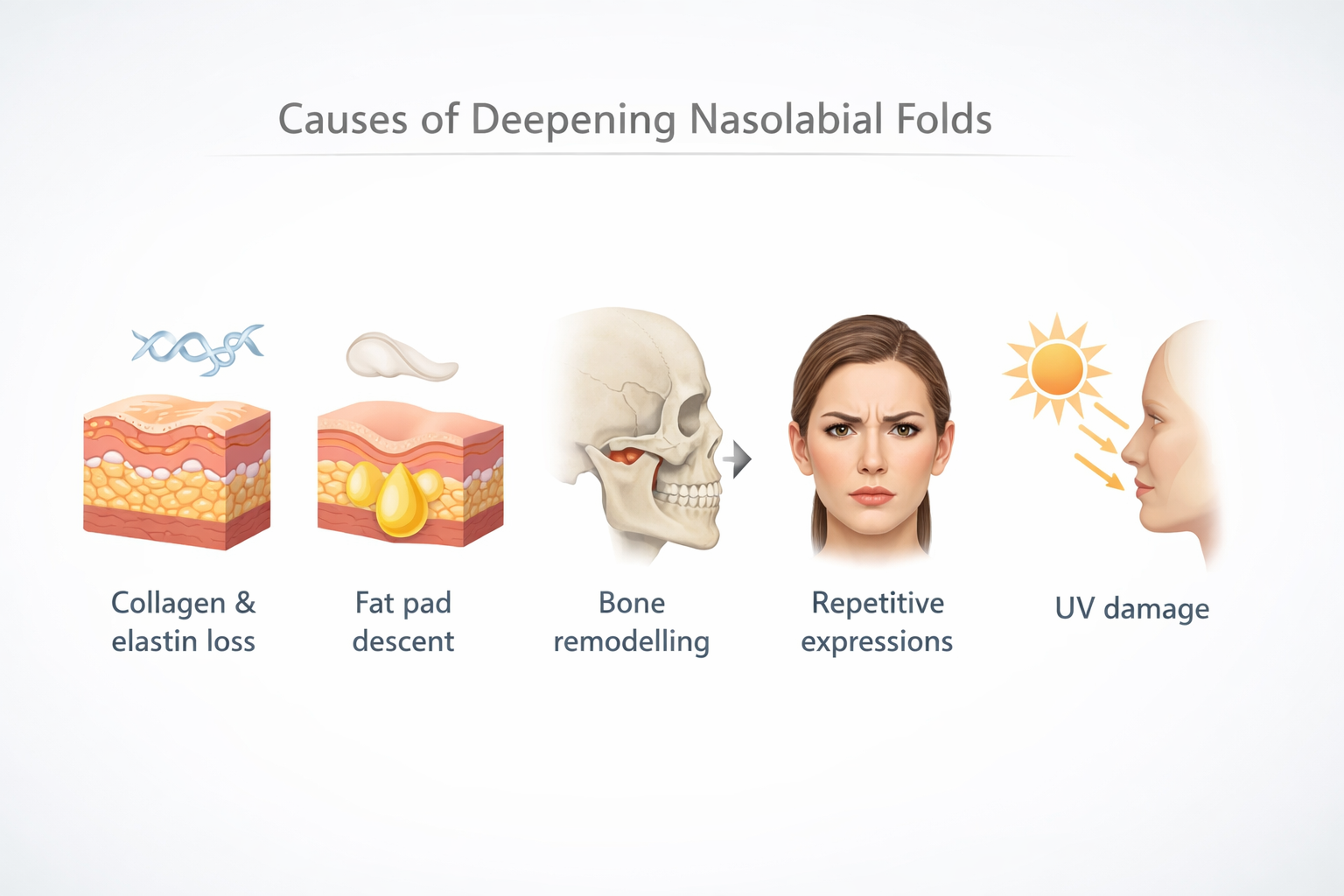
Loss of Collagen and Elastin
From the mid-twenties onward, the skin produces progressively less collagen and elastin — the structural proteins responsible for firmness and recoil. As collagen and elastin levels decline, the skin becomes thinner, less resilient, and less able to spring back after repeated movement. This makes expression lines more likely to become permanently etched into the skin’s surface.
Fat Pad Descent and Volume Loss
The face contains several distinct compartments of fat that sit beneath the skin and give the midface its youthful contour. With age, these fat pads lose volume and shift downward — a process known as fat pad descent. As the cheek fat pads descend, they pile up above the nasolabial fold, making the crease appear deeper and more shadowed. This midface ageing effect is one of the primary drivers of pronounced nasolabial folds in people over forty.
Bone Remodelling
The facial skeleton provides the foundation on which soft tissue rests. Research shows that the facial bones gradually remodel with age, with the cheekbones and eye sockets losing projection and the jaw losing height. This skeletal change reduces the scaffolding that supports the overlying fat and skin, contributing to skin laxity and fold deepening.
Repetitive Facial Expressions
Smiling, talking, and laughing involve repeated contraction of the muscles around the mouth and cheeks. Over decades, this repetitive movement creases the skin in the same location, gradually converting dynamic lines — those that appear only during expression — into static lines that remain visible at rest.
Sun Damage and Lifestyle Factors
UV radiation accelerates the breakdown of collagen and elastin through a process called photoageing. Smoking reduces blood flow to the skin and impairs collagen synthesis, compounding age-related changes. Significant weight fluctuations can stretch and then deflate the skin, while chronic dehydration and poor nutrition may reduce the skin’s ability to maintain its structure. Genetics also plays a role: some people are predisposed to deeper folds based on their skin type, facial structure, and inherited rate of collagen loss.
Assessing Severity: Mild, Moderate, and Deep Folds
Nasolabial folds are commonly graded on a scale from mild to severe, and this grading helps guide treatment decisions. A mild fold is a shallow line visible mainly during expression, with little shadow at rest. A moderate fold is a clearly visible crease at rest that creates a noticeable groove but does not overhang the surrounding skin. A deep or severe fold involves a pronounced groove with overhanging skin and significant shadowing, often accompanied by visible cheek descent and skin laxity.
Understanding where your folds sit on this spectrum matters because mild folds may respond well to skin quality treatments such as Profhilo or retinoids, moderate folds often benefit most from targeted dermal fillers or cheek volume restoration, and deep folds may require a combination approach or, in some cases, a surgical consultation. A qualified practitioner can assess severity in person and recommend the most appropriate pathway.
Non-Surgical Treatments for Nose to Mouth Lines
A range of minimally invasive and non-surgical treatment options are available, each working through a different mechanism. The right choice depends on the primary cause of the fold, its severity, skin quality, and individual anatomy.
Hyaluronic Acid Dermal Fillers
Hyaluronic acid dermal fillers are the most commonly used non-surgical treatment for nasolabial folds. Hyaluronic acid is a naturally occurring substance in the skin that attracts and retains water, and injectable formulations use a cross-linked gel to add volume and smooth the fold directly. Brands such as Juvéderm, Restylane, and Belotero offer products with different consistencies suited to different fold depths and tissue types. Results are typically visible immediately and may last between nine and eighteen months, after which the filler is gradually broken down by the body. Hyaluronic acid fillers are also reversible using an enzyme called hyaluronidase, which is an important safety consideration.
The Cheek Filler Approach: Treating the Cause, Not Just the Fold
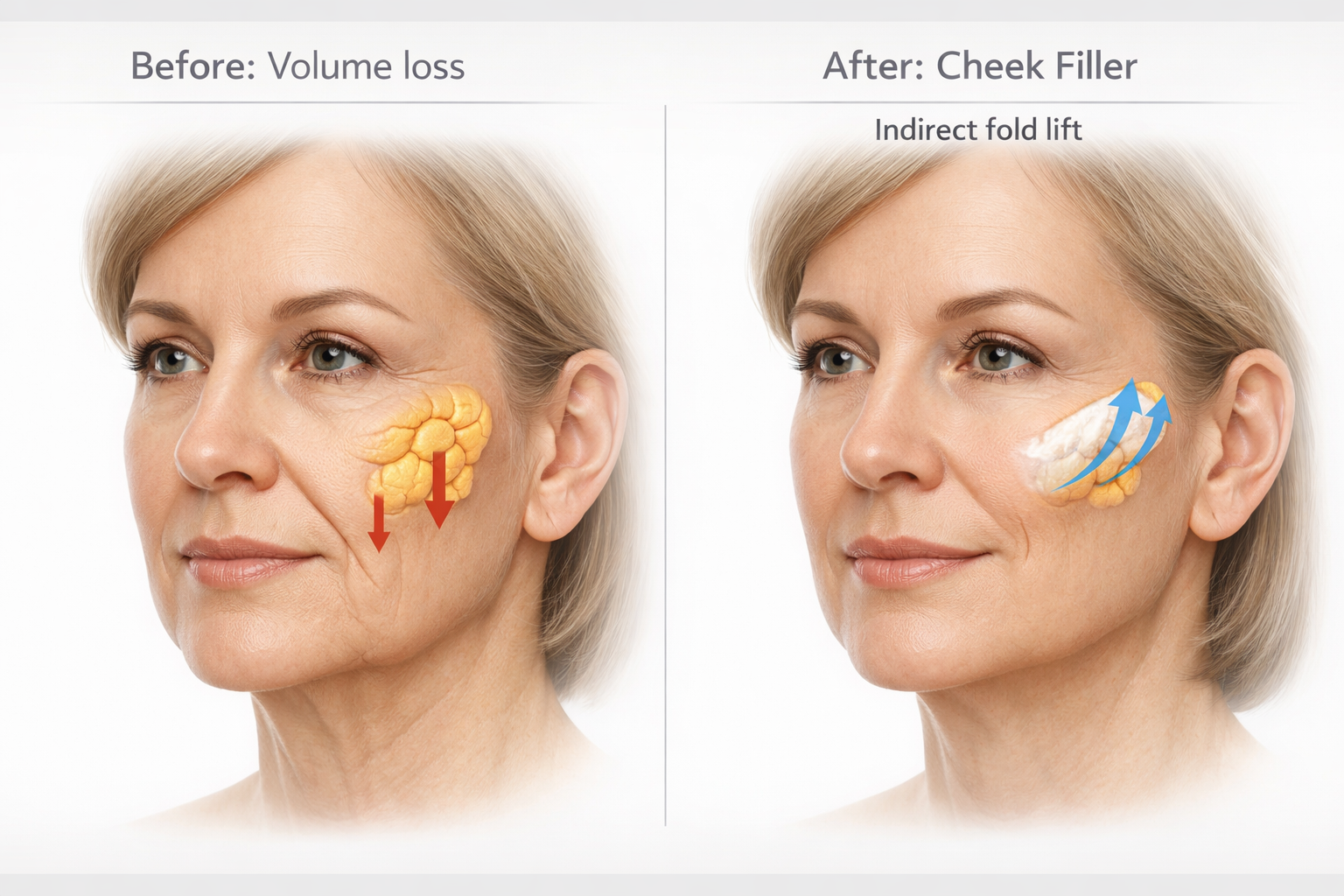
One of the most clinically important concepts in treating nasolabial folds is that placing filler directly into the fold is not always the most effective approach — and in some cases, it can produce an unnatural result if the underlying volume loss is not addressed first. The cheeks act as a structural support for the midface. When cheek volume is lost, the overlying tissue descends and the nasolabial fold deepens. Restoring volume to the cheeks with cheek filler can lift the midface tissue, reducing the depth of the fold indirectly and producing a more natural-looking result than fold-only treatment. Many practitioners use a combination of cheek filler and targeted nasolabial filler for moderate to deep folds, tailoring the approach to the individual’s anatomy.
Collagen-Stimulating Fillers
Unlike hyaluronic acid fillers, collagen-stimulating fillers work by triggering the body’s own collagen production rather than simply adding volume. Sculptra (poly-L-lactic acid) and Radiesse (calcium hydroxylapatite) are the two most established options in this category. Sculptra is injected in a series of sessions and gradually builds collagen over several months, with results that may last up to two years or longer. Radiesse provides immediate volume while also stimulating collagen production, with results typically lasting twelve to eighteen months. These options may be particularly suitable for patients with significant volume loss who want longer-lasting improvement and are comfortable with a gradual result.
Profhilo and Skin Remodelling Treatments
Profhilo is a high-concentration hyaluronic acid injectable that is not a traditional filler — it does not add structural volume but instead disperses through the tissue to hydrate, improve skin elasticity, and stimulate collagen and elastin production. It is typically delivered in two sessions four weeks apart and may be useful for patients whose nasolabial folds are driven primarily by skin quality and laxity rather than volume loss. Polynucleotides (PDRN) are an emerging injectable treatment that may also support skin remodelling and collagen stimulation, though the evidence base for this specific application is still developing.
Thread Lifts
PDO (polydioxanone) threads, PLLA threads, and Silhouette Soft threads are minimally invasive options that physically lift descended tissue while also stimulating collagen production as they dissolve. Thread lifts may be appropriate for patients with mild to moderate skin laxity and fat pad descent who want a lifting effect without surgery. Results typically last twelve to eighteen months. A published clinical study found that combining PDO threads with botulinum toxin produced improved outcomes compared with either treatment alone in patients with nasolabial folds, suggesting that combination approaches may offer advantages in selected cases.
Energy-Based Devices
High-intensity focused ultrasound (HIFU), marketed under names such as Ultherapy and Ultraformer III, uses focused ultrasound energy to heat the deep structural layer of the skin, stimulating collagen production and producing a gradual tightening effect. Radiofrequency devices such as Morpheus8 and Thermage work through a similar collagen-stimulating mechanism using radiofrequency energy, with Morpheus8 combining radiofrequency with microneedling for additional skin remodelling. These treatments are generally better suited to patients with mild to moderate skin laxity and are unlikely to produce significant improvement in deep folds on their own. Multiple sessions may be required, and results develop gradually over several months.
Laser Resurfacing and Skin Peels
Fractional laser resurfacing treatments such as Fraxel and Tixel can improve skin texture, stimulate collagen production, and soften fine lines in the perioral area. Chemical peels may also improve skin quality and reduce the appearance of superficial lines. These treatments address skin quality rather than volume or structural support, so they are most useful as part of a combination approach or for patients with mild folds and primarily textural concerns.
Botulinum Toxin
Botulinum toxin injections are not a primary treatment for nasolabial folds, as the folds are not caused by muscle overactivity in the same way as forehead lines or crow’s feet. However, small amounts of botulinum toxin may be used in the perioral area to relax muscles that pull downward on the corners of the mouth, which can complement filler treatment in some patients. This is a nuanced application that requires careful assessment by an experienced practitioner.
Treatment Comparison at a Glance
| Treatment | Mechanism | Typical Longevity | Downtime | Best Suited To |
|---|---|---|---|---|
| Hyaluronic acid dermal fillers | Direct volume replacement | 9–18 months | Minimal (1–3 days bruising/swelling) | Moderate to deep folds; reversible option |
| Cheek filler | Indirect midface lift via volume restoration | 12–18 months | Minimal | Folds driven by midface volume loss |
| Sculptra (PLLA) | Collagen stimulation | Up to 2+ years | Minimal | Significant volume loss; gradual result preferred |
| Radiesse (CaHA) | Immediate volume + collagen stimulation | 12–18 months | Minimal | Volume loss with desire for longer duration |
| Profhilo | Skin remodelling and hydration | 6–9 months | Minimal | Skin laxity and quality; mild folds |
| Thread lift (PDO/PLLA) | Mechanical lift + collagen stimulation | 12–18 months | Low to moderate (3–7 days) | Mild to moderate laxity; lifting effect desired |
| HIFU / Ultherapy | Deep collagen stimulation via focused ultrasound | 12–18 months | Minimal | Mild to moderate laxity; gradual tightening |
| Radiofrequency (Morpheus8) | Collagen stimulation via RF energy | 12–18 months | Low to moderate | Skin laxity and texture improvement |
| Facelift (surgical) | Tissue repositioning and excess skin removal | 5–10 years | Significant (2–4 weeks) | Deep folds with significant laxity |
Nasolabial Folds vs. Marionette Lines: What Is the Difference?
Nasolabial folds and marionette lines are frequently confused because they both affect the lower face and often develop together. Nasolabial folds run from the nostrils to the corners of the mouth, while marionette lines extend downward from the corners of the mouth toward the chin — creating the appearance of a puppet’s hinged jaw, which gives them their name. Both are driven by similar mechanisms: collagen and elastin loss, fat pad descent, and skin laxity. However, marionette lines are more strongly influenced by the downward pull of the depressor muscles around the mouth, which means botulinum toxin may play a more useful role in their treatment than it does for nasolabial folds. The two concerns are often addressed together as part of a lower-face rejuvenation plan.
Surgical Options
For patients with deep nasolabial folds accompanied by significant skin laxity and tissue descent, non-surgical treatments may produce limited improvement. In these cases, a surgical consultation may be appropriate. A facelift (rhytidectomy) repositions descended facial tissue and removes excess skin, addressing the structural causes of deep folds rather than simply filling them. A mid-face lift specifically targets the cheek and midface region. Fat grafting — transferring the patient’s own fat from another area of the body — can restore volume to the midface in a longer-lasting way than injectable fillers. Surgical options involve meaningful downtime, typically two to four weeks, and carry the risks associated with any surgical procedure. They are generally considered when non-surgical approaches have been insufficient or when the degree of laxity is beyond what injectables can reasonably address.
Skincare and Prevention
No topical skincare product can eliminate established nasolabial folds, but a consistent evidence-based routine may slow their progression and improve overall skin quality, which can make the folds appear less prominent.
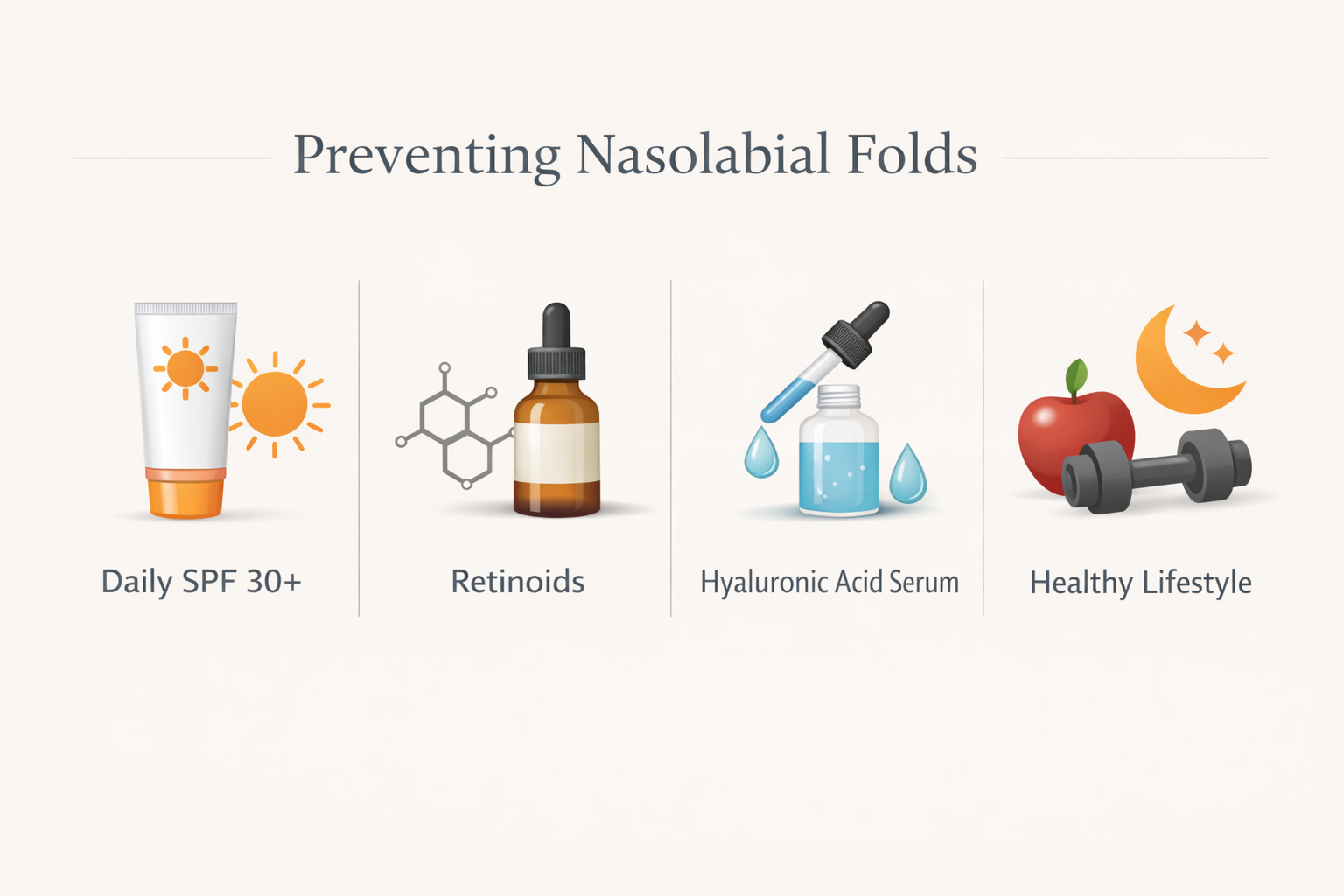
- Retinoids and tretinoin: Vitamin A derivatives are the most evidence-supported topical ingredients for stimulating collagen production and improving skin texture. Prescription-strength tretinoin produces the most significant results; over-the-counter retinol formulations are milder but still beneficial with consistent use.
- Broad-spectrum SPF: Daily use of a broad-spectrum sunscreen with SPF 30 or higher is one of the most effective ways to slow photoageing and protect existing collagen. This applies year-round, not only in summer.
- Hyaluronic acid serums: Topical hyaluronic acid helps maintain skin hydration and surface plumpness, which can temporarily soften the appearance of fine lines, though it does not penetrate deeply enough to address structural folds.
- Peptides and moisturisers: Peptide-containing moisturisers may support skin barrier function and provide mild collagen-signalling benefits, though the evidence for dramatic structural improvement is limited.
- Lifestyle factors: Not smoking, maintaining a stable weight, staying well hydrated, and eating a diet rich in antioxidants all support skin health over the long term.
Starting a preventative skincare routine in the late twenties or early thirties — before folds become static — is likely to be more effective than beginning later, though it is never too late to benefit from sun protection and retinoid use.
What to Expect from Treatment
For injectable treatments such as hyaluronic acid dermal fillers, the appointment typically begins with a consultation to assess facial anatomy, fold severity, and skin quality. A topical anaesthetic cream is usually applied before treatment to minimise discomfort. The injections themselves take between fifteen and thirty minutes depending on the areas treated. Some bruising, swelling, and redness at the injection sites is common and usually resolves within a few days. Results from hyaluronic acid fillers are visible immediately, though final results are best assessed after any swelling has settled — usually within one to two weeks.
Collagen-stimulating treatments such as Sculptra require a series of sessions, typically three to four spaced several weeks apart, with results developing gradually over three to six months. Energy-based treatments such as HIFU and radiofrequency microneedling also produce gradual results that continue to improve for up to three to six months after treatment. Thread lifts produce an immediate lifting effect that continues to improve as collagen is stimulated over the following weeks.
Maintenance sessions are typically needed to sustain results, as all non-surgical treatments are temporary. The frequency of maintenance depends on the treatment chosen, individual metabolism, and lifestyle factors such as sun exposure and smoking.
Frequently Asked Questions
Can fillers make nose to mouth lines look worse?
Poorly placed or excessive filler in the nasolabial fold can create an unnatural appearance — sometimes described as a sausage-like bulge — particularly if the underlying midface volume loss is not addressed at the same time. This is why experienced practitioners often treat the cheeks first to restore structural support before adding targeted filler to the fold itself. Choosing a qualified, medically trained practitioner significantly reduces this risk.
At what age do nasolabial folds typically become noticeable?
Most people begin to notice nasolabial folds becoming more prominent in their thirties, when collagen production starts to decline more noticeably and the first signs of fat pad descent appear. However, the timing varies considerably based on genetics, sun exposure history, smoking, and skin type. Some people in their late twenties notice early deepening, while others may not be concerned until their forties or fifties.
Is Botox or filler better for nose to mouth lines?
Dermal fillers are generally more effective than botulinum toxin for nasolabial folds. The folds are primarily caused by volume loss and tissue descent rather than muscle overactivity, so relaxing the muscles with botulinum toxin has limited direct impact on the fold itself. Botulinum toxin may be used as a complementary treatment in the perioral area in some cases, but it is not a standalone solution for nasolabial folds.
How long do results from nasolabial fold treatment last?
This depends on the treatment. Hyaluronic acid dermal fillers typically last nine to eighteen months. Collagen-stimulating fillers such as Sculptra may last two years or longer. Thread lifts and energy-based treatments generally last twelve to eighteen months. All non-surgical results are temporary, and maintenance sessions are needed to sustain improvement.
Can nose to mouth lines be prevented entirely?
Nasolabial folds are a natural part of facial ageing and cannot be prevented entirely. However, consistent sun protection, not smoking, maintaining a stable weight, and using evidence-based skincare ingredients such as retinoids from an early age may slow their progression. Starting preventative injectable treatments such as Profhilo or low-volume cheek filler before folds become deep may also help maintain a more youthful facial contour over time.
What is the difference between nasolabial folds and marionette lines?
Nasolabial folds run from the nostrils to the corners of the mouth. Marionette lines run downward from the corners of the mouth toward the chin. Both are caused by similar ageing mechanisms, but marionette lines are also influenced by downward-pulling muscles around the mouth, making botulinum toxin a more relevant treatment option for that area. The two concerns are often treated together.
Will treating nose to mouth lines look natural?
When treatment is tailored to the individual’s anatomy and the underlying cause of the fold is properly addressed, results can look very natural. The goal of a well-designed personalised treatment plan is to restore a rested, refreshed appearance rather than an obviously treated one. Overfilling or treating the fold in isolation without addressing midface volume loss is the most common reason results can look unnatural.
Choosing the Right Approach for Your Nose to Mouth Lines
Nose to mouth lines develop through a combination of collagen and elastin loss, fat pad descent, bone remodelling, and cumulative sun and lifestyle damage. Because multiple mechanisms are usually involved, the most effective treatment approach is one that is matched to the specific causes driving the fold in each individual — rather than a one-size-fits-all solution.
For mild folds, improving skin quality through retinoids, SPF, and treatments such as Profhilo may be sufficient. For moderate folds, hyaluronic acid dermal fillers — often combined with cheek filler to restore midface support — tend to produce the most natural-looking results. For deep folds with significant skin laxity, a combination approach involving fillers, collagen stimulation, and possibly energy-based devices may be appropriate, with surgical options worth discussing when non-surgical treatments have reached their limits.
A consultation with a qualified medical practitioner who can assess your facial anatomy, skin quality, and fold severity is the most reliable starting point. A personalised treatment plan developed from that assessment is far more likely to produce results that look balanced and appropriate for your face than any single treatment chosen without that context.