

A slimmer, more defined facial contour is one of the most common aesthetic goals — and today there are more non-surgical routes to achieve it than ever before. Whether your concern is a wide jawline caused by an enlarged masseter muscle, submental fat beneath the chin, general facial fullness, or simply a loss of definition with age, the right approach depends heavily on understanding what is actually driving the appearance you want to change. This guide covers the main clinical treatments, natural methods, realistic timelines, and the key questions to ask before booking a consultation.
Key Takeaways
- Non-surgical face slimming is not a single treatment — it is a category that includes injectables, energy-based devices, thread-based procedures, and lifestyle strategies, each targeting different causes of facial fullness.
- Masseter Botox, dermal fillers, HIFU, radiofrequency treatments, and PDO thread lifts are the most clinically established non-surgical options, with results that are temporary and require maintenance.
- No non-surgical treatment can spot-reduce facial fat in the way surgical liposuction can; overall body fat reduction through diet and exercise remains the most reliable way to reduce fat-related facial fullness.
- Realistic expectations and a thorough consultation with a qualified injector or board-certified provider are essential before choosing any treatment.
- A combination treatment approach — for example, masseter Botox paired with chin filler and a skin-tightening device — often produces more balanced results than any single procedure alone.
Why Faces Look Fuller: Understanding the Cause First
Most guides jump straight to treatment lists, but identifying the underlying cause of facial fullness is the most important step. The same face can look wide or heavy for very different anatomical reasons, and the wrong treatment will produce little visible change.
Masseter muscle hypertrophy is one of the most common and underrecognised causes of a square or wide lower face. The masseter is the large chewing muscle that sits at the angle of the jaw. In some people — particularly those who grind their teeth (bruxism) or clench habitually — this muscle enlarges over time, creating a broad, angular jawline that has nothing to do with fat or bone structure.
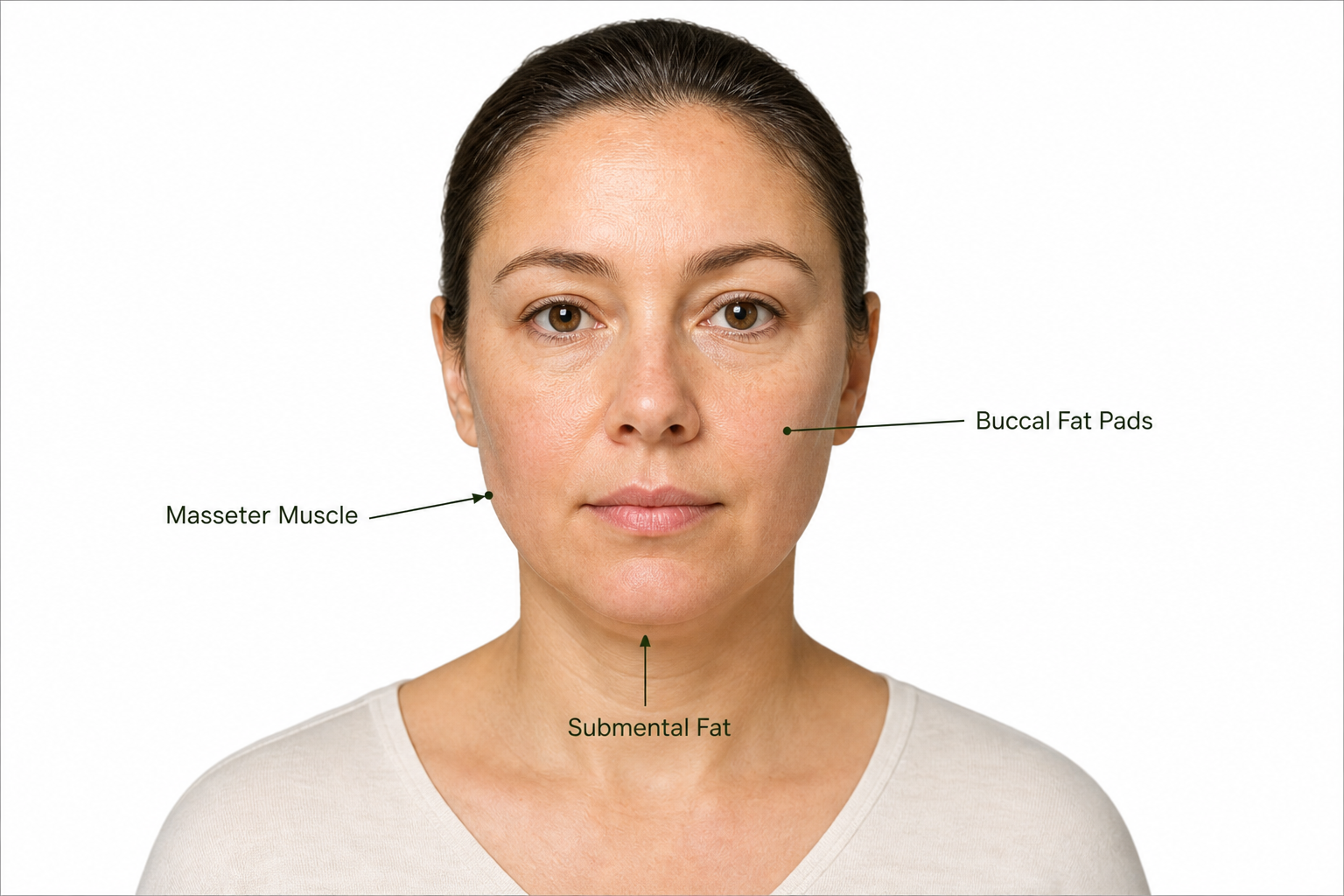
Submental fat — the layer of fat beneath the chin — is largely genetic and does not always correlate with overall body weight. It can create the appearance of a double chin or a less defined jaw-to-neck transition even in people who are otherwise lean.
Buccal fat pads sit deep in the mid-cheek and contribute to rounded, full cheeks. Their prominence is primarily genetic and tends to reduce naturally with age, which is why surgical buccal fat removal has become more controversial in recent years.
Water retention and facial puffiness can make the face appear significantly fuller, particularly in the morning or after high-sodium meals, alcohol, or poor sleep. This type of fullness is temporary and responds well to lifestyle changes rather than clinical procedures.
Skin laxity and volume redistribution with age can cause the face to look heavier even as overall volume is lost, because tissue descends rather than sitting in its original position. This is a different problem from excess fat and calls for lifting or repositioning rather than reduction.
Understanding which of these factors — or which combination — applies to you is the starting point for any sensible treatment plan.
Clinical Non-Surgical Treatments for Face Slimming
Masseter Botox for Jaw Slimming
Botulinum toxin injected into the masseter muscle is one of the most effective and well-evidenced non-surgical face slimming treatments available. When a neuromodulator is injected into an enlarged masseter, it temporarily reduces the muscle’s ability to contract with full force. Over several weeks, the muscle gradually reduces in bulk, softening the angle of the jaw and creating a narrower, more tapered lower face — often described as a V-shape facial contouring effect.
Masseter muscle reduction with botulinum toxin typically shows initial softening at one to two weeks, with the most visible change at four to eight weeks as the muscle gradually atrophies. Results generally last three to six months, after which the muscle slowly returns to its previous size if treatment is not repeated. With consistent maintenance over one to two years, some patients find they need less frequent top-ups as the muscle adapts.
Masseter Botox also has a functional benefit for people with bruxism or TMJ-related jaw tension, making it one of the few aesthetic treatments that can address both appearance and discomfort simultaneously. Risks include temporary asymmetry, difficulty chewing very hard foods in the first few weeks, and — rarely — unintended spread to adjacent muscles affecting the smile. These effects are temporary and resolve as the neuromodulator wears off. Treatment should only be performed by a qualified injector with experience in facial anatomy.
Kybella and Deoxycholic Acid for Double Chin
Kybella (deoxycholic acid) is an FDA-approved injectable treatment designed to reduce submental fat — the fat pad beneath the chin. Deoxycholic acid is a naturally occurring molecule that disrupts fat cell membranes, causing them to break down and be cleared by the body over several weeks. Unlike masseter Botox, which targets muscle, Kybella directly addresses fat tissue.
Most patients require two to four treatment sessions spaced at least four weeks apart to achieve meaningful reduction. Swelling after each session can be significant and may last one to two weeks, which is an important practical consideration. Results, once achieved, are considered long-lasting because the destroyed fat cells do not regenerate — though weight gain can still cause remaining fat cells to enlarge. Kybella is not suitable for patients with significant skin laxity in the submental area, as reducing the fat volume without addressing loose skin can worsen the appearance of sagging.
Dermal Fillers for Jawline Contouring
Hyaluronic acid filler injected along the jawline does not reduce facial width directly, but it reshapes facial proportions in a way that creates the visual impression of a slimmer, more defined face. By adding structure to the chin and jaw angle, a skilled practitioner can elongate the lower face, improve the jaw-to-neck transition, and create a more balanced profile — all without removing any tissue.
Hyaluronic acid fillers such as Juvederm Voluma and Restylane are the most commonly used products for this purpose. Results are visible immediately and typically last twelve to eighteen months depending on the product, the area treated, and individual metabolism. The main risks include bruising, swelling, asymmetry, and — in rare cases — vascular complications, which is why injections in this area should only be performed by an experienced, board-certified provider familiar with the vascular anatomy of the jaw and chin.
Chin filler is frequently combined with masseter Botox as part of a combination treatment approach: reducing the width of the jaw while simultaneously adding projection to the chin creates a more pronounced V-shape effect than either treatment achieves alone.
HIFU and Ultherapy for Skin Tightening
High-Intensity Focused Ultrasound (HIFU), marketed under brand names including Ultherapy, delivers focused ultrasound energy to the SMAS layer — the same tissue layer addressed in surgical facelifts. This thermal energy stimulates collagen production and collagen remodeling over the following months, gradually tightening lax skin and lifting soft tissue.
HIFU does not reduce fat or muscle bulk, but it can meaningfully improve skin laxity along the jawline and under the chin, making it a useful complement to other face slimming treatments. Results develop gradually over two to six months as new collagen forms, and a single session may provide improvement lasting twelve to eighteen months. Some patients benefit from annual maintenance. HIFU is generally better suited to patients with mild to moderate skin laxity rather than significant tissue descent, and it is not a substitute for surgical lifting in cases of advanced laxity.
Radiofrequency Treatments
Radiofrequency (RF) therapy uses controlled heat energy to stimulate collagen stimulation and skin tightening in the dermis and deeper tissue layers. Devices such as Morpheus8 combine RF energy with microneedling to deliver heat at precise depths, targeting both skin quality and mild fat remodeling in the submental and jowl areas. FaceTite is a more intensive RF treatment that uses internal and external electrodes for greater tissue contraction, though it sits at the boundary between non-surgical and minimally invasive.
RF treatments are generally well tolerated with manageable downtime — Morpheus8 typically involves two to five days of redness and mild swelling. Multiple sessions are usually recommended for optimal results, and collagen remodeling continues for several months after treatment. RF microneedling is particularly useful for patients who want to address both skin texture and mild facial laxity in a single treatment category.
PDO Thread Lifts for Facial Definition
A PDO thread lift uses fine polydioxanone threads — the same absorbable material used in surgical sutures — inserted beneath the skin to mechanically reposition tissue and stimulate collagen production as the threads dissolve. Barbed PDO threads can provide an immediate lifting effect along the jawline and mid-face, while smooth threads are used primarily for collagen stimulation rather than mechanical lift.
PDO thread lifts offer a middle ground between energy-based devices and surgery. Results are visible immediately and improve further over two to three months as collagen forms around the threads. The threads themselves dissolve within four to six months, but the collagen response they trigger can maintain some improvement for twelve to eighteen months. Risks include thread visibility or palpability, asymmetry, dimpling, and infection — all of which are more likely if the procedure is performed by an inexperienced practitioner. A PDO thread lift is not a replacement for a surgical facelift in patients with significant tissue laxity, but it can provide meaningful definition for those with early to moderate changes.
Non-Surgical Face Slimming: Treatment Comparison
| Treatment | Primary Target | Onset | Peak Results | Duration | Downtime | Best Suited For |
|---|---|---|---|---|---|---|
| Masseter Botox | Masseter muscle bulk | 1–2 weeks | 4–8 weeks | 3–6 months | Minimal | Wide/square jaw from muscle hypertrophy |
| Kybella / Deoxycholic Acid | Submental fat | 4–6 weeks per session | After 2–4 sessions | Long-lasting | 1–2 weeks swelling per session | Double chin, submental fat |
| Hyaluronic Acid Filler | Facial proportions / structure | Immediate | Immediate | 12–18 months | Minimal (bruising possible) | Undefined jawline, weak chin projection |
| HIFU / Ultherapy | Skin laxity, SMAS layer | 2–3 months | 3–6 months | 12–18 months | Minimal | Mild to moderate skin laxity, jowling |
| RF / Morpheus8 | Skin quality, mild fat remodeling | 4–8 weeks | 3–6 months | 12–18 months | 2–5 days | Skin laxity, texture, submental area |
| PDO Thread Lift | Tissue position, collagen | Immediate lift | 2–3 months | 12–18 months | 3–7 days | Early to moderate jowling, jawline definition |
Natural Methods for a Slimmer-Looking Face
Lifestyle approaches will not replicate the results of clinical treatments, but they are genuinely useful — particularly for people whose facial fullness is driven by water retention, overall body fat, or habits that cause facial puffiness. It is important to be clear that spot reduction of facial fat through exercise is a myth: you cannot target fat loss in the face specifically through facial exercises or any other localised technique.

Overall Body Fat Reduction
The most reliable way to reduce fat-related facial fullness is overall body fat reduction through a sustained calorie deficit, regular cardiovascular exercise, and strength training. As body fat percentage decreases, the face typically becomes leaner alongside the rest of the body. The degree to which this affects the face varies significantly between individuals and is largely determined by genetics and fat distribution patterns.
Reducing Water Retention and Facial Puffiness
High sodium intake causes the body to retain water, which can make the face appear noticeably puffier — particularly in the morning. Reducing processed food and salt intake, staying well hydrated, limiting alcohol, and improving sleep quality can all reduce water retention and facial puffiness within days. These changes are not permanent structural alterations, but they can make a meaningful difference to how the face looks day to day.
Facial Massage and Gua Sha
Facial massage and gua sha — a technique using a smooth stone tool to apply pressure along facial contours — are widely used to temporarily reduce puffiness by encouraging lymphatic drainage. The evidence for lasting structural change is limited, but regular use may help reduce morning swelling and improve circulation. These techniques are low-risk when performed correctly and can complement clinical treatments during recovery periods.
Facial Exercises
Facial exercises and face yoga are popular, but the evidence for meaningful structural change is modest. Some small studies suggest that consistent facial exercise may improve muscle tone and contribute to a slightly more lifted appearance over several months, but the effect size is unlikely to match clinical treatments. Facial exercises are unlikely to cause harm and may be worth incorporating as a low-cost adjunct, but they should not be expected to slim the face in the way that masseter Botox or fat-reduction treatments can.
Combining Treatments for Better Results
A combination treatment approach is increasingly recognised as the most effective strategy for meaningful facial contouring. Individual treatments address single concerns; combining them allows a practitioner to reshape multiple aspects of facial structure simultaneously.
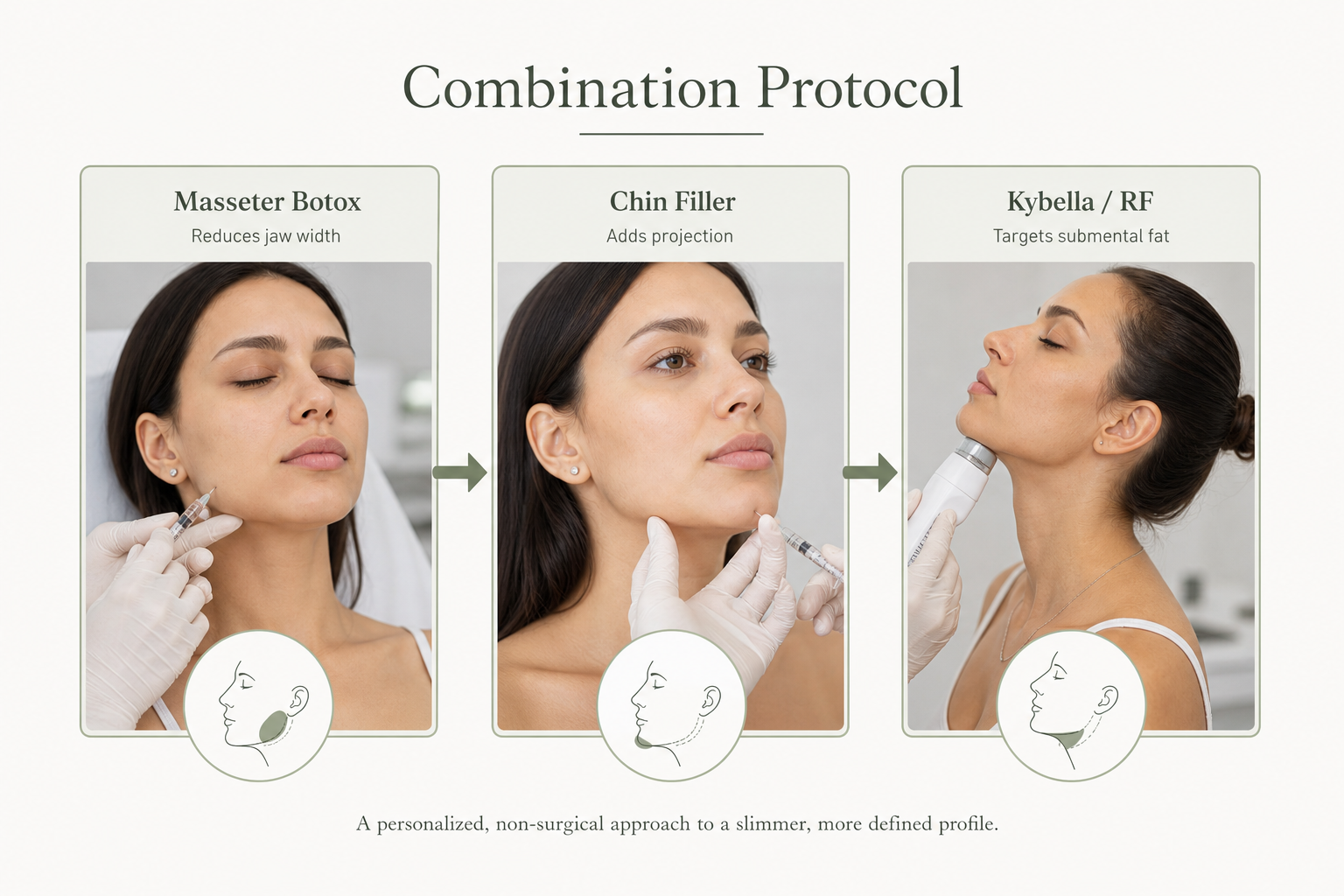
A practical example: a patient with a wide lower face due to masseter hypertrophy, a weak chin, and mild submental fat might benefit from masseter Botox to reduce jaw width, chin filler to improve projection and elongate the lower face, and a course of Kybella or RF treatment to address the submental area. The result is a more balanced, defined profile that no single treatment could achieve alone.
Similarly, a patient with early jowling and skin laxity might combine a PDO thread lift for immediate mechanical repositioning with HIFU or RF treatment to stimulate longer-term collagen production — addressing both the immediate appearance and the underlying tissue quality.
Combination protocols should always be planned by an experienced practitioner who can assess facial anatomy, prioritise treatments, and space sessions appropriately to allow recovery and avoid over-treatment.
Risks, Limitations, and What Can Go Wrong
Every non-surgical treatment carries some risk, and it is important to understand these before proceeding. The most common risks across injectable and device-based treatments include bruising, swelling, temporary asymmetry, and discomfort during or after the procedure. These are generally mild and resolve within days to weeks.
More specific risks worth understanding include: masseter Botox can occasionally cause temporary difficulty chewing firm foods or a subtle change in smile appearance if the neuromodulator spreads to adjacent muscles — both effects resolve as the product wears off. Dermal filler carries a small but serious risk of vascular occlusion if injected near a blood vessel, which is why practitioner selection and emergency preparedness matter significantly. PDO threads can occasionally become visible or palpable under the skin, particularly in patients with thin skin. Kybella injections in the submental area can cause significant swelling and, rarely, temporary numbness or nerve effects.
Choosing a qualified injector or board-certified provider with specific experience in facial anatomy is the single most important factor in minimising risk across all of these treatments. A thorough consultation should include a discussion of your medical history, current medications, previous procedures, and any contraindications relevant to the specific treatment being considered.
Planning Your Treatment Maintenance Schedule
Non-surgical face slimming treatments are not permanent. Understanding the treatment maintenance schedule before you begin helps you plan realistically — both financially and practically.
Masseter Botox typically requires repeat treatment every three to six months initially, though some patients find the interval extends with consistent treatment as the muscle adapts. Dermal fillers in the jawline and chin usually need topping up every twelve to eighteen months. HIFU and RF treatments are often performed annually or as needed based on how the skin responds. PDO thread lifts may be repeated every twelve to eighteen months.
A realistic maintenance plan over twelve to twenty-four months — including the cost of repeat sessions — should be part of any initial consultation discussion. Before and after results from a single treatment cycle can be impressive, but maintaining those results requires ongoing commitment.
Frequently Asked Questions
Can you spot-reduce fat in the face without surgery?
No. Spot reduction of facial fat through exercise or topical products is not supported by evidence. The most reliable way to reduce fat-related facial fullness is overall body fat reduction. Clinical treatments such as Kybella can destroy submental fat cells in a targeted area, but this is a medical procedure rather than spot reduction in the traditional sense.
Is masseter Botox permanent?
No. Masseter Botox is temporary. The neuromodulator wears off over three to six months, and the masseter muscle gradually returns to its previous size if treatment is not maintained. With consistent repeat treatments over one to two years, some patients experience a degree of lasting muscle reduction, but this varies between individuals and is not guaranteed.
How many sessions of Kybella are needed to see results?
Most patients require two to four sessions of deoxycholic acid injections spaced at least four weeks apart. Some patients with more significant submental fat may need up to six sessions. Results develop gradually over several weeks after each session as the body clears the treated fat cells.
What is the difference between HIFU and radiofrequency for face slimming?
Both HIFU and radiofrequency use heat energy to stimulate collagen production and improve skin laxity, but they work at different tissue depths and through different mechanisms. HIFU delivers focused ultrasound energy to the SMAS layer deep beneath the skin, making it particularly useful for lifting. Radiofrequency treatments like Morpheus8 work primarily in the dermis and superficial fat layer, addressing skin quality and mild tissue remodeling. The best choice depends on the specific concern and the depth of tissue change required.
Can I combine masseter Botox with dermal fillers at the same appointment?
In many cases, yes — combining masseter Botox with chin or jawline filler at the same appointment is a common and practical approach. However, the suitability of same-day combination treatments depends on the individual patient, the products being used, and the practitioner’s assessment. Your provider will advise on the safest and most effective sequencing for your specific plan.
Who is not suitable for non-surgical face slimming treatments?
Suitability varies by treatment. Generally, botulinum toxin and dermal fillers are not recommended during pregnancy or breastfeeding. Patients with certain neuromuscular conditions, active skin infections, or known allergies to treatment components may not be suitable candidates. HIFU and RF devices may be contraindicated in patients with implanted metal devices or pacemakers in the treatment area. A full medical history review at consultation is essential before any procedure.
Choosing the Right Non-Surgical Face Slimming Approach
The most important insight from reviewing the full range of non-surgical face slimming options is that there is no single best treatment — only the treatment that best matches the underlying cause of your concern, your anatomy, your goals, and your tolerance for downtime and maintenance.
If a wide jaw is caused by masseter muscle hypertrophy, neuromodulator injections are the most direct and well-evidenced solution. If the concern is submental fat, deoxycholic acid injections or RF-based treatments may be more appropriate. If the face looks heavy due to poor definition rather than excess tissue, strategic use of hyaluronic acid filler to reshape facial proportions may achieve more than any reduction-based treatment. If skin laxity is the primary issue, HIFU, RF, or a PDO thread lift may be the most relevant starting point.
For many patients, a combination treatment approach — planned carefully by an experienced practitioner — will produce the most balanced and natural-looking outcome. Realistic expectations are essential: non-surgical treatments can create meaningful, visible improvement, but they work within the limits of what is anatomically possible without surgery, and all require ongoing maintenance to sustain results.
If you are considering any of these treatments, a consultation with a qualified injector or board-certified aesthetic provider is the right first step. A thorough assessment of your facial anatomy, skin quality, and goals will allow a practitioner to recommend the most appropriate approach — or combination of approaches — for your specific situation.