

Lip shapes vary considerably from person to person, and understanding your natural lip anatomy is one of the most important factors in planning any enhancement treatment. Whether you are considering dermal filler for the first time or reassessing a previous result, knowing how different lip proportions respond to treatment can help you set realistic expectations and have a more productive conversation with your practitioner.
Key Takeaways
- Natural lip shape, including the ratio of upper to lower lip, the definition of the cupid’s bow, and the degree of lip border visibility, directly influences how filler is planned and placed.
- Hyaluronic acid filler is the most widely used option for lip enhancement and can be dissolved if the result is unsatisfactory.
- Enhancement can add volume, improve symmetry, define the lip border, or subtly reshape the lip, but results depend heavily on individual anatomy and practitioner technique.
- Swelling after lip filler is normal and the final result is typically visible after one to two weeks.
- A thorough consultation, including an assessment of your lip shape and facial proportions, is essential before any treatment.
Understanding Natural Lip Shapes
Lips are described using several anatomical landmarks that practitioners assess before planning any enhancement. The cupid’s bow refers to the double curve at the centre of the upper lip border, named for its resemblance to the bow of Cupid. The philtrum columns are the two vertical ridges running from the base of the nose to the peaks of the cupid’s bow, and their prominence influences how defined the upper lip appears. The vermilion border is the edge where the coloured lip tissue meets the surrounding skin, and its clarity affects how sharp or soft the lip looks. The tubercles are the three subtle projections along the lower lip that give it a natural fullness.
Common natural lip shapes include lips with a pronounced cupid’s bow and relatively thin body, lips with a fuller lower lip and less defined upper border, lips that are relatively even in upper and lower volume, and lips where the corners turn slightly downward. Some people have lips that appear to thin with age as collagen and fat diminish, while others have always had naturally thin or asymmetric lips. None of these variations is a medical concern, but each one responds differently to enhancement techniques, which is why a practitioner’s assessment of your specific anatomy matters more than a generic treatment plan.
How Lip Shape Influences Enhancement Planning
Practitioners typically assess the ratio of upper to lower lip volume before recommending a treatment approach. A commonly referenced aesthetic guideline suggests that the lower lip is often slightly fuller than the upper lip, though this varies across different facial structures and aesthetic preferences. Attempting to significantly alter a naturally established ratio can sometimes produce results that look disproportionate or unnatural, so experienced practitioners tend to work with existing anatomy rather than against it.
The definition of the cupid’s bow is another key consideration. Some patients want a more pronounced cupid’s bow, which can be achieved by placing filler precisely along the vermilion border at the peaks. Others prefer a softer, more rounded upper lip silhouette, which requires a different placement approach. Lip border definition, sometimes called lip liner effect, is a distinct goal from adding overall volume, and the two are not always achieved simultaneously with the same technique.
Lip symmetry is also commonly addressed during enhancement. Minor natural asymmetries are extremely common and can often be partially corrected by placing slightly more product on one side. However, significant anatomical asymmetry may have structural causes that filler alone cannot fully address, and a practitioner should explain what is realistically achievable during the consultation.
Dermal Filler for Lip Enhancement: How It Works
Hyaluronic acid filler is the most commonly used product for lip enhancement. Hyaluronic acid is a naturally occurring substance found in connective tissue throughout the body, and when used as a filler it attracts water molecules, adding volume and hydration to the treated area. Most lip fillers are formulated with a cross-linked hyaluronic acid gel, meaning the molecules are chemically bonded to create a more stable structure that resists breakdown. Different formulations vary in their firmness, elasticity, and how they integrate with lip tissue, and practitioners select products based on the specific goal, whether that is adding body volume, defining the border, or improving overall hydration and texture.
The treatment itself typically involves applying a topical anaesthetic cream to the lips before injection. Many lip filler products also contain lidocaine, a local anaesthetic, within the formulation, which helps reduce discomfort during the procedure. Injections are placed at specific points along the lip border, within the body of the lip, or at the philtrum columns depending on the treatment plan. The appointment usually takes between thirty and sixty minutes including preparation time, though the injection process itself is often considerably shorter.
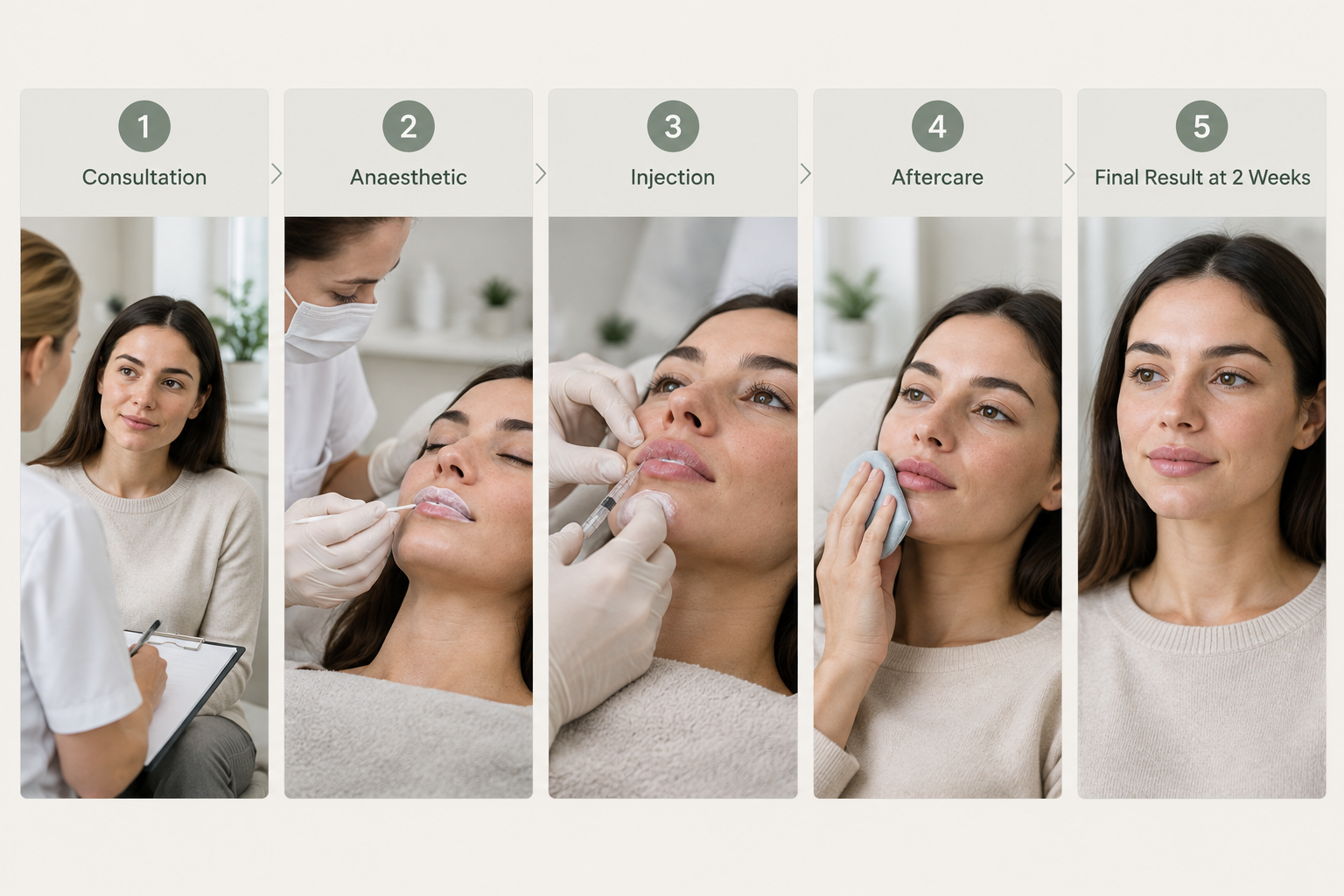
Because hyaluronic acid filler can be dissolved using an enzyme called hyaluronidase, it is considered a reversible treatment. This is a meaningful safety consideration for patients who are uncertain about the outcome or who have had unsatisfactory results previously. Dissolution is not always complete in a single session and should be performed by a qualified practitioner.
What Lip Enhancement Can and Cannot Achieve
Lip filler can realistically add volume to thin lips, improve the definition of the vermilion border, subtly enhance the cupid’s bow, reduce the appearance of fine lines around the mouth, and address minor asymmetries. When performed by an experienced practitioner using an appropriate product and quantity, results can look natural and proportionate to the rest of the face.
There are meaningful limitations to be aware of. Filler cannot permanently change the underlying structure of the lip or the surrounding muscles. It cannot correct significant anatomical asymmetry caused by muscle imbalance or skeletal differences. Overfilling, or placing more product than the lip tissue can accommodate naturally, can result in a stretched or unnatural appearance, sometimes described as the duck lip effect, which occurs when the upper lip is disproportionately projected forward. This outcome is associated with excessive volume rather than with lip filler as a category, and it underlines the importance of conservative treatment planning.
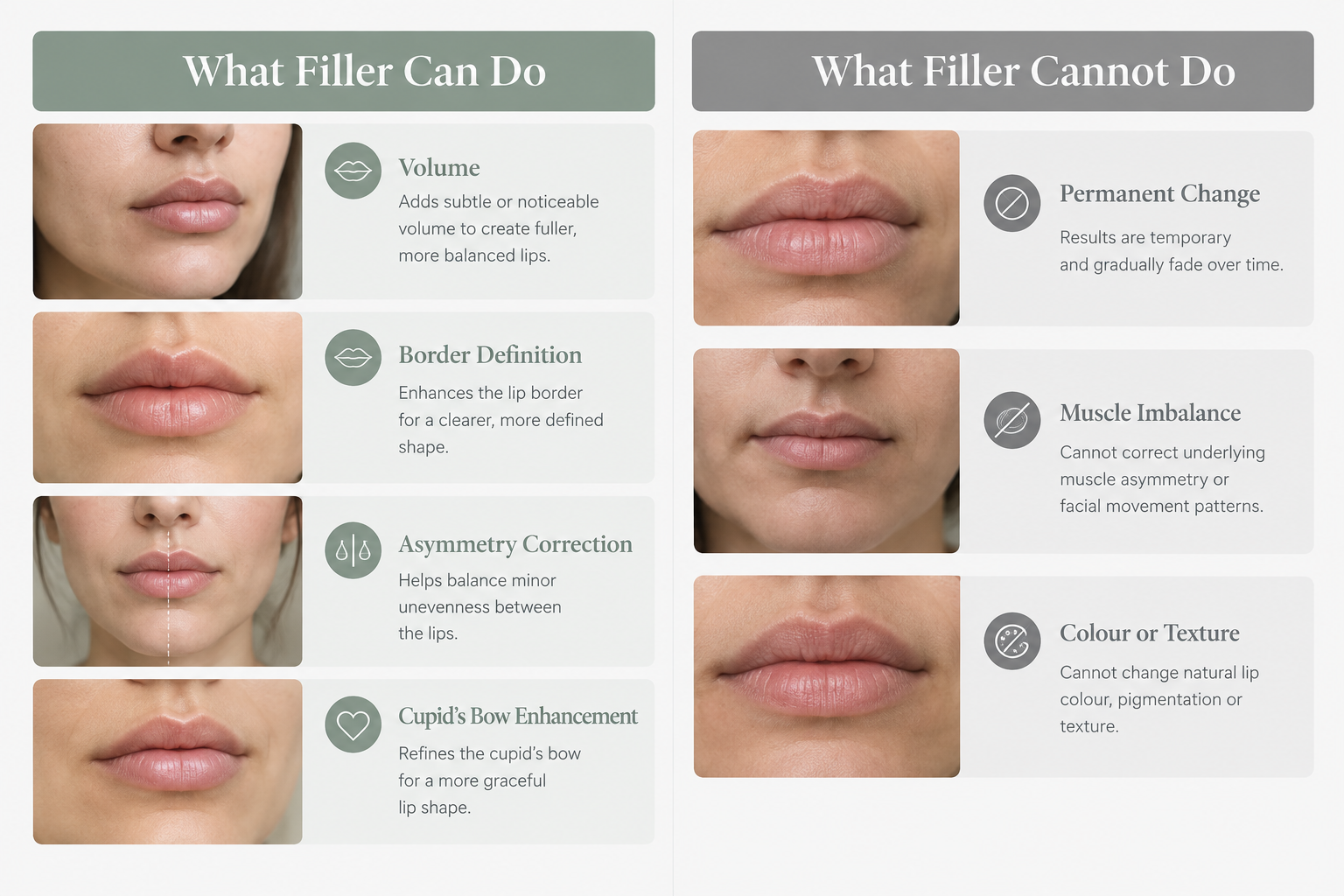
Lip filler also does not address concerns related to lip colour, surface texture, or perioral lines caused by repeated muscle movement. Some patients with significant perioral lines may benefit from a combination approach that includes botulinum toxin treatment to reduce muscle activity around the mouth, though this requires careful assessment as it can affect speech and oral function if not placed appropriately.
Popular Lip Shape Goals and How They Are Approached
Patients often describe their goals using reference images or specific terms, and understanding what these goals involve clinically helps set realistic expectations.
Adding Overall Volume
Patients seeking fuller lips overall typically want volume added to both the upper and lower lip body. This is usually achieved by placing filler within the wet-dry border and the body of the lip itself. The amount of product used is guided by the existing lip size, the degree of change desired, and the practitioner’s assessment of what will remain proportionate. Starting conservatively and building volume across more than one appointment is a common approach, particularly for patients new to lip filler.
Defining the Lip Border
Some patients have naturally soft or indistinct lip borders and want more definition without necessarily adding significant volume. Border definition is achieved by placing small amounts of filler precisely along the vermilion border, which can make the lip appear more structured and can also create the impression of a slightly fuller lip without dramatically increasing its size. This approach is often suitable for patients who want a subtle result.
Enhancing the Cupid’s Bow
Enhancing the cupid’s bow involves placing filler at the two peaks of the upper lip border to make the characteristic double curve more pronounced. This can give the upper lip a more defined and aesthetically prominent shape. The degree of enhancement possible depends on the existing anatomy; patients with a naturally flat or poorly defined upper lip border may see a more noticeable change than those who already have a well-defined cupid’s bow.
Addressing Lip Asymmetry
Mild lip asymmetry is extremely common and can often be partially improved with careful filler placement. Practitioners assess whether the asymmetry is in the border, the volume, or the position of the cupid’s bow peaks, and plan placement accordingly. Patients should be aware that perfect symmetry is rarely achievable and that some degree of natural variation is normal and expected.
Lifting Downturned Corners
Downturned lip corners can contribute to a resting expression that appears sad or stern. Filler placed at the oral commissures, the corners of the mouth, can provide a subtle lift. In some cases, a small amount of botulinum toxin injected into the depressor anguli oris muscle, which pulls the corners downward, may be used alongside or instead of filler. This combination approach requires careful assessment and precise technique.
Risks and Side Effects
Lip filler carries a range of possible side effects and risks that patients should understand before proceeding. Common and expected side effects include swelling, bruising, tenderness, and redness at the injection sites. These typically resolve within one to two weeks, though swelling in the lip area can be more pronounced than in other facial areas due to the lip’s vascular supply and tissue characteristics. The final result should not be assessed until swelling has fully resolved.
Less common but more serious risks include infection, nodule formation, and vascular occlusion. Vascular occlusion occurs when filler is inadvertently injected into or compresses a blood vessel, potentially restricting blood flow to surrounding tissue. This is a rare but serious complication that requires immediate treatment. Choosing a qualified and experienced practitioner who is trained to recognise and manage complications is an important safety consideration. Patients should ask about the practitioner’s training, their approach to complication management, and whether hyaluronidase is available on-site.
Tyndall effect, a bluish discolouration visible through the skin, can occur if filler is placed too superficially. Filler migration, where product moves away from the intended area over time, can also occur, particularly with repeated treatments or excessive volumes. Allergic reactions are rare with hyaluronic acid products but are possible.
How Long Lip Filler Results Last
Lip filler longevity varies between individuals and depends on the specific product used, the volume placed, the patient’s metabolism, and lifestyle factors. Most hyaluronic acid lip fillers last between six and twelve months, though some patients find results persist longer and others notice a more rapid breakdown. The lips are a highly mobile area of the face, and repeated movement may contribute to faster product breakdown compared with less mobile areas such as the cheeks.
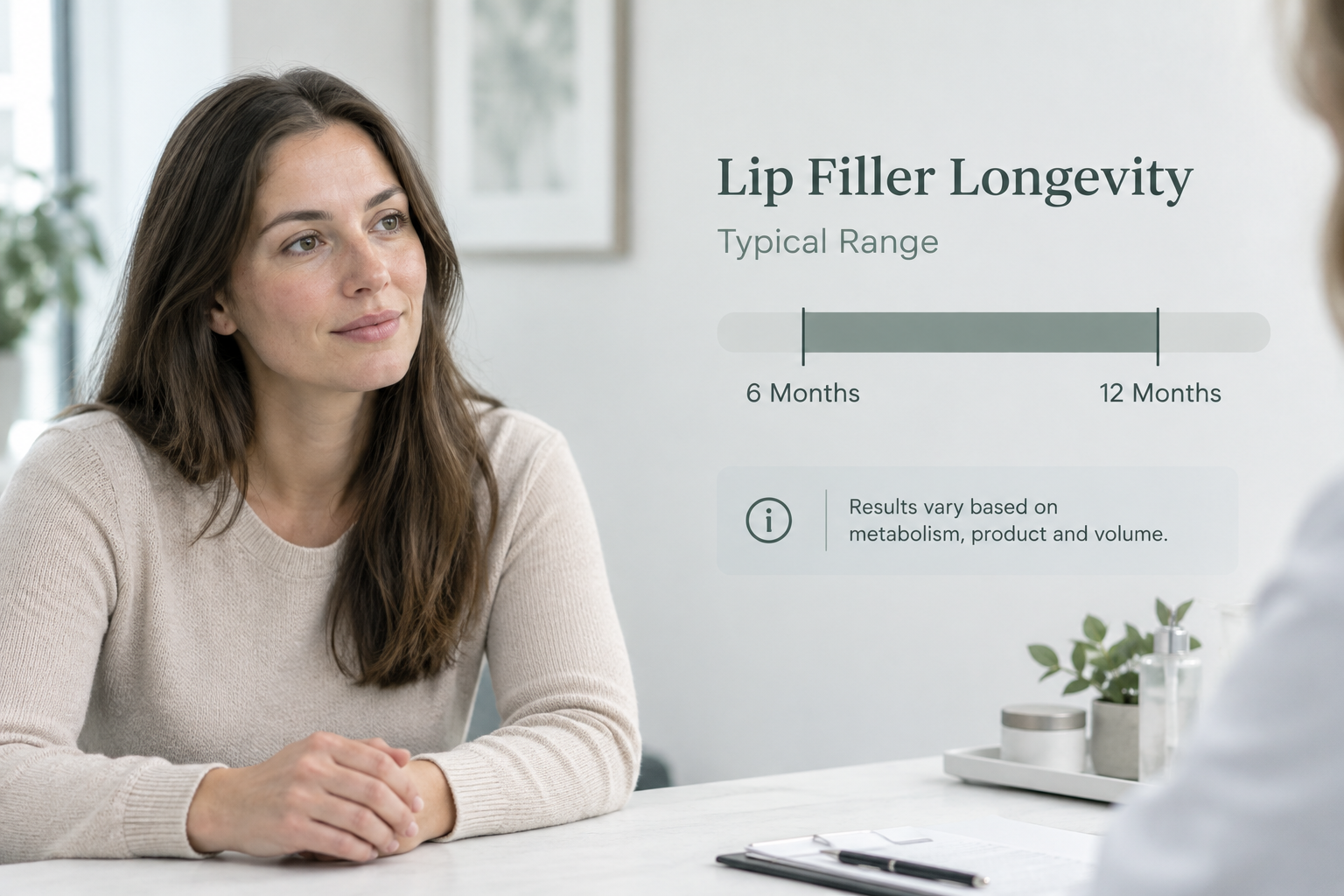
Maintenance treatments are typically required to sustain results. Some practitioners recommend waiting until the filler has substantially broken down before retreating, while others suggest top-up appointments before the product is fully gone. The appropriate interval depends on the individual’s response and goals, and this is best discussed during follow-up appointments.
Who May Be Suitable for Lip Enhancement
Lip filler may be suitable for adults who are in good general health, have realistic expectations about what the treatment can achieve, and have discussed their goals thoroughly with a qualified practitioner. Patients who are pregnant or breastfeeding are generally advised to postpone elective cosmetic treatments. Those with active infections, cold sores, or inflammatory skin conditions affecting the lip area should wait until these have resolved before treatment.
Patients with certain autoimmune conditions, bleeding disorders, or those taking blood-thinning medications may face a higher risk of bruising or other complications and should disclose their full medical history during consultation. A history of cold sores is relevant because the trauma of injection can trigger a herpes simplex outbreak; practitioners may recommend antiviral prophylaxis in these cases.
Patients who have had permanent lip filler in the past should inform their practitioner, as hyaluronic acid filler behaves differently in tissue that already contains non-dissolvable product. A thorough consultation should include a review of any previous lip treatments.
Alternatives to Lip Filler
For patients who are not ready for injectable treatment or who are looking for less invasive options, several alternatives exist, though their effects are generally more limited.
Lip flip is a technique using a small amount of botulinum toxin injected into the orbicularis oris muscle at the upper lip border. This relaxes the muscle slightly, allowing the upper lip to roll outward and appear slightly fuller. The effect is subtle and temporary, lasting approximately six to eight weeks, and it does not add volume. It may be suitable for patients who want a minor change or who want to trial a subtle enhancement before committing to filler.
Profhilo and similar injectable moisturisers containing high concentrations of hyaluronic acid can improve lip hydration and skin quality around the mouth but do not add structural volume in the same way as traditional filler. These treatments may be appropriate for patients whose primary concern is lip texture or fine perioral lines rather than shape or volume.
Topical lip plumpers containing ingredients such as peptides or mild irritants like cinnamon or capsaicin can create a temporary appearance of fullness through mild swelling or increased blood flow, but their effects are transient and cosmetic rather than structural.
Frequently Asked Questions
How much filler is typically used for lip enhancement?
The amount of filler used varies depending on the patient’s existing lip size, the degree of change desired, and the practitioner’s assessment. Many practitioners start with a conservative amount, often around 0.5 to 1 millilitre, and recommend building volume gradually across more than one appointment. Using excessive amounts in a single session increases the risk of an unnatural result and complications.
Will lip filler change my natural lip shape permanently?
Hyaluronic acid lip filler is not permanent. It breaks down over time and the lips return to their natural shape. Repeated treatments over many years may have a cumulative effect on the surrounding tissue, but this is not the same as a permanent structural change. If you are unhappy with the result, the filler can be dissolved using hyaluronidase.
Does lip filler hurt?
Most patients experience some discomfort during lip filler treatment. Topical anaesthetic cream is usually applied beforehand, and many filler products contain lidocaine to reduce discomfort during injection. The lips are a sensitive area and some patients find the treatment more uncomfortable than other facial areas. Discomfort is generally manageable and brief.
Can lip filler correct a very asymmetric lip?
Filler can partially improve mild to moderate lip asymmetry by adjusting volume distribution. Significant asymmetry caused by muscle imbalance or structural differences may not be fully correctable with filler alone, and a practitioner should explain realistic expectations during the consultation.
How soon can I wear lipstick after lip filler?
Most practitioners advise avoiding pressure on the lips and products applied directly to the lip surface for at least twenty-four hours after treatment. Specific aftercare guidance varies by practitioner and product, so follow the instructions provided at your appointment.
Is there a risk of the filler migrating outside the lip border?
Filler migration beyond the intended area can occur, particularly with repeated treatments, excessive volumes, or certain product formulations. Choosing an experienced practitioner and starting with conservative amounts reduces this risk. Migration is more commonly associated with overfilling over multiple sessions than with a single conservative treatment.
Choosing Lip Enhancement: What to Consider Before Your Consultation
Lip enhancement using hyaluronic acid filler is a well-established aesthetic treatment that can meaningfully improve lip definition, volume, and symmetry when planned carefully and performed by a qualified practitioner. The most important factor in achieving a result that suits you is a thorough consultation that takes your natural lip shape, facial proportions, and specific goals into account. Generic treatment plans that do not consider individual anatomy are more likely to produce results that look out of place.
Before booking a treatment, consider what specifically you want to change about your lips, whether that is volume, border definition, cupid’s bow shape, symmetry, or corner position. Bring reference images if they help communicate your goals, but be open to your practitioner’s assessment of what is achievable given your anatomy. Ask about the practitioner’s qualifications, their experience with lip treatments, how they manage complications, and whether hyaluronidase is available. A practitioner who takes time to assess your lip shape and explain the treatment plan in detail is more likely to deliver a result that meets your expectations than one who proceeds without a thorough discussion.
If you are uncertain, starting conservatively and reviewing the result before adding more volume is a sensible approach. Lip filler is reversible, but the best outcome comes from careful planning rather than relying on dissolution as a fallback.