

Lip flip and lip filler are two distinct treatments that can both enhance the appearance of the lips, but they work through entirely different mechanisms, produce different results, and suit different patient goals. Understanding the practical differences between them is essential before booking a consultation, because choosing the wrong approach for your anatomy or expectations can lead to disappointment even when the treatment itself is performed correctly.
Quick Comparison
| Characteristic | Lip Flip | Lip Filler |
|---|---|---|
| Treatment type | Botulinum toxin injection | Dermal filler injection (typically hyaluronic acid) |
| Mechanism | Relaxes the orbicularis oris muscle to allow the upper lip to roll outward | Adds physical volume and shape to the lip tissue |
| Primary goal | Subtle definition, reduced gummy smile, improved lip shape without added volume | Increased lip volume, improved symmetry, enhanced border definition |
| Volume added | None — creates the appearance of a fuller upper lip without adding tissue | Yes — measurable volume increase |
| Onset of results | 3–7 days, full effect around 10–14 days | Immediate, with final result visible after swelling resolves (1–2 weeks) |
| Longevity | Approximately 6–12 weeks | Approximately 6–18 months depending on product and individual metabolism |
| Downtime | Minimal; small injection marks may be visible briefly | Swelling and bruising common for several days to two weeks |
| Reversibility | Wears off naturally; not immediately reversible | Hyaluronic acid fillers can be dissolved with hyaluronidase |
| Suitable for | Patients wanting subtle enhancement, gummy smile reduction, or a trial before filler | Patients wanting noticeable volume, improved symmetry, or border definition |
| Not suitable for | Patients wanting significant volume; those with very thin lips may see limited effect | Patients with active infection, certain allergies, or unrealistic volume expectations |
| Can be combined? | Yes — often used alongside lip filler for complementary results | Yes — can be combined with lip flip for shape and volume together |
What Is a Lip Flip?
A lip flip is a cosmetic procedure that uses a small amount of botulinum toxin — the same active ingredient found in products such as Botox or Dysport — injected into the orbicularis oris muscle along the upper lip border. The orbicularis oris is the circular muscle that surrounds the mouth and controls lip movement. When a precise, low dose of botulinum toxin is placed into the central portion of this muscle, it partially relaxes the muscle fibres, allowing the upper lip to roll slightly outward and upward rather than curling inward when at rest or during expression.
The result is a subtle change in lip posture. The upper lip appears slightly fuller and more defined at the vermilion border — the edge where the lip meets the surrounding skin — without any actual tissue volume being added. The lip flip does not increase the size of the lips in the way that a filler does. Instead, it changes the way the lip sits, which can make it look more prominent, particularly when smiling. For patients who experience a gummy smile — where a significant amount of upper gum is visible during a full smile — a lip flip may also help reduce this by limiting how far the upper lip elevates.
Because botulinum toxin is a temporary neuromodulator, the effects of a lip flip gradually wear off as the muscle function returns to normal. The duration is typically shorter than most dermal filler treatments, usually lasting around six to twelve weeks, which means maintenance appointments are required more frequently if a patient wishes to sustain the result.
What Is Lip Filler?
Lip filler refers to the injection of a dermal filler substance directly into the lip tissue to add volume, reshape the lips, or improve symmetry. The most widely used products for lip augmentation are hyaluronic acid fillers — a gel-like substance based on a molecule that occurs naturally in the body. Hyaluronic acid attracts and retains water within the tissue, which creates a soft, pliable increase in lip volume. Common hyaluronic acid filler brands used for lip treatments include Juvederm, Restylane, and Belotero, among others, though product availability varies by country and regulatory approval.
Lip filler can be used to address several different concerns. Patients may seek treatment to increase overall lip volume, to define the cupid’s bow or vermilion border, to improve asymmetry between the upper and lower lip, to restore volume lost through natural ageing, or to smooth vertical lip lines around the mouth. The amount of filler used, the injection technique, and the specific product chosen will all influence the final result. A skilled practitioner will assess the patient’s natural lip anatomy, facial proportions, and goals before recommending an approach.
One practical advantage of hyaluronic acid lip filler is that it can be partially or fully dissolved using an enzyme called hyaluronidase if the result is unsatisfactory or if a complication arises. This reversibility is an important safety consideration that distinguishes hyaluronic acid fillers from some other filler types. Results from lip filler are typically visible immediately, though the final appearance is best assessed after any post-treatment swelling has resolved, which usually takes one to two weeks.
How the Mechanisms Differ
The fundamental difference between a lip flip and lip filler lies in their mechanisms of action. A lip flip works by temporarily reducing muscle activity. Botulinum toxin blocks the release of acetylcholine at the neuromuscular junction, which prevents the targeted muscle fibres from contracting with their usual force. In the context of the lip flip, this partial relaxation changes the resting posture of the upper lip, creating the visual impression of greater fullness without altering the actual tissue volume.
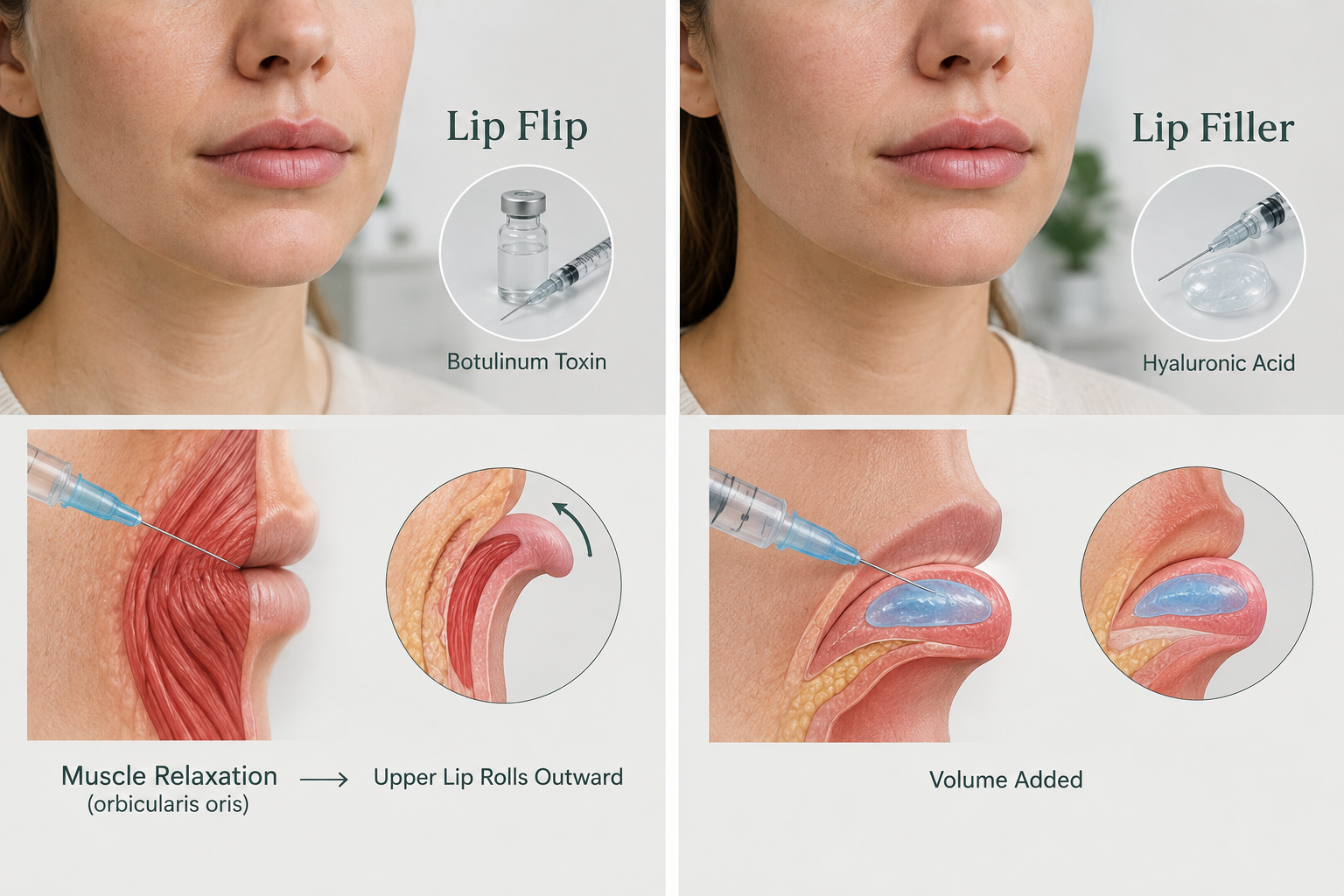
Lip filler, by contrast, works by physically occupying space within the lip tissue. The injected hyaluronic acid gel integrates into the existing tissue architecture and adds measurable volume. This is why lip filler produces a more immediately visible and more substantial change in lip size, while the lip flip produces a subtler, posture-based change. Understanding this distinction helps explain why the two treatments are not interchangeable — they address different aspects of lip appearance and are suited to different patient goals.
Results: What Each Treatment Can and Cannot Achieve
A lip flip is best suited to patients who want a subtle, natural-looking enhancement of the upper lip without adding volume. It can make the upper lip appear slightly more prominent, improve the visibility of the lip at rest, and in some cases reduce the appearance of a gummy smile. However, a lip flip will not significantly increase lip size, will not improve lower lip volume, and will not correct marked asymmetry or deep lip lines. Patients with very thin lips may find the visible change from a lip flip to be minimal.
Lip filler can achieve a broader range of outcomes. It can meaningfully increase lip volume in both the upper and lower lip, define the lip border, improve symmetry, and restore age-related volume loss. The degree of change is adjustable depending on the amount of product used, and an experienced practitioner can tailor the result to look natural rather than overdone. That said, lip filler carries a higher risk of visible swelling and bruising in the days following treatment, and overfilling or poor technique can result in an unnatural appearance. Results also vary between individuals depending on anatomy, the specific product used, and how quickly the body metabolises the filler.
Some patients choose to combine both treatments — using a small amount of botulinum toxin along the upper lip border alongside hyaluronic acid filler — to achieve both improved shape and added volume simultaneously. This combination approach is a recognised option in aesthetic practice, though it requires careful assessment to ensure the botulinum toxin does not interfere with normal lip function to a degree that causes difficulty with activities such as drinking through a straw or playing a wind instrument.
How Long Results Last
The longevity of a lip flip is considerably shorter than that of most lip filler treatments. Botulinum toxin effects in the lip area typically last approximately six to twelve weeks, though individual variation exists. The lip area tends to produce shorter duration results than areas such as the forehead or glabella, partly because the orbicularis oris muscle is used frequently during everyday activities including speaking, eating, and facial expression, which may accelerate the breakdown of the toxin’s effect.
Hyaluronic acid lip filler generally lasts longer, with most patients experiencing results for approximately six to eighteen months. Duration depends on several factors including the specific product used, the volume injected, the patient’s individual metabolism, and the injection technique. Thicker, more cross-linked hyaluronic acid formulations tend to last longer than softer, more fluid products. It is worth noting that the lips are a high-movement area, and filler in this location may metabolise more quickly than filler placed in lower-movement areas of the face.
Downtime and Recovery
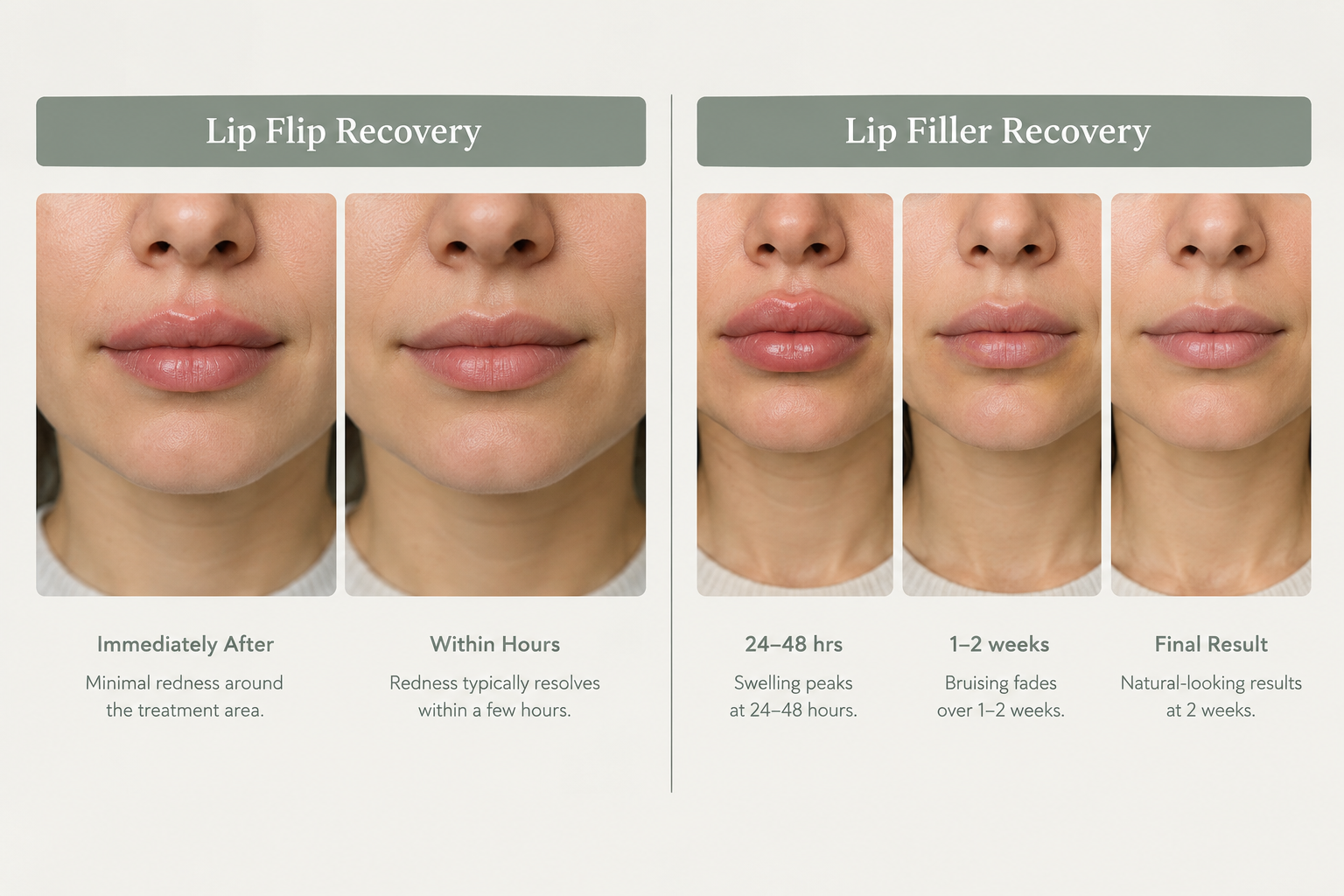
Recovery from a lip flip is generally straightforward. The injections are made with a very fine needle, and most patients experience only minor redness or small injection marks at the treatment sites, which typically resolve within a few hours. Bruising is possible but less common than with lip filler. There is no significant downtime, and most patients return to normal activities immediately. However, patients are usually advised to avoid vigorous exercise, alcohol, and lying face-down for the first twenty-four hours after any botulinum toxin treatment.
Lip filler recovery involves a more noticeable period of swelling. Swelling after lip filler is expected and is often most pronounced in the first twenty-four to forty-eight hours. Bruising is common and may take several days to two weeks to fully resolve. The lips may feel firm or tender initially. Patients are typically advised to avoid strenuous exercise, excessive heat such as saunas or hot baths, alcohol, and blood-thinning medications or supplements in the days surrounding treatment to reduce the risk of bruising and swelling. The final result is generally best assessed after the swelling has fully settled, which usually takes one to two weeks.
Risks and Side Effects
Both treatments carry risks that patients should understand before proceeding. For the lip flip, the most common side effects are temporary and include minor bruising, redness, or swelling at the injection sites. Because botulinum toxin affects muscle function, there is a risk that too much product or imprecise placement could cause temporary difficulty with certain lip movements, such as pursing the lips, drinking through a straw, or pronouncing certain sounds clearly. These effects are temporary and resolve as the toxin wears off, but they can be inconvenient. Choosing a practitioner with specific experience in perioral botulinum toxin treatment is important to minimise this risk.
Lip filler carries a broader range of potential risks. Common side effects include swelling, bruising, tenderness, and temporary asymmetry. Less common but more serious risks include nodule formation, filler migration, infection, and — in rare cases — vascular occlusion, where filler inadvertently enters or compresses a blood vessel. Vascular occlusion is a rare but serious complication that requires immediate treatment. Patients should only receive lip filler from a qualified and experienced practitioner who is trained to recognise and manage this complication and who has access to hyaluronidase for emergency dissolution if required. Allergic reactions to hyaluronic acid fillers are uncommon but possible.
Neither treatment is appropriate during pregnancy or breastfeeding. Patients with active infections, cold sores, or inflammatory skin conditions in or around the lip area should postpone treatment until the condition has resolved. A thorough medical history and consultation should always precede any injectable treatment.
Who May Be Suitable for Each Treatment
A lip flip may be worth discussing with a practitioner if you want a subtle improvement in upper lip definition without adding volume, if you are concerned about a gummy smile, if you are new to lip treatments and want to try a lower-commitment option first, or if you want to complement existing lip filler with improved lip posture. It may also appeal to patients who prefer to avoid the swelling and bruising associated with filler, or those who want a shorter-duration treatment they can reassess before committing to something longer-lasting.
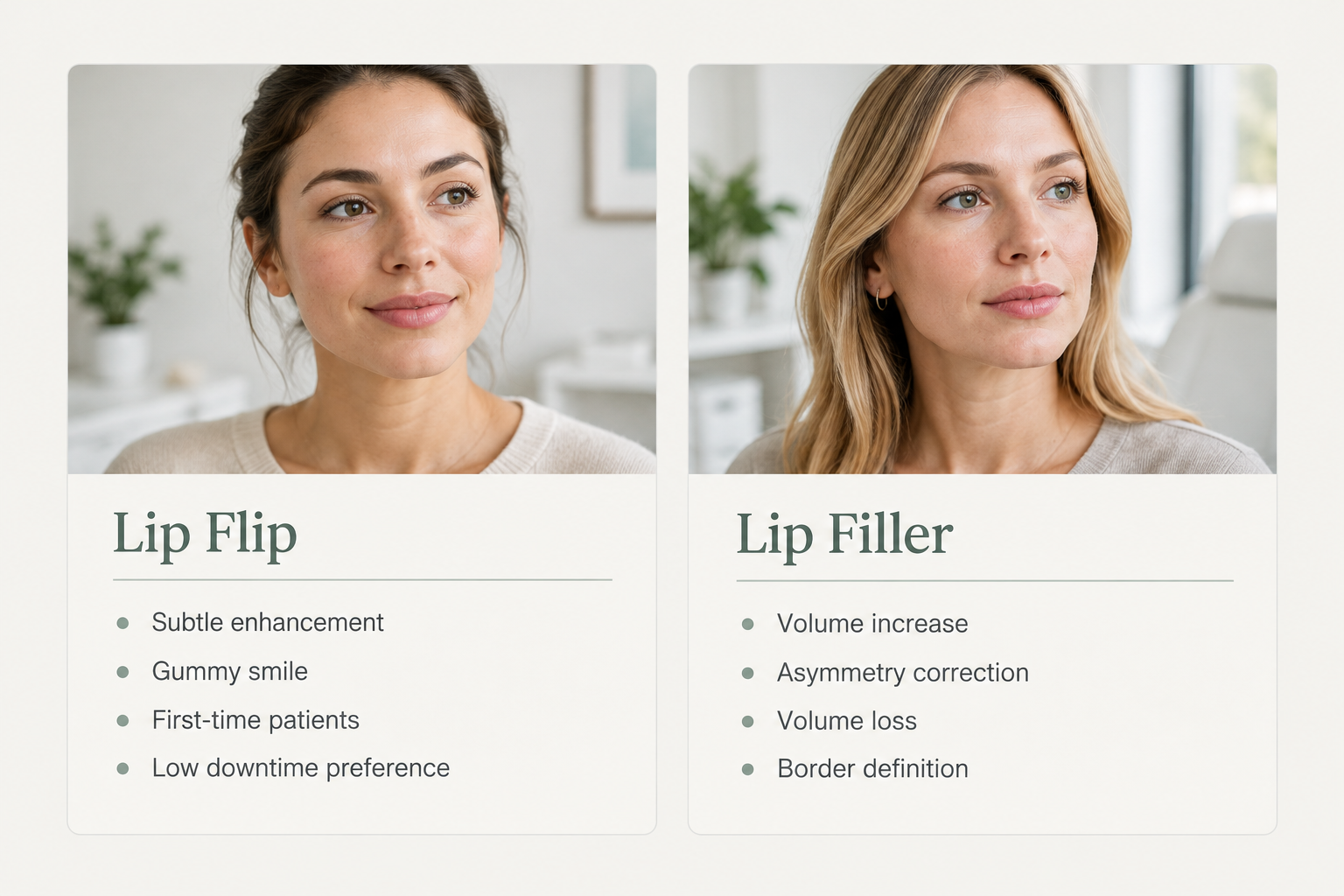
Lip filler may be more appropriate if you want a noticeable increase in lip volume, if you have significant asymmetry between the upper and lower lip, if you have experienced age-related volume loss in the lip area, or if you want to define the vermilion border or cupid’s bow more clearly. Lip filler offers more versatility in terms of the range of outcomes it can achieve, but it also requires a greater tolerance for post-treatment swelling and a longer recovery period before the final result is visible.
Some patients are not suitable for either treatment. Contraindications may include active infection at or near the treatment site, known allergy to any component of the product, certain neurological conditions, and use of medications that significantly increase bleeding risk. A qualified practitioner will assess individual suitability during a consultation.
Cost Considerations
The cost of a lip flip is generally lower than lip filler at a single appointment, partly because the amount of botulinum toxin used is small. However, because the results of a lip flip last only six to twelve weeks, the cumulative cost of maintaining the result over a year may be comparable to or exceed the cost of lip filler, which typically lasts considerably longer. Patients should factor in the frequency of maintenance treatments when comparing the overall cost of each option rather than focusing solely on the price of a single session.
Lip filler costs vary depending on the volume of product used, the specific brand, the practitioner’s experience, and the clinic’s location. Patients should be cautious of unusually low prices for either treatment, as the quality of the product, the practitioner’s training, and the clinical environment all have a direct bearing on safety and outcome.
Frequently Asked Questions
Can a lip flip make my lips look bigger?
A lip flip does not add volume to the lips. It changes the resting posture of the upper lip by partially relaxing the surrounding muscle, which can make the upper lip appear slightly more prominent or defined. The change is subtle. If you want a noticeable increase in lip size, lip filler is the more appropriate treatment.
Is a lip flip painful?
Most patients describe the lip flip as mildly uncomfortable rather than painful. The injections are made with a very fine needle, and the number of injection points is small. Topical anaesthetic cream can be applied beforehand to reduce discomfort if needed. Lip filler injections may cause more discomfort because more injection points are typically used and the lips are a sensitive area, though most practitioners use topical anaesthetic or a dental block to manage this.
How soon can I see results from a lip flip?
Botulinum toxin takes time to take effect. Most patients begin to notice the lip flip result within three to seven days, with the full effect visible at around ten to fourteen days. Lip filler produces an immediate visible change, though the final result is best assessed after post-treatment swelling has resolved, which usually takes one to two weeks.
Can I have a lip flip and lip filler at the same time?
Yes, combining a lip flip with lip filler is a recognised approach in aesthetic practice. The botulinum toxin can help refine the shape and posture of the upper lip while the filler adds volume. However, this combination requires careful assessment and precise technique to avoid over-relaxing the lip muscles, which could temporarily affect normal lip function. Not every patient will be a suitable candidate for the combined approach.
Will a lip flip affect my ability to speak or eat normally?
In most cases, a correctly performed lip flip does not significantly affect speech or eating. However, because the treatment partially relaxes the orbicularis oris muscle, some patients notice temporary difficulty with activities that require strong lip control, such as drinking through a straw, playing a wind instrument, or pronouncing certain sounds. These effects are temporary and resolve as the botulinum toxin wears off. Patients whose work or lifestyle depends heavily on precise lip movement should discuss this with their practitioner before proceeding.
Can lip filler be removed if I don’t like the result?
Hyaluronic acid lip filler can be partially or fully dissolved using an enzyme called hyaluronidase. This is one of the practical safety advantages of hyaluronic acid-based products. Dissolution is not always immediate and may require more than one session depending on the amount of filler present, but it provides a meaningful option if the result is unsatisfactory or if a complication occurs. Botulinum toxin used in a lip flip cannot be reversed; it wears off naturally over six to twelve weeks.
How do I choose between a lip flip and lip filler?
The most important factor is your goal. If you want subtle upper lip definition, a reduced gummy smile, or a low-commitment introduction to lip enhancement, a lip flip may be worth discussing. If you want a meaningful increase in lip volume, improved symmetry, or longer-lasting results, lip filler is likely the more suitable option. A qualified practitioner can assess your lip anatomy, discuss your expectations, and recommend the most appropriate approach for your individual situation.
Lip Flip or Lip Filler: Which May Better Match Your Goals?
Lip flip and lip filler are complementary rather than competing treatments, and the better choice depends entirely on what you want to achieve. A lip flip is a subtle, shorter-duration option that works by changing lip posture rather than adding volume — it may suit patients who want a natural-looking refinement, a reduction in gummy smile, or a low-risk introduction to lip aesthetics. Lip filler offers a broader range of outcomes, including meaningful volume increase and improved symmetry, with longer-lasting results, but it also involves more post-treatment swelling and a slightly higher risk profile.
Neither treatment is universally superior. Some patients benefit most from one or the other; others find that a carefully planned combination of both produces the most balanced result. What matters most is that the treatment is matched to your anatomy, your goals, and your tolerance for downtime and maintenance — and that it is performed by a qualified practitioner who can assess your suitability honestly and manage any complications if they arise. A thorough consultation before any injectable lip treatment is not optional; it is the foundation of a safe and satisfying outcome.