

Key Takeaways
- Natural-looking lip filler is achievable for most patients when the right hyaluronic acid filler, conservative dosing, and skilled injection technique are combined.
- The injector’s experience and aesthetic judgment matter as much as the product chosen — possibly more.
- A gradual, incremental approach using 0.5 mL at a time reduces the risk of overfilled lips and allows results to be refined over time.
- Hyaluronic acid fillers are reversible with hyaluronidase, making them the safest and most flexible option for lip augmentation.
- Swelling in the first 48–72 hours is normal and does not reflect the final result — the true outcome becomes visible at around two weeks.
What Does a Natural-Looking Lip Filler Result Actually Mean?
A natural-looking lip filler result is one where the lips appear subtly fuller, better defined, or more symmetrical — but where no one can immediately identify that a procedure has taken place. The goal is enhancement of what is already there, not a dramatic transformation. Lips that move naturally when speaking and smiling, maintain soft texture, and sit in proportion with the rest of the face are the hallmarks of a well-executed treatment.
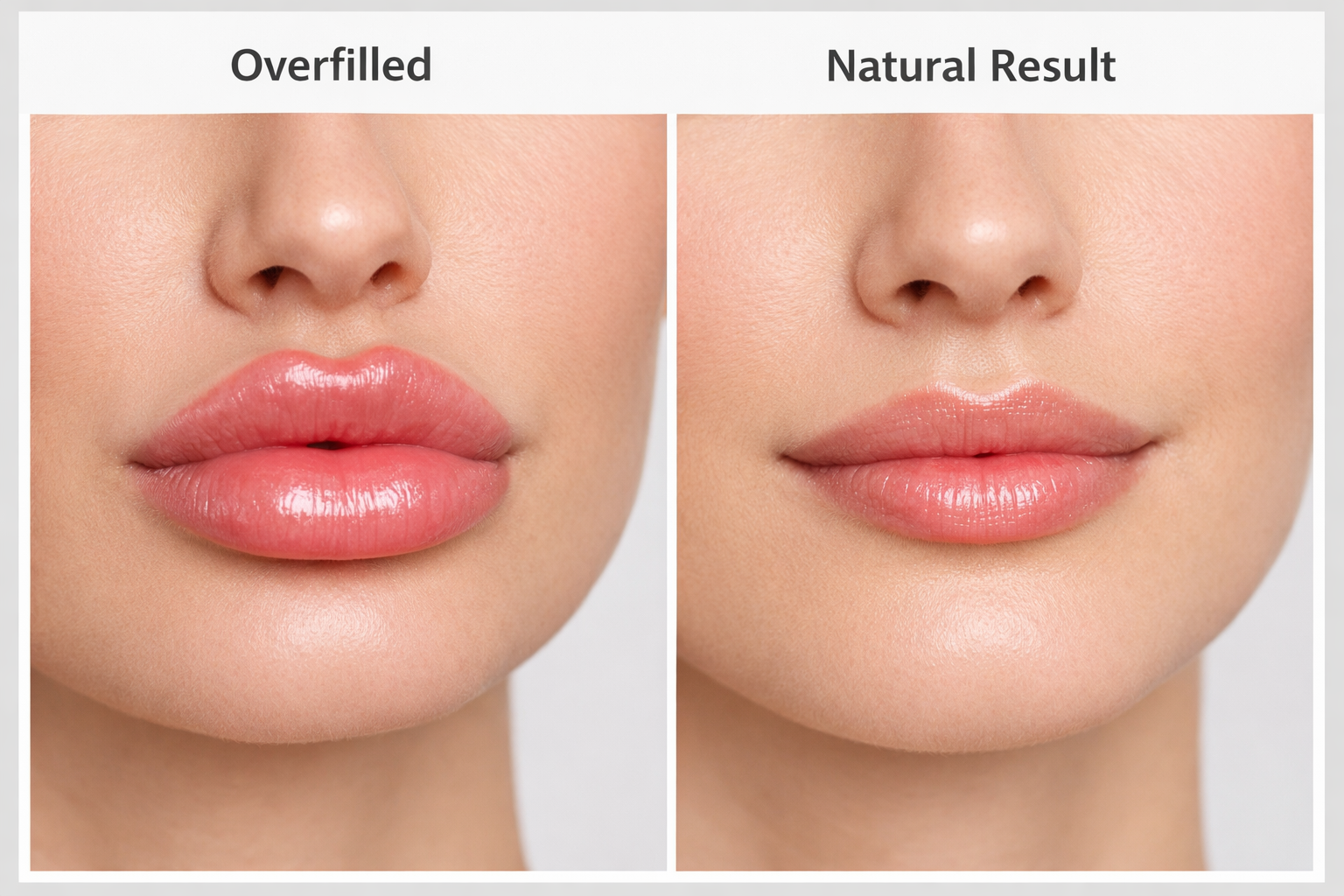
This is distinct from the overfilled lips or duck lip effect that many patients fear. That outcome typically results from excessive volume, inappropriate filler placement, or the use of products that are too firm or too hydrophilic (water-attracting) for the delicate lip tissue. Understanding what separates a natural result from an unnatural one helps patients ask better questions and set realistic expectations before their consultation.
Facial harmony is central to the concept. Lips do not exist in isolation — they sit within a face that has its own proportions, bone structure, and skin quality. A skilled injector considers the relationship between the upper and lower lip, the definition of the Cupid’s bow, the philtral columns above the upper lip, and the overall balance between the lips and surrounding features before placing a single drop of filler.
Why Do Some Lip Fillers Look Unnatural?
Unnatural results usually come down to one or more of three factors: too much product, the wrong product, or poor injection technique. Overfilling is the most common cause. When volume exceeds what the lip tissue can accommodate naturally, the lips lose their shape, the vermilion border becomes distorted, and the characteristic duck lip appearance emerges. This is why the principle of less is more is so widely repeated in aesthetic medicine — it is not a cliché but a genuine clinical guideline.
Product selection also plays a significant role. Fillers that are too dense or too firm for lip tissue can create a stiff, unnatural feel and appearance. Lips require a soft, flexible filler that moves with facial expressions and integrates smoothly with the surrounding tissue. Using a product designed for deeper structural areas — such as the jawline or cheeks — in the lips is a common technical error that contributes to unnatural outcomes.
Filler migration is another concern. This occurs when filler moves beyond the intended injection zone, most often above the vermilion border, creating a blurred or puffy appearance around the lip edge. Migration is more likely with high-volume injections, overly hydrophilic products, and superficial placement. Choosing an experienced injector who understands lip anatomy significantly reduces this risk.
Choosing the Right Filler Product for Natural Results
Not all hyaluronic acid fillers are the same. The cross-linking technology, particle size, and gel consistency vary between products and directly affect how they look and feel in the lips. For natural lip augmentation, soft, low-viscosity HA fillers that integrate well with lip tissue are generally preferred over firmer, higher-density products.
| Filler | Technology | Best For | Natural Look Suitability | Approximate Duration |
|---|---|---|---|---|
| Juvéderm Volbella XC | VYCROSS | Subtle volume, fine lip lines, delicate definition | Excellent — very soft and natural feel | Up to 12 months |
| Juvéderm Ultra XC | HYLACROSS | Moderate volume, fuller enhancement | Good — slightly firmer than Volbella | Up to 12 months |
| Restylane Kysse | XpresHAn Technology™ | Natural movement, colour enhancement, flexibility | Excellent — designed specifically for lip flexibility | Up to 12 months |
| Restylane Silk | Smaller HA particles | Fine lines, subtle definition, thin lips | Very good — particularly for delicate enhancement | 6–9 months |
Radiesse, Bellafill, and Sculptra are biostimulatory agents not recommended for lip augmentation. These products work by stimulating collagen or contain calcium hydroxylapatite microspheres, making them difficult to reverse and poorly suited to the dynamic movement and delicate anatomy of the lips. A qualified injector will not use these products in the lip area.
The choice between products should be guided by your individual lip anatomy, the degree of enhancement you are seeking, and your injector’s clinical experience with each formulation. No single product is universally superior — the right choice depends on the patient.
How Much Filler Creates a Natural Look?
Volume is one of the most important variables in achieving a natural result. For most patients seeking subtle lip enhancement, 0.5 mL (half a syringe) is a sensible starting point. This amount can add gentle definition, improve symmetry, and restore mild volume loss without dramatically altering the lip shape. Patients with naturally thin lips or those seeking more noticeable enhancement may consider 1 mL, but this is best approached gradually rather than all at once.
A conservative dosing strategy — sometimes called a gradual or incremental approach — involves treating in stages, typically with a two-week review between sessions. This allows both the patient and the injector to assess the settled result before deciding whether additional volume is appropriate. It is far easier to add a small amount of filler at a follow-up appointment than to dissolve an overfilled result.
The upper-to-lower lip ratio also guides volume decisions. A commonly referenced aesthetic guideline suggests the lower lip should be approximately twice the volume of the upper lip — roughly a 1:2 ratio. Maintaining this proportion, rather than simply adding equal volume to both lips, tends to produce results that look balanced and harmonious rather than artificially inflated. Injectors familiar with the golden ratio concept apply this principle to preserve facial harmony throughout treatment.
Injection Techniques That Support Natural Results
The technique used to place filler is as important as the product and volume chosen. Several approaches are used in clinical practice, and experienced injectors often combine methods depending on the patient’s anatomy and goals.
The retrograde linear technique involves depositing filler in a thin, even thread as the needle or cannula is withdrawn. This creates smooth, consistent volume along the lip body and vermilion border without creating lumps or uneven distribution. The fanning technique uses multiple passes from a single entry point to distribute filler across a wider area, which can be useful for adding subtle volume to the body of the lip.
Microdosing — placing very small amounts of filler at multiple precise points — is particularly well-suited to patients who want minimal, natural-looking enhancement or who are having lip filler for the first time. This technique reduces the risk of overcorrection and allows fine-tuning of the result. A clinical technique described in recent literature as the “4.3” method involves specific injection zones targeting the body of the lip, the vermilion border, the Cupid’s bow, and the philtral columns in a structured sequence designed to preserve natural lip anatomy while adding definition and subtle volume.
Cannulas — blunt-tipped instruments — are sometimes preferred over sharp needles for lip body injections because they can reduce bruising and allow smoother filler distribution. The choice between cannula and needle depends on the injection zone and the injector’s training and preference. Neither is universally superior; both can produce excellent results in experienced hands.
Preserving Your Natural Lip Shape
One of the most common concerns among patients considering lip augmentation is losing the character of their natural lip shape. A well-planned treatment should enhance existing features rather than replace them. Key anatomical landmarks — the Cupid’s bow, the vermilion border, and the philtral columns — should be respected and, where appropriate, gently accentuated rather than obscured.
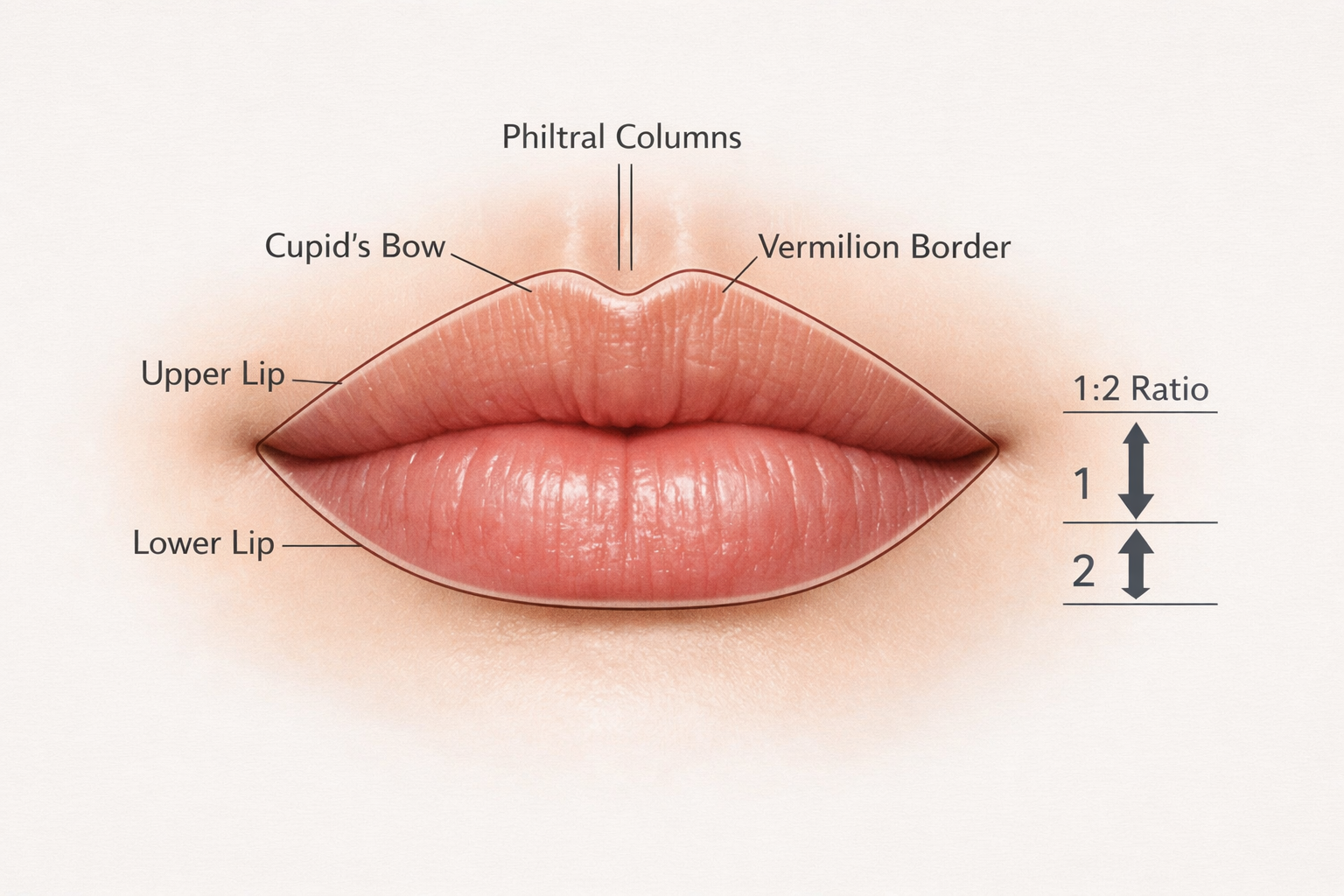
The Cupid’s bow is the double-curved upper lip edge that gives the upper lip its distinctive shape. Overfilling the upper lip or placing filler too superficially can flatten or distort this curve, contributing to an unnatural appearance. Skilled injectors work to preserve or subtly define the Cupid’s bow rather than erase it.
Lip filler can also be used to address asymmetry — a common and entirely normal feature of natural lips. Correcting mild asymmetry through targeted, conservative placement can improve the overall appearance without making the result look artificial. Significant asymmetry correction may require more than one session to achieve gradually and safely.
For patients experiencing age-related volume loss rather than seeking augmentation, the goal is often restoration rather than enhancement. Replacing lost volume in the lip body and softening fine lines around the lips (perioral lines) can create a refreshed appearance without any obvious sign of treatment. This is a different clinical objective from adding volume to naturally thin lips, and the approach — including product choice and injection zones — should reflect that difference.
Lip Filler vs. Lip Flip: Understanding the Difference
Patients researching natural lip enhancement often encounter the lip flip as an alternative or complementary option. A lip flip uses a small amount of botulinum toxin injected into the orbicularis oris muscle just above the upper lip. This relaxes the muscle slightly, causing the upper lip to roll outward and appear fuller without adding any volume. The effect is subtle and temporary, typically lasting 6–8 weeks.
A lip flip does not add volume or definition to the vermilion border. It is best suited to patients who want a very subtle change to the upper lip’s appearance, particularly those who feel their upper lip disappears when they smile. It is not a replacement for lip filler when volume, definition, or symmetry correction is the goal. Some patients benefit from a combination of both treatments, but this should be discussed with a qualified injector based on individual anatomy and objectives.
How to Choose a Qualified Injector
The injector’s skill, training, and aesthetic judgment are arguably the most important factors in achieving a natural-looking result. Lip anatomy is complex, and the margin between a subtle, beautiful enhancement and an overdone outcome is narrow. Choosing a practitioner based on price alone or without reviewing their work is one of the most common reasons patients end up dissatisfied.
When evaluating a potential injector, consider the following:
- Qualifications and training: Look for a medically qualified practitioner — a doctor, dentist, or nurse prescriber — with specific training in facial aesthetics and injectables.
- Before and after portfolio: Review their lip filler results specifically. Look for natural-looking outcomes across a range of lip types, not just one aesthetic. Be cautious if all results look identical or uniformly very full.
- Consultation quality: A good injector will assess your facial proportions, discuss your goals, explain realistic outcomes, and recommend a conservative starting point. They should not pressure you toward more volume than you are comfortable with.
- Willingness to stage treatment: An experienced injector will support a gradual approach and offer a two-week review appointment as standard.
- Knowledge of reversal: Any qualified injector should be able to discuss hyaluronidase reversal and have access to it in the event of a complication or an unsatisfactory result.
Swelling, Bruising, and the Recovery Timeline
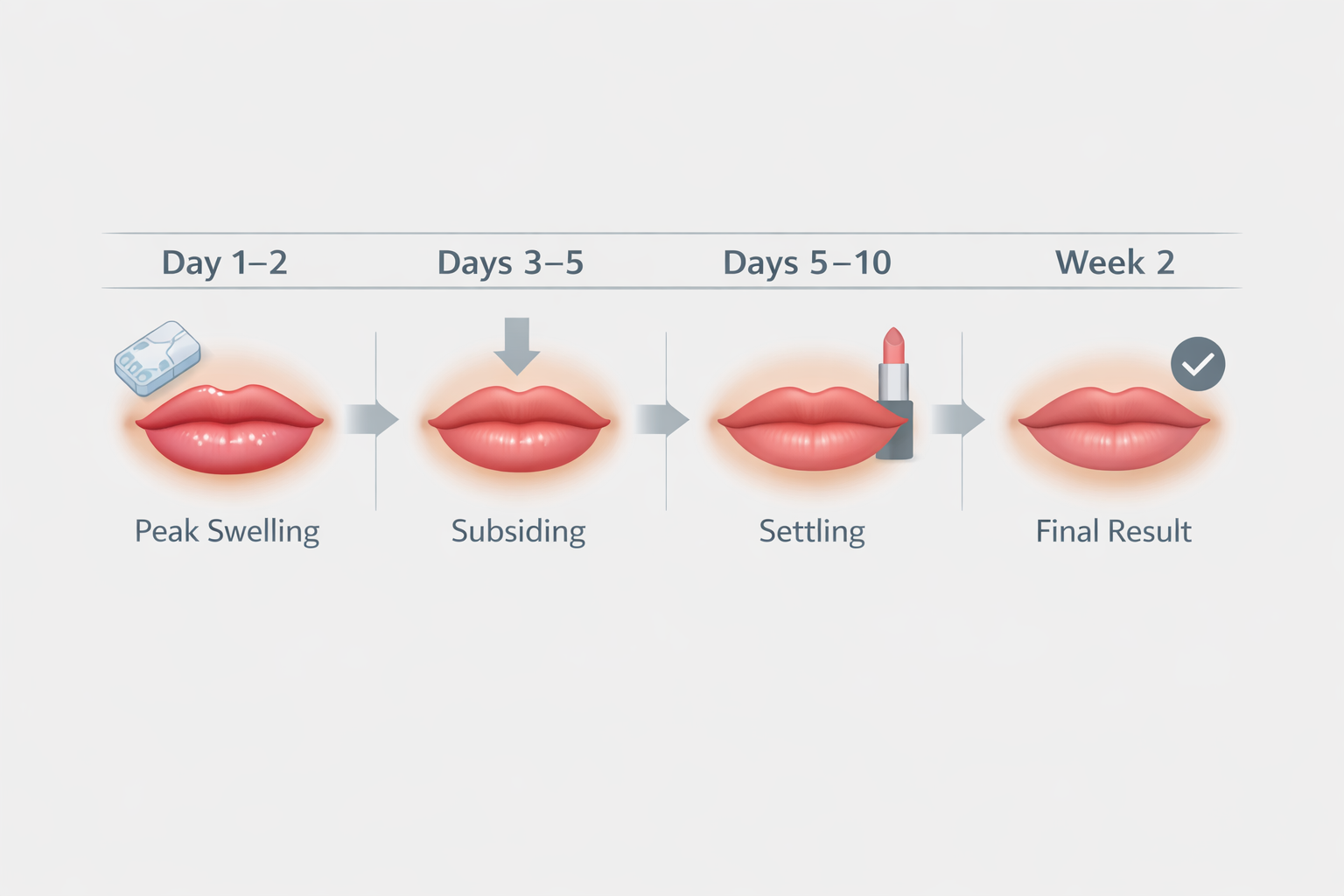
Understanding the recovery process helps patients avoid unnecessary anxiety and make accurate assessments of their results. Swelling after lip filler is normal and expected — it does not reflect the final outcome.
| Timeframe | What to Expect |
|---|---|
| Day 1–2 | Swelling peaks. Lips may appear significantly fuller than intended. Some bruising is common. This is normal. |
| Days 3–5 | Swelling begins to subside. Bruising may still be visible. Lips start to feel softer. |
| Days 5–10 | Most visible swelling has resolved. The lip shape becomes clearer. Minor unevenness may still be present as filler settles. |
| Week 2 | The settled result is visible. This is the appropriate time for a review appointment to assess whether any refinement is needed. |
Bruising can be minimised by avoiding blood-thinning medications and supplements (such as aspirin, ibuprofen, fish oil, and vitamin E) in the days before treatment, where clinically appropriate. Applying a cold compress gently to the area in the first 24 hours can help reduce swelling. Avoiding alcohol, strenuous exercise, and heat exposure — including saunas and hot showers — for at least 48 hours after treatment also supports a smoother recovery.
Lip Filler Aftercare: Dos and Don’ts
Proper aftercare supports both the healing process and the quality of the final result. The following guidance applies to most patients, though your injector may provide specific instructions based on your treatment.
| Do | Avoid |
|---|---|
| Keep lips hydrated with a gentle lip balm | Alcohol for at least 24–48 hours |
| Apply a cold compress gently if swelling is uncomfortable | Strenuous exercise for 24–48 hours |
| Stay well hydrated | Extreme heat (saunas, steam rooms, hot yoga) for 48 hours |
| Attend your two-week review appointment | Pressing, massaging, or manipulating the lips |
| Use sun protection on the perioral area | Dental procedures for at least two weeks |
| Sleep with your head slightly elevated if swelling is significant | Wearing tight face masks or applying pressure to the lips |
How Long Do Natural Lip Fillers Last?
Hyaluronic acid lip fillers are gradually broken down by the body’s natural enzymes over time. Most patients find that lip filler longevity ranges from approximately 6 to 12 months, depending on the product used, the volume placed, the patient’s metabolism, and lifestyle factors such as sun exposure and smoking. Lips are a high-movement area, which means filler tends to break down somewhat faster here than in less dynamic areas of the face.
For patients following a gradual approach, top-up treatments at 9–12 month intervals are common. It is important to avoid cumulative overfilling over time — each top-up session should be assessed on its own merits, with the injector evaluating how much residual filler remains before adding more. Patients who have had multiple rounds of lip filler over several years without adequate assessment between sessions are at greater risk of gradual volume accumulation that can eventually look unnatural.
If at any point a patient is unhappy with their result — whether immediately after treatment or over time — hyaluronic acid filler is reversible with hyaluronidase, an enzyme that dissolves HA filler relatively quickly. This reversibility is one of the key reasons HA fillers are the preferred choice for lip augmentation in evidence-based aesthetic practice.
Risks and Limitations to Be Aware Of
Lip filler is a medical procedure and carries real risks that patients should understand before proceeding. Common side effects include swelling, bruising, tenderness, and temporary asymmetry — these typically resolve within one to two weeks. Less common but more serious risks include:
- Filler migration: Movement of filler beyond the intended zone, most often above the vermilion border. More likely with high volumes and superficial placement.
- Lumps and nodules: Uneven filler distribution can create palpable or visible irregularities. Many resolve on their own; persistent lumps may require hyaluronidase treatment.
- Vascular complications: Rare but serious. Accidental injection into or compression of a blood vessel can compromise blood supply to surrounding tissue. This is a medical emergency requiring immediate treatment. Choosing a medically qualified injector with emergency protocols in place significantly reduces this risk.
- Infection: Any injectable procedure carries a small risk of infection. Signs include increasing redness, warmth, pain, or swelling beyond the first few days.
- Allergic reaction: Rare with modern HA fillers, but possible. A thorough consultation should include a review of any known allergies.
Lip filler is not suitable for patients who are pregnant or breastfeeding, have active infection or inflammation in the treatment area, or have certain autoimmune conditions. A full medical history should be taken at consultation.
Frequently Asked Questions
Can lip fillers really look completely natural?
Yes — when the right product, volume, and technique are used by an experienced injector, lip filler results can be entirely undetectable to others. The key is conservative dosing, appropriate product selection, and a gradual approach. Many patients report that friends and colleagues notice they look well-rested or refreshed without identifying any specific change.
Will anyone be able to tell I’ve had lip filler?
With a subtle enhancement approach, most people will not notice. Results that attract attention are usually the product of too much volume, the wrong product, or poor technique — not lip filler itself. Starting with 0.5 mL and reviewing at two weeks gives you and your injector the opportunity to assess the result before committing to more.
What is the best filler for a natural lip look?
Restylane Kysse and Juvéderm Volbella XC are frequently cited by clinicians for their soft, flexible properties and natural feel in the lips. The best choice for any individual patient depends on their lip anatomy, goals, and the injector’s clinical assessment. There is no single universally superior product.
Can lip filler be reversed if I don’t like the result?
Yes. Hyaluronic acid fillers can be dissolved using hyaluronidase, an enzyme that breaks down HA relatively quickly. Reversal is not always instantaneous and may require more than one treatment session, but it is a reliable option. This reversibility is one of the main reasons HA fillers are recommended over permanent or semi-permanent alternatives for lip augmentation.
How do I avoid filler migration?
Filler migration is most commonly associated with high-volume injections, overly hydrophilic products, and superficial placement. Choosing an experienced injector, starting with conservative volumes, and using an appropriate product for the lip area significantly reduces the risk. Avoiding excessive pressure or manipulation of the lips in the days following treatment also helps.
Is a lip flip better than lip filler for a natural look?
A lip flip uses botulinum toxin to create a subtle eversion of the upper lip without adding volume. It suits patients who want a very minimal change, particularly to the upper lip. It does not add definition, correct asymmetry, or restore volume. For most patients seeking a natural but noticeable improvement, lip filler with conservative dosing offers more versatility and longer-lasting results.
How soon can I have a top-up after my first lip filler treatment?
Most injectors recommend waiting at least two weeks after the initial treatment before considering any additional volume. This allows swelling to fully resolve and gives an accurate picture of the settled result. Topping up before the filler has settled risks overcorrection.
Making an Informed Decision About Lip Filler
Achieving a natural-looking lip filler result is realistic for most patients — but it requires the right combination of product, technique, volume, and clinical judgment. The fear of ending up with overdone lips is understandable, and it is a valid concern when treatment is approached without care. However, with a conservative dosing strategy, a soft and flexible hyaluronic acid filler, and a qualified injector who prioritises facial harmony over dramatic transformation, subtle and beautiful results are well within reach.
The most important step is a thorough before and after consultation with a medically qualified practitioner who takes time to understand your goals, assess your lip anatomy, and explain what is realistically achievable. Be cautious of any injector who discourages a gradual approach, recommends starting with more than 1 mL for a first treatment, or cannot clearly explain the products they use and why. A good consultation should leave you feeling informed and confident — not pressured.
If you are considering lip augmentation for the first time, starting conservatively and reviewing results at two weeks is the approach most likely to leave you satisfied. You can always add more; removing filler is possible but adds cost and inconvenience. The gradual approach is not just a safety measure — it is the most reliable path to a result that looks and feels like you, only better.