

Laser hair removal has historically been associated with complications in people with darker skin tones, but advances in laser technology have made safe and effective treatment increasingly achievable for melanin-rich skin. Understanding which devices are appropriate, why skin tone matters, and what realistic outcomes look like can help you make a well-informed decision before booking a consultation.
Key Takeaways
- The Nd:YAG 1064 nm laser is currently the most widely recommended option for dark skin tones due to its deeper penetration and lower melanin absorption at the skin surface.
- Fitzpatrick skin types V and VI carry a higher risk of post-inflammatory hyperpigmentation, burns, and blistering if the wrong laser or settings are used.
- Multiple sessions are required for meaningful hair reduction; complete elimination is not guaranteed for any skin type.
- Practitioner experience with darker skin tones is as important as the device itself — settings, cooling, and technique all affect safety.
- A thorough consultation and patch test before full treatment are strongly advisable for anyone with a darker complexion.
Why Skin Tone Affects Laser Hair Removal Safety
Laser hair removal works by targeting melanin — the pigment found in hair follicles. A laser emits a specific wavelength of light that is absorbed by melanin in the hair shaft, converting to heat and damaging the follicle enough to inhibit future growth. The challenge for darker skin tones is that melanin is also present in the surrounding skin. When the skin contains significant melanin, it competes with the hair follicle for laser energy, increasing the risk of the skin itself absorbing heat rather than the follicle alone.
Dermatologists use the Fitzpatrick scale — a classification system ranging from Type I (very fair, always burns) to Type VI (deeply pigmented, never burns) — to assess how a patient’s skin is likely to respond to light-based treatments. People with Fitzpatrick Types IV, V, and VI have higher concentrations of eumelanin in the epidermis, which makes standard laser settings used for lighter skin potentially dangerous. The risks include thermal injury to the skin surface, post-inflammatory hyperpigmentation (PIH), hypopigmentation, blistering, and scarring. These are not theoretical concerns — they have been documented in clinical literature when inappropriate devices or settings are used on darker complexions.
This does not mean laser hair removal is unsuitable for dark skin. It means that the choice of laser wavelength, pulse duration, fluence (energy level), and cooling method must be carefully matched to the individual’s skin tone and hair characteristics.
Which Lasers Are Considered Safe for Dark Skin Tones
Not all laser systems carry the same risk profile for melanin-rich skin. The key variable is wavelength: longer wavelengths penetrate more deeply into the dermis and are absorbed less by surface melanin, reducing the risk of epidermal injury.
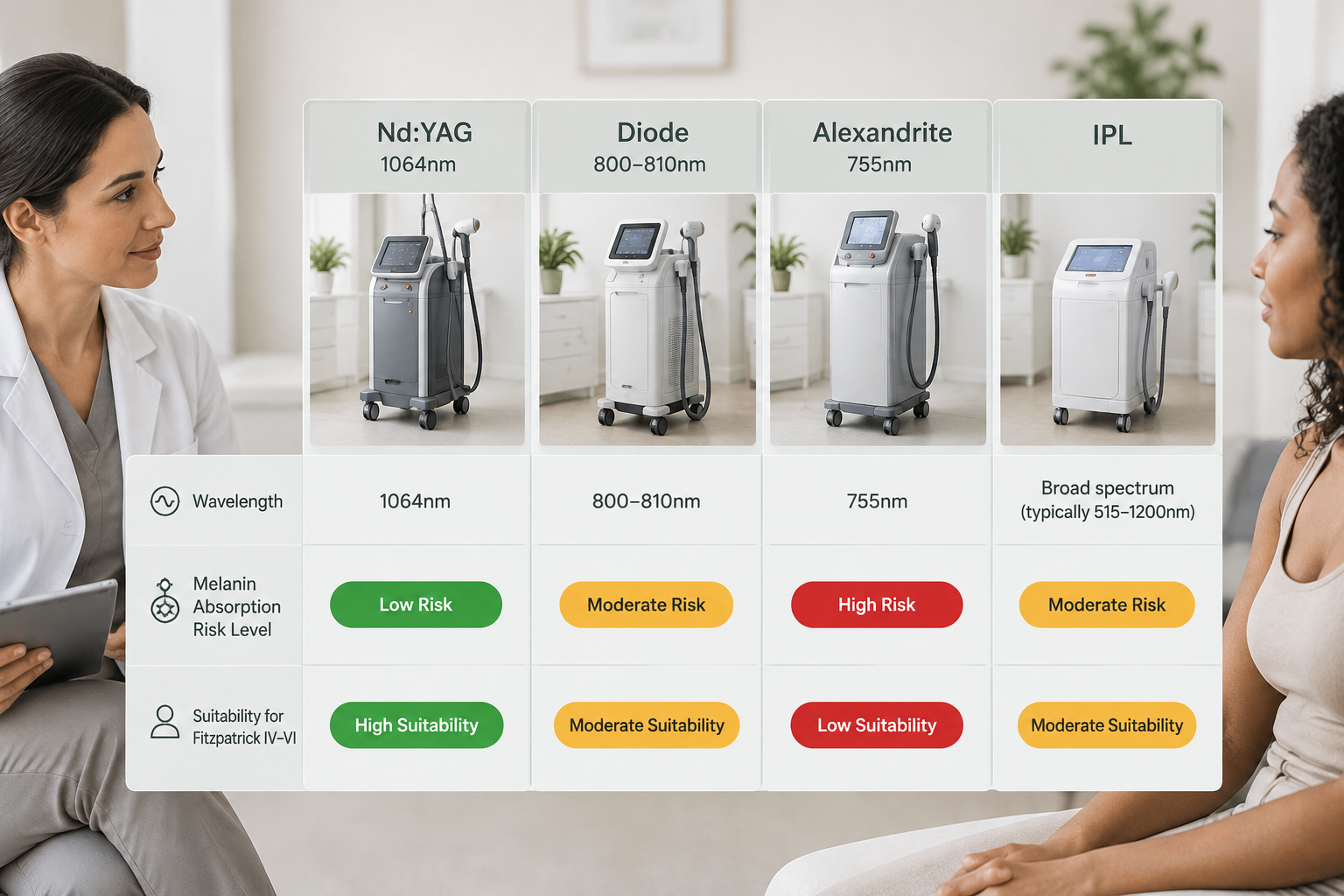
Nd:YAG 1064 nm Laser
The Nd:YAG (neodymium-doped yttrium aluminium garnet) laser operating at 1064 nm is widely regarded as the most appropriate laser for dark skin tones, including Fitzpatrick Types V and VI. At this wavelength, melanin absorption is significantly lower than at shorter wavelengths, meaning the laser energy passes through the epidermis more safely and targets the deeper hair follicle. The Nd:YAG laser also allows for longer pulse durations, which distribute heat more gradually and reduce the risk of acute thermal damage to surrounding tissue. Clinical studies and dermatological guidelines consistently identify the Nd:YAG 1064 nm as the preferred device for patients with darker complexions. It is effective on coarse, dark hair, though it may be less effective on fine or light-coloured hair regardless of skin tone.
Diode Laser (800–810 nm)
Diode lasers operating in the 800–810 nm range occupy a middle ground. They are more effective than shorter-wavelength devices on darker skin and are used in clinical practice for Fitzpatrick Types IV and sometimes V, particularly when combined with adequate cooling and conservative fluence settings. However, diode lasers carry a higher risk than the Nd:YAG for very dark skin tones, and their suitability depends heavily on the specific device, the practitioner’s experience, and the individual patient’s complexion. Some newer diode systems incorporate advanced contact cooling and longer pulse durations that improve their safety profile for darker skin, but the Nd:YAG remains the more cautious choice for Types V and VI.
Alexandrite Laser (755 nm) and IPL
The alexandrite laser at 755 nm and intense pulsed light (IPL) devices are generally not recommended for dark skin tones. Both operate at wavelengths where epidermal melanin absorption is high, significantly increasing the risk of burns, blistering, and post-inflammatory hyperpigmentation in patients with Fitzpatrick Types IV and above. IPL, in particular, emits a broad spectrum of light rather than a single wavelength, making precise targeting of the hair follicle more difficult and the risk of surface skin damage greater. Some practitioners may use alexandrite lasers cautiously on Type IV skin with appropriate settings and cooling, but this requires considerable expertise and carries meaningful risk. For Types V and VI, these devices are generally contraindicated.
Ruby Laser (694 nm)
The ruby laser is one of the earliest laser systems used for hair removal and operates at a wavelength with high melanin absorption. It is not appropriate for dark skin tones and is now rarely used in modern clinical practice for this purpose.
How Treatment Parameters Affect Safety
The laser device alone does not determine safety — the settings applied during treatment are equally important. For dark skin, practitioners typically use longer pulse durations to allow heat to dissipate more gradually, lower fluence levels to reduce the risk of surface heating, and effective epidermal cooling before, during, and after each pulse. Cooling methods may include contact cooling built into the handpiece, cryogen spray, or cold air devices. These measures help protect the epidermis while still delivering sufficient energy to the follicle.
Spot size also plays a role: larger spot sizes allow deeper penetration at a given fluence, which can be advantageous for reaching follicles in darker skin. Practitioners experienced in treating melanin-rich skin will adjust these parameters based on the patient’s specific skin tone, hair colour, hair thickness, and treatment area. A practitioner who applies the same settings used for fair skin to a patient with a dark complexion significantly increases the risk of adverse effects.
What to Expect During a Consultation and Patch Test
Before any laser hair removal session on dark skin, a thorough consultation is essential. A qualified practitioner should assess your Fitzpatrick skin type, review your medical history, ask about any medications that may increase photosensitivity (such as certain antibiotics, retinoids, or hormonal treatments), and discuss your hair colour and texture. Darker skin with coarse, dark hair generally responds better to laser treatment than darker skin with fine or light hair, because the contrast between hair and follicle melanin and the surrounding skin melanin is still meaningful.
A patch test — applying the laser to a small area of skin and observing the response over several days — is strongly advisable before full treatment. This allows the practitioner to assess how your skin responds to the chosen settings and identify any early signs of adverse reaction before treating a larger area. Some clinics may skip this step, but for darker skin tones it represents a meaningful safety measure.
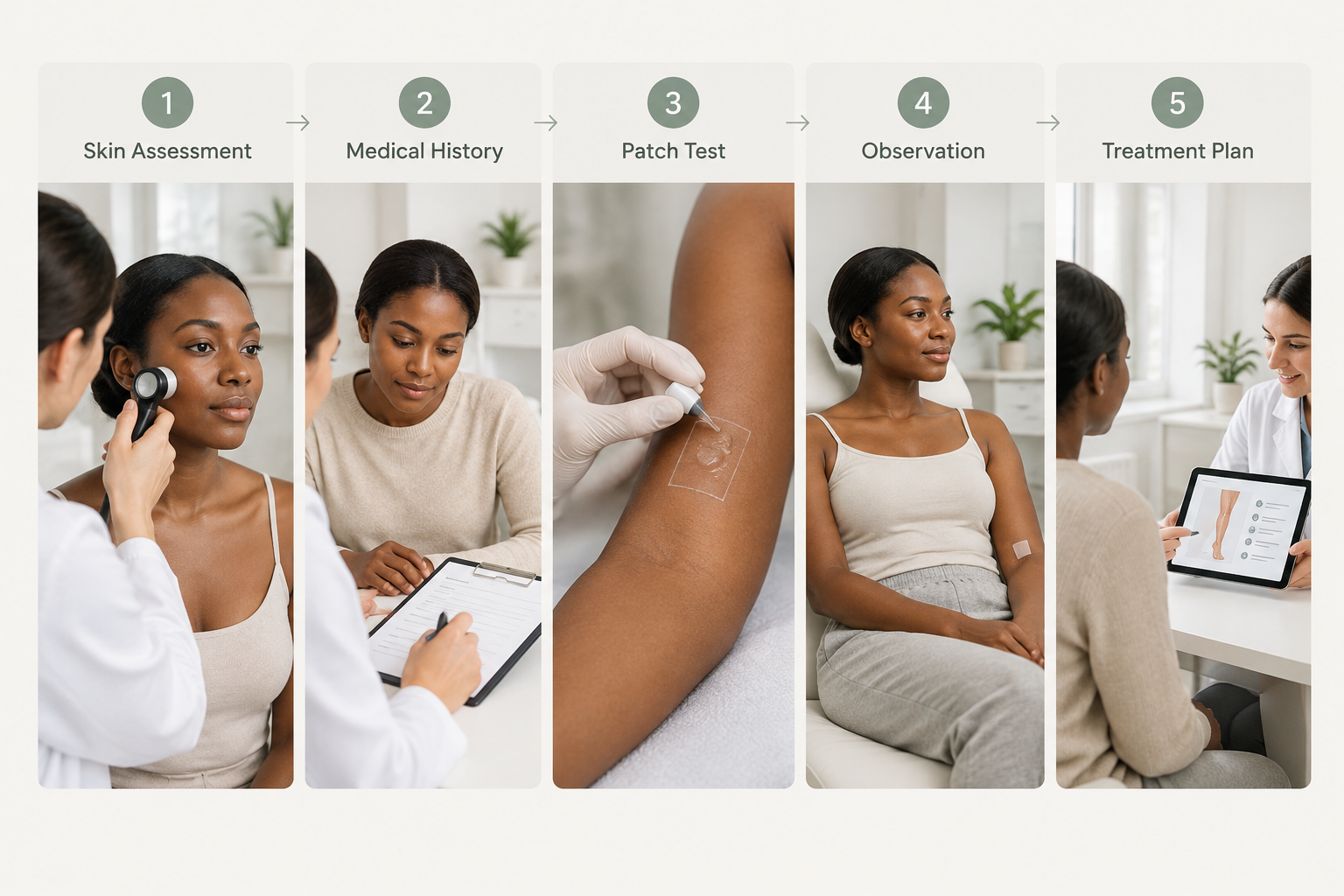
You should also discuss your history of keloid scarring, as laser treatment may trigger keloid formation in susceptible individuals. Any active skin infection, open wounds, or inflammatory skin conditions in the treatment area should be resolved before proceeding.
How Many Sessions Are Typically Needed
Laser hair removal targets hair follicles in the active growth phase (anagen). Because not all follicles are in this phase simultaneously, multiple sessions are required to treat the full population of follicles in any given area. For most patients, a course of six to eight sessions spaced four to eight weeks apart is a common starting point, though the exact number varies depending on the treatment area, hair density, hormonal factors, and individual response.
For patients with darker skin tones, sessions may be spaced slightly further apart to allow the skin to recover fully between treatments, and initial fluence settings may be more conservative, potentially requiring additional sessions to achieve comparable results. It is important to have realistic expectations: laser hair removal typically achieves significant long-term hair reduction rather than permanent complete elimination. Some regrowth may occur over time, and maintenance sessions may be needed.
Risks and Side Effects Specific to Dark Skin
Even with appropriate laser selection and settings, patients with darker skin tones face a higher baseline risk of certain side effects compared to those with lighter complexions. Understanding these risks helps set realistic expectations and supports informed consent.
- Post-inflammatory hyperpigmentation (PIH): Darkening of the treated skin following inflammation or thermal injury. This is the most common adverse effect in darker skin tones and can persist for weeks to months. It is usually temporary but may take time to resolve, particularly without appropriate skincare support.
- Hypopigmentation: Lightening of the skin in the treated area, caused by damage to melanocytes. This can be more difficult to treat than hyperpigmentation and may be longer-lasting.
- Burns and blistering: Occur when excessive heat is delivered to the epidermis. These are more likely with inappropriate laser choice or settings and can lead to scarring.
- Paradoxical hypertrichosis: An uncommon but documented phenomenon where laser treatment stimulates rather than reduces hair growth, particularly in areas of fine or vellus hair. The mechanism is not fully understood, and it has been reported more frequently in patients with darker skin tones and certain hair types.
- Folliculitis: Inflammation of hair follicles following treatment, which may present as small red bumps in the treated area. Usually temporary and manageable.
- Scarring: Rare but possible, particularly if blistering or burns are not managed appropriately.

Many of these risks can be significantly reduced by choosing a practitioner with documented experience treating darker skin tones, using an appropriate laser system, and following pre- and post-treatment care instructions carefully.
Pre- and Post-Treatment Care for Darker Skin
Preparation before laser hair removal can meaningfully reduce the risk of adverse effects. Avoiding sun exposure and tanning — including self-tanning products — for at least four to six weeks before treatment is important, as tanned skin increases epidermal melanin and raises the risk of surface burns. Some practitioners recommend a course of topical agents such as hydroquinone or azelaic acid before treatment to reduce baseline pigmentation and lower the risk of PIH, though this should only be done under professional guidance.
Shaving the treatment area one to two days before the session is typically recommended, as surface hair can absorb laser energy and cause superficial burns. Waxing, threading, or plucking should be avoided in the weeks before treatment, as these methods remove the hair root that the laser needs to target.
After treatment, the skin may appear red, swollen, or feel similar to mild sunburn for one to three days. Applying a soothing, fragrance-free moisturiser and avoiding heat, friction, and sun exposure during this period supports recovery. Broad-spectrum SPF 30 or higher sunscreen should be applied consistently to treated areas throughout the course of treatment and for several weeks after each session. This is particularly important for darker skin tones, where sun exposure can worsen PIH.
Alternatives to Laser Hair Removal for Dark Skin
For individuals who are not suitable candidates for laser hair removal, or who prefer a different approach, several alternatives exist.
Electrolysis is the only hair removal method currently recognised as capable of achieving permanent hair removal. It works by inserting a fine probe into each individual hair follicle and delivering an electrical current to destroy the follicle. Because electrolysis does not rely on melanin targeting, it is suitable for all skin tones and all hair colours, including light or grey hair that lasers cannot effectively target. The main limitations are that it is time-consuming (each follicle is treated individually), can be uncomfortable, and is most practical for smaller areas.
Intense pulsed light (IPL) home devices are widely marketed but are generally not appropriate for dark skin tones. Most consumer IPL devices include safety sensors that prevent activation on darker skin, and using them outside their intended parameters carries meaningful risk.
Topical hair reduction creams containing eflornithine (available on prescription in some countries) can slow hair regrowth when applied regularly, though they do not remove existing hair and are typically used as an adjunct to other methods rather than a standalone treatment.
Shaving, waxing, and threading remain practical options for managing unwanted hair without the risks associated with energy-based treatments, though they require ongoing maintenance and do not reduce hair growth over time.
Choosing a Practitioner for Laser Hair Removal on Dark Skin
The practitioner’s experience and training are critical factors when seeking laser hair removal for darker skin tones. Not all laser clinics have experience treating Fitzpatrick Types IV–VI, and not all clinics own an Nd:YAG or a suitable diode laser. Before committing to treatment, it is reasonable to ask which laser device the clinic uses, whether the practitioner has specific experience treating your skin tone, whether a patch test is offered, and how adverse effects such as PIH are managed if they occur.
Regulatory requirements for laser operators vary by country and region. In some jurisdictions, laser hair removal may be performed by non-medical staff with varying levels of training. Seeking treatment at a clinic where a qualified medical professional oversees the service, or where practitioners hold recognised laser safety qualifications, provides an additional layer of assurance.
Frequently Asked Questions
Can laser hair removal permanently remove hair on dark skin?
Laser hair removal can achieve significant long-term hair reduction on dark skin when an appropriate laser is used by an experienced practitioner. However, complete permanent elimination is not guaranteed for any skin type. Some regrowth may occur over time, and maintenance sessions may be needed. Electrolysis is the only method currently recognised as capable of permanent hair removal and is suitable for all skin tones.
Is the Nd:YAG laser painful on dark skin?
Most patients describe laser hair removal as feeling like a snapping or stinging sensation with each pulse. The Nd:YAG laser is often described as slightly more uncomfortable than shorter-wavelength lasers, partly because it delivers energy more deeply. Cooling systems built into the handpiece or applied separately help manage discomfort. Tolerance varies between individuals and treatment areas; areas with thinner skin or higher nerve density tend to be more sensitive.
How long does post-inflammatory hyperpigmentation last after laser treatment?
Post-inflammatory hyperpigmentation following laser hair removal on dark skin is usually temporary, but resolution time varies. Mild PIH may fade within a few weeks with consistent sun protection. More pronounced pigmentation changes can persist for several months. Topical treatments such as vitamin C serums, niacinamide, or prescribed depigmenting agents may support resolution, but should be discussed with a qualified practitioner rather than self-prescribed.
Can I have laser hair removal if I have a tan?
Active tanning — whether from sun exposure or self-tanning products — significantly increases the risk of adverse effects on dark skin. Most practitioners will advise postponing treatment until the tan has fully faded, which may take several weeks. Tanned skin raises the level of epidermal melanin, increasing the likelihood of surface burns and PIH even with an appropriate laser.
How many sessions will I need on dark skin?
The number of sessions varies depending on the treatment area, hair density, hair growth cycle, and individual response. A typical starting course involves six to eight sessions, though some patients may need more. Sessions on darker skin may be spaced slightly further apart than for lighter skin tones to allow adequate recovery between treatments. Your practitioner should provide a personalised estimate after the initial consultation and patch test.
Are there any skin conditions that make laser hair removal unsuitable?
Active skin infections, open wounds, eczema, psoriasis, or other inflammatory skin conditions in the treatment area are generally reasons to postpone treatment until the condition has resolved. A history of keloid scarring is a relevant consideration, as laser treatment may trigger keloid formation in susceptible individuals. Certain medications that increase photosensitivity may also affect suitability. A thorough medical history review at consultation will identify any relevant contraindications.
Making an Informed Decision About Laser Hair Removal for Dark Skin
Laser hair removal for dark skin is achievable and can deliver meaningful, long-lasting hair reduction when approached carefully. The Nd:YAG 1064 nm laser remains the most evidence-supported option for Fitzpatrick Types V and VI, while appropriately configured diode lasers may be suitable for Types IV and V depending on the specific device and practitioner expertise. Alexandrite lasers and IPL devices carry substantially higher risks for melanin-rich skin and are generally not recommended for darker complexions.
The most important factors in achieving a safe outcome are selecting a practitioner with genuine experience treating darker skin tones, ensuring the clinic uses an appropriate laser system, completing a patch test before full treatment, and following pre- and post-treatment care instructions consistently. Realistic expectations are also important: laser hair removal typically reduces hair significantly rather than eliminating it permanently, and multiple sessions are always required.
If you have a darker skin tone and are considering laser hair removal, a consultation with a qualified practitioner who can assess your individual skin type, hair characteristics, and medical history is the appropriate starting point. This allows treatment parameters to be tailored to your specific needs and gives you the opportunity to ask questions before committing to a course of treatment.