

Excess fat on the inner or outer thighs is one of the most common aesthetic concerns among both women and men, and it is also one of the most resistant to diet and exercise alone. Understanding why thigh fat behaves differently from fat elsewhere on the body — and which reduction options are supported by clinical evidence — can help you make a more informed decision before booking a consultation.
Key Takeaways
- Spot reduction through exercise alone is not supported by evidence; thigh fat responds to overall body fat loss, which varies significantly between individuals.
- Non-surgical body contouring treatments such as cryolipolysis, radiofrequency, and injectable fat dissolvers may reduce localised thigh fat, but results are gradual and vary between patients.
- Surgical options such as liposuction offer more predictable volume reduction but carry greater risks and require meaningful recovery time.
- No treatment eliminates the possibility of fat returning if lifestyle factors change significantly after treatment.
- A clinical assessment is essential to determine which approach, if any, is appropriate for your anatomy, health status, and goals.
Why Thigh Fat Is Difficult to Lose
Fat distribution across the body is largely determined by genetics, hormones, and sex. The thighs — particularly the inner thighs and outer thighs, sometimes called saddlebags — are common sites of subcutaneous fat storage, especially in women. Subcutaneous fat sits just beneath the skin and above the muscle layer. Unlike visceral fat, which surrounds internal organs and responds relatively well to caloric deficit and aerobic exercise, subcutaneous fat in the lower body can be particularly stubborn.
Oestrogen plays a significant role in directing fat storage toward the hips, buttocks, and thighs. This pattern, sometimes described as a gynoid or pear-shaped fat distribution, is a normal physiological characteristic rather than a sign of poor health. However, it does mean that even individuals who maintain a healthy weight and exercise regularly may carry persistent fat deposits in the thigh area that do not reduce proportionally with overall weight loss.
The concept of spot reduction — the idea that exercising a specific muscle group will burn fat in that area — is not supported by clinical evidence. Squats and lunges build and tone the underlying quadriceps and hamstrings, which can improve the overall appearance of the thighs, but they do not selectively reduce the subcutaneous fat layer above those muscles. Meaningful fat loss in the thighs requires a sustained caloric deficit that leads to overall body fat reduction, and even then, the thighs may be among the last areas to respond.
Lifestyle Approaches: What They Can and Cannot Achieve
Before considering any clinical or aesthetic treatment, it is worth understanding what lifestyle changes can realistically achieve for thigh fat reduction. A sustained caloric deficit, achieved through a combination of dietary adjustment and increased physical activity, remains the most evidence-supported approach to reducing overall body fat, including in the thighs. However, the rate and pattern of fat loss are not fully controllable.
Cardiovascular exercise — such as walking, cycling, swimming, or running — contributes to overall energy expenditure and supports fat loss across the body. Resistance training helps preserve lean muscle mass during a caloric deficit, which is important for maintaining metabolic rate and improving body composition. Neither approach guarantees preferential fat loss from the thighs specifically.
Dietary strategies that reduce overall caloric intake without severely restricting essential nutrients are generally more sustainable than highly restrictive approaches. Reducing ultra-processed foods, added sugars, and excess dietary fat while maintaining adequate protein intake supports both fat loss and muscle preservation. Hydration, sleep quality, and stress management also influence hormonal balance and can affect where and how efficiently the body stores or releases fat.
For individuals who are significantly overweight, lifestyle modification is the appropriate first step and may produce meaningful thigh fat reduction as part of overall body fat loss. For those already at or near a healthy weight who carry localised thigh fat that does not respond to sustained lifestyle efforts, clinical body contouring options may be worth discussing with a qualified practitioner.
Non-Surgical Body Contouring Options for the Thighs
Non-surgical body contouring describes a range of clinic-based treatments designed to reduce localised fat deposits without surgery. These treatments work through different mechanisms and vary in their evidence base, suitability for the thigh area, expected results, and downtime. None of these treatments are weight loss interventions, and they are generally most appropriate for individuals who are close to their target weight but carry stubborn localised fat.
Cryolipolysis
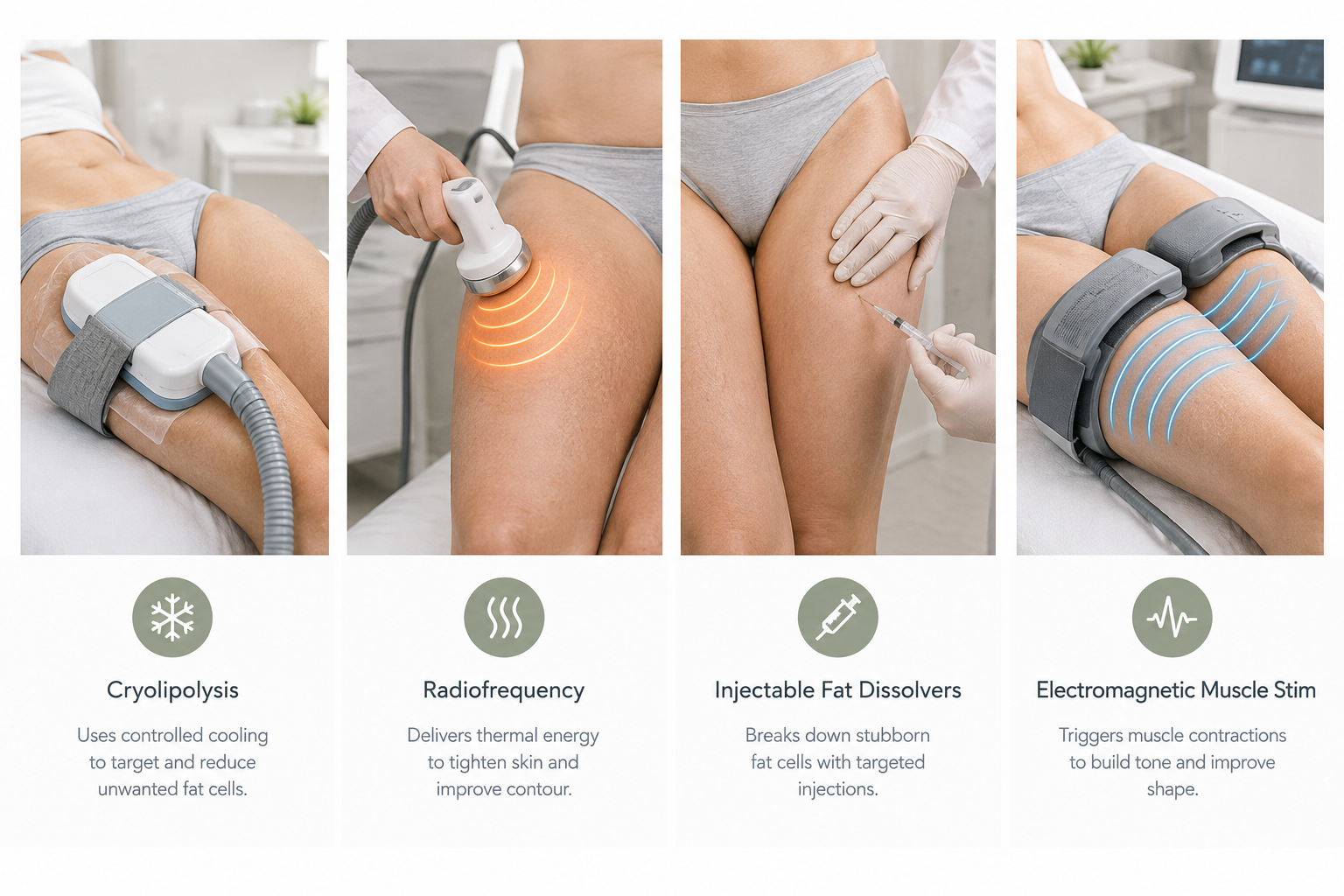
Cryolipolysis, widely known by the brand name CoolSculpting, uses controlled cooling to selectively damage and destroy fat cells in a targeted area. Fat cells are more sensitive to cold temperatures than surrounding skin and tissue. When exposed to precisely controlled cooling, fat cells undergo a process called apoptosis — a form of programmed cell death — and are gradually cleared by the body’s lymphatic system over the following weeks and months.
Cryolipolysis has been studied for use on the inner and outer thighs and may produce a measurable reduction in the fat layer in these areas. Clinical studies have generally reported a reduction in fat layer thickness in treated areas, though the degree of reduction varies between individuals. Multiple treatment sessions may be required to achieve the desired outcome, and results typically become visible over eight to twelve weeks as the body clears the treated fat cells.
Common side effects include temporary redness, swelling, bruising, numbness, and tingling in the treated area. A rare but recognised complication called paradoxical adipose hyperplasia — in which the treated area paradoxically increases in volume rather than decreasing — has been reported, though it is uncommon. Cryolipolysis is generally not suitable for individuals with cold-related conditions such as cryoglobulinaemia or cold agglutinin disease, and a thorough medical assessment is required before treatment.
Radiofrequency and High-Intensity Focused Ultrasound
Radiofrequency (RF) energy and high-intensity focused ultrasound (HIFU) are two additional non-surgical approaches used in body contouring. Radiofrequency devices deliver controlled heat energy into the deeper layers of the skin and subcutaneous fat, which may disrupt fat cells and stimulate collagen production, potentially improving both fat volume and skin laxity in the treated area. Some devices combine radiofrequency with other technologies such as vacuum suction or mechanical massage to enhance delivery.
High-intensity focused ultrasound targets fat cells at a specific depth using focused sound waves, generating heat that may destroy fat cells without affecting the overlying skin. Both technologies have been used on the thighs, though the evidence base for these specific applications varies, and results tend to be more modest than those achieved with cryolipolysis or surgical approaches. Multiple sessions are typically required, and improvements may take several months to become apparent.
Injectable Fat Dissolvers
Injectable fat dissolving treatments use substances that break down the membranes of fat cells, causing them to release their contents and be cleared by the body. Deoxycholic acid is the most established active ingredient in this category and is licensed for use in specific areas in certain countries. Other injectable formulations, including phosphatidylcholine-based products and newer preparations such as those marketed under brand names like Aqualyx or Lemon Bottle, are used in aesthetic practice, though their regulatory status and evidence base vary by country and product.
Fat dissolving injections for the thighs may be considered for small, localised deposits such as inner thigh fat. They are generally not appropriate for large volumes of fat and typically require a course of multiple treatment sessions spaced several weeks apart. Side effects commonly include swelling, bruising, redness, tenderness, and temporary firmness or nodularity in the treated area. These effects are usually temporary but can be pronounced, particularly in the days immediately following treatment. A thorough consultation is essential to assess suitability and to discuss realistic expectations.
Electromagnetic Muscle Stimulation
Devices such as Emsculpt use high-intensity focused electromagnetic (HIFEM) technology to induce powerful involuntary muscle contractions in the treated area. These supramaximal contractions are more intense than those achievable through voluntary exercise and are intended to build and strengthen muscle while also triggering some degree of fat reduction in the overlying tissue. Emsculpt Neo combines HIFEM technology with radiofrequency energy, aiming to address both muscle and fat simultaneously.
These devices have been used on the thighs and buttocks, and some clinical data suggest improvements in muscle tone and modest fat reduction in treated areas. However, electromagnetic muscle stimulation is primarily a muscle-building and body-shaping technology rather than a fat reduction treatment in the same sense as cryolipolysis or fat dissolving injections. It may be most relevant for individuals who want to improve thigh definition and tone alongside modest fat reduction, rather than those seeking significant volume reduction. Multiple sessions are required, and results vary.
Surgical Options for Thigh Fat Reduction
For individuals seeking more significant or predictable fat volume reduction in the thighs, surgical options may be discussed with a qualified plastic or cosmetic surgeon. Liposuction remains the most established surgical approach for removing localised subcutaneous fat deposits. During liposuction, a thin tube called a cannula is inserted through small incisions and used to suction out fat from the targeted area. The inner thighs, outer thighs, and the area around the knees are all areas where liposuction is commonly performed.
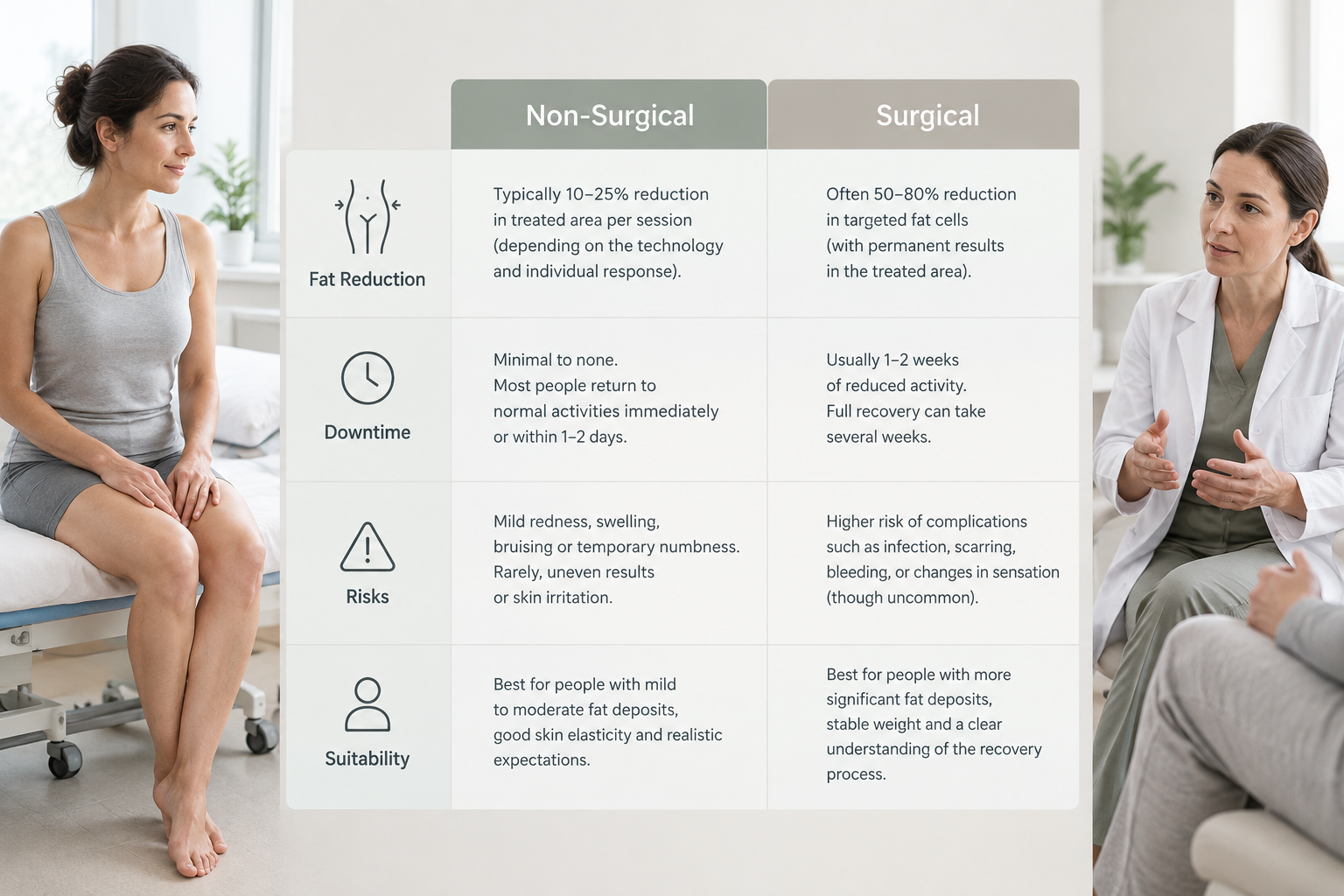
Liposuction can produce more substantial and immediate fat volume reduction than non-surgical alternatives, and results are generally more predictable in terms of the amount of fat removed. However, liposuction is a surgical procedure and carries risks including infection, bleeding, contour irregularities, skin changes, fluid accumulation, and anaesthesia-related complications. Recovery typically involves several days to weeks of restricted activity, compression garment use, and temporary swelling and bruising that may take months to fully resolve.
Thigh lift surgery, which removes excess skin and fat from the inner thigh, may be considered in cases where significant skin laxity accompanies fat excess — for example, following substantial weight loss. This is a more extensive procedure with a longer recovery and more visible scarring, and it is generally reserved for cases where skin redundancy is the primary concern rather than fat volume alone.
Surgical options are not appropriate for everyone and require a thorough assessment of overall health, weight stability, realistic expectations, and willingness to accept the associated risks and recovery demands. Weight stability before surgery is generally recommended, as significant weight gain after liposuction can cause fat to redistribute to other areas of the body.
Skin Laxity and the Thigh Area
An important consideration when addressing thigh fat is the condition of the overlying skin. Reducing fat volume — whether through lifestyle changes, non-surgical treatments, or surgery — does not automatically tighten the skin. In individuals with good skin elasticity, the skin may contract reasonably well following fat reduction. In those with reduced skin elasticity, which may be related to age, genetics, significant weight fluctuation, or sun damage, fat reduction can sometimes make skin laxity more apparent rather than less.
Some non-surgical body contouring treatments, particularly those using radiofrequency energy, are designed to stimulate collagen and elastin production alongside fat reduction, which may offer some degree of skin tightening. However, the degree of skin tightening achievable non-surgically is generally modest and may not be sufficient for individuals with significant laxity. Discussing skin quality alongside fat reduction goals during a consultation is important for setting realistic expectations.
Risks, Limitations, and Realistic Expectations
Every approach to thigh fat reduction — whether lifestyle-based, non-surgical, or surgical — carries limitations that are important to understand before committing to a course of treatment. Non-surgical body contouring treatments generally produce more gradual and modest results than surgery, require multiple sessions, and may not achieve the degree of change that some patients hope for. Results vary significantly between individuals depending on factors including the amount and distribution of fat, skin quality, age, and individual response to treatment.
Fat cells that are destroyed by non-surgical treatments or removed by liposuction do not regenerate. However, remaining fat cells can enlarge if caloric intake consistently exceeds energy expenditure, meaning that significant weight gain after treatment can diminish or reverse the results. Maintaining a stable weight through a balanced diet and regular physical activity is important for preserving the outcomes of any fat reduction treatment.
It is also worth noting that body contouring treatments are not treatments for obesity and are not intended to produce significant overall weight loss. They are designed to address localised fat deposits in individuals who are already at or near a healthy weight. Using these treatments as a substitute for addressing underlying lifestyle factors is unlikely to produce satisfactory long-term results.
Who May Be Suitable for Clinical Thigh Fat Reduction
Suitability for any clinical fat reduction treatment depends on a range of individual factors that can only be properly assessed during a face-to-face consultation with a qualified practitioner. In general, candidates who may benefit from non-surgical or surgical thigh fat reduction tend to share certain characteristics:
- They are at or close to a stable, healthy weight and are not seeking treatment as a weight loss solution.
- They have localised fat deposits in the inner or outer thighs that have not responded adequately to sustained lifestyle efforts.
- They have realistic expectations about the degree of improvement achievable and understand that results vary.
- They are in good general health without contraindications relevant to the specific treatment being considered.
- They are not pregnant or breastfeeding.
- They understand the potential risks, side effects, and recovery requirements associated with the chosen approach.

Individuals with certain medical conditions, those taking specific medications, or those with a history of relevant procedures may not be suitable for particular treatments. A thorough medical history review is an essential part of any pre-treatment assessment.
Frequently Asked Questions
Can you target thigh fat specifically with exercise?
Spot reduction through exercise is not supported by clinical evidence. Exercises that work the thigh muscles, such as squats, lunges, and leg presses, build and strengthen the underlying muscle but do not selectively burn the subcutaneous fat above them. Overall body fat reduction through a sustained caloric deficit is the mechanism through which thigh fat decreases with lifestyle changes.
How many sessions of non-surgical treatment are typically needed?
The number of sessions varies depending on the treatment type, the amount of fat being addressed, and the individual’s response. Cryolipolysis may require one to three sessions per area, while injectable fat dissolvers and radiofrequency treatments often require a course of three to six or more sessions. A practitioner will advise on a realistic treatment plan during consultation.
How long does it take to see results from non-surgical thigh contouring?
Non-surgical treatments generally produce gradual results. Cryolipolysis results typically become visible over eight to twelve weeks as the body clears treated fat cells. Injectable fat dissolvers and radiofrequency treatments may show progressive improvement over a similar or longer timeframe. Results are not immediate, and patience is required.
Will the fat come back after treatment?
Fat cells destroyed or removed by treatment do not regenerate. However, if overall body fat increases significantly due to sustained caloric excess, remaining fat cells in the thighs and elsewhere can enlarge, which may reduce or reverse the aesthetic improvement. Maintaining a stable weight after treatment helps preserve results.
Is liposuction the most effective option for thigh fat?
Liposuction generally allows for more substantial and predictable fat volume reduction than non-surgical alternatives, but it is a surgical procedure with associated risks, recovery demands, and costs. Whether it is the most appropriate option depends on the individual’s goals, anatomy, health status, and tolerance for surgical risk and downtime. Non-surgical options may be sufficient for those with smaller, more localised deposits.
Can thigh fat reduction improve cellulite?
Cellulite is caused by the structural arrangement of fibrous connective tissue bands beneath the skin, which pull the skin surface downward and create a dimpled appearance. Reducing fat volume may slightly improve the appearance of cellulite in some cases, but it does not address the underlying structural cause. Dedicated cellulite treatments exist separately and may be discussed alongside fat reduction options during a consultation.
Making an Informed Decision About Thigh Fat Reduction
Reducing thigh fat is achievable through a combination of approaches, but no single treatment offers a guaranteed or permanent solution for every individual. Lifestyle modification remains the foundation of any fat reduction effort and should be considered before or alongside clinical treatments. For those with localised, stubborn thigh fat that persists despite sustained lifestyle efforts, non-surgical body contouring treatments may offer a meaningful improvement, though results are gradual, variable, and dependent on individual factors.
Surgical options such as liposuction provide more substantial fat volume reduction but carry greater risks and require a more significant recovery commitment. The right approach depends on the amount of fat involved, skin quality, overall health, realistic expectations, and personal priorities regarding downtime and risk tolerance.
A consultation with a qualified aesthetic practitioner or plastic surgeon is the most reliable way to assess which options may be appropriate for your specific anatomy and goals. A responsible practitioner will take a thorough medical history, explain the realistic outcomes and limitations of each relevant option, and help you make a decision that is genuinely aligned with your health and aesthetic objectives rather than simply recommending the most expensive or intensive treatment available.