

Smile lines — the creases that run from the sides of the nose down toward the corners of the mouth — are one of the most common concerns patients raise in aesthetic consultations. They develop naturally with age, but their depth and visibility vary considerably depending on skin type, facial structure, sun exposure, and lifestyle. This article explains the main treatment options available, how each one works, what results may realistically be expected, and the factors worth considering before booking a consultation.
Key Takeaways
- Smile lines, also called nasolabial folds, deepen over time due to volume loss, collagen decline, and repeated facial movement — and different causes may respond better to different treatments.
- Dermal fillers are currently the most widely used clinical approach for reducing the appearance of deep nasolabial folds, though results are temporary and maintenance is required.
- Skin-quality treatments such as collagen stimulators, radiofrequency, and laser resurfacing may improve finer lines and skin texture around the mouth, but are less effective for deep structural folds.
- No single treatment eliminates smile lines permanently; realistic improvement rather than complete removal is the appropriate expectation for most patients.
- A qualified practitioner assessment is essential to identify the underlying cause and recommend the most appropriate approach for your anatomy and goals.
What Are Smile Lines and Why Do They Form?
Nasolabial folds are the natural skin folds that extend from the outer edges of the nostrils to the corners of the mouth. A degree of nasolabial folding is anatomically normal and present even in younger faces, particularly during smiling. The concern most patients describe is the deepening of these folds at rest, which can create a tired or aged appearance even when the face is relaxed.
Several overlapping factors contribute to this deepening. Subcutaneous fat in the mid-face diminishes with age, reducing the structural support beneath the skin. Collagen and elastin fibres — the proteins responsible for skin firmness and elasticity — decline progressively from the mid-twenties onward. Gravity causes soft tissue to descend, and the repeated movement of smiling, chewing, and speaking gradually etches creases into the skin surface. Sun damage accelerates collagen breakdown and contributes to skin laxity, making lines appear earlier and more prominently in people with significant cumulative UV exposure.
Understanding which of these mechanisms is most responsible for an individual’s smile lines is clinically important, because it directly influences which treatment approach is most likely to be useful. A deep fold caused primarily by mid-face volume loss will respond differently to treatment than a fine surface line caused by skin quality changes.
Dermal Fillers for Nasolabial Folds
Dermal fillers are the most commonly used injectable treatment for reducing the depth of nasolabial folds. Most fillers used in this area contain hyaluronic acid, a naturally occurring substance found in skin and connective tissue. When injected into or around the nasolabial fold, hyaluronic acid filler adds volume beneath the crease, softening its appearance from below rather than simply filling the surface line.
Practitioners may also address the mid-face — specifically the cheek and malar area — rather than injecting directly into the fold itself. Restoring volume higher in the face can lift soft tissue and reduce the depth of the nasolabial fold indirectly, which is often considered a more anatomically appropriate approach for patients whose primary issue is mid-face volume loss rather than a localised crease. The most suitable injection strategy depends on individual facial anatomy and is determined during a clinical assessment.
Results from hyaluronic acid fillers in the nasolabial area typically become visible within a few days once any initial swelling has settled. Duration varies between patients and depends on the specific product used, the volume injected, the individual’s metabolism, and the degree of facial movement in the area. Many patients find that results in the nasolabial region last between nine and eighteen months, though this varies. Because hyaluronic acid fillers are reversible using an enzyme called hyaluronidase, they are generally considered a lower-risk option compared with permanent or semi-permanent fillers, which carry a higher risk of long-term complications if problems arise.
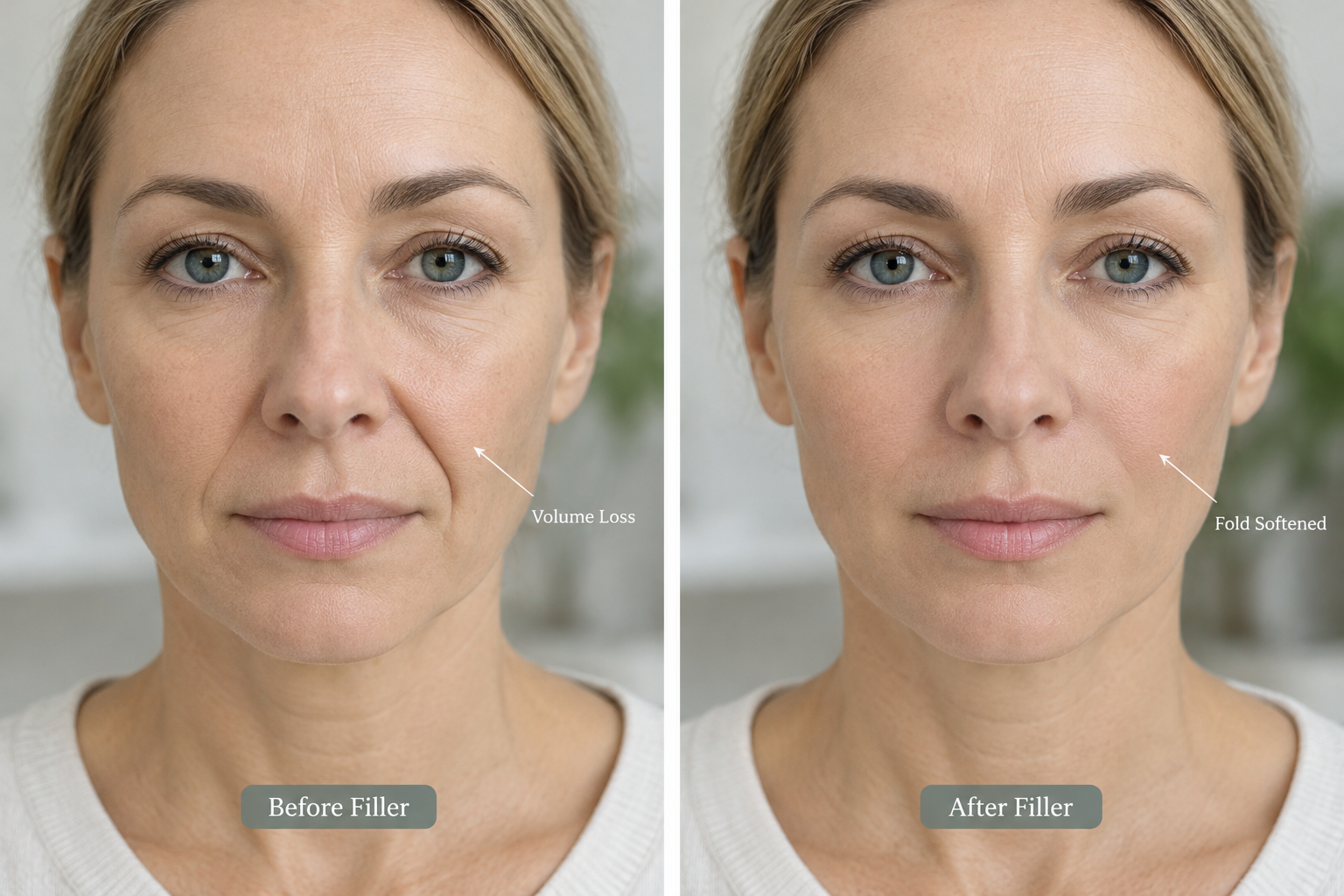
Common side effects after dermal filler treatment include temporary swelling, bruising, redness, and tenderness at the injection sites. These typically resolve within a few days to two weeks. More serious but less common risks include vascular occlusion — where filler inadvertently enters or compresses a blood vessel — which requires prompt treatment. Choosing a qualified and experienced practitioner who understands the relevant facial anatomy significantly reduces this risk, though it cannot be eliminated entirely.
Collagen Stimulators: A Longer-Term Approach
Collagen-stimulating injectables, such as those containing poly-L-lactic acid or calcium hydroxylapatite, work differently from hyaluronic acid fillers. Rather than providing immediate volume, these substances trigger the body’s own collagen production over a period of weeks to months. The result is a gradual improvement in skin thickness, firmness, and the appearance of lines, rather than an immediate volumising effect.
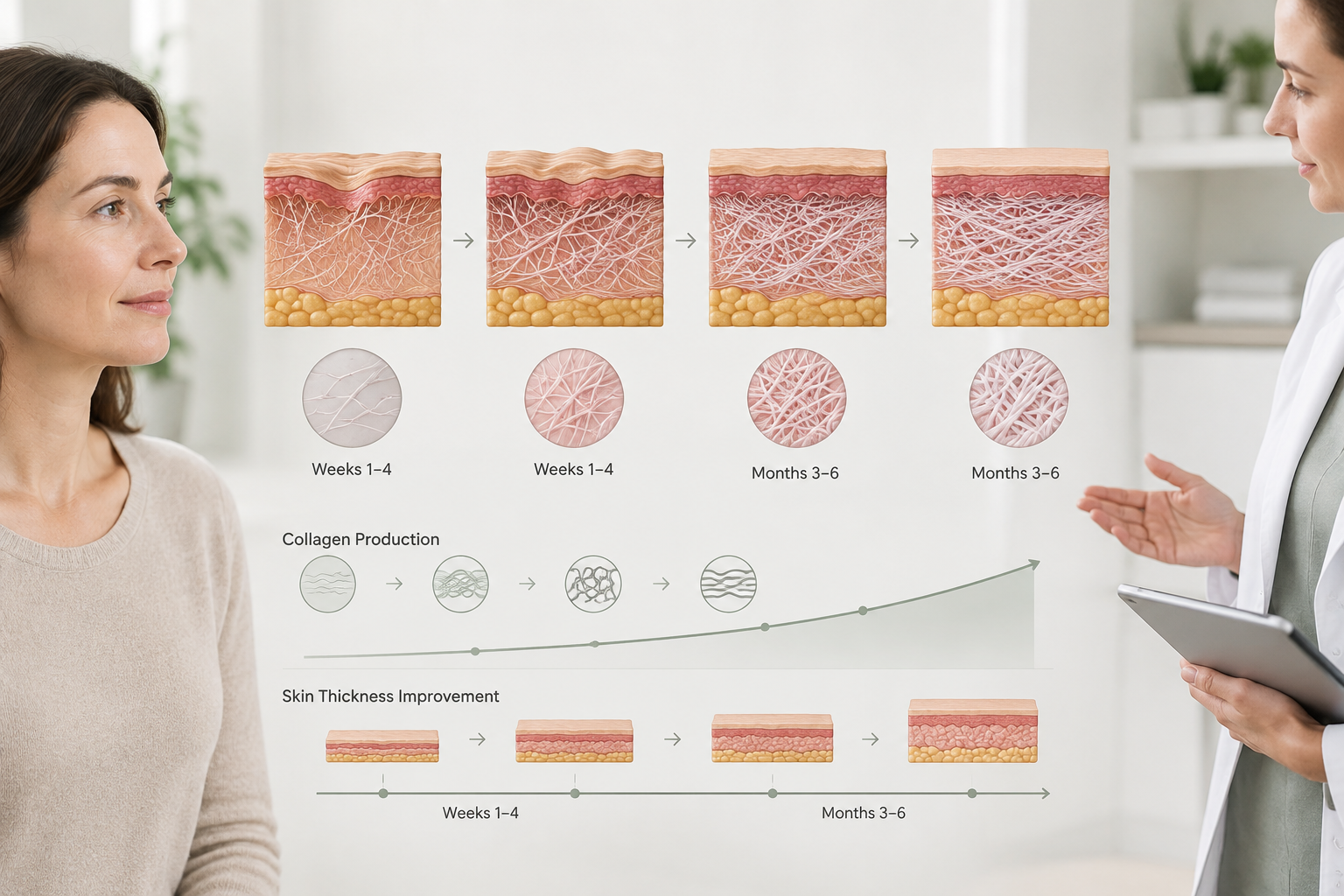
Poly-L-lactic acid, for example, is gradually absorbed by the body while stimulating new collagen formation in the treated area. Multiple treatment sessions are typically required, and visible improvement develops progressively over three to six months. The effects may last longer than standard hyaluronic acid fillers — in some cases up to two years or more — though individual responses vary and maintenance sessions are still likely to be needed over time.
Collagen stimulators may be particularly relevant for patients who want a more gradual, natural-looking improvement, or for those in whom immediate volumising is not the primary goal. They are not suitable for every patient, and a clinical assessment is needed to determine whether this approach is appropriate for a given individual’s anatomy and skin condition.
Botulinum Toxin: A Limited but Relevant Role
Botulinum toxin injections — commonly known by brand names such as Botox or Dysport — are frequently discussed in the context of facial lines, but their role in treating nasolabial folds specifically is limited. Botulinum toxin works by temporarily reducing muscle activity, which is effective for dynamic lines caused by repeated muscle contraction, such as forehead lines or crow’s feet. Nasolabial folds, however, are primarily structural — caused by volume loss and tissue descent rather than by a single overactive muscle — so botulinum toxin alone is rarely the most appropriate treatment for deep smile lines.
In some cases, a practitioner may use small amounts of botulinum toxin in muscles around the mouth or lower face to subtly adjust facial dynamics and reduce the forces that contribute to fold deepening. This is a nuanced technique that requires careful assessment, as over-treatment in this area can affect natural facial expression and function. Botulinum toxin is more commonly used alongside other treatments as part of a combined approach rather than as a standalone solution for nasolabial folds.
Skin Resurfacing and Energy-Based Treatments
For patients whose primary concern is fine lines and skin texture around the mouth rather than deep structural folds, skin resurfacing and energy-based treatments may offer meaningful improvement. These approaches work at the level of the skin itself rather than the underlying soft tissue.
Laser Resurfacing
Ablative laser treatments, such as fractional CO2 or erbium lasers, remove the outer layers of skin in a controlled manner, stimulating collagen remodelling and revealing smoother skin as healing occurs. Ablative laser resurfacing can produce significant improvement in fine perioral lines — the small lines around the mouth — and in overall skin texture. However, it involves a meaningful recovery period, typically one to two weeks of redness, swelling, and skin peeling, and carries risks including temporary or, rarely, longer-lasting changes in skin pigmentation. It is generally not suitable for all skin tones without careful assessment.
Non-ablative and fractional laser treatments cause less surface disruption and have shorter downtime, but typically produce more modest results that may require multiple sessions to achieve. The choice between ablative and non-ablative approaches depends on the degree of improvement needed, the patient’s skin type, and their tolerance for downtime.
Radiofrequency and Ultrasound Treatments
Radiofrequency (RF) devices and high-intensity focused ultrasound (HIFU) treatments deliver energy into the deeper layers of the skin and underlying tissue to stimulate collagen production and promote tissue tightening. These treatments are generally better suited to mild-to-moderate skin laxity and fine lines rather than deep nasolabial folds. Results develop gradually over two to six months as new collagen forms, and multiple sessions may be needed. Downtime is typically minimal, though some patients experience temporary redness or mild swelling. Evidence for these treatments continues to develop, and results vary considerably between individuals.
Chemical Peels
Chemical peels use acids — such as glycolic acid, trichloroacetic acid (TCA), or salicylic acid — to exfoliate the skin surface and stimulate renewal. Superficial and medium-depth peels can improve skin texture, fine lines, and uneven tone around the mouth area. They are unlikely to significantly reduce deep nasolabial folds but may complement other treatments as part of a broader skin health programme. Recovery depends on the depth of the peel, ranging from minimal peeling with superficial treatments to several days of visible skin shedding with medium-depth options.
Microneedling and Combination Approaches
Microneedling involves creating controlled micro-injuries in the skin using fine needles, which stimulates the skin’s natural healing response and collagen production. It can improve skin texture, fine lines, and overall skin quality in the perioral area. Radiofrequency microneedling — which combines microneedling with radiofrequency energy delivered through the needle tips — may offer additional skin tightening effects compared with standard microneedling alone. Results are typically gradual and cumulative, with a course of treatments usually recommended.
In clinical practice, combination approaches are common. A practitioner might recommend dermal filler to address volume loss and fold depth, alongside a skin-quality treatment such as radiofrequency or laser to improve the surrounding skin texture. The rationale is that different mechanisms contribute to smile line formation, and addressing more than one factor simultaneously may produce a more comprehensive result. Any combination plan should be discussed carefully with a qualified practitioner, as combining treatments also means combining their respective risks and recovery requirements.
Skincare and Preventive Measures
While topical skincare cannot reverse established deep nasolabial folds, certain ingredients may help slow the progression of fine lines and support overall skin health. Retinoids — vitamin A derivatives available in both prescription and over-the-counter formulations — have the most robust evidence for stimulating collagen production and improving fine lines with consistent long-term use. Broad-spectrum sun protection is arguably the most important preventive measure, as UV exposure is a major driver of collagen breakdown and premature skin ageing. Antioxidant serums containing vitamin C may help protect against oxidative damage and support collagen synthesis, though the evidence for topical antioxidants is less extensive than for retinoids.
Skincare alone is unlikely to produce significant improvement in established deep smile lines, but it plays a meaningful role in maintaining results after clinical treatments and in slowing future progression. A practitioner may recommend a tailored skincare regimen as part of an overall treatment plan.
Who May Be Suitable for Smile Line Treatments?
Suitability for any smile line treatment depends on a range of individual factors that a qualified practitioner will assess during a consultation. Generally, adults who are bothered by the depth or appearance of their nasolabial folds and who have realistic expectations about the degree of improvement achievable may be appropriate candidates for one or more of the treatments described above.
Certain factors may affect suitability or require additional consideration. These include active skin infections or inflammation in the treatment area, a history of severe allergic reactions, bleeding disorders or the use of blood-thinning medications, autoimmune conditions, pregnancy or breastfeeding, and a history of previous filler treatments in the same area. Patients with very thin skin, significant asymmetry, or complex facial anatomy may require a more cautious approach. A thorough medical history and facial assessment are essential before any treatment is undertaken.
Age is not a simple determinant of suitability. Younger patients with early, fine nasolabial lines may benefit from preventive skin-quality treatments and good skincare, while older patients with significant volume loss and tissue descent may require a more comprehensive approach involving volumising and potentially lifting strategies.
What to Expect During and After Treatment
The treatment experience varies depending on the approach chosen. Injectable treatments such as dermal fillers are typically performed in a clinic appointment lasting between thirty and sixty minutes. A topical anaesthetic cream is often applied beforehand to reduce discomfort, and many filler products contain lidocaine — a local anaesthetic — within the formulation. Most patients describe the sensation as mild pressure or a brief stinging feeling. Immediately after treatment, the area may appear slightly swollen or red, and bruising is possible. Most patients can return to normal activities the same day, though strenuous exercise and alcohol are usually advised against for twenty-four to forty-eight hours.
Energy-based treatments such as radiofrequency or laser resurfacing involve different sensations — often described as warmth or a snapping feeling — and recovery varies from minimal downtime with non-ablative devices to one to two weeks of visible skin healing with ablative laser treatments. A practitioner will explain what to expect for the specific treatment recommended.
Results from injectable treatments may be visible almost immediately, though final results are better assessed once swelling has fully resolved, usually within one to two weeks. Results from collagen-stimulating treatments and energy-based devices develop more gradually over weeks to months. Maintenance treatments are typically needed to sustain results over time, as no currently available non-surgical treatment for smile lines produces permanent correction.
Risks and Limitations to Consider
Every treatment carries potential risks, and smile line treatments are no exception. For injectable treatments, risks include bruising, swelling, asymmetry, lumpiness or irregularity, infection, and — in rare but serious cases — vascular complications. The risk of serious complications is significantly reduced when treatment is performed by a qualified practitioner with appropriate training and knowledge of facial anatomy, but cannot be eliminated entirely.

Energy-based treatments carry risks including burns, blistering, pigmentation changes, and scarring, particularly if settings are not appropriate for the individual’s skin type. Chemical peels can cause temporary redness, peeling, and sensitivity, and deeper peels carry a risk of pigmentation changes, particularly in darker skin tones.
A realistic understanding of limitations is equally important. Non-surgical treatments can soften and reduce the appearance of smile lines, but they cannot replicate the results of surgical procedures such as a facelift, which addresses tissue repositioning more comprehensively. For patients with significant skin laxity and tissue descent, non-surgical options may produce only modest improvement, and a surgical consultation may be worth considering.
Frequently Asked Questions
Can smile lines be permanently removed without surgery?
No currently available non-surgical treatment permanently removes nasolabial folds. Injectable fillers, collagen stimulators, and energy-based treatments can reduce their appearance, but results are temporary and maintenance is required. Surgical options such as a facelift can produce longer-lasting structural changes, but also carry greater risks and recovery requirements.
How many filler sessions are needed for smile lines?
Many patients achieve a satisfactory result from a single dermal filler session, though the volume required and whether a top-up is needed depends on the depth of the fold and the individual’s anatomy. Maintenance treatments are typically needed every nine to eighteen months as the filler gradually breaks down, though this varies between patients and products.
Does treating smile lines look natural?
When performed by an experienced practitioner using an appropriate volume and technique, dermal filler treatment for nasolabial folds can produce a natural-looking softening of the crease. Overfilling or incorrect placement can result in an unnatural appearance, which is one reason why practitioner selection and a conservative approach are important. Results should enhance rather than dramatically alter facial appearance.
At what age do smile lines typically become a concern?
Nasolabial folds begin to deepen gradually from the mid-thirties onward for many people, though this varies considerably depending on genetics, sun exposure, skin type, and lifestyle factors. Some individuals notice deepening earlier, particularly with significant weight fluctuation or high cumulative sun exposure. There is no single age at which treatment becomes appropriate; this is an individual decision based on personal concern and clinical assessment.
Can exercise or facial massage reduce smile lines?
There is limited clinical evidence that facial exercises or massage meaningfully reduce established nasolabial folds. Some proponents suggest that facial muscle exercises may improve muscle tone and skin appearance, but robust clinical data supporting significant fold reduction through these methods is lacking. Maintaining general skin health through good skincare, sun protection, and hydration is more reliably supported.
Is it safe to have filler in the nasolabial area?
Dermal filler treatment in the nasolabial area is considered relatively safe when performed by a qualified and experienced practitioner. The area has a well-understood vascular anatomy, and serious complications such as vascular occlusion are uncommon but possible. Choosing a practitioner with appropriate medical training and a clear understanding of how to manage complications is the most important safety consideration.
What is the difference between smile lines and marionette lines?
Smile lines (nasolabial folds) run from the sides of the nose to the corners of the mouth. Marionette lines extend downward from the corners of the mouth toward the chin. Both are related to age-related volume loss and tissue descent, but they are anatomically distinct and may require different treatment approaches. A practitioner will assess both areas during a facial consultation.
Choosing the Right Approach for Your Smile Lines
Getting rid of smile lines entirely is not a realistic expectation from any non-surgical treatment, but meaningful, natural-looking improvement is achievable for many patients. The most appropriate treatment depends on the underlying cause — whether volume loss, skin laxity, surface texture changes, or a combination — and on individual anatomy, skin type, and personal goals.
Dermal fillers remain the most established non-surgical option for reducing the depth of nasolabial folds, with a well-documented safety profile when administered by qualified practitioners. Collagen stimulators, energy-based devices, and skin resurfacing treatments each have a role depending on the specific concern being addressed. A combination approach tailored to the individual often produces the most balanced result.
If you are considering treatment for smile lines, a consultation with a qualified aesthetic practitioner — ideally one with a medical background and experience in facial anatomy — is the appropriate starting point. A thorough assessment of your facial structure, skin condition, and goals will allow a practitioner to recommend the most suitable options and set realistic expectations for what treatment may achieve.