

Excess fat beneath the chin and along the neck — often called a double chin or submental fat — is a common concern that can be difficult to address through diet and exercise alone. Genetics, age-related changes, and shifts in body composition all play a role, which is why many people find that even significant weight loss does not fully resolve the appearance of neck fullness. This article explains the main options available for reducing neck fat, how each approach works, who may be suitable, and what realistic results look like.
Key Takeaways
- Submental fat (fat beneath the chin and along the neck) can be resistant to diet and exercise due to genetic and anatomical factors.
- Non-surgical options such as fat-dissolving injections and cryolipolysis may reduce localised neck fat, though results vary and multiple sessions are often needed.
- Skin laxity, muscle banding, and overall body weight all influence the final appearance of the neck and may need to be addressed separately.
- Surgical options such as liposuction or a neck lift offer more significant and longer-lasting results but carry greater risks and recovery time.
- A clinical assessment is essential to determine which approach, or combination of approaches, is appropriate for your anatomy and goals.
Why Neck Fat Can Be Difficult to Reduce
Submental fat — the layer of fat that sits beneath the chin and in front of the neck — is a distinct anatomical compartment. Like fat in other areas such as the lower abdomen or inner thighs, it can be disproportionately resistant to caloric restriction. This is partly because fat distribution is strongly influenced by genetics and hormonal factors rather than simply by overall body weight. Some individuals carry a noticeable amount of submental fat even at a healthy weight, while others may find that weight gain preferentially accumulates in this area.
Age also plays a role. As skin loses collagen and elastin over time, it becomes less able to retract after volume changes. This means that even if fat is reduced, loose or crepey skin may remain — a factor that significantly affects which treatment options are appropriate. Platysmal banding, where the vertical neck muscles become more prominent with age, can further contribute to the appearance of a heavy or undefined neck, and this is a separate concern from fat alone.
Understanding the underlying cause of neck fullness is the first step in choosing an effective approach. A qualified practitioner will assess whether the concern is primarily fat, skin laxity, muscle tone, overall weight, or a combination of these factors before recommending any treatment.
Lifestyle Changes: What They Can and Cannot Achieve
Sustained caloric deficit through a balanced diet and regular physical activity remains the foundation of overall fat reduction, and this includes fat in the neck and chin area. If submental fullness is partly related to higher overall body weight, meaningful weight loss may produce a visible improvement in neck contour. Cardiovascular exercise and resistance training support fat loss and can improve overall body composition, which may indirectly benefit the neck area.
However, it is not possible to target fat loss in a specific area through exercise — a concept sometimes called spot reduction. Exercises that work the neck or jaw muscles may improve muscle tone but will not selectively burn the fat layer beneath the chin. For individuals whose submental fat is primarily genetic or who are already at a healthy weight, lifestyle changes alone are unlikely to produce a significant change in neck contour. In these cases, clinical treatments may be worth discussing with a qualified practitioner.
Non-Surgical Treatments for Neck Fat
Several non-surgical or minimally invasive treatments are used to reduce localised fat deposits in the neck and chin area. Each works through a different mechanism, carries different risks, and suits different patient profiles. None of these treatments are substitutes for weight management, and none are appropriate for individuals seeking general weight loss.
Fat-Dissolving Injections
Fat-dissolving injections use a solution — commonly containing deoxycholic acid or a phosphatidylcholine-based compound — that is injected directly into the submental fat layer. Deoxycholic acid is a bile acid that disrupts the membrane of fat cells, causing them to break down. The body then gradually clears the released fat through its natural metabolic processes over several weeks. In the UK and many other markets, products such as Aqualyx are used for this purpose, while deoxycholic acid (marketed as Kybella in the United States) has regulatory approval specifically for submental fat reduction in that market.
Fat-dissolving injections for the neck and chin area typically require a course of two to four sessions, spaced four to six weeks apart, though the number of sessions depends on the volume of fat present and the individual’s response. Results develop gradually over several weeks after each session as the body processes the disrupted fat cells. Once fat cells are destroyed, they do not regenerate, so results in treated areas can be long-lasting provided overall body weight remains stable.
Common side effects include swelling, redness, bruising, and tenderness at the injection sites, which can be pronounced in the days following treatment. Numbness or firmness beneath the skin may persist for several weeks. Rare but more serious risks include nerve injury affecting the marginal mandibular nerve, which can cause temporary weakness of the lower lip, and skin irregularities. Treatment should only be performed by a trained and experienced practitioner who is familiar with the anatomy of the submental region.
Fat-dissolving injections are generally most suitable for individuals with a moderate, well-defined pocket of submental fat and reasonably good skin elasticity. They are less appropriate for those with significant skin laxity, as reducing the fat volume without addressing loose skin may worsen the appearance of sagging.
Cryolipolysis (Fat Freezing)
Cryolipolysis — commonly known by the brand name CoolSculpting — uses controlled cooling to selectively damage fat cells without harming the overlying skin. When fat cells are exposed to precise low temperatures, they undergo a process called apoptosis (programmed cell death) and are gradually eliminated by the body over the following weeks and months. Specific applicators designed for the chin and submental area are available, making cryolipolysis a recognised option for neck fat reduction.
A single cryolipolysis session for the submental area typically lasts around 35 to 45 minutes. Some individuals see a meaningful reduction after one session, while others may benefit from a second treatment. Results generally become visible over two to three months as the body clears the treated fat cells. As with fat-dissolving injections, results can be durable if body weight remains stable, since the treated fat cells are permanently removed.
Side effects include temporary redness, swelling, bruising, and numbness in the treated area. A rare but recognised complication called paradoxical adipose hyperplasia — where the treated area paradoxically increases in volume rather than decreasing — has been reported with cryolipolysis. This complication appears to be uncommon but is worth discussing with a practitioner before treatment. Cryolipolysis is not suitable for individuals with certain cold-related conditions such as cryoglobulinaemia or cold agglutinin disease.
Ultrasound-Based Treatments
High-intensity focused ultrasound (HIFU) and ultrasound cavitation are sometimes used in the neck area, though their primary application in aesthetic medicine is skin tightening rather than fat reduction. HIFU delivers focused ultrasound energy to specific tissue depths, stimulating collagen production and causing tissue contraction. This can improve skin laxity in the neck and jawline area, which may complement fat reduction treatments. Ultrasonic cavitation uses lower-frequency ultrasound to disrupt fat cell membranes, though the evidence for its effectiveness in the submental area specifically is less robust than for injectable or cryolipolysis-based approaches.
HIFU treatments for the neck and lower face are generally well tolerated, with minimal downtime, though some individuals experience temporary discomfort, redness, or mild swelling. Results from HIFU develop gradually over two to three months as new collagen forms, and maintenance treatments may be needed over time. HIFU is not a fat reduction treatment in the same sense as fat-dissolving injections or cryolipolysis, but it may be a useful adjunct for individuals whose primary concern is skin laxity alongside mild submental fullness.
Radiofrequency Treatments
Radiofrequency (RF) energy is used in a range of aesthetic devices to heat the deeper layers of the skin and underlying tissue, stimulating collagen remodelling and producing a degree of skin tightening. Some RF devices are also used to target fat cells through thermal disruption. In the context of neck fat, RF treatments are more commonly used to address skin laxity and improve overall neck contour rather than to produce significant fat volume reduction. They may be used as a standalone treatment or in combination with other approaches.
RF treatments are generally low-downtime procedures, with temporary redness and warmth being the most common immediate effects. Results are typically gradual and may require a course of sessions. The degree of fat reduction achievable with RF alone is generally modest, and individuals with a significant volume of submental fat are unlikely to achieve their goals through RF treatment alone.
Addressing Skin Laxity Alongside Fat Reduction
One of the most important considerations when planning neck fat reduction is the condition of the overlying skin. Reducing the volume of fat beneath the chin without adequate skin retraction can result in loose, sagging skin — sometimes described as a turkey neck appearance — which may be more noticeable than the original concern. This is particularly relevant for older patients, those who have experienced significant weight fluctuations, or those with naturally thinner or less elastic skin.

Practitioners will typically assess skin elasticity before recommending any fat reduction treatment. In individuals with good skin tone, the skin may retract adequately after fat reduction, producing a smoother contour. In those with reduced elasticity, a combined approach — addressing both fat and skin laxity — may produce a better outcome. Skin-tightening treatments such as HIFU, radiofrequency, or, in more significant cases, surgical procedures may be recommended alongside or instead of fat reduction treatments.
Surgical Options for Neck Fat Reduction
For individuals with a larger volume of submental fat, significant skin laxity, or those who have not achieved satisfactory results with non-surgical approaches, surgical options may be worth discussing with a qualified plastic or cosmetic surgeon.
Liposuction of the Neck and Chin
Submental liposuction involves the surgical removal of fat from beneath the chin and along the neck through small incisions. It is one of the most established and effective methods for reducing neck fat and can produce significant, long-lasting improvements in neck contour. The procedure is typically performed under local anaesthesia with sedation or general anaesthesia, depending on the extent of treatment and the patient’s preference.
Recovery from submental liposuction generally involves swelling, bruising, and some discomfort for one to two weeks, with most patients returning to normal activities within a week or two. A compression garment is usually worn for several weeks to support healing and encourage skin retraction. Final results may take three to six months to fully develop as swelling resolves and the skin adapts. As with non-surgical fat reduction, results are long-lasting provided body weight remains stable, since the removed fat cells do not return.
Risks associated with submental liposuction include infection, scarring, contour irregularities, skin changes, and nerve injury. Choosing a qualified and experienced surgeon and having a thorough pre-operative assessment significantly reduces but does not eliminate these risks.
Neck Lift
A neck lift (platysmaplasty or lower rhytidectomy) is a surgical procedure that addresses both excess fat and skin laxity in the neck. It may involve liposuction, tightening of the platysma muscle, and removal of excess skin. A neck lift produces more comprehensive and longer-lasting results than non-surgical treatments, particularly for individuals with significant skin sagging or muscle banding. However, it carries greater surgical risks, requires general anaesthesia, and involves a longer recovery period — typically two to four weeks before returning to most normal activities, with full recovery taking several months.
A neck lift is generally considered when non-surgical treatments are unlikely to achieve the desired outcome, particularly in older patients or those with substantial skin excess. It is a significant surgical procedure and requires careful consideration of the risks, recovery, and realistic expectations.
Who May Be Suitable for Neck Fat Treatments
Suitability for any neck fat reduction treatment depends on a range of individual factors. Non-surgical treatments such as fat-dissolving injections or cryolipolysis may be appropriate for individuals who have a localised, pinchable deposit of submental fat, are at or near a stable healthy weight, have reasonable skin elasticity, and have realistic expectations about the degree of improvement achievable without surgery.
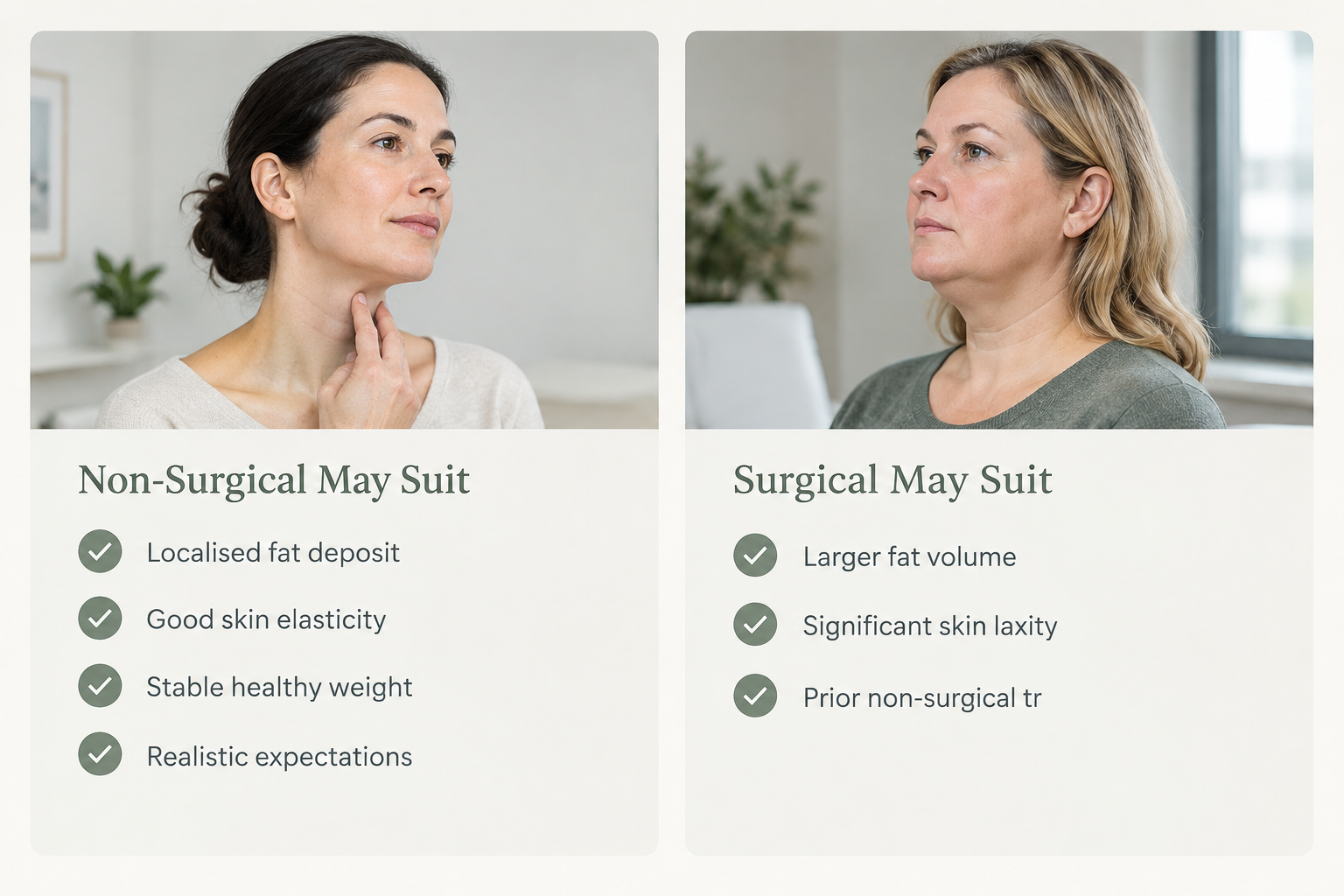
Surgical options may be more appropriate for those with a larger volume of fat, significant skin laxity, or those who have not responded adequately to non-surgical approaches. Individuals who are significantly overweight are generally advised to achieve a stable, healthier weight before considering any fat reduction procedure, as further weight changes can affect results.
Certain medical conditions, medications, pregnancy, breastfeeding, active skin infections, or a history of specific conditions affecting the treatment area may affect suitability for particular treatments. A thorough consultation with a qualified practitioner is essential before proceeding with any approach.
Frequently Asked Questions
Can exercise get rid of neck fat?
Exercise supports overall fat loss and can improve body composition, which may reduce submental fullness if it is related to higher overall body weight. However, it is not possible to target fat loss in a specific area through exercise alone. For individuals whose neck fat is primarily genetic or who are already at a healthy weight, exercise is unlikely to produce a significant change in neck contour without additional intervention.
How many sessions of fat-dissolving injections are needed for the neck?
Most individuals require between two and four sessions of fat-dissolving injections in the submental area, spaced four to six weeks apart. The exact number depends on the volume of fat present and how the individual responds to treatment. A practitioner will reassess after each session before recommending further treatment.
Is neck fat reduction permanent?
Treatments that destroy or remove fat cells — such as fat-dissolving injections, cryolipolysis, and liposuction — produce results that can be long-lasting, since the treated fat cells do not regenerate. However, remaining fat cells in the area can still enlarge with weight gain, and overall body weight changes will affect the result. Skin-tightening treatments typically require maintenance over time as the natural ageing process continues.
Will reducing neck fat leave loose skin?
This depends on the individual’s skin elasticity and the volume of fat reduced. Younger patients and those with good skin tone are more likely to experience adequate skin retraction after fat reduction. Older patients or those with reduced skin elasticity may find that skin laxity becomes more noticeable after fat reduction, in which case a combined approach addressing both fat and skin may produce a better outcome.
What is the difference between a double chin and neck fat?
A double chin typically refers specifically to the fold of fat beneath the chin in the submental area. Neck fat is a broader term that may include fat along the sides and front of the neck. Both can be addressed with similar treatments, though the specific anatomy and distribution of fat will influence which approach is most appropriate.
Are fat-dissolving injections or cryolipolysis better for neck fat?
Both fat-dissolving injections and cryolipolysis can be effective for submental fat reduction, and neither is universally superior. Fat-dissolving injections allow more precise targeting of small or irregularly shaped fat deposits, while cryolipolysis may suit those who prefer to avoid injections. The best option depends on the individual’s anatomy, the volume of fat, skin condition, and personal preference. A practitioner can advise on which approach is more likely to suit a particular patient.
Making an Informed Decision About Neck Fat Reduction
Reducing neck fat is achievable for many people, but the most appropriate approach depends heavily on the underlying cause of the fullness, the volume of fat present, skin quality, and individual goals. Non-surgical treatments such as fat-dissolving injections and cryolipolysis offer meaningful options for those with localised submental fat and good skin elasticity, with the advantage of minimal downtime and no surgical risk. However, they require realistic expectations: results develop gradually, multiple sessions are often needed, and the degree of improvement is generally more modest than surgical alternatives.
Surgical options such as submental liposuction or a neck lift can produce more significant and comprehensive results, particularly for those with larger fat volumes or skin laxity, but they carry greater risks and require a longer recovery. Skin-tightening treatments may be a useful complement to fat reduction for those with mild to moderate laxity who are not ready for or do not require surgery.
The most important first step is a thorough consultation with a qualified and experienced practitioner who can assess your anatomy, discuss your goals honestly, and recommend an approach — or combination of approaches — that is appropriate for your individual situation. Treatments that are well-matched to the patient’s anatomy and expectations are far more likely to produce a satisfying outcome than those chosen without proper assessment.