

Losing a significant amount of weight is a meaningful health achievement, but many people find that the skin does not automatically spring back once the underlying fat is reduced. Understanding why loose skin develops after weight loss — and what can realistically be done about it — helps you set informed expectations and make better decisions about your skin health, both during and after your slimming journey.
Key Takeaways
- Skin elasticity depends on collagen and elastin levels, which are influenced by age, genetics, the amount of weight lost, and how quickly it was lost.
- Gradual, sustained weight loss gives the skin more time to adapt compared with rapid loss, and may reduce the degree of skin laxity.
- Lifestyle factors including nutrition, hydration, resistance exercise, and sun protection all play a supporting role in maintaining skin quality during weight loss.
- Non-surgical skin tightening treatments may offer modest improvement for mild to moderate laxity, but results vary and no non-surgical option fully replicates the outcome of surgical skin removal for significant excess skin.
- A clinical assessment is necessary to determine which approach — lifestyle, non-surgical, or surgical — is appropriate for your individual situation.
Why Skin Becomes Loose After Weight Loss
Skin is a living organ with a remarkable capacity to stretch and contract, but that capacity has limits. When body weight increases over months or years, the skin gradually expands to accommodate the larger volume beneath it. During this expansion, the structural proteins responsible for firmness — primarily collagen and elastin — are stretched and, over time, may become damaged or reduced in quantity. When the fat that was supporting the skin from within is then lost through dieting or exercise, the skin does not always retract fully, leaving a degree of laxity or sagging.
The extent of loose skin after weight loss is not the same for everyone. Several biological and lifestyle factors determine how well the skin rebounds. Age is one of the most significant: collagen production naturally declines from the mid-twenties onward, and elastin fibres become less resilient with time, meaning older individuals generally experience more noticeable skin laxity after significant weight loss. Genetics also play a role, influencing baseline skin thickness, collagen density, and the skin’s inherent elasticity. The total amount of weight lost matters considerably — losing 10 kilograms is unlikely to produce the same degree of loose skin as losing 50 kilograms or more. The speed of weight loss is equally important, as rapid loss through very low-calorie diets or bariatric surgery gives the skin less time to adapt compared with gradual, sustained reduction.
Sun exposure history, smoking, and chronic dehydration can all impair collagen integrity and reduce the skin’s ability to contract after weight loss. These factors are worth understanding because some of them are modifiable, meaning that choices made before, during, and after a weight loss programme can genuinely influence the skin outcome.
The Role of Collagen and Elastin in Skin Firmness
Collagen is the most abundant structural protein in the skin and provides tensile strength — the resistance that prevents skin from tearing or sagging under its own weight. Elastin, as the name suggests, gives skin its elastic recoil, allowing it to return to its original position after being stretched. Together, these proteins form the dermal scaffold that determines how firm and resilient the skin appears and feels.
When skin is stretched over a prolonged period, the collagen fibres within the dermis can become disorganised and partially degraded. Elastin fibres, once significantly damaged, do not regenerate efficiently. This is why skin that has been stretched for years — as is common with long-standing obesity — may not fully retract even after the weight is lost. The dermis has effectively been remodelled in a way that reduces its capacity for elastic recoil.
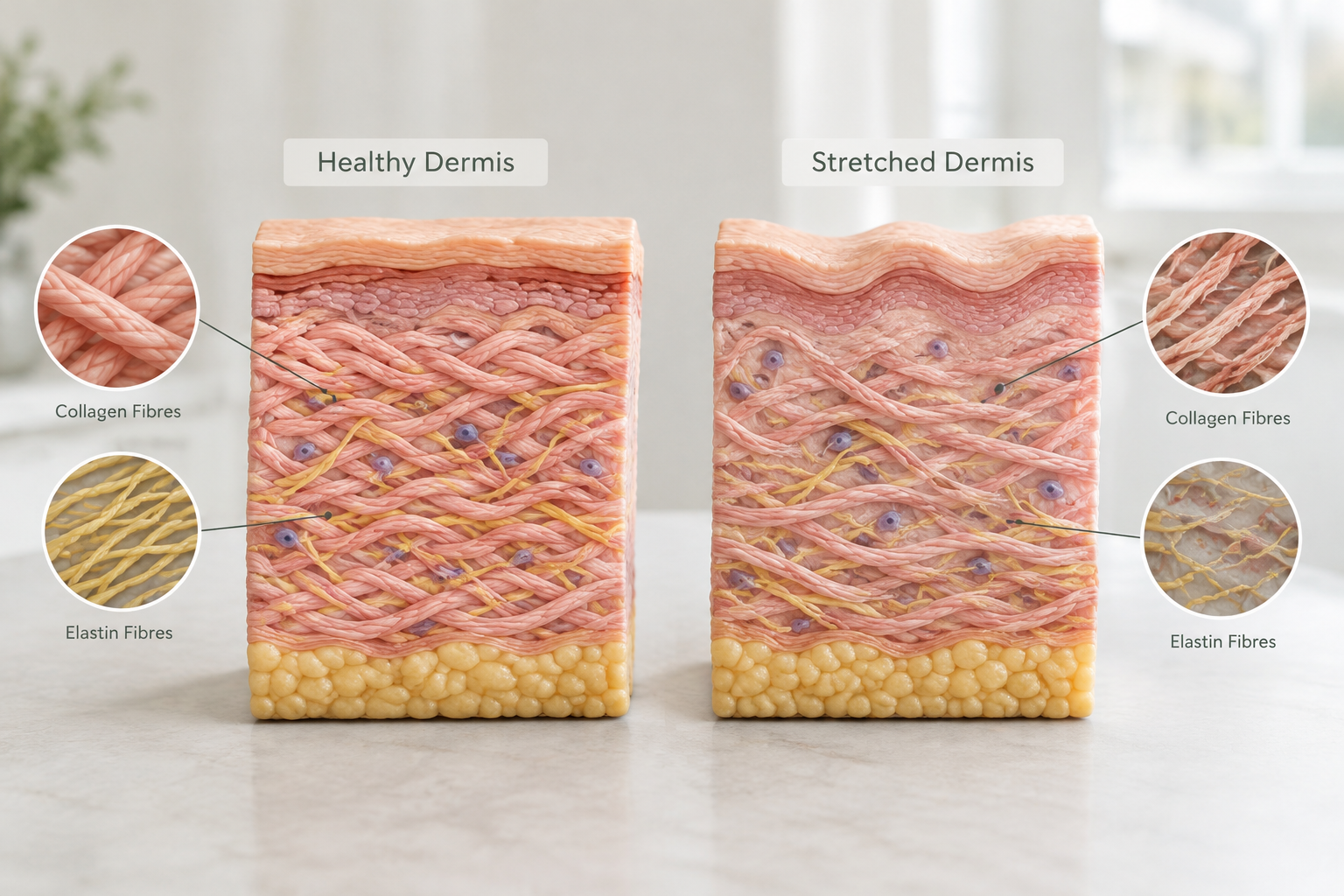
Stimulating new collagen production is therefore a central goal of many skin tightening strategies, whether through lifestyle measures or clinical treatments. It is important to understand that collagen remodelling is a slow biological process. Even with effective interventions, meaningful improvement in skin firmness typically takes several months to become visible, and results are rarely dramatic in cases of significant laxity.
Lifestyle Strategies That May Support Skin Elasticity
While no lifestyle measure can guarantee tight skin after major weight loss, several evidence-informed habits may support the skin’s ability to adapt during and after a slimming programme. These strategies are most effective when implemented consistently throughout the weight loss process rather than only after laxity has already developed.
Pace Your Weight Loss
Gradual weight loss — generally considered to be around 0.5 to 1 kilogram per week — gives the skin more time to contract incrementally as the underlying fat volume decreases. Very rapid weight loss, such as that achieved through extreme caloric restriction or some surgical interventions, tends to produce more pronounced skin laxity because the skin cannot adapt quickly enough. If you are planning a weight loss programme, discussing a sustainable rate of loss with a healthcare professional is worthwhile both for metabolic health and for skin outcomes.
Resistance Training
Building and maintaining lean muscle mass through resistance exercise serves two purposes in the context of skin laxity. First, muscle tissue beneath the skin provides a degree of structural support, helping to fill the space left by lost fat and reducing the appearance of loose skin. Second, resistance training has been associated with improvements in skin thickness and collagen content in some research, though the evidence in the context of post-weight-loss skin specifically remains limited. Incorporating progressive resistance training alongside a caloric deficit is generally recommended as part of a comprehensive body composition approach.
Nutrition and Hydration
Adequate protein intake is important for collagen synthesis. The body requires amino acids — particularly glycine, proline, and hydroxyproline — to produce collagen, and these are obtained primarily from dietary protein sources. Vitamin C is an essential cofactor in collagen production and is found in fruits and vegetables. Zinc and copper also contribute to collagen cross-linking and skin repair. Staying well hydrated supports overall skin plumpness and may help maintain the appearance of skin tone during weight loss. While no specific supplement has been proven to prevent loose skin after weight loss, a balanced diet that supports collagen synthesis is a reasonable foundation.
Sun Protection and Smoking Cessation
Ultraviolet radiation is one of the most well-documented causes of collagen degradation in the skin. Chronic sun exposure accelerates the breakdown of collagen and elastin fibres, reducing the skin’s capacity for recoil. Using broad-spectrum sun protection consistently is a practical measure to preserve existing collagen during a weight loss programme. Smoking impairs blood flow to the skin, reduces collagen production, and accelerates skin ageing — all of which worsen skin laxity outcomes. Stopping smoking before or during weight loss may meaningfully support skin quality.
Topical Skincare
Topical products containing retinoids, peptides, or hyaluronic acid are widely marketed for skin firming, but their ability to significantly improve established skin laxity after weight loss is limited. Retinoids (vitamin A derivatives) have the strongest evidence for stimulating collagen production in the dermis, but their effect on loose skin after major weight loss is modest at best. Topical skincare may support overall skin quality and hydration, and is a reasonable adjunct to other strategies, but should not be expected to replace clinical or surgical intervention in cases of significant excess skin.
Non-Surgical Skin Tightening Treatments
For individuals with mild to moderate skin laxity after weight loss, a range of non-surgical treatments may offer some degree of improvement. These treatments work primarily by stimulating collagen production and remodelling within the dermis, which gradually improves skin firmness over several weeks to months. It is important to understand that non-surgical options are generally more appropriate for early or mild laxity and are unlikely to produce results comparable to surgical skin removal in cases of significant excess skin.
Radiofrequency Treatments
Radiofrequency (RF) energy delivers controlled heat to the deeper layers of the skin, causing immediate collagen contraction and stimulating longer-term collagen remodelling. RF treatments are available in several forms, including monopolar, bipolar, and multipolar devices, as well as microneedling radiofrequency systems that combine RF energy with micro-injuries to enhance collagen stimulation. Clinical studies suggest that RF treatments can produce modest improvements in skin laxity on the face, neck, abdomen, and thighs, though results vary considerably between individuals. Multiple sessions are typically required, and improvements continue to develop over three to six months following treatment. RF treatments are generally well tolerated, with temporary redness and mild swelling as the most common side effects.
High-Intensity Focused Ultrasound (HIFU)
High-intensity focused ultrasound delivers precise thermal energy to targeted depths within the skin and the superficial muscular aponeurotic system (SMAS) layer beneath it. This stimulates collagen production and can produce a degree of tissue lifting and tightening. HIFU is most commonly used on the face and neck but is also applied to body areas including the abdomen and inner thighs. Results typically develop gradually over two to three months and may last up to a year or longer in some patients, though individual response varies. The treatment can cause discomfort during the procedure, and temporary redness, swelling, or tingling may occur afterward.
Laser Skin Tightening
Certain laser technologies, including fractional laser resurfacing and non-ablative infrared lasers, can stimulate dermal collagen remodelling and improve skin texture and mild laxity. Fractional laser treatments create microscopic zones of controlled thermal injury in the skin, triggering a wound-healing response that produces new collagen. These treatments may be useful for improving skin quality and mild laxity, particularly on the abdomen or arms after moderate weight loss. Downtime varies depending on the laser type and intensity used, ranging from minimal redness with non-ablative approaches to several days of recovery with more aggressive fractional treatments.
Body Contouring Devices
Some body contouring technologies combine fat reduction with skin tightening mechanisms. Devices that use radiofrequency, infrared light, or ultrasound alongside mechanical massage or suction may offer modest improvements in skin laxity alongside body contouring. It is important to distinguish between fat reduction, body contouring, and genuine skin tightening — these are different outcomes, and not all devices that reduce fat volume will meaningfully tighten loose skin. A qualified practitioner can help clarify what a specific device is realistically likely to achieve for your individual concern.
Polynucleotides and Biostimulators
Injectable biostimulators, including polynucleotides and products such as Sculptra (poly-L-lactic acid), work by stimulating the body’s own collagen production over time. Polynucleotides are fragments of purified DNA that have been shown in clinical studies to support tissue regeneration and improve skin quality. These injectable treatments are increasingly used for skin laxity on the face, neck, and décolletage, and interest in their use for body skin laxity is growing, though evidence for body applications remains more limited. Results develop gradually over several weeks to months and typically require a course of treatments. These options may be worth discussing with a practitioner if you are looking for a non-surgical approach to improving skin quality after weight loss.
When Non-Surgical Treatments May Not Be Enough
Non-surgical skin tightening treatments have meaningful limitations. They work best for mild to moderate laxity in patients with reasonable skin quality and elasticity. In cases of significant excess skin — such as that commonly seen after bariatric surgery or very large weight loss — the degree of skin redundancy is typically beyond what any non-surgical technology can adequately address. In these situations, surgical skin removal procedures, such as abdominoplasty (tummy tuck), brachioplasty (arm lift), thigh lift, or body lift procedures, may be the only realistic option for achieving a significant improvement in skin contour.
Surgical procedures carry their own risks, including scarring, infection, wound healing complications, and the general risks associated with anaesthesia. They also require meaningful recovery time. However, for patients with substantial excess skin that is causing functional problems — such as skin fold infections, hygiene difficulties, or significant physical discomfort — surgical intervention may be both medically appropriate and quality-of-life improving. A consultation with a plastic surgeon experienced in post-weight-loss body contouring is the appropriate next step for anyone considering this route.
Realistic Expectations After Weight Loss
Setting realistic expectations is one of the most important aspects of planning for skin health after weight loss. The degree of skin retraction that occurs naturally after weight loss depends on factors that are largely outside your control — particularly age, genetics, and the total amount of weight lost. Younger individuals with good skin elasticity who lose a moderate amount of weight gradually may find that their skin adapts well with minimal intervention. Older individuals, or those who have lost a large amount of weight, are more likely to experience persistent laxity regardless of the measures taken.
Non-surgical treatments can produce genuine improvements in skin firmness and quality, but they are unlikely to eliminate significant loose skin. They are best understood as tools for optimising skin quality and achieving modest tightening, rather than as alternatives to surgery in cases of substantial excess skin. Combining lifestyle measures with appropriate clinical treatments, guided by a qualified practitioner, gives the best chance of a satisfying outcome within realistic limits.
Frequently Asked Questions
At what age does skin stop bouncing back after weight loss?
There is no single age at which skin loses all elasticity, but collagen production begins to decline gradually from the mid-twenties and continues to decrease with age. By the forties and fifties, skin elasticity is noticeably reduced compared with younger years. This means that older individuals are more likely to experience persistent loose skin after weight loss, though the degree varies considerably between people depending on genetics and lifestyle factors.
Does losing weight slowly really make a difference to skin laxity?
Gradual weight loss is generally considered preferable for skin adaptation. When weight is lost slowly, the skin has more time to contract incrementally as the underlying fat volume decreases. Rapid weight loss — particularly through very low-calorie diets or bariatric surgery — tends to produce more pronounced laxity because the skin cannot adapt quickly enough. That said, the rate of loss is only one of several factors, and gradual loss does not guarantee tight skin, particularly in cases of large total weight loss.
Can exercise tighten loose skin after weight loss?
Exercise, particularly resistance training, can improve the appearance of loose skin by building muscle mass beneath it, which provides structural support and reduces the visual prominence of laxity. Some research suggests resistance training may also support collagen production in the skin, though evidence specifically in the context of post-weight-loss skin is limited. Exercise is unlikely to eliminate significant loose skin but is a valuable component of an overall approach to body composition and skin health.
Are skin tightening creams effective for loose skin after weight loss?
Topical products can support skin hydration and may modestly improve skin texture and tone, but their ability to significantly tighten loose skin after weight loss is limited. Retinoid-containing products have the strongest evidence for stimulating collagen production, but the effect on established skin laxity is modest. Topical skincare is a reasonable supportive measure but should not be expected to produce significant tightening in cases of meaningful skin laxity.
How many sessions of radiofrequency or HIFU are typically needed?
The number of sessions required varies depending on the specific device, the area being treated, and the degree of laxity. Many radiofrequency protocols involve a course of three to six sessions spaced several weeks apart, while some HIFU treatments are designed as single sessions with results developing over several months. A qualified practitioner will assess your skin and recommend an appropriate treatment plan based on your individual starting point and goals.
Is surgery the only option for significant loose skin after bariatric surgery?
For significant excess skin following bariatric surgery or very large weight loss, surgical skin removal procedures are generally the most effective option. Non-surgical treatments can improve skin quality and provide modest tightening, but they cannot remove substantial volumes of redundant skin. Whether surgery is appropriate depends on the degree of laxity, overall health, and individual goals, and should be discussed with a plastic surgeon experienced in post-bariatric body contouring.
Planning Your Approach to Skin Health After Weight Loss
Avoiding or minimising loose skin after weight loss is not a single intervention but a combination of informed choices made throughout the process. Losing weight at a sustainable pace, maintaining adequate nutrition to support collagen synthesis, incorporating resistance training, protecting the skin from sun damage, and avoiding smoking all contribute to the best possible skin outcome within your individual biological limits. These measures are most effective when started early — ideally at the beginning of a weight loss programme rather than after laxity has already developed.
For those who experience persistent skin laxity despite these measures, non-surgical treatments such as radiofrequency, HIFU, or injectable biostimulators may offer meaningful improvement for mild to moderate concerns. For significant excess skin, a consultation with a plastic surgeon is the appropriate step to explore whether surgical body contouring is suitable. In all cases, a thorough clinical assessment by a qualified practitioner is essential to identify the most appropriate approach for your skin type, degree of laxity, health status, and realistic goals. There is no universal solution, but with the right information and professional guidance, most people can make meaningful progress toward the skin outcome they are hoping for.