

Lip filler longevity is one of the most common questions patients ask before booking a treatment. The honest answer is that results are temporary and vary considerably between individuals, but understanding the factors that influence how long hyaluronic acid filler lasts in the lips can help you plan realistically and make a more informed decision before your consultation.
Key Takeaways
- Most hyaluronic acid lip fillers last between six and twelve months, though individual results vary widely depending on the product used, the volume injected, and patient-specific factors.
- Metabolism, lifestyle habits, lip movement, and the specific filler formulation all influence how quickly the product breaks down.
- Lip filler is not permanent; maintenance appointments are required to sustain results over time.
- Hyaluronic acid fillers can be partially or fully dissolved with hyaluronidase if needed, which is an important safety consideration.
- A qualified medical practitioner should assess your anatomy, goals, and medical history before any filler treatment.
What Is Lip Filler and How Does It Work?
Lip filler refers to injectable dermal filler products used to add volume, improve lip shape, define the lip border, or reduce the appearance of fine lines around the mouth. The vast majority of lip fillers used in aesthetic practice today are based on hyaluronic acid (HA), a naturally occurring polysaccharide found in connective tissue and skin. Hyaluronic acid attracts and retains water molecules, which is what gives HA filler its volumising effect once injected into the lip tissue.
Different HA filler products are formulated with varying degrees of cross-linking — a chemical process that determines how firm, cohesive, and long-lasting the gel is. More heavily cross-linked fillers tend to be denser and may last longer, but they also behave differently in the tissue and require careful product selection by an experienced practitioner. Brands such as Juvederm, Restylane, and Belotero each offer lip-specific formulations with distinct rheological properties, meaning the choice of product matters both for the aesthetic result and for how long that result is likely to be maintained.
Once injected, the body gradually breaks down hyaluronic acid through enzymatic activity. This is a natural process, and it is why lip filler results are temporary rather than permanent. The rate of breakdown depends on several interacting factors, which are explored in detail below.
How Long Does Lip Filler Typically Last?
For most patients, hyaluronic acid lip filler lasts approximately six to twelve months. Some patients notice their results beginning to fade closer to the four- to six-month mark, while others find that a meaningful degree of volume is still present at twelve months or slightly beyond. Results outside this range are possible in either direction, and individual variation is significant enough that a single average figure can be misleading.

It is worth noting that the lips are a particularly dynamic area of the face. The mouth moves constantly during speaking, eating, drinking, and facial expression, and this repeated mechanical activity accelerates the breakdown of filler compared with less mobile areas such as the cheeks or tear troughs. This is one reason why lip filler tends to have a shorter duration than filler placed in other facial regions, where longevity of twelve to eighteen months or longer is more commonly reported.
First-time patients sometimes find that their initial treatment does not last as long as subsequent ones. One proposed explanation is that the tissue has not yet been conditioned by previous filler, and that repeat treatments over time may allow results to build incrementally. However, this observation is largely based on clinical experience rather than robust controlled trial data, and individual responses remain unpredictable.
Factors That Affect How Long Lip Filler Lasts
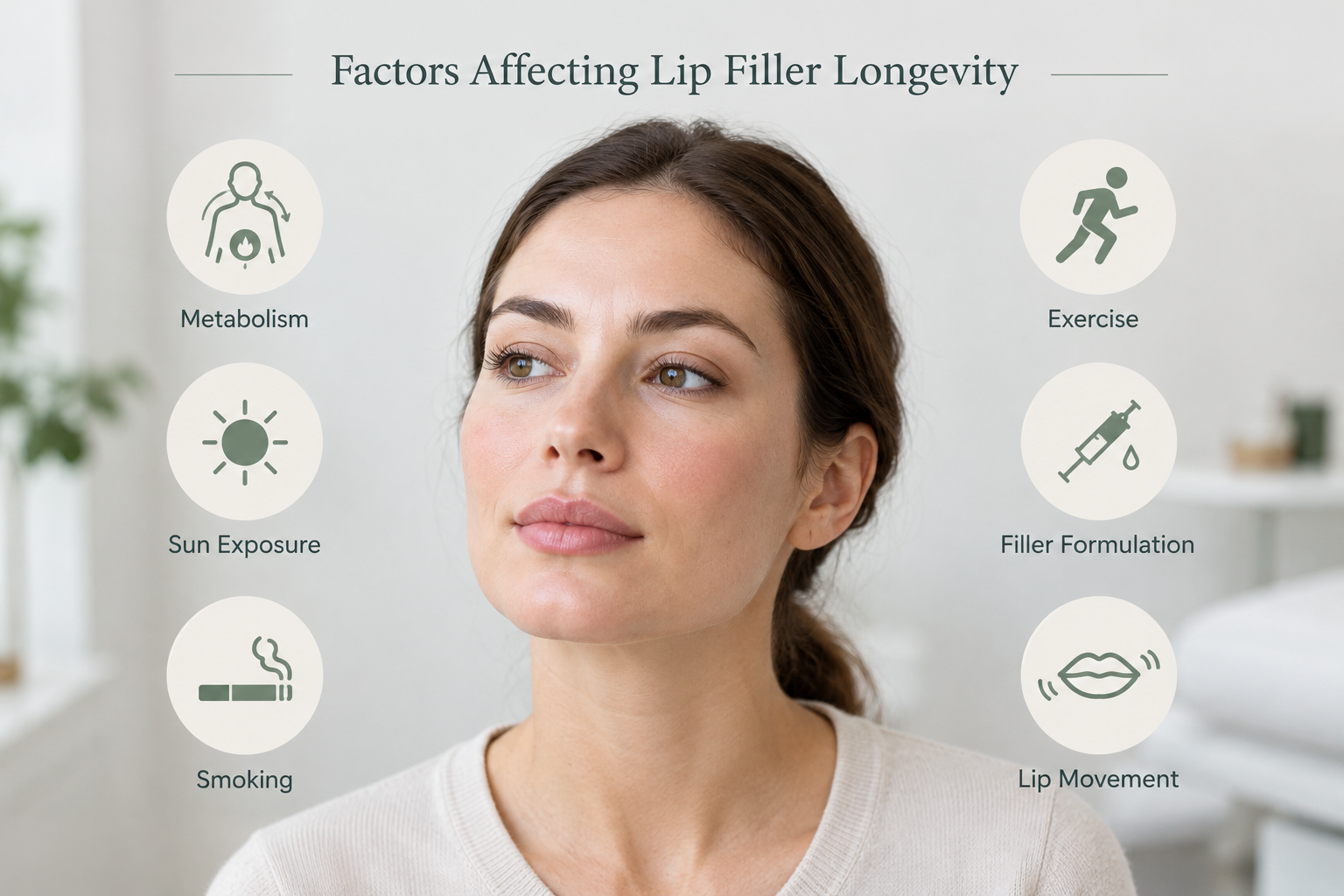
Several well-recognised factors influence the longevity of lip filler results. Understanding these can help set realistic expectations before treatment.
Filler Product and Formulation
Not all hyaluronic acid fillers are equivalent. Products differ in their concentration of HA, degree of cross-linking, particle size, and gel consistency. Denser, more cross-linked formulations are generally associated with greater longevity, but they may not be appropriate for all lip areas or all patients. A practitioner experienced in lip anatomy will select a product suited to the specific goal — whether that is subtle hydration, defined border enhancement, or significant volume addition — and this choice directly affects how long the result is likely to last.
Volume of Filler Injected
Larger volumes of filler placed during a single session may produce results that remain visible for longer, simply because there is more product present before the gradual breakdown becomes noticeable. However, injecting excessive volume in a single session carries aesthetic and safety risks, including an unnatural appearance and increased pressure on surrounding tissue. Most practitioners recommend a conservative, staged approach, particularly for first-time patients.
Individual Metabolism
Patients with a faster metabolic rate tend to break down hyaluronic acid more quickly. This is a physiological reality that cannot be reliably predicted in advance, and it is one reason why two patients receiving identical treatments with the same product can have noticeably different durations of effect. Younger patients and those who are very physically active may find that their filler metabolises more rapidly.
Exercise and Physical Activity
High levels of physical activity and regular intense exercise are associated with increased metabolic rate and greater blood flow, both of which may accelerate the breakdown of hyaluronic acid filler. Patients who exercise frequently sometimes report shorter-lasting results compared with less active individuals, though this relationship is not absolute and other factors also play a role.
Sun Exposure and UV Damage
Prolonged or repeated sun exposure may contribute to faster degradation of hyaluronic acid in the skin and lips. UV radiation promotes oxidative stress and can stimulate enzymatic activity that breaks down HA. Using appropriate sun protection and avoiding excessive sun exposure may help support the longevity of filler results, alongside its broader skin health benefits.
Smoking
Smoking is associated with accelerated skin ageing and impaired tissue health. It may also contribute to faster breakdown of dermal filler. Additionally, the repetitive pursing motion involved in smoking places repeated mechanical stress on the lip area, which can hasten the dispersal of filler over time.
Lip Movement and Anatomy
As noted above, the lips are one of the most mobile areas of the face. Patients with particularly expressive or active lip movement may find that filler breaks down more quickly than in patients with less pronounced lip activity. Individual lip anatomy — including tissue thickness, natural lip volume, and the structure of surrounding muscles — also influences how filler integrates and how long it remains visible.
Practitioner Technique and Injection Placement
The skill and technique of the injecting practitioner affect both the aesthetic outcome and the longevity of results. Precise placement of filler in the appropriate tissue plane, using a technique suited to the patient’s anatomy and goals, can influence how evenly the product integrates and how predictably it behaves over time. This is one reason why choosing a qualified and experienced medical practitioner matters beyond the immediate result.
What Happens as Lip Filler Fades?
As hyaluronic acid lip filler gradually breaks down, patients typically notice a slow reduction in volume and definition rather than a sudden change. The lips do not usually return to a worse state than before treatment; they generally return toward their natural pre-treatment appearance as the filler is metabolised. Some patients report that repeated treatments over time may have a mild cumulative effect on lip tissue, though this is not guaranteed and the evidence base for long-term tissue changes from repeated HA filler is still developing.
It is important to distinguish between natural fading and complications such as filler migration, nodule formation, or vascular compromise. If you notice unexpected lumps, asymmetry, discolouration, or pain at any point after treatment, you should contact your treating practitioner promptly rather than waiting for the filler to dissolve on its own.
Can Lip Filler Be Dissolved?
One of the significant advantages of hyaluronic acid lip filler over some alternative volumising approaches is that it can be partially or fully dissolved using an enzyme called hyaluronidase. Hyaluronidase breaks down hyaluronic acid rapidly, and it is used both to correct aesthetic concerns such as overfilling or migration and to manage rare but serious complications such as vascular occlusion. The ability to reverse HA filler is an important safety feature that distinguishes it from permanent or semi-permanent filler options.
Dissolution is not always complete or perfectly predictable, and the process itself carries a small risk of allergic reaction. It should only be performed by a qualified medical practitioner who is trained in managing complications. If you are considering lip filler, confirming that your practitioner has access to hyaluronidase and is trained in its use is a reasonable and sensible question to ask before treatment.
Lip Filler Maintenance: When to Book a Top-Up
Because lip filler results are temporary, patients who wish to maintain their results will need periodic top-up treatments. The timing of maintenance appointments depends on how quickly an individual’s filler breaks down, the volume originally placed, and the patient’s personal preference for how full they want their lips to appear at all times.
Many patients choose to book a review or top-up appointment when they notice that approximately half of their original result has faded, rather than waiting until the filler has completely dissolved. This approach can make it easier to maintain a consistent appearance and may allow smaller volumes to be used at each maintenance session. However, there is no universal schedule that suits every patient, and the decision should be guided by a practitioner assessment rather than a fixed calendar interval.
It is generally advisable to allow adequate time between treatments rather than topping up too frequently. Repeated injections at short intervals without allowing the previous filler to integrate fully can increase the risk of product accumulation, tissue changes, and complications. A practitioner who recommends a conservative and considered approach to maintenance frequency is acting in the patient’s best interest.
Risks, Side Effects, and Limitations
Lip filler is a medical procedure and carries risks that should be understood before treatment. Common and expected side effects include swelling, bruising, tenderness, and redness at the injection sites. These typically resolve within a few days to two weeks, though individual recovery varies. Swelling is often most pronounced in the first twenty-four to forty-eight hours and can temporarily make the lips appear larger than the intended final result.
Less common but more serious risks include infection, allergic reaction, filler migration, nodule or granuloma formation, and — most critically — vascular occlusion. Vascular occlusion occurs when filler is inadvertently injected into or compresses a blood vessel, potentially compromising blood supply to surrounding tissue. This is a rare but serious complication that requires immediate treatment. Choosing a practitioner with appropriate medical training, a thorough knowledge of facial anatomy, and access to hyaluronidase for emergency use significantly reduces this risk, though it cannot be eliminated entirely.
Lip filler is not suitable for everyone. It is generally not recommended during pregnancy or breastfeeding. Patients with active infection, cold sores, or inflammatory skin conditions in or around the lips should delay treatment until these have resolved. Certain autoimmune conditions, bleeding disorders, or medications that affect clotting may also affect suitability. A thorough medical history and consultation with a qualified practitioner is essential before proceeding.
Alternatives to Hyaluronic Acid Lip Filler
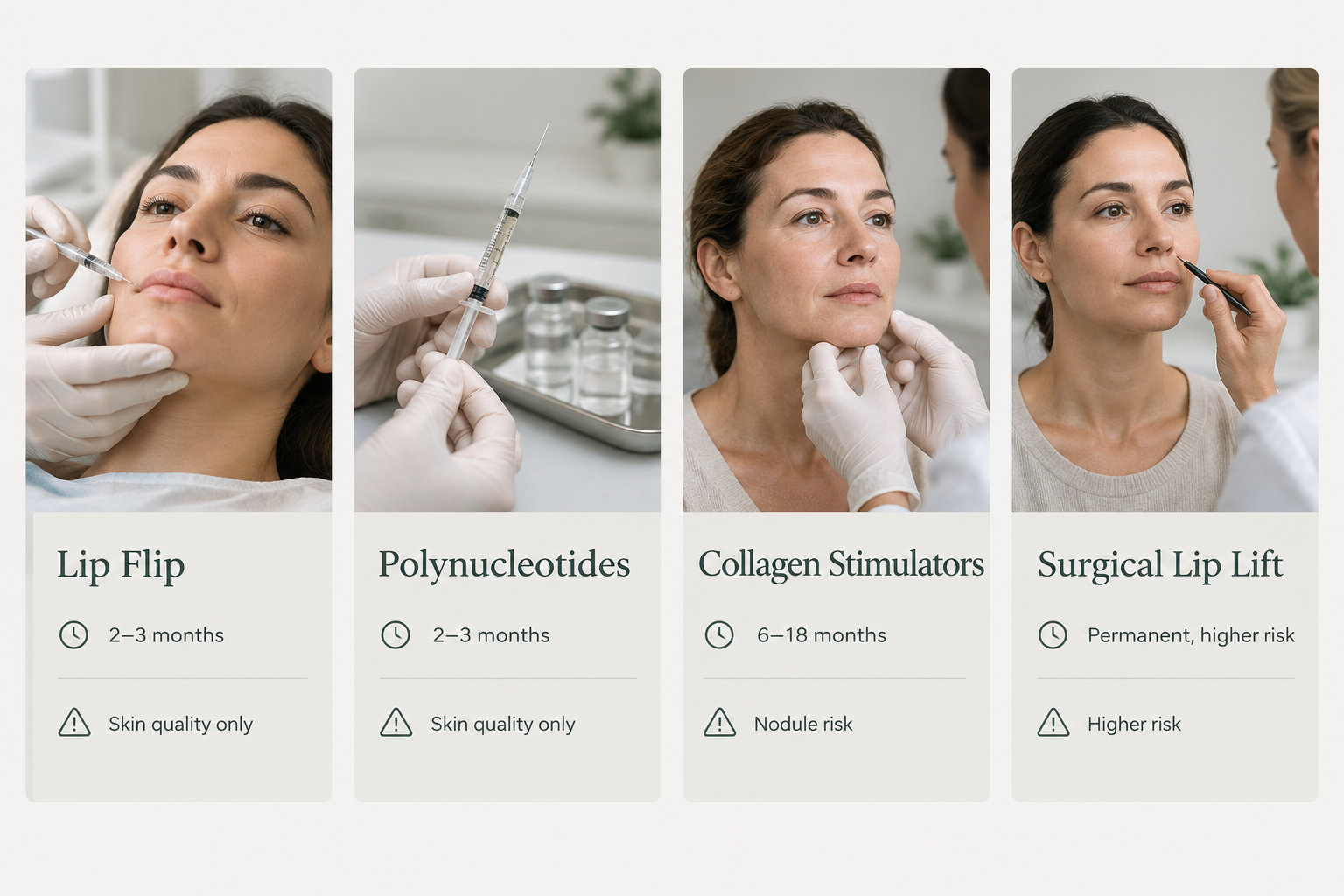
Hyaluronic acid filler is the most widely used approach to lip augmentation in aesthetic medicine, but it is not the only option. Understanding the alternatives can help patients make a more informed choice.
- Lip flip with botulinum toxin: A small amount of botulinum toxin injected into the orbicularis oris muscle can cause the upper lip to roll slightly outward, creating the appearance of a fuller lip without adding volume. This is a subtle effect suited to patients who want a minor change rather than significant augmentation. Results typically last two to three months.
- Polynucleotide injections: Polynucleotide (PDRN) treatments are sometimes used in the perioral area to improve skin quality and hydration rather than to add volume. They are not a direct substitute for HA filler but may complement it or suit patients whose primary concern is lip skin texture rather than size.
- Collagen-stimulating fillers: Products based on poly-L-lactic acid or calcium hydroxylapatite work by stimulating the body’s own collagen production rather than directly adding volume. These are less commonly used in the lips specifically due to the dynamic nature of the area and the risk of nodule formation, but they may be discussed in certain clinical contexts.
- Surgical lip augmentation: Procedures such as lip lift surgery or fat transfer offer more permanent results but involve greater risk, recovery time, and cost. These are typically considered when non-surgical options have not achieved the patient’s goals or when a more lasting structural change is desired.
Each alternative has its own profile of benefits, limitations, and risks. A consultation with a qualified practitioner who can assess your anatomy and goals is the appropriate starting point for deciding which approach, if any, may be suitable for you.
Questions to Ask Your Practitioner Before Lip Filler
Before proceeding with lip filler treatment, it is reasonable to ask your practitioner the following questions to help you make an informed decision:
- What filler product do you recommend for my goals, and why?
- How long do you expect the results to last based on my anatomy and the product you are using?
- Do you have hyaluronidase available, and are you trained in managing vascular complications?
- What are the most likely side effects I should expect, and how long will they last?
- Are there any aspects of my medical history or anatomy that might affect my suitability or the longevity of results?
- How many treatments do you recommend before my review appointment, and when would you suggest a top-up?
Frequently Asked Questions
Does lip filler last longer with repeated treatments?
Some patients and practitioners report that results appear to last longer after several rounds of treatment, possibly because repeated HA filler may have a cumulative effect on tissue hydration and structure. However, this is not guaranteed, and the evidence from controlled studies is limited. Individual response remains the dominant factor.
Will my lips look deflated when the filler wears off?
In most cases, lips return gradually toward their natural pre-treatment appearance as hyaluronic acid filler is metabolised. They do not typically look worse than before treatment. Sudden or uneven changes in appearance should be assessed by your practitioner.
Does exercise make lip filler dissolve faster?
High levels of physical activity may be associated with faster filler breakdown due to increased metabolic rate and circulation, though this effect varies between individuals and is not the only factor involved. It is not a reason to avoid exercise, but it is worth discussing with your practitioner if you are very active.
Can I make my lip filler last longer?
While you cannot fully control how quickly your body metabolises hyaluronic acid, certain habits may support longevity. These include protecting the lips from excessive sun exposure, avoiding smoking, staying well hydrated, and following any aftercare advice provided by your practitioner. Choosing an experienced injector who selects an appropriate product for your goals also matters.
Is there a filler that lasts longer than hyaluronic acid in the lips?
Some non-HA fillers, such as those based on poly-L-lactic acid or calcium hydroxylapatite, may offer longer-lasting effects in certain facial areas, but they are generally not recommended as first-line options for the lips due to the dynamic nature of the area and a higher risk of complications such as nodule formation. Permanent fillers exist but carry significant long-term risks and are not widely recommended in reputable aesthetic practice. Your practitioner can discuss the most appropriate options for your specific situation.
How soon after lip filler can I have a top-up?
Most practitioners recommend waiting at least two to four weeks after an initial treatment before assessing whether a top-up is needed. This allows swelling to fully resolve and gives an accurate picture of the final result. Topping up too soon increases the risk of overfilling and complications.
Does lip filler hurt?
Most lip filler products contain lidocaine, a local anaesthetic, within the formulation, which helps reduce discomfort during injection. Topical anaesthetic cream is also commonly applied before treatment. Some degree of discomfort, pressure, or stinging during injection is normal, but the procedure is generally well tolerated. Pain levels vary between individuals and depend on practitioner technique.
Planning Realistic Expectations for Lip Filler Longevity
Lip filler can be an effective way to enhance lip volume, shape, and definition, but it is a temporary treatment that requires ongoing maintenance to sustain results. For most patients, hyaluronic acid lip filler lasts somewhere between six and twelve months, with meaningful variation on either side of that range depending on the product used, the volume placed, individual metabolism, lifestyle factors, and practitioner technique.
Understanding that results are not permanent — and that the lips are a particularly dynamic area where filler breaks down relatively quickly — is important for setting realistic expectations before treatment. The reversibility of hyaluronic acid filler with hyaluronidase is a genuine safety advantage, and it is one reason why HA-based products remain the standard of care for lip augmentation in reputable aesthetic practice.
If you are considering lip filler, a thorough consultation with a qualified medical practitioner who can assess your anatomy, discuss your goals, explain the risks, and recommend an appropriate product and approach is the essential first step. Results vary, and an honest conversation about what is realistically achievable for your individual anatomy will serve you better than any general estimate of how long filler lasts.