

The heart-shaped face is one of the most recognised facial structures in aesthetic medicine, characterised by a broad forehead, prominent cheekbones, and a narrow, often pointed chin. Understanding the specific features that define this face shape can help individuals make more informed decisions about hairstyles, makeup techniques, and — where relevant — aesthetic treatments designed to harmonise facial proportions. This article explains the anatomical characteristics of the heart-shaped face, how it differs from similar face shapes, and what aesthetic considerations may be worth discussing with a qualified practitioner.
Key Takeaways
- A heart-shaped face is defined by a wide forehead and cheekbones that taper to a narrow, pointed chin, sometimes accompanied by a widow’s peak hairline.
- The heart shape shares features with the oval and diamond face shapes but differs in the relative width of the forehead compared to the jaw.
- Aesthetic treatments such as dermal fillers, jawline contouring, and chin augmentation may help balance proportions, but suitability depends on individual anatomy and goals.
- Non-surgical options can subtly adjust the appearance of facial structure, though results vary and a thorough clinical assessment is always required before any procedure.
- Many people with heart-shaped faces seek guidance not because of a perceived flaw, but to better understand how to complement their natural features.
What Defines a Heart-Shaped Face?
A heart-shaped face is broadly defined by three structural characteristics: a forehead that is wider than the jawline, cheekbones that sit at or near the widest point of the face, and a chin that narrows to a relatively pointed tip. When viewed from the front, the overall outline resembles the upper half of a heart symbol — wide at the top and tapering symmetrically toward the lower third of the face. This tapering is the most consistent defining feature and distinguishes the heart shape from rounder or squarer face structures.
A widow’s peak — a V-shaped point in the hairline at the centre of the forehead — is frequently associated with the heart-shaped face, though it is not a universal feature. Its presence can accentuate the width of the upper face and draw attention to the forehead, reinforcing the characteristic silhouette. Not everyone with a heart-shaped face has a widow’s peak, and conversely, a widow’s peak alone does not confirm this face shape.
The lower face in a heart-shaped structure tends to be narrower overall, with the jawline angling inward from the cheekbones toward a defined chin point. The chin itself may appear delicate or prominent depending on the individual, but it is typically narrower than the mid-face. This proportional relationship — wide upper and mid-face, narrow lower face — is the core anatomical signature of the heart shape.
How to Identify a Heart-Shaped Face
Identifying face shape involves assessing the relative widths of the forehead, cheekbones, and jawline, as well as the length and shape of the chin. For a heart-shaped face, the forehead is typically the widest horizontal measurement, followed closely by the cheekbones. The jawline is noticeably narrower than both, and the chin comes to a point rather than being flat or rounded.
A practical self-assessment involves pulling the hair back from the face and examining the overall outline in a mirror or photograph taken from directly in front. If the widest point is clearly at the forehead or upper cheekbones, and the face narrows progressively toward a pointed chin, a heart shape is likely. If the widest point is at the cheekbones with a narrower forehead and jaw of similar width, the face may be closer to a diamond shape. If the forehead, cheekbones, and jaw are all relatively similar in width, the face is more likely to be oval or round.
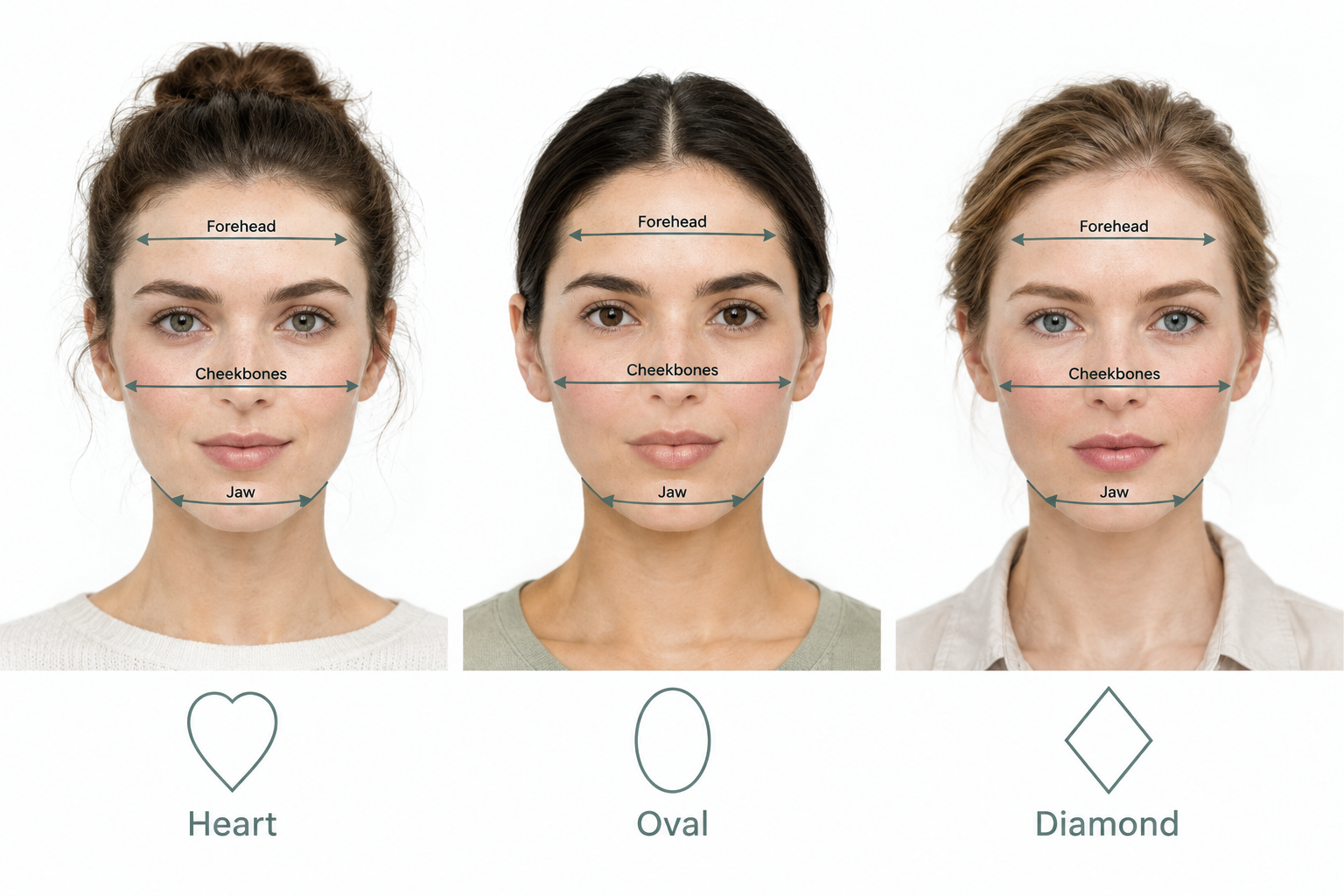
It is worth noting that face shape classification is not a precise science. Most faces do not fit neatly into a single category, and many people have features that overlap between two or more shapes. Aesthetic practitioners typically assess facial proportions in three dimensions rather than relying on a flat two-dimensional classification, which provides a more clinically useful picture of facial structure and balance.
Heart-Shaped Face vs Similar Face Shapes
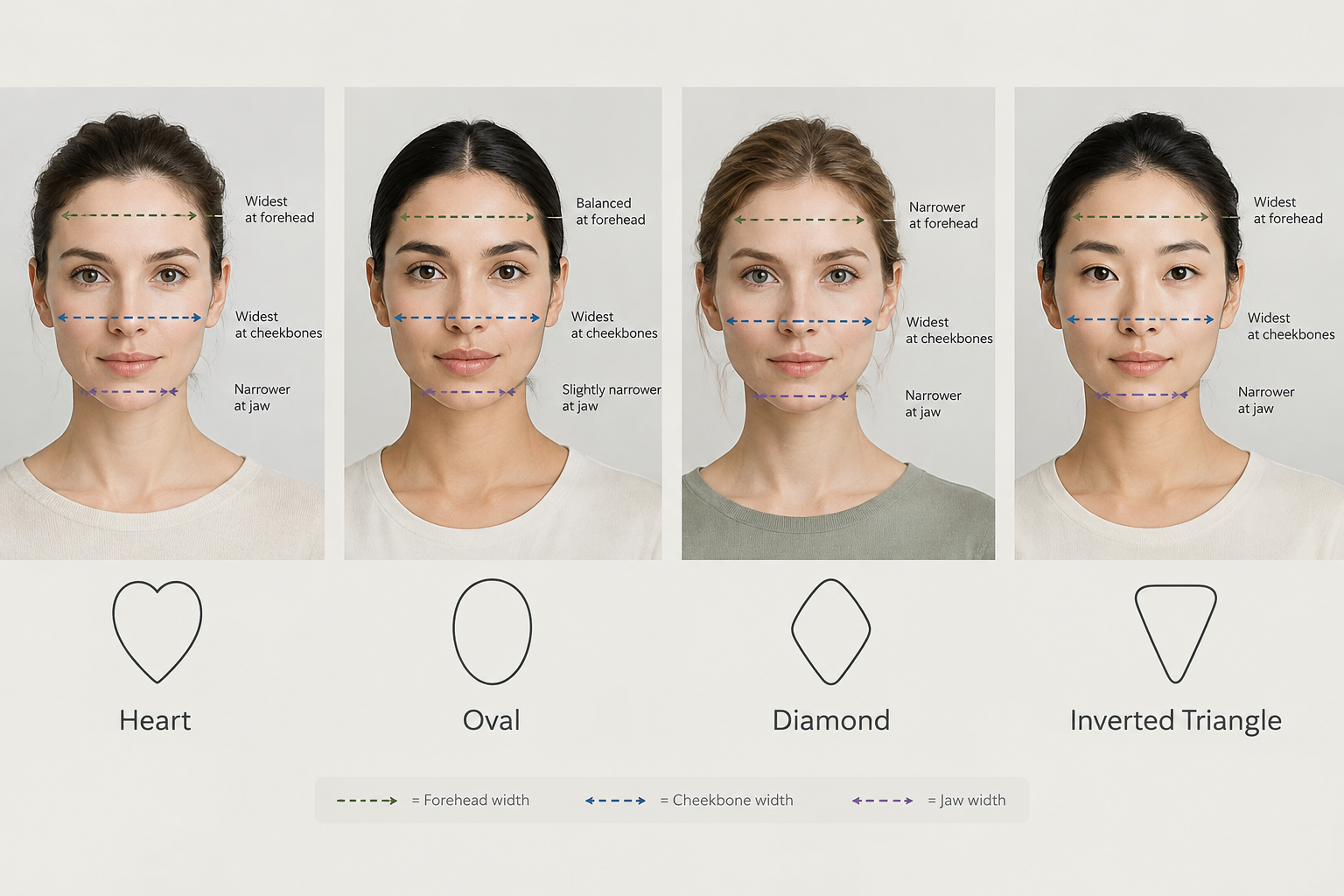
The heart-shaped face is sometimes confused with the oval, diamond, and inverted triangle face shapes because all four involve some degree of tapering toward the lower face. Understanding the distinctions can help clarify which category best describes an individual’s features.
- Heart vs oval: An oval face has a forehead that is slightly wider than the jaw, but the overall proportions are more balanced and elongated. The chin in an oval face is rounded rather than pointed, and the face length is generally greater than its width. A heart-shaped face tends to have a more pronounced width difference between the forehead and jaw, with a more defined chin point.
- Heart vs diamond: A diamond face shape has a narrow forehead and a narrow chin, with the cheekbones forming the widest point. In a heart-shaped face, the forehead is wide — often wider than the cheekbones — which is the key distinguishing feature.
- Heart vs inverted triangle: These two shapes are closely related and sometimes used interchangeably. The inverted triangle typically describes a face where the forehead is very broad and the jaw is very narrow, with less emphasis on cheekbone prominence. The heart shape implies a slightly softer, more curved outline and often includes a more defined chin point. In clinical and aesthetic contexts, the distinction between these two shapes is sometimes a matter of degree rather than a clear boundary.
Facial Proportions and the Golden Ratio
Aesthetic medicine frequently references facial proportions when assessing balance and harmony. The concept of the golden ratio — a mathematical relationship of approximately 1:1.618 — has been applied to facial aesthetics to describe proportions that are widely perceived as balanced. In practice, this means that the width of the face at the cheekbones ideally relates proportionally to the width of the forehead and the lower face, and that the vertical thirds of the face (forehead to brow, brow to nose base, nose base to chin) are roughly equal.
For a heart-shaped face, the upper third and mid-face tend to be proportionally wider, while the lower third narrows more sharply than in a classically balanced oval face. This does not mean the heart-shaped face is aesthetically inferior — many people with this face shape are considered to have striking, distinctive features. However, for those who feel their proportions feel unbalanced, aesthetic treatments may be able to make subtle adjustments to the lower face to create a greater sense of harmony.
It is important to approach the concept of facial proportions with appropriate nuance. Aesthetic ideals vary across cultures, change over time, and are highly individual. A practitioner’s role is not to impose a single standard of beauty but to understand what the patient perceives as their concern and to assess whether any intervention is appropriate, safe, and likely to achieve a meaningful improvement.
Common Aesthetic Concerns Associated with a Heart-Shaped Face
People with heart-shaped faces who seek aesthetic advice most commonly raise concerns related to the lower face. A narrow or pointed chin can sometimes appear disproportionate relative to the width of the forehead and cheekbones, particularly in photographs or certain lighting conditions. Some individuals feel that the lower face looks too delicate or that the chin appears too prominent in profile. Others are comfortable with their natural proportions but want guidance on how to complement their features.
A wide forehead is another area that some people with this face shape wish to address. While a broad forehead is a defining feature of the heart shape, individuals who feel self-conscious about it may explore options such as hairline-framing hairstyles or, in some cases, hairline-lowering procedures — though the latter falls outside the scope of standard aesthetic injectable treatments.
Cheekbone prominence is generally considered a desirable feature in aesthetic medicine, and many people with heart-shaped faces already have naturally well-defined mid-face structure. For those who feel their cheekbones are less defined than they would like, or who have experienced volume loss in the mid-face with age, dermal filler treatments may be considered — though this requires careful assessment to avoid over-augmenting an already wide mid-face.
Aesthetic Treatments That May Be Relevant
Several non-surgical aesthetic treatments may be relevant for individuals with a heart-shaped face who wish to adjust the appearance of their facial proportions. These are not treatments that change the underlying bone structure, but they can subtly alter the soft tissue contours of the face to create a different visual impression of balance.
Chin Augmentation with Dermal Filler
Dermal filler injected into the chin area can add projection, length, or width to a narrow or pointed chin, which may help balance the wider upper face characteristic of the heart shape. Hyaluronic acid fillers are most commonly used for this purpose because they are reversible — the enzyme hyaluronidase can dissolve hyaluronic acid filler if the result is unsatisfactory or if a complication arises. Results from chin filler typically last between nine and eighteen months, depending on the product used, the volume injected, and individual factors such as metabolism and tissue characteristics. As with all injectable treatments, risks include bruising, swelling, asymmetry, and — in rare cases — vascular complications, which is why chin filler should only be performed by a trained and experienced practitioner.
Jawline Contouring
Jawline contouring with dermal filler can add definition along the angle and body of the jaw, creating a more structured lower face. For a heart-shaped face, this may help visually widen the lower third of the face and reduce the contrast between the broad upper face and the narrow jaw. The effect is typically subtle rather than dramatic, and results depend heavily on the individual’s existing anatomy, skin laxity, and the amount of filler used. Jawline filler carries similar risks to chin filler, including bruising, swelling, and the possibility of vascular injury if injected incorrectly.
Botulinum Toxin for Masseter Reduction
Botulinum toxin injected into the masseter muscles — the large chewing muscles at the sides of the jaw — can reduce their bulk over time, which may slim the lower face. This treatment is more commonly used for square or wide jaw shapes, and its relevance for a heart-shaped face is limited. In some cases, however, if the jaw appears disproportionately wide relative to the chin, masseter reduction may be considered as part of a broader treatment plan. Results typically become apparent over four to six weeks and may last three to six months or longer with repeated treatments. This treatment is not appropriate for everyone and requires careful assessment of jaw muscle anatomy and dental occlusion.
Forehead Smoothing and Brow Shaping
Botulinum toxin is widely used to smooth forehead lines and adjust brow position. For individuals with a heart-shaped face who feel their forehead appears very prominent, subtle brow shaping with botulinum toxin may help draw attention away from the upper face. This is a nuanced treatment that requires an experienced injector, as changes to brow position can significantly affect the overall appearance of the face.
Non-Surgical Rhinoplasty
Non-surgical rhinoplasty — the use of dermal filler to adjust the appearance of the nose — is occasionally relevant for heart-shaped faces where the nose appears disproportionate relative to the narrow lower face. By refining the nasal profile or tip, a practitioner may be able to improve the overall sense of facial balance. This is a high-risk treatment area due to the proximity of important blood vessels, and it should only be performed by practitioners with specific training and experience in nasal anatomy.
Non-Aesthetic Considerations: Hairstyles and Makeup
Not everyone with a heart-shaped face is interested in aesthetic treatments, and many people find that hairstyle and makeup choices are sufficient to complement their natural features. These approaches carry no medical risk and are worth considering before exploring any clinical intervention.
Hairstyles that add volume at the jaw and chin — such as chin-length bobs, layered cuts that fall below the cheekbones, or styles with volume at the nape of the neck — can visually balance the wider upper face. Styles that add height or volume at the crown tend to elongate the face, which may or may not be desirable depending on the individual’s proportions. A widow’s peak can be softened with a side parting or fringe, or embraced as a distinctive feature.
Makeup contouring techniques can also create the impression of a more balanced lower face. Applying a lighter shade of foundation or highlighter along the jawline and chin can add visual width to the lower face, while contouring the temples and sides of the forehead can reduce the apparent width of the upper face. These are non-permanent, reversible approaches that allow individuals to experiment with different looks without any clinical risk.
Who May Be Suitable for Aesthetic Treatment
Aesthetic treatments for facial balancing are generally suitable for adults in good general health who have realistic expectations about what non-surgical procedures can achieve. Suitability depends on a range of individual factors, including the degree of the perceived imbalance, skin quality, tissue characteristics, medical history, and the specific treatment being considered.

Individuals who may not be suitable for injectable treatments include those who are pregnant or breastfeeding, those with active skin infections or inflammatory conditions in the treatment area, those with certain autoimmune conditions, and those taking medications that affect bleeding or immune function. A thorough medical history and clinical assessment are essential before any treatment is undertaken.
It is also important that individuals seeking aesthetic treatment have a clear and realistic understanding of what the treatment can and cannot achieve. Non-surgical treatments can make subtle improvements to facial proportions, but they cannot replicate the results of surgical procedures such as chin implants or orthognathic surgery. For individuals with significant structural concerns, a referral to a maxillofacial surgeon or plastic surgeon may be more appropriate than non-surgical treatment.
Frequently Asked Questions
Is a heart-shaped face considered attractive?
Attractiveness is highly subjective and varies across cultures and individuals. The heart-shaped face is widely associated with distinctive, expressive features — particularly the prominent cheekbones and defined chin — and is considered appealing by many aesthetic standards. However, there is no single face shape that is universally considered most attractive, and aesthetic medicine does not aim to impose a single ideal.
Can I change my face shape without surgery?
Non-surgical treatments such as dermal fillers and botulinum toxin can subtly alter the appearance of facial proportions, but they cannot change the underlying bone structure. The changes achievable without surgery are generally modest and temporary. For more significant structural changes, surgical options such as chin implants or jaw surgery would need to be discussed with an appropriate surgical specialist.
How do I know if I have a heart-shaped face or an oval face?
The key difference is the width of the forehead relative to the jaw and the shape of the chin. A heart-shaped face has a clearly wider forehead than jaw, with a pointed chin. An oval face has more balanced proportions overall, with a slightly wider forehead than jaw but a rounded rather than pointed chin, and a greater face length relative to width.
Are dermal fillers safe for chin and jaw contouring?
Dermal fillers are widely used for chin and jaw contouring and have a well-established safety profile when administered by trained practitioners. However, all injectable treatments carry risks, including bruising, swelling, asymmetry, and — in rare cases — vascular complications that can cause tissue damage. Choosing a qualified and experienced practitioner and having a thorough consultation beforehand significantly reduces these risks.
How long do results from facial contouring treatments last?
The duration of results depends on the specific treatment, the product used, the area treated, and individual factors. Hyaluronic acid filler in the chin and jaw typically lasts between nine and eighteen months. Botulinum toxin results generally last three to six months. Results are not permanent, and maintenance treatments are usually required to sustain the effect.
Do I need treatment if I have a heart-shaped face?
No. A heart-shaped face is a natural facial structure, not a condition that requires treatment. Many people with this face shape are entirely comfortable with their appearance and have no interest in aesthetic procedures. Treatment is only worth considering if an individual has a specific concern about their proportions that they feel affects their confidence, and only after a thorough consultation with a qualified practitioner who can assess whether any intervention is appropriate.
Understanding Your Face Shape Before Making Any Decisions
A heart-shaped face is a distinctive and well-defined facial structure with characteristics that many people find appealing. The broad forehead, prominent cheekbones, and narrow, pointed chin create a recognisable silhouette that does not inherently require any aesthetic intervention. For those who do wish to explore options for balancing their facial proportions, a range of non-surgical treatments may be worth discussing with a qualified aesthetic practitioner — but only after a thorough assessment of individual anatomy, realistic expectations, and the potential risks and benefits of any proposed treatment.
If you are considering aesthetic treatment to complement your heart-shaped face features, the most important first step is a detailed consultation with a practitioner who has specific experience in facial anatomy and non-surgical contouring. A good practitioner will take time to understand your concerns, explain what is and is not achievable, and help you make an informed decision that is right for your individual face and goals — rather than applying a generic approach based on face shape classification alone.