

Key Takeaways
- French bikini laser hair removal removes hair from the sides and upper pubic area, leaving a small shaped strip at the front — more coverage than a classic bikini line treatment but less than a full Brazilian.
- The treatment uses laser energy to target hair follicles and achieve long-term hair reduction, typically requiring a course of 6–8 sessions spaced several weeks apart.
- It is widely considered an ideal starting point for those new to intimate laser hair removal, offering a groomed result without committing to complete removal.
- Results and suitability depend on hair colour, skin tone, and individual hair growth cycles — a consultation and patch test are essential before beginning treatment.
- Common side effects such as temporary redness and mild swelling are normal; rare but more serious risks can be minimised by choosing a qualified, experienced provider.
What Is French Bikini Laser Hair Removal?
French bikini laser hair removal is a style of intimate laser hair removal that removes unwanted hair from the sides and top of the pubic area while leaving a small, neatly shaped strip of hair at the front. The result is a visibly groomed appearance that sits comfortably between the conservative classic bikini line treatment and the more extensive Brazilian style. The labia and perianal area are not treated, which distinguishes the French bikini clearly from a full Brazilian.
The name derives from the French-cut bikini swimsuit, a high-cut style that became fashionable in the 1970s and 1980s. The swimwear’s narrow coverage at the sides and front inspired the corresponding hair removal style, which is designed to ensure no hair is visible beyond the edges of that type of swimwear. Today, the French bikini remains one of the most requested styles in clinics offering intimate laser hair removal.
The shape of hair left at the front can be customised. Common options include a narrow landing strip — a vertical rectangle of hair — or a Bermuda triangle, a downward-pointing triangular shape. The width and length of the remaining hair can usually be adjusted to personal preference during the consultation.
Quick Style Comparison: French Bikini vs Other Bikini Laser Styles
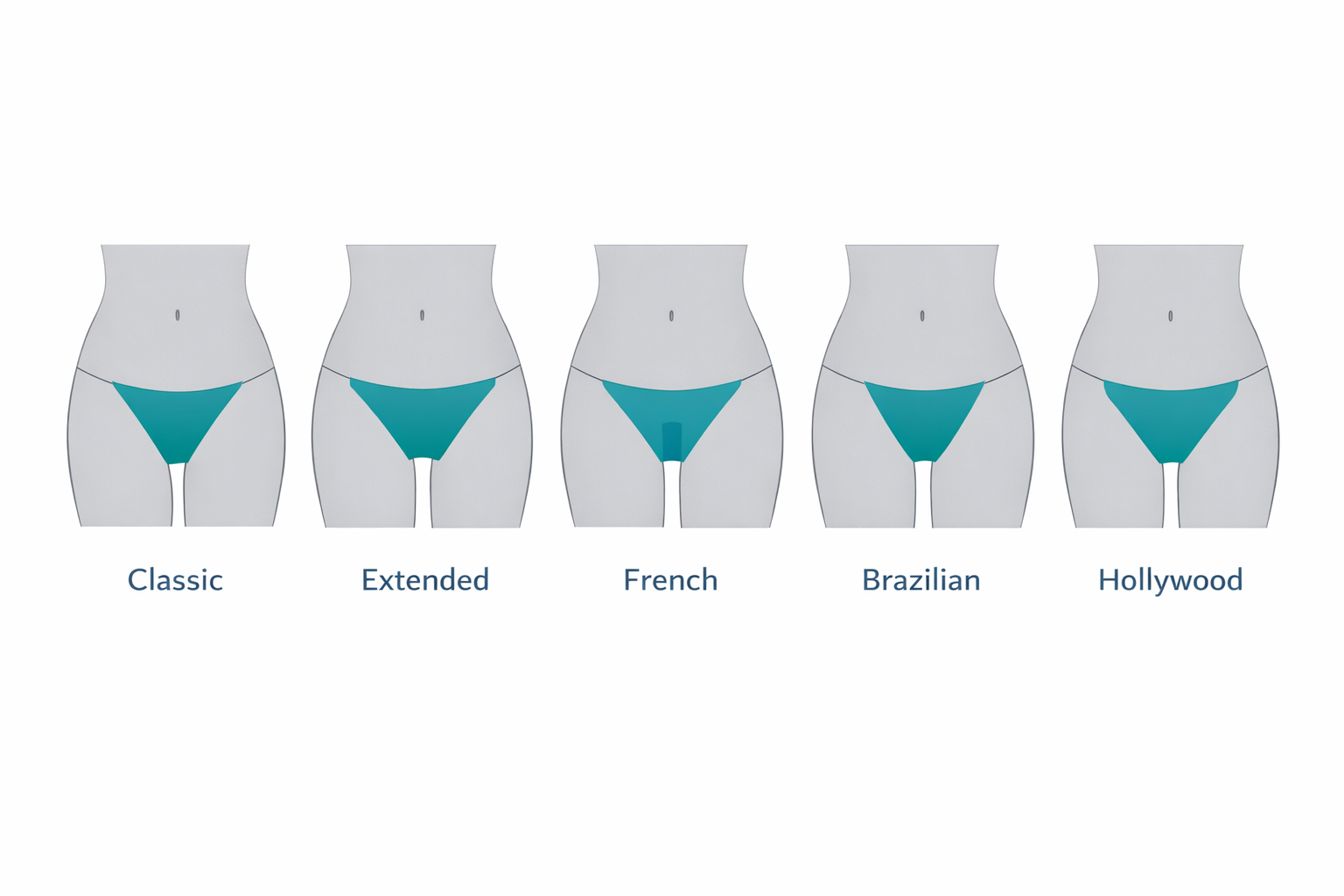
Understanding where the French bikini sits within the range of available styles helps clarify whether it matches your goals. The table below compares the four main bikini laser hair removal styles by coverage area and what remains after treatment.
| Style | Hair Removed | Hair Left | Labia / Perianal Treated? | Best For |
|---|---|---|---|---|
| Classic Bikini Line | Hair outside the panty line only — sides and a little off the top | Most pubic hair remains | No | First-timers wanting minimal change; those preferring a natural look |
| Extended Bikini | Slightly more than classic — further inward on sides and top | Most of the front area remains | No | Those wanting more than a bikini line but not ready for French |
| French Bikini | Sides, top, and most of the front pubic area | Small shaped strip or triangle at the front | No | Groomed look without full removal; suits most swimwear; ideal entry point |
| Brazilian | Front, sides, top, labia, and optionally the perianal area | Optional landing strip or nothing | Yes (labia); perianal optional | Those wanting near-complete or complete front-to-back removal |
| Hollywood / Sphinx | Everything — front, sides, labia, and perianal area | Nothing | Yes — fully | Complete hair-free result front and back |
The French bikini occupies a practical middle ground. It delivers a noticeably polished look and eliminates the most visible hair without the more extensive coverage — and greater sensitivity — involved in Brazilian laser hair removal or Hollywood laser hair removal.
How Does Laser Hair Removal Work in This Area?
Laser hair removal works through a process called selective photothermolysis. The laser emits a concentrated beam of light at a wavelength specifically absorbed by melanin — the pigment found in hair. This light energy is converted to heat within the hair follicle, damaging the follicle’s ability to produce new hair. When the follicle is sufficiently damaged, the result is long-term hair reduction in the treated area.
Because the laser targets melanin in the hair follicle rather than the surrounding skin, the treatment is most effective on darker, coarser hair against a lighter skin background. The contrast between hair pigment and skin tone allows the laser to identify and heat the follicle precisely while minimising energy absorption by the surrounding tissue.
Several laser technologies are used for bikini area treatments. Alexandrite lasers are well suited to lighter Fitzpatrick skin types (I–III) and work efficiently on coarse dark hair. Diode lasers offer a broader range of suitability and are commonly used across skin types II–V. Nd:YAG lasers penetrate more deeply and carry less risk of pigmentation changes in darker skin tones, making them the preferred option for Fitzpatrick skin types V and VI. A qualified practitioner will select the appropriate technology based on your individual skin tone and hair characteristics.
Why Multiple Sessions Are Needed
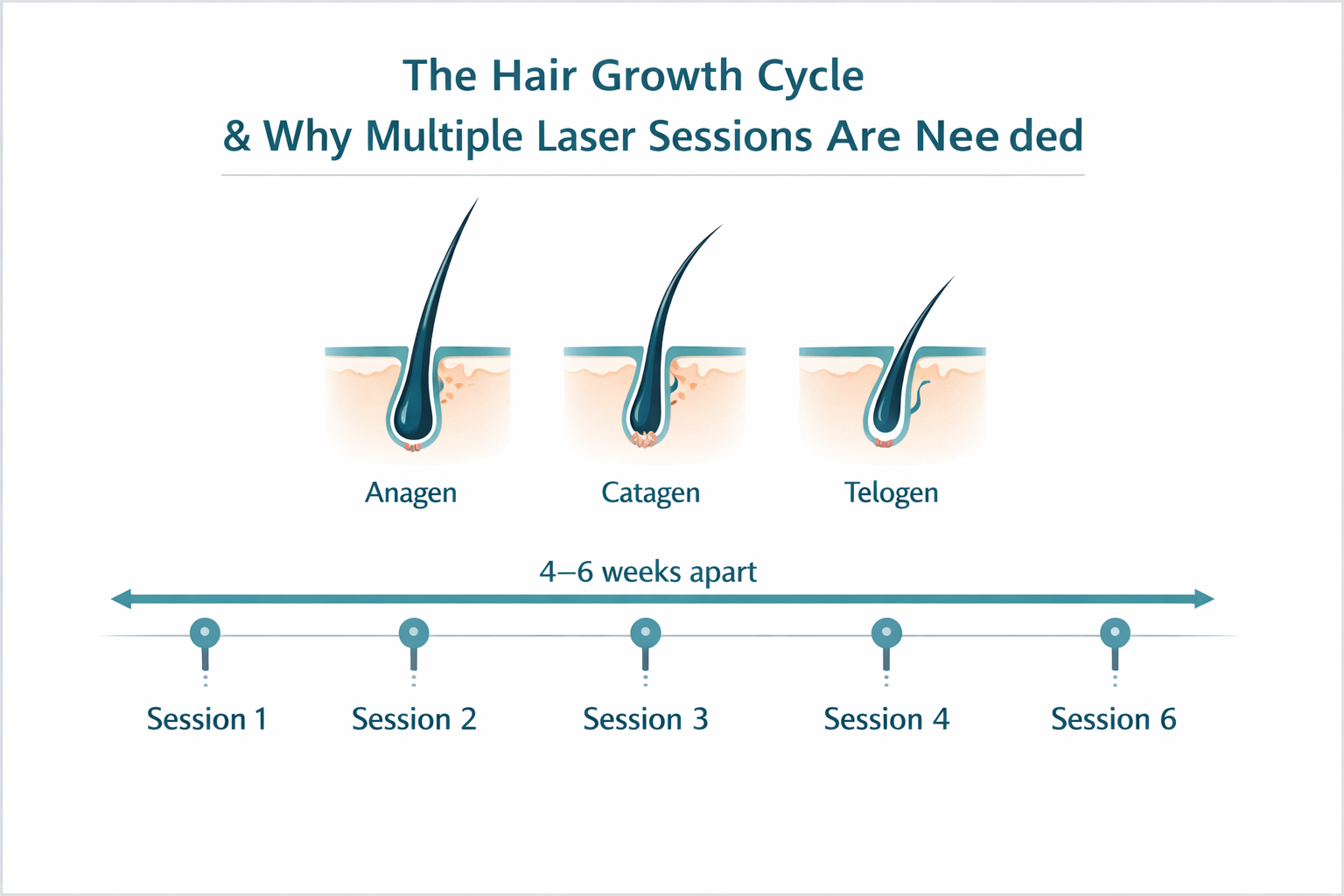
Laser hair removal only affects follicles that are actively growing at the time of treatment. Hair grows in cycles, and only follicles in the active growth phase — known as the anagen phase — contain enough melanin-rich cells close to the follicle to be effectively targeted by the laser. Follicles in the resting or shedding phases are not significantly affected during that session.
Because not all follicles in the treatment area are in the anagen phase simultaneously, a single session cannot address every active follicle. A full treatment course of typically 6 to 8 sessions, spaced approximately 4 to 6 weeks apart, is needed to progressively treat follicles as they cycle into the active growth phase. After completing the initial course, most people find that hair regrowth is significantly reduced. Periodic maintenance sessions — usually once or twice a year — may be needed to address any follicles that recover partial activity over time.
Preparing for Your French Bikini Laser Appointment
Preparation plays a meaningful role in both the safety and effectiveness of each session. Following pre-treatment guidance carefully helps reduce the risk of side effects and ensures the laser can work as intended.
- Shave the area 24 to 48 hours before your appointment. The laser needs the hair shaft to be present just below the skin surface to conduct heat to the follicle, but visible surface hair can cause unnecessary skin irritation. Do not wax, thread, or pluck in the weeks before treatment — these methods remove the follicle temporarily, leaving nothing for the laser to target.
- Avoid sun exposure and tanning for at least two to three weeks before treatment. Tanned skin — whether from sun, sunbeds, or self-tanning products — increases the risk of pigmentation changes. Avoid self-tanners and spray tans in the weeks leading up to each session.
- Arrive with clean, dry skin. Remove any lotions, oils, deodorants, or creams from the treatment area before your appointment. Some clinics will cleanse the area on arrival.
- Attend a consultation and patch test before your first session. A patch test allows the practitioner to assess your skin’s response to the laser at the intended settings, reducing the risk of unexpected reactions. This step is particularly important for those with darker skin tones or a history of skin sensitivity.
- Inform your practitioner of any relevant medications or health changes. Certain medications — including some antibiotics and hormonal treatments — can affect skin sensitivity or treatment outcomes.
What Happens During the Treatment?
A French bikini laser hair removal session typically takes between 15 and 30 minutes, depending on the coverage area and the laser system used. You will be asked to lie in a comfortable position, and the practitioner will apply a handheld laser device to the treatment area in a systematic pattern, ensuring even coverage across the sides, top, and front of the pubic region while carefully avoiding the labia.
Most people describe the sensation as similar to a rubber band snapping against the skin, or a brief warm prickling feeling. The bikini area is more sensitive than the legs or underarms, so some discomfort is normal. Many modern laser systems incorporate integrated cooling mechanisms — such as a chilled tip or a stream of cool air — to reduce discomfort and protect the skin surface during treatment. If you are concerned about pain, discuss the option of a topical numbing cream with your practitioner before the appointment; this is sometimes applied 30 to 45 minutes prior to the session.
The sensation during French bikini laser hair removal is generally considered comparable to or less uncomfortable than waxing, particularly after the first couple of sessions as hair density reduces.
Aftercare: What to Do in the Days Following Treatment
Post-treatment care helps the skin recover comfortably and reduces the risk of complications. The following guidance applies to the 24 to 72 hours after each session, though your practitioner may provide more specific instructions based on your skin’s response.
- Apply a cool compress or aloe vera gel to the treated area if you experience redness or a warm sensation. This helps soothe the skin and reduce mild swelling.
- Avoid hot baths, saunas, steam rooms, and vigorous exercise for at least 24 to 48 hours. Heat can exacerbate post-treatment inflammation and increase the risk of irritation.
- Keep the area moisturised with a gentle, fragrance-free lotion. Avoid products containing active ingredients such as retinoids, AHAs, or BHAs on the treated skin until it has fully settled.
- Protect the area from sun exposure. Apply SPF to any skin that may be exposed to sunlight, and avoid sunbeds throughout the treatment course.
- Do not wax, thread, or pluck between sessions. Shaving is the only acceptable method of managing any regrowth between appointments, as other methods remove the follicle and interfere with subsequent laser sessions.
- Expect some hair shedding in the one to three weeks following each session. This is a normal part of the process as treated hairs are expelled from the follicle.
Side Effects and Risks
French bikini laser hair removal is generally well tolerated when performed by a trained professional using appropriate settings for your skin type. Understanding the difference between expected reactions and signs that warrant attention helps you manage the process confidently.
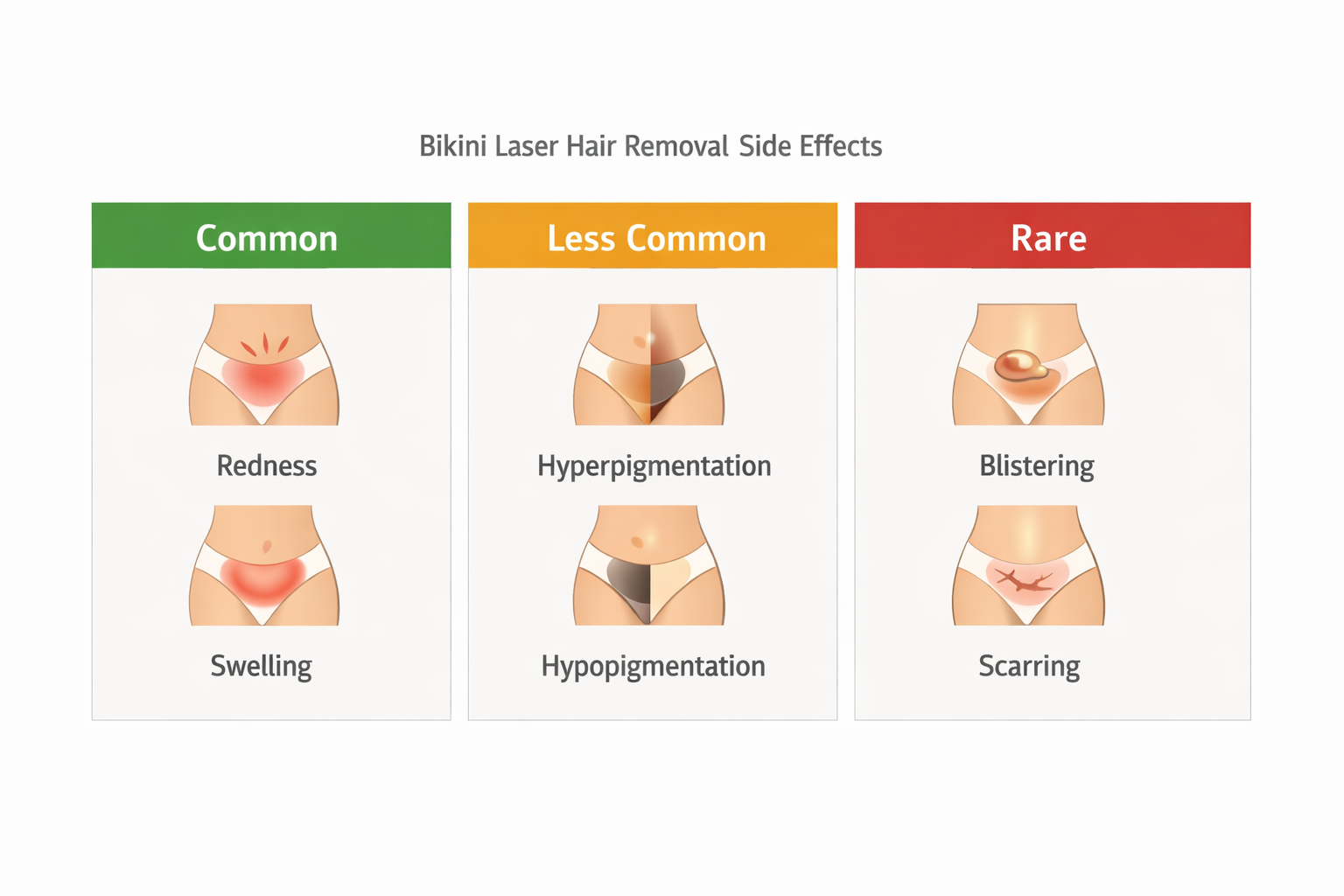
Common and expected reactions include redness, mild swelling, and a sensation similar to mild sunburn in the treated area. These typically resolve within a few hours to a day or two and do not require medical attention. Temporary darkening or lightening of individual hair follicle sites can also occur as treated hairs shed.
Less common side effects include hyperpigmentation (darkening of the skin) or hypopigmentation (lightening of the skin) in the treated area. These are more likely to occur when the laser settings are not appropriately adjusted for the patient’s Fitzpatrick skin type, when the skin is tanned at the time of treatment, or when post-treatment sun exposure is not avoided. In most cases, pigmentation changes are temporary, but they can persist for several months.
Rare but more serious risks include blistering, crusting, or — in very rare cases with improper technique — scarring. These outcomes are significantly more likely when treatment is performed by an inadequately trained provider or when contraindications are not properly assessed. Choosing a clinic with qualified, experienced practitioners and appropriate laser technology for your skin tone substantially reduces these risks.
The bikini area is a sensitive region, and the skin here may react more noticeably than less sensitive areas. This makes the pre-treatment patch test and an honest discussion of your skin history particularly important before beginning a treatment course.
Who May Be a Good Candidate?
French bikini laser hair removal tends to produce the most consistent results in people with darker, coarser hair and lighter skin tones, where the contrast between hair pigment and skin allows the laser to target follicles precisely. However, advances in laser technology — particularly Nd:YAG systems — have made treatment more accessible to a wider range of skin tones, including darker complexions.
You may be a suitable candidate if you:
- Have dark, coarse pubic hair and are looking for long-term hair reduction in the bikini area
- Experience recurring ingrown hairs, razor burn, or skin irritation from shaving or waxing
- Want a consistently groomed appearance without the ongoing time and cost of regular hair removal
- Are in good general health with no active skin conditions in the treatment area
- Are not pregnant or breastfeeding
- Have realistic expectations about the process — understanding that multiple sessions are required and that results vary between individuals
Treatment may not be appropriate if you have very light, blonde, grey, or red hair, as these hair types contain insufficient melanin for the laser to target effectively. Hormonal conditions such as polycystic ovary syndrome (PCOS) can affect hair growth patterns and may influence how many sessions are needed or how well results are maintained. A thorough consultation allows the practitioner to assess your individual suitability and recommend the most appropriate laser technology for your skin and hair type.
Why Some People Choose French Over Brazilian or Hollywood
The decision between bikini laser hair removal styles is personal, and the French bikini appeals to a specific set of preferences and priorities. Many people choose it because they want a clearly groomed result — eliminating the hair that would be visible in swimwear and reducing the burden of regular maintenance — without opting for complete removal. For those who feel that a fully hair-free result looks too bare or prefer to retain some natural appearance, the French style offers a practical middle ground.
The French bikini is also widely recommended as an entry point for those new to intimate laser hair removal. Because the labia and perianal area are not treated, the session involves less sensitive anatomy than a Brazilian, which can make the experience more comfortable and less daunting for first-timers. It also represents a lower commitment in terms of coverage — if you later decide you would prefer a Brazilian or Hollywood result, it is straightforward to extend the treatment area in future sessions.
From a practical standpoint, the French bikini style suits a wide range of swimwear, including higher-cut styles, without requiring complete removal. It also significantly reduces ingrown hairs and razor bumps in the areas where hair is removed, which is one of the most commonly cited reasons people transition from shaving or waxing to laser treatment.
How Much Does French Bikini Laser Hair Removal Cost?
Pricing for French bikini laser hair removal varies depending on the clinic’s location, the laser technology used, the practitioner’s experience, and the size of the treatment area. As a general guide, the French bikini is typically priced between a classic bikini line treatment and a full Brazilian, reflecting its intermediate coverage area.
Individual session pricing varies considerably between clinics and geographic markets. Many clinics offer package pricing for a full treatment course of 6 to 8 sessions, which typically represents a saving of 15 to 25% compared with paying per session individually. When evaluating cost, it is worth considering the long-term reduction in spending on razors, waxing appointments, and related products — for many people, a full laser treatment course becomes cost-neutral over two to three years compared with ongoing conventional hair removal.
Maintenance sessions after the initial course are usually priced as single sessions and are needed less frequently — typically once or twice a year — once the primary treatment course is complete.
Frequently Asked Questions
How is a French bikini different from a Brazilian?
The key difference is coverage. French bikini laser hair removal removes hair from the sides, top, and most of the front pubic area, leaving a small shaped strip at the front. Brazilian laser hair removal goes further — it includes the labia and optionally the perianal area, and may leave a landing strip or remove all hair entirely. The French style does not treat the labia or perianal area at all.
Is French bikini laser hair removal permanent?
Laser hair removal is more accurately described as achieving long-term hair reduction rather than permanent removal. Most people experience a significant and lasting reduction in hair density and regrowth after completing a full treatment course. Some follicles may partially recover activity over time, which is why periodic maintenance sessions are recommended. Results vary depending on hair type, skin tone, hormonal factors, and the laser technology used.
How many sessions will I need?
Most people require between 6 and 8 sessions to complete an initial treatment course, spaced approximately 4 to 6 weeks apart. This spacing allows the laser to target follicles as they cycle into the active anagen phase. Individual variation in hair growth cycles, hair density, and hormonal factors means some people may need additional sessions to achieve their desired result.
Does it hurt more than waxing?
Most people find French bikini laser hair removal comparable to or less uncomfortable than waxing, particularly after the first few sessions as hair density decreases. The sensation is often described as a brief snapping or warm prickling feeling. The bikini area is more sensitive than other body areas, so some discomfort is expected. Topical numbing cream can be applied before the session if you are concerned about pain — discuss this with your practitioner at consultation.
Can I have laser hair removal if I have darker skin?
Yes, but the choice of laser technology matters. Nd:YAG lasers are generally considered the safest and most effective option for darker Fitzpatrick skin types (V and VI) because they penetrate more deeply and carry a lower risk of pigmentation changes compared with shorter-wavelength lasers. A thorough consultation and patch test are essential to ensure the correct settings are used for your skin tone.
What should I avoid after each session?
In the 24 to 48 hours following treatment, avoid hot baths, saunas, sunbeds, and vigorous exercise. Keep the area moisturised with a gentle product and protect any exposed skin from sun exposure using SPF. Do not wax or pluck between sessions — shaving is the only acceptable method of managing regrowth during the treatment course.
Can I change to a Brazilian style later if I start with French?
Yes. Starting with a French bikini does not prevent you from extending the treatment area in future. Many people begin with a French style and later choose to progress to a Brazilian or Hollywood treatment once they are comfortable with the process. Your practitioner can adjust the coverage area at any point during or after your initial treatment course.
Is French Bikini Laser Hair Removal the Right Choice for You?
French bikini laser hair removal offers a well-defined, groomed result that suits a wide range of personal preferences and swimwear styles. It removes the hair most likely to be visible beyond swimwear coverage while leaving a small, shaped strip at the front — making it a practical and popular option for those who want meaningful long-term hair reduction without committing to complete removal.
The treatment is particularly worth considering if you regularly experience ingrown hairs, razor burn, or skin irritation from conventional hair removal methods, or if you simply want to reduce the time and ongoing cost associated with shaving or waxing. As an entry point into intimate laser hair removal, it offers a comfortable introduction to the process with the flexibility to extend coverage in future if your preferences change.
Results depend on individual factors including hair colour, skin tone, and hair growth patterns, and a realistic expectation is significant long-term reduction rather than guaranteed complete removal. A consultation with a qualified practitioner — including a patch test before your first session — is the appropriate starting point to assess your suitability, discuss the right laser technology for your skin type, and plan a treatment course tailored to your goals.