

Key Takeaways
- Dermal filler can reduce the visible shadow of jowls by restoring volume to the midface and jawline, but it works best for mild to moderate sagging rather than significant skin laxity.
- Both hyaluronic acid fillers and collagen-stimulating biostimulatory fillers are used, each with different longevity, cost, and reversibility profiles.
- Treatment typically involves a combination approach — addressing midface volume loss and directly contouring the jawline — rather than simply injecting into the jowl itself.
- Results are not permanent; maintenance appointments are usually needed every 9–18 months depending on the product used.
- Serious risks are rare but real; choosing a qualified, experienced injector is the most important safety factor.
What Are Jowls and Why Do They Form?
Jowls are the soft tissue that descends below the jawline on either side of the chin, creating a loss of the clean jaw definition most people associate with a youthful face. They are not a single structural problem but the visible result of several age-related changes happening simultaneously across the face.
Collagen and elastin — the proteins that keep skin firm and resilient — decline steadily from the mid-twenties onward. As skin loses its elasticity, it becomes less able to resist the constant downward pull of gravity. At the same time, the fat pads that give the midface its fullness begin to shrink and shift downward, removing the structural support that once held the lower face in place. Bone resorption also plays a role: the mandible (jawbone) gradually loses density with age, reducing the scaffold on which overlying soft tissue rests. The mandibular septum — a fibrous structure that anchors skin to the jawbone — weakens over time, allowing tissue to slide further downward.
Muscle activity contributes too. The depressor anguli oris and platysma muscles pull downward on the lower face, and their influence becomes more visible as the surrounding support structures weaken. Genetics, sun exposure, significant weight fluctuation, and even habitual posture (sometimes called “tech neck” from prolonged screen use) can accelerate the process. Jowling typically becomes noticeable in the forties and fifties, though some people notice early changes in their late thirties. The overall effect is a shift from the V-shaped facial profile of youth toward a heavier, U-shaped lower face.
How Does Filler for Jowls Work?
Dermal filler does not physically lift or reattach descended tissue. Instead, it works by strategically restoring volume in areas where loss has allowed the jowl to become visible, and by creating structural support that camouflages the shadow the jowl casts. Understanding this distinction is important for setting realistic expectations.
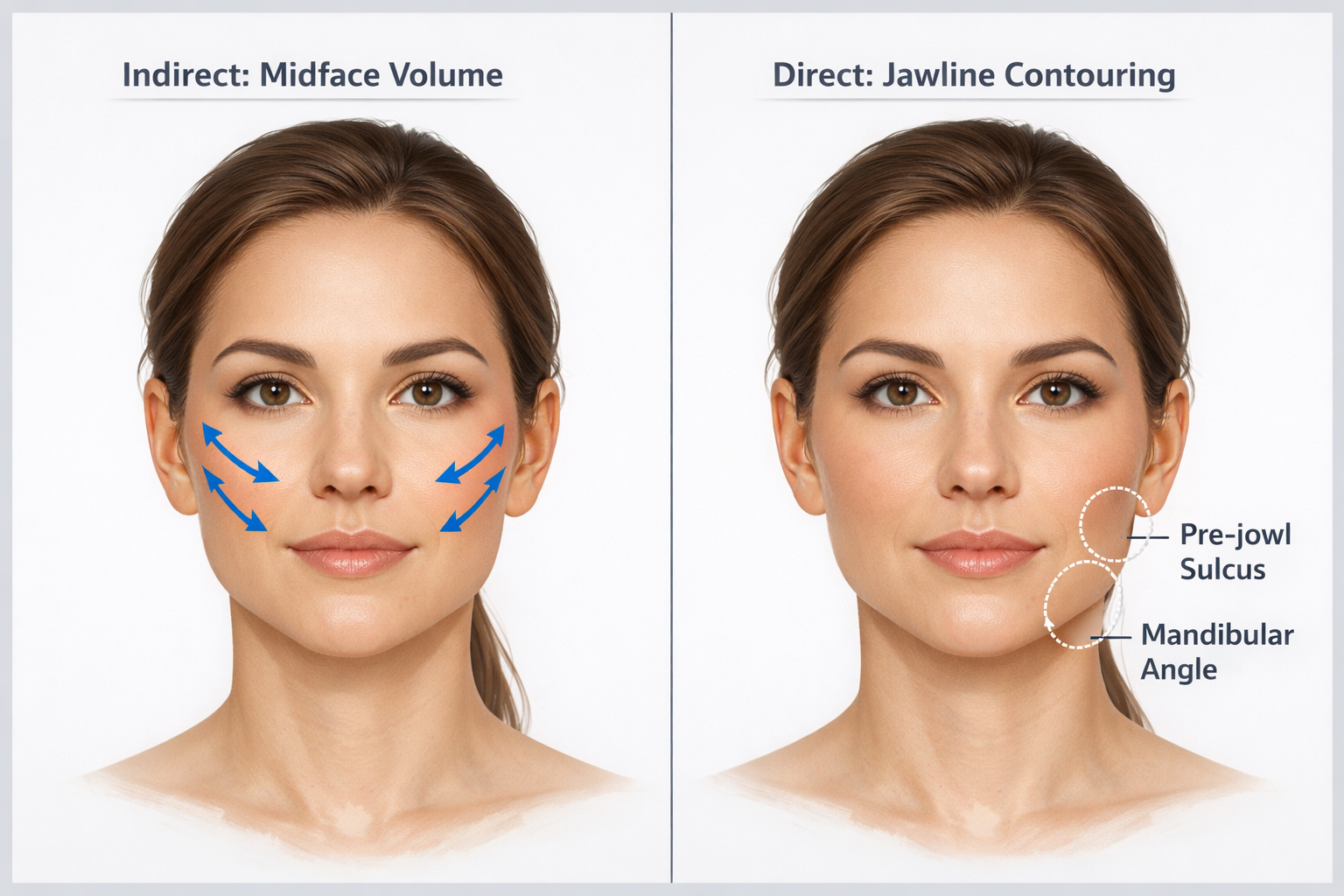
There are two main approaches, and most experienced injectors use a combination of both. The first is midface volume restoration — an indirect method that addresses the root cause rather than the symptom. When the cheeks lose volume, the overlying skin has less support and descends, contributing to jowl formation. Replacing that volume with filler in the cheek and midface area can provide a subtle lifting effect on the lower face, reducing jowl prominence without placing filler directly into the jowl itself.
The second is direct jawline contouring — placing filler along the jawline, at the mandibular angle, and into the pre-jowl sulcus (the hollow depression that forms beside the chin and creates the characteristic jowl shadow). By filling this sulcus and reinforcing the jawline, the injector can visually blend the jowl into the surrounding tissue, restoring a smoother, more defined jaw profile. Chin augmentation with filler is sometimes included to improve overall lower-face balance and facial harmony.
This combination approach — addressing both the midface and the lower face — tends to produce more natural-looking results than treating either area in isolation.
Which Fillers Are Used for Jowls?
Several filler types are used for lower-face rejuvenation, each with different properties, longevity, and suitability depending on the patient’s anatomy and goals.
| Filler Type | Examples | Mechanism | Longevity | Reversible? | Best For |
|---|---|---|---|---|---|
| Hyaluronic acid (HA) | Juvéderm Voluma, Juvéderm Volux, Restylane Lyft | Immediate volume replacement | 6–18 months | Yes (hyaluronidase) | First-time patients; those wanting reversible results |
| Calcium hydroxylapatite (CaHA) | Radiesse | Volume + collagen stimulation | 12–18 months | No | Structural jawline support; collagen rebuilding |
| Poly-L-lactic acid (PLLA) | Sculptra | Gradual collagen stimulation | Up to 24+ months | No | Gradual, natural-looking volume restoration over multiple sessions |
| PMMA-collagen gel | Bellafill | Permanent microspheres + collagen | Long-lasting (semi-permanent) | No | Patients seeking longer-term correction; experienced injector required |
Hyaluronic acid fillers such as Juvéderm Voluma XC, Juvéderm Volux, and Restylane Lyft are the most commonly used for jowl treatment. They provide immediate visible results and are reversible with hyaluronidase — an enzyme that can dissolve HA filler if the result is unsatisfactory or a complication occurs. For the lower face and jawline, injectors typically select a firmer, higher-viscosity HA product. The technical term for this property is G-prime: a higher G-prime filler resists deformation better, making it more suitable for structural support along the jaw.
Biostimulatory fillers such as Radiesse (calcium hydroxylapatite) and Sculptra (poly-L-lactic acid) work differently. Rather than simply replacing lost volume, they stimulate the body’s own collagen production over weeks to months. Results develop gradually and tend to last longer than HA fillers, but these products are not reversible, and multiple treatment sessions are usually required before the full effect is visible. They may be particularly well suited to patients who want gradual, natural-looking improvement and are comfortable with a longer treatment timeline.
Injection Technique and Placement
The technique used matters as much as the product chosen. For structural jawline support, filler is often placed at a deep level — sometimes described as supraperiosteal placement, meaning just above the bone — to provide a firm foundation without distorting the overlying soft tissue. Shallower placement may be used for the pre-jowl sulcus to smooth the surface contour.
Injectors may use a fine needle or a blunt-tipped cannula depending on the area being treated and their clinical preference. Cannulas are associated with a lower risk of bruising and vascular injury in some areas because they are less likely to pierce a blood vessel, though both techniques are used safely by experienced practitioners. The jawline and lower face are highly vascularised regions, meaning there are many blood vessels in the area, which is one reason why injector experience and anatomical knowledge are particularly important here.
Am I a Suitable Candidate?
Filler for jowls tends to work best for people with mild to moderate jowling and reasonable skin elasticity. If the skin still has some ability to contract and remodel, filler can produce a noticeably smoother jawline. Typical candidates are in their thirties to early sixties, though age alone is not the deciding factor — skin quality and the degree of tissue descent matter more.
Factors that may make someone a good candidate include:
- Mild to moderate jowling rather than heavy, descended tissue
- Adequate skin elasticity — skin that still has some firmness and recoil
- Realistic expectations about what non-surgical treatment can achieve
- Good general health with no active skin infections or inflammatory conditions in the treatment area
- No allergy to filler components
- Not pregnant or breastfeeding
Filler is unlikely to produce satisfying results for people with significant skin laxity, very heavy jowls, or substantial excess skin. In these cases, the volume added by filler may not be sufficient to camouflage the degree of descent, and a surgical option such as a lower facelift may be a more appropriate discussion to have with a qualified surgeon. An honest assessment of this limitation at consultation is a sign of a trustworthy practitioner.
Certain medications — particularly blood thinners — and health conditions may affect suitability or require timing adjustments. A thorough medical history review at consultation is essential before any injectable treatment.
What Happens During the Procedure?
A filler appointment for jowls typically begins with a detailed consultation and facial assessment. The injector will evaluate your facial anatomy, skin quality, degree of jowling, and overall facial proportions before recommending a treatment plan. This may include discussion of how many syringes are likely to be needed and whether a combination approach involving the midface, jawline, and chin is appropriate.
On the day of treatment, a topical numbing cream is usually applied to the skin for 20–30 minutes before injections begin. Most modern fillers also contain lidocaine — a local anaesthetic — within the gel itself, which helps reduce discomfort during the procedure. The injections themselves typically take 15–30 minutes depending on the areas being treated and the number of syringes used.
Patients can usually see an immediate change in the jawline contour after treatment, though some swelling is normal and the final result becomes clearer once this settles, usually within one to two weeks.
Recovery, Aftercare, and What to Expect Day by Day
Filler for jowls is a minimally invasive treatment with no significant downtime, but some temporary side effects are expected and normal.
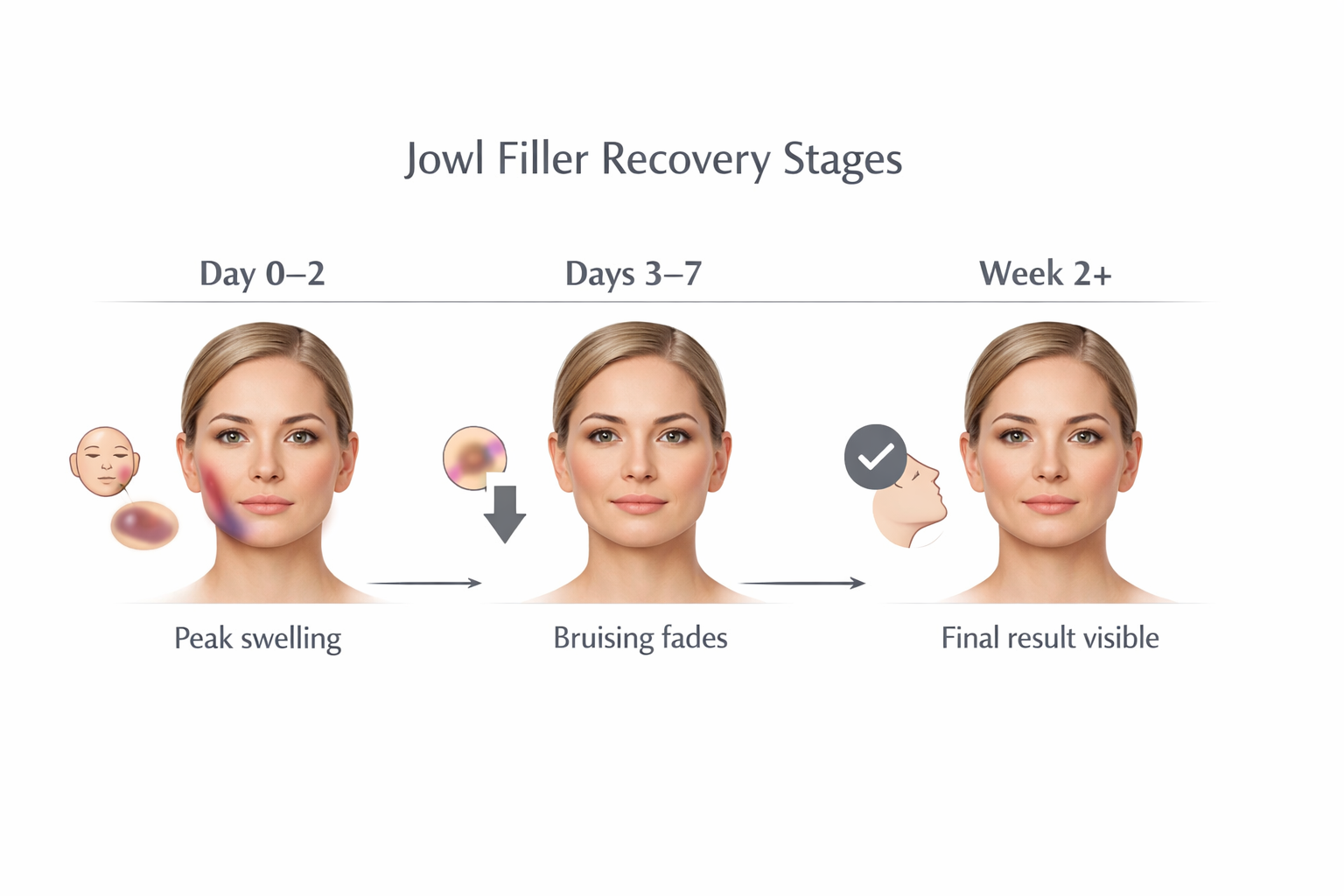
- Day 0–2: Swelling, redness, and tenderness at injection sites are common. Bruising may appear, particularly along the jawline. This is the peak of any post-treatment reaction.
- Days 3–7: Swelling begins to reduce. Bruising, if present, typically fades during this period. The treated area may feel slightly firm or uneven as the filler integrates with surrounding tissue.
- Week 2 onward: Swelling has largely resolved and the filler has settled into its final position. This is when the true result becomes visible.
Standard aftercare advice includes avoiding strenuous exercise and significant heat exposure (saunas, hot baths) for 24–48 hours, not pressing or massaging the treated area for at least 24 hours, and avoiding alcohol and blood-thinning supplements such as fish oil or high-dose vitamin E in the days before treatment to reduce bruising risk. Your injector will provide specific aftercare instructions tailored to your treatment.
How Long Do Results Last?
Longevity depends on the filler type used, the area treated, individual metabolism, and lifestyle factors. As a general guide:
- HA fillers in the lower face typically last 9–18 months. The jawline area tends to experience more movement than areas like the cheeks, which can accelerate breakdown.
- Radiesse (CaHA) generally lasts 12–18 months, with some collagen-stimulating benefit persisting beyond the filler itself.
- Sculptra (PLLA) results may last up to two years or more, though multiple initial sessions are needed to build the effect.
Most patients benefit from maintenance appointments every 9–18 months to preserve their results. Over time, some patients find they need less product at each session as collagen-stimulating effects accumulate, though this varies considerably between individuals.
How Much Does Filler for Jowls Cost?
Cost varies depending on the clinic, the injector’s experience, the geographic location, and the number of syringes required. As a general indication, individual syringes of HA filler typically range from around £300 to £700 in the UK (or approximately $500–$1,000 in the US), while biostimulatory products such as Sculptra may be priced per vial at a similar or higher range.
Treating jowls effectively often requires more than one syringe — a combination approach addressing the midface and jawline may use two to four syringes in a single session. A realistic full-treatment cost for jowl filler commonly falls in the range of £600–£2,000+ per session depending on the extent of treatment. Ongoing maintenance costs over several years should also be factored into any decision. Clinics offering unusually low prices for premium products warrant careful scrutiny, as product authenticity and injector qualifications are both important safety considerations.
Risks and Side Effects
Filler for jowls is generally well tolerated, but it is not without risk. Understanding the difference between common, expected side effects and rare but serious complications helps patients make an informed decision.
Common and expected: Bruising, swelling, redness, tenderness, and temporary firmness at injection sites. These typically resolve within one to two weeks.
Less common: Asymmetry, visible lumps or nodules, the Tyndall effect (a bluish discolouration if HA filler is placed too superficially), and filler migration over time.
Rare but serious: Vascular occlusion — where filler inadvertently enters or compresses a blood vessel — is the most significant risk associated with any injectable filler. In the lower face and jawline, which are highly vascularised, this risk underscores the importance of choosing an injector with thorough anatomical knowledge and access to hyaluronidase for emergency reversal of HA filler. In very rare cases, vascular complications can lead to skin necrosis or, in the most severe scenarios involving certain facial vessels, vision changes. These outcomes are uncommon but are the reason why filler should only be administered by appropriately trained practitioners in a clinical setting.
Granuloma formation — a delayed inflammatory reaction to filler — is another rare possibility, particularly with non-HA products. Patients with a history of cold sores should inform their injector, as treatment can occasionally trigger a flare.
Filler vs. Other Treatments for Jowls
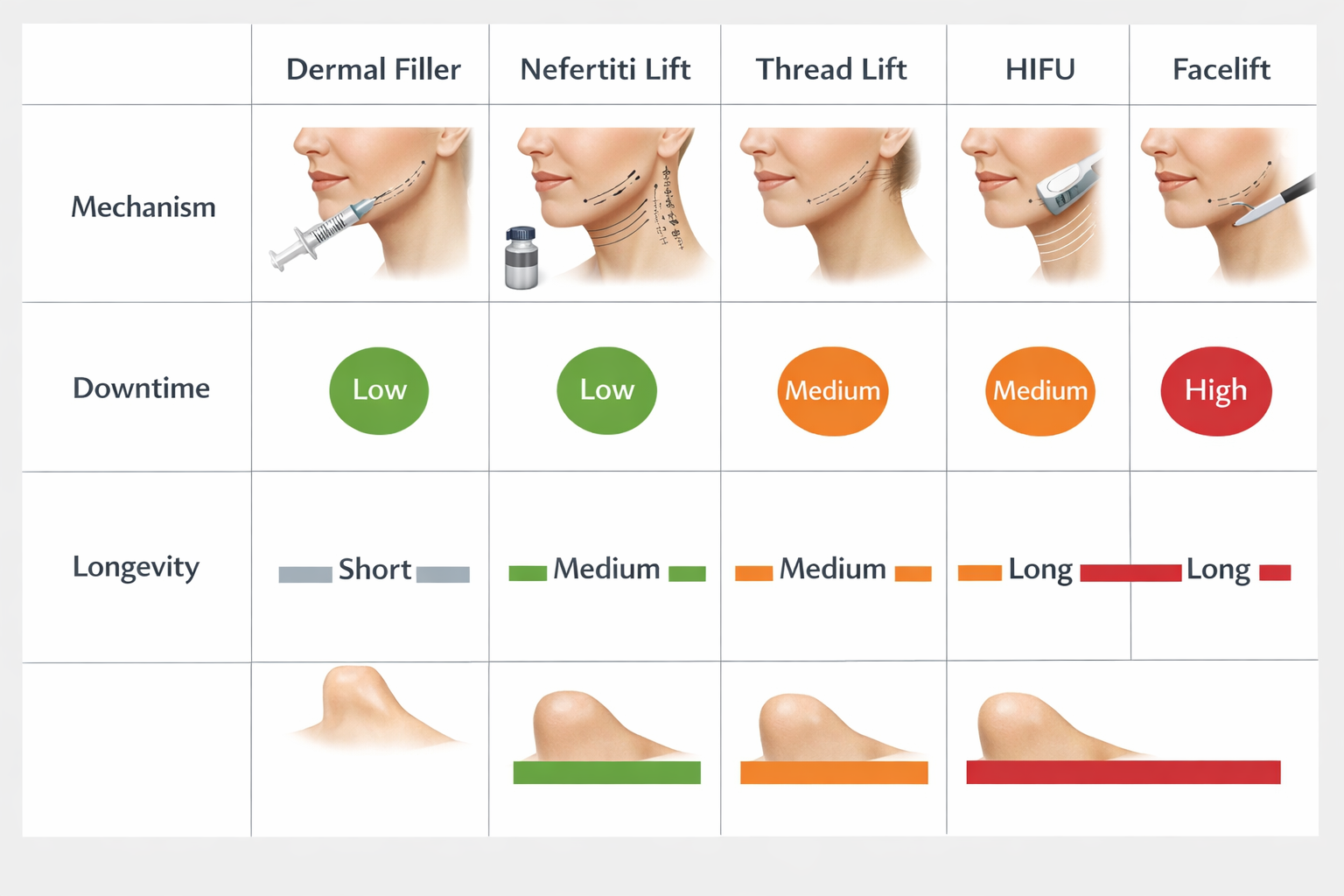
Filler is one of several options for addressing jowls, and it is not always the most appropriate choice. Understanding how it compares to alternatives helps clarify when it may be the right starting point and when a different approach might be worth discussing.
| Treatment | Mechanism | Best For | Longevity | Downtime | Surgical? |
|---|---|---|---|---|---|
| Dermal filler | Volume restoration and contouring | Mild–moderate jowls with good skin elasticity | 9–24+ months | Minimal (1–2 weeks bruising/swelling) | No |
| Botox / Nefertiti lift | Relaxes platysma muscle to reduce downward pull | Early jowling; complements filler | 3–4 months | Minimal | No |
| PDO thread lift | Mechanical tissue lifting + collagen stimulation | Mild–moderate laxity; lifting effect | 12–18 months | Low–moderate | No |
| Ultherapy / HIFU | Ultrasound energy to tighten deep tissue | Skin laxity; gradual tightening | 12–18 months | Minimal | No |
| Radiofrequency (RF) / RF microneedling | Heat energy to stimulate collagen and tighten skin | Skin quality and mild laxity | 12–18 months | Low–moderate | No |
| Lower facelift / mini facelift | Surgical repositioning of tissue and skin | Moderate–severe jowling; significant laxity | 5–10+ years | Significant (weeks) | Yes |
The Nefertiti lift — a technique using botulinum toxin injected along the jawline and into the platysma muscle of the neck — can complement filler by reducing the downward muscular pull that contributes to jowl formation. It does not add volume but can enhance the overall lower-face result when used alongside filler as part of a combination treatment plan.
For patients with significant skin laxity or heavy jowling that filler cannot adequately address, a surgical consultation may be the more honest recommendation. A lower facelift physically repositions descended tissue and removes excess skin, producing results that non-surgical treatments cannot replicate in more advanced cases. Filler used in this context may temporarily camouflage rather than correct the underlying problem, and an experienced injector should be transparent about this distinction.
Combination Treatment Protocols
Many practitioners now approach lower-face rejuvenation as a multi-modal plan rather than a single-product treatment. A typical combination protocol might include midface filler (to restore cheek volume and provide indirect lift), jawline and pre-jowl sulcus filler (for direct contouring), a Nefertiti lift with botulinum toxin (to address platysma pull), and a skin-tightening technology such as radiofrequency or HIFU (to improve skin quality and elasticity). These elements address different aspects of the aging process simultaneously and can produce results that are more comprehensive than any single treatment alone.
This approach is also relevant for patients considering preventative treatment — those in their thirties or early forties who are beginning to notice early jowl formation. Addressing volume loss at an earlier stage, before significant tissue descent has occurred, may slow the visible progression of jowling over time, though this use of filler as a preventative measure is based on clinical reasoning rather than long-term controlled trial data.
How to Choose a Provider
The jawline and lower face are anatomically complex areas with a high density of blood vessels and important facial nerves. The injector’s qualifications, training, and experience are the most important safety variables in any filler treatment — more so than the brand of product used.
When researching providers, look for practitioners with a recognised medical background (doctor, dentist, nurse prescriber, or equivalent depending on your country’s regulations), specific training in facial anatomy and injectable techniques, and a clear protocol for managing complications including access to hyaluronidase. A thorough consultation that includes facial assessment, discussion of realistic expectations, and honest acknowledgment of limitations is a positive indicator. Be cautious of providers who offer very low prices, skip the consultation, or promise dramatic lifting results from filler alone.
Frequently Asked Questions
Can filler completely eliminate jowls?
Filler can significantly reduce the appearance of mild to moderate jowls by restoring volume and improving jawline definition, but it does not physically lift or reattach descended tissue. For more advanced jowling with significant skin laxity, filler provides camouflage rather than correction, and surgical options may produce more satisfying results.
Is filler for jowls painful?
Most patients find the procedure tolerable. Topical numbing cream is applied beforehand, and most fillers contain lidocaine within the gel to reduce discomfort during injection. Some tenderness and sensitivity in the treated area is normal for a few days afterward.
How many syringes will I need?
This depends on the degree of volume loss, the areas being treated, and the filler product used. A combination approach addressing the midface and jawline may require two to four syringes in a single session. Your injector should give you a realistic estimate at consultation based on your individual anatomy.
Can filler for jowls be reversed if I don’t like the result?
Hyaluronic acid fillers are reversible with hyaluronidase, an enzyme that dissolves HA gel. Biostimulatory fillers such as Radiesse and Sculptra are not reversible in the same way, which is one reason many practitioners recommend starting with an HA filler for first-time patients.
Will I look unnatural or “overfilled”?
In experienced hands, filler for jowls should produce natural-looking results that restore facial balance rather than an obviously treated appearance. Overfilling is a risk when too much product is used or when the treatment plan does not account for overall facial proportions. Choosing an injector who takes a conservative, anatomy-led approach reduces this risk.
How soon can I return to normal activities?
Most people return to work and daily activities the same day or the following day. Strenuous exercise, significant heat exposure, and alcohol are generally avoided for 24–48 hours. Any bruising can usually be covered with makeup after 24 hours if the skin is not broken.
Is there a difference in treatment goals between men and women?
Yes. Female facial goals typically focus on a smooth, contoured jawline with gentle definition, while male patients often prefer a sharper, more angular jaw. An experienced injector will tailor filler placement and product selection to suit the patient’s facial structure and aesthetic goals rather than applying a one-size-fits-all approach.
Is Filler the Right Approach for Your Jowls?
Filler for jowls is a well-established non-surgical option that can meaningfully improve lower-face definition for the right candidate. It works best when jowling is mild to moderate, skin elasticity is reasonable, and the patient has realistic expectations about what injectable treatment can and cannot achieve. The combination approach — addressing midface volume alongside direct jawline contouring — tends to produce the most balanced, natural-looking outcomes.
The treatment is not a permanent solution, and ongoing maintenance appointments are part of the commitment. For patients with significant skin laxity or heavy jowling, a surgical consultation may ultimately offer more lasting correction. An honest practitioner will tell you which category you fall into rather than recommending filler when it is unlikely to meet your goals.
If you are considering filler for jowls, a thorough consultation with a qualified, experienced injector is the essential first step. A good consultation should include a full facial assessment, a clear explanation of the proposed treatment plan, realistic discussion of expected results and limitations, and transparent information about costs and risks. That conversation will give you the information you need to decide whether this treatment is the right fit for you.