

Key Takeaways
- Filler for double chin works primarily by improving chin projection, which creates an optical illusion of a slimmer, more defined neck and jawline — it does not remove submental fat.
- It is most effective when the double chin is partly caused by a recessed or weak chin rather than a large volume of excess fat.
- Hyaluronic acid fillers are the most commonly used option; results typically last 12–18 months, and the treatment is reversible with hyaluronidase.
- Kybella, CoolSculpting, and surgical options may be more appropriate when submental fullness is driven primarily by excess fat rather than structural deficit.
- A thorough assessment by a qualified injector is essential to determine whether filler, an alternative treatment, or a combination approach is most appropriate for your anatomy.
What Is Filler for Double Chin and How Does It Work?
A double chin — clinically referred to as submental fullness — can result from several overlapping factors: genetics, bone structure, submental fat accumulation, skin laxity, and the natural descent of facial fat pads with age. Not all double chins have the same cause, and this distinction matters significantly when choosing a treatment.
Chin filler, or chin dermal filler, is a non-surgical injectable treatment that adds volume and structural support to the chin area. The most important mechanism to understand is that filler does not dissolve or remove fat. Instead, it works by extending chin projection — pushing the chin forward and downward — which changes the angle between the chin and neck. This improved facial profile creates an optical illusion of a slimmer, more defined submental area, even though the underlying fat volume remains unchanged.
Think of it this way: when the chin sits further back than ideal, the neck and chin appear to merge, making submental fullness look more pronounced. By advancing the chin point, filler restores a cleaner visual separation between the jaw and neck. This is why filler for double chin tends to produce the most noticeable improvement in people whose submental fullness is partly a consequence of a recessed chin or weak chin rather than a large accumulation of fat alone.
A secondary mechanism involves the cascading lift effect on the lower face. When filler is placed strategically in the chin and sometimes the jawline, it can improve lower face support, subtly tightening the appearance of the area beneath the jaw. Some practitioners also address mid-face volume loss with cheek filler as part of a broader facial contouring plan, since restoring cheek structure can reduce the descent of tissue that contributes to jowling and lower face heaviness.
Types of Filler Used for the Chin
Several filler categories are used in the chin area, each with different properties, longevity, and clinical applications.
Hyaluronic Acid Fillers
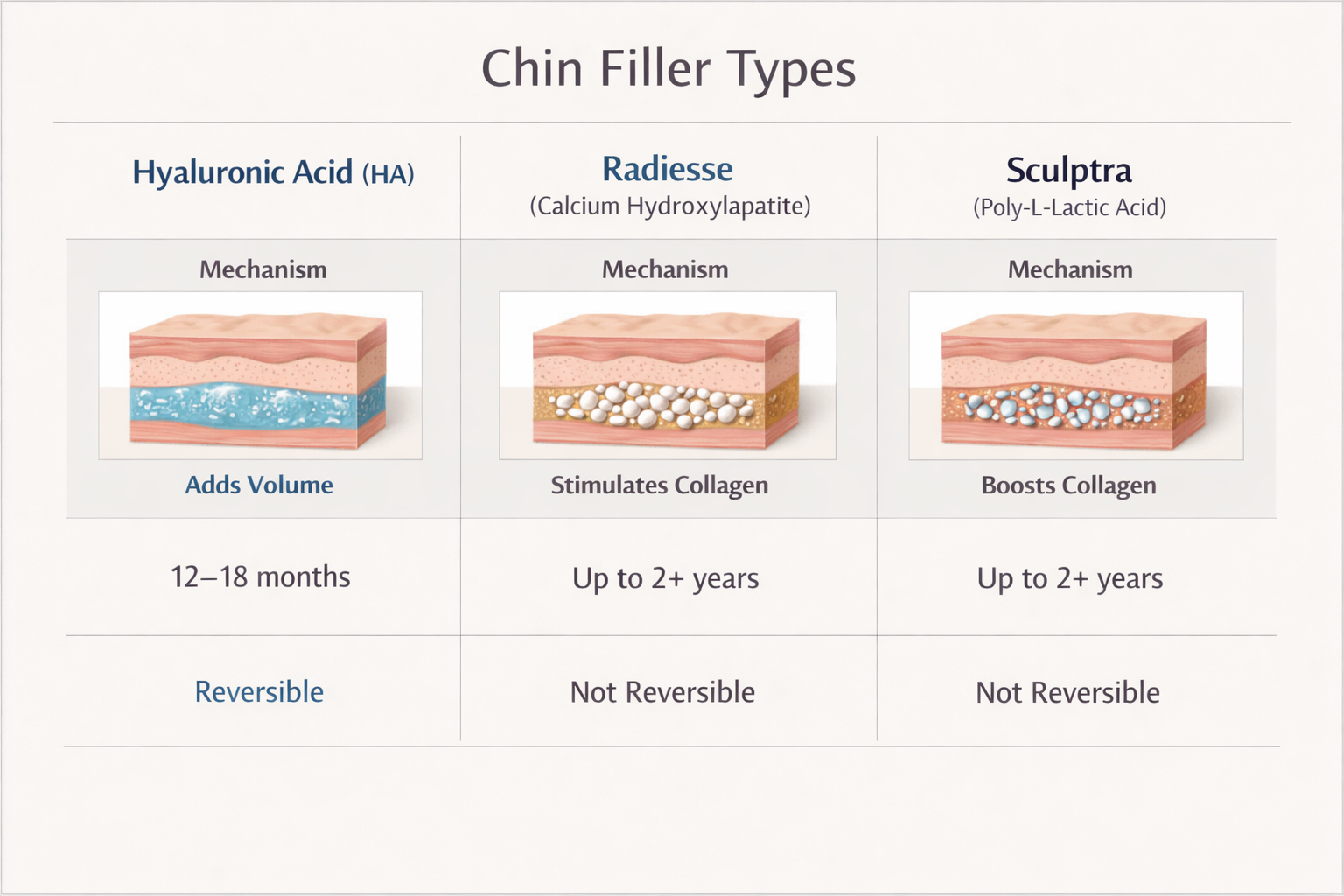
Hyaluronic acid (HA) fillers are the most widely used option for non-surgical chin augmentation. Products such as Restylane Defyne, Restylane Lyft, and Juvéderm Voluma are commonly selected for the chin because of their firmer consistency, which provides structural lift and projection rather than soft tissue plumping. HA fillers are particularly valued for their reversibility — if the result is unsatisfactory or a complication arises, hyaluronidase can be injected to dissolve the filler relatively quickly. Results from HA fillers in the chin area typically last between 12 and 18 months, though this varies by product, volume used, and individual metabolism.
Calcium Hydroxylapatite (CaHA) — Radiesse
Radiesse is a calcium hydroxylapatite filler that provides immediate volume while also acting as a collagen stimulator, encouraging the body to produce new collagen around the injected area over time. It tends to offer a firmer result than most HA fillers and may last slightly longer — often 12 to 18 months or more. Radiesse is not reversible with hyaluronidase, which is an important consideration for safety planning.
Poly-L-Lactic Acid (PLLA) — Sculptra
Sculptra is a collagen stimulator rather than a traditional volumising filler. It works gradually by stimulating the body’s own collagen production, with results building over several weeks and multiple sessions. In the chin and lower face, Sculptra can improve skin quality, add subtle structural support, and address skin laxity over time. Results may last two years or longer, but the gradual onset means it is less suited to patients seeking immediate definition. It is also not reversible.
| Filler Type | Examples | Mechanism | Longevity (Chin) | Reversible? |
|---|---|---|---|---|
| Hyaluronic Acid | Restylane Defyne, Juvéderm Voluma, Restylane Lyft | Immediate volume and structural projection | 12–18 months | Yes (hyaluronidase) |
| Calcium Hydroxylapatite | Radiesse | Volume + collagen stimulation | 12–18+ months | No |
| Poly-L-Lactic Acid | Sculptra | Gradual collagen stimulation | Up to 2+ years | No |
Who Is a Good Candidate for Chin Filler?
Chin filler tends to produce the most satisfying before and after results in patients whose double chin is at least partly structural in origin. A qualified injector will assess your facial anatomy carefully before recommending this approach.
You may be a suitable candidate if you have a recessed chin or weak chin that makes the submental area appear fuller than it actually is, mild to moderate submental fullness without a large volume of excess fat, reasonable skin elasticity with limited skin laxity, realistic expectations about what a non-surgical treatment can achieve, and no contraindications such as pregnancy, breastfeeding, active infection in the treatment area, or relevant allergies.
Chin filler is generally less effective — and may not be appropriate — if submental fullness is primarily caused by a significant accumulation of submental fat, if skin laxity is pronounced, or if the patient’s expectations exceed what a non-surgical approach can realistically deliver. In these cases, fat-reduction treatments or surgical options may produce better outcomes.
Men and women may have different aesthetic goals for chin filler. Male jawline contouring often prioritises a stronger, more angular chin projection, while female patients may seek a softer, more refined lower face contour. An experienced injector will tailor the placement and volume to suit individual facial proportions and gender-specific aesthetic goals.
What to Expect: The Treatment Process
A chin filler appointment typically begins with a detailed consultation, during which the practitioner assesses your facial anatomy, discusses your concerns and goals, reviews your medical history, and takes clinical photographs. This assessment determines whether filler is appropriate, which product is most suitable, and how much volume may be needed.
Before the injections, a topical anaesthetic or numbing cream is usually applied to the chin area to minimise discomfort. Many filler products also contain lidocaine, a local anaesthetic, within the formulation itself. The injection process is generally brief — often 15 to 30 minutes — though the full appointment including consultation and aftercare discussion may take 45 to 90 minutes.
Patients are typically advised to avoid blood-thinning medications (such as aspirin and ibuprofen, where medically appropriate to stop), alcohol, and supplements like fish oil and vitamin E for several days before treatment, as these can increase bruising risk. After treatment, common aftercare guidance includes avoiding strenuous exercise, excessive heat, and pressure on the treated area for 24 to 48 hours.
Immediately after the appointment, some swelling, redness, and tenderness in the chin area is normal and expected. Bruising is possible. Most of these effects settle within a few days to a week. The final result becomes clearer once initial swelling has resolved, usually within one to two weeks.
Results, Longevity, and Maintenance
One of the advantages of chin filler is that some improvement in chin projection and jawline definition is visible immediately after treatment. The result refines further as swelling subsides over the following days.
For hyaluronic acid fillers, results in the chin area typically last between 12 and 18 months, depending on the specific product, the volume used, and how quickly an individual metabolises the filler. Touch-up or maintenance sessions every 12 to 18 months are generally needed to sustain the result. Collagen-stimulating options like Sculptra may offer longer-lasting structural improvement, but require multiple sessions and a longer wait to see the full effect.
Most chin filler treatments use one to two syringes of product per session, though this varies considerably depending on the degree of chin retrusion and the desired outcome. The cost of chin filler typically ranges from approximately £400 to £1,200 per session in the UK, or $600 to $2,000 in the US, depending on the product used, the volume required, and the provider’s experience and location. These figures are approximate and subject to variation.
Filler vs. Kybella vs. CoolSculpting: Choosing the Right Approach
Understanding how chin filler compares to fat-reduction treatments is essential for making an informed decision. These treatments work through entirely different mechanisms and suit different underlying causes of submental fullness.
| Treatment | Mechanism | Removes Fat? | Sessions Needed | Downtime | Longevity | Reversible? | Best Suited For |
|---|---|---|---|---|---|---|---|
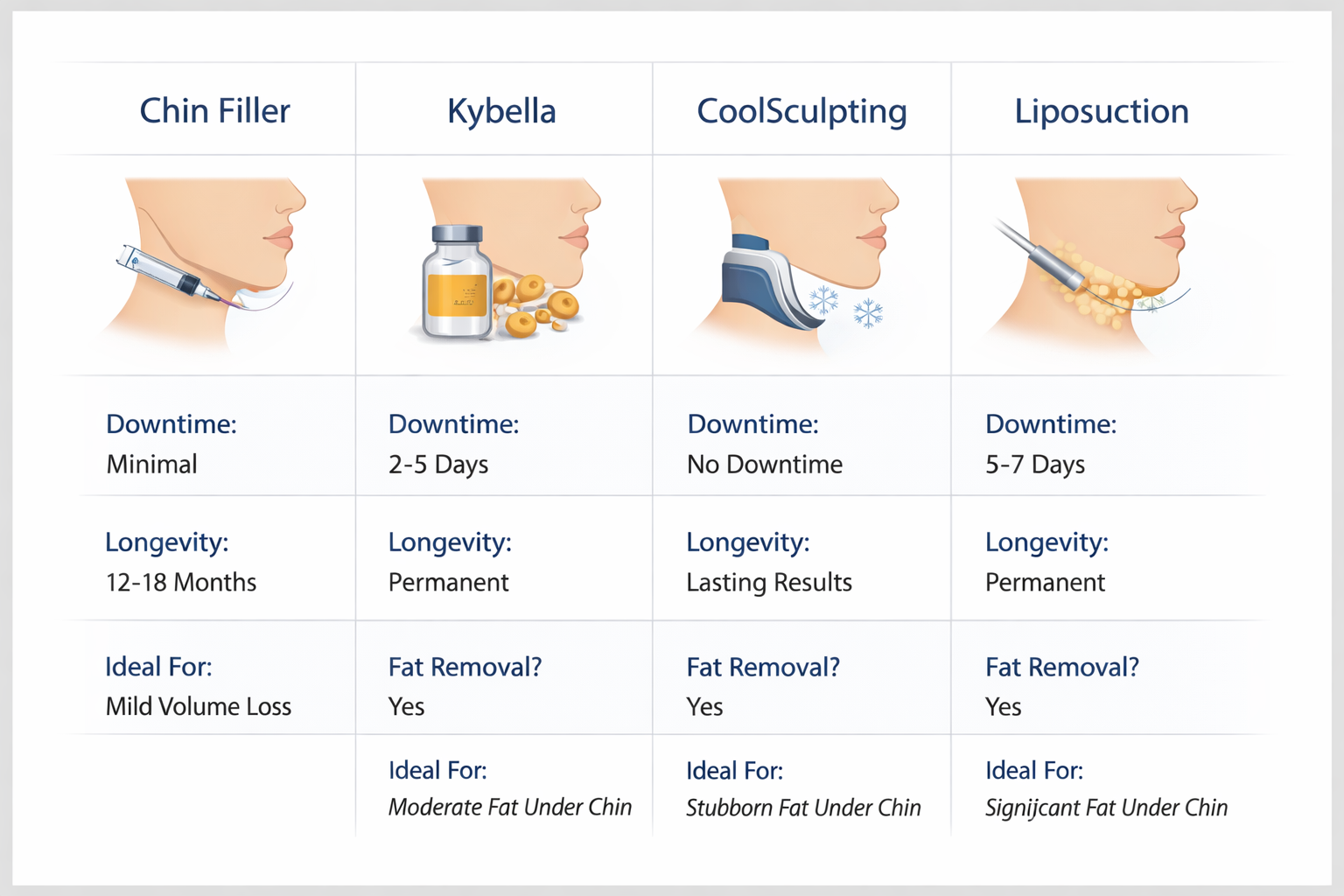
| Chin Filler (HA) | Adds projection; optical illusion of slimmer profile | No | 1 (top-ups needed) | Minimal (days) | 12–18 months | Yes | Recessed chin, mild structural double chin |
| Kybella / Belkyra (deoxycholic acid) | Destroys fat cell membranes | Yes | 2–4 typically | Moderate (1–2 weeks swelling) | Long-lasting (fat cells destroyed) | No | Moderate submental fat, good skin elasticity |
| CoolSculpting (cryolipolysis) | Freezes and eliminates fat cells | Yes | 1–2 | Minimal to moderate | Long-lasting (fat cells eliminated) | No | Pinchable submental fat, good skin tone |
| Submental liposuction | Surgical fat removal | Yes | 1 (surgical) | Significant (weeks) | Permanent (fat cells removed) | No | Larger fat volume, may combine with skin tightening |
Kybella (known as Belkyra in some markets) uses deoxycholic acid to permanently destroy submental fat cells. It requires multiple sessions and involves a period of noticeable swelling, but the fat reduction is long-lasting once the treated cells are eliminated. CoolSculpting uses cryolipolysis — controlled cooling — to freeze and gradually eliminate fat cells in the submental area. Both are appropriate when excess fat is the primary driver of submental fullness and skin elasticity is adequate.
Chin filler and fat-reduction treatments are not mutually exclusive. A combination treatment approach — for example, using Kybella to reduce fat volume and chin filler to improve projection — can address both the structural and fat-related components of a double chin simultaneously or sequentially. This combined approach is increasingly used in clinical practice and may produce more comprehensive results than either treatment alone.
When Filler Is Not the Right Answer
It is important to be honest about the limitations of chin filler. If submental fullness is primarily caused by a significant accumulation of submental fat, filler alone is unlikely to produce a satisfying result. Adding chin projection may improve the profile angle, but it will not meaningfully reduce a prominent fat pad beneath the chin.
Similarly, if skin laxity is a significant factor — for example, loose or crepey skin beneath the chin — filler will not tighten the skin. In these cases, skin-tightening treatments such as radiofrequency microneedling, Thermage, or Ultherapy may be considered, or a surgical neck lift may be the most appropriate option depending on the degree of laxity.
A thorough assessment by a trained medical professional is the only reliable way to determine which treatment or combination of treatments is most likely to address your specific concerns. Practitioners who offer a whole-face assessment — considering chin structure, fat distribution, skin quality, and mid-face volume — are better placed to recommend an approach that produces balanced, natural-looking facial harmony.
Risks and Safety Considerations
Chin filler is a minimally invasive procedure, but it carries real risks that should be understood before proceeding. Common side effects include swelling, bruising, redness, and tenderness at the injection site. These typically resolve within a few days to a week.
Less common but more serious risks include infection, filler migration, and — most critically — vascular occlusion. Vascular occlusion occurs when filler is inadvertently injected into or compresses a blood vessel, potentially restricting blood flow to surrounding tissue. The chin and lower face contain important vascular anatomy, and this risk underscores why the choice of a qualified injector with a thorough understanding of facial anatomy is not optional — it is essential.
Hyaluronic acid fillers carry the significant safety advantage of reversibility. If a complication arises or the result is unsatisfactory, hyaluronidase can be injected to dissolve the HA filler. This is not possible with Radiesse or Sculptra, which is an important factor when weighing product options, particularly for first-time patients.
Chin filler is generally not recommended during pregnancy or breastfeeding, in the presence of active infection or inflammation in the treatment area, or in patients with certain autoimmune conditions or known hypersensitivity to filler components. A full medical history review at consultation is essential.
Combining Chin Filler with Other Treatments
Chin filler is often most effective as part of a broader lower face contouring plan rather than as a standalone treatment. Several combination approaches are used in clinical practice.
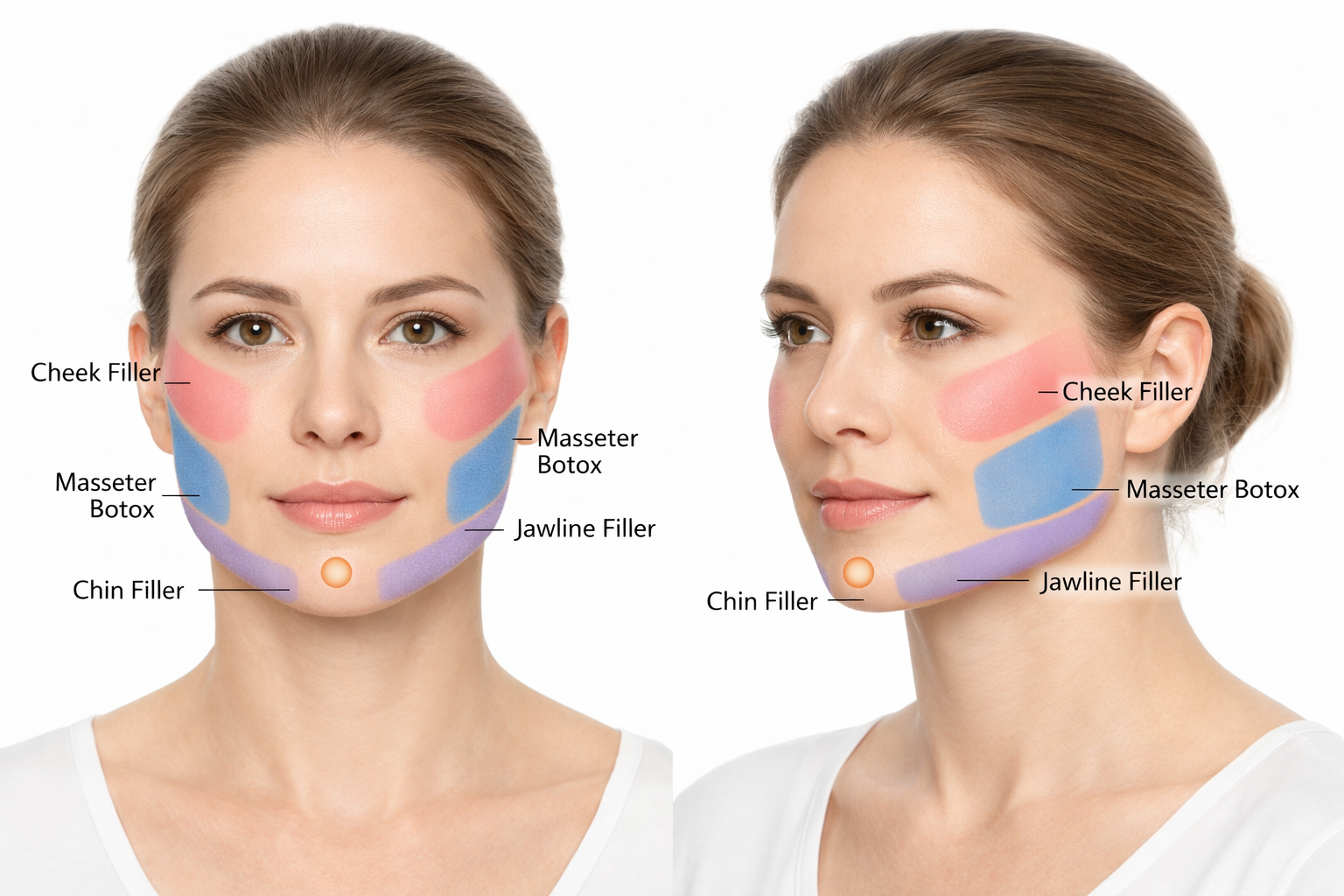
Masseter Botox combined with chin filler is a popular pairing: botulinum toxin injected into the masseter muscles can slim the lower face width, while chin filler improves projection and vertical definition, together creating a more balanced and refined lower face contour. The Nefertiti neck lift — botulinum toxin injected along the platysma muscle bands — can complement chin filler by improving neck definition and reducing downward pull on the lower face.
For patients with both submental fat and a recessed chin, combining Kybella or CoolSculpting with chin filler addresses both components: fat reduction improves the volume beneath the chin, while filler improves the structural angle. Cheek filler may also be incorporated to restore mid-face volume, which can reduce the descent of tissue contributing to jowls and lower face heaviness — a cascading lift effect that improves overall facial harmony.
Any combination treatment plan should be developed by an experienced practitioner who assesses the face as a whole rather than treating individual areas in isolation.
Frequently Asked Questions
Does chin filler actually remove the fat under my chin?
No. Chin filler does not remove or dissolve submental fat. It works by improving chin projection, which changes the visual angle between the chin and neck and creates the appearance of a slimmer profile. If excess fat is the primary cause of your double chin, a fat-reduction treatment such as Kybella or CoolSculpting may be more appropriate.
Is chin filler painful?
Most patients find chin filler tolerable. Topical numbing cream is applied before treatment, and many filler products contain lidocaine within the formulation. Some pressure or mild discomfort during injection is common, but significant pain is not typical. Tenderness in the area for a day or two after treatment is normal.
How long does chin filler last?
Hyaluronic acid fillers in the chin area typically last 12 to 18 months, depending on the product, the volume used, and individual factors such as metabolism. Collagen-stimulating options like Sculptra may last longer but require multiple sessions and a gradual build-up period. Maintenance sessions are needed to sustain results over time.
Can chin filler be reversed?
Hyaluronic acid fillers can be dissolved using hyaluronidase, an enzyme that breaks down HA. This makes HA fillers the most flexible and safest option for patients who want the reassurance of reversibility. Radiesse and Sculptra cannot be reversed in the same way.
How many syringes of filler are needed for the chin?
This varies depending on the degree of chin retrusion and the desired result. Many patients require one to two syringes per session, but the appropriate volume should be determined by a qualified injector based on your individual anatomy and goals.
Is chin filler suitable for men?
Yes. Chin filler is used in both men and women, though the aesthetic goals often differ. Male patients typically seek stronger, more angular chin projection to enhance jawline definition, while female patients may prefer a softer, more refined contour. An experienced injector will adapt the technique and placement accordingly.
What is the difference between chin filler and jawline filler?
Chin filler is placed specifically at the chin point to improve projection and vertical definition. Jawline filler is placed along the mandibular border to sharpen the angle of the jaw and improve lateral definition. The two are often used together as part of a comprehensive lower face contouring treatment.
Is Chin Filler the Right Approach for Your Double Chin?
Chin filler can be a genuinely effective non-surgical option for improving the appearance of a double chin — but only when the underlying cause is at least partly structural. If a recessed or weak chin is contributing to submental fullness, improving chin projection with dermal filler can create a meaningful and immediate improvement in facial profile and jawline definition without surgery or significant downtime.
However, filler is not a fat-reduction treatment, and it will not produce satisfying results when excess submental fat or significant skin laxity is the dominant concern. In those cases, deoxycholic acid injections, cryolipolysis, skin-tightening treatments, or surgical options may be more appropriate — either alone or in combination with filler.
The most important step is a thorough consultation with a qualified, medically trained injector who can assess your facial anatomy honestly, explain what filler can and cannot achieve for your specific situation, and recommend a treatment plan — whether that involves filler alone, an alternative, or a combination approach — that is genuinely suited to your goals and anatomy.