

Understanding your face shape is a genuinely useful starting point — not because any shape is more desirable than another, but because knowing your facial structure helps you make more informed decisions about hairstyles, makeup techniques, eyewear, and, where relevant, aesthetic treatments. This guide explains how to identify the most common face shapes, what distinguishes each one, and why this knowledge matters in both everyday styling and clinical aesthetic consultations.
Key Takeaways
- Face shape is determined by the relative proportions of the forehead, cheekbones, jawline, and face length — not by a single measurement alone.
- Most people have a face shape that blends characteristics of two or more categories; a perfect match to one type is less common than a dominant tendency.
- Identifying your face shape accurately requires consistent measurements or a careful mirror assessment — not a quick glance.
- In aesthetic medicine, face shape analysis informs treatment planning for procedures such as dermal filler placement, jawline contouring, and cheek augmentation.
- No face shape requires correction; aesthetic treatments are a personal choice, not a clinical necessity based on facial geometry.
Why Face Shape Matters
Face shape analysis has practical applications across hairstyling, cosmetic artistry, eyewear design, and aesthetic medicine. In each of these fields, understanding the underlying bone structure and soft tissue distribution helps practitioners and individuals make choices that complement natural features rather than work against them. A hairstylist uses face shape to recommend cuts that balance proportions; a makeup artist uses it to guide contouring and highlighting; an aesthetic practitioner uses it to plan where dermal filler or other treatments may create the most harmonious result.
It is worth noting that face shape is not a fixed category with rigid boundaries. Facial structure changes with age as bone density shifts, soft tissue redistributes, and skin loses elasticity. The face shape you identify in your twenties may appear subtly different in your forties or fifties, which is one reason aesthetic practitioners assess facial anatomy holistically rather than relying on a single classification.
How to Measure Your Face Shape at Home
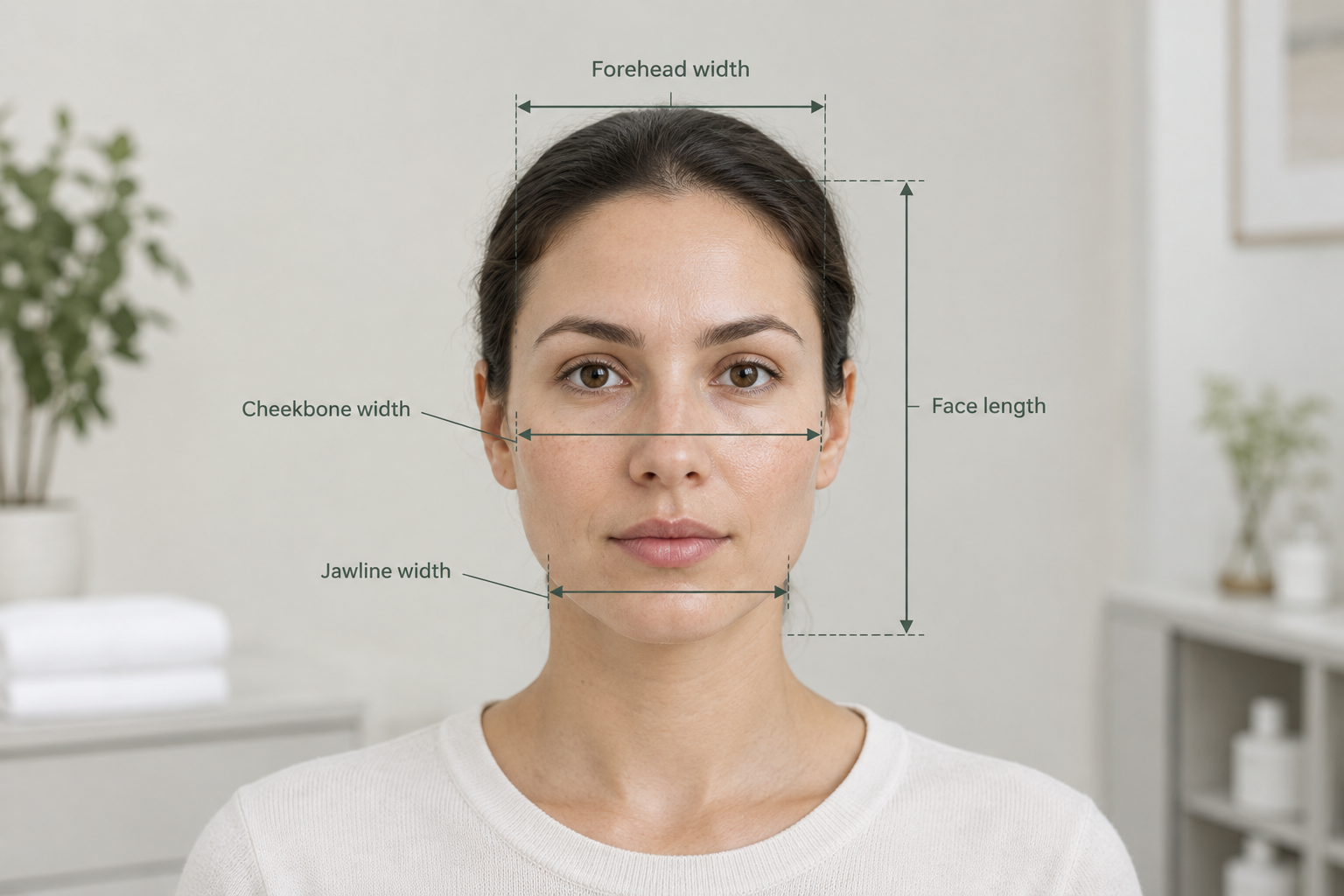
Accurate face shape identification requires looking at four key measurements: forehead width, cheekbone width, jawline width, and face length. You can take these measurements yourself using a flexible tape measure or a ruler held against a mirror, though a photograph taken straight-on in good lighting is often easier to work with.
The Four Key Measurements
- Forehead width: Measure across the widest point of your forehead, roughly halfway between your hairline and your eyebrows.
- Cheekbone width: Measure from the outer corner of one eye to the outer corner of the other, or across the widest point of your cheeks just below the outer corners of the eyes.
- Jawline width: Measure from the tip of your chin to the angle of your jaw on one side, then double that figure. Alternatively, measure straight across the jaw at its widest point.
- Face length: Measure from the centre of your hairline to the tip of your chin.
Once you have these four figures, compare them. The relative proportions — which measurement is largest, which is smallest, and how the face length compares to the width — are what determine face shape. No single measurement is meaningful in isolation.
Using a Mirror or Photograph
If you prefer a visual approach, stand in front of a mirror with your hair pulled back so your full hairline is visible. Look at the overall silhouette of your face. Notice whether your face appears longer than it is wide, roughly equal in length and width, or wider than it is long. Then observe whether the widest point sits at the forehead, the cheekbones, or the jaw. These two observations — overall proportions and the location of the widest point — will narrow down your face shape considerably before you take any measurements.
The Main Face Shape Categories
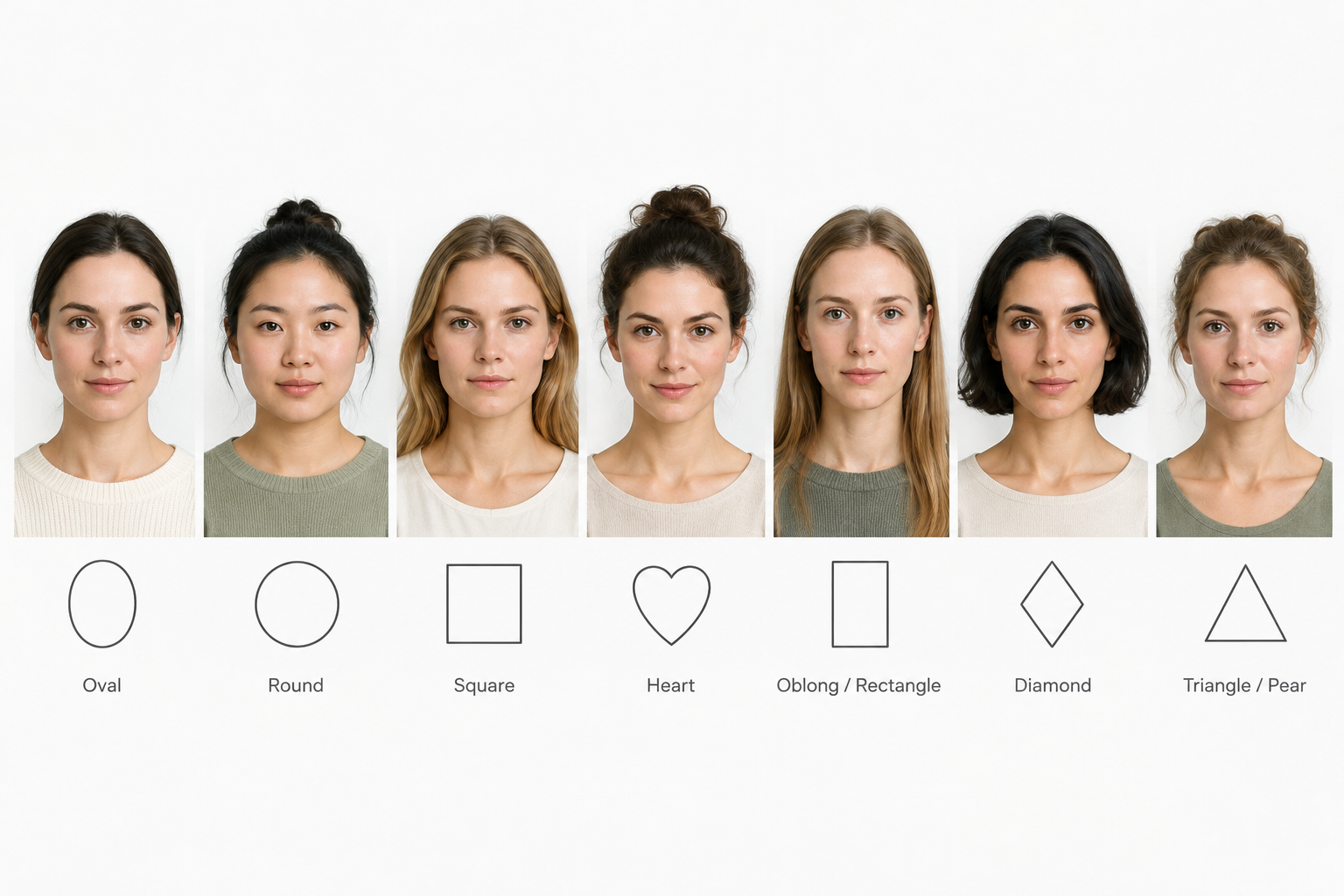
Most classification systems recognise between six and eight face shapes. The descriptions below cover the most widely used categories. Remember that these are reference points, not rigid boxes — many people will find their features sit between two categories.
Oval Face Shape
An oval face shape is characterised by a face length that is noticeably greater than the width, with the cheekbones being the widest point. The forehead is slightly wider than the jawline, and the jaw tapers gently to a rounded chin. The overall silhouette resembles an egg shape, wider at the top than at the bottom. Oval faces are often described in styling guides as the most versatile shape because the balanced proportions tend to suit a wide range of hairstyles and eyewear frames. In aesthetic medicine, the oval face is sometimes used as a reference proportion when planning treatments aimed at facial balancing, though this does not mean other shapes require alteration.
Round Face Shape
A round face shape has a face length and width that are roughly equal, with the cheekbones being the widest point and the jawline appearing soft and curved rather than angular. The forehead is also rounded, and there is little visible angularity anywhere along the face outline. Round faces often appear fuller, particularly in the lower cheek and jaw area. In styling, techniques that add vertical length — such as longer hairstyles or vertical makeup contouring — are commonly recommended to create the appearance of more elongation.
Square Face Shape
A square face shape is defined by a forehead, cheekbone, and jawline width that are all roughly equal, combined with a strong, angular jawline and a relatively flat chin. The face length is similar to the face width, but unlike a round face, the jaw angle is sharp rather than curved. Square faces have a structured, defined appearance. In aesthetic consultations, patients with square faces who seek a softer look sometimes enquire about jawline slimming treatments, though this is entirely a matter of personal preference.
Heart Face Shape
A heart-shaped face has a wide forehead and high cheekbones that taper to a narrow, pointed chin. The forehead is the widest part of the face, and the jawline is noticeably narrower. Some people with a heart-shaped face also have a widow’s peak — a downward point in the centre of the hairline — which accentuates the triangular appearance. In aesthetic practice, patients with heart-shaped faces who feel their chin appears too pointed sometimes explore chin augmentation options, while those who feel the forehead appears disproportionately wide may consider treatments to add volume to the lower face.
Oblong or Rectangle Face Shape
An oblong or rectangular face shape is longer than it is wide, with the forehead, cheekbones, and jawline all being roughly equal in width. Unlike an oval face, the sides of an oblong face are relatively straight rather than gently curved, giving the face a more elongated, rectangular appearance. People with oblong faces often find that hairstyles with volume at the sides help to visually widen the face and reduce the appearance of length.
Diamond Face Shape
A diamond face shape has narrow forehead and jawline measurements with wide, prominent cheekbones as the widest point. The chin is often pointed, and the overall silhouette narrows at both the top and the bottom. Diamond faces are less common than oval or round shapes. The prominent cheekbones are a defining feature, and styling choices often aim to soften the narrow forehead or add width to the jawline area.
Triangle or Pear Face Shape
A triangular or pear-shaped face is the inverse of a heart shape: the jawline is the widest point, the cheekbones are moderately wide, and the forehead is noticeably narrower. This shape is sometimes called a pear face because the face widens toward the bottom. Styling approaches for triangular faces often focus on adding visual width to the forehead and temples while minimising emphasis on the jaw.
Comparing Face Shape Characteristics
| Face Shape | Widest Point | Jawline | Face Length vs Width | Key Feature |
|---|---|---|---|---|
| Oval | Cheekbones | Gently tapered, rounded | Length greater than width | Balanced proportions, slightly wider at top |
| Round | Cheekbones | Soft, curved | Roughly equal | Full cheeks, minimal angularity |
| Square | Forehead, cheeks, jaw roughly equal | Angular, strong | Roughly equal | Defined jaw angle, flat chin |
| Heart | Forehead | Narrow, pointed chin | Length greater than width | Wide forehead, narrow jaw |
| Oblong / Rectangle | Forehead, cheeks, jaw roughly equal | Relatively straight | Length noticeably greater than width | Elongated, straight sides |
| Diamond | Cheekbones | Narrow, pointed chin | Length greater than width | Prominent cheekbones, narrow forehead and jaw |
| Triangle / Pear | Jawline | Wide, prominent | Length greater than width | Narrow forehead, wide jaw |
Why Identifying Your Face Shape Can Be Difficult
Many people find it genuinely difficult to identify their own face shape, and this is not unusual. Several factors contribute to the challenge. First, most people are not accustomed to looking at their face as a geometric outline — we tend to focus on individual features rather than the overall silhouette. Second, hair, makeup, and even the angle at which we look in the mirror can significantly alter the apparent shape of the face. Third, as noted earlier, most faces blend characteristics of more than one category, making a definitive single classification difficult.
Pulling the hair back completely — ideally into a tight bun or under a headband — and looking at a straight-on photograph rather than a mirror reflection often makes the overall face outline much clearer. A mirror reflection can be subtly distorted by the angle of your head, whereas a photograph taken at eye level with the camera positioned directly in front of the face provides a more accurate reference.
It is also worth acknowledging that facial asymmetry is normal and universal. Very few faces are perfectly symmetrical, and asymmetry can make it harder to match your face to a single shape category. In clinical aesthetic assessments, practitioners are trained to evaluate facial asymmetry carefully, as it influences treatment planning in ways that a simple shape classification does not capture.
Face Shape and Aesthetic Treatments
In aesthetic medicine, face shape analysis is one component of a broader facial assessment that also considers skin quality, soft tissue volume, bone structure, facial symmetry, and the patient’s individual goals. Understanding face shape helps practitioners identify where volume may have been lost with age, where structural support may benefit from enhancement, and how proposed treatments might affect overall facial harmony.
Dermal Fillers and Facial Contouring
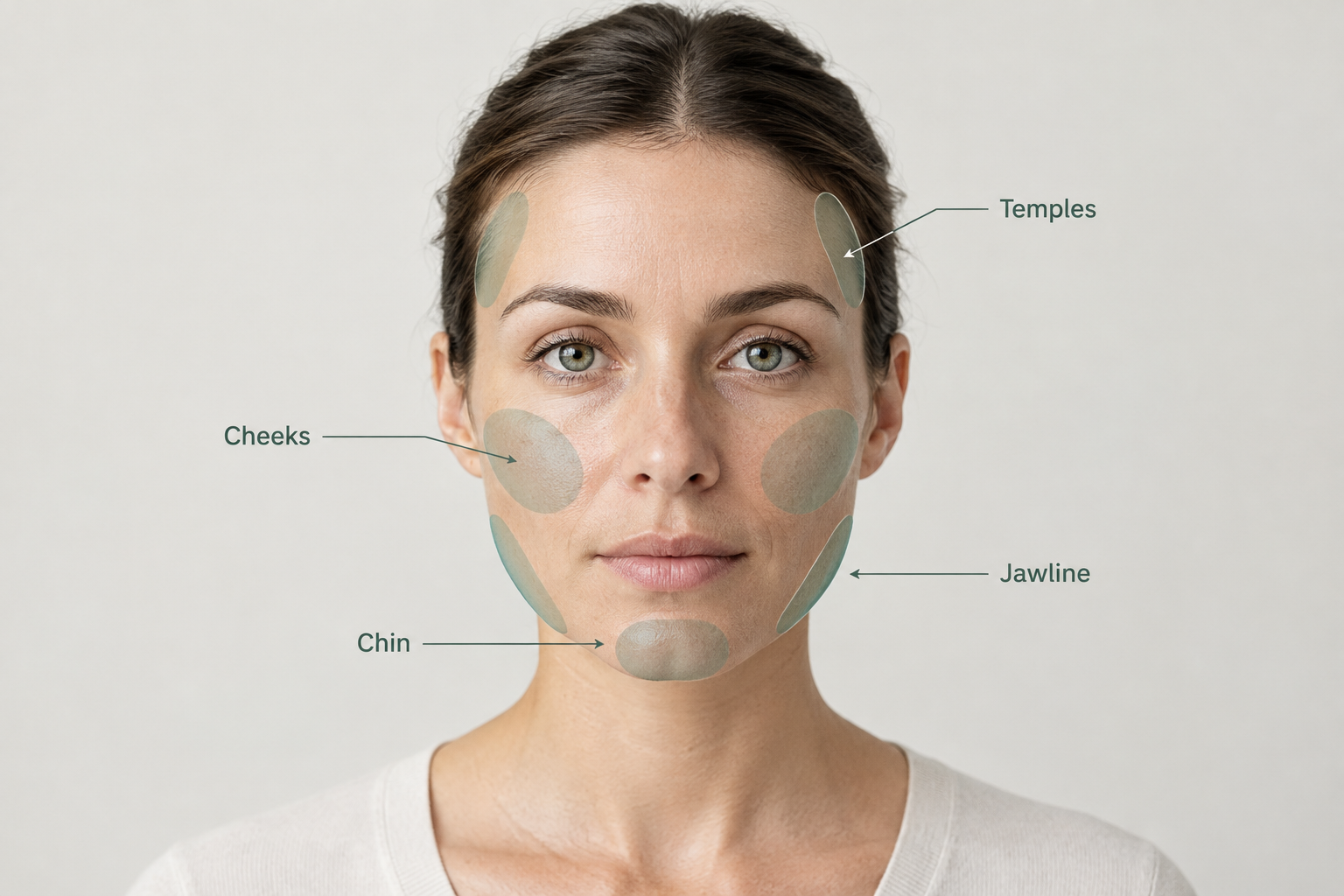
Dermal fillers — injectable gels, most commonly based on hyaluronic acid — can be used to add volume, define contours, or restore areas of volume loss. The placement of filler is guided by the patient’s existing facial structure, including their face shape. For example, a patient with a heart-shaped face who has experienced volume loss in the lower face may benefit from filler placed along the jawline or in the chin area to restore balance. A patient with a round face who has lost cheek projection may find that targeted cheek filler restores a more defined midface appearance. These are examples of how face shape informs clinical decision-making — not prescriptions for what any individual should do.
It is important to understand that dermal filler treatment outcomes depend on many factors beyond face shape, including the practitioner’s skill and experience, the specific product used, the volume injected, and the patient’s individual anatomy. Results vary between patients, and a thorough consultation with a qualified aesthetic practitioner is essential before any treatment.
Jawline and Chin Treatments
Jawline definition and chin projection are areas where face shape analysis is particularly relevant. Patients with square faces sometimes enquire about botulinum toxin injections into the masseter muscles — the large chewing muscles at the sides of the jaw — to reduce the appearance of jaw width and create a softer facial outline. Patients with receding chins or weak chin projection, which can affect the apparent balance of heart-shaped or round faces, may explore chin filler or surgical chin augmentation options. These treatments carry their own risks and suitability considerations, and a clinical assessment is required to determine whether any intervention is appropriate.
Cheek Augmentation
Cheek volume and projection influence how a face shape is perceived. High, defined cheekbones are associated with diamond and oval face shapes, while flatter cheeks are more characteristic of round or oblong faces. With age, cheek fat pads descend and volume is lost, which can cause a previously oval or heart-shaped face to appear rounder or more rectangular. Cheek augmentation using dermal fillers may help restore midface volume and projection, though the appropriateness of this approach depends on individual anatomy and goals rather than face shape alone.
Face Shape, Hairstyles, and Makeup
Outside of aesthetic medicine, face shape is most commonly used as a guide for hairstyling and makeup. The underlying principle in both fields is the same: use styling or product placement to create the visual impression of balanced proportions, if that is the desired effect. It is equally valid to embrace and highlight the natural characteristics of any face shape rather than attempting to alter its apparent proportions.
Hairstyle Considerations by Face Shape
For oval faces, most hairstyle lengths and shapes tend to work well because the proportions are already considered balanced. For round faces, hairstyles that add height at the crown and keep volume away from the widest part of the cheeks can create the appearance of more length. For square faces, soft layers around the jaw and face-framing waves can reduce the visual emphasis on the angular jawline. For heart-shaped faces, hairstyles with volume at the jaw level — such as bobs or lobs — can visually widen the lower face and balance the wider forehead. For oblong faces, styles with width at the sides and avoiding excessive height at the crown help to reduce the appearance of length. For diamond faces, styles that add width at the forehead or jaw can balance the prominent cheekbones. For triangular faces, volume at the temples and forehead with minimal volume at the jaw helps to balance the wider lower face.
Makeup Contouring and Face Shape
Makeup contouring uses darker and lighter products to create the illusion of shadow and light, which can alter the perceived shape of the face. The placement of contour and highlight products is guided by face shape. For round faces, contour is typically applied along the sides of the face and under the cheekbones to create the appearance of more definition and length. For square faces, contour along the jaw angles softens the appearance of the corners. For heart-shaped faces, contour at the temples and forehead can reduce the visual width at the top of the face. These are general principles — individual features, skin tone, and personal preference all influence what works best for any given person.
Frequently Asked Questions
Can my face shape change over time?
Yes, facial structure changes with age. Bone remodelling, loss of facial fat, changes in muscle tone, and reduced skin elasticity can all alter the apparent shape of the face. A face that appeared oval in youth may appear more rectangular or square with age as volume is lost from the cheeks and the jawline becomes more prominent. These changes are gradual and normal.
What if my face doesn’t clearly match any one shape?
This is very common. Most people have features that correspond to more than one face shape category. Rather than forcing a single classification, it is more useful to note which characteristics are most prominent — for example, a relatively wide jaw combined with moderately wide cheekbones — and use that information practically. In aesthetic consultations, practitioners assess individual anatomy rather than relying on a single shape label.
Does face shape determine which aesthetic treatments I need?
No. Face shape is one factor among many in an aesthetic assessment. Whether any treatment is appropriate depends on your individual anatomy, skin condition, medical history, personal goals, and a thorough consultation with a qualified practitioner. No face shape inherently requires treatment.
Is there a most common face shape?
Research on face shape prevalence is limited and varies by population studied. Oval and round face shapes are frequently cited as among the more common categories in general population studies, but the distribution varies considerably across different ethnic backgrounds and age groups. Face shape classification systems themselves are not standardised across all research, which makes direct comparisons difficult.
How do aesthetic practitioners assess face shape?
Qualified aesthetic practitioners typically assess facial structure through a combination of visual analysis, physical examination, and sometimes photographic assessment. They consider not only the overall face shape but also facial symmetry, soft tissue volume distribution, skin quality, bone prominence, and the patient’s specific concerns and goals. This holistic assessment goes well beyond a simple shape classification.
Can makeup or hairstyling really change how my face shape looks?
Makeup contouring and hairstyling can create meaningful visual impressions of altered proportions, but they do not change the underlying bone structure or soft tissue. The effect is perceptual rather than structural. Some people find these techniques genuinely useful; others prefer to work with their natural features without attempting to alter their apparent shape.
Using Face Shape Knowledge Practically
Identifying your face shape is most useful when it informs practical decisions — whether that means choosing a flattering haircut, selecting eyewear frames that complement your features, refining a makeup technique, or preparing for a conversation with an aesthetic practitioner. The value of face shape analysis lies in its application, not in the classification itself.
If you are considering aesthetic treatments and want to understand how your facial structure might influence treatment options, a consultation with a qualified and experienced aesthetic practitioner is the appropriate next step. A practitioner can assess your individual anatomy in detail, discuss realistic outcomes, explain the risks and limitations of any proposed treatment, and help you make an informed decision that reflects your own goals — not a generic template based on face shape alone. No face shape requires correction, and the most important factor in any aesthetic decision is what you genuinely want for yourself, based on accurate information.