

Salicylic acid is one of the most widely used active ingredients in acne skincare, appearing in cleansers, toners, spot treatments, and professional chemical peels. It has a well-established mechanism of action and a reasonable body of clinical evidence supporting its use for certain types of acne. However, whether salicylic acid will effectively reduce your acne depends on the type of breakouts you experience, the concentration used, how consistently you apply it, and your individual skin response. This article explains how salicylic acid works, what it can and cannot do, and how it compares to other acne treatments.
Key Takeaways
- Salicylic acid is a beta hydroxy acid (BHA) that works primarily by exfoliating inside the pore, making it most effective for blackheads, whiteheads, and mild to moderate inflammatory acne.
- It does not eliminate acne permanently; consistent use is generally required to maintain results, and it may not adequately control severe or cystic acne on its own.
- Over-the-counter concentrations typically range from 0.5% to 2%, while professional chemical peels use higher concentrations under clinical supervision.
- Side effects such as dryness, irritation, and peeling are common, particularly when starting treatment or using higher concentrations.
- For moderate to severe acne, salicylic acid is often used alongside other treatments rather than as a standalone solution.
What Is Salicylic Acid and How Does It Work?
Salicylic acid is a beta hydroxy acid (BHA) derived originally from willow bark. Unlike alpha hydroxy acids (AHAs) such as glycolic acid, which are water-soluble and work primarily on the skin’s surface, salicylic acid is oil-soluble. This property allows it to penetrate into the sebaceous follicle — the pore — and dissolve the mixture of sebum and dead skin cells that contributes to blockages. This process is known as comedolysis, meaning the breakdown of comedones (the blocked pores that form blackheads and whiteheads).
Salicylic acid also has mild anti-inflammatory properties, which may help reduce the redness and swelling associated with inflamed pimples. Additionally, it has some keratolytic activity, meaning it softens and loosens the bonds between dead skin cells on the surface, promoting more even exfoliation. These combined actions — pore penetration, comedolysis, surface exfoliation, and mild anti-inflammatory effect — explain why salicylic acid is considered a useful ingredient for acne-prone skin rather than simply a general exfoliant.
The ingredient works gradually. Most people do not see a dramatic overnight change; instead, consistent use over several weeks tends to produce a progressive reduction in blocked pores and breakout frequency. Clinical studies generally assess outcomes over four to twelve weeks of regular use, which reflects the realistic timeline for meaningful improvement.
What Types of Acne May Salicylic Acid Help With?
Acne is not a single condition. It presents across a spectrum from non-inflammatory comedonal acne through to severe nodulocystic acne, and the effectiveness of any treatment depends significantly on which type is present.
Comedonal acne — blackheads (open comedones) and whiteheads (closed comedones) — represents the area where salicylic acid tends to perform best. Because the ingredient can penetrate the follicle and dissolve the sebum-and-keratin plug responsible for these lesions, regular use can meaningfully reduce their number and prevent new ones from forming. This makes salicylic acid a reasonable first-line option for people whose acne is predominantly non-inflammatory.

Mild to moderate inflammatory acne, characterized by papules (small red bumps) and pustules (pimples with visible pus), may also respond to salicylic acid, particularly when the inflammatory lesions are arising from blocked pores. The anti-inflammatory properties of salicylic acid may help reduce the severity of individual lesions, and by keeping pores clearer, it may reduce the frequency of new inflammatory breakouts. Evidence for this use is reasonable, though results vary between individuals.
Severe acne, including nodules and cysts, is unlikely to be adequately controlled by salicylic acid alone. These deeper lesions involve significant inflammation and often bacterial involvement that topical BHA exfoliation cannot sufficiently address. In these cases, salicylic acid may be used as a supportive ingredient alongside prescription treatments, but it should not be relied upon as the primary intervention.
Acne on the back and chest (truncal acne) is another area where salicylic acid is commonly used, often in body wash formulations. The skin on the back and chest is thicker than facial skin, and the follicles can be more deeply blocked. Salicylic acid body washes may help reduce surface congestion, though the contact time of a rinse-off product is shorter than a leave-on treatment, which may limit effectiveness.
Salicylic Acid Concentrations: Over-the-Counter vs Professional Treatments
The concentration of salicylic acid in a product significantly affects how it works and what side effects it may cause. Understanding the difference between consumer products and professional treatments helps set realistic expectations.
Over-the-counter (OTC) products in most countries are formulated with salicylic acid concentrations typically between 0.5% and 2%. At these concentrations, the ingredient is effective for mild comedonal and inflammatory acne with a relatively low risk of significant irritation when used as directed. Products include cleansers, toners, serums, spot treatments, and moisturizers. Leave-on formulations generally deliver more sustained contact with the skin than rinse-off products, which may improve efficacy.
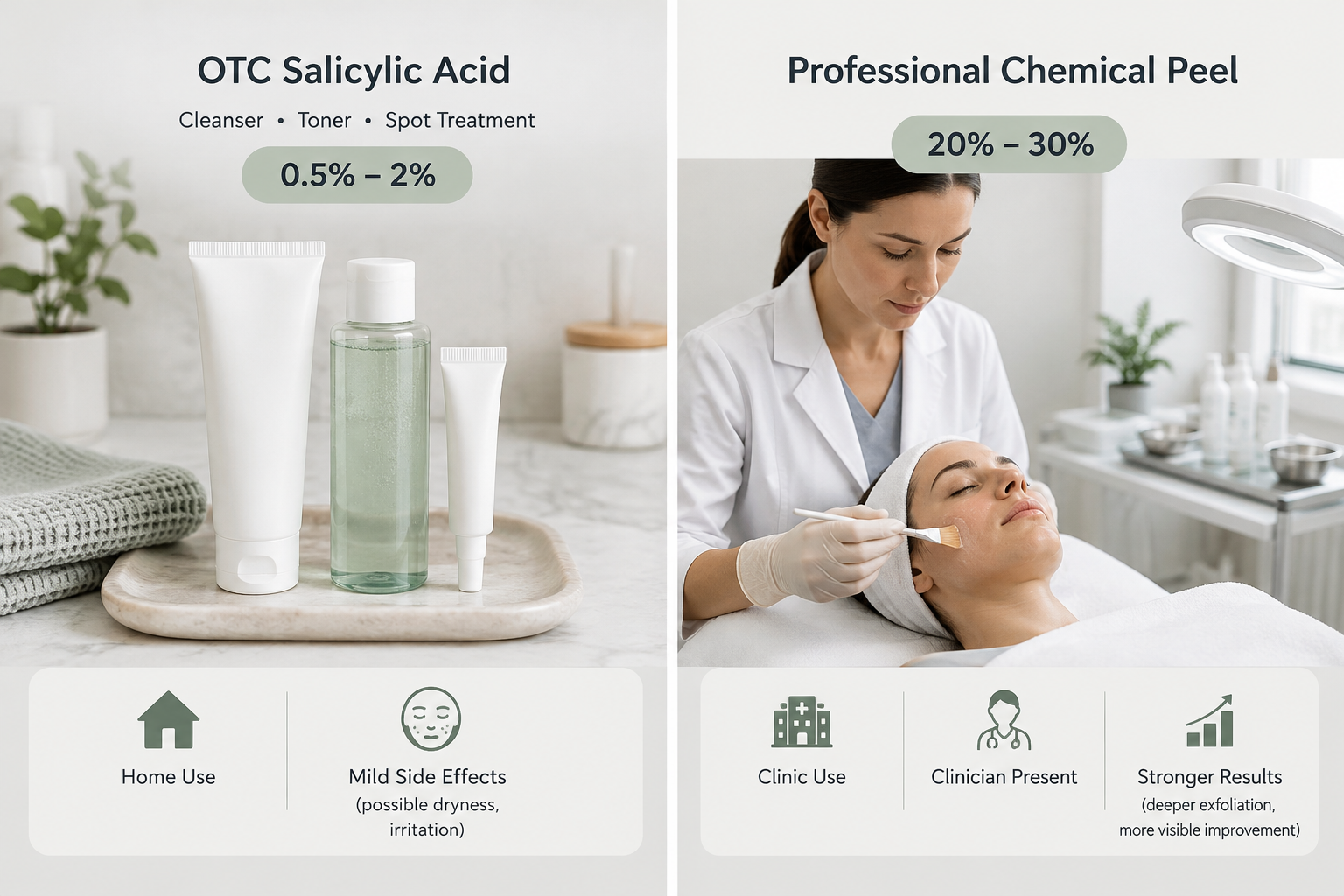
Professional salicylic acid chemical peels use higher concentrations, commonly between 20% and 30%, applied by a trained clinician in a controlled setting. At these concentrations, the exfoliating effect is considerably more pronounced, and the treatment can address more significant congestion and surface irregularities. Professional peels are typically performed as a course of treatments spaced several weeks apart. They carry a higher risk of side effects including post-inflammatory hyperpigmentation, particularly in darker skin tones, and should only be performed by a qualified practitioner who can assess suitability and manage any adverse reactions.
It is important not to assume that a higher concentration is always better. Skin tolerance, skin type, and the specific concern being treated all influence which concentration is appropriate. Using a concentration that is too high for your skin’s tolerance can cause significant irritation, barrier disruption, and paradoxically worsen acne by triggering inflammation.
How to Use Salicylic Acid Effectively
Consistent and appropriate use is central to getting results from salicylic acid. Applying it occasionally or incorrectly is unlikely to produce meaningful improvement.
For most people starting with an OTC salicylic acid product, beginning with a lower frequency — such as every other day — and gradually increasing to daily use allows the skin to adapt and reduces the risk of irritation. Applying the product to clean, dry skin and following with a non-comedogenic moisturizer helps maintain the skin barrier, which can be compromised by regular exfoliation. Using a broad-spectrum sunscreen daily is also important, as salicylic acid increases photosensitivity by removing the outermost layer of dead skin cells.
Combining salicylic acid with other potentially irritating active ingredients — such as retinoids, benzoyl peroxide, or other acids — requires care. While these combinations can be effective, they also increase the risk of irritation and barrier disruption. A qualified skincare professional or dermatologist can advise on how to layer or alternate active ingredients safely based on your skin type and acne severity.
Patience is necessary. Most clinical assessments of topical acne treatments evaluate outcomes at eight to twelve weeks. Expecting visible improvement within a few days is unrealistic for most people, and discontinuing treatment prematurely is a common reason for perceived ineffectiveness.
Realistic Results: What Salicylic Acid Can and Cannot Do
Salicylic acid can meaningfully reduce the number of blackheads and whiteheads with consistent use, and it may reduce the frequency and severity of mild to moderate inflammatory breakouts. For people with predominantly comedonal acne, it can be a genuinely useful long-term maintenance ingredient. Some individuals with oily, acne-prone skin find that incorporating a salicylic acid product into their routine helps keep pores clearer and reduces the overall burden of breakouts over time.
However, salicylic acid does not address all the factors that contribute to acne. It does not significantly reduce the activity of the sebaceous glands (oil production), it does not directly target the bacterium Cutibacterium acnes (formerly known as Propionibacterium acnes) in the way that benzoyl peroxide or topical antibiotics do, and it does not regulate the hormonal influences that drive many cases of adult acne. For acne with a significant hormonal component — common in adult women, for example — salicylic acid alone is unlikely to provide adequate control.
Salicylic acid also does not treat acne scarring or post-inflammatory hyperpigmentation (the dark marks left after a pimple heals), though by reducing the frequency of new breakouts it may indirectly limit the formation of new marks. Addressing existing acne scars or pigmentation typically requires separate treatments such as chemical peels, microneedling, laser resurfacing, or topical brightening agents, depending on the type and severity of the scarring.
Results are not permanent in the sense that stopping salicylic acid use typically leads to a gradual return of congestion and breakouts in people who are prone to acne. It is generally a maintenance ingredient rather than a cure.
Side Effects and Risks
Salicylic acid is generally well tolerated at OTC concentrations when used appropriately, but side effects are possible and should be understood before starting treatment.
- Dryness and peeling: The exfoliating action of salicylic acid can strip moisture from the skin, leading to dryness, flaking, and tightness, particularly in the first few weeks of use or if used too frequently.
- Irritation and redness: Some individuals experience stinging, burning, or redness, especially those with sensitive skin or a compromised skin barrier.
- Increased sun sensitivity: By removing the outermost layer of skin cells, salicylic acid increases vulnerability to UV damage. Daily sunscreen use is important during treatment.
- Contact dermatitis: Allergic reactions to salicylic acid are uncommon but possible. Signs include significant redness, itching, swelling, or a rash that worsens rather than improves.
- Post-inflammatory hyperpigmentation: This is a particular concern with professional-strength peels, especially in individuals with medium to darker skin tones (Fitzpatrick skin types III–VI). Careful patient selection and appropriate aftercare are essential in a clinical setting.
- Salicylate toxicity: This is extremely rare with topical use at standard concentrations but is a theoretical concern if very large areas of skin are treated with high concentrations, particularly in children. Standard adult use of OTC products does not carry a meaningful risk of systemic toxicity.
People who are pregnant or breastfeeding are generally advised to avoid salicylic acid, particularly at higher concentrations or over large body surface areas, due to theoretical concerns about salicylate absorption. A healthcare professional should be consulted before using salicylic acid during pregnancy.
Who May Be Suitable for Salicylic Acid Treatment?
Salicylic acid may be a reasonable option for individuals with oily or combination skin who experience blackheads, whiteheads, or mild to moderate inflammatory acne. It tends to be particularly useful for people whose acne is driven by excess sebum production and pore congestion rather than primarily by hormonal or bacterial factors.
People with dry or sensitive skin can sometimes use salicylic acid but may need to start with a lower concentration, use it less frequently, and pay careful attention to moisturization and barrier support. Those with a known aspirin (acetylsalicylic acid) allergy should exercise caution, as there is a potential for cross-reactivity, though this is not universal.
For professional salicylic acid peels, a clinical assessment is required to determine suitability. Factors such as skin type, Fitzpatrick phototype, current skincare routine, history of skin conditions, and medication use all influence whether a peel is appropriate and at what concentration.
Alternatives and Complementary Treatments
Salicylic acid is one of several evidence-supported options for acne management. Understanding the alternatives helps in making an informed decision about which approach — or combination of approaches — may be most appropriate.
Benzoyl peroxide is an antimicrobial agent that directly targets Cutibacterium acnes and also has some comedolytic activity. It is often considered more effective than salicylic acid for inflammatory acne with a significant bacterial component. It can be used alongside salicylic acid, though this combination requires careful management to avoid excessive irritation.

Retinoids (including adapalene, tretinoin, and retinol) work by normalizing the rate of skin cell turnover within the follicle, preventing the formation of comedones and reducing inflammation. Prescription retinoids such as tretinoin have a strong evidence base for acne treatment. Adapalene is available over the counter in some countries. Retinoids are generally considered more potent than salicylic acid for comedonal acne and are often preferred for moderate to severe presentations.
Topical antibiotics such as clindamycin or erythromycin (usually prescribed in combination with benzoyl peroxide to reduce antibiotic resistance) target the bacterial component of acne and are typically used for moderate inflammatory acne under medical supervision.
Azelaic acid is another topical option with anti-inflammatory, antimicrobial, and mild comedolytic properties. It is generally well tolerated and is sometimes preferred for individuals with sensitive skin or those who are pregnant, as it has a more established safety profile in pregnancy than some other acne treatments.
Niacinamide does not directly treat acne in the same way as salicylic acid but may help reduce sebum production, improve skin barrier function, and reduce post-inflammatory hyperpigmentation. It is often used as a complementary ingredient alongside active acne treatments.
Professional treatments for acne include chemical peels (using salicylic acid, glycolic acid, or other agents), LED light therapy, and in some cases laser or intense pulsed light (IPL) treatments. These are typically considered when topical treatments have not provided adequate control, or when there is significant scarring or pigmentation to address alongside active acne.
Prescription oral treatments — including oral antibiotics, combined oral contraceptives (for hormonal acne in women), and isotretinoin — are reserved for moderate to severe acne or cases that have not responded to topical management. These require medical assessment and ongoing supervision.
Frequently Asked Questions
How long does salicylic acid take to work on acne?
Most people need to use salicylic acid consistently for at least four to eight weeks before seeing a meaningful reduction in blackheads and breakouts. Some improvement in skin texture may be noticeable earlier, but significant changes in acne frequency typically take longer. Assessing results before eight to twelve weeks of consistent use is generally premature.
Can salicylic acid make acne worse at first?
Some people experience a temporary increase in breakouts when starting salicylic acid, sometimes referred to as a purging phase. This is thought to occur because the accelerated exfoliation brings congestion to the surface more quickly. Not everyone experiences this, and it typically resolves within a few weeks. If breakouts worsen significantly or persist beyond four to six weeks, it is worth reassessing whether the product or concentration is appropriate for your skin.
Is salicylic acid safe to use every day?
Daily use of OTC salicylic acid products is appropriate for many people, particularly in lower concentrations such as 0.5% to 1%. However, daily use of higher concentrations or multiple salicylic acid products simultaneously increases the risk of dryness and irritation. Starting with less frequent use and building up gradually is a sensible approach, particularly for those with sensitive or dry skin.
Can salicylic acid help with acne scars?
Salicylic acid does not directly treat acne scars, particularly atrophic (depressed) scars or deep pigmentation. By reducing active breakouts, it may prevent new scars from forming. For existing post-inflammatory hyperpigmentation, some improvement may occur with consistent use over time, but dedicated treatments such as chemical peels, microneedling, or topical brightening agents are generally more effective for established scarring and pigmentation.
Can I use salicylic acid with retinol or retinoids?
Combining salicylic acid with retinoids is possible but requires care, as both ingredients can cause dryness and irritation. Many practitioners recommend using them at different times — for example, salicylic acid in the morning and a retinoid at night — or alternating nights. Starting with one active ingredient at a time and introducing the second gradually is generally advisable. A dermatologist or qualified skincare professional can provide guidance tailored to your skin type and acne severity.
Does salicylic acid work for hormonal acne?
Salicylic acid may help manage some of the surface congestion associated with hormonal acne, but it does not address the underlying hormonal drivers. Hormonal acne — which often presents as deep, painful breakouts around the jawline, chin, and lower cheeks — typically requires a different treatment approach, which may include hormonal therapies, oral medications, or prescription topicals. Salicylic acid can be a useful supportive ingredient but is unlikely to provide adequate control on its own for predominantly hormonal presentations.
Is Salicylic Acid the Right Acne Treatment for You?
Salicylic acid is a well-established, evidence-supported ingredient for acne-prone skin, particularly for blackheads, whiteheads, and mild to moderate inflammatory breakouts. Its ability to penetrate the pore and dissolve the sebum-and-keratin blockages that initiate acne lesions gives it a meaningful advantage over purely surface-level exfoliants for this specific concern. For many people with oily, congestion-prone skin, incorporating a salicylic acid product into a consistent skincare routine can produce a genuine and sustained reduction in breakout frequency.
However, salicylic acid is not a universal acne solution. It is unlikely to adequately control severe, cystic, or predominantly hormonal acne on its own, and it does not address acne scarring or the bacterial component of acne as directly as some other treatments. Realistic expectations — improvement rather than elimination, maintenance rather than cure — are important for anyone considering this ingredient.
If your acne is mild and primarily comedonal, a well-chosen OTC salicylic acid product used consistently may be a reasonable starting point. If your acne is moderate to severe, persistent, or causing significant scarring or distress, a consultation with a dermatologist or qualified aesthetic practitioner is worthwhile. A clinical assessment can identify the type and severity of your acne, rule out contributing factors, and help determine whether salicylic acid alone, in combination with other treatments, or as part of a professional treatment plan is the most appropriate approach for your skin.