

The Russian lip technique has become one of the most requested approaches in aesthetic lip augmentation, but it is not a single fixed method. Several distinct variations exist, each producing a different shape, projection, and overall aesthetic. Understanding the differences between these styles can help you have a more informed conversation with your practitioner and set realistic expectations before your appointment.
Key Takeaways
- The Russian lip technique is an injection method, not a single fixed look — several variations exist, each producing different results in terms of shape, height, and projection.
- Classic Russian lips emphasise vertical height and a defined cupid’s bow, while other styles such as the Russian doll, Barbie lip, and tenting technique each modify the approach to suit different aesthetic goals.
- Choosing the right variation depends on your natural lip anatomy, the amount of filler used, and your practitioner’s assessment of what will suit your facial proportions.
- All Russian lip variations carry the same general risks as standard lip filler, including swelling, bruising, asymmetry, and rare but serious vascular complications.
- A qualified and experienced injector is essential regardless of which style you choose, as the technique requires precise placement and a thorough understanding of lip anatomy.
What Is the Russian Lip Technique?
The Russian lip technique is a method of injecting hyaluronic acid filler into the lips that differs from conventional lip augmentation in both needle placement and the direction of product delivery. In a standard lip filler treatment, filler is typically placed horizontally along the lip border and body to add volume. The Russian technique instead uses a series of vertical injections, placing small amounts of filler from the base of the lip upward toward the vermilion border. This approach is designed to lift the centre of the lip and create a more defined cupid’s bow, giving the lips a heart-shaped appearance with increased vertical height rather than simple forward projection.
The name is thought to reference the aesthetic associated with certain Eastern European beauty ideals — a lifted, structured lip with a prominent cupid’s bow and relatively flat profile when viewed from the side. The technique became widely discussed in the UK and internationally from around 2019 onward, and demand has continued to grow as patients seek alternatives to the fuller, more projected look associated with traditional lip filler. It is worth noting that the Russian lip technique is a practitioner skill, not a specific product — any suitable hyaluronic acid filler may be used, and results depend heavily on the injector’s experience and the patient’s anatomy.
Why There Are Multiple Variations
No two patients have identical lip anatomy, and aesthetic preferences vary considerably. As the Russian lip technique gained popularity, practitioners began adapting the core method to achieve different outcomes — more or less height, varying degrees of cupid’s bow definition, different amounts of lateral fullness, and different levels of overall volume. These adaptations gave rise to several named styles, each representing a modification of the original vertical injection approach. Some variations are primarily marketing terms used by clinics, while others reflect genuinely distinct technical differences in injection depth, placement, or the combination of techniques used.
It is also important to understand that the boundaries between these styles are not always rigid. A skilled practitioner may blend elements of more than one approach to suit an individual patient’s anatomy and goals. The names below represent the most commonly discussed variations, but your practitioner may describe their approach differently or use a combination of methods.
The Classic Russian Lip Style
The classic Russian lip is the foundational version of the technique. It focuses on creating a defined, heart-shaped cupid’s bow with increased vertical height in the centre of the upper lip. The lower lip is typically treated to complement the upper, with the goal of maintaining a natural-looking ratio rather than adding excessive volume. When viewed from the front, the result is a lifted, structured lip. When viewed from the side, the profile tends to be flatter than a conventionally filled lip, with less forward projection.
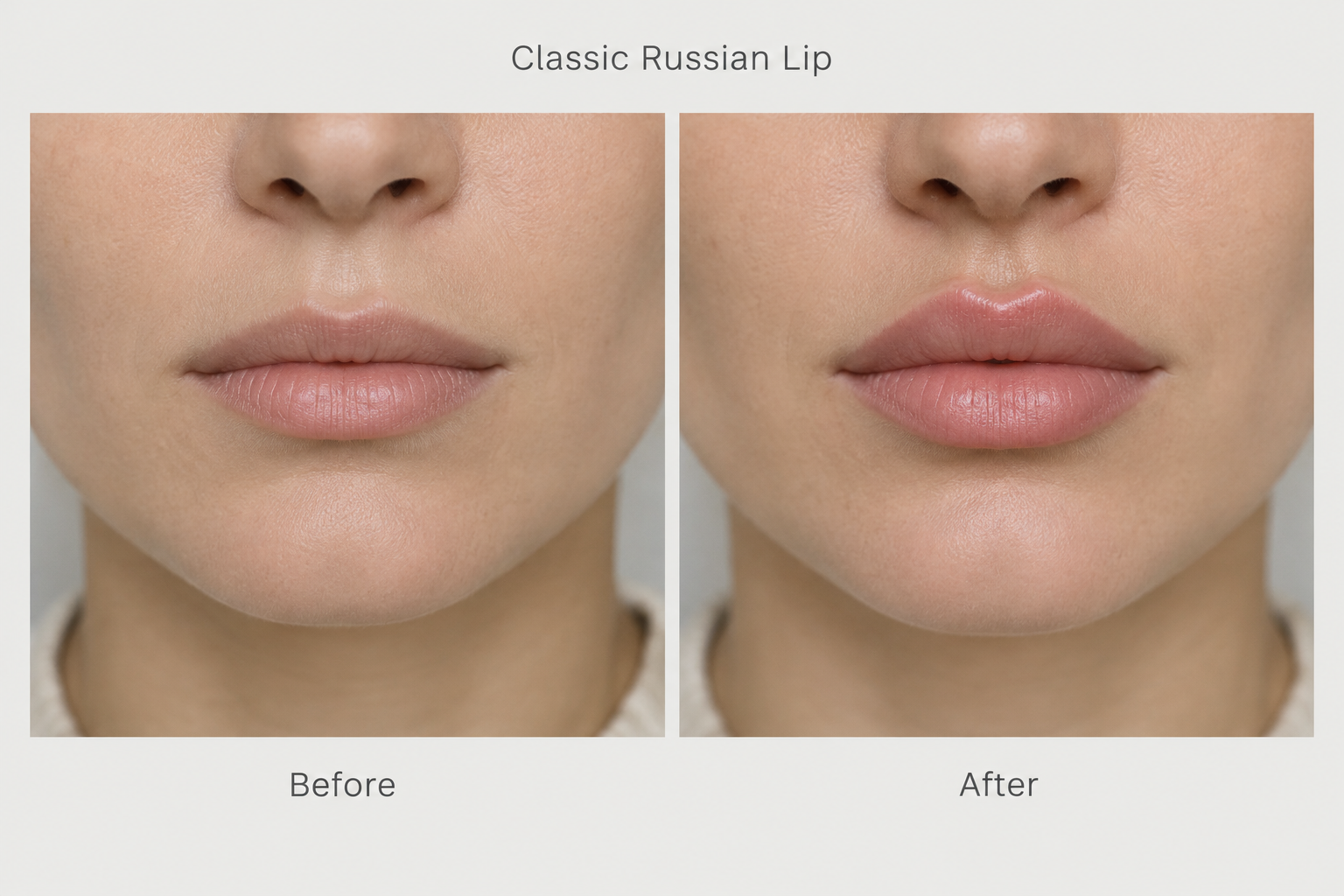
This style suits patients who want more definition and shape rather than volume, and who prefer a result that looks structured without appearing overly augmented. It generally works well for patients who have a naturally flat or undefined cupid’s bow, or those who feel their lips lack vertical height. The classic Russian style typically requires a moderate amount of filler — often between 0.5 ml and 1 ml depending on the starting anatomy — though the appropriate amount should always be determined by the practitioner during consultation.
The Russian Doll Lip Variation
The Russian doll lip is a variation that builds on the classic technique by adding slightly more volume to the body of the lip while retaining the characteristic vertical lift and defined border. The aim is to create a fuller, rounder appearance reminiscent of the rounded lips associated with traditional Russian matryoshka dolls — hence the name. Compared to the classic Russian style, the Russian doll variation tends to produce a softer, more voluminous result while still maintaining the lifted cupid’s bow and structured border that distinguish Russian technique lips from standard filler.
This variation may appeal to patients who want the defined shape of the Russian technique but also desire more overall fullness. It can require slightly more product than the classic approach, and the balance between volume and definition needs careful management to avoid the result looking overfilled or losing the characteristic lifted appearance. Patient selection is important — this style may not be appropriate for patients with very thin lips or limited tissue, as adding volume without sufficient structural support can affect the final shape.
The Barbie Lip Variation
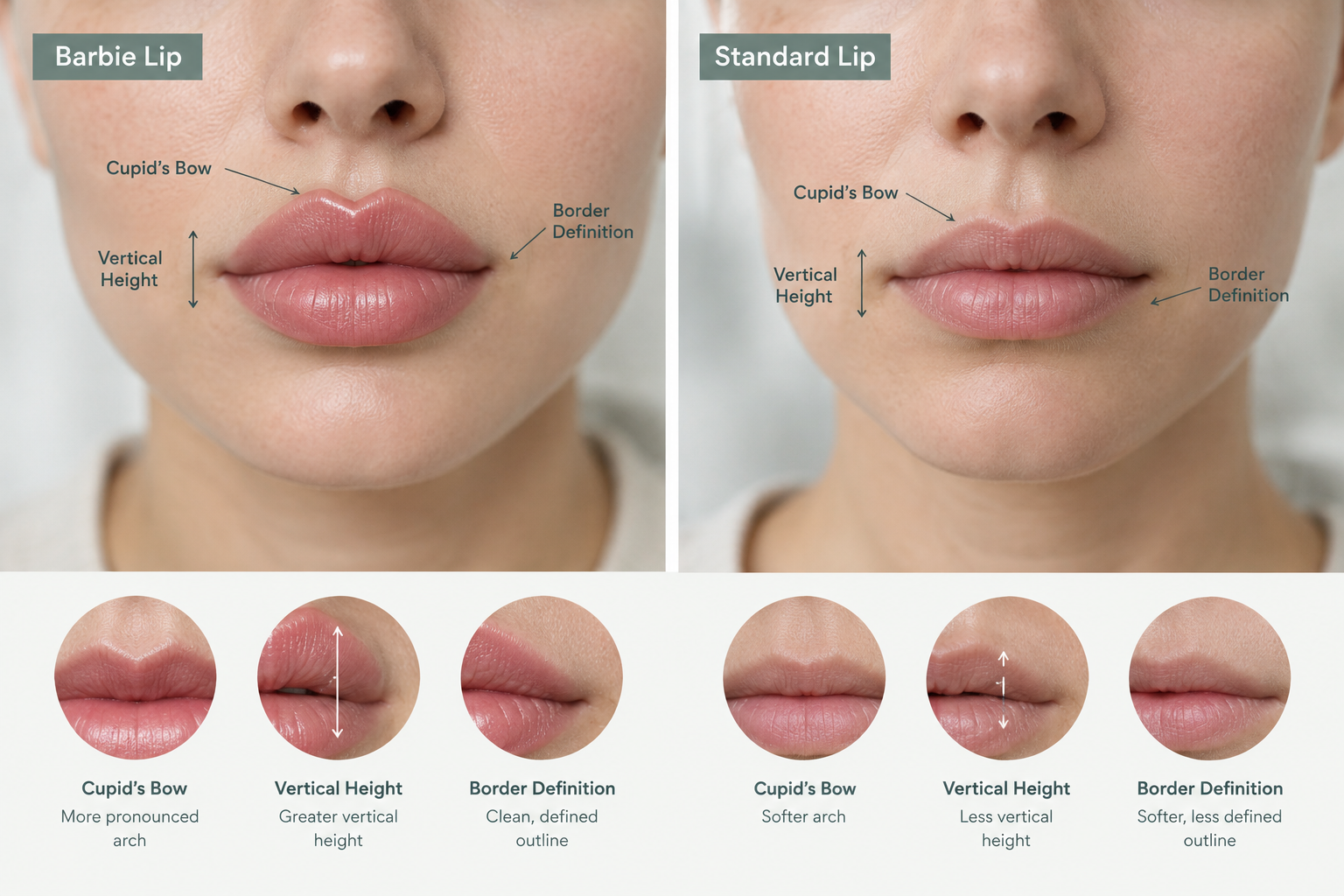
The Barbie lip is a more exaggerated variation of the Russian technique that emphasises a very pronounced cupid’s bow, significant vertical height, and a smooth, doll-like upper lip contour. The aesthetic goal is a highly defined, symmetrical lip with a strong arch and a relatively small-looking mouth in proportion to the face — an effect associated with the stylised appearance of the Barbie doll. This variation tends to use more precise border definition and may involve additional product placement along the philtrum columns to enhance the appearance of the cupid’s bow peaks.
The Barbie lip style is considered one of the more technically demanding variations because the exaggerated definition requires very controlled product placement. It is also one of the styles most likely to look unnatural if not executed carefully or if the patient’s anatomy is not well suited to it. Patients with naturally wide mouths, very thin lips, or significant asymmetry may find this variation difficult to achieve convincingly. It is also worth noting that the Barbie lip aesthetic is a strong, distinctive look — it may not suit all facial structures or personal preferences, and a thorough consultation is particularly important before choosing this style.
The Tenting Technique
The tenting technique is a specific injection method sometimes used within Russian lip treatments rather than a distinct aesthetic style in its own right. It involves placing the needle vertically into the lip tissue and injecting small boluses of filler while slowly withdrawing the needle, creating a tent-like lift of the tissue. This approach is designed to maximise vertical projection from the base of the lip upward and is particularly useful for lifting the central upper lip and defining the cupid’s bow peaks.
The tenting method can be used as part of the classic Russian technique or combined with other placement strategies. It requires precise depth control and a thorough understanding of lip vasculature to minimise the risk of intravascular injection. Some practitioners use the tenting technique specifically to address a flat or poorly defined philtrum area, while others apply it more broadly across the lip. Because the technique involves multiple small injection points, there may be slightly more post-treatment bruising compared to a linear threading approach, though this varies between patients.
The Keyhole Lip Variation
The keyhole lip is a variation that focuses on creating a small, visible gap between the upper and lower lips when the mouth is gently closed — resembling the shape of a keyhole. This is achieved by concentrating volume in the centre of both lips while keeping the corners relatively light. The result is a pouty, central fullness with a defined cupid’s bow and a characteristic small opening at the centre of the mouth.
The keyhole lip variation can be achieved using Russian technique principles or through a combination of Russian and conventional placement methods. It tends to suit patients who want a sensual, pouty appearance with a natural-looking border rather than an exaggerated or highly structured shape. This style may not be appropriate for patients who want significant overall volume, as the keyhole effect depends on a specific distribution of product rather than uniform fullness. It is also worth noting that the keyhole appearance may be less visible once the lips are fully relaxed or when speaking, so patients should discuss realistic expectations with their practitioner.
Comparing the Main Russian Lip Variations
| Style | Primary Goal | Cupid’s Bow Definition | Volume Level | Profile Projection | Best Suited To |
|---|---|---|---|---|---|
| Classic Russian | Vertical height, defined shape | Strong | Moderate | Low to moderate | Patients wanting definition over volume |
| Russian Doll | Fullness with structure | Strong | Moderate to high | Moderate | Patients wanting volume and definition |
| Barbie Lip | Exaggerated definition, doll-like shape | Very strong | Moderate | Low | Patients wanting a highly stylised look |
| Tenting Technique | Vertical lift, cupid’s bow peaks | Strong | Variable | Low to moderate | Patients with flat or undefined philtrum |
| Keyhole Lip | Central pout, visible gap | Moderate | Moderate | Moderate | Patients wanting a pouty, natural look |
Which Variation May Suit You?
Choosing between the different Russian lip styles is not simply a matter of selecting a look from a menu. Your natural lip anatomy plays a significant role in determining which variation is achievable and which will look proportionate on your face. Patients with a naturally well-defined cupid’s bow may find that the classic Russian technique enhances what they already have, while those with a very flat or undefined border may benefit from the more structured approach of the Barbie or tenting variation. Patients with thinner lips may find that some variations — particularly those requiring higher volumes — are more difficult to achieve without the result looking overfilled or unnatural.
Facial proportions also matter. The ratio of upper to lower lip, the width of the mouth, the prominence of the philtrum columns, and the overall balance of the face all influence which style will look most harmonious. A practitioner experienced in Russian lip techniques should assess these factors during consultation and advise on which variation — or combination of approaches — is most likely to achieve a result that suits your individual features. Bringing reference images to your consultation can be helpful, but it is important to understand that results will always be influenced by your starting anatomy rather than replicating another person’s lips exactly.
Risks and Limitations of Russian Lip Techniques
All variations of the Russian lip technique carry the same general risks as any lip filler treatment. Swelling and bruising are the most common side effects and are expected to some degree after any lip injection. Because the Russian technique typically involves more injection points than a standard lip filler treatment, there may be a slightly higher likelihood of bruising, though this depends on the practitioner’s approach and the patient’s individual response. Swelling usually peaks within 24 to 48 hours and subsides over the following one to two weeks, though significant swelling can temporarily distort the final shape.
Asymmetry is a risk with all lip filler techniques. Minor asymmetry is common in the days immediately after treatment due to uneven swelling, but persistent asymmetry may require a review appointment and possible correction. Lumps, nodules, or uneven product distribution can occur, particularly if the filler is not placed evenly or if the patient has significant pre-existing asymmetry. These issues can often be addressed with hyaluronidase, an enzyme that dissolves hyaluronic acid filler, though this should only be administered by a qualified practitioner.
The most serious risk associated with any lip filler treatment is vascular occlusion — a rare but potentially serious complication in which filler enters or compresses a blood vessel, restricting blood flow to the surrounding tissue. The Russian lip technique, with its vertical injection approach and multiple injection points, requires a thorough understanding of lip vasculature to minimise this risk. Choosing a practitioner with specific training and experience in Russian lip techniques is therefore particularly important. Signs of vascular compromise include blanching, severe pain, or skin colour changes, and require immediate medical attention.
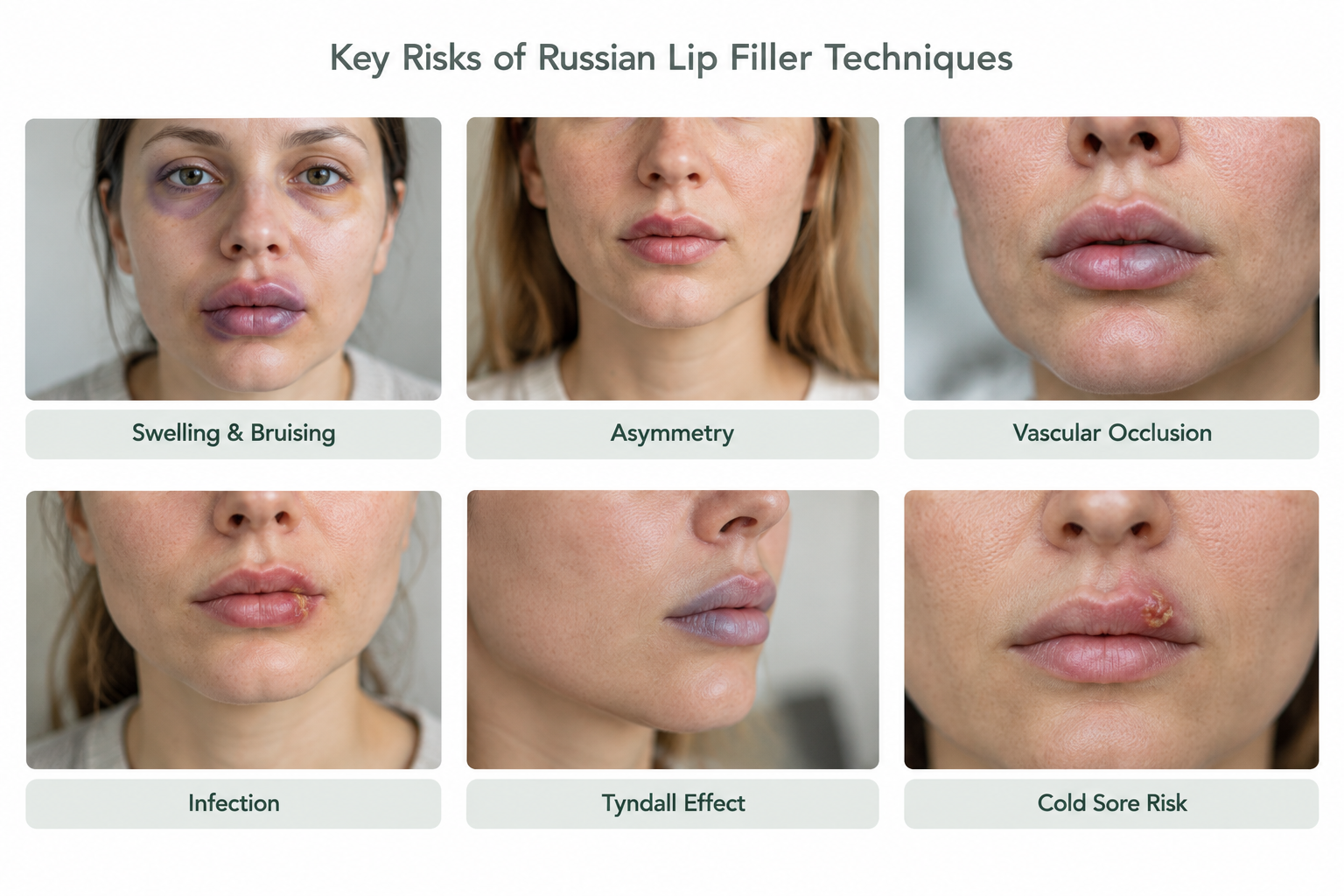
Other possible risks include infection, allergic reaction, migration of filler over time, and the Tyndall effect — a bluish discolouration that can occur if filler is placed too superficially. Patients with a history of cold sores should inform their practitioner, as lip injections can trigger an outbreak and antiviral prophylaxis may be recommended. Lip filler is not suitable during pregnancy or breastfeeding, and patients taking blood-thinning medications may have an increased risk of bruising.
What to Expect During and After Treatment
A Russian lip filler appointment typically begins with a consultation to discuss your goals, assess your anatomy, and agree on the most appropriate variation and amount of filler. A topical anaesthetic cream is usually applied to the lips before treatment to reduce discomfort. Most hyaluronic acid fillers used for lips also contain lidocaine, a local anaesthetic, which further reduces discomfort during injection. The treatment itself generally takes between 30 and 60 minutes depending on the complexity of the technique and the number of injection points used.
Immediately after treatment, the lips will appear swollen and may feel tender. The final shape will not be visible until swelling has fully resolved, which typically takes one to two weeks. During this period, the lips may look uneven, overly full, or different from the intended result — this is normal and does not necessarily indicate a problem. Patients are generally advised to avoid strenuous exercise, alcohol, and excessive heat for 24 to 48 hours after treatment, and to avoid pressing or massaging the lips unless specifically instructed to do so by their practitioner.
Results from Russian lip filler typically last between six and twelve months, though this varies depending on the type of filler used, the amount injected, the patient’s metabolism, and lifestyle factors. Maintenance treatments are usually required to sustain the result. Some patients find that repeated treatments over time lead to a longer-lasting effect as the filler integrates with the tissue, though this is not guaranteed and individual responses vary.
Alternatives to the Russian Lip Technique
Patients who are interested in lip enhancement but are uncertain about the Russian technique have several alternatives to consider. Conventional lip filler using a linear threading or bolus technique can add volume and definition without the specific vertical lift associated with the Russian approach. This may be more appropriate for patients who want a fuller, more projected lip rather than increased height and cupid’s bow definition.
Lip flip treatments using botulinum toxin can subtly evert the upper lip border, creating the appearance of a slightly fuller upper lip without adding volume. This is a temporary option with results typically lasting two to three months, and it may suit patients who want a minimal change or who are not yet ready for filler. Lip liner and overlining techniques using cosmetics can also create the illusion of a more defined cupid’s bow without any injectable treatment.
For patients concerned about the appearance of vertical lip lines or loss of lip volume associated with ageing, skin booster treatments or combination approaches using both filler and skin quality treatments may be worth discussing with a practitioner. The most appropriate option depends on the specific concern, the patient’s anatomy, and their goals.
Frequently Asked Questions
Is the Russian lip technique more painful than standard lip filler?
The Russian lip technique typically involves more injection points than a conventional lip filler treatment, which may mean slightly more discomfort during the procedure. However, topical anaesthetic cream and lidocaine-containing filler are routinely used to minimise pain, and most patients find the treatment tolerable. Individual pain thresholds vary, and your practitioner can discuss options to make the experience as comfortable as possible.
Can the Russian lip technique be reversed?
Yes. Because Russian lip techniques use hyaluronic acid filler, the results can be partially or fully reversed using hyaluronidase, an enzyme that dissolves hyaluronic acid. Reversal should only be carried out by a qualified practitioner and is typically used when a patient is unhappy with the result or when a complication such as a vascular occlusion requires urgent treatment.
How much filler is typically used for a Russian lip treatment?
The amount of filler used varies depending on the variation chosen, the patient’s starting anatomy, and the desired result. Many practitioners use between 0.5 ml and 1 ml for a first treatment, with the option to add more at a review appointment if needed. The appropriate amount should always be determined by the practitioner based on an individual assessment rather than a fixed standard amount.
Will Russian lip filler look natural?
When performed by an experienced practitioner using an appropriate amount of filler for the patient’s anatomy, Russian lip techniques can produce a natural-looking result. However, the aesthetic is more structured and defined than a conventional lip filler result, and some variations — particularly the Barbie lip — are intentionally more stylised. Discussing your expectations clearly during consultation and reviewing before-and-after images of your practitioner’s work can help ensure the result aligns with your goals.
Can anyone have a Russian lip treatment?
Most adults in good general health who want lip enhancement may be suitable for a Russian lip treatment, but suitability depends on individual anatomy, medical history, and realistic expectations. Patients with very thin lips, significant pre-existing asymmetry, or certain medical conditions may not be ideal candidates for some variations. A thorough consultation with a qualified practitioner is essential to determine whether the technique is appropriate for you.
How long does swelling last after Russian lip filler?
Swelling typically peaks within 24 to 48 hours of treatment and gradually subsides over one to two weeks. Because the Russian technique involves multiple injection points, swelling may be slightly more pronounced than after a conventional lip filler treatment. The final shape of the lips will not be fully visible until swelling has resolved, so it is important not to judge the result too early.
Choosing the Right Russian Lip Style for Your Goals
The different variations of the Russian lip technique offer a range of aesthetic outcomes, from the subtle definition of the classic style to the more pronounced shape of the Barbie or Russian doll approach. No single variation is universally superior — the right choice depends on your natural lip anatomy, your facial proportions, the amount of change you want, and your personal aesthetic preferences. Some patients find that a combination of techniques produces the most balanced result, and an experienced practitioner will often adapt their approach based on what they observe during the treatment rather than rigidly following one named style.
If you are considering a Russian lip treatment, the most important step is to choose a practitioner with specific training and demonstrable experience in these techniques. Ask to see examples of their work, discuss which variation they recommend for your anatomy and why, and ensure you understand the realistic outcomes, the recovery process, and the risks involved. A thorough consultation before any injectable treatment is not optional — it is the foundation of a safe and satisfying result.