

Key Takeaways
- The chin anchors the lower third of the face and has a significant influence on how balanced, youthful, and proportionate the entire face appears.
- A weak chin or recessed chin can make the nose appear larger, the neck less defined, and the jawline less structured — even when those features are anatomically normal.
- Non-surgical chin augmentation using hyaluronic acid filler is a reversible, lower-risk option; surgical approaches such as chin implants and genioplasty offer more permanent correction.
- Aging causes measurable changes to the chin through bone resorption, fat pad loss, and mentalis muscle overactivity — all of which can be addressed with a customised treatment plan.
- Gender-specific aesthetic goals differ meaningfully: masculine chins tend to be broader and more projected, while feminine chins are typically softer and more tapered.
Why the Chin Matters More Than Most People Realise
The chin is one of the most structurally important features of the face, yet it is frequently overlooked by patients seeking aesthetic improvement. Many people focus on the nose, eyes, or lips without recognising that a poorly projected or asymmetric chin can undermine the appearance of every other feature around it. When the chin is appropriately sized and positioned, it creates a visual anchor for the lower face — balancing the nose above it, defining the jawline to either side, and shaping the transition to the neck below.
Facial harmony is not simply about individual features being attractive in isolation. It depends on the proportional relationship between features. The chin is central to that relationship. A chin that is too small, too recessed, or too prominent shifts the visual weight of the face in ways that affect how the nose, lips, and neck are perceived. Understanding the chin’s role is therefore a prerequisite for any meaningful facial aesthetic assessment.
Chin Anatomy: What Lies Beneath the Surface
The chin is formed by the anterior projection of the mandible — the lower jawbone — at a point called the mental protuberance. Overlying this bony structure is the chin pad, a layer of soft tissue composed of fat, connective tissue, and the mentalis muscle. The mentalis muscle is a paired muscle that originates on the mandible and inserts into the skin of the chin. It controls lip movement and chin elevation, but when it is overactive or hyperactive, it can create a dimpled, pebbly, or cobblestone texture on the chin surface.
The submental area — the region beneath the chin and above the neck — is also anatomically relevant. The angle formed between the underside of the chin and the front of the neck is called the cervico-mental angle. An ideal cervico-mental angle is generally considered to fall between 100 and 110 degrees. When the chin lacks adequate projection or when submental fat accumulates, this angle becomes obtuse and the neck-to-chin transition appears less defined. Conversely, a well-projected chin with minimal submental fullness produces a sharper, more youthful cervico-mental angle.
Facial Proportions and the Rule of Vertical Thirds
Aesthetic practitioners use the rule of vertical thirds as a foundational framework for facial analysis. This principle divides the face into three roughly equal horizontal zones: the upper third from the hairline to the brow, the middle third from the brow to the base of the nose, and the lower third from the base of the nose to the chin tip. When these thirds are balanced, the face tends to read as proportionate and harmonious.
The lower third of the face is further subdivided: the upper portion runs from the nose base to the upper lip, and the lower portion from the upper lip to the chin. In an ideally proportioned face, the lower portion is slightly longer. When the chin is underdeveloped, the lower third appears compressed, which can make the nose look disproportionately large and the lips appear to dominate the lower face. Restoring chin projection — whether through filler or surgery — effectively recalibrates these proportions without altering any other feature.
Practitioners may also reference profile lines such as Ricketts’ E-line, which connects the tip of the nose to the tip of the chin, to assess how the lips and chin relate in the facial profile. These clinical measurement tools help practitioners plan treatment with precision rather than relying on subjective impression alone.
What Is a Weak or Recessed Chin?
A weak chin — also described as a recessed chin, retrogenia, or retrognathia — refers to a chin that lacks sufficient forward projection relative to the rest of the face. The clinical term microgenia describes an underdeveloped chin that is small in size rather than simply set back in position, though the two often coexist. These conditions may be present from birth due to skeletal development, or they may become more apparent with age as the supporting bone and soft tissue change.
Common signs that a chin may be contributing to facial imbalance include:
- The chin tip sits behind an imaginary vertical line dropped from the lower lip when viewed in profile
- The nose appears disproportionately large despite being anatomically normal
- The jawline lacks definition or appears to merge gradually into the neck
- The neck looks shorter or the cervico-mental angle appears blunted
- The lower face appears heavy or undefined even without significant submental fat
- Profile photographs feel unflattering despite the face appearing balanced from the front
It is worth noting that a weak chin does not indicate any medical problem. However, it can meaningfully affect how a person perceives their own facial profile and how others read their facial structure — a concern that has become more prominent with the widespread use of front-facing cameras and video calls.
How the Chin Affects the Nose, Jawline, and Neck
The chin does not exist in isolation. Its size and position directly influence the perceived appearance of adjacent structures. In rhinoplasty consultations, surgeons routinely assess chin projection because a recessed chin can make the nose appear larger than it is. In some cases, augmenting the chin alone — without touching the nose — produces a more balanced facial profile and reduces the perceived nasal prominence. This is why chin assessment is considered an essential part of any nasal surgery planning.
Jawline definition is similarly affected. A chin with adequate projection creates a clear endpoint for the jawline, giving the lower face a structured, defined appearance. When chin projection is insufficient, the jawline may appear to fade rather than terminate cleanly, reducing the overall sense of facial structure. This effect is particularly noticeable in men, where a strong, well-defined jawline is a key aesthetic marker.
The relationship between the chin and the neck is equally important. Submental fullness — commonly called a double chin — is more visually prominent when chin projection is limited, because the reduced forward projection compresses the cervico-mental angle. Addressing chin projection, either alone or in combination with submental fat reduction, can meaningfully improve the neck-to-chin transition.
How the Chin Changes With Age
The chin undergoes several structural changes as part of the natural aging process, and understanding these mechanisms helps explain why the lower face can appear to lose definition over time even in the absence of significant weight gain.
Bone resorption is one of the primary drivers of age-related chin change. The mandible gradually loses density and volume with age, causing the chin to appear less projected and the lower face to lose its structural foundation. This process accelerates after menopause in women due to hormonal changes affecting bone metabolism. As the bony support diminishes, the overlying soft tissue has less structure to rest on, contributing to skin laxity and jowl formation along the jawline.
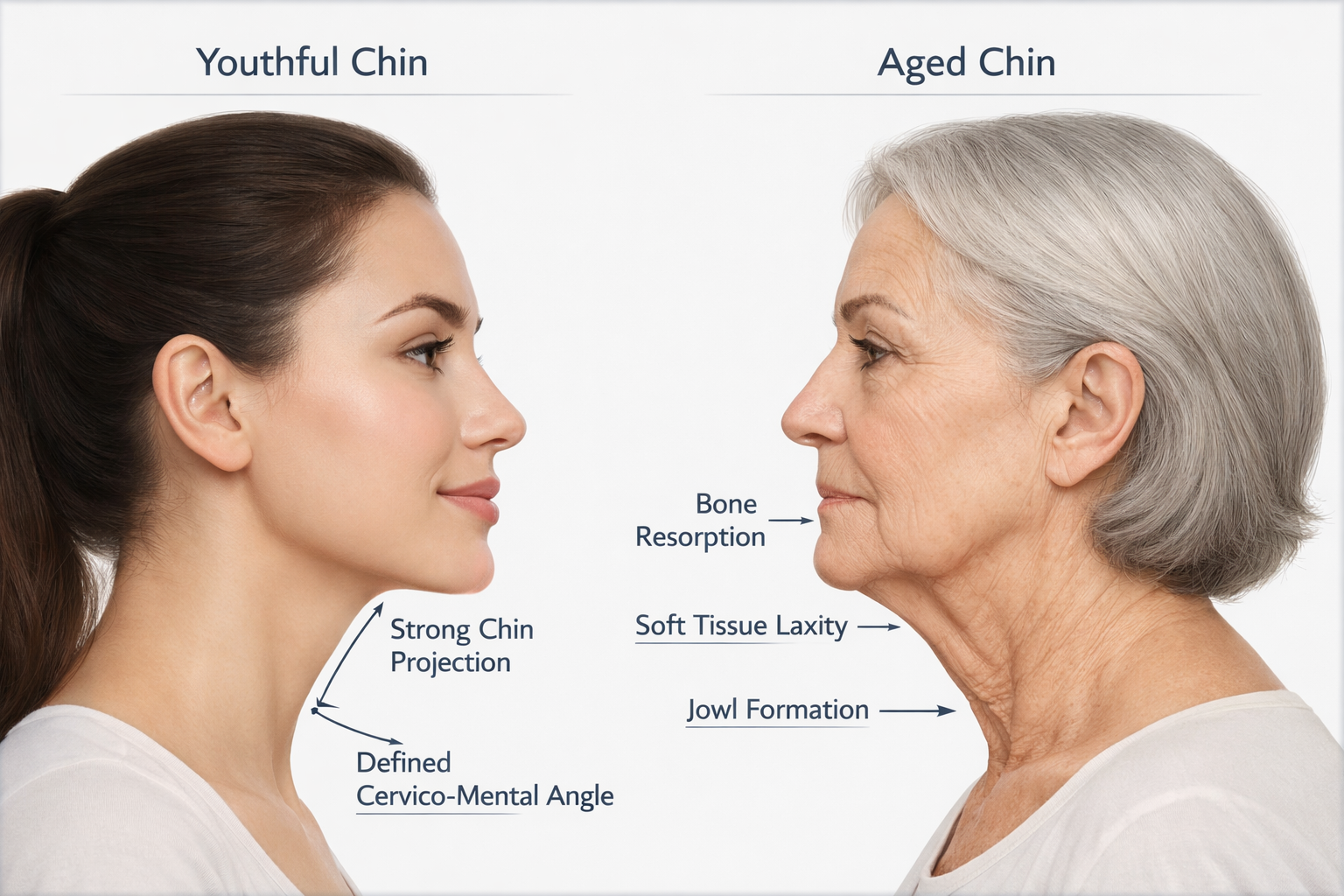
Fat pad loss in the chin and lower face compounds this effect. The subcutaneous fat that gives the lower face a smooth, supported appearance thins over time, causing the skin to appear looser and the chin contour to become less defined. Simultaneously, collagen depletion reduces skin elasticity, making it harder for the skin to conform to the underlying structure.
Mentalis muscle hyperactivity is another age-related concern. As the chin loses volume and the soft tissue becomes less supported, the mentalis muscle may work harder to maintain lip position, leading to a chronically contracted, dimpled, or pebbly chin surface. This texture change is often one of the earlier visible signs of lower face aging and can be addressed with targeted neuromodulator treatment.
Prejowl hollowing — the loss of volume along the jawline just in front of the jowls — can also make the chin appear more isolated and less connected to the rest of the lower face. Addressing this area as part of a broader lower face treatment plan can restore a more continuous, youthful jawline contour.
Chin Aesthetics in Men and Women
Aesthetic goals for the chin differ meaningfully between male and female patients, and a well-designed treatment plan should reflect these differences rather than applying a single standard.
In men, a strong, well-projected chin is associated with masculinity, confidence, and facial structure. The ideal masculine chin tends to be broader, more angular, and more prominent — with a relatively flat or square lower border. Jawline definition is a priority, and treatment approaches for male patients typically aim to increase chin projection and width while maintaining a structured, angular appearance.
In women, the aesthetic ideal is generally softer and more tapered. A feminine chin is typically narrower, slightly pointed or rounded at the tip, and less aggressively projected than a masculine chin. The goal is usually to create balance and refinement rather than dominance. Overly aggressive augmentation in female patients can masculinise the lower face, which is why precise assessment and conservative treatment increments are important.
These gender-specific differences also apply to chin reduction. Patients seeking facial feminisation may request reduction of a chin that is too prominent, too wide, or too square. Conversely, patients seeking facial masculinisation may require more substantial augmentation than would typically be appropriate for a female patient with the same baseline anatomy.
Non-Surgical Chin Treatments
Non-surgical chin augmentation has become one of the most commonly performed aesthetic procedures, offering meaningful improvement in chin projection and lower face balance without surgery or general anaesthesia.
Hyaluronic Acid Fillers
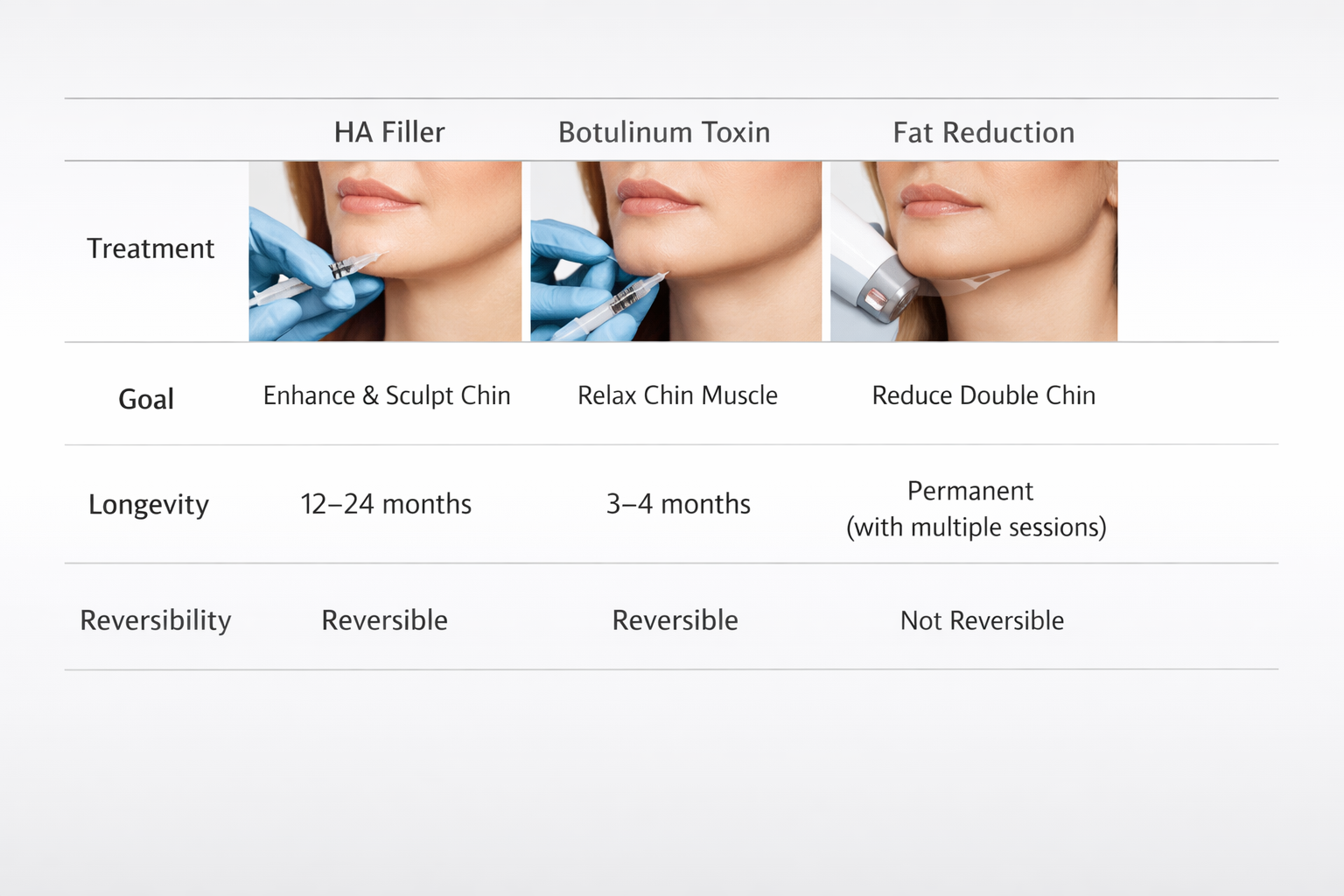
Hyaluronic acid filler is the most widely used non-surgical option for chin enhancement. Products such as Juvederm Volux, Radiesse, and Restylane Lyft are formulated with higher viscosity and greater lifting capacity than softer fillers used in other areas, making them suitable for structural augmentation of the chin. Hyaluronic acid filler can be used to increase chin projection, refine the chin shape, improve symmetry, and enhance the overall facial profile. Results typically last between 12 and 24 months depending on the product used, the volume injected, and individual metabolism.
A key advantage of hyaluronic acid filler is reversibility. If a patient is unhappy with the result or experiences a complication, the filler can be dissolved using hyaluronidase — an enzyme that breaks down hyaluronic acid. This reversibility makes non-surgical chin augmentation a lower-commitment option for patients who are uncertain about permanent change or who want to preview the aesthetic effect before considering surgery.
Risks associated with chin filler include bruising, swelling, asymmetry, nodule formation, and — in rare but serious cases — vascular occlusion if filler is inadvertently injected into a blood vessel. Treatment should be performed by a qualified practitioner with a thorough understanding of chin anatomy and vascular anatomy in the area.
Neuromodulators for the Mentalis Muscle
Botulinum toxin injected into the mentalis muscle can relax chronic overactivity, smoothing a dimpled or pebbly chin surface and reducing the appearance of a chin crease. This treatment is often combined with chin filler for a more comprehensive result. The effect typically lasts three to four months and requires periodic maintenance.
Submental Fat Reduction
When submental fullness is contributing to a poorly defined cervico-mental angle, non-surgical fat reduction treatments such as injectable deoxycholic acid (Kybella) or cryolipolysis (CoolSculpting) may be considered. These treatments target the fat beneath the chin rather than augmenting the chin itself, but they can meaningfully improve the chin-to-neck transition when used appropriately. They are not substitutes for chin augmentation in patients with a genuinely recessed chin.
Surgical Chin Treatments
Surgical options offer more permanent and structurally significant correction for patients with moderate to severe chin deficiency, asymmetry, or excess. Surgical treatment is typically considered when non-surgical options cannot achieve the desired degree of change, or when the patient prefers a long-term solution.
Chin Implant (Alloplastic Augmentation)
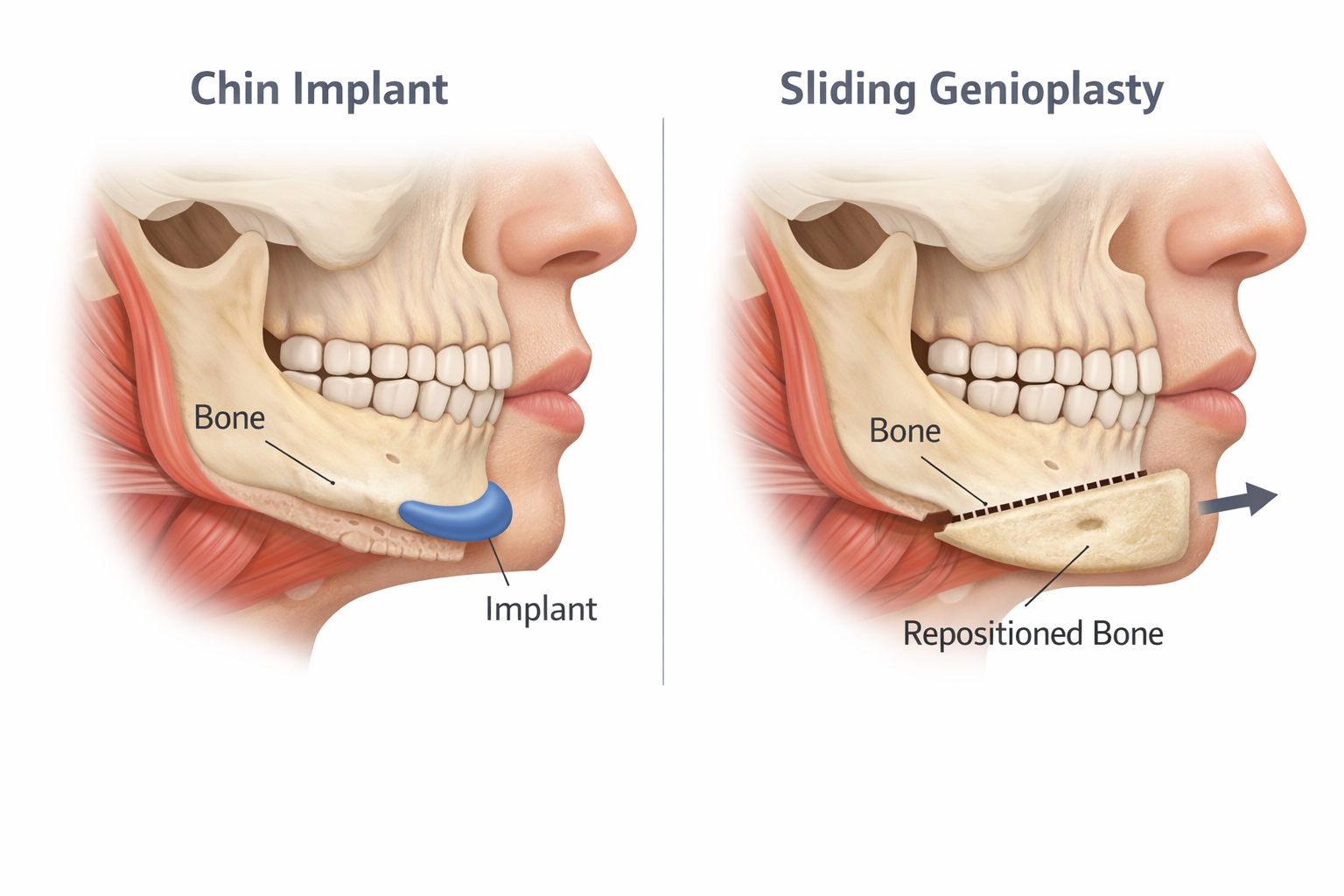
A chin implant — also called alloplastic chin augmentation — involves placing a solid silicone implant over the chin bone through a small incision made either inside the mouth or beneath the chin. The implant increases chin projection and can be selected in various shapes and sizes to match the patient’s anatomy and aesthetic goals. Chin implant surgery is typically performed under local anaesthesia with sedation or general anaesthesia and involves a recovery period of one to two weeks for initial swelling to subside, with final results becoming apparent over several months.
Risks include infection, implant displacement, nerve injury causing temporary or permanent numbness, and bone resorption beneath the implant over time. Implants can be removed or replaced if necessary. When performed by an experienced surgeon on an appropriately selected patient, chin implant surgery can produce natural-looking results with a high degree of patient satisfaction.
Genioplasty (Sliding Genioplasty / Osseous Genioplasty)
Genioplasty — also referred to as mentoplasty or osseous genioplasty — is a surgical procedure in which the chin bone itself is cut and repositioned. Unlike a chin implant, which adds volume over the existing bone, a sliding genioplasty physically moves the chin forward, backward, upward, downward, or laterally to correct projection, height, and symmetry. This approach offers greater versatility than implants and is particularly useful for patients with significant asymmetry or complex three-dimensional chin concerns.
Genioplasty is a more involved procedure than implant placement and typically requires a longer recovery. It is usually performed under general anaesthesia. The repositioned bone is held in place with titanium plates and screws, which are generally left in place permanently. Swelling can persist for several weeks to months, and final results may take up to a year to fully manifest.
Chin Reduction
Not all patients seek augmentation. Some patients have a chin that is overly prominent, too wide, or asymmetric in a way that creates imbalance. Chin reduction — achieved through bone burring, bone removal, or a reverse sliding genioplasty — can reduce chin projection or width. This procedure is relevant for patients seeking facial feminisation, those with macrogenia (an overly large chin), or those with post-traumatic chin deformity.
Combining Chin Treatment With Other Procedures
Chin treatment is frequently most effective when considered as part of a broader facial aesthetic plan rather than in isolation. Several combination approaches are commonly used.
Chin augmentation and rhinoplasty are among the most frequently combined procedures in facial aesthetics. Because the chin and nose are the two primary projecting structures of the facial profile, addressing both simultaneously can produce a more balanced result than treating either in isolation. In some cases, augmenting the chin alone reduces the perceived nasal prominence sufficiently that rhinoplasty becomes unnecessary.
Chin treatment combined with neck liposuction or a neck lift addresses both the forward projection of the chin and the submental fullness or skin laxity beneath it. This combination is particularly effective for patients whose primary concern is a poorly defined cervico-mental angle. A facelift combined with chin augmentation can address jowling, skin laxity, and chin deficiency simultaneously, producing a comprehensive lower face rejuvenation.
Common Myths: Can Exercises or Posture Fix a Weak Chin?
A number of popular techniques — including tongue posture exercises sometimes called “mewing,” jaw exercises, and specific posture practices — are promoted online as methods for improving chin and jawline definition. It is important to understand the anatomical limits of these approaches. In adults, the position and size of the mandible and chin bone are determined by skeletal structure that cannot be meaningfully altered through muscle exercise or tongue posture. Bone cannot be repositioned in adults by soft tissue pressure alone.
Facial exercises may improve muscle tone and may have a modest effect on the appearance of the lower face in some individuals, but they cannot correct a structurally recessed chin, increase chin projection, or address bone resorption. Patients who have seen dramatic before-and-after results attributed to these techniques online should be aware that lighting, camera angle, and posture changes account for the majority of visible differences in such comparisons.
What to Expect at a Chin Consultation
A thorough chin consultation involves more than simply discussing the patient’s concerns. A qualified practitioner will assess the chin in the context of the entire face — evaluating facial proportions, the facial profile, the cervico-mental angle, skin quality, bone structure, and the relationship between the chin and adjacent features including the nose, lips, and jawline.
The practitioner should discuss the patient’s aesthetic goals, explain the relevant treatment options with their respective benefits and limitations, and outline a customised treatment plan that reflects the patient’s anatomy, preferences, and risk tolerance. Patients should feel comfortable asking about the practitioner’s experience with chin treatments, the specific products or techniques proposed, expected recovery, and what happens if they are unhappy with the result.
For non-surgical treatment, the appointment itself is typically brief — often 30 to 60 minutes — with minimal downtime. Surgical consultations involve a more detailed discussion of anaesthesia, recovery, and surgical planning, and may require imaging or dental assessment depending on the procedure.
Frequently Asked Questions
How long does chin filler last?
Chin filler longevity varies depending on the product used, the volume injected, and individual metabolism. Most hyaluronic acid fillers used for chin augmentation last between 12 and 24 months. Some patients metabolise filler more quickly. Maintenance treatments are typically needed to sustain the result.
Is chin filler reversible?
Yes. Hyaluronic acid filler can be dissolved using hyaluronidase, an enzyme that breaks down the filler material. This makes non-surgical chin augmentation a reversible option, which is one of its key advantages over surgical approaches. Dissolution is typically performed if the patient is unhappy with the result or if a complication such as a nodule or asymmetry occurs.
Can a weak chin make the nose look bigger?
Yes. Because the nose and chin are the two primary projecting structures of the facial profile, a recessed chin can make the nose appear disproportionately large even when the nose itself is anatomically normal. Augmenting the chin can improve the perceived nasal-chin balance without any change to the nose.
Am I a candidate for chin augmentation?
Candidacy depends on the degree of chin deficiency, the patient’s anatomy, medical history, and aesthetic goals. Non-surgical chin augmentation with filler is suitable for many patients with mild to moderate chin deficiency. Surgical options may be more appropriate for patients with significant recurrence, asymmetry, or those seeking a permanent result. A clinical assessment by a qualified practitioner is required to determine the most appropriate approach.
What is the difference between a chin implant and genioplasty?
A chin implant places a solid silicone implant over the existing chin bone to increase projection. Genioplasty physically cuts and repositions the chin bone itself. Implants are generally simpler to perform and recover from, while genioplasty offers greater versatility for complex corrections including asymmetry and multi-directional repositioning.
Does chin treatment hurt?
Non-surgical chin filler treatment involves injections that may cause mild discomfort. Topical anaesthetic cream and local anaesthetic are typically used to minimise pain during the procedure. Surgical procedures are performed under appropriate anaesthesia. Post-procedure soreness, swelling, and bruising are common with both approaches and generally resolve within days to weeks depending on the treatment.
Can chin treatment be combined with other procedures?
Yes. Chin treatment is frequently combined with rhinoplasty, neck liposuction, jawline contouring, or facelift procedures for a more comprehensive result. Non-surgical chin filler is also commonly combined with neuromodulator treatment for the mentalis muscle. A practitioner can advise on which combinations may be appropriate based on individual assessment.
Is Chin Treatment the Right Consideration for You?
The chin’s influence on facial harmony, jawline definition, and the overall facial profile is substantial — and often underestimated until a thorough facial analysis is performed. For patients who feel that their lower face lacks definition, that their nose appears disproportionate, or that their profile is less balanced than they would like, a chin assessment is a logical starting point.
Non-surgical chin augmentation with hyaluronic acid filler offers a reversible, relatively low-risk entry point for patients who want to explore the aesthetic impact of improved chin projection before committing to a permanent change. Surgical options — including chin implants and genioplasty — provide more durable correction for patients with greater structural deficiency or those who prefer a long-term solution. Chin reduction addresses the less commonly discussed but equally valid concern of an overly prominent or asymmetric chin.
No treatment is universally appropriate, and realistic expectations are essential. Results depend on the degree of the underlying concern, the treatment chosen, the practitioner’s skill, and individual healing. A consultation with a qualified aesthetic practitioner or surgeon who performs a thorough facial analysis and discusses a customised treatment plan is the most reliable way to determine whether chin treatment may be appropriate for your specific anatomy and goals.