

Chemical peel treatment uses carefully selected acids or chemical solutions to remove damaged outer layers of skin, encouraging cell renewal and improving the appearance of a range of skin concerns. With several distinct peel types available — from very light lunchtime peels to deeper clinical treatments — understanding the differences helps you have a more informed conversation with a qualified practitioner before committing to any procedure.
Key Takeaways
- Chemical peels are broadly divided into three categories — superficial, medium-depth, and deep — each penetrating to a different level of the skin and carrying a different risk and recovery profile.
- The right peel type depends on your skin concern, skin tone, medical history, and tolerance for downtime, not simply on which peel produces the most dramatic results.
- Superficial peels require little to no downtime but typically need a course of treatments; deep peels offer more significant change but carry greater risks and a longer recovery period.
- Darker skin tones require careful practitioner assessment because certain peels carry a higher risk of post-inflammatory hyperpigmentation in higher Fitzpatrick skin types.
- A thorough consultation with a qualified and experienced practitioner is essential before any chemical peel treatment to assess suitability and manage expectations.
What Is a Chemical Peel and How Does It Work?
A chemical peel treatment involves applying an acidic or chemical solution to the skin surface, which causes controlled damage to the targeted skin layers. As the treated skin sheds, the body responds by producing new collagen and generating fresher, more evenly pigmented skin cells. The depth of this controlled injury determines the category of peel, the skin concerns it can realistically address, and the recovery the patient should expect.
The skin is structured in layers: the outermost epidermis, which itself has several sub-layers, and the deeper dermis beneath it. Superficial peels act only within the epidermis. Medium-depth peels reach the upper dermis. Deep peels penetrate into the mid-dermis. The deeper the peel, the more significant the potential improvement — but also the greater the risk of side effects, complications, and prolonged healing.
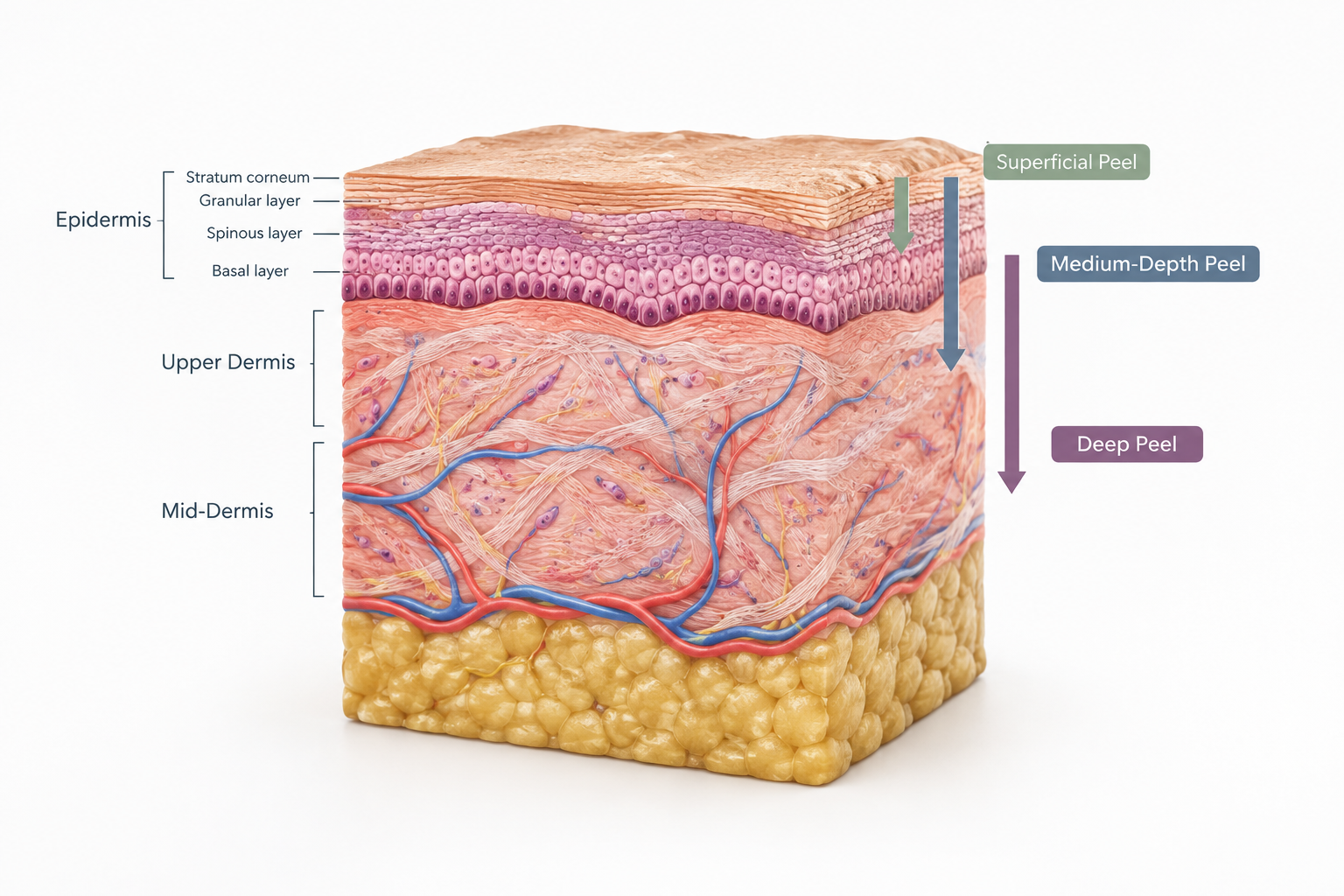
Chemical peels are used to address concerns including uneven skin tone, fine lines, acne, acne scarring, sun damage, melasma, and rough skin texture. No single peel type is universally superior; the most appropriate choice depends on the individual’s skin concern, skin type, Fitzpatrick phototype, medical history, and realistic goals.
Superficial Chemical Peels
Superficial peels, sometimes called light peels or lunchtime peels, are the mildest category of chemical peel treatment. They work within the outermost layers of the epidermis and are generally well tolerated with minimal downtime. Common acids used in superficial peels include alpha-hydroxy acids (AHAs) such as glycolic acid and lactic acid, beta-hydroxy acids (BHAs) such as salicylic acid, mandelic acid, and low-concentration trichloroacetic acid (TCA) formulations.
Glycolic Acid Peels
Glycolic acid is an AHA derived from sugar cane and is one of the most widely used agents in superficial chemical peel treatment. It has a small molecular size, which allows it to penetrate the skin relatively efficiently at low concentrations. Glycolic acid peels may help improve skin texture, mild hyperpigmentation, dullness, and fine surface lines. Concentrations used in clinical settings typically range from around 20% to 70%, with higher concentrations requiring careful application and neutralisation. Multiple sessions are usually recommended to achieve noticeable improvement, often spaced two to four weeks apart.
Salicylic Acid Peels
Salicylic acid is a BHA that is oil-soluble, meaning it can penetrate into the sebaceous follicle. This property makes salicylic acid peels particularly useful for patients with oily or acne-prone skin, active breakouts, and comedones. Salicylic acid also has mild anti-inflammatory properties, which may make it better tolerated in some patients with sensitive or reactive skin. Concentrations used clinically are typically between 20% and 30%. Salicylic acid peels are generally not recommended for patients with aspirin sensitivity or salicylate allergy.
Lactic Acid Peels
Lactic acid is an AHA derived from milk and tends to be gentler than glycolic acid due to its larger molecular size and slower penetration. Lactic acid peels may be a suitable starting point for patients with sensitive skin, dry skin, or those new to chemical peel treatment. In addition to exfoliation, lactic acid has some humectant properties, meaning it may help the skin retain moisture. It is sometimes used to address mild pigmentation irregularities and skin dullness.
Mandelic Acid Peels
Mandelic acid is an AHA derived from bitter almonds with a larger molecular size than glycolic or lactic acid, resulting in slower and more even penetration. This characteristic may make mandelic acid peels a useful option for patients with darker skin tones or those at higher risk of post-inflammatory hyperpigmentation, though individual assessment remains essential. Mandelic acid also has some antibacterial properties and may be used to address mild acne alongside pigmentation concerns.
What to Expect from a Superficial Peel
During a superficial chemical peel appointment, the skin is cleansed and the peel solution is applied for a defined period before being neutralised or removed. Patients typically experience a mild tingling or stinging sensation during application. Redness and mild flaking or peeling may occur in the days following treatment, though some superficial peels produce very little visible peeling at all. Most patients can return to normal activities the same day or the following day. Sun protection is essential after any chemical peel treatment, as the skin is more vulnerable to UV damage during the recovery period.
Medium-Depth Chemical Peels
Medium-depth peels penetrate through the full epidermis and into the upper dermis, producing more significant skin remodelling than superficial peels. The most commonly used agents for medium-depth chemical peel treatment include TCA at concentrations of approximately 35% to 50%, and the Jessner’s solution combined with TCA. The combination of Jessner’s solution — which typically contains resorcinol, salicylic acid, and lactic acid — with TCA is a well-established approach that may allow effective medium-depth penetration with a degree of predictability.
Medium-depth peels may be appropriate for patients with moderate sun damage, moderate acne scarring, more pronounced pigmentation irregularities such as melasma, and moderate fine lines and wrinkles. They generally produce more noticeable improvement than superficial peels but require a longer recovery period, typically seven to fourteen days of visible peeling, redness, and skin shedding. During this time, the skin may appear red, swollen, and crusted before new skin emerges.
The risk profile of medium-depth peels is higher than that of superficial peels. Potential side effects include prolonged redness, post-inflammatory hyperpigmentation (particularly in darker skin tones), infection, and scarring, though serious complications are uncommon when the treatment is performed by an experienced practitioner on appropriately selected patients. Pre-treatment skin preparation with topical retinoids or hydroquinone is sometimes recommended to improve outcomes and reduce the risk of pigmentation complications, though protocols vary between practitioners.
Deep Chemical Peels
Deep chemical peels penetrate into the mid-dermis and produce the most significant degree of skin remodelling of any chemical peel type. The phenol peel — sometimes referred to as a carbolic acid peel — is the primary agent used for deep chemical peel treatment. Phenol peels have a long clinical history and have been used to address severe sun damage, deep wrinkles, significant acne scarring, and certain precancerous skin lesions.
Phenol Peels
Phenol is a powerful chemical agent that causes deep controlled injury to the skin. The Baker-Gordon formula, which combines phenol with croton oil and other components, is one of the most studied deep peel formulations. The depth of penetration and the degree of skin remodelling achievable with phenol peels can be considerable, and results may be long-lasting compared to superficial or medium-depth peels. However, the risk profile is substantially higher.
Phenol is absorbed systemically through the skin and can affect cardiac rhythm, which means deep phenol peels are typically performed under medical supervision with cardiac monitoring, often in a clinical or hospital setting. The procedure may require sedation or anaesthesia. Recovery from a deep chemical peel is prolonged — the skin may remain red and sensitive for several weeks to months, and patients are generally advised to avoid sun exposure for an extended period. Permanent skin lightening (hypopigmentation) is a recognised risk of deep phenol peels, which means they are generally not suitable for patients with darker skin tones. Other risks include scarring, infection, prolonged erythema, and changes in skin texture.
Because of the significant recovery demands and risk profile, deep chemical peels are less commonly performed today than in previous decades, partly due to the availability of alternative treatments such as fractional laser resurfacing. However, for carefully selected patients with specific concerns, a deep peel may still be a clinically relevant option when discussed thoroughly with a qualified practitioner.
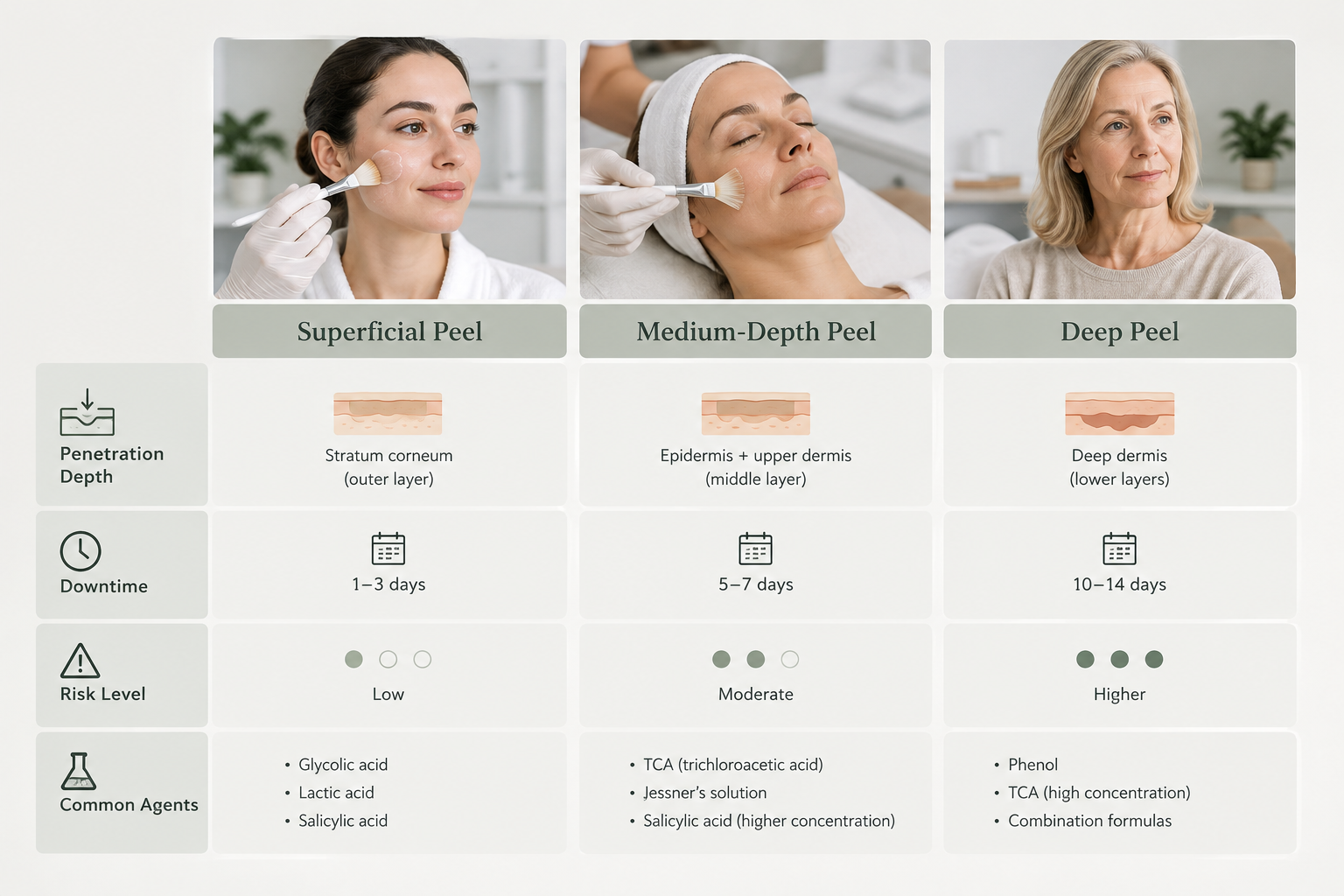
Comparing Chemical Peel Types at a Glance
| Feature | Superficial Peel | Medium-Depth Peel | Deep Peel |
|---|---|---|---|
| Depth of penetration | Epidermis only | Epidermis to upper dermis | Mid-dermis |
| Common agents | Glycolic acid, salicylic acid, lactic acid, mandelic acid | TCA 35–50%, Jessner’s + TCA | Phenol (Baker-Gordon formula) |
| Skin concerns addressed | Dullness, mild pigmentation, mild acne, texture | Moderate sun damage, pigmentation, acne scarring, fine lines | Severe sun damage, deep wrinkles, significant scarring |
| Downtime | Minimal to none (1–3 days) | 7–14 days | Several weeks to months |
| Sessions typically needed | Course of treatments (4–6+) | 1–2 sessions | Usually 1 session |
| Risk level | Low | Moderate | High |
| Suitability for darker skin tones | Generally more suitable (with care) | Requires careful assessment | Generally not suitable |
| Longevity of results | Shorter; maintenance required | Moderate; maintenance advised | Longer-lasting; sun protection essential |
Skin Concerns and Which Peel Type May Help
Acne and Oily Skin
Salicylic acid peels are frequently used for acne-prone skin because salicylic acid’s oil-solubility allows it to penetrate blocked follicles and help reduce comedones and inflammatory lesions. Glycolic acid peels may also be used for acne management. For acne scarring, the appropriate peel depth depends on the severity of the scarring — superficial peels may improve mild post-inflammatory discolouration, while medium-depth peels may be more relevant for atrophic scarring. Deeper ice-pick or boxcar scars may require alternative or combined approaches such as subcision, microneedling, or laser resurfacing.
Hyperpigmentation and Melasma
Hyperpigmentation — including sun spots, post-inflammatory hyperpigmentation, and melasma — is one of the most common reasons patients seek chemical peel treatment. Superficial peels with glycolic acid, lactic acid, or mandelic acid may help improve mild to moderate pigmentation over a course of treatments. Medium-depth TCA peels may address more significant pigmentation, though the risk of triggering further post-inflammatory hyperpigmentation must be carefully weighed, particularly in patients with Fitzpatrick skin types IV to VI. Melasma is a complex condition influenced by hormonal factors and UV exposure, and chemical peels are typically used as part of a broader management plan rather than as a standalone cure.
Fine Lines and Skin Ageing
Superficial peels can improve skin texture and mild surface lines by stimulating cell turnover, but they are unlikely to produce significant improvement in deeper wrinkles. Medium-depth peels stimulate collagen remodelling in the upper dermis and may produce more noticeable improvement in moderate fine lines and skin laxity. Deep phenol peels have historically been used for significant perioral and periorbital wrinkles, though the recovery demands and risks are considerable. For patients seeking improvement in skin ageing without the downtime of a deep peel, alternatives such as fractional laser resurfacing, radiofrequency microneedling, or injectable treatments may be worth discussing.
Sun Damage and Uneven Skin Tone
Cumulative sun damage — presenting as uneven pigmentation, rough texture, and superficial discolouration — may respond well to a course of superficial chemical peels or to a medium-depth peel depending on severity. Patients with significant actinic damage may benefit from a thorough skin assessment before treatment, as certain lesions may require medical evaluation rather than cosmetic treatment alone.
Who May Be Suitable for Chemical Peel Treatment
Chemical peel treatment may be suitable for adults with a range of skin concerns including mild to severe sun damage, acne, acne scarring, hyperpigmentation, uneven skin tone, and fine lines. Suitability depends on several individual factors that a qualified practitioner will assess during consultation.
Factors that may affect suitability include:
- Skin type and Fitzpatrick phototype — darker skin tones carry a higher risk of pigmentation complications with certain peels
- Active skin infections, cold sores (herpes simplex), or open wounds in the treatment area
- Recent use of isotretinoin (roaccutane) — most practitioners advise waiting at least six to twelve months after completing a course before performing medium or deep peels
- Pregnancy or breastfeeding — many chemical agents are not recommended during pregnancy
- History of abnormal scarring or keloid formation
- Use of certain medications that increase photosensitivity
- Previous radiation therapy to the face
- Realistic expectations about the degree of improvement achievable
Risks and Side Effects of Chemical Peels
All chemical peel types carry some degree of risk, and the likelihood and severity of side effects generally increases with peel depth. Patients should be fully informed of potential risks before consenting to treatment.
Common side effects across peel types include temporary redness, mild swelling, skin sensitivity, and peeling or flaking. These are expected parts of the healing process and typically resolve within the expected recovery window for the peel type used.
More significant risks include:
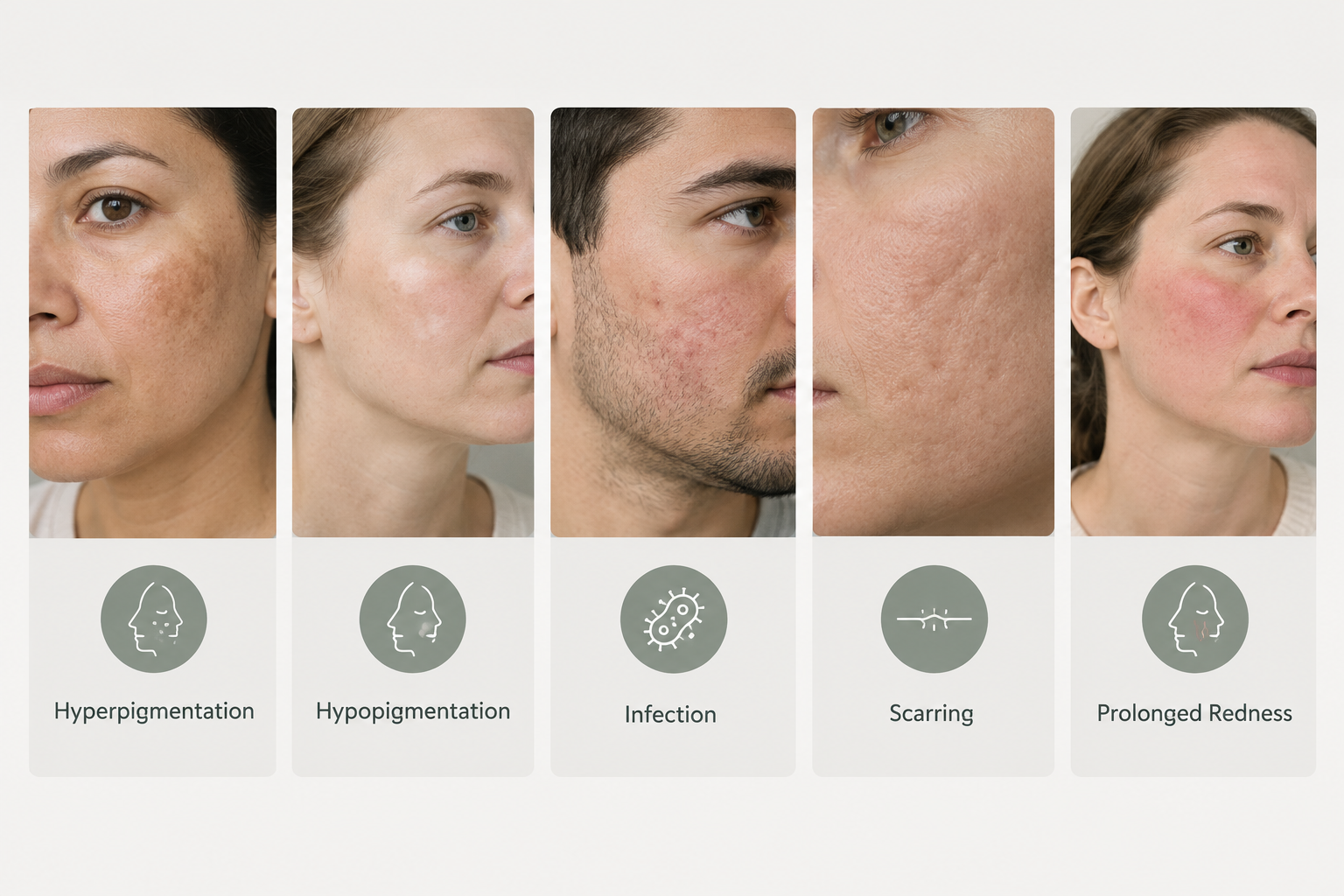
- Post-inflammatory hyperpigmentation: Darkening of the skin following treatment, more common in patients with darker skin tones or those who do not follow post-treatment sun protection advice
- Hypopigmentation: Permanent lightening of the skin, a recognised risk particularly with deep phenol peels
- Infection: Bacterial, viral (including herpes simplex reactivation), or fungal infection during the healing period; prophylactic antiviral medication is sometimes prescribed before medium or deep peels in patients with a history of cold sores
- Scarring: Uncommon but possible, particularly with deeper peels or if post-treatment care instructions are not followed
- Prolonged erythema: Redness lasting beyond the expected recovery period
- Allergic or irritant reactions: To the peel solution or post-treatment products
- Systemic effects: Relevant specifically to phenol peels, which require cardiac monitoring due to systemic absorption
Choosing a qualified and experienced practitioner, following pre- and post-treatment instructions carefully, and using appropriate sun protection significantly reduces — but does not eliminate — the risk of complications.
Alternatives to Chemical Peel Treatment
Chemical peels are one of several approaches available for skin resurfacing and rejuvenation. Depending on the patient’s concern and skin type, a practitioner may discuss alternatives including:
- Laser resurfacing: Ablative lasers such as CO2 and erbium lasers, and fractional laser devices, can address similar concerns to medium and deep peels with a degree of precision. Fractional laser resurfacing treats a fraction of the skin surface at a time, which may reduce recovery time compared to fully ablative approaches.
- Microneedling and radiofrequency microneedling: These treatments stimulate collagen production and may improve skin texture, fine lines, and mild scarring with a different risk profile to chemical peels.
- Intense pulsed light (IPL): IPL may be used to address pigmentation and vascular concerns, though it does not resurface the skin in the same way as a chemical peel.
- Topical skincare: A well-structured skincare routine incorporating retinoids, vitamin C, niacinamide, and broad-spectrum SPF can complement or, for mild concerns, substitute for in-clinic peel treatments.
- HydraFacial: A non-chemical resurfacing treatment that combines cleansing, exfoliation, and hydration; generally suitable for patients seeking a gentle skin refresh with no downtime.
The most appropriate treatment depends on the individual’s skin concern, skin type, downtime tolerance, and clinical assessment. In some cases, a combination approach may be recommended.
Frequently Asked Questions
How many chemical peel sessions will I need?
The number of sessions depends on the peel type and the concern being treated. Superficial peels are typically performed as a course of four to six or more treatments, spaced two to four weeks apart. Medium-depth peels may produce meaningful improvement in one to two sessions. Deep peels are usually a single treatment. Your practitioner will recommend a treatment plan based on your individual assessment.
Can chemical peels be used on all skin tones?
Some chemical peels can be used across a range of skin tones, but the risk of post-inflammatory hyperpigmentation is higher in patients with darker skin (Fitzpatrick types IV–VI). Gentler acids such as mandelic acid or lactic acid are sometimes preferred for these patients. Deep phenol peels are generally not suitable for darker skin tones due to the risk of permanent hypopigmentation. A thorough assessment by an experienced practitioner is essential.
Is a chemical peel painful?
Superficial peels typically cause mild tingling or stinging during application, which most patients find tolerable. Medium-depth peels may cause more significant discomfort, and some practitioners use topical anaesthetic or cooling measures. Deep phenol peels are usually performed with sedation or anaesthesia. Discomfort during recovery varies depending on peel depth.
How long do chemical peel results last?
Results from superficial peels are generally shorter-lived and require ongoing maintenance treatments. Medium-depth peels may produce results lasting one to two years or longer with appropriate sun protection and skincare. Deep peel results can be long-lasting, though the skin continues to age naturally and ongoing sun protection remains essential. Individual results vary.
Can I wear makeup after a chemical peel?
After a superficial peel, most patients can apply makeup within a day or two once any redness has settled. After a medium or deep peel, makeup should generally be avoided until the skin has healed sufficiently, which may take one to two weeks or longer. Your practitioner will advise on specific post-treatment care.
What is the difference between a clinic peel and an at-home peel?
At-home peel products contain lower concentrations of active acids than professional clinical peels and are designed for consumer use without practitioner supervision. Clinical peels use higher concentrations that require trained application and, in some cases, neutralisation. The results achievable with at-home products are generally more modest, and the risk of misuse is a consideration. Professional chemical peel treatment should always be performed by a qualified and experienced practitioner.
Choosing the Right Chemical Peel for Your Skin
Selecting the most appropriate chemical peel type is not simply a matter of choosing the strongest option available. The right peel is the one that matches your specific skin concern, skin type, medical history, and realistic expectations — while carrying a risk profile you are comfortable with and a recovery period that fits your circumstances.
Superficial peels are a reasonable starting point for patients new to chemical peel treatment, those with mild concerns, or those who cannot accommodate significant downtime. Medium-depth peels may offer more meaningful improvement for moderate concerns but require a commitment to recovery and careful post-treatment care. Deep peels remain an option for specific patients with significant concerns, but the recovery demands, risks, and suitability restrictions mean they are not appropriate for everyone.
A qualified practitioner will assess your skin type, Fitzpatrick phototype, the nature and severity of your concern, your medical history, and your goals before recommending any chemical peel treatment. If you are considering a peel, seeking a consultation with a practitioner who has specific experience in skin resurfacing and a thorough understanding of peel chemistry and patient selection is an important first step.