

Key Takeaways
- Cheek lift filler is a non-surgical procedure that uses injectable dermal fillers to restore lost midface volume, improve cheekbone definition and create a gentle lifting effect on the lower face.
- Hyaluronic acid fillers such as Juvéderm Voluma and Restylane Lyft are the most commonly used products; calcium hydroxylapatite (Radiesse) and collagen stimulators such as Sculptra are also used depending on patient goals.
- Results typically last 12–18 months for hyaluronic acid fillers, with some products offering longer-lasting effects; individual longevity varies based on metabolism, lifestyle and filler type.
- Hyaluronic acid fillers are reversible using hyaluronidase, which is an important safety consideration when choosing a product and provider.
- A qualified, experienced injector and a thorough facial assessment are essential for natural-looking results and minimising the risk of complications.
What Is a Cheek Lift with Filler?
A cheek lift filler treatment uses strategically placed dermal fillers to restore volume in the midface, enhance cheekbone projection and produce a subtle upward lift across the cheeks and lower face. Unlike a surgical facelift, the procedure involves no incisions, no general anaesthetic and minimal downtime. It is one of the most commonly requested non-surgical facial rejuvenation treatments because the midface is often the first area to show visible signs of ageing.
The lifting effect is not simply cosmetic padding. By replacing volume in specific anatomical zones — particularly around the zygomatic arch and the deep fat compartments beneath the cheek — a skilled injector can mechanically support the overlying tissue, softening nasolabial folds, reducing the appearance of jowls and restoring the broader facial proportions associated with a younger face. This structural approach is what distinguishes a well-executed cheek lift from simply adding bulk to the cheeks.
Why Cheeks Lose Volume and Sag with Age
Facial ageing is driven by several simultaneous processes. The skin gradually loses collagen and elastin, reducing its firmness and elasticity. Hyaluronic acid — a naturally occurring molecule that helps maintain skin hydration and plumpness — also depletes over time. Beneath the skin, the facial fat compartments that give the face its youthful roundness begin to shrink and shift downward through gravitational descent, a process sometimes called midface descent.
The malar fat pad, which sits over the cheekbone and contributes to the full, lifted appearance of a young face, is particularly susceptible to this downward migration. As it descends, it creates a heavier appearance in the lower face, deepens the nasolabial folds and contributes to the formation of jowls. The result is a shift from the inverted triangle of youth — where the face is widest at the cheekbones and tapers toward the chin — toward a heavier, more rectangular or square lower-face shape.
Bone resorption also plays a role. The zygomatic arch and the bony structures of the midface gradually recede with age, reducing the natural cheekbone scaffolding that supports the overlying soft tissue. Replacing this lost structural support is one of the core goals of cheek lift filler treatment.
Which Fillers Are Used for a Cheek Lift?
Not all dermal fillers are suitable for cheek lifting. The midface requires products with sufficient structural support — technically described as a high G-prime (G’) value — meaning the filler is firm enough to resist compression and maintain its shape under the weight of overlying tissue. Softer, more fluid fillers designed for lips or fine lines would not provide the necessary lift.
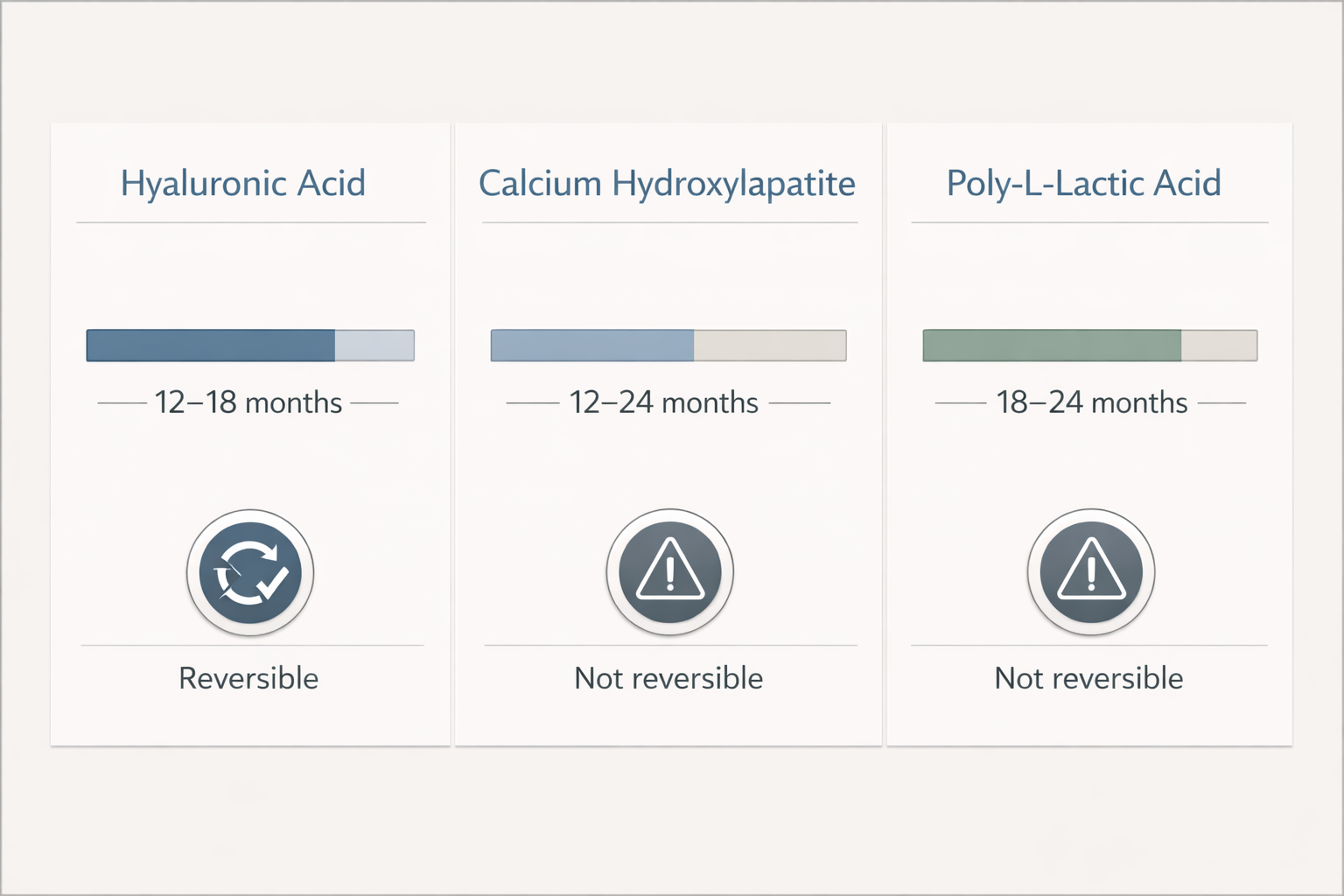
| Filler Type | Examples | Mechanism | Typical Longevity | Reversible? |
|---|---|---|---|---|
| Hyaluronic acid (HA) | Juvéderm Voluma XC, Restylane Lyft, Restylane Contour | Immediate volume replacement; attracts water molecules | 12–18 months | Yes, with hyaluronidase |
| Calcium hydroxylapatite (CaHA) | Radiesse | Immediate volume plus collagen stimulation over time | 12–18 months | No |
| Poly-L-lactic acid (PLLA) | Sculptra | Collagen stimulator; gradual volume improvement over weeks | Up to 2 years or more | No |
Juvéderm Voluma XC, developed using Vycross cross-linking technology, is FDA-approved specifically for cheek augmentation and is one of the most widely used products for this indication. Its high G-prime filler properties make it well suited to deep placement in the midface. Restylane Lyft offers similar structural support and is also FDA-approved for cheek augmentation.
Radiesse, a calcium hydroxylapatite filler, provides immediate lift and also acts as a collagen stimulator, encouraging the body to produce new collagen around the injected material over the following months. Sculptra (poly-L-lactic acid) works differently: it does not provide immediate volume but gradually stimulates collagen production over several weeks, with results building across multiple treatment sessions. Sculptra is often preferred for patients who want a very gradual, natural-looking improvement or who have significant volume loss across a broad area.
The choice of filler depends on the patient’s anatomy, the degree of volume loss, their preference for immediate versus gradual results, and whether reversibility is a priority. Hyaluronic acid fillers remain the most popular choice partly because they can be dissolved with hyaluronidase if the result is unsatisfactory or if a complication arises.
Where Is Filler Injected for a Cheek Lift?
Precise placement is what separates a natural-looking cheek lift from an overfilled or unnatural result. Injectors typically work across several anatomical zones depending on the patient’s facial structure and the specific concerns being addressed.
The primary injection zones include the malar area (directly over the cheekbone), the submalar area (below the cheekbone, which adds fullness to the mid-cheek), and along the zygomatic arch to restore lateral cheekbone projection. Deep placement — often described as supraperiosteal placement, meaning the filler is deposited close to the bone — provides the most structural support and is the preferred technique for lifting rather than simply adding surface volume.
Targeting the deep medial cheek fat compartment is particularly important for restoring the triangle of youth and creating a genuine lifting effect on the nasolabial folds and jowl area. The facial fat compartments are distinct anatomical spaces, and understanding their individual contribution to facial ageing allows an experienced injector to address volume loss in a targeted, layered way rather than simply filling the most visible hollow.
Needle vs. Cannula: Which Technique Is Used?
Cheek filler can be administered using either a sharp needle or a blunt-tipped flexible cannula, and many practitioners use both within the same treatment session depending on the injection zone.
A needle allows precise, targeted placement at specific anatomical points and is often preferred for deep bolus injections close to the periosteum (the tissue covering the bone). A cannula is a flexible tube with a rounded tip that is inserted through a single entry point and threaded through the tissue to reach multiple areas. Because the cannula tip is blunt, it is less likely to puncture blood vessels, which reduces the risk of bruising and — importantly — lowers the risk of inadvertent intravascular injection, one of the most serious potential complications of any filler treatment.
Neither technique is universally superior. The choice depends on the specific injection zone, the filler product being used, the depth of placement required and the injector’s training and preference. A practitioner experienced in both approaches can select the most appropriate tool for each part of the treatment.
What Happens During a Cheek Lift Filler Appointment?
A cheek lift filler appointment typically begins with a detailed facial assessment. The practitioner will evaluate your facial anatomy, skin quality, degree of volume loss and overall facial proportions before recommending a treatment plan. Photographs are usually taken for reference.
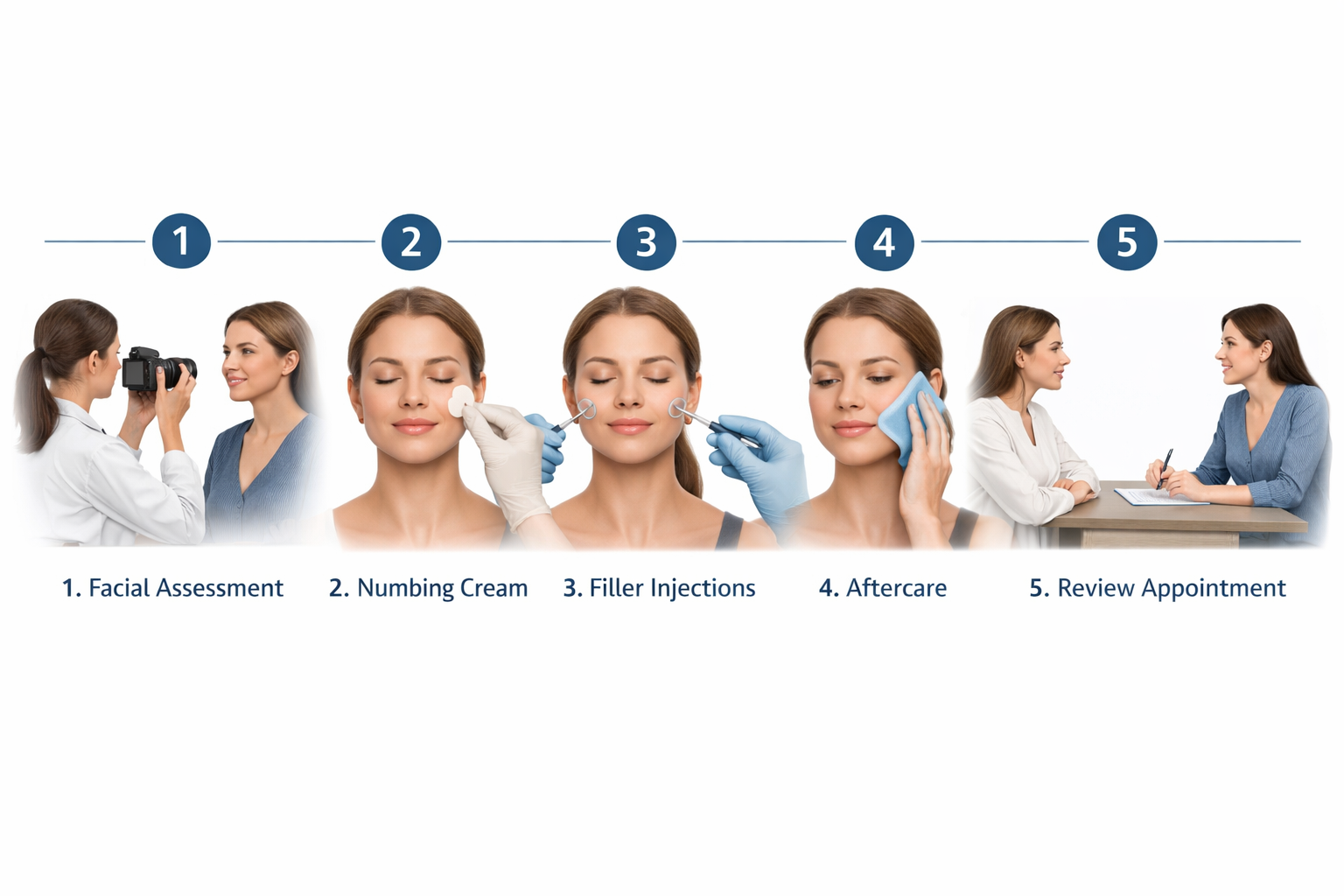
A topical numbing cream is applied to the treatment area and left for approximately 20–30 minutes before the injections begin. Most filler products used for cheek augmentation also contain lidocaine, a local anaesthetic, which further reduces discomfort during injection. The injections themselves typically take 15–30 minutes depending on the number of areas being treated.
The volume of filler used varies considerably between patients. A subtle enhancement may require 1 ml per side, while patients with more significant midface volume loss may benefit from 2–3 ml per side. Experienced practitioners often recommend a staged approach — treating conservatively in the first session and reviewing results after two to four weeks before deciding whether additional filler is needed. This layered strategy helps avoid overcorrection and allows the practitioner to refine the result incrementally.
Results: What to Expect and How Long They Last
Some improvement is visible immediately after treatment, though the initial result is often affected by swelling. Most patients see their true result once swelling has fully resolved, which typically takes 7–14 days. During the first 48–72 hours, the treated area may appear slightly puffy or uneven; this is normal and settles as the filler integrates with the surrounding tissue.
When placed correctly, cheek lift filler can improve cheekbone definition, restore midface fullness, soften nasolabial folds and create a subtle upward lift that reduces the heaviness of the lower face. The degree of improvement depends on the starting anatomy, the volume of filler used and the precision of placement.
For hyaluronic acid fillers, results typically last 12–18 months before a top-up is needed. Radiesse may last a similar duration, with the collagen-stimulating effect potentially extending the benefit beyond the filler’s physical presence. Sculptra results can persist for two years or longer, though multiple initial sessions are usually required to build the effect. Individual longevity is influenced by factors including metabolism, exercise habits, sun exposure and the specific product used.
Avoiding Pillow Face: The Importance of Proportionate Treatment
One of the most common concerns patients raise before cheek filler treatment is the risk of an overfilled, unnatural appearance — sometimes called pillow face. This outcome typically results from excessive filler volume, incorrect placement depth, or a failure to consider the face as a whole rather than treating isolated areas in isolation.
A well-trained injector approaches cheek filler as part of broader facial balancing rather than simply maximising cheekbone projection. The goal is to restore proportions that look natural for the patient’s age and facial structure, not to create exaggerated features. Using a staged approach — starting conservatively and reviewing before adding more — significantly reduces the risk of overcorrection. Patients should be cautious of any practitioner who recommends very large volumes in a single session without a clear clinical rationale.
It is also worth asking your practitioner about their approach to facial analysis, how they determine the appropriate volume for your anatomy, and what their process is if you are unhappy with the result.
Reversibility and What Happens If You Dislike the Result
One of the practical advantages of hyaluronic acid fillers is that they are reversible. If a patient is unhappy with the outcome, or if a complication such as vascular occlusion occurs, the filler can be dissolved using hyaluronidase — an enzyme that breaks down hyaluronic acid relatively quickly. This reversibility is a meaningful safety net and is one reason why HA fillers remain the preferred choice for many practitioners and patients, particularly for first-time treatments.
Calcium hydroxylapatite and poly-L-lactic acid fillers are not reversible in the same way. If a result is unsatisfactory, the options are limited to waiting for the product to naturally degrade or, in some cases, attempting to modify the result with additional treatment. This is an important consideration when choosing between filler types, and it should be discussed openly during the consultation.
Risks and Side Effects
Cheek lift filler is generally considered a low-risk procedure when performed by a qualified and experienced practitioner, but it is not without potential complications. Understanding the range of possible side effects helps patients make an informed decision.
Common and expected side effects include swelling, bruising, redness and tenderness at the injection sites. These typically resolve within a few days to two weeks and do not usually require treatment.
Less common complications include asymmetry, lumpiness or visible filler if the product is placed too superficially, and the Tyndall effect (a bluish discolouration visible through thin skin). These can often be corrected with hyaluronidase in the case of HA fillers.
Serious but rare complications include vascular occlusion, which occurs when filler is inadvertently injected into or compresses a blood vessel, potentially restricting blood flow to the skin or, in very rare cases, to the eye. This is a medical emergency requiring immediate treatment. Granuloma formation — a delayed inflammatory reaction to the filler — is another rare but recognised risk. Choosing a practitioner with thorough knowledge of facial anatomy and vascular safety protocols is the most important factor in minimising serious risk.
Aftercare: Dos and Don’ts
- Do apply a cold compress gently to reduce swelling in the first 24 hours.
- Do sleep on your back for the first night or two to avoid pressure on the treated area.
- Do attend any recommended follow-up appointment to review the result.
- Don’t massage the treated area unless specifically instructed to do so by your practitioner.
- Don’t engage in strenuous exercise for 24–48 hours after treatment.
- Don’t consume alcohol or take blood-thinning medications (such as aspirin or ibuprofen, unless medically necessary) in the 24 hours before and after treatment, as these increase bruising risk.
- Don’t apply glycolic acid, lactic acid or other active exfoliants to the treated area for at least 24 hours post-treatment.
- Don’t expose the treated area to intense heat (saunas, steam rooms, sunbeds) for 48 hours.
Who May Be a Suitable Candidate?
Cheek lift filler may be worth discussing with a practitioner if you have noticed a loss of fullness or definition in the midface, deepening nasolabial folds, early jowling or a general flattening of the cheekbone area. It is most commonly sought by adults in their mid-thirties and older, though younger patients occasionally request it for augmentation rather than restoration purposes.
Men can also benefit from cheek filler, though the aesthetic goals typically differ. Male facial anatomy generally favours sharper, more angular cheekbone definition rather than the softer, rounder apple-cheek appearance often preferred by female patients. A practitioner experienced in treating male patients will adjust placement and volume accordingly to achieve proportionate, gender-appropriate results.
Patients with good skin quality and mild to moderate midface volume loss tend to achieve the most satisfying outcomes. Those with significant skin laxity, very deep folds or substantial jowling may find that filler alone provides limited improvement and that a surgical consultation is worth considering alongside or instead of injectable treatment.
Who May Not Be Suitable?
Cheek filler is not appropriate for everyone. A clinical assessment is required to determine individual suitability. Factors that may affect candidacy include active skin infections or inflammatory skin conditions in the treatment area, a history of severe allergic reactions, bleeding disorders or current use of anticoagulant medications, pregnancy or breastfeeding, and certain autoimmune conditions. Patients with a history of cold sores may require prophylactic antiviral treatment before any facial filler procedure. Previous filler treatments in the same area should always be disclosed, as residual product can affect placement decisions.
Cheek Lift Filler vs. Surgical and Non-Surgical Alternatives
Cheek lift filler is one of several options for addressing midface volume loss and facial sagging. Understanding how it compares to alternatives helps patients choose the most appropriate approach for their goals and anatomy.
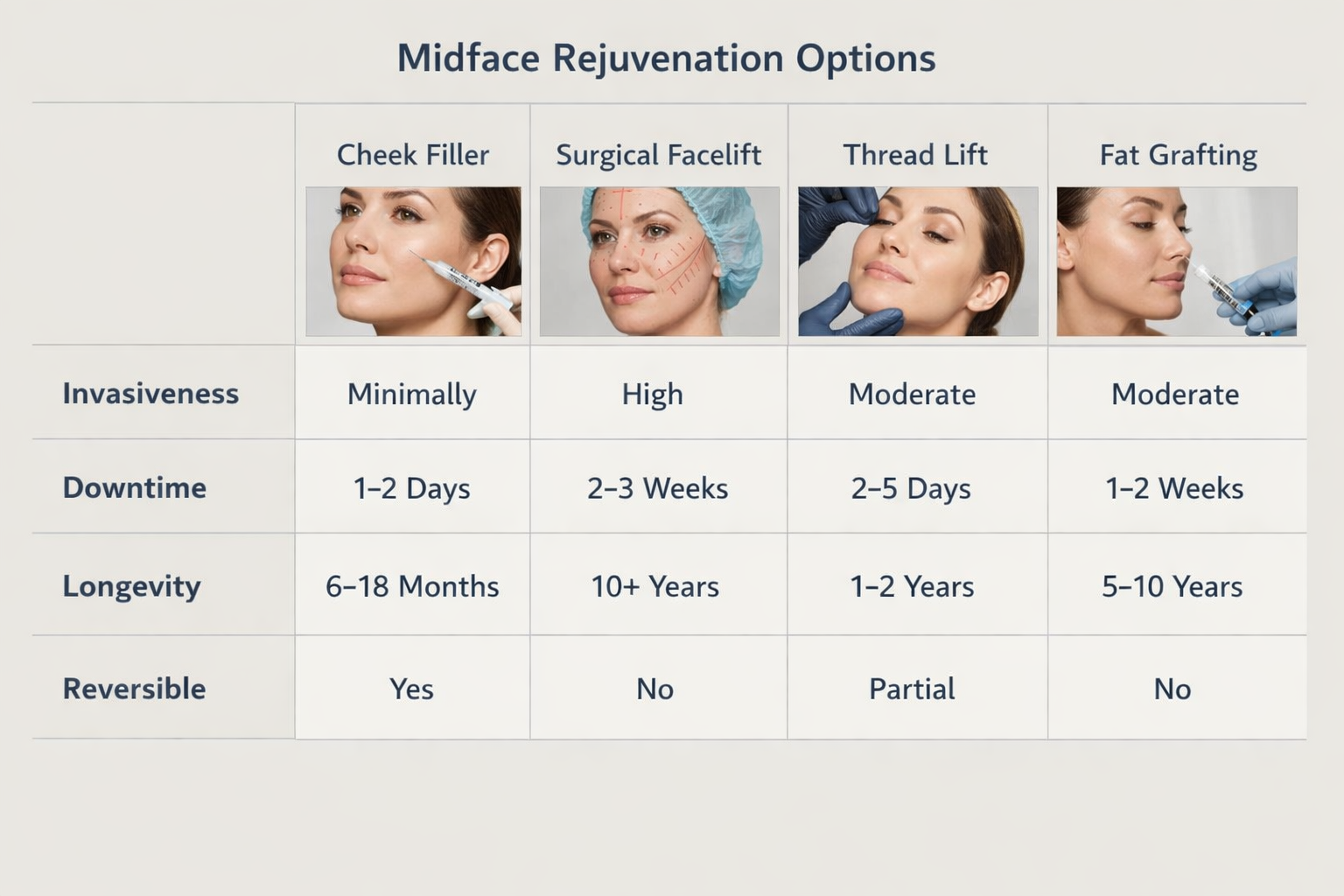
Surgical facelift: A surgical facelift addresses skin laxity, repositions descended soft tissue and can produce more dramatic and longer-lasting results than any injectable treatment. It is the most appropriate option for patients with significant skin laxity, deep folds or pronounced jowling. However, it involves general or sedation anaesthesia, a recovery period of several weeks and the risks associated with surgery. It is not interchangeable with filler for patients with mild to moderate concerns.
Cheek implants: Solid silicone cheek implants provide permanent cheekbone augmentation through surgery. They are best suited to patients seeking a structural change rather than volume restoration, and they carry surgical risks including implant displacement and infection.
Thread lift: A thread lift uses dissolvable sutures inserted under the skin to mechanically lift sagging tissue. It can complement filler treatment but generally produces more modest and shorter-lived results than either filler or surgery. It may suit patients who want some lifting effect without the commitment of surgery but who have more skin laxity than filler alone can adequately address.
Fat grafting: Autologous fat transfer uses the patient’s own fat, harvested from elsewhere on the body, to restore facial volume. Results can be long-lasting, but the procedure requires liposuction under anaesthesia, involves a longer recovery and carries some unpredictability in terms of how much transferred fat survives.
How to Choose an Injector for Cheek Filler
The outcome of cheek lift filler depends heavily on the skill, training and anatomical knowledge of the person performing the treatment. The midface is a complex area with important vascular structures, and incorrect technique or placement can lead to serious complications.
Look for a practitioner with a recognised medical qualification (doctor, dentist or nurse prescriber with appropriate aesthetic training), specific experience in facial filler treatments, and a clear approach to facial analysis and safety. Ask to see examples of their work on patients with similar concerns to your own. A reputable practitioner will conduct a thorough consultation, explain the risks honestly, discuss realistic outcomes and not pressure you into treatment or excessive volumes.
Red flags include practitioners who cannot clearly explain which product they are using and why, who do not discuss risks or contraindications, who offer very low prices without explanation, or who suggest unusually large volumes without a clear clinical rationale.
Frequently Asked Questions
Is cheek lift filler painful?
Most patients find the procedure tolerable. Topical numbing cream is applied before treatment, and most filler products used for cheek augmentation contain lidocaine, which reduces discomfort during injection. Some patients experience a brief pressure or stinging sensation at the injection site. Discomfort levels vary between individuals and injection zones.
How many syringes of filler are needed for a cheek lift?
The volume required depends on the degree of volume loss and the patient’s facial anatomy. A subtle enhancement may require 1 ml per side, while more significant volume restoration may involve 2–3 ml per side. A staged approach — starting conservatively and reviewing before adding more — is generally recommended to avoid overcorrection.
How much does cheek lift filler cost?
Cost varies depending on the filler brand, the volume used, the injector’s experience and geographic location. Hyaluronic acid fillers are typically priced per syringe, with costs varying significantly between clinics and regions. Treatments involving multiple syringes or premium products will cost more. It is advisable to obtain a full cost breakdown during the consultation rather than comparing headline prices alone.
Can cheek filler lift jowls?
Restoring volume in the midface can have an indirect lifting effect on the lower face, including a softening of jowls and nasolabial folds. This occurs because replacing lost cheekbone scaffolding provides structural support for the tissue above the jowl area. However, filler is not a direct treatment for significant skin laxity or pronounced jowling; patients with more advanced sagging may require a surgical assessment.
What is the swelling timeline after cheek filler?
Swelling is most noticeable in the first 24–72 hours after treatment. It typically reduces significantly by the end of the first week, with most patients seeing their settled result by 10–14 days. Some mild residual swelling may persist for up to four weeks in certain patients, particularly those who bruise or swell easily.
Can cheek filler be dissolved if I don’t like the result?
Hyaluronic acid fillers can be dissolved using hyaluronidase, an enzyme that breaks down the filler relatively quickly. This makes HA fillers a reversible option, which is an important consideration for first-time patients. Calcium hydroxylapatite and poly-L-lactic acid fillers cannot be dissolved in the same way and must be allowed to degrade naturally.
How can I extend the longevity of my cheek filler results?
Protecting the skin from UV exposure, maintaining a stable weight, avoiding smoking and following a good skincare routine may help support the longevity of filler results. High-intensity exercise and significant weight fluctuations can accelerate filler breakdown in some patients. Attending timely top-up appointments before the filler has fully degraded may also help maintain a more consistent result over time.
Is Cheek Lift Filler the Right Option for Your Concerns?
Cheek lift filler can be an effective, minimally invasive option for patients experiencing midface volume loss, reduced cheekbone definition or early signs of gravitational descent in the lower face. When performed by a qualified practitioner using appropriate products and precise placement, it can restore a more youthful facial proportion without surgery, with results that typically last 12–18 months or longer depending on the product used.
It is not a universal solution. Patients with significant skin laxity, pronounced jowling or deep structural changes may find that filler provides limited improvement and that surgical options are worth exploring. The staged approach, careful product selection and a thorough consultation are all important factors in achieving a result that looks natural and proportionate rather than overdone.
If you are considering a non-surgical cheek lift, a consultation with a qualified and experienced aesthetic practitioner is the appropriate starting point. A detailed facial assessment will help determine whether cheek filler is suitable for your anatomy and goals, which product and volume may be appropriate, and whether any complementary treatments might enhance the overall result.