

Key Takeaways
- Smoking — including cigarettes, vaping, and cannabis — is best avoided for at least 48 hours after lip filler, and ideally for longer during the full healing process.
- The suction motion of smoking stresses the injection sites and can contribute to filler migration and uneven results.
- Nicotine restricts blood flow, reducing the oxygen supply that tissues need to heal efficiently after treatment.
- Long-term smoking accelerates the breakdown of hyaluronic acid filler and damages collagen and elastin, shortening filler longevity and worsening the perioral area over time.
- Practical harm-reduction steps exist for those who cannot abstain entirely, but a qualified practitioner should always be consulted for personalised aftercare instructions.
If you have recently had lip filler — or are planning to — and you smoke, vape, or use cannabis, you are likely wondering how much it matters and how long you need to wait. The short answer is that smoking in any form is not recommended for at least 48 hours after lip filler treatment, and there are several well-understood reasons why. This article explains the mechanisms behind that advice, covers cigarettes, vaping, and cannabis separately, addresses the long-term picture, and offers practical guidance for smokers who want to protect their results.
Why Smoking Is Problematic After Lip Filler
Lip filler treatment — most commonly performed using a hyaluronic acid filler such as Juvederm or Restylane — involves injecting a gel-like substance into and around the lips through multiple injection sites. The lips are a highly vascular area, and the procedure creates minor trauma to the surrounding tissue. In the hours and days that follow, the body works to manage swelling and bruising, stabilise the filler, and repair the injection sites. Anything that interferes with that process can affect both the safety and the quality of the outcome.
Smoking creates problems through several overlapping mechanisms. Understanding each one helps explain why the advice to avoid smoking is not simply cautious box-ticking — it reflects genuine physiological risks.
Nicotine Restricts Blood Flow
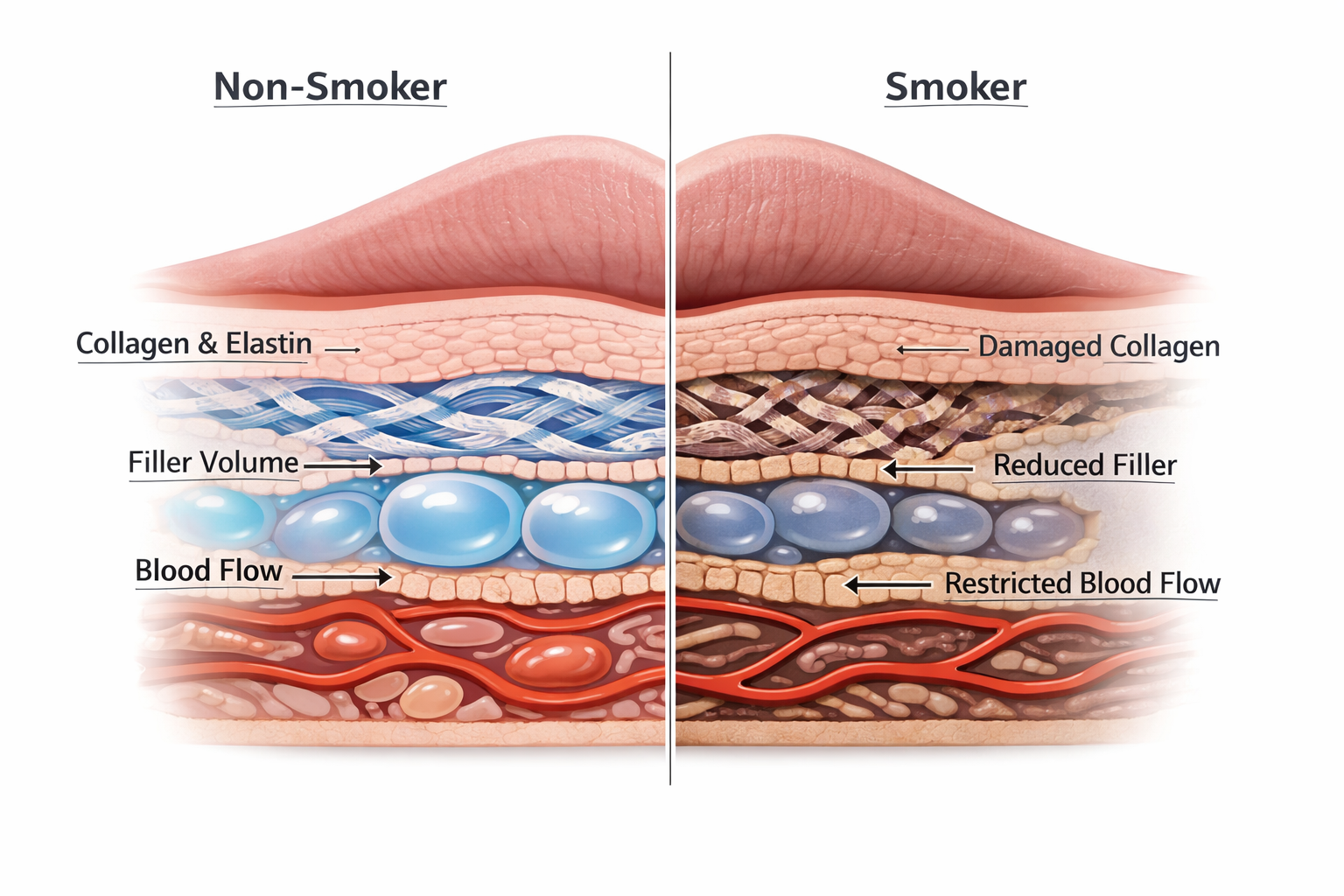
Nicotine is a potent vasoconstrictor, meaning it causes blood vessels to narrow. When nicotine restricts blood flow to the perioral area after lip filler treatment, the tissues around the injection sites receive less oxygen and fewer of the nutrients needed for efficient repair. Reduced circulation also means that the body’s natural immune response — which helps protect against infection — is less effective at the treatment site. This is not a minor or theoretical concern; impaired circulation is one of the primary reasons smokers generally experience slower wound healing than non-smokers across a wide range of medical and cosmetic procedures.
The Suction Motion and Filler Migration
Beyond the chemical effects of nicotine, the physical act of smoking itself poses a direct mechanical risk. Smoking requires pursing your lips and creating a sustained suction motion — the same action involved in using a straw or drinking from a bottle. In the first 24 to 72 hours after lip filler, the hyaluronic acid filler has not yet fully settled into its intended position. Repeated pursing and suction can physically displace the filler, contributing to filler migration — where the product moves away from the intended treatment area — or creating an uneven distribution that results in lumps, asymmetry, or an irregular lip border. Once filler has migrated, correction typically requires either additional treatment or dissolving the filler with hyaluronidase.
Infection Risk at the Injection Sites
Cigarettes and vaping devices introduce bacteria and chemical irritants directly into the mouth and onto the lips. In the immediate post-treatment period, the injection sites are small open wounds, and the skin barrier around them is temporarily compromised. Introducing bacteria to this area — whether from cigarette smoke, a vape mouthpiece, or contaminated fingers — raises the risk of infection. Signs of infection after lip filler include increasing redness, warmth, pain, or discharge at the injection sites, and any of these warrant prompt contact with your practitioner.
How Long Should You Wait Before Smoking After Lip Filler?
The most widely recommended minimum waiting period is 48 hours, and this figure appears consistently across clinical aftercare guidance. However, 48 hours represents a minimum threshold rather than a guarantee that all risk has passed. The healing process after lip filler typically continues for up to two weeks, with the filler gradually settling and integrating with the surrounding tissue over that period.
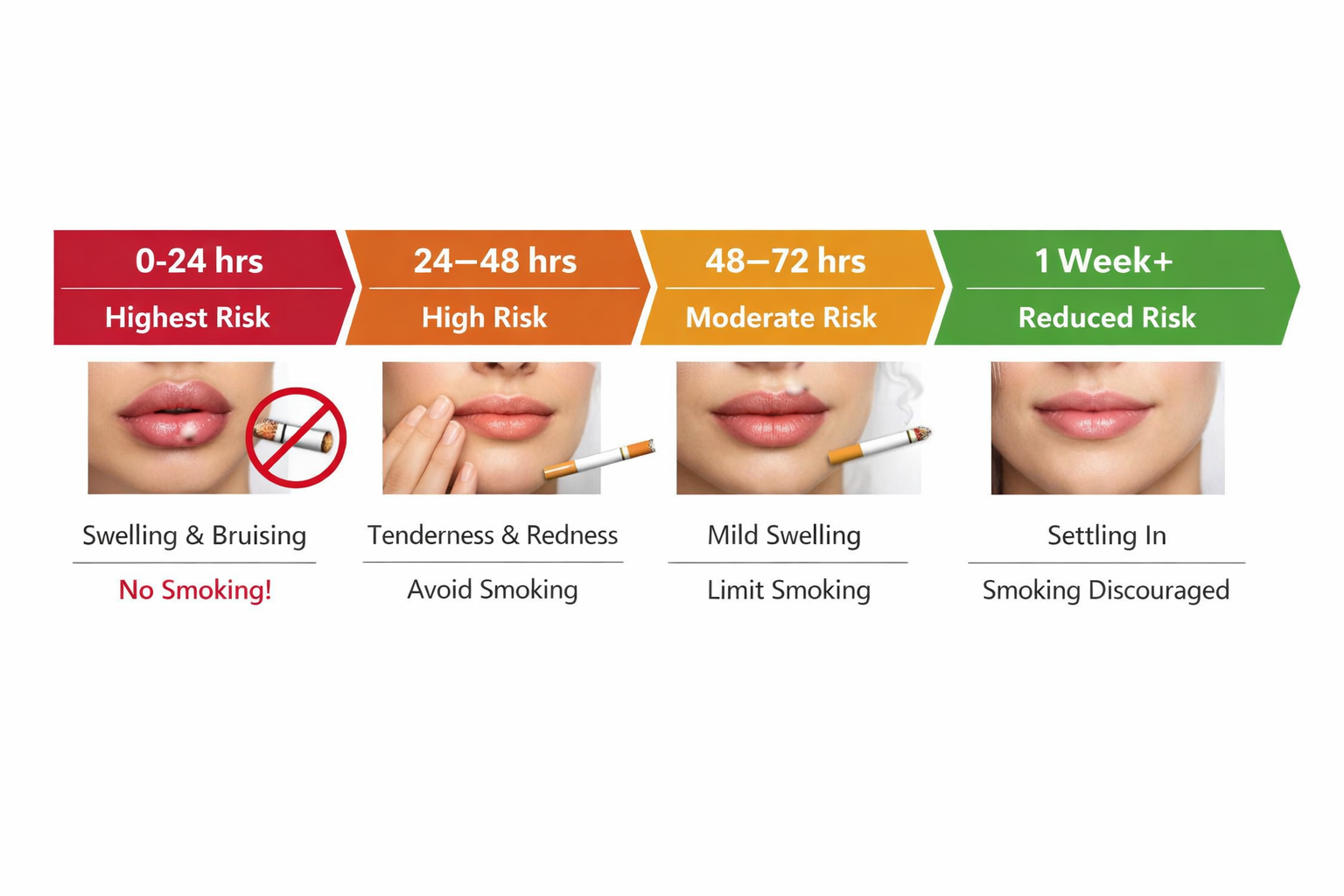
| Time After Treatment | What Is Happening | Smoking Risk Level |
|---|---|---|
| 0–24 hours | Peak swelling and bruising; injection sites are open; filler is highly mobile | Highest — avoid entirely |
| 24–48 hours | Initial swelling beginning to subside; filler starting to settle | High — avoid entirely |
| 48–72 hours | Filler continuing to integrate; injection sites closing | Moderate — still advisable to avoid |
| 3–7 days | Most swelling resolved; filler largely settled | Reduced but not eliminated |
| Beyond 1 week | Healing largely complete; filler in final position | Ongoing long-term risks remain |
If you can extend your abstinence beyond 48 hours, doing so is likely to benefit both your recovery and the quality of your results. Many practitioners recommend avoiding smoking for a full week where possible. Always follow the specific aftercare instructions provided by your own qualified injector, as individual advice may vary based on the product used, the volume injected, and your personal health history.
Can You Vape After Lip Filler?
Vaping after lip filler carries many of the same risks as smoking cigarettes, and it is not a safe alternative during the recovery period. The physical act of vaping involves the same pursing your lips and suction motion as cigarette smoking, which means the mechanical risk of filler migration and uneven results applies equally. If the vape device contains nicotine, the vasoconstrictive effects on blood flow are also present.
Even nicotine-free vape products are not without concern. Vape juice typically contains propylene glycol, vegetable glycerin, flavourings, and other chemicals that can act as irritants to the delicate tissue around fresh injection sites. The heat and vapour produced may also contribute to dehydration of the lips, which is counterproductive when the tissue needs adequate hydration to heal well. The same 48-hour minimum — and ideally longer — applies to vaping after lip filler as it does to cigarette smoking.
Can You Smoke Weed After Lip Filler?
Smoking cannabis after lip filler raises a distinct but overlapping set of concerns. The act of smoking weed involves the same pursing and suction motion as cigarette smoking, so the mechanical risk to filler placement remains. Cannabis smoke also contains irritants and combustion byproducts that can affect the injection sites in a similar way to tobacco smoke.
There is an additional consideration specific to cannabis: THC has mild blood-thinning properties, which may increase the likelihood of bruising or bleeding at the injection sites in the immediate post-treatment period. Cannabis use can also cause dry mouth and dehydration, both of which are unhelpful during a recovery period when lip hydration supports better healing.
For those who use cannabis medicinally or recreationally and wish to continue during their recovery, edibles are a practical alternative that avoids the suction motion, the smoke, and the direct irritation to the lips and injection sites. However, it is worth discussing this with your practitioner before treatment, as individual circumstances vary.
Long-Term Effects of Smoking on Lip Fillers
The risks of smoking after lip filler are not limited to the immediate recovery window. Regular smoking has well-documented long-term effects on skin health and on the behaviour of hyaluronic acid filler that are worth understanding before committing to treatment.
Accelerated Filler Breakdown
Hyaluronic acid filler is gradually broken down by the body’s own enzymes over time. The rate at which this happens is influenced by several factors, including metabolism, the specific product used, and lifestyle. Smoking is associated with increased oxidative stress and inflammation, both of which can accelerate the enzymatic breakdown of hyaluronic acid. In practical terms, this means that regular smokers may find their lip filler fades more quickly than it would in a non-smoker, requiring more frequent top-up treatments and, over time, a higher cumulative cost.
Damage to Collagen and Elastin
Smoking degrades collagen and elastin — the structural proteins that give skin its firmness, elasticity, and ability to hold volume. The perioral area is particularly vulnerable to this effect. Over time, smoking contributes to the formation of fine vertical lines around the mouth, commonly known as smoker’s lines. These are the very lines that lip filler and perioral treatments are often used to address. Continuing to smoke while receiving lip augmentation treatments creates a situation where the treatment is working against an ongoing cause of the problem it is trying to correct, reducing the overall effectiveness and longevity of results.
Dehydration and Lip Quality
Smoking reduces skin hydration and impairs the skin’s barrier function. Chronically dehydrated lips are less plump, less smooth, and less able to hold filler volume effectively. Maintaining good lip hydration — through adequate water intake and regular use of a nourishing lip balm — is a standard part of aftercare, and smoking works directly against this goal.
Practical Tips for Smokers After Lip Filler
Quitting smoking entirely is the most effective way to protect your results and support your recovery. However, for those who are not in a position to stop completely, the following harm-reduction steps may help minimise the impact during the critical healing period.
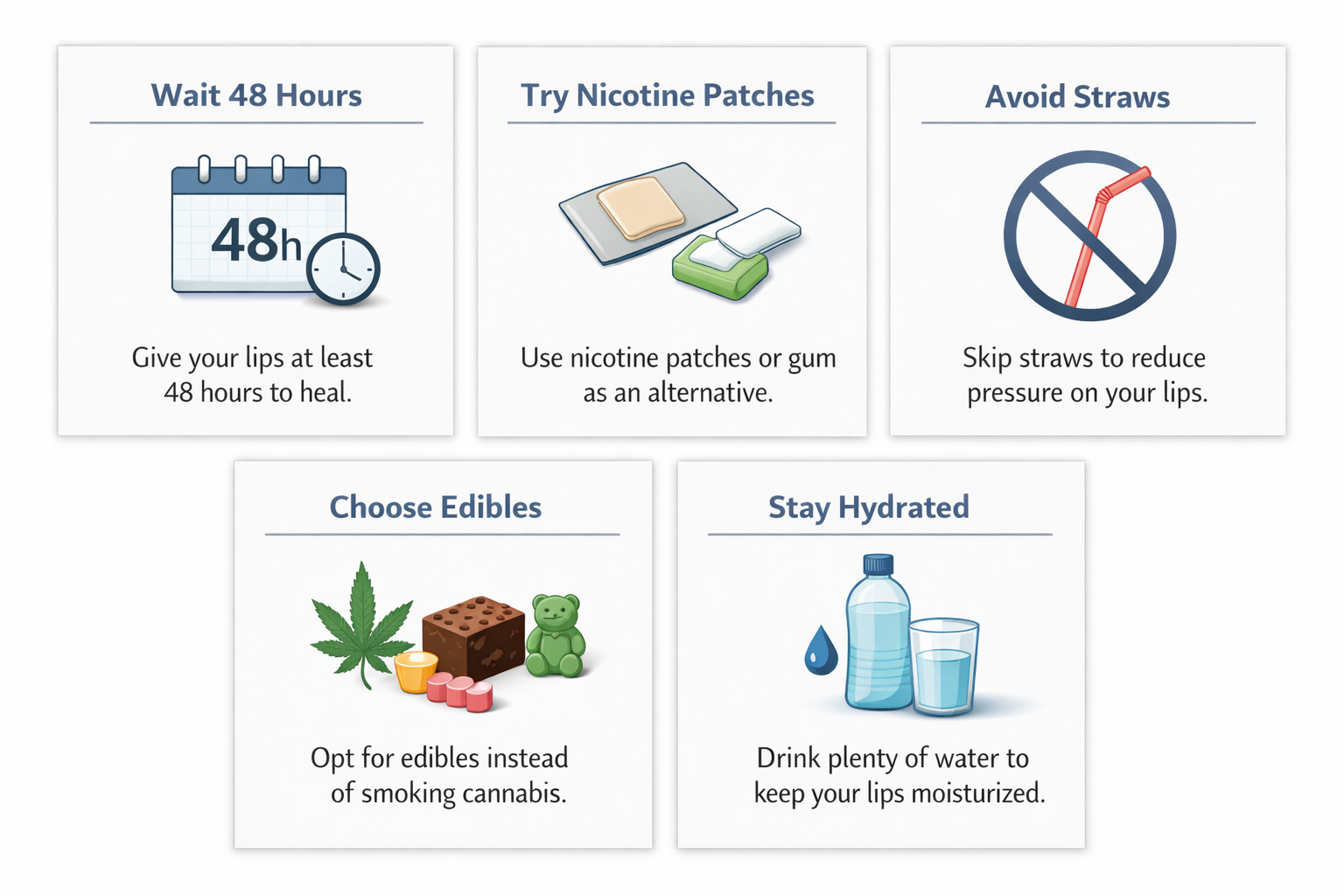
- Observe the 48-hour minimum strictly. Even if you cannot abstain for longer, protecting the first 48 hours gives the filler the best chance to settle without mechanical disruption.
- Consider nicotine patches or nicotine gum as a temporary substitute during the recovery period. These deliver nicotine without requiring the suction motion or introducing smoke and bacteria to the injection sites. Discuss this option with your GP or pharmacist if you are unsure.
- Avoid straws for the same reason. The suction motion from a straw carries the same mechanical risk as smoking during the first 48 to 72 hours, so both should be avoided together.
- If you do smoke, minimise the suction force and avoid pressing the cigarette or vape device firmly against the lips, which adds direct pressure to the injection sites.
- Choose edibles over smoking cannabis if you use cannabis and wish to continue during recovery.
- Stay well hydrated and use a gentle, fragrance-free lip balm to counteract the dehydrating effects of smoking on the lips.
- Avoid secondhand smoke exposure where possible. Passive smoke around the face and lips can introduce irritants to the injection sites even if you are not actively smoking.
- Stop smoking before your treatment if possible. Reducing or stopping smoking in the days before lip filler can improve baseline circulation and tissue health, giving the treatment a better starting point.
When to Contact Your Practitioner
Some degree of swelling and bruising after lip filler is entirely normal and expected, typically peaking within the first 24 to 48 hours and resolving over the following days. However, certain signs may indicate a complication that requires prompt attention, particularly if you have smoked during the recovery period.
Contact your practitioner promptly if you notice any of the following after lip filler treatment:
- Increasing redness, warmth, or pain at or around the injection sites rather than gradual improvement
- Discharge, crusting, or open sores at the injection sites
- Visible lumps, asymmetry, or an uneven lip border that does not improve after the first week
- Blanching (white or pale patches) of the skin around the lips, which may indicate vascular compromise
- Fever or feeling generally unwell in the days following treatment
Do not attempt to massage or manipulate the filler yourself without specific guidance from your practitioner, as this can worsen displacement rather than correct it.
Broader Lip Filler Aftercare: Other Things to Avoid
Smoking is one of several lifestyle factors that can affect the outcome of lip filler treatment. A complete aftercare approach also involves avoiding the following during the initial recovery period:
- Alcohol — increases the risk of bruising and swelling and can thin the blood
- Strenuous exercise — raises heart rate and blood pressure, which can worsen swelling and bruising
- Heat exposure — saunas, steam rooms, very hot showers, and sunbathing can increase swelling and may affect filler stability
- Touching or pressing the lips — including kissing, applying pressure, or sleeping face-down
- Makeup on the lips — lipstick and lip liner should be avoided for at least 24 hours to reduce infection risk at the injection sites
- Straws — the suction motion carries the same filler displacement risk as smoking
- Flying — cabin pressure changes and dehydration associated with air travel may worsen swelling; many practitioners recommend waiting 24 to 48 hours before flying
Following your practitioner’s full aftercare instructions — not just the advice about smoking — gives your lip filler the best possible chance of settling evenly and lasting well.
Frequently Asked Questions
Can I smoke just one cigarette after lip filler?
Even a single cigarette involves the suction motion that can stress the injection sites and the vasoconstrictive effects of nicotine. During the first 48 hours in particular, when the filler is most mobile and the injection sites are most vulnerable, any smoking carries risk. If you must smoke, waiting until after the 48-hour mark and minimising suction force is preferable to smoking immediately after treatment, but abstaining entirely during the recovery period remains the recommended approach.
Does vaping count the same as smoking for lip filler aftercare?
Yes. Vaping after lip filler carries the same mechanical risk from the pursing and suction motion, and many vape products contain nicotine, which restricts blood flow. Even nicotine-free vapes introduce chemicals and heat to the lips. The same waiting period applies to vaping as to cigarette smoking.
Will smoking ruin my lip filler completely?
Smoking shortly after lip filler does not automatically ruin the results, but it does increase the risk of complications including filler migration, uneven results, slower healing, and infection. Long-term smoking reduces filler longevity and worsens the perioral area over time. The extent of any impact depends on how soon after treatment you smoke, how much you smoke, and individual factors.
Can I use nicotine patches instead of smoking after lip filler?
Nicotine patches or nicotine gum are a more suitable alternative during the recovery period because they deliver nicotine without requiring the suction motion or introducing smoke and bacteria to the lips. They do not eliminate the vasoconstrictive effects of nicotine entirely, but they remove the mechanical and bacterial risks associated with smoking. Speak to your GP or pharmacist before using nicotine replacement products if you have any health concerns.
Should I stop smoking before getting lip filler?
Stopping or reducing smoking before lip filler treatment is beneficial. Better baseline circulation and healthier tissue at the time of treatment can support a smoother healing process and may improve how well the filler integrates. Even a few days of reduced smoking before the procedure may be helpful, though the most important period remains the 48 to 72 hours immediately after treatment.
How does smoking affect how long lip filler lasts?
Regular smoking is associated with faster breakdown of hyaluronic acid filler due to increased oxidative stress and inflammation. It also degrades collagen and elastin in the perioral area, reducing the skin’s ability to support and maintain filler volume. Smokers may find they need more frequent top-up treatments to maintain their results compared with non-smokers, which has both practical and financial implications over time.
Protecting Your Lip Filler Results: What Smokers Need to Know
The evidence behind the advice to avoid smoking after lip filler is grounded in well-understood physiology rather than excessive caution. Nicotine restricts blood flow, the suction motion risks filler migration, and smoke introduces bacteria to vulnerable injection sites — each of these factors is relevant in the immediate recovery period, and the long-term effects of smoking on collagen, elastin, and filler longevity add further reason to take the guidance seriously.
For most people, observing a strict 48-hour minimum and ideally extending that to a full week will meaningfully reduce the risk of complications and give the hyaluronic acid filler the best chance to settle evenly. For those who smoke cannabis, choosing edibles during the recovery period is a practical alternative. For those who cannot abstain from nicotine, patches or gum remove the most immediate mechanical and bacterial risks while still delivering nicotine.
If you are a smoker considering lip augmentation, it is worth discussing your smoking habits openly with your practitioner before treatment. A qualified injector can tailor their aftercare instructions to your situation, advise on the most appropriate product and technique, and help you set realistic expectations for how long your results are likely to last. Transparent communication before and after treatment is always the most effective foundation for a safe outcome.