

Buying syringes at a pharmacy in the UK is possible in many circumstances, but the rules depend on why you need them, what type you require, and which pharmacy you visit. Whether you are a patient managing a medical condition at home, a carer administering medication, or someone seeking harm reduction support, understanding the legal framework and pharmacy policies can help you access what you need safely and lawfully.
Key Takeaways
- Syringes and hypodermic needles are not classified as prescription-only items in England, Scotland, Wales, or Northern Ireland, meaning pharmacies can legally sell them without a prescription in most situations.
- Individual pharmacy policies vary considerably — some will sell syringes over the counter freely, while others apply their own restrictions or require a brief conversation with the pharmacist.
- NHS needle and syringe programmes (NSPs) provide free sterile injecting equipment to people who inject drugs, with the aim of reducing blood-borne virus transmission.
- Carrying syringes without a legitimate medical reason is not automatically illegal, but context matters, and police may ask questions if syringes are found alongside controlled substances.
- Safe disposal of used sharps is a public health responsibility — most pharmacies and local councils offer sharps bin collection or exchange services.
Are Syringes Available Over the Counter in the UK?
In the United Kingdom, hypodermic needles and syringes are not classified as prescription-only medicines or controlled drugs under the Medicines Act 1968 or the Misuse of Drugs Act 1971. This means that, from a legal standpoint, a pharmacy is permitted to sell them without requiring a prescription. However, the law does not compel any pharmacy to sell syringes to every person who asks. Individual pharmacies retain the right to apply their own professional judgement and internal policies.
In practice, most high-street pharmacies — including large chains such as Boots, Lloyds Pharmacy, and Well Pharmacy — stock insulin syringes and pen needles as a matter of routine, primarily to support patients with diabetes who self-inject insulin at home. These are generally available to purchase directly, though a pharmacist may ask a brief question about intended use. Smaller independent pharmacies may have more variable stock and policies.
Syringes intended for other purposes, such as oral medication administration, wound irrigation, or veterinary use, are also widely available without restriction. The situation becomes more nuanced when the intended use is unclear or when the request involves larger quantities, which may prompt a pharmacist to ask further questions before completing the sale.
Who Typically Needs to Buy Syringes at a Pharmacy?
The most common reason patients purchase syringes from a UK pharmacy is to self-administer prescribed injectable medications at home. People living with type 1 or type 2 diabetes who use insulin therapy represent the largest group. Other patients who may need to purchase injecting equipment include those self-administering medications such as methotrexate for rheumatoid arthritis or psoriasis, biological therapies for inflammatory conditions, fertility hormones during IVF treatment, anticoagulants such as low-molecular-weight heparin after surgery, or growth hormone therapy.
In these situations, the prescribing clinician or specialist nurse will usually advise the patient on the correct needle gauge, syringe size, and injection technique. The prescription itself covers the medication, but the injecting equipment may need to be sourced separately. Some NHS prescriptions do include needles and syringes as prescribed items, in which case they can be dispensed at no cost to eligible patients. If injecting equipment is not included on the prescription, patients can purchase it over the counter.
Carers who administer injectable medications on behalf of a family member or patient in a home care setting may also need to purchase syringes. In these cases, the same rules apply — no prescription is required for the equipment itself, though the medication being administered will require its own valid prescription.
Needle and Syringe Programmes in the UK
NHS needle and syringe programmes, commonly referred to as NSPs or needle exchanges, are a well-established public health intervention in the UK. These services provide free sterile injecting equipment — including syringes, needles, swabs, and in many cases sharps disposal bins — to people who inject drugs. The primary aim is to reduce the transmission of blood-borne viruses such as HIV and hepatitis C, which can spread rapidly through the sharing of contaminated injecting equipment.
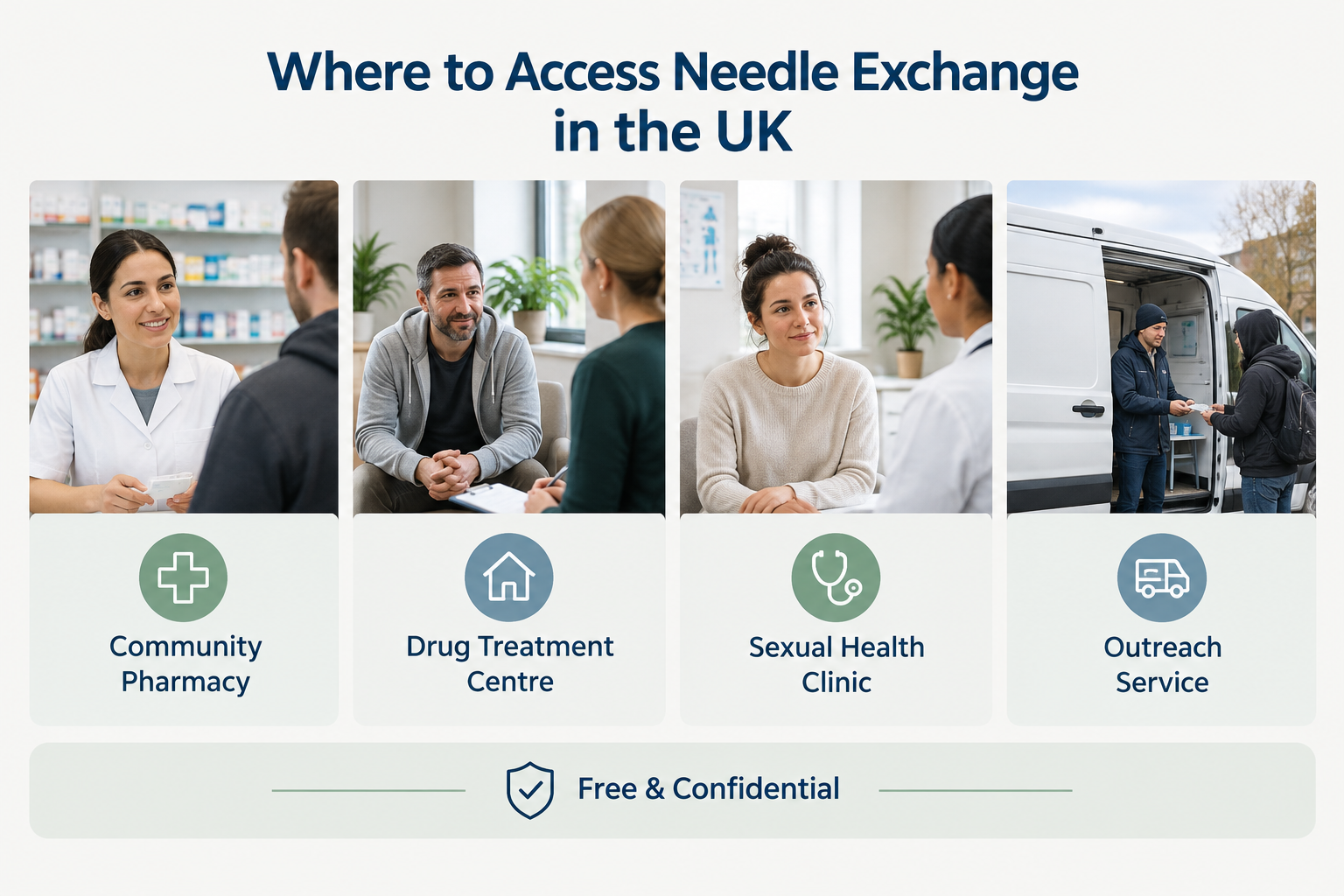
NSPs operate from a range of locations, including community pharmacies, drug treatment services, sexual health clinics, and outreach vans. Many pharmacies across England, Scotland, Wales, and Northern Ireland are commissioned by their local NHS authority to run needle exchange services as part of their community pharmacy contract. To find a local needle exchange, individuals can contact their GP, local drug and alcohol service, or search through NHS service directories. The service is confidential and does not require the person to be registered with a GP or to disclose their identity.
The evidence base for needle and syringe programmes is well established. Public Health England, Public Health Scotland, and equivalent bodies in Wales and Northern Ireland consistently support NSPs as a cost-effective harm reduction measure. Research consistently shows that these programmes reduce new HIV and hepatitis C infections without increasing drug use in the community. Accessing a needle exchange is not an admission of criminal activity — possession of syringes alone is not a criminal offence in the UK.
Legal Position: Is It Illegal to Carry Syringes in the UK?
Possessing a syringe or hypodermic needle is not, by itself, a criminal offence under UK law. The Misuse of Drugs Act 1971 does not list syringes as controlled items. However, the legal picture changes significantly if syringes are found in conjunction with controlled drugs. A syringe containing traces of a controlled substance, or found alongside drugs paraphernalia, may be treated as evidence of drug possession or supply, which carries serious criminal penalties.
Under the Drug Paraphernalia provisions that apply in some jurisdictions, and under general police powers, officers may question individuals found carrying syringes in circumstances that suggest drug misuse. Carrying syringes for a legitimate medical reason — such as insulin administration — is entirely lawful, and it is sensible to carry a letter from your GP or a copy of your prescription if you travel frequently or are concerned about being questioned.
It is worth noting that the law in Scotland differs slightly from England and Wales in some respects regarding drug-related offences, and Northern Ireland has its own legislative framework. If you have specific legal concerns, seeking advice from a solicitor or a harm reduction organisation is advisable rather than relying on general guidance.
Buying Syringes for Aesthetic or Cosmetic Purposes
A question that arises increasingly in the context of aesthetic medicine is whether members of the public can purchase syringes and needles for the purpose of self-administering cosmetic injectables such as dermal fillers or botulinum toxin. This is a critically important area where the legal, safety, and ethical considerations are very different from medical self-injection.
While syringes themselves are not prescription-only items, the substances used in aesthetic injectable treatments are a separate matter entirely. Botulinum toxin products — including those used for cosmetic purposes — are prescription-only medicines (POMs) in the UK. Since July 2022, following changes introduced under the Health and Care Act 2022, it has been a legal requirement in England that botulinum toxin for cosmetic use is prescribed by a registered healthcare professional and administered by, or under the supervision of, a prescriber. Similar protections are being developed or applied across the devolved nations.

Hyaluronic acid dermal fillers are not currently classified as prescription-only medicines in the UK, which has historically created a regulatory gap. However, the same 2022 legislation introduced a licensing requirement for practitioners performing certain cosmetic procedures, including the administration of dermal fillers, in England. Administering injectable fillers without the appropriate licence is now a criminal offence. Purchasing syringes to self-administer dermal fillers at home therefore carries serious legal risk, in addition to the very significant clinical risks involved.
Self-injection of aesthetic products outside a clinical setting — without proper training, sterile technique, knowledge of facial anatomy, and access to emergency management — carries risks of severe and potentially permanent harm. These include vascular occlusion, where filler material blocks a blood vessel, which can lead to tissue death, blindness, or stroke. These are not theoretical risks; they are documented complications that occur even in experienced clinical hands. No reputable aesthetic practitioner or medical organisation supports the self-administration of injectable cosmetic treatments.
What Types of Syringes Are Available at UK Pharmacies?
UK pharmacies typically stock a range of syringe types suited to different medical needs. The most commonly available include insulin syringes, which are designed for subcutaneous injection and come in various capacities, typically 0.3 ml, 0.5 ml, and 1 ml, with fixed or detachable needles. Insulin pen needles, used with pre-filled insulin pens, are also widely stocked in multiple lengths and gauges to suit different body types and injection sites.
Oral syringes, which have no needle and are used to measure and administer liquid medications by mouth, are available without restriction and are commonly used for children’s medicines. Larger syringes for wound irrigation or enteral feeding may be available in some pharmacies or can be ordered. Veterinary syringes are also sold in some pharmacies and agricultural suppliers, though these are not intended for human use.
The gauge and length of needle appropriate for a given medical purpose varies considerably. A healthcare professional — whether a GP, practice nurse, diabetes specialist nurse, or pharmacist — can advise on the correct specification for a patient’s individual needs. Using an incorrect needle gauge or length can affect medication absorption and increase the risk of injection site complications.
Do You Need a Prescription to Buy Syringes in the UK?
No prescription is required to purchase syringes or needles at a UK pharmacy. As noted above, these items are not classified as prescription-only medicines. However, if the medication you intend to inject is a prescription-only medicine — which includes insulin, most biological therapies, fertility hormones, and anticoagulants — then a valid prescription is required for the medication itself, even if the injecting equipment can be purchased separately.
Some NHS prescriptions include injecting equipment as a prescribed item. In England, patients who are exempt from prescription charges — including those with diabetes — can receive needles and syringes on prescription at no cost. If you are unsure whether your injecting equipment should be included on your prescription, your GP, practice nurse, or pharmacist can advise you.
For patients who purchase syringes privately, the cost is generally modest. Insulin syringes and pen needles are among the most affordable items in a pharmacy, typically costing a few pence to a few pounds depending on quantity and specification. Some pharmacies offer bulk packs at reduced cost per unit for patients who use them regularly.
Safe Disposal of Used Syringes and Sharps
Used syringes and needles — collectively referred to as sharps — must never be placed in household recycling or general waste bins. Discarded sharps pose a serious risk of needlestick injury to waste handlers, members of the public, and children. In the UK, there are several safe disposal routes available.
NHS patients who self-inject at home are entitled to receive a sharps disposal bin on prescription or through their local council. Once full, the bin can be collected by the local authority’s clinical waste service, or returned to a pharmacy or GP surgery that participates in a sharps collection scheme. Many pharmacies that run needle exchange services will also accept used sharps bins from the public.
Local councils in England, Scotland, Wales, and Northern Ireland are required to provide a clinical waste collection service for household sharps. Contact details for local sharps disposal services can be found through the NHS website, your GP surgery, or your local council’s waste management department. Disposing of sharps safely is both a legal responsibility and a matter of public health consideration.
Frequently Asked Questions
Can I buy insulin syringes at a pharmacy without a prescription?
Yes. Insulin syringes are available over the counter at most UK pharmacies without a prescription. The insulin medication itself requires a valid prescription, but the syringes and pen needles used to administer it can be purchased directly. If your injecting equipment is included on your NHS prescription, it may be dispensed free of charge if you are exempt from prescription charges.
Will a pharmacist refuse to sell me syringes?
A pharmacist has the professional discretion to decline a sale if they have concerns about the intended use or if the request seems unusual. In practice, most pharmacies will sell syringes for clearly medical purposes without difficulty. If you are asked about the reason for your purchase, a brief explanation is usually sufficient. If one pharmacy declines, you are free to try another.
Can I get free syringes through a needle exchange?
Yes. NHS needle and syringe programmes provide free sterile injecting equipment to people who inject drugs. These services operate from many community pharmacies, drug treatment centres, and outreach services across the UK. The service is confidential and does not require a GP referral or proof of identity.
Is it legal to buy syringes to inject cosmetic fillers at home?
Purchasing syringes is not illegal, but self-administering dermal fillers or other cosmetic injectables at home carries serious legal and clinical risks. In England, administering certain cosmetic injectables without a licence is now a criminal offence. Beyond the legal position, self-injection of aesthetic products without clinical training and proper anatomy knowledge carries a risk of severe, potentially permanent complications including vascular injury. This practice is not supported by any reputable medical or aesthetic professional body.
How do I dispose of used syringes safely?
Used syringes should be placed immediately into an approved sharps disposal bin — never into household bins or recycling. NHS patients can obtain sharps bins on prescription or through their local council. Full bins can be collected by the local authority’s clinical waste service or returned to participating pharmacies. Many needle exchange pharmacies also accept used sharps from the public.
Can I travel with syringes in the UK?
Carrying syringes for a legitimate medical purpose — such as insulin administration — is lawful in the UK. If you are concerned about being questioned, carrying a letter from your GP or a copy of your prescription is a sensible precaution, particularly when travelling by air or crossing borders. Airlines and transport operators may have their own policies regarding sharps in hand luggage, so it is worth checking in advance.
Are needles and syringes available on the NHS?
Injecting equipment can be prescribed on the NHS for patients who self-administer prescribed injectable medications at home. Whether this is included on your prescription depends on your clinical situation and the prescribing clinician’s decision. Patients exempt from prescription charges — including those with diabetes — can receive needles and syringes at no cost when prescribed. Needle exchange services also provide free equipment to people who inject drugs, funded through NHS public health commissioning.
Understanding Your Options Before Purchasing Syringes in the UK
For the majority of people asking whether they can buy syringes at a pharmacy in the UK, the answer is yes — pharmacies can legally sell syringes without a prescription, and most will do so for clearly medical purposes without difficulty. The key considerations are the intended use, the type of equipment needed, and whether the medication being administered requires its own prescription.
Patients managing long-term conditions such as diabetes, inflammatory disease, or fertility treatment should speak with their GP, specialist nurse, or pharmacist to confirm the correct equipment specification and to explore whether injecting supplies can be included on their NHS prescription. This can reduce cost and ensure the right product is used safely.
For people who inject drugs, NHS needle and syringe programmes offer a confidential, non-judgmental route to free sterile equipment and can also connect individuals with wider support services if they choose to access them. Harm reduction services exist to protect health, not to penalise people.
Anyone considering purchasing syringes for cosmetic self-injection should be clearly aware that this approach carries serious legal and clinical risks in the current UK regulatory environment. Aesthetic injectable treatments — whether botulinum toxin or dermal fillers — should only be administered by appropriately trained and licensed practitioners in a clinical setting, where proper assessment, sterile technique, and emergency management are available. If you are interested in cosmetic injectable treatments, the appropriate first step is a consultation with a qualified aesthetic practitioner or prescriber, not a visit to a pharmacy for supplies.