

Key Takeaways
- Jowls develop due to a combination of bone resorption, facial fat pad descent, ligament laxity, and collagen and elastin loss — no single factor is responsible.
- Non-surgical treatments including dermal fillers, Morpheus8, HIFU, and thread lifts can meaningfully improve mild to moderate jowling, but cannot remove excess hanging skin.
- For significant or established jowls, lower facelift surgery remains the most reliable long-term option.
- A combination treatment approach — addressing skin laxity, lost volume, and collagen stimulation together — typically produces better results than any single treatment alone.
- Choosing a GMC, NMC, GDC, or HCPC-registered practitioner at a CQC-registered clinic is essential for safe treatment in the UK.
What Are Jowls and Why Do They Form?
Jowls refer to the soft tissue that sags below the jawline on either side of the chin, creating a loss of the clean jaw definition most people associate with a youthful lower face. They are not simply a skin problem — jowls develop because of changes happening at every layer of the face simultaneously, which is why superficial skincare alone rarely makes a meaningful difference.
At the deepest level, bone resorption gradually reduces the bony scaffold of the jaw and cheekbones. With less underlying support, the soft tissues above have less to anchor to. The SMAS layer — a fibromuscular sheet that connects facial muscles to the overlying skin — loses its tone over time, and the facial ligaments that hold tissue in position become lax. Meanwhile, facial fat pads in the mid-face descend under gravity, and the skin itself loses collagen and elastin, reducing its ability to spring back. The result is a gradual pooling of tissue at the lower face and jawline.
Genetics play a significant role in when and how severely jowls develop. Sun damage accelerates collagen breakdown, smoking impairs circulation and skin repair, and significant weight fluctuation can stretch the skin beyond its ability to recover. The platysma muscle in the neck can also contribute to the appearance of jowling as it loses tone with age. Understanding these layered causes matters because effective treatment needs to address the right layer — or layers — for each individual patient.
Matching Treatment to Severity: Mild, Moderate, and Significant Jowling
One of the most important decisions in treating jowls is matching the intervention to the degree of tissue change. Non-surgical options are genuinely effective when used at the right stage; they are frequently oversold when jowling is already well established.
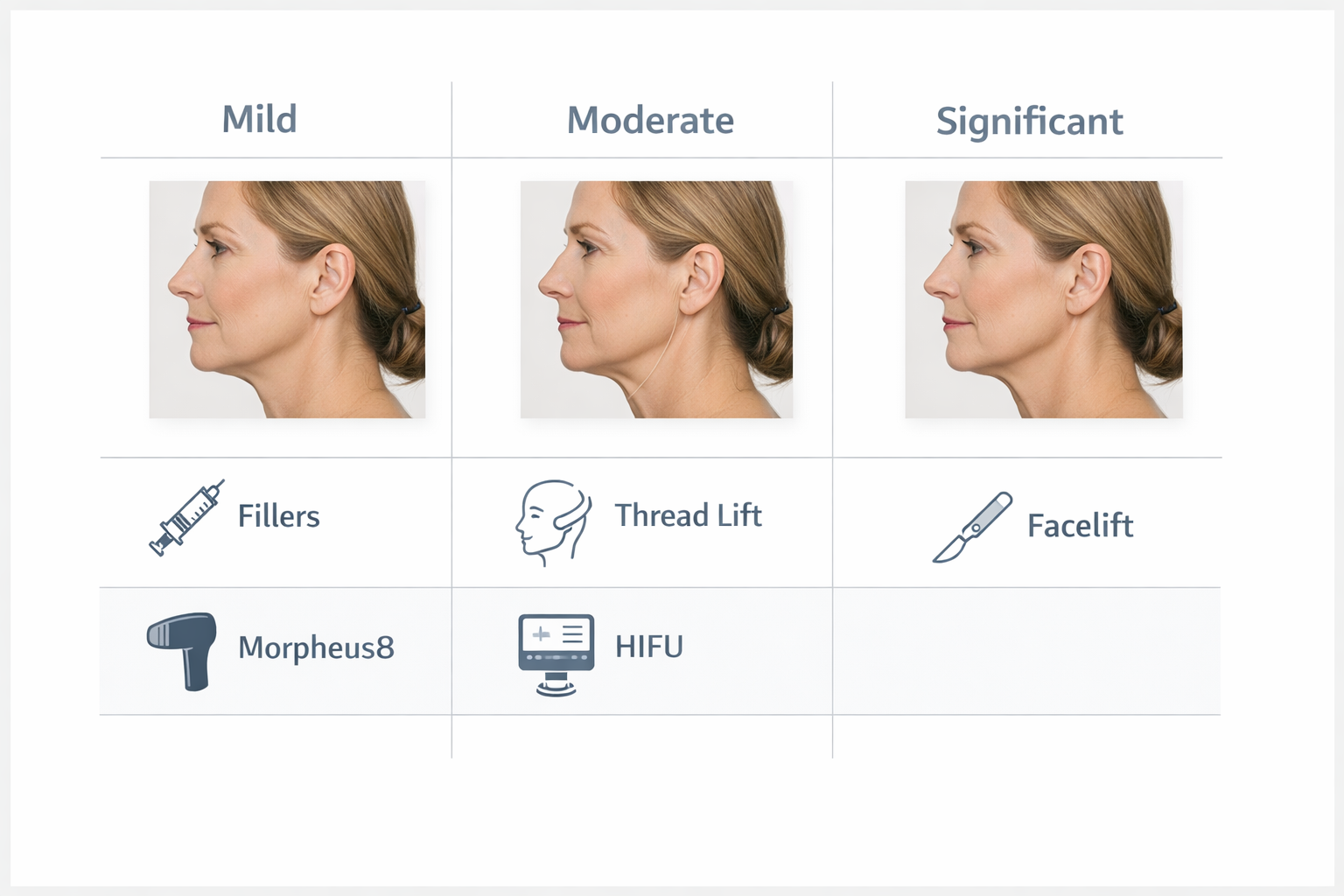
| Severity | Typical Appearance | Recommended Approach | Likely Age Range |
|---|---|---|---|
| Mild | Early softening of the jawline; slight heaviness below the jaw | Dermal fillers, Profhilo, RF microneedling, HIFU, skin boosters | 30s–40s |
| Moderate | Visible jowl formation; marionette lines developing; some skin laxity | Morpheus8, thread lift, FaceTite, combination treatment, HIFU | 40s–50s |
| Significant | Pronounced drooping; excess skin; deep marionette lines; poor jawline definition | Lower facelift / jowl lift surgery, neck lift; non-surgical as adjunct only | 50s–70s+ |
This framework is a guide, not a rule. Tissue quality, skin thickness, bone structure, and individual anatomy all influence which treatments are appropriate. A thorough face-to-face consultation with a qualified practitioner is the only reliable way to assess suitability.
Non-Surgical Treatments for Jowls
Non-surgical jowl treatment has advanced considerably over the past decade. Several technologies now offer genuine tissue tightening and structural support without the recovery associated with surgery. The key is understanding what each treatment can and cannot achieve.
Dermal Fillers for Jowls
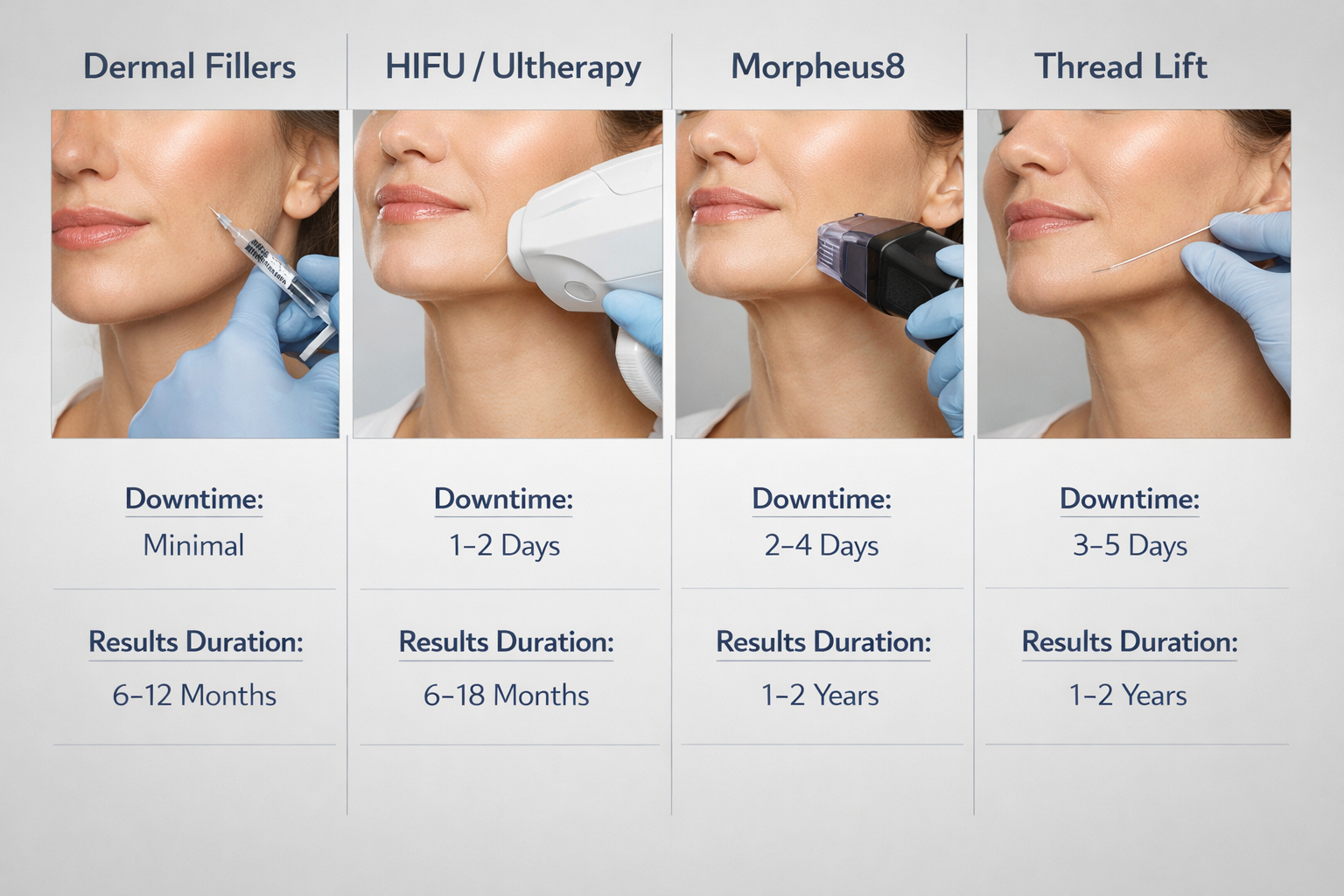
Dermal fillers — most commonly hyaluronic acid-based products — can improve the appearance of jowls by restoring lost volume to the cheeks and mid-face, which lifts and supports the tissues above the jowl. Filler placed strategically along the jawline can also redefine the lower border of the face, creating the visual impression of a sharper jaw. This approach is sometimes called a liquid facelift or volumetric facelift.
Jowl filler works best when volume loss is a significant contributor to the problem. It does not tighten loose skin or address tissue laxity directly. Results typically last 12 to 18 months depending on the product used and individual metabolism. Risks include bruising, swelling, asymmetry, and — in rare but serious cases — vascular occlusion, which requires immediate management by a trained clinician. Dermal fillers for jowls should only be administered by a practitioner with appropriate qualifications and access to hyaluronidase for emergency reversal.
Profhilo and Polynucleotides
Profhilo is a high-concentration hyaluronic acid injectable that spreads through the tissue rather than adding structural volume. It stimulates collagen and elastin production and improves overall skin quality and hydration. Polynucleotides — another class of biostimulator — work by promoting cellular repair and collagen remodelling. Neither treatment lifts jowls directly, but both can improve skin laxity and texture, making them useful as part of a combination treatment plan, particularly for patients in their 30s and 40s with early skin quality changes.
HIFU and Ultherapy
High-Intensity Focused Ultrasound (HIFU), with Ultherapy being the most clinically studied device in this category, delivers focused ultrasound energy to the SMAS layer and deeper dermis. This controlled thermal injury stimulates collagen remodelling over the following three to six months. HIFU is one of the few non-surgical technologies that targets the same anatomical layer addressed during a facelift, which is why it is often described as a non-surgical jowl lift.
Results are gradual and typically most visible three to six months after treatment. HIFU is best suited to patients with mild to moderate skin laxity and reasonable tissue quality. It is less effective when jowling is significant or when there is substantial excess skin. A single session is often sufficient, with maintenance treatments recommended every 12 to 18 months. Discomfort during treatment can be notable, and temporary redness or swelling is common. Rare risks include nerve irritation and uneven results.
Radiofrequency: Thermage and Morpheus8
Radiofrequency (RF) energy heats the deeper layers of the skin to stimulate collagen production and cause immediate tissue contraction. Thermage delivers monopolar RF to the skin surface and deeper dermis and has a long clinical track record for skin tightening on the lower face. Morpheus8 combines RF with microneedling, delivering energy directly into the dermis and subdermal tissue through fine needles. This RF microneedling approach allows more precise depth control and can address both skin quality and tissue tightening simultaneously.
Morpheus8 is one of the most widely used treatments for moderate jowling in UK private clinics. A course of three sessions is typically recommended, spaced four to six weeks apart. Results develop over three to six months as new collagen forms. Downtime is usually three to five days of redness and mild swelling. UK pricing for Morpheus8 typically ranges from approximately £500 to £1,500 per session, with a course of three sessions commonly priced between £1,400 and £2,400.
Thread Lifts: PDO and Silhouette Soft
Thread lifts use dissolvable sutures inserted under the skin to physically lift sagging tissue and stimulate collagen production as the threads dissolve. PDO (polydioxanone) thread lifts and Silhouette Soft threads are the most commonly used options in the UK for jowl treatment. Cog threads — which have small barbs along their length — provide the most mechanical lift, while smooth threads primarily stimulate collagen.
Thread lifts offer more immediate visible lifting than energy-based devices and are sometimes described as a lunchtime lift due to their relatively quick procedure time. However, results are typically less dramatic than surgical lifting and last 12 to 24 months. Risks include thread migration, puckering, infection, and asymmetry. Thread lifts are best suited to patients with mild to moderate jowling who want a visible improvement without surgical downtime. UK pricing ranges from approximately £850 for a PDO cog jowl lift to around £1,950 for non-PDO thread options, with some CQC-regulated providers pricing courses from £599 to over £2,000 depending on the number of threads used.
FaceTite, Endolift, and Fotona4D
FaceTite is a minimally invasive radiofrequency-assisted procedure that delivers RF energy from a small probe inserted just beneath the skin, combined with an external electrode on the skin surface. This bipolar RF approach causes significant tissue contraction and fat reduction with more dramatic results than surface-based RF devices. FaceTite requires local anaesthetic and involves a few days of downtime, but avoids the recovery associated with a full facelift. It is a useful option for patients with moderate jowling who want more than non-invasive treatments can offer but are not ready for surgery.
Endolift is a laser-based minimally invasive treatment that uses a fine optical fibre inserted under the skin to deliver laser energy, stimulating collagen and causing tissue retraction. Fotona4D is a non-invasive laser protocol that combines intraoral and external laser passes to tighten the skin and underlying tissue from multiple depths. Both treatments are available at specialist UK clinics and may suit patients seeking alternatives to RF-based approaches, though the evidence base for these newer technologies continues to develop.
Surgical Options: When Non-Surgical Treatment Is Not Enough
Non-surgical treatments cannot remove excess hanging skin. For patients with significant, established jowls — where the skin has lost its elasticity and the tissue has descended substantially — surgery remains the most reliable option for meaningful, long-lasting improvement.
Lower Facelift and Jowl Lift Surgery
A lower facelift, sometimes called a jowl lift surgery, directly addresses the SMAS layer and removes or repositions excess skin and tissue in the lower face and jawline. Unlike older facelift techniques that simply pulled the skin tight, modern SMAS facelift and deep plane facelift techniques reposition the deeper facial structures, producing more natural-looking results with greater longevity.
A mini facelift uses shorter incisions and is suitable for patients with earlier-stage jowling who want surgical correction without the full recovery of a traditional facelift. Recovery from a lower facelift typically involves one to two weeks of visible bruising and swelling, with most patients returning to normal activities within two to three weeks. Results can last five to ten years or longer, depending on the technique used and how the individual ages subsequently.
In the UK, a lower facelift or jowl lift surgery typically starts from around £11,500. Combining a lower face and neck lift — which is commonly performed together — typically costs between £8,000 and £16,000 at UK private clinics in 2026, depending on the surgeon, location, and complexity of the procedure. A neck lift may be recommended alongside jowl surgery when there is significant laxity in the neck as well as the lower face.
Fat Grafting and Chin Liposuction
Fat grafting — transferring the patient’s own fat from another area of the body to the face — can restore lost volume to the mid-face and cheeks as part of a surgical plan, complementing the lifting effect of a facelift. Chin liposuction or submental liposuction may be recommended when excess submental fat contributes to the appearance of jowling or a poorly defined jawline. These procedures are often performed in combination with a lower facelift rather than as standalone treatments for jowls.
Combination Treatment: Why One Approach Rarely Does Everything
Jowls develop across multiple tissue layers, and the most effective treatment plans typically address more than one contributing factor. A combination treatment approach might involve using Morpheus8 to tighten the skin and stimulate collagen, dermal fillers to restore mid-face volume and support the overlying tissue, and Profhilo or polynucleotides to improve overall skin quality. For patients who have had surgical correction, non-surgical maintenance treatments can help prolong results and address ongoing skin quality changes.
The specific combination that works best depends on the individual’s anatomy, the degree of jowling, their skin quality, and their goals. A treatment plan tailored to you — developed after a thorough clinical assessment — is far more likely to produce natural-looking results than a one-size-fits-all approach. Be cautious of clinics that recommend the same treatment to every patient without a detailed consultation.
Choosing a Safe Practitioner in the UK
The UK cosmetic industry remains incompletely regulated, and the quality of practitioners varies significantly. For any treatment involving injections or energy-based devices on the lower face and jawline, choosing the right provider is as important as choosing the right treatment.
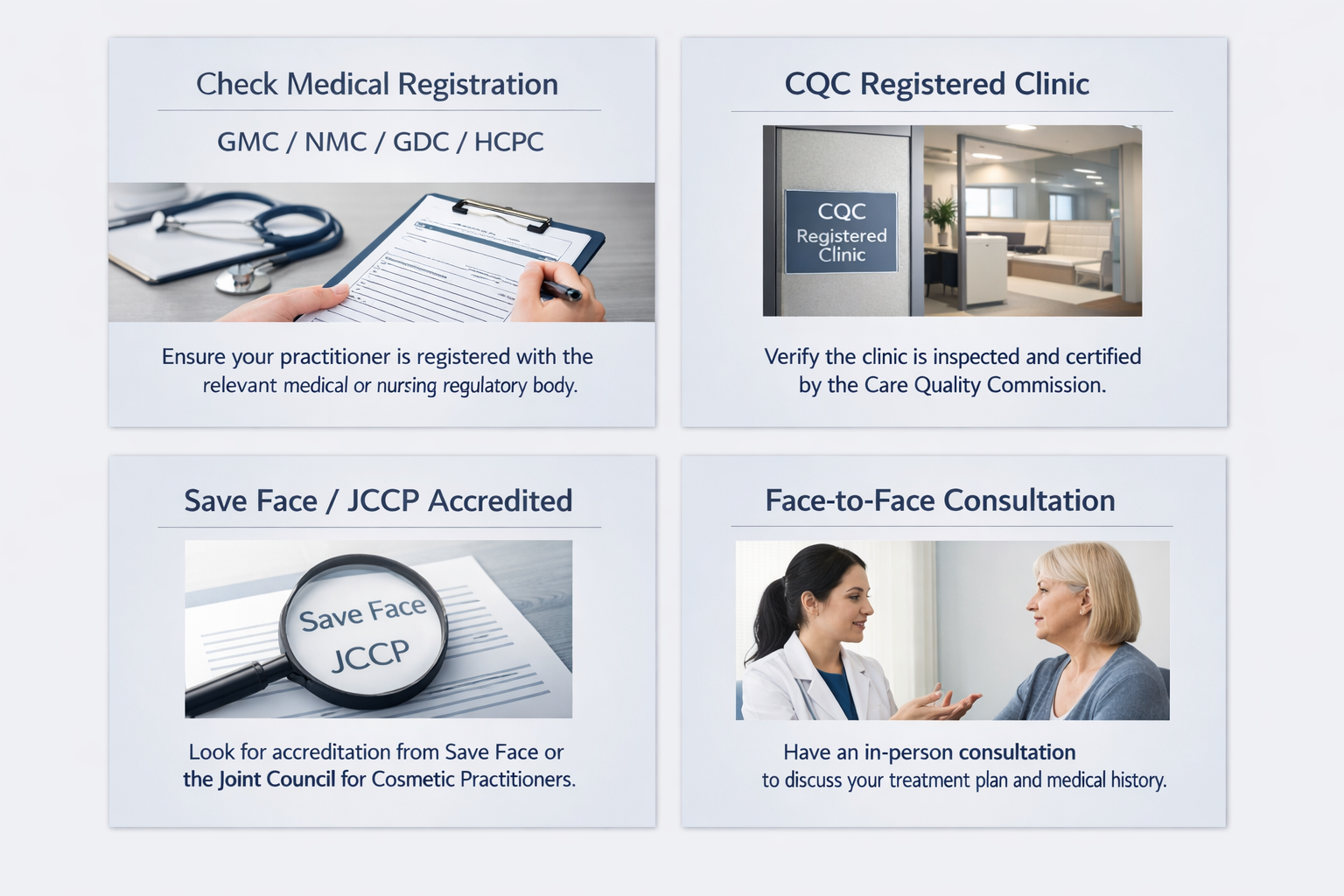
- Look for practitioners registered with the GMC (doctors), NMC (nurses), GDC (dentists), or HCPC (allied health professionals). These registers are publicly searchable.
- For injectable treatments, seek practitioners with a Level 7 postgraduate qualification in aesthetic medicine or equivalent clinical training.
- Any clinic that breaks the skin as part of treatment in England should be registered with the CQC (Care Quality Commission). Check the CQC register before booking.
- The Save Face register and the JCCP (Joint Council for Cosmetic Practitioners) accreditation are additional quality markers worth checking.
- Under the Botulism Toxin and Cosmetic Fillers (Children) Act 2021, injectable treatments are restricted to patients aged 18 and over in the UK.
- A reputable practitioner will always conduct a thorough face-to-face consultation before recommending treatment, discuss realistic outcomes and limitations, and explain the risks involved.
Be wary of any provider who offers treatment without a consultation, quotes unusually low prices, or cannot clearly explain their qualifications and the clinic’s regulatory status.
Lifestyle, Prevention, and At-Home Options
No at-home device or lifestyle measure can reverse established jowls, but several approaches may slow their progression and support the results of professional treatment. Daily broad-spectrum SPF use is the single most evidence-supported step for preserving skin collagen and preventing UV-related elastin breakdown. Retinoids — available in prescription and cosmetic formulations — have a reasonable evidence base for stimulating collagen production and improving skin texture over time. Peptide-based skincare may offer modest supporting benefits, though the evidence is less robust.
Facial exercises and facial yoga are widely promoted online as a way to lift jowls. There is no good clinical evidence that facial exercises meaningfully lift or tighten jowling. They are free and low-risk, but should not be expected to produce a significant change, and should not replace sun protection or professional assessment. Smoking cessation and maintaining a stable, healthy weight are both sensible steps that reduce the rate of skin ageing and tissue laxity over time.
At-home radiofrequency and microcurrent devices are available at various price points. Some may offer modest skin quality improvements with consistent use, but their energy output is substantially lower than clinical devices, and results are not comparable to professional treatment.
Does the NHS Treat Jowls?
Jowls are considered a cosmetic concern, and treatment is almost always available only through UK private clinics. The NHS does not fund cosmetic procedures for aesthetic reasons. In rare cases where significant facial sagging is associated with an underlying medical condition, NHS involvement may be possible, but this is not the norm. Patients seeking jowl treatment should expect to fund this privately.
Frequently Asked Questions
Can you get rid of jowls without surgery?
Non-surgical treatments can meaningfully improve mild to moderate jowling, but they cannot remove excess hanging skin. Treatments such as Morpheus8, HIFU, thread lifts, and dermal fillers can tighten tissue, restore volume, and improve jawline definition. For significant or established jowls, surgery remains the most reliable option for substantial, long-lasting correction.
How long do non-surgical jowl treatments last?
Results vary by treatment. Dermal fillers typically last 12 to 18 months. Thread lifts generally last 12 to 24 months. HIFU and RF-based treatments such as Morpheus8 produce results that may last 12 to 24 months, with maintenance sessions recommended. Surgical results from a lower facelift can last five to ten years or more.
Do facial exercises get rid of jowls?
There is no reliable clinical evidence that facial exercises or facial yoga lift established jowls. They are harmless and free, but should not be expected to produce meaningful structural change. Sun protection and evidence-based skincare are more useful preventive measures.
What is the best age to treat jowls?
There is no single best age. Treating early — when jowling is mild and tissue quality is still good — gives non-surgical treatments the best chance of producing meaningful results. Waiting until jowling is significant may mean that only surgical correction can achieve the desired outcome. The right time to seek assessment is when the change begins to bother you.
Is Morpheus8 good for jowls?
Morpheus8 RF microneedling is one of the most widely used treatments for moderate jowling in UK private clinics. It combines radiofrequency energy with microneedling to stimulate collagen remodelling and cause tissue contraction. A course of three sessions is typically recommended, with results developing over three to six months. It works best for patients with moderate skin laxity rather than significant excess skin.
What is the difference between a mini facelift and a full lower facelift?
A mini facelift uses shorter incisions and addresses earlier-stage jowling with less surgical intervention and a shorter recovery. A full lower facelift or SMAS facelift addresses deeper tissue layers and is more appropriate for significant jowling with excess skin. A surgeon will recommend the appropriate technique based on the degree of tissue change and the patient’s goals.
Are jowl treatments painful?
Most non-surgical treatments involve some discomfort. HIFU can be notably uncomfortable during the procedure. Morpheus8 is performed with topical anaesthetic and is generally well tolerated. Thread lifts use local anaesthetic. Surgical procedures are performed under local or general anaesthetic. Practitioners should discuss pain management options at consultation.
Choosing the Right Jowl Treatment for Your Situation
The best treatment for jowls in the UK depends on the severity of your jowling, your skin quality, your anatomy, your tolerance for downtime, and your realistic goals. There is no single answer that applies to every patient.
For patients in their 30s and 40s with early softening of the jawline, non-surgical options — particularly a combination of collagen-stimulating treatments and strategic dermal fillers — can produce genuinely satisfying, natural-looking results with minimal downtime. For patients in their 50s and beyond with more established jowling, an honest conversation about the limitations of non-surgical treatment is important. Energy-based devices and thread lifts can still offer improvement, but the degree of change will be more modest when tissue laxity is significant. Lower facelift surgery, performed by a qualified plastic or cosmetic surgeon, remains the most effective long-term solution for pronounced jowls.
Whatever your starting point, seek a face-to-face consultation at a CQC-registered clinic with a GMC, NMC, GDC, or HCPC-registered practitioner who will assess your anatomy honestly, explain the realistic outcomes of each option, and develop a treatment plan tailored to you — rather than simply recommending the most expensive or most popular treatment on the menu.