

Key Takeaways
- Upper lip lines form through a combination of repetitive muscle movement, collagen loss, sun damage, and volume depletion — and the type of line present (dynamic or static) directly influences which treatment is most appropriate.
- The most effective non-surgical options include hyaluronic acid fillers, botulinum toxin injections, fractional CO2 laser resurfacing, RF microneedling, chemical peels, and skin-boosting injectables such as Profhilo or polynucleotides.
- A combination treatment approach — for example, pairing a neuromodulator with a filler — typically produces more complete and longer-lasting results than any single treatment alone.
- Realistic expectations matter: non-surgical treatments can significantly soften perioral rhytides and improve skin texture, but they do not permanently eliminate lines and require maintenance over time.
- Skin tone, line severity, downtime tolerance, and budget all influence which treatment is most suitable — a personalised treatment plan from a qualified practitioner is essential.
What Are Upper Lip Lines and Why Do They Form?
Upper lip lines — clinically referred to as perioral rhytides — are the fine to deep vertical creases that radiate upward from the lip border into the skin above. They are commonly known as smoker’s lines or lipstick lines, though they affect non-smokers too. Understanding why they form is the first step toward choosing the right treatment.
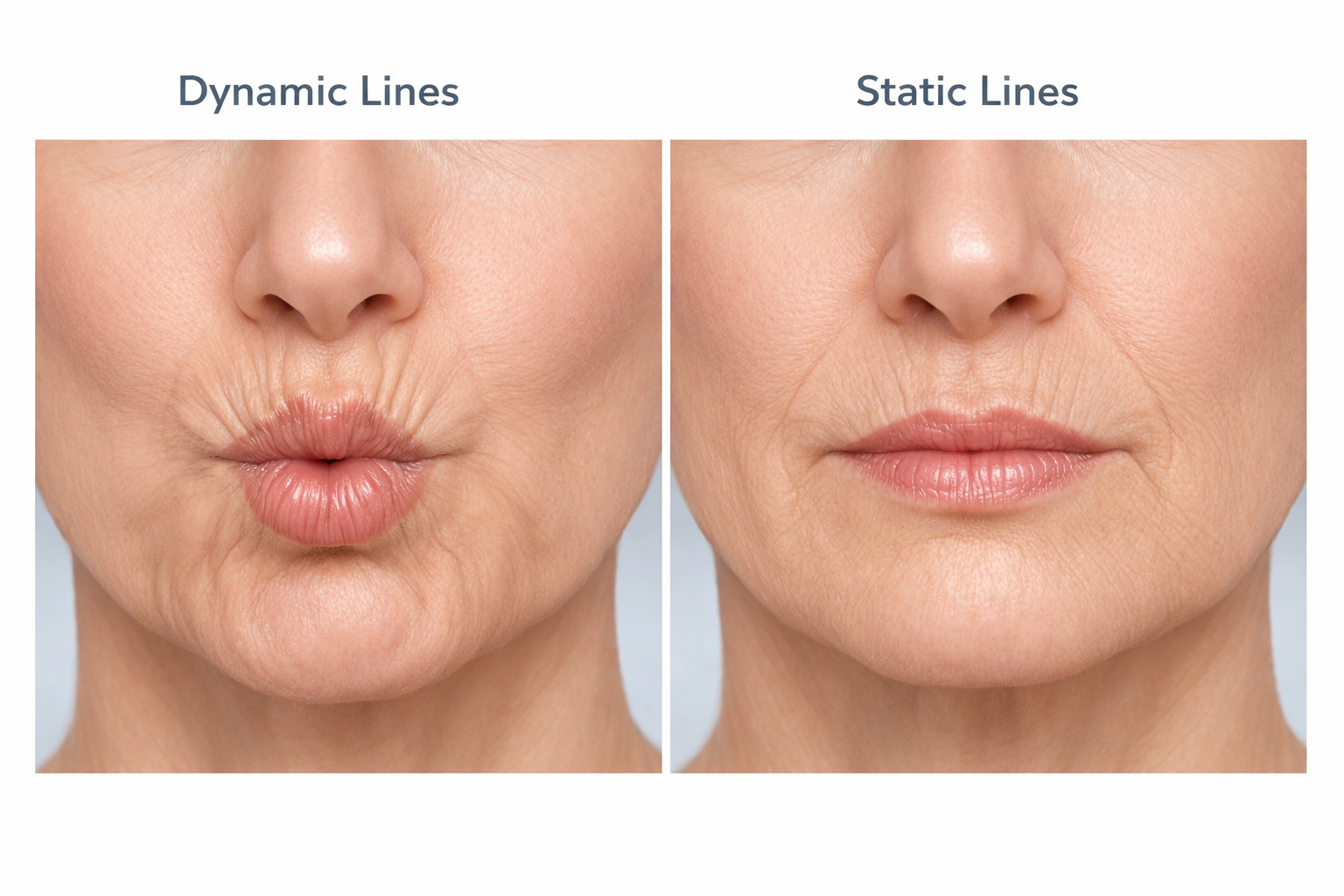
The primary driver is the orbicularis oris, the circular muscle that encircles the mouth and controls lip movement. Every time you speak, smile, sip through a straw, or purse your lips, this muscle contracts and folds the overlying skin. Over years, these repeated movements etch lines into the skin — initially appearing only during expression (dynamic lines), and eventually becoming visible even at rest (static lines).
Ageing compounds the problem significantly. From the mid-twenties onward, the skin produces progressively less collagen and elastin, reducing its ability to spring back after repeated folding. Volume loss in the fat pads beneath the perioral area causes the skin to sag slightly, deepening existing creases. Sun damage accelerates this process by degrading collagen fibres and impairing the skin’s repair mechanisms. Genetics, smoking, and habitual lip pursing all contribute further — which is why the severity and timing of upper lip lines varies considerably between individuals.
Dynamic vs. Static Lip Lines: Why the Distinction Matters
One of the most clinically important — and most frequently overlooked — distinctions in treating upper lip lines is whether they are dynamic or static. Dynamic lip lines appear or deepen during muscle movement and may be barely visible at rest. Static lip lines are present continuously, regardless of expression, because the skin has lost enough structural support that the crease persists without any muscle contraction.
This distinction directly determines the most appropriate treatment. Dynamic lines respond well to botulinum toxin (neuromodulator) injections, which temporarily reduce the intensity of orbicularis oris contractions and allow the skin to recover. Static lines, by contrast, require treatments that restore volume, stimulate collagen remodelling, or resurface the skin — such as hyaluronic acid fillers, laser resurfacing, or RF microneedling. Many patients present with a combination of both types, which is one reason a combination treatment approach often produces the best outcomes.
Treatment Comparison at a Glance
The table below summarises the main non-surgical options for upper lip lines to help you compare them before a consultation.
| Treatment | Mechanism | Best For | Downtime | Results Duration | Sessions Needed |
|---|---|---|---|---|---|
| Hyaluronic acid fillers | Volume restoration, structural support | Static lines, volume loss | Minimal (1–3 days bruising/swelling) | 6–12 months | 1 (maintenance ongoing) |
| Botulinum toxin (neuromodulator) | Reduces orbicularis oris contractions | Dynamic lines, lip flip | None to minimal | 3–4 months | 1 (repeat every 3–4 months) |
| Fractional CO2 laser resurfacing | Ablative resurfacing, collagen remodelling | Moderate to deep static lines, skin texture | 7–10 days | 1–3 years (with maintenance) | 1–2 |
| RF microneedling (e.g. Morpheus8) | Radiofrequency energy + micro-injuries stimulate collagen | Skin laxity, fine to moderate lines, all skin tones | 2–5 days | 12–18 months | 2–3 |
| Chemical peel | Controlled exfoliation, collagen stimulation | Fine lines, skin texture, mild perioral lines | 2–7 days (depth-dependent) | 3–6 months | 3–6 (superficial); 1–2 (medium) |
| Profhilo / skin boosters | Deep hydration, bioremodelling, collagen and elastin stimulation | Skin quality, fine lines, early laxity | Minimal | 6–9 months | 2 (initial); then maintenance |
| Polynucleotides (e.g. Rejuran) | DNA-fragment tissue repair, collagen induction | Skin quality, fine perioral lines | Minimal | 6–12 months | 3–4 |
| Microneedling (collagen induction therapy) | Micro-injuries trigger collagen production | Fine lines, skin texture improvement | 1–3 days | 3–6 months | 3–6 |
Injectable Treatments for Upper Lip Lines
Hyaluronic Acid Fillers
Hyaluronic acid (HA) fillers are among the most widely used treatments for perioral lines. Hyaluronic acid is a naturally occurring substance in the skin that attracts and retains water, providing volume and structural support. When injected into or around the upper lip, HA fillers can soften static lines by physically filling the crease, restore lost volume in the perioral area, and improve the definition of the lip border — which itself helps prevent lipstick from bleeding into lines.
Products such as Juvederm Volbella and Restylane Silk are formulated specifically for delicate perioral skin, offering a softer consistency suited to fine lines rather than the firmer gels used for deeper volume restoration. Results typically last six to twelve months, after which the filler is gradually broken down by the body. Mild swelling and bruising are common for one to three days. Overfilling the perioral area can create an unnatural appearance, which is why technique and product selection by an experienced practitioner are critical.
Botulinum Toxin and the Lip Flip
Botulinum toxin — the active ingredient in brands such as Botox and Dysport — works by temporarily blocking the nerve signals that trigger muscle contraction. When used in micro-doses around the upper lip, it reduces the intensity of orbicularis oris activity, allowing dynamic lip lines to soften over two to four weeks. This approach is sometimes called a lip flip when a small amount is placed just above the lip border, causing the upper lip to relax slightly outward and appear fuller without adding volume.
Botulinum toxin is most effective for dynamic lines and works best in combination with fillers when static lines are also present. Results generally last three to four months. Because the perioral area is involved in speech, eating, and expression, the dose used here is typically very conservative — too much toxin can impair lip function. This is not a treatment to attempt with an inexperienced injector.
Profhilo and Skin Boosters
Profhilo is an injectable treatment containing a high concentration of hyaluronic acid that spreads through the tissue rather than adding structural volume. It works by deeply hydrating the skin and stimulating the production of collagen and elastin — a process sometimes called bioremodelling. In the perioral area, Profhilo can improve overall skin quality, reduce the appearance of fine lines, and address early skin laxity. Two sessions spaced four weeks apart are typically recommended, with results lasting around six to nine months.
Polynucleotides (Rejuran)
Polynucleotides are injectable treatments derived from purified DNA fragments, most commonly from salmon. They work by promoting tissue repair and stimulating fibroblast activity — the cells responsible for producing collagen and elastin. Rejuran, one of the better-known polynucleotide products, has been used in aesthetic medicine for perioral skin quality improvement and fine line reduction. Evidence is still developing compared to more established treatments, but early clinical data and clinical experience suggest meaningful improvements in skin texture and hydration. A course of three to four sessions is usually recommended.
Energy-Based Treatments for Perioral Lines
Fractional CO2 Laser Resurfacing
Fractional CO2 laser resurfacing is one of the most effective treatments available for moderate to deep perioral rhytides. The laser delivers thousands of microscopic columns of energy into the skin, removing the outer layers (ablative action) while simultaneously triggering an intense collagen remodelling response in the deeper dermis. The result is smoother, tighter skin with visibly reduced lines — often after a single treatment.
The trade-off is meaningful downtime: the skin typically appears red, swollen, and raw for seven to ten days, with full healing taking several weeks. An important consideration is skin tone. Fractional CO2 laser carries a risk of post-inflammatory hyperpigmentation and hypopigmentation, particularly in patients with darker skin tones (Fitzpatrick types IV–VI). For these patients, a qualified practitioner may recommend a non-ablative or RF-based alternative instead. When performed by an experienced clinician on suitable candidates, fractional CO2 laser can produce results lasting one to three years.
RF Microneedling (Morpheus8 and Similar Devices)
RF microneedling combines the collagen induction therapy of standard microneedling with the addition of radiofrequency energy delivered through the needle tips into the deeper dermis. Devices such as Morpheus8 and Sylfirm X use this dual mechanism to stimulate collagen remodelling and address skin laxity more effectively than microneedling alone. The perioral area responds well to RF microneedling, with improvements in fine to moderate lines, skin texture, and overall firmness.
A significant advantage of RF microneedling over ablative laser is its suitability across a broader range of skin tones. Because the radiofrequency energy is delivered below the skin surface rather than targeting surface pigment, the risk of pigmentation changes is considerably lower. Downtime is typically two to five days of redness and mild swelling. A course of two to three sessions spaced four to six weeks apart is usually recommended, with results lasting up to twelve to eighteen months.
Non-Ablative Laser and Fotona LipLase
Non-ablative lasers work by delivering heat energy into the dermis without removing the outer skin layer, stimulating collagen production with minimal surface disruption. Fotona LipLase is a specific non-ablative laser protocol designed for the perioral area, using Er:YAG laser energy to tighten the lip tissue and reduce fine lines from both inside and outside the lip. Because it does not break the skin surface, downtime is minimal — typically redness for a few hours. Results are generally more gradual and less dramatic than ablative CO2 laser, making it a suitable option for patients with mild to moderate lines who cannot accommodate significant downtime.
Chemical Peels
Chemical peels use controlled application of an acid solution to exfoliate the outer skin layers and stimulate collagen production beneath. Superficial peels (such as glycolic or lactic acid) address fine lines and uneven texture with minimal downtime of one to three days. Medium-depth peels (such as TCA) penetrate more deeply and can improve moderate perioral lines, but require five to seven days of recovery. Deep phenol peels are rarely used today given the availability of laser alternatives.
Chemical peels are often used as part of a maintenance programme between more intensive treatments, or as a standalone option for patients with mild lines and good skin quality. As with ablative laser, medium and deep peels carry a higher risk of pigmentation changes in darker skin tones and require careful patient selection.
Skin-Renewal and Collagen Induction Treatments
Microneedling
Standard microneedling — also called collagen induction therapy — uses a device with fine needles to create controlled micro-injuries in the skin. The healing response stimulates new collagen and elastin production, gradually improving skin texture, fine lines, and overall skin quality in the perioral area. Results are more modest than laser or RF microneedling, but the treatment is well-tolerated, suitable for most skin tones, and carries minimal downtime of one to three days. A course of three to six sessions is typically needed to see meaningful improvement.
Microneedling is often combined with platelet-rich plasma (PRP) — a concentration of the patient’s own growth factors derived from a blood sample — to potentially enhance the collagen stimulation response. Evidence for PRP as a standalone treatment for lip lines remains limited, but it is commonly used as an adjunct to microneedling or laser treatments.
Combination Treatment Approaches
For most patients with established upper lip lines, a single treatment modality rarely addresses all contributing factors simultaneously. A combination treatment approach — tailored to the individual’s line type, severity, skin quality, and goals — typically produces more complete and longer-lasting results.
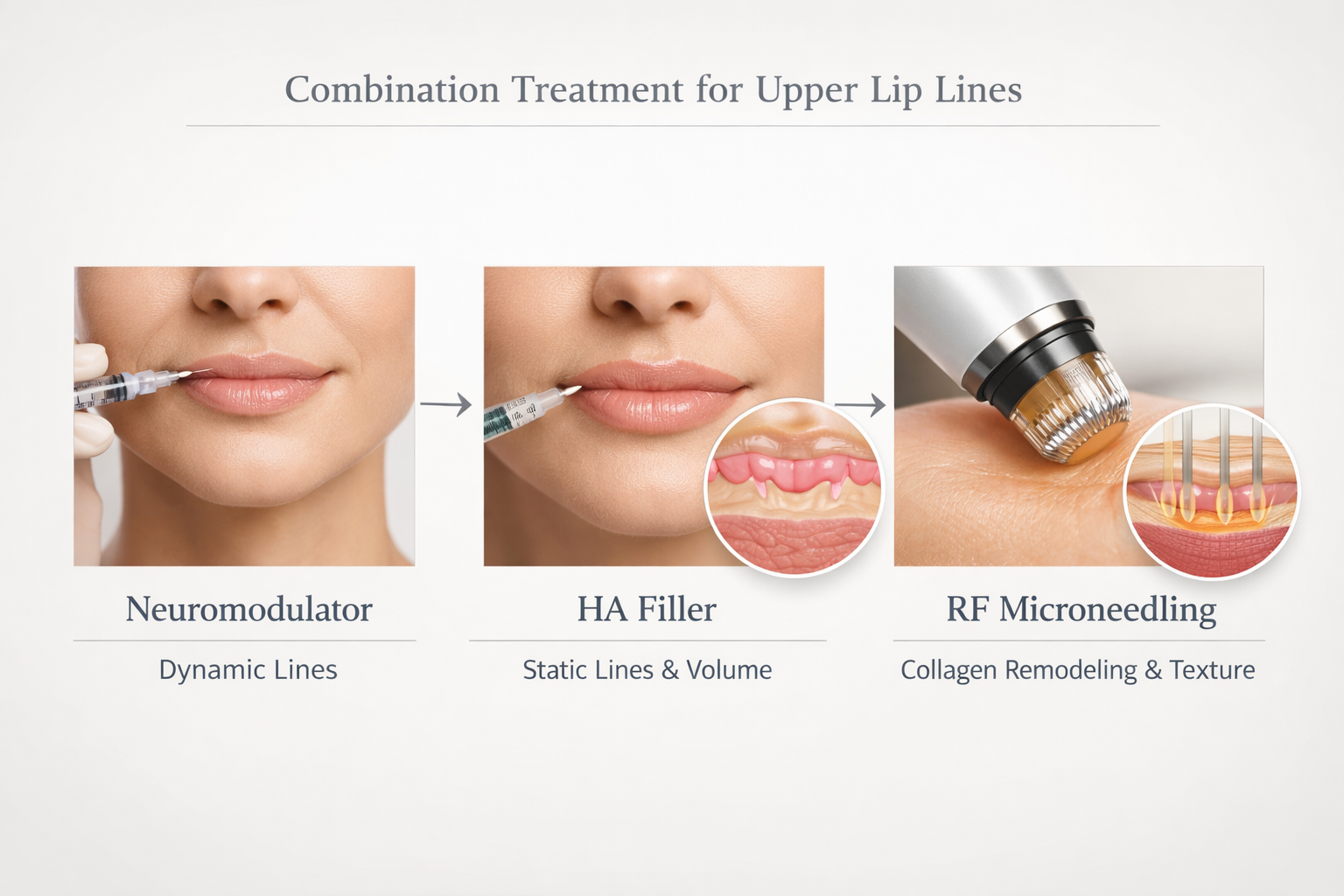
A common and clinically logical combination is botulinum toxin to reduce dynamic muscle activity, paired with hyaluronic acid fillers to restore lost volume and fill static creases. This addresses both the cause (muscle movement) and the structural deficit (volume loss) at the same time. For patients with significant skin texture changes or deeper lines, adding a course of RF microneedling or a fractional laser treatment to this injectable foundation can further improve collagen density and surface smoothness.
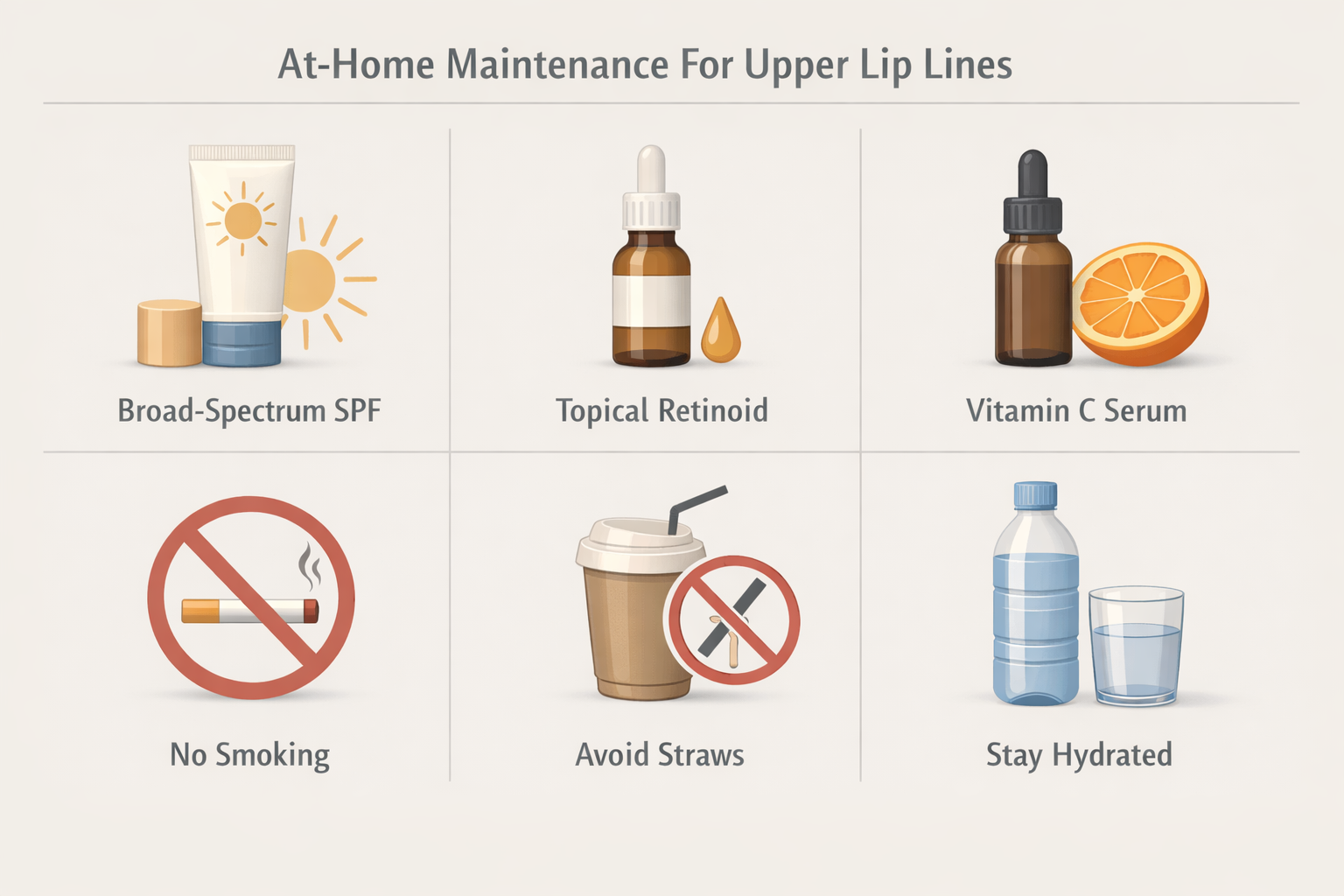
Skin-boosting treatments such as Profhilo or polynucleotides work well as a preparatory or maintenance layer, improving the overall quality of the perioral skin so that other treatments perform better and results last longer. At-home skincare — particularly topical retinoids, vitamin C serum, and broad-spectrum SPF — plays an important supporting role in maintaining results and slowing the progression of new lines.
Prevention and At-Home Maintenance
While clinic treatments address existing lines, a consistent at-home routine helps preserve results and slow the formation of new perioral rhytides. Topical retinoids (prescription-strength or over-the-counter retinol) are the most evidence-supported topical option for stimulating collagen production and improving skin cell turnover around the mouth. They require consistent use over several months before meaningful improvement becomes visible, and they can cause initial dryness or irritation.
Daily application of a broad-spectrum SPF to the perioral area is essential — UV radiation is one of the primary drivers of collagen degradation and photoageing in this region. A lip balm with SPF protects the lip border specifically. Vitamin C serum applied in the morning provides antioxidant protection and supports collagen synthesis. Avoiding habitual lip pursing — including reducing straw use — can meaningfully slow the progression of dynamic lines over time. Smoking cessation is strongly recommended, as smoking accelerates collagen breakdown and impairs skin repair.
Choosing the Right Treatment for Your Lip Lines
The most appropriate treatment depends on several individual factors that a qualified practitioner will assess during a consultation. Line severity is a primary consideration: fine, early lines respond well to skin boosters, superficial peels, or microneedling, while moderate to deep static lines typically require fillers, laser resurfacing, or RF microneedling. Whether lines are predominantly dynamic or static — or a mixture — determines whether a neuromodulator should be part of the plan.
Skin tone matters significantly when considering ablative or medium-depth treatments. Patients with darker skin tones are at higher risk of pigmentation changes from CO2 laser and medium-depth chemical peels; RF microneedling and non-ablative options are generally safer across the Fitzpatrick scale. Downtime tolerance is a practical factor — a patient who cannot take time off work may prefer injectables or RF microneedling over ablative laser. Budget and willingness to commit to maintenance sessions also shape the realistic treatment pathway.
No single treatment is universally best. The goal of a consultation is to match the right combination of treatments to your specific anatomy, skin type, line severity, and lifestyle — not to apply a one-size-fits-all protocol.
Frequently Asked Questions
Can upper lip lines be removed completely without surgery?
Non-surgical treatments can significantly reduce the appearance of upper lip lines, but complete elimination is rarely achievable and results are not permanent. The degree of improvement depends on line depth, skin quality, and the treatments used. Realistic expectations — meaningful softening rather than total erasure — lead to greater satisfaction with outcomes.
Is Botox or filler better for lip lines?
Neither is universally better — they address different aspects of the problem. Botulinum toxin is most effective for dynamic lines caused by muscle movement, while hyaluronic acid fillers are better suited to static lines and volume loss. Many patients benefit most from both used together as part of a combination treatment approach.
How long do results from lip line treatments last?
Duration varies by treatment. Botulinum toxin typically lasts three to four months. Hyaluronic acid fillers generally last six to twelve months. RF microneedling results can persist for twelve to eighteen months. Fractional CO2 laser resurfacing may provide improvement lasting one to three years, though maintenance is still recommended. All results are influenced by individual skin ageing, lifestyle, and sun exposure.
Which treatment is safest for darker skin tones?
RF microneedling, injectables (fillers and botulinum toxin), Profhilo, polynucleotides, and non-ablative laser treatments are generally considered safer options for patients with darker skin tones. Ablative CO2 laser and medium-depth chemical peels carry a higher risk of post-inflammatory hyperpigmentation in Fitzpatrick types IV–VI and require careful assessment by an experienced practitioner.
How many sessions will I need?
This depends on the treatment and your starting point. Injectable treatments typically require one session with repeat appointments every few months. RF microneedling usually requires two to three sessions. Microneedling and superficial chemical peels often need three to six sessions. A qualified practitioner will recommend a realistic treatment plan at consultation.
Can I combine treatments for better results?
Yes — combining treatments is often the most effective strategy. Common combinations include botulinum toxin with hyaluronic acid fillers, or injectables followed by a course of RF microneedling or laser resurfacing. Treatments should be sequenced appropriately, and a practitioner will advise on timing and suitability for your skin.
What at-home care helps maintain results?
Daily broad-spectrum SPF, topical retinoids used consistently, and a vitamin C serum in the morning all support collagen maintenance and slow the progression of perioral lines. Avoiding smoking, minimising straw use, and staying well hydrated also contribute to longer-lasting results from clinic treatments.
Deciding on the Right Approach for Your Upper Lip Lines
Upper lip lines are one of the more nuanced concerns in aesthetic medicine because they involve multiple contributing factors — muscle activity, volume loss, collagen depletion, and skin quality — that rarely all respond to a single treatment. The good news is that the range of effective non-surgical options is broader than ever, and a thoughtfully constructed personalised treatment plan can produce genuinely meaningful improvement without surgery or significant risk.
If your lines are mild and primarily related to skin texture, starting with skin boosters, polynucleotides, or a course of RF microneedling may be appropriate. If volume loss and deeper static creases are the main concern, hyaluronic acid fillers — possibly combined with a neuromodulator for dynamic lines — are likely to be central to your plan. For patients with more advanced perioral rhytides and the ability to accommodate downtime, fractional CO2 laser resurfacing remains one of the most effective single-session options available.
Whatever the starting point, a consultation with a qualified and experienced practitioner is the essential first step. A thorough assessment of your skin type, line severity, anatomy, and goals will determine which treatments are appropriate, in what order, and at what intervals — giving you the clearest possible picture of what to realistically expect before committing to any procedure.