

Lip filler is one of the most requested aesthetic treatments, yet choosing the right product and approach is rarely straightforward. The term “best lip filler” does not refer to a single product — it describes the option that best matches an individual’s lip anatomy, skin type, desired outcome, and tolerance for downtime. This article explains the main types of lip filler available, how they differ in terms of texture, longevity, and suitability, and what realistic results look like so you can have a more informed conversation with a qualified practitioner.
Key Takeaways
- Hyaluronic acid fillers are the most widely used lip fillers and are reversible with an enzyme called hyaluronidase, making them a practical first choice for most patients.
- Different hyaluronic acid products vary in thickness, cross-linking density, and lift capacity — the right choice depends on your lip anatomy and goals, not just brand name.
- Longevity typically ranges from six to eighteen months depending on the product, the volume placed, individual metabolism, and lifestyle factors.
- Lip filler carries real risks including bruising, swelling, asymmetry, and rarer but serious vascular complications — practitioner skill and product selection both matter.
- A thorough consultation with an experienced, medically qualified injector is the most important step in achieving a safe and satisfying outcome.
What Lip Fillers Are and How They Work
Lip fillers are injectable substances placed into or around the lips to add volume, improve shape, define the lip border, or reduce the appearance of fine lines around the mouth. The vast majority of lip fillers used in clinical practice today are based on hyaluronic acid, a naturally occurring sugar molecule found in skin and connective tissue. Hyaluronic acid attracts and retains water, which is what gives it volumising properties when injected into soft tissue.
During a lip filler appointment, a practitioner uses a fine needle or blunt-tipped cannula to deposit small amounts of gel into specific areas of the lip. The technique varies depending on the goal — for example, adding volume to the body of the lip requires a different approach than defining the vermilion border or lifting a downturned corner. The gel integrates with surrounding tissue and creates a soft, pliable result when the correct product is selected for the area being treated.
Non-hyaluronic acid fillers do exist — including calcium hydroxylapatite and poly-L-lactic acid — but these are generally not recommended for lip augmentation because they carry a higher risk of nodule formation in this area and are not reversible. Most experienced practitioners reserve these products for other facial regions.
Types of Lip Filler: How Products Differ
Not all hyaluronic acid lip fillers are the same. Products differ in their cross-linking technology, gel consistency, particle size, and the concentration of hyaluronic acid they contain. These differences affect how the filler behaves in tissue, how long it lasts, and which treatment goals it is best suited to.

Thin, Soft Fillers
Softer, lower-viscosity hyaluronic acid gels are well suited to subtle enhancement, fine lip line treatment, and patients with naturally thin lips who want a natural-looking result. These products integrate easily into delicate lip tissue and tend to feel soft to the touch. Because they have less lifting capacity, they are generally not the best choice for patients seeking significant volume increase. Common examples in this category include products from the Juvederm and Restylane ranges specifically formulated for lips, such as Juvederm Volbella and Restylane Kysse, though availability varies by country and regulatory approval status differs between markets.
Medium-Density Fillers
Medium-density hyaluronic acid fillers offer a balance between softness and structural support. They are frequently used for moderate volume enhancement, improving lip proportion, and addressing mild asymmetry. These products tend to provide more visible augmentation than softer gels while still feeling natural in the lip. Juvederm Ultra and Restylane Lip are examples often used in this category, though a practitioner’s product selection will depend on their training, the patient’s anatomy, and what is available in their market.
Firmer, Higher-Lift Fillers
Firmer hyaluronic acid gels with higher cross-linking density provide more structural support and are sometimes used to project the lip forward or create a more defined cupid’s bow. However, firmer products carry a greater risk of visible lumps or an unnatural feel if placed incorrectly in the lip, which is why product selection and injection technique are closely linked. These products are more commonly used in areas such as the cheeks or jawline, and their use in lips requires careful clinical judgement.
Collagen-Stimulating Fillers
Poly-L-lactic acid (such as Sculptra) and calcium hydroxylapatite (such as Radiesse) stimulate collagen production rather than providing immediate volume through gel displacement. While these products have established uses in other facial areas, they are not typically recommended for lip augmentation. The lip is a highly mobile, vascular area, and these non-reversible products carry a higher risk of nodule formation and are difficult to manage if complications arise. Most clinical guidelines advise against their use in the lips.
Choosing the Right Lip Filler for Your Goals
The concept of the “best” lip filler is inseparable from the individual patient’s anatomy and objectives. A product that works well for one person may produce an unsatisfactory result in another. Several factors influence which filler type is most appropriate.
Natural Lip Volume and Anatomy
Patients with very thin lips may benefit from a gradual approach using a soft to medium filler, building volume across two or more sessions rather than attempting significant augmentation in a single appointment. Patients with moderate existing volume who want definition rather than size may be better served by a softer product placed precisely along the vermilion border. Lip anatomy — including the natural ratio between upper and lower lip, the prominence of the cupid’s bow, and the position of the lip relative to the teeth — all influence which product and technique are most appropriate.
Desired Outcome
Lip filler goals vary considerably. Some patients want subtle hydration and a slight plumping effect. Others want a more defined lip border, a lifted cupid’s bow, or correction of asymmetry. Some patients are primarily concerned with perioral lines — the fine vertical lines above the upper lip — rather than volume. Each of these goals may call for a different product, a different injection technique, or a combination of approaches. Communicating your specific goals clearly during consultation helps a practitioner recommend the most appropriate option.
Previous Filler History
Patients who have had lip filler before may have residual product present, even if they cannot feel it. Accumulated hyaluronic acid can affect how new filler integrates and may contribute to an overfilled appearance over time. Some practitioners recommend dissolving existing filler with hyaluronidase before starting fresh, particularly if the patient is unhappy with their current result or if the lips feel firm. This is worth discussing during consultation.
Tolerance for Downtime
All lip fillers cause some degree of swelling and bruising, particularly in the first 24 to 72 hours. The extent varies between individuals and between injection techniques. Patients with important events planned within two weeks of treatment should factor this into their timing. Softer products and cannula techniques may sometimes reduce bruising compared to needle injection, though this is not guaranteed and depends on individual factors.
What Happens During a Lip Filler Appointment
A lip filler appointment typically begins with a consultation, during which the practitioner assesses your lip anatomy, reviews your medical history, and discusses your goals. Photographs are often taken for reference. The practitioner should explain which product they intend to use and why, how much volume they recommend, and what results are realistic for your anatomy.
Before injection, a topical anaesthetic cream is usually applied to the lips and surrounding area and left for approximately 15 to 20 minutes. Many hyaluronic acid lip fillers also contain lidocaine, a local anaesthetic, within the gel itself, which helps reduce discomfort during injection. Most patients describe the sensation as a mild stinging or pressure rather than sharp pain, though individual pain tolerance varies.
The injection process itself typically takes between 15 and 30 minutes. The practitioner may use a needle, a blunt-tipped cannula, or a combination of both depending on the areas being treated and their preferred technique. After injection, gentle massage may be applied to distribute the product evenly. Patients are usually given aftercare instructions and advised to avoid strenuous exercise, alcohol, and excessive heat for 24 to 48 hours.
Results: What to Expect and How Long They Last
Immediately after lip filler treatment, the lips will appear swollen — often more so than the intended final result. This initial swelling typically peaks within 24 to 48 hours and subsides over the following week. The true result becomes visible once swelling has resolved, usually around 10 to 14 days after treatment. Some patients find that their lips look slightly uneven during the healing phase, which often resolves as swelling settles.
Lip filler longevity depends on several variables. The product used, the volume injected, the patient’s individual metabolism, and lifestyle factors such as sun exposure and smoking all influence how long results last. As a general guide, most hyaluronic acid lip fillers last between six and twelve months, with some products and patients experiencing results closer to fifteen to eighteen months. The lips are a highly mobile area, which means filler tends to break down more quickly here than in less active facial regions such as the cheeks.
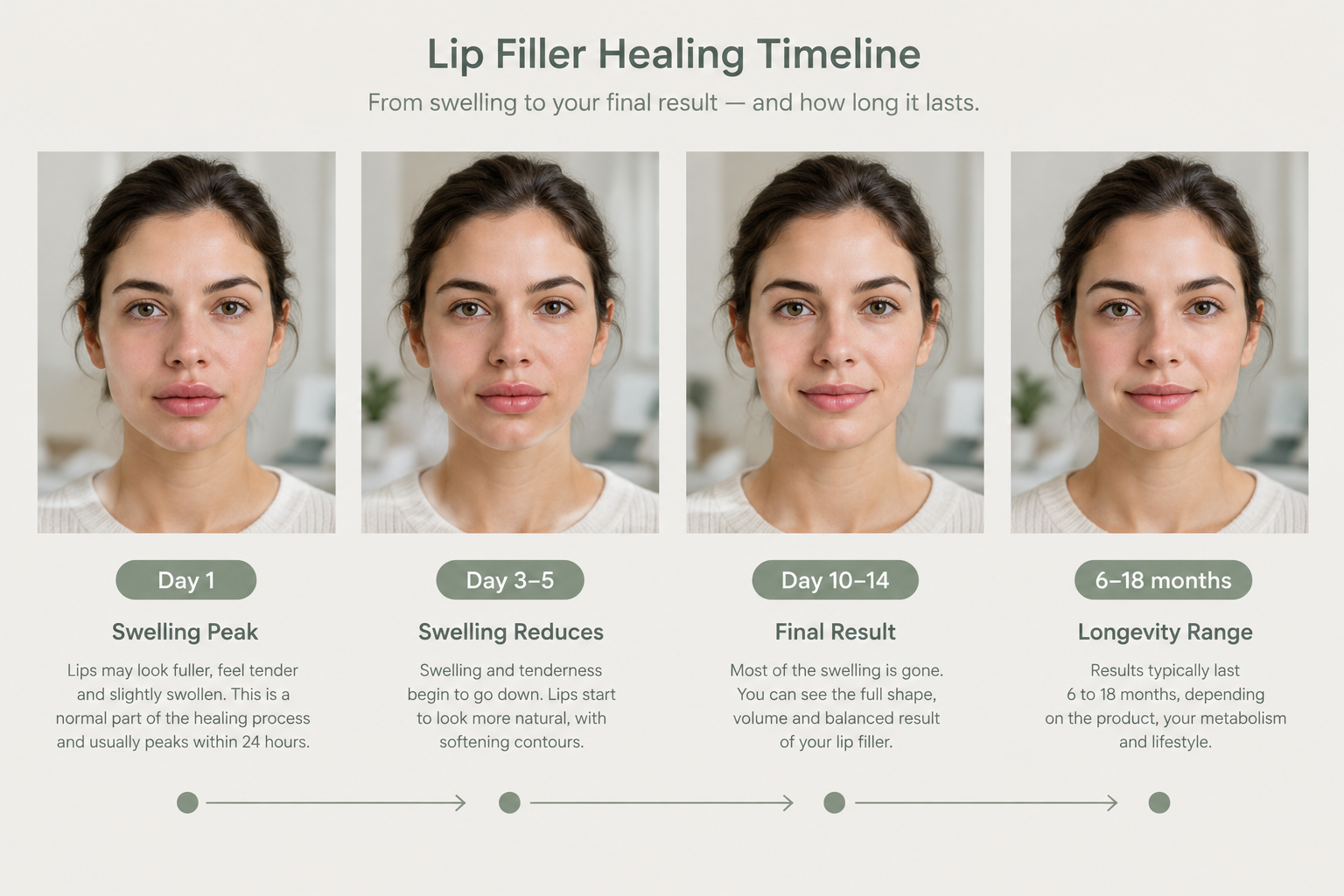
Repeat treatments are typically needed to maintain results. Some patients choose to have a small top-up treatment before the filler has fully dissolved, which can help maintain a consistent appearance over time. Others prefer to allow the filler to break down fully between treatments. Neither approach is universally superior — it depends on individual preference and the practitioner’s assessment.
Risks and Side Effects of Lip Filler
Lip filler is not without risk, and patients should understand both common and rare adverse effects before proceeding with treatment.
Common Side Effects
Bruising, swelling, redness, and tenderness at the injection site are the most frequently reported side effects. These are generally temporary and resolve within one to two weeks. Asymmetry immediately after treatment is common due to uneven swelling and usually improves as healing progresses. Lumps or irregularities can sometimes be felt in the days following treatment and often resolve with gentle massage, though persistent lumps should be assessed by the treating practitioner.
Less Common Complications
Infection, allergic reaction, and delayed inflammatory nodules are less common but possible. Delayed nodules — small firm lumps that appear weeks or months after treatment — are thought to be related to an immune response to the filler material and can usually be managed with hyaluronidase, corticosteroids, or antibiotics depending on the cause. Tyndall effect, a bluish discolouration caused by superficially placed filler, can also occur and is typically treatable with hyaluronidase.
Vascular Complications
The most serious risk associated with lip filler is vascular occlusion — accidental injection of filler into or compression of a blood vessel, which can restrict blood flow to surrounding tissue. In the lip and perioral area, this can cause tissue damage and, in rare cases, necrosis. Vascular complications require immediate recognition and treatment, typically with hyaluronidase. This is one of the most important reasons to choose a medically qualified practitioner who is trained to recognise and manage complications, and who has hyaluronidase available at the point of treatment.
Who May Be Suitable for Lip Filler
Lip filler may be appropriate for adults who are in good general health, have realistic expectations, and want to enhance lip volume, shape, or definition. Suitability depends on a clinical assessment and a thorough review of medical history. Lip filler is generally not recommended during pregnancy or breastfeeding. Patients with active cold sores or oral infections should postpone treatment until the infection has resolved, as injection can trigger a herpes simplex outbreak or spread infection. Patients with certain autoimmune conditions, bleeding disorders, or those taking blood-thinning medications may face a higher risk of bruising or other complications and should discuss this with their practitioner.
Patients who have had permanent filler placed in the lips previously — such as silicone or other non-hyaluronic acid materials — require careful assessment, as hyaluronic acid filler placed over permanent filler carries a higher risk of complications. A detailed history of previous treatments is essential during consultation.
Alternatives to Lip Filler
Lip filler is not the only option for patients who want to improve the appearance of their lips. The most appropriate alternative depends on the specific concern being addressed.
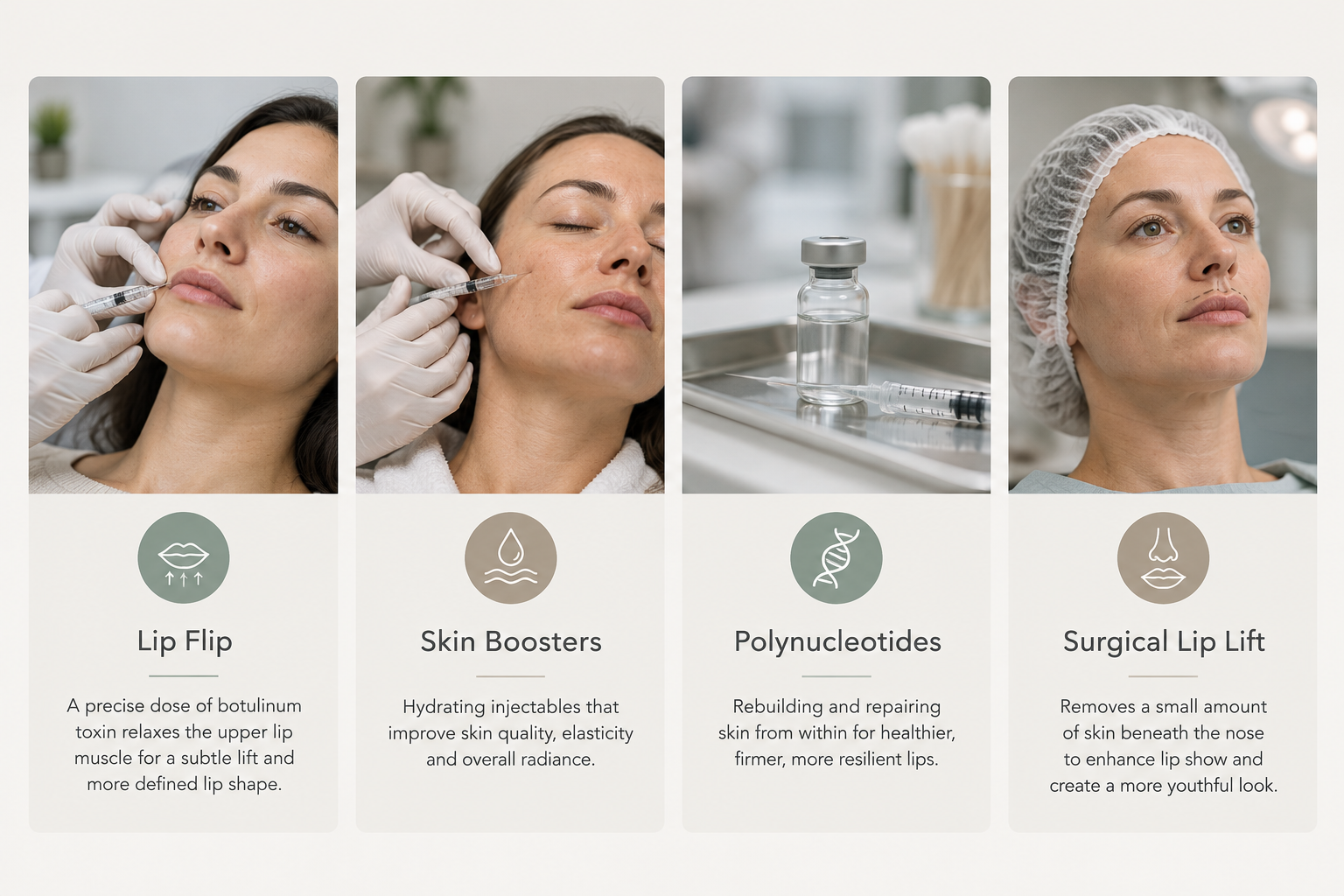
- Lip flip with botulinum toxin: A small amount of botulinum toxin injected into the orbicularis oris muscle above the upper lip can cause the lip to roll slightly outward, creating the appearance of a fuller upper lip without adding volume. This is a subtle effect and is not a substitute for filler in patients who want significant augmentation, but it may suit patients who want a natural enhancement or who are not ready for filler.
- Skin boosters: Injectable skin boosters containing hyaluronic acid — such as Profhilo or Restylane Skinboosters — can improve lip hydration and skin quality around the mouth without adding structural volume. These may be appropriate for patients whose primary concern is dryness, fine lines, or skin texture rather than lip size.
- Polynucleotides: Polynucleotide injections are an emerging option for improving skin quality and hydration in the perioral area. Evidence for their use specifically in lip augmentation is still developing, and they are not a direct substitute for volume-adding filler.
- Surgical lip augmentation: Surgical options such as lip lift procedures or fat transfer exist for patients seeking more permanent results. These carry greater risks and recovery time than injectable treatments and are typically considered when non-surgical options have not achieved the desired outcome.
Questions to Ask During Your Consultation
A thorough consultation is the foundation of a safe and satisfying lip filler experience. The following questions can help you assess whether a practitioner and treatment plan are appropriate for your needs.
- What product do you recommend for my lips and why?
- How much filler do you suggest for my first treatment, and what results are realistic for my anatomy?
- Do you have hyaluronidase available in case of complications?
- What is your training and experience with lip filler specifically?
- What should I do if I experience unusual symptoms after treatment?
- How long should I wait before assessing the final result?
- Do I have any existing filler that should be dissolved before we proceed?
Frequently Asked Questions
How much lip filler do I need?
The appropriate volume depends on your existing lip anatomy and your goals. Many practitioners recommend starting with 0.5 to 1 ml for a first treatment, particularly for patients who want a natural result. Larger volumes can be added in subsequent sessions once you have seen how your lips respond. Starting conservatively reduces the risk of an overfilled appearance and allows for gradual, controlled enhancement.
Does lip filler hurt?
Most patients experience mild to moderate discomfort during lip filler injection. Topical anaesthetic cream applied before treatment and lidocaine within the filler gel both help reduce pain. The lips are a sensitive area, so some stinging or pressure is normal. Most patients find the procedure tolerable, though individual pain thresholds vary.
Can lip filler be dissolved if I don’t like the result?
Hyaluronic acid lip filler can be dissolved using an enzyme called hyaluronidase. This is one of the key advantages of hyaluronic acid over non-reversible filler materials. Hyaluronidase breaks down the hyaluronic acid gel relatively quickly, and most of the filler can be dissolved within 24 to 48 hours of treatment. Dissolving filler is also the primary emergency treatment for vascular occlusion, which is why practitioner access to hyaluronidase is important.
Will my lips look unnatural?
The risk of an unnatural result depends on the volume of filler used, the product selected, the injection technique, and the practitioner’s aesthetic judgement. Overfilling — placing more product than the lip anatomy can accommodate naturally — is the most common cause of an unnatural appearance. Choosing an experienced practitioner, communicating your goals clearly, and starting with a conservative volume all reduce this risk. Results that look overfilled can often be improved with hyaluronidase.
How soon can I wear lipstick after lip filler?
Most practitioners advise avoiding lipstick and lip products for at least 24 hours after treatment to reduce the risk of infection at injection sites. After this period, makeup can generally be applied gently. Specific aftercare guidance may vary between practitioners and products, so follow the instructions provided at your appointment.
Is there a difference between lip filler brands?
Yes. Different brands use different cross-linking technologies, hyaluronic acid concentrations, and gel consistencies, which affect how the product behaves in tissue, how long it lasts, and which treatment goals it is best suited to. However, brand name alone is not the most important factor — the practitioner’s skill, their understanding of lip anatomy, and their ability to match the right product to the right patient matter considerably more than the label on the syringe.
Choosing Lip Filler: Making an Informed Decision
The best lip filler for any individual is the one that matches their anatomy, goals, and risk tolerance — selected and placed by a practitioner with the training and clinical judgement to make that assessment safely. Hyaluronic acid fillers remain the most appropriate choice for the majority of patients seeking lip augmentation because they are reversible, well-studied, and available in a range of formulations suited to different goals and lip types.
Realistic expectations are important. Lip filler can meaningfully improve lip volume, shape, and definition, but results are temporary and require maintenance. The treatment carries real risks, including the rare but serious possibility of vascular complications, which is why practitioner selection matters as much as product selection. Choosing a medically qualified injector who conducts a thorough consultation, explains their product choice, and has the skills and materials to manage complications is the most important decision you will make in this process.
If you are considering lip filler for the first time, a consultation with a qualified aesthetic practitioner is the appropriate starting point. A good practitioner will assess your lips, listen to your goals, explain what is and is not achievable, and recommend a treatment plan that prioritises your safety and a natural-looking result.