

Quick Comparison
| Characteristic | Azzalure | Botox |
|---|---|---|
| Active ingredient | abobotulinumtoxinA | onabotulinumtoxinA |
| Manufacturer | Ipsen (distributed by Galderma in the UK) | Allergan (AbbVie) |
| Unit system | Speywood units | Allergan units |
| Molecular size | Smaller; fewer accessory proteins | Larger; more complexing proteins |
| Diffusion | Wider spread from injection point | More localised |
| Onset | 2–3 days; full effect around 1 week | 3–5 days; full effect 7–14 days |
| Duration | Approximately 3–4 months | Approximately 3–4 months |
| MHRA-licensed areas | Glabellar lines, lateral canthal lines | Glabellar lines, lateral canthal lines, hyperhidrosis, chronic migraine, muscle spasms |
| Typical result character | Softer, broader relaxation | More targeted, precise relaxation |
| Regulatory status (UK) | Prescription-only medicine, MHRA licensed | Prescription-only medicine, MHRA licensed |
What Are Azzalure and Botox?
Both Azzalure and Botox are injectable wrinkle relaxers derived from botulinum toxin type A, a purified protein that temporarily reduces muscle activity to smooth dynamic wrinkles — the lines that form through repeated facial expressions such as frowning, squinting, and raising the eyebrows. Despite sharing the same general mechanism, they are distinct pharmaceutical products with different formulations, unit systems, and diffusion characteristics.
Botox is manufactured by Allergan (now part of AbbVie) and contains onabotulinumtoxinA. It has been available for cosmetic use for decades and is often described as the gold standard against which other botulinum toxin products are compared, largely because of the volume of long-term clinical data behind it.
Azzalure contains abobotulinumtoxinA and is manufactured by Ipsen. In the UK, it is marketed and distributed by Galderma. Azzalure is the aesthetic-specific brand of the same molecule used in Dysport — the therapeutic and US-market equivalent. Azzalure received MHRA approval in 2009 for the cosmetic treatment of glabellar lines (frown lines between the brows) and lateral canthal lines (crow’s feet). Both products are prescription-only medicines and must be prescribed and administered by a qualified medical professional.
How Do They Work?
Both Azzalure and Botox work by blocking the release of acetylcholine at the neuromuscular junction — the point where a nerve signal meets a muscle fibre. Acetylcholine is the chemical messenger that triggers muscle contraction. When its release is temporarily inhibited, the targeted muscle relaxes, and the overlying skin smooths out. This effect is temporary because the nerve endings gradually regenerate new signalling pathways over the following months.
The key distinction is not in the mechanism — which is identical — but in the molecular structure of each product. Botox contains a larger molecular complex with more complexing proteins (sometimes called accessory proteins or clostridial proteins), which contribute to a more localised effect at the injection site. Azzalure has a smaller molecular structure with fewer accessory proteins, which is associated with greater diffusion — meaning the product tends to spread slightly further from the injection point into surrounding tissue.
This difference in diffusion is clinically meaningful. It influences how many injection points are needed, which treatment areas each product may be better suited to, and the level of precision required from the injector.
Formulation Differences: Why They Are Not the Same Product
A common misconception is that all botulinum toxin type A products are interchangeable. They are not. Azzalure and Botox differ in their molecular weight, protein content, and the unit systems used to measure their potency.
Botox is supplied in vials measured in Allergan units. Azzalure is supplied in 125-unit vials measured in Speywood units — a separate measurement system developed specifically for abobotulinumtoxinA products. These unit systems are not equivalent. Approximately 2–4 Speywood units of Azzalure are needed to achieve an effect broadly comparable to 1 Allergan unit of Botox, though this is a rough clinical guide rather than a fixed conversion ratio. The practical implication is that a patient switching between products will require a dosing recalibration by their practitioner — the number on the vial does not translate directly.
This also affects how cost is perceived. Azzalure may appear less expensive on a per-unit basis at wholesale level, but because more Speywood units are required to achieve an equivalent effect, the overall treatment cost tends to be comparable between the two products. Clinics typically charge per treatment area rather than per unit, so the price a patient pays is usually similar regardless of which product is used.
Onset and Duration: How Quickly Do Results Appear and How Long Do They Last?
Azzalure tends to have a slightly faster onset than Botox. Most patients notice the initial effects of Azzalure within 2–3 days, with the full result visible at around one week. Botox typically begins to take effect within 3–5 days, with the full result appearing between 7 and 14 days after treatment.
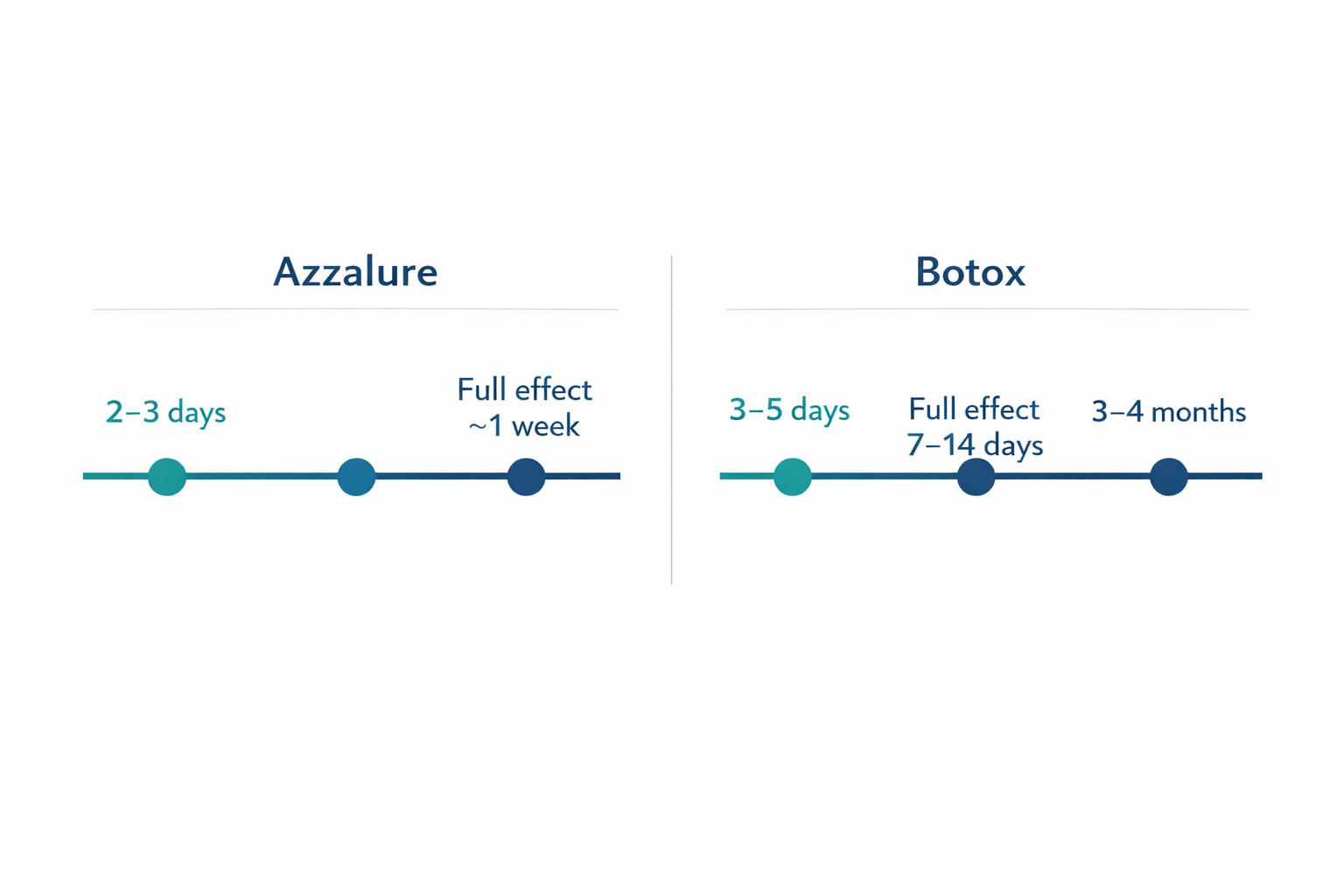
In terms of duration, both products last approximately 3–4 months for most patients, after which muscle activity gradually returns and the dynamic wrinkles reappear. Some individuals report that Azzalure may fade slightly faster in certain areas, though this varies considerably between patients and is influenced by factors such as muscle mass, metabolism, lifestyle, and the dose administered. Neither product offers permanent results, and maintenance treatments are required to sustain the effect.
It is worth noting that individual response to botulinum toxin varies. Some patients find one product suits them better than the other in terms of how natural the result feels or how long it lasts. This is one reason why an experienced practitioner may adjust the product choice based on a patient’s previous treatment history.
Diffusion and Treatment Areas: Where Each Product May Be Better Suited
The difference in diffusion properties between Azzalure and Botox has practical implications for which treatment areas each product may be better suited to.
Because Azzalure spreads more widely from the injection point, it can be advantageous for broader treatment areas such as the forehead, where a softer, more even relaxation across a larger surface is often desirable. Fewer injection points may be needed to cover the area, which some patients find more comfortable. However, this wider spread also means that precision is critical — if Azzalure diffuses into an adjacent muscle that was not intended to be treated, it can cause unwanted effects such as a drooping brow or eyelid ptosis.
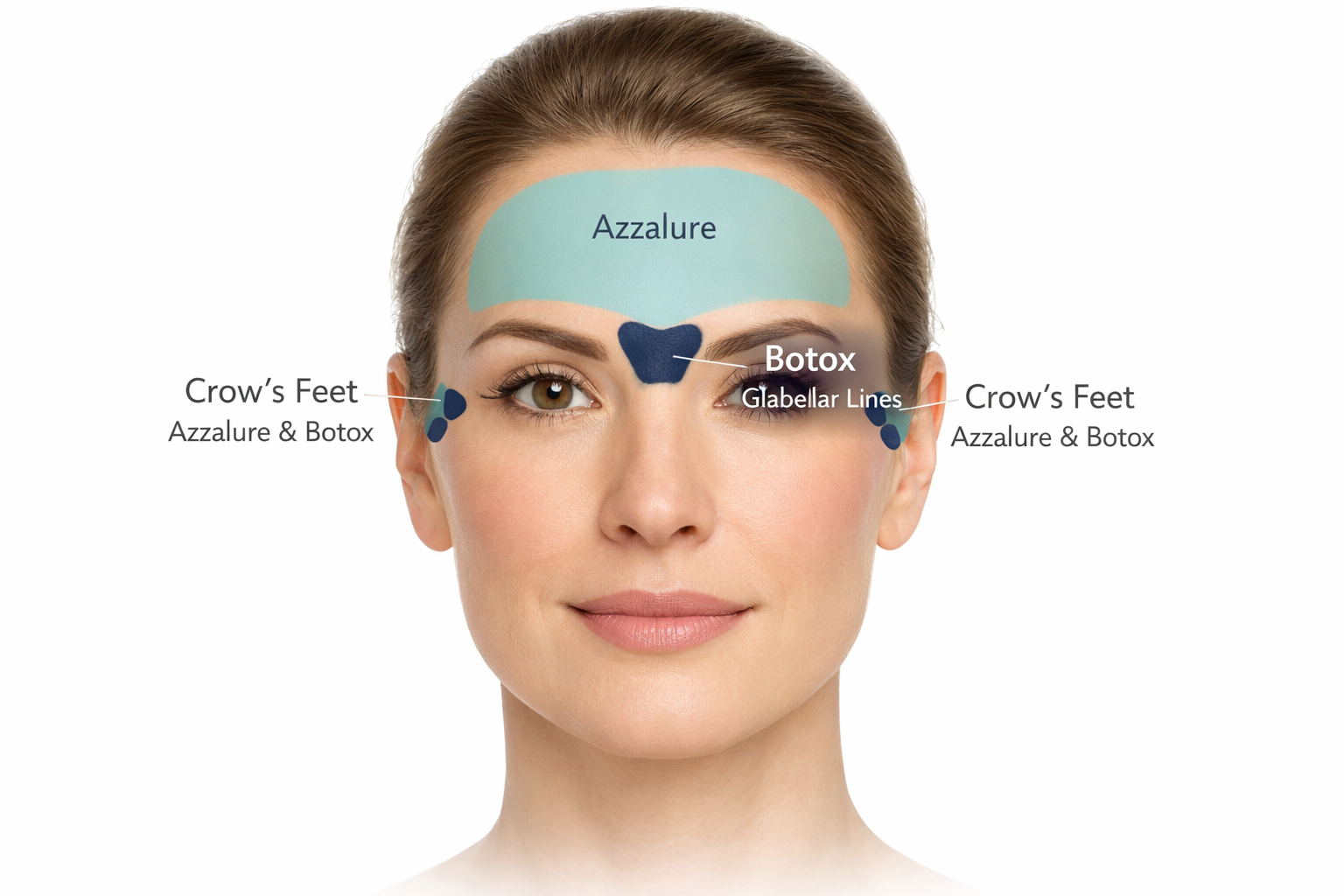
Botox, with its more localised effect, is often preferred for areas requiring pinpoint accuracy — such as the glabellar lines (the vertical frown lines between the eyebrows), fine perioral lines, or smaller defined areas where unintended spread would be problematic. More injection points may be needed to cover a broader area, but the practitioner has greater control over exactly where the product acts.
Both products are MHRA licensed for glabellar lines and lateral canthal lines (crow’s feet). Treatment of forehead lines, brow lifting, bunny lines, gummy smile, chin dimpling, jawline slimming, and neck bands are considered off-label use for both products — meaning these applications are not covered by the product’s formal licence, though they are widely practised by experienced clinicians. Botox additionally holds MHRA licences for medical indications including hyperhidrosis (excessive sweating) and chronic migraines, which Azzalure does not.
Results: Natural Look vs Precision
The aesthetic outcome of botulinum toxin treatment depends far more on the skill and judgement of the injector than on the specific product used. That said, the formulation differences between Azzalure and Botox do influence the character of the result in some patients.
Azzalure is often associated with a softer, more diffuse relaxation that some patients describe as more natural-looking. Because the product spreads more broadly, it can create a gradual transition between treated and untreated muscle, which may reduce the risk of a sharp or unnatural demarcation. For patients concerned about a frozen look, this characteristic can be appealing — though it is worth emphasising that a frozen or overly stiff appearance is primarily the result of excessive dosing or poor technique, not the product itself.
Botox’s more targeted action is valued when a practitioner wants to relax a specific muscle without affecting adjacent structures. This precision can be particularly important in areas where the margin between a desirable and an undesirable outcome is narrow.
Ultimately, the most important factor in achieving natural-looking results is choosing a qualified medical injector with a thorough understanding of facial anatomy and experience with both products. The product is a tool; the outcome depends on how it is used.
Safety, Side Effects, and Contraindications
Both Azzalure and Botox have well-established safety profiles when administered correctly by a qualified practitioner. Common side effects for both products include temporary bruising, mild swelling, or redness at the injection site, which typically resolve within a few days. Headache is occasionally reported after treatment. More significant but less common side effects include temporary drooping of the eyelid or brow if the product migrates to an unintended area — a risk that is higher with Azzalure if diffusion is not carefully managed.
One clinically relevant distinction is the risk of antibody formation over time. With repeated botulinum toxin treatments, a small number of patients develop neutralising antibodies that reduce the product’s effectiveness — a phenomenon sometimes called treatment resistance. Botox has a larger body of long-term clinical data on this topic, and some evidence suggests that products with higher protein content may carry a marginally higher risk of triggering an immune response. Azzalure’s lower accessory protein content has been proposed as a potential advantage in this regard, though the clinical significance for most cosmetic patients receiving standard doses remains uncertain.
Azzalure carries specific contraindications that patients should be aware of. It should not be used in individuals with neuromuscular conditions such as myasthenia gravis, Eaton-Lambert syndrome, or amyotrophic lateral sclerosis (ALS), as these conditions affect the neuromuscular junction and can amplify the product’s effects unpredictably. Azzalure is also contraindicated during pregnancy and breastfeeding, in patients with an active infection at the proposed injection site, and in those under 18 or over 65 years of age according to its licensed indications. Botox shares many of the same contraindications, though the specific age and population restrictions differ slightly between products.
A thorough medical consultation before treatment is essential for both products. Patients should disclose all medications, medical conditions, and previous aesthetic treatments to allow the practitioner to assess suitability safely.
Azzalure and Dysport: Are They the Same?
This is a question that causes genuine confusion. Azzalure and Dysport both contain abobotulinumtoxinA manufactured by Ipsen, and they are derived from the same molecule. However, they are not identical products in terms of their licensed indications, dosing, and the markets in which they are used.
Dysport is the name used in therapeutic (medical) settings and in some international markets, including the United States. Azzalure is the UK aesthetic brand — a cosmetic-specific formulation and dosing presentation of the same active ingredient, distributed in the UK by Galderma. If you have previously had Dysport treatment abroad and are considering Azzalure in the UK, it is worth informing your practitioner, as the dosing context may differ.
Switching Between Azzalure and Botox
Patients sometimes ask whether they can switch between Azzalure and Botox between treatment cycles. The answer is yes, but the switch requires careful dosing recalibration by the practitioner. Because the two products use different unit systems — Speywood units for Azzalure and Allergan units for Botox — a dose that worked well with one product cannot simply be replicated with the other using the same number. An experienced injector will reassess the appropriate dose for the new product based on the patient’s muscle response, treatment history, and the area being treated.
Switching products is not inherently problematic, but it does underline the importance of working with a practitioner who keeps accurate treatment records and understands the clinical differences between botulinum toxin brands.
Cost: Is One More Affordable Than the Other?
In the UK, both Azzalure and Botox are typically priced per treatment area rather than per unit, with costs generally ranging from approximately £150 to £350 per area depending on the clinic, location, and practitioner experience. The product used rarely changes the price a patient pays significantly, because although Azzalure may cost slightly less per Speywood unit at wholesale level, more units are required to achieve an equivalent effect — making the overall treatment cost broadly comparable.
Patients should be cautious of unusually low prices for either product. Botulinum toxin treatments are prescription-only medicines, and suspiciously cheap offers may indicate diluted product, unqualified practitioners, or products sourced outside regulated supply chains. The wholesale prices set by Galderma, Allergan, and other licensed suppliers are fixed, and significant undercutting of market rates is a potential warning sign.
Choosing Between Azzalure and Botox: A Practical Framework
Rather than declaring one product universally superior, it is more useful to consider which characteristics may align better with a patient’s specific goals and anatomy. The following framework is a guide for discussion with your practitioner — not a substitute for a clinical assessment.
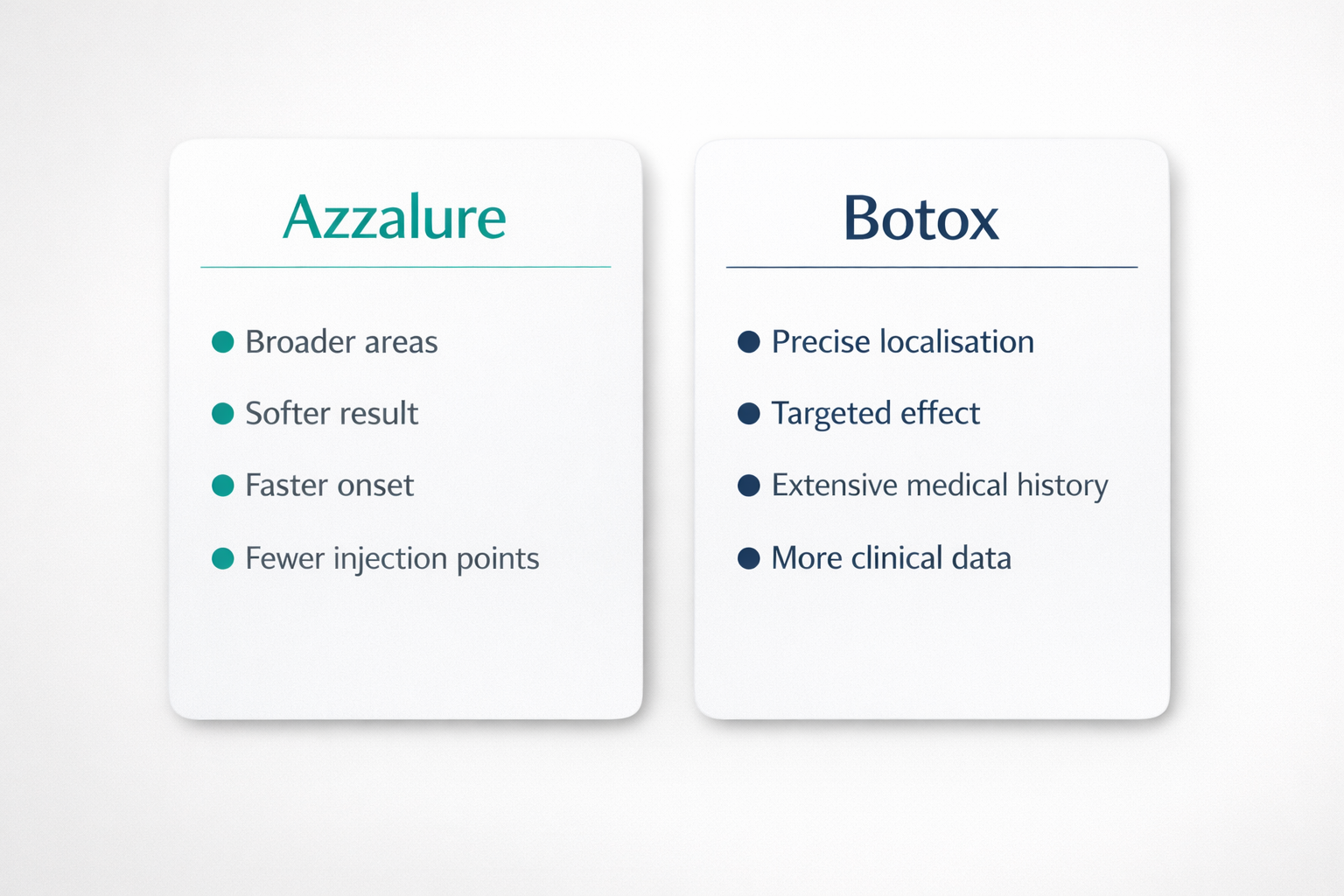
- Consider discussing Azzalure if: you are treating a broader area such as the forehead, you prefer a softer and more diffuse relaxation, you have previously responded well to abobotulinumtoxinA products, or your practitioner has particular expertise with this formulation.
- Consider discussing Botox if: you are treating a smaller or more defined area requiring precise localisation, you have a history of good response to onabotulinumtoxinA, you require a product with a broader range of licensed medical indications, or your practitioner recommends it based on your facial anatomy.
- In either case: the injector’s skill, knowledge of facial anatomy, and familiarity with the chosen product matter more than the brand itself. A highly experienced practitioner using either product will generally achieve better results than a less experienced one using the theoretically preferred option.
If you are new to botulinum toxin treatment, your practitioner will typically recommend the product they have the most experience with and that they believe is best suited to your anatomy and goals. This is a reasonable approach — both products are clinically effective and well-established.
Frequently Asked Questions
Is Azzalure the same as Dysport?
Azzalure and Dysport both contain abobotulinumtoxinA manufactured by Ipsen, but they are not identical products. Azzalure is the UK aesthetic brand with its own licensed indications and dosing presentation, distributed by Galderma. Dysport is used in therapeutic settings and in other international markets. If you have had Dysport treatment previously, inform your practitioner before switching to Azzalure.
Can I switch from Botox to Azzalure, or vice versa?
Yes, but the switch requires dosing recalibration. Azzalure uses Speywood units and Botox uses Allergan units — these are not interchangeable. Your practitioner will need to reassess the appropriate dose for the new product based on your treatment history and muscle response.
Which lasts longer — Azzalure or Botox?
Both products typically last approximately 3–4 months. Some patients report that Azzalure may fade slightly faster in certain areas, but this varies considerably between individuals. Duration is influenced by muscle mass, metabolism, lifestyle, and the dose administered, as much as by the product itself.
Is Azzalure safer than Botox, or vice versa?
Both products have well-established safety profiles when administered by a qualified medical injector. Neither is categorically safer than the other. The most important safety factor is the skill and training of the practitioner, not the specific brand. Both are prescription-only medicines regulated by the MHRA.
Why does Azzalure use more units than Botox?
Azzalure is measured in Speywood units, which are a different potency measurement from the Allergan units used for Botox. Approximately 2–4 Speywood units are needed to achieve an effect broadly comparable to 1 Allergan unit. This does not mean Azzalure is weaker — it simply uses a different scale. The overall treatment cost is generally comparable between the two products.
Is aftercare different for Azzalure and Botox?
No. Standard aftercare advice applies to both products: avoid rubbing or massaging the treated area for at least 24 hours, remain upright for several hours after treatment, avoid strenuous exercise and excessive heat on the day of treatment, and follow any specific guidance from your practitioner. There is no meaningful difference in aftercare requirements between the two products.
Can Azzalure be used for forehead lines?
Azzalure is MHRA licensed for glabellar lines and lateral canthal lines only. Treatment of forehead lines with Azzalure is considered off-label use — a common and widely practised application, but one that falls outside the product’s formal licence. Your practitioner should discuss this with you as part of the consent process.
Azzalure or Botox: Which May Be Right for You?
For most patients, the choice between Azzalure and Botox will be guided primarily by their practitioner’s clinical judgement, training, and experience with each product — and this is appropriate. Both are effective, MHRA-licensed botulinum toxin type A treatments with comparable safety profiles and similar treatment durations. The differences that exist — in diffusion, molecular structure, onset speed, and unit systems — are clinically meaningful but do not make one product universally superior to the other.
Azzalure may be particularly well suited to patients seeking a softer, more diffuse result across broader areas, and its faster onset can be appealing. Botox may be preferred when precise localisation is important or when treating areas where unintended spread would be problematic. In practice, many experienced practitioners work comfortably with both products and select between them based on the individual patient’s anatomy, goals, and treatment history.
What matters most is not which brand is in the vial, but the knowledge, skill, and care of the person holding it. If you are considering botulinum toxin treatment, seek a consultation with a qualified medical professional who can assess your suitability, explain which product they recommend and why, and discuss realistic expectations for your specific concerns.