

Almost every face is asymmetrical to some degree — this is entirely normal and, in most cases, imperceptible to others. However, when differences between the left and right sides of the face become more pronounced, they can affect how a person feels about their appearance. Understanding what causes facial asymmetry, which treatment options exist, and what realistic improvements look like is essential before considering any intervention.
Key Takeaways
- A degree of facial asymmetry is universal and considered a normal feature of human anatomy.
- Causes range from natural developmental variation to lifestyle habits, dental issues, ageing, and medical conditions.
- Non-surgical options such as dermal fillers and botulinum toxin may improve the appearance of mild to moderate asymmetry, with results that are temporary and variable.
- Surgical approaches may be more appropriate for structural or skeletal asymmetry, but carry greater risks and longer recovery.
- A thorough clinical assessment is essential before any treatment, as the underlying cause significantly influences which approach, if any, is appropriate.
What Is Facial Asymmetry?
Facial asymmetry refers to a measurable or visible difference between the left and right sides of the face. The human face develops from two halves that fuse during embryonic growth, and perfect bilateral symmetry is essentially never achieved. Studies using facial measurement tools consistently show that all faces display some degree of asymmetry, and research in aesthetic medicine generally regards minor asymmetry as a normal anatomical finding rather than a condition requiring correction.
The degree of asymmetry that becomes noticeable — either to the individual or to others — varies considerably. Mild asymmetry is typically only apparent in close-up photographs or when the face is divided digitally into mirrored halves. More significant asymmetry may involve differences in the position of the eyes, the height of the eyebrows, the projection of the cheekbones, the shape of the jaw, or the fullness of the lips. When asymmetry is pronounced, it may occasionally signal an underlying structural, dental, or medical cause that warrants professional evaluation.
Common Causes of an Asymmetrical Face
Facial asymmetry can arise from a wide range of factors, and identifying the likely cause is an important first step before considering any treatment. The causes broadly fall into developmental, lifestyle-related, age-related, and medical categories.
Developmental and Genetic Factors
Natural variation in how the facial skeleton, soft tissue, and cartilage develop during childhood and adolescence accounts for the majority of facial asymmetry seen in adults. Genetic factors influence bone structure, muscle attachment, and fat distribution, all of which contribute to the overall shape and balance of the face. Conditions such as hemifacial microsomia — where one side of the face develops incompletely — represent a more significant developmental cause, though these are relatively uncommon.
Lifestyle and Postural Habits
Habitual behaviours can gradually influence facial symmetry over time. Consistently sleeping on one side of the face, chewing predominantly on one side, or resting the face on a hand are commonly cited contributing factors. While the evidence linking these habits directly to measurable asymmetry in adults is limited, they are plausible mechanisms given the adaptability of soft tissue and, to a lesser extent, bone in younger individuals.
Dental and Jaw-Related Causes
The alignment of the teeth and jaw has a direct relationship with facial symmetry. Malocclusion (misaligned bite), missing teeth, or temporomandibular joint (TMJ) dysfunction can alter the position of the jaw and the balance of the muscles around it, contributing to visible asymmetry in the lower face. In these cases, addressing the dental or orthodontic issue may be a more appropriate first step than aesthetic treatment.
Ageing and Volume Loss
As the face ages, bone resorption, fat redistribution, and changes in skin laxity occur at different rates on each side of the face. This means that asymmetry which was barely noticeable in youth can become more apparent with age. Volume loss in the cheeks, temples, or under-eye area may be more pronounced on one side, and the descent of soft tissue structures can differ between left and right. Age-related asymmetry is one of the most common presentations seen in aesthetic medicine consultations.
Sun Exposure and Environmental Factors
Chronic unilateral sun exposure — for example, through a car window on the driver’s side — can accelerate skin ageing on one side of the face more than the other. This may result in differences in skin texture, pigmentation, and laxity between the two sides over many years.
Medical Conditions and Injury
Certain medical conditions can cause or worsen facial asymmetry. Bell’s palsy, a condition causing temporary weakness or paralysis of the facial nerve, can result in noticeable asymmetry of the muscles controlling facial expression. Stroke, trauma, previous surgery, or scarring may also produce structural changes that affect facial balance. When asymmetry has a medical cause, treatment should be directed by the relevant medical specialist before any aesthetic intervention is considered.
Assessing Facial Asymmetry: What a Clinical Evaluation Involves
Before any treatment is recommended, a qualified practitioner should conduct a thorough facial assessment. This typically involves evaluating the face at rest and during movement, examining the underlying bone structure, soft tissue volume, skin quality, and muscle activity. Standardised photographs taken from multiple angles are commonly used to document asymmetry and to plan treatment.
A good assessment also considers the patient’s concerns and goals, distinguishing between asymmetry that is genuinely visible to others and asymmetry that is primarily perceived by the patient themselves. In some cases, what a patient identifies as asymmetry may relate to other concerns such as volume loss, skin laxity, or muscle hyperactivity rather than a true structural imbalance. Identifying the correct underlying cause is essential, because the most appropriate treatment — or the decision that no treatment is needed — depends on it.
Non-Surgical Treatment Options for Facial Asymmetry
Non-surgical approaches are most appropriate for mild to moderate facial asymmetry caused by differences in soft tissue volume, muscle activity, or skin quality. They are generally not suitable for significant skeletal or structural asymmetry.
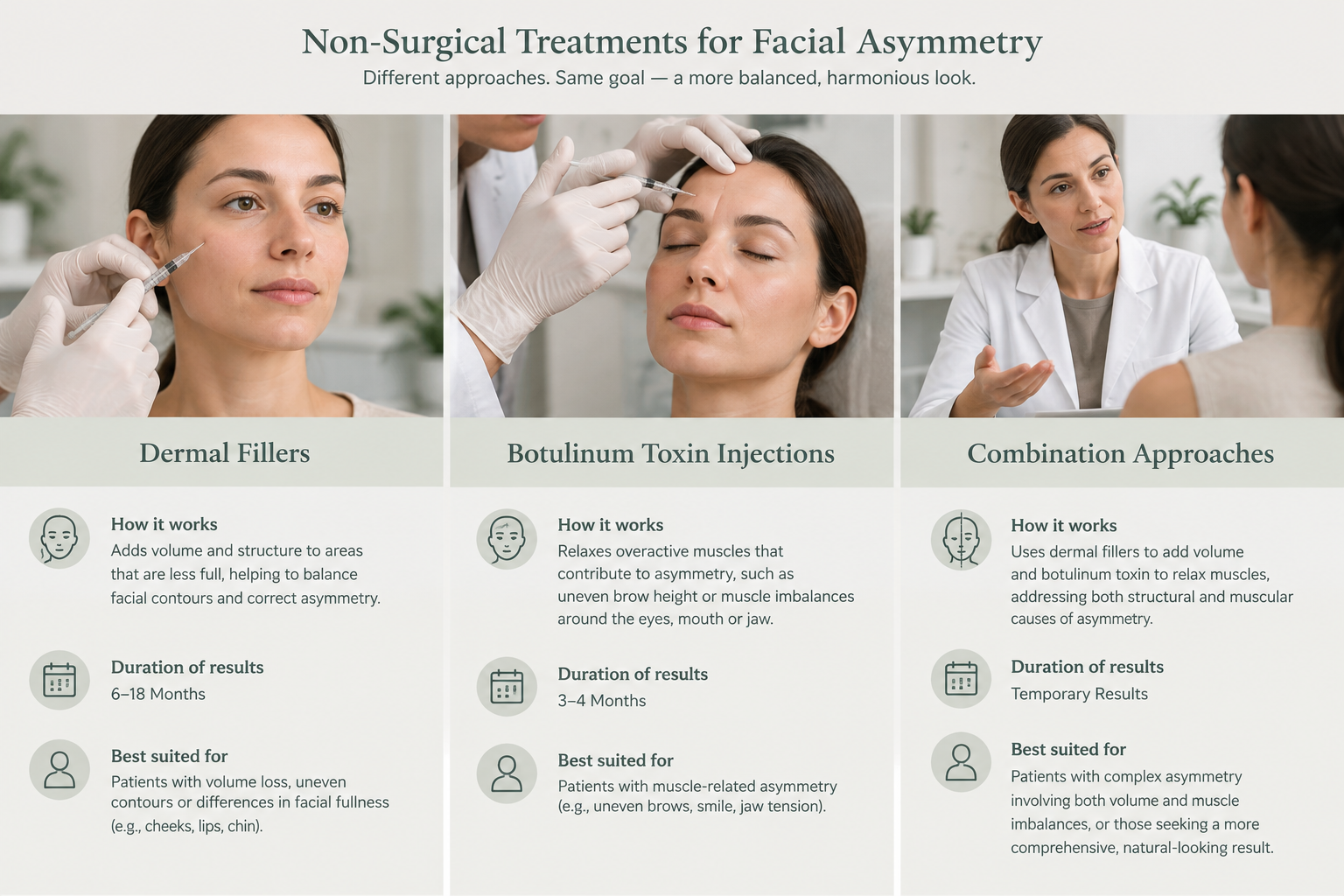
Dermal Fillers
Injectable dermal fillers — most commonly based on hyaluronic acid — are one of the most frequently used non-surgical tools for addressing facial asymmetry. Fillers can be placed strategically to add volume to a deficient area, improve the projection of a flatter cheekbone, enhance lip symmetry, or restore balance to the chin or jawline. Because hyaluronic acid fillers are reversible using an enzyme called hyaluronidase, they offer a degree of flexibility that other treatments do not.
Results from dermal fillers for facial asymmetry are temporary, typically lasting between six and eighteen months depending on the product used, the area treated, and individual factors such as metabolism and lifestyle. Multiple treatment sessions may be needed to achieve the desired balance, and maintenance appointments are required to sustain results. Risks include bruising, swelling, asymmetry from uneven placement, and, in rare cases, more serious complications such as vascular occlusion. Treatment should only be performed by a qualified and experienced medical professional.
Botulinum Toxin Injections
Botulinum toxin (commonly known by brand names such as Botox or Dysport) can be used to address asymmetry caused by differences in muscle activity between the two sides of the face. For example, if one eyebrow sits lower than the other due to differences in the underlying muscle pull, carefully placed botulinum toxin injections may help to elevate the lower brow or relax the overactive muscle on the higher side. Similarly, asymmetry in the lip position, the corners of the mouth, or the jaw muscles may be amenable to botulinum toxin treatment in selected cases.
The effects of botulinum toxin are temporary, typically lasting three to four months, after which the muscle activity gradually returns. Achieving symmetry with botulinum toxin requires precise assessment and injection technique, as incorrect placement can worsen asymmetry. Risks include bruising, temporary weakness of adjacent muscles, drooping of the eyelid or brow, and uneven results. A thorough consultation with a practitioner experienced in facial anatomy is essential.
Combination Approaches
In many cases, addressing facial asymmetry non-surgically involves a combination of treatments rather than a single modality. For example, dermal fillers may be used to restore volume on one side of the face while botulinum toxin addresses a muscle imbalance on the other. Skin quality treatments such as chemical peels, laser resurfacing, or radiofrequency may also be incorporated where differences in skin texture or laxity contribute to the overall appearance of asymmetry. A staged, conservative approach is generally recommended, particularly for patients new to aesthetic treatments.
Surgical Options for Facial Asymmetry
When facial asymmetry is structural — involving differences in bone position, jaw alignment, or significant soft tissue excess — surgical intervention may be the most appropriate option. Surgical approaches are typically considered when non-surgical treatments are unlikely to produce a meaningful improvement, or when the degree of asymmetry significantly affects function as well as appearance.
Orthognathic Surgery
Orthognathic surgery involves repositioning the upper jaw (maxilla), lower jaw (mandible), or both to correct skeletal imbalances. It is typically performed in collaboration with an orthodontist and is most appropriate for patients with significant jaw asymmetry, malocclusion, or facial skeletal discrepancies. Recovery is substantial, involving several weeks of restricted diet and activity, and the procedure carries the risks associated with general anaesthesia and major facial surgery.
Fat Grafting
Autologous fat grafting — transferring fat from another area of the body to the face — can be used to add volume to a deficient side of the face in a more durable way than temporary fillers. Results may last longer than hyaluronic acid fillers, though some resorption of the transferred fat is expected, and outcomes can be less predictable. Fat grafting is a surgical procedure performed under local or general anaesthesia and carries risks including infection, contour irregularity, and variable fat survival.
Rhinoplasty and Other Facial Surgical Procedures
When asymmetry involves the nose, ears, or eyelids, targeted surgical procedures such as rhinoplasty, otoplasty, or blepharoplasty may be considered. These are specialist surgical interventions with their own specific indications, risks, and recovery requirements. A consultation with a qualified plastic or maxillofacial surgeon is necessary to determine suitability.
Realistic Expectations and Limitations of Treatment
One of the most important aspects of any consultation for facial asymmetry is establishing realistic expectations. No treatment — surgical or non-surgical — can produce a perfectly symmetrical face, and attempting to do so is neither a realistic nor necessarily a desirable goal. Research in facial aesthetics suggests that a degree of natural asymmetry is associated with a more authentic and approachable appearance, and that overly symmetrical faces can appear unnatural.

Non-surgical treatments can meaningfully improve the appearance of mild to moderate asymmetry, but results depend heavily on the underlying cause, the skill of the practitioner, and individual anatomy. Patients with significant skeletal asymmetry are unlikely to achieve satisfactory results from fillers or botulinum toxin alone. Similarly, asymmetry caused by a medical condition such as facial nerve palsy requires medical management first, and aesthetic treatment may only be appropriate once the underlying condition has stabilised.
It is also worth noting that the perception of one’s own facial asymmetry is often greater than what others observe. Photographs — particularly close-up selfies taken with a wide-angle lens — can exaggerate asymmetry due to lens distortion. A practitioner can help to provide an objective assessment and to distinguish between asymmetry that is clinically significant and that which falls within the normal range of human facial variation.
Risks and Side Effects to Consider
All treatments for facial asymmetry carry some degree of risk, and these should be discussed in detail during a consultation before any procedure is undertaken.
- Dermal fillers: Bruising, swelling, tenderness, lumpiness, migration of product, allergic reaction, infection, and — in rare but serious cases — vascular occlusion leading to tissue damage or vision changes.
- Botulinum toxin: Bruising, headache, temporary muscle weakness, drooping of the eyelid or brow, asymmetrical results, and spread of effect to adjacent muscles.
- Surgical procedures: Infection, scarring, nerve damage, anaesthetic risks, prolonged swelling, asymmetrical healing, and the possibility of revision surgery.
- Fat grafting: Variable fat survival, contour irregularity, infection, and the risks associated with the donor site liposuction.
The risk profile of any treatment is influenced by the practitioner’s experience and training, the patient’s individual anatomy and medical history, and the specific technique used. Choosing a qualified, experienced practitioner and attending a thorough pre-treatment consultation significantly reduces — but does not eliminate — the risk of adverse outcomes.
Who May Be Suitable for Facial Asymmetry Treatment
Suitability for treatment depends on the nature and cause of the asymmetry, the patient’s overall health, and their expectations. Non-surgical treatments may be appropriate for adults with mild to moderate soft tissue asymmetry who are in good general health, have realistic expectations, and understand that results are temporary and variable. Patients with active skin infections, certain autoimmune conditions, a history of severe allergic reactions, or who are pregnant or breastfeeding are generally not suitable candidates for injectable treatments.
Surgical options require a more detailed assessment of overall health, including fitness for anaesthesia. Patients with significant skeletal asymmetry, those who have not responded adequately to non-surgical approaches, or those whose asymmetry affects function as well as appearance may be better served by a surgical consultation.
Patients who are primarily concerned about asymmetry they perceive in photographs but that is not clearly visible in person may benefit from a discussion with their practitioner about the role of lens distortion and the normal range of facial variation before committing to any treatment.
Frequently Asked Questions
Is it normal to have an asymmetrical face?
Yes. All human faces display some degree of asymmetry, and this is considered a normal anatomical feature. Studies consistently show that perfect facial symmetry does not exist in nature. Minor asymmetry is typically imperceptible to others and does not require treatment.
Can facial asymmetry worsen with age?
Facial asymmetry can become more noticeable with age due to differential rates of bone resorption, fat redistribution, and skin laxity on each side of the face. Asymmetry that was barely visible in youth may become more apparent in middle age and beyond.
Can dermal fillers fix facial asymmetry permanently?
Dermal fillers do not provide permanent correction. Hyaluronic acid fillers typically last between six and eighteen months before the body gradually breaks them down. Maintenance treatments are required to sustain results. Fat grafting may offer longer-lasting volume correction, but some resorption is expected and outcomes vary.
Will botulinum toxin make my face look unnatural?
When performed by an experienced practitioner using appropriate doses and placement, botulinum toxin treatment for facial asymmetry should produce a natural-looking result. Over-treatment or incorrect placement can lead to an unnatural appearance or worsened asymmetry, which is why practitioner selection and a conservative approach are important.
How do I know if my facial asymmetry needs treatment?
Most facial asymmetry does not require treatment. If asymmetry is causing significant distress, affecting function, or has changed noticeably over a short period, a consultation with a qualified medical professional is appropriate. A practitioner can help determine whether the asymmetry is within the normal range, whether it has an identifiable cause, and whether treatment is likely to provide a meaningful benefit.
Can lifestyle changes improve facial asymmetry?
Addressing habits such as one-sided chewing, sleeping consistently on one side, or resting the face on a hand may help prevent further asymmetry from developing, particularly in younger individuals. However, lifestyle changes alone are unlikely to correct established asymmetry, especially if it has a structural or skeletal basis.
Is facial asymmetry ever a sign of a medical problem?
In most cases, facial asymmetry is a normal anatomical variation. However, asymmetry that develops suddenly, is accompanied by weakness or numbness, or is associated with other symptoms should be assessed by a doctor promptly, as it may indicate a neurological condition such as Bell’s palsy or, in rare cases, stroke.
Deciding Whether to Seek Treatment for Facial Asymmetry
Facial asymmetry is a normal human characteristic, and the decision to seek treatment should be based on a clear understanding of what is achievable, what the risks involve, and whether the likely benefit justifies the cost, recovery, and ongoing maintenance that treatment requires. For many people, a consultation with a qualified practitioner — even if it concludes that no treatment is needed — provides reassurance and a more objective perspective on their appearance.
When treatment is appropriate, non-surgical options such as dermal fillers and botulinum toxin can offer meaningful improvements for soft tissue asymmetry with relatively limited downtime, provided expectations are realistic and the practitioner is experienced. Surgical options may be more suitable for structural asymmetry but involve greater commitment and risk. In all cases, the underlying cause of the asymmetry should be identified before treatment is planned, and any medical causes should be addressed first.
If you are considering treatment for facial asymmetry, seek a consultation with a qualified medical professional who can assess your specific anatomy, discuss the most appropriate options for your situation, and provide an honest appraisal of what treatment can and cannot achieve.