

Key Takeaways
- The Alexandrite laser operates at a 755 nm wavelength and works through selective photothermolysis — targeting melanin in hair follicles, pigmented lesions, and tattoo ink without damaging surrounding skin.
- It is most effective for Fitzpatrick skin types I–III (fair to light olive skin) and carries a higher risk of pigmentation changes on darker skin tones.
- Two distinct modes exist: the long-pulse Alexandrite laser for hair removal and vascular concerns, and the Q-switched Alexandrite laser for pigmentation and tattoo removal.
- Multiple treatment sessions are typically required, spaced 4–6 weeks apart for hair removal and at longer intervals for tattoo removal.
- Common side effects include temporary redness and swelling; post-inflammatory hyperpigmentation is a meaningful risk, particularly on olive or darker skin tones.
What Is the Alexandrite Laser?
The Alexandrite laser is a solid-state laser that uses an alexandrite crystal — a chromium-doped chrysoberyl gemstone — as its gain medium. When energised by a flashlamp, this crystal emits light at a 755 nm wavelength, placing it in the near-infrared portion of the spectrum. This specific wavelength is strongly absorbed by melanin, the pigment found in hair follicles, skin lesions, and certain tattoo inks, making the Alexandrite laser particularly well suited to treatments that depend on melanin as a target.
The device is FDA-cleared for several aesthetic applications, including permanent hair reduction, the treatment of pigmented lesions such as solar lentigines and freckles, and — in its Q-switched configuration — tattoo removal. It is one of the most widely studied laser platforms in dermatology and has been in clinical use since the 1990s.
How Does the Alexandrite Laser Work?
The Alexandrite laser operates on the principle of selective photothermolysis. This means the laser delivers a precise wavelength of light that is preferentially absorbed by a specific target — in this case, the melanin chromophore — while leaving the surrounding tissue largely unaffected. The absorbed light energy converts to heat, which damages the target structure. In hair removal, this heat causes hair follicle destruction. In pigmentation treatments, it breaks down melanin deposits. In tattoo removal, it fragments tattoo ink particles into smaller pieces that the body’s immune cells can gradually clear.
The effectiveness of this process depends on matching the pulse duration to the thermal relaxation time of the target — the time it takes for the target to cool. For hair follicles, millisecond pulse durations are used (long-pulse mode). For tattoo ink particles and superficial pigmentation, nanosecond pulses are required (Q-switched mode), as ink particles are far smaller and cool much faster than follicles.
To protect the skin surface during treatment, modern Alexandrite laser systems incorporate skin surface cooling mechanisms such as cryogen spray or contact cooling. This reduces discomfort and lowers the risk of epidermal damage, particularly at higher fluence (J/cm²) settings.
Long-Pulse vs. Q-Switched Alexandrite Laser
Understanding the difference between the two main operating modes helps clarify what the Alexandrite laser can and cannot do in each context.
The long-pulse Alexandrite laser delivers energy in millisecond pulses. This mode is used for laser hair removal and, to a lesser extent, for superficial vascular lesions such as spider veins and thread veins. The longer pulse duration allows heat to build up within the hair follicle and its surrounding structures, causing sufficient damage to inhibit future hair growth.
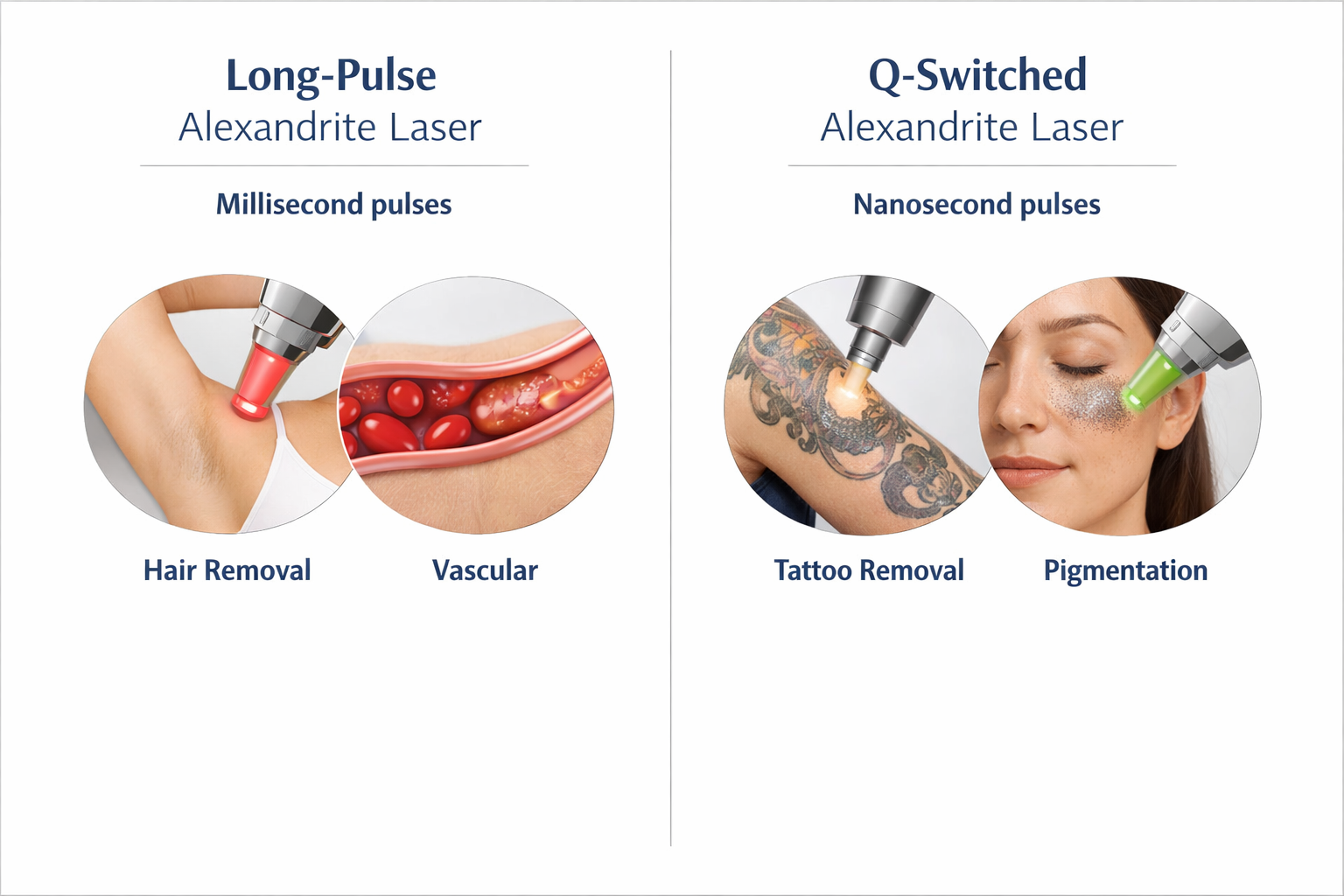
The Q-switched Alexandrite laser delivers energy in nanosecond pulses — extremely short bursts that generate a photoacoustic shockwave capable of shattering small targets such as tattoo ink particles and melanin granules in pigmented lesions. This mode is used for tattoo removal (particularly black, blue, and green inks) and for treating conditions such as nevus of Ota, café-au-lait macules, and acquired dermal melanocytosis. The Q-switched mode does not damage hair follicles and is not used for hair removal.
What Can the Alexandrite Laser Treat?
Laser Hair Removal
Laser hair removal is the most common application of the long-pulse Alexandrite laser. The 755 nm wavelength is highly absorbed by melanin in dark terminal hair, making it particularly effective for patients with fair to light olive skin and dark hair — a combination that provides strong contrast between the target (hair) and the surrounding skin. Clinical studies have reported mean hair reduction figures in the range of 65% or more for Alexandrite laser treatments in suitable candidates, though individual results vary depending on hair colour, thickness, treatment area, and the number of sessions completed.
Hair removal typically requires 6–8 treatment sessions spaced 4–6 weeks apart, as the laser can only affect follicles in the active growth phase at the time of treatment. Maintenance sessions may be needed annually or every few years, as the laser achieves long-term reduction rather than guaranteed permanent removal in every follicle. Common treatment areas include the underarms (approximately 5–10 minutes per session), bikini line, legs, back, chest, face, and neck.
Pigmented Lesions
Both the long-pulse and Q-switched configurations can address pigmented lesions, though the Q-switched mode is generally preferred for deeper or more resistant pigmentation. Treatable conditions include solar lentigines (age spots and sun spots), freckles, café-au-lait macules, nevus of Ota, and some congenital melanocytic naevi. The laser targets excess melanin deposits, breaking them down so they can be cleared by the body over the following weeks. Results vary depending on the depth and type of pigmentation, and not all lesions respond equally well. A clinical assessment is essential before treatment, as some pigmented lesions require dermatological evaluation to rule out other diagnoses.
Tattoo Removal
In Q-switched mode, the Alexandrite laser is effective at fragmenting black, blue, and green tattoo inks. The 755 nm wavelength is less well absorbed by red, orange, and yellow pigments, which typically require different laser wavelengths for effective clearance. Professional tattoos generally require more sessions than amateur tattoos — published estimates suggest an average of around 8 or more sessions for professional tattoos, though this varies considerably with ink density, colour, depth, and individual immune response. Sessions for tattoo removal are usually spaced further apart than hair removal sessions — often 6–8 weeks or longer — to allow the body time to clear fragmented ink particles between treatments.
Vascular Lesions
The long-pulse Alexandrite laser can target haemoglobin in small superficial blood vessels, making it useful for some spider veins, thread veins, and capillary vascular malformations on the face and body. However, longer wavelengths such as the Nd:YAG (1064 nm) are often preferred for vascular treatments, particularly for deeper or larger vessels, as they penetrate more effectively into the dermis.
Who Is a Suitable Candidate?
The Alexandrite laser is most effective and carries the lowest risk profile for individuals with Fitzpatrick skin types I–III — that is, fair, light, and light-to-medium skin tones. In these skin types, the contrast between the melanin in the target (hair or lesion) and the melanin in the surrounding skin is sufficient for selective targeting without significant risk to the epidermis.
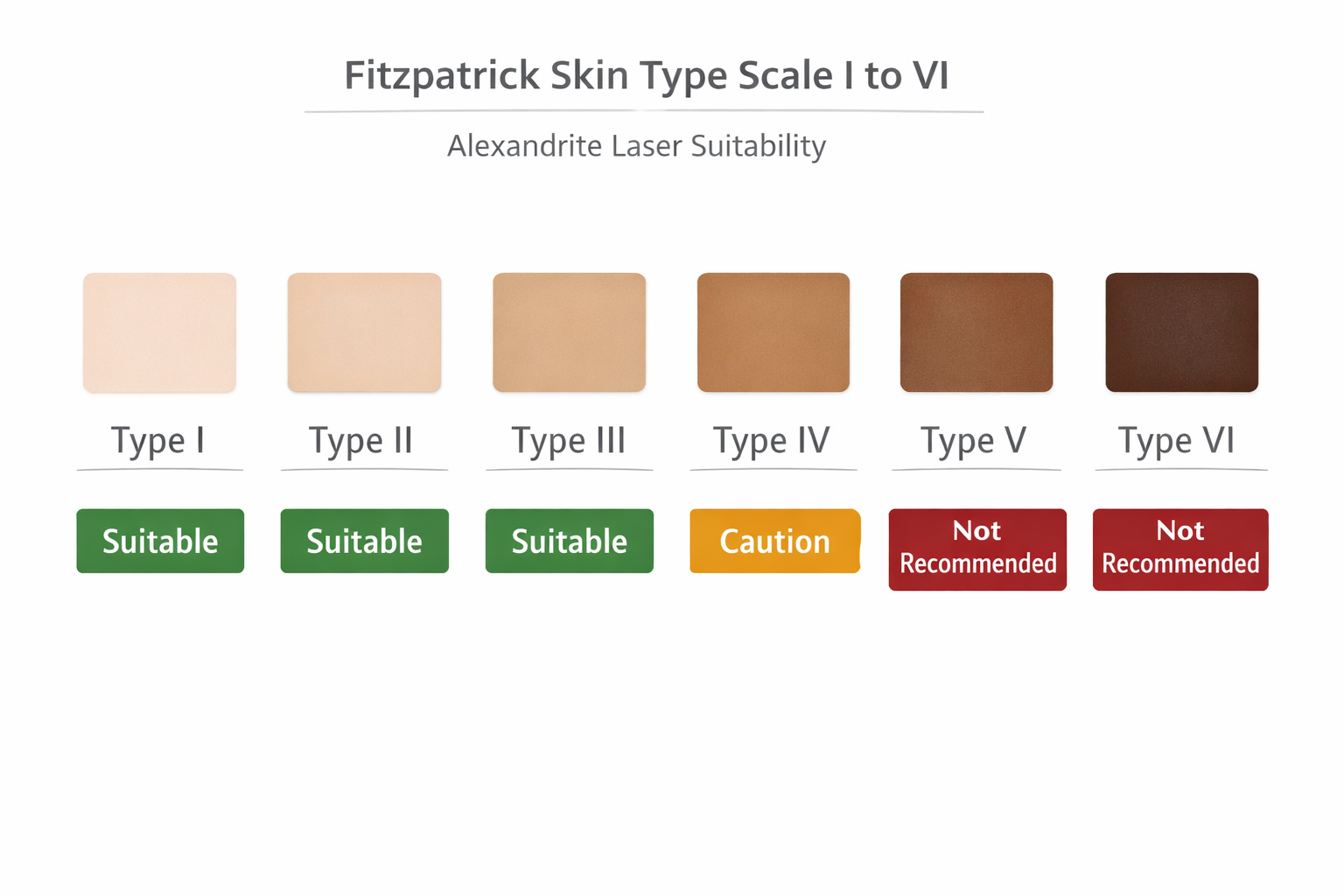
Patients with Fitzpatrick type IV skin (medium olive) may be treated with appropriate caution, lower fluence settings, and longer pulse durations, but the risk of side effects increases. For Fitzpatrick types V and VI (brown and dark skin), the Alexandrite laser is generally not recommended for hair removal or pigmentation treatments, as the high melanin content of the skin itself absorbs significant laser energy, raising the risk of burns, blistering, and post-inflammatory hyperpigmentation or hypopigmentation.
Good candidates for Alexandrite laser hair removal typically have dark hair and lighter skin. The laser is less effective on blonde, red, grey, or white hair, as these hair colours contain little or no eumelanin — the melanin type most strongly absorbed at 755 nm.
Who May Not Be Suitable
- Individuals with Fitzpatrick skin types V or VI (for hair removal and pigmentation treatments)
- Those with a recent tan or sun-exposed skin at the treatment site
- Pregnant or breastfeeding individuals
- People taking photosensitising medications (such as certain antibiotics or retinoids)
- Those with active skin infections, open wounds, or inflammatory skin conditions at the treatment site
- Individuals with a history of keloid scarring
- Those with very light or white hair (for hair removal)
- People with certain pigmented lesions that have not been assessed by a dermatologist
A thorough consultation and, where appropriate, a patch test are important steps before beginning any course of Alexandrite laser treatment. Your practitioner should review your medical history, current medications, and skin type before proceeding.
Alexandrite Laser vs. Other Laser and Light Technologies
The Alexandrite laser is one of several laser and light-based technologies used in aesthetic practice. Understanding how it compares to alternatives helps clarify when it may be the most appropriate choice and when a different device might be better suited.
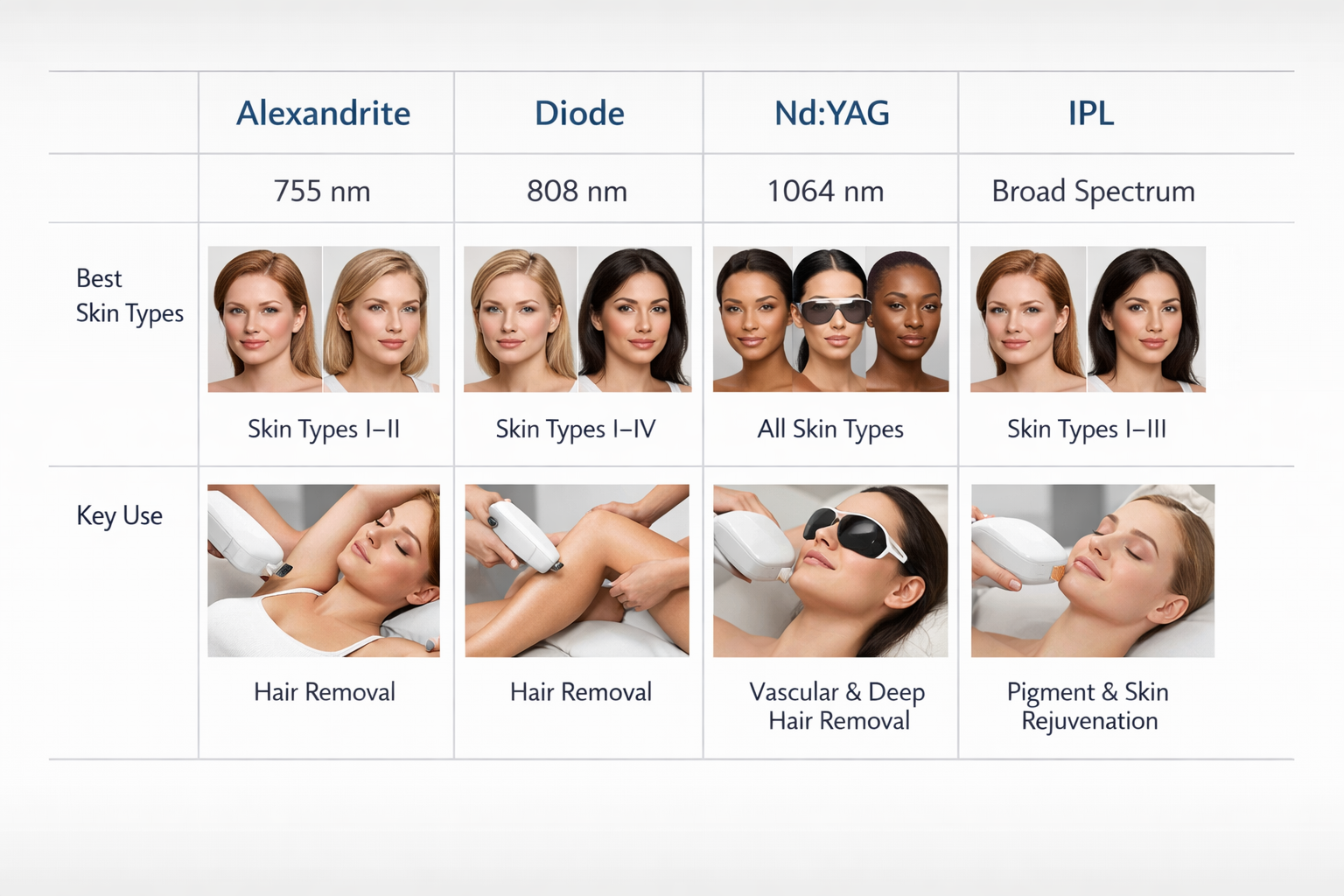
| Technology | Wavelength | Best Skin Types | Key Strengths | Key Limitations |
|---|---|---|---|---|
| Alexandrite laser | 755 nm | I–III (possibly IV) | Fast treatment, high melanin absorption, effective on fine dark hair | Not suitable for darker skin; less effective on light or fine hair |
| Diode laser | 800–810 nm | I–IV (some devices up to V) | Deeper penetration, broader skin type range than Alexandrite | May require more sessions; slightly less melanin absorption than Alexandrite |
| Nd:YAG laser | 1064 nm | I–VI | Safest option for darker skin tones; deeper penetration | Less effective on fine or light hair; can be more uncomfortable |
| Ruby laser | 694 nm | I–II | High melanin absorption; useful for pigmentation | Older technology; slower; suitable only for very fair skin |
| IPL (Intense Pulsed Light) | 500–1200 nm (broad spectrum) | I–III typically | Versatile; can address multiple concerns in one session | Not a true laser; less precise; generally less effective for hair removal than laser |
When comparing the Diode vs. Alexandrite laser specifically, published clinical data suggests the Alexandrite laser may achieve higher mean hair reduction rates in lighter skin types, while the Diode laser offers a broader safety margin for slightly darker skin. The Nd:YAG laser remains the standard recommendation for Fitzpatrick types V and VI, though it is generally considered less effective on fine or light-coloured hair than either the Alexandrite or Diode.
Some devices — such as the Candela GentleMax Pro — combine both Alexandrite (755 nm) and Nd:YAG (1064 nm) wavelengths in a single platform. This dual-wavelength approach allows practitioners to treat a wider range of skin types and to switch between wavelengths depending on the treatment area, concern, or individual patient characteristics. This combination protocol is increasingly used in clinics that see patients across the full Fitzpatrick spectrum.
What to Expect Before, During, and After Treatment
Before Treatment
A consultation is the essential first step. Your practitioner will assess your skin type, hair or lesion characteristics, medical history, and any medications you are taking. Sun avoidance for at least 4–6 weeks before treatment is typically recommended, as tanned skin increases the risk of adverse effects. You may be advised to shave the treatment area (for hair removal) but to avoid waxing, threading, or epilating, as these remove the hair root that the laser needs to target. A patch test may be recommended, particularly for patients with olive or darker skin tones.
During Treatment
The treatment area is cleaned and, where necessary, a topical anaesthetic cream may be applied beforehand to reduce discomfort. The practitioner will use a handheld laser device, adjusting the spot size, fluence (J/cm²), and pulse duration according to your skin type and the area being treated. Most modern Alexandrite laser systems include integrated skin surface cooling — either cryogen spray or a cooled contact tip — to protect the epidermis and improve comfort. The sensation is often described as a snapping or stinging feeling, similar to a rubber band flicking against the skin. Treatment times vary by area: underarms may take 5–10 minutes, while the legs or back may take 30–45 minutes or longer.
After Treatment
Redness and mild swelling at the treatment site are common and usually resolve within a few hours to a day. Applying a cool compress or aloe vera gel can help soothe the skin. Sun avoidance and daily SPF application are important in the weeks following treatment to reduce the risk of post-inflammatory hyperpigmentation. You should avoid scrubbing, exfoliating, or using active skincare ingredients such as retinoids or acids on the treated area until the skin has fully settled. For hair removal, treated hairs will shed gradually over the 1–3 weeks following each session rather than falling out immediately.
Risks and Side Effects
The Alexandrite laser has a well-established safety profile when used appropriately on suitable skin types, but it is not without risk. Understanding potential side effects helps patients make an informed decision.
- Redness and swelling: The most common immediate reactions, typically resolving within hours.
- Post-inflammatory hyperpigmentation: Darkening of the treated skin, more likely in olive or darker skin tones or following sun exposure. Usually temporary but can persist for months.
- Hypopigmentation: Lightening of the skin, which may be longer-lasting and is more likely at higher fluence settings or in darker skin types.
- Blistering or crusting: Can occur if settings are too aggressive or if the skin is tanned at the time of treatment.
- Scarring: Rare when treatment is performed correctly, but a risk if blistering is severe or poorly managed.
- Paradoxical hypertrichosis: An uncommon phenomenon where laser treatment stimulates rather than reduces hair growth, more often reported in hormonal areas or in patients with certain skin types.
- Eye injury: Appropriate protective eyewear must be worn by both the patient and practitioner throughout treatment.
The risk of serious adverse effects is significantly reduced when treatment is performed by a trained and experienced practitioner using appropriate settings for the individual patient’s skin type, and when pre-treatment assessment and aftercare guidance are followed carefully.
How Many Sessions Are Needed and What Results Are Realistic?
For laser hair removal, most patients require 6–8 treatment sessions spaced 4–6 weeks apart to achieve meaningful long-term hair reduction. This is because hair grows in cycles, and the laser is only effective on follicles in the active growth phase. After completing an initial course, many patients find that hair regrowth is significantly reduced in density and thickness. Maintenance sessions — typically once every 12–24 months — may be needed to address any regrowth over time.
For pigmented lesions, results often become visible within 2–4 weeks of a session as the body clears fragmented melanin. Some lesions resolve after a single session; others may require 2–4 treatments depending on depth and type.
For tattoo removal, the process is gradual. Ink fades progressively over multiple sessions, with the body’s immune system clearing fragmented ink particles between appointments. Black and dark blue inks typically respond best. Green ink also responds to the 755 nm wavelength, though often less completely. Red, orange, and yellow inks do not respond well to the Alexandrite laser and may require a different wavelength. Realistic expectations and patience are important — complete clearance is not guaranteed for all tattoos, and the process can take a year or more.
Frequently Asked Questions
Is the Alexandrite laser painful?
Most patients describe the sensation as a sharp snapping or stinging feeling with each pulse. Integrated cooling systems reduce discomfort considerably. Topical anaesthetic cream can be applied before treatment for more sensitive areas. Pain tolerance varies between individuals and treatment sites.
Can the Alexandrite laser be used on dark skin?
The Alexandrite laser is generally not recommended for Fitzpatrick skin types V and VI due to the elevated risk of burns, hyperpigmentation, and hypopigmentation. For darker skin tones, the Nd:YAG laser (1064 nm) is typically the safer and more appropriate choice. Patients with type IV skin may be treated with caution and adjusted settings — a thorough consultation is essential.
How long do hair removal results last?
The Alexandrite laser achieves long-term hair reduction rather than guaranteed permanent removal. Many patients see a significant and lasting reduction in hair density and thickness after completing a full course. Some regrowth may occur over time, particularly in hormonally sensitive areas, and occasional maintenance sessions may be beneficial.
Which tattoo ink colours does the Alexandrite laser remove?
The 755 nm wavelength is most effective on black, dark blue, and green inks. It is not well absorbed by red, orange, yellow, or pink pigments. Tattoos containing multiple colours may require treatment with more than one laser wavelength for comprehensive clearance.
How soon can I return to normal activities after treatment?
Most patients can resume daily activities immediately after treatment. Strenuous exercise, hot baths, saunas, and direct sun exposure should be avoided for at least 24–48 hours. Sun protection is important for several weeks following treatment.
Is a patch test necessary?
A patch test is not always mandatory but is strongly advisable for patients with olive or darker skin tones, those who have not had laser treatment before, or anyone with a history of pigmentation changes following skin trauma. It allows the practitioner to assess how your skin responds to the laser before treating a larger area.
Can the Alexandrite laser be combined with other treatments?
In some cases, practitioners may recommend combining Alexandrite laser treatment with other modalities — for example, using an Nd:YAG laser in the same session for patients with slightly darker skin or for areas where deeper penetration is beneficial. Combination protocols should always be guided by a qualified practitioner based on individual assessment.
Is the Alexandrite Laser the Right Choice for Your Concern?
The Alexandrite laser is a well-established, clinically supported technology with a strong track record for laser hair removal, pigmented lesion treatment, and tattoo removal in suitable patients. Its 755 nm wavelength makes it one of the most effective options for individuals with fair to light olive skin and dark hair, and its speed and large spot size make it practical for treating larger body areas efficiently.
However, it is not a universal solution. Patients with darker skin tones, light or fine hair, or certain pigmented lesions may be better served by alternative technologies such as the Nd:YAG laser or a dual-wavelength device. Realistic expectations are important: results develop gradually over multiple sessions, maintenance may be needed, and outcomes vary between individuals.
If you are considering Alexandrite laser treatment, a consultation with a qualified and experienced practitioner is the most important first step. A thorough assessment of your skin type, treatment goals, and medical history will help determine whether this laser is appropriate for you, what settings and number of sessions may be needed, and what results you can reasonably expect.