

Open pores are one of the most common skin concerns, yet they are also one of the most misunderstood. Enlarged pores cannot be permanently closed or eliminated — they are a normal part of skin anatomy — but with the right approach, it is genuinely possible to minimise the appearance of pores, refine skin texture, and keep them looking smaller over time. This guide explains what causes large pores, which skincare ingredients and routines actually work, and when professional treatments may offer a meaningful improvement.
Key Takeaways
- Pores do not open and close — they have no muscles — but their visible size can be reduced with consistent skincare and targeted treatments.
- Salicylic acid, niacinamide, and retinol are the most evidence-supported ingredients for minimising pore appearance.
- The underlying cause of your enlarged pores — excess oil, congestion, or age-related skin laxity — determines which approach will work best.
- Professional treatments such as microneedling, chemical peels, and laser resurfacing can produce more significant improvements than home care alone, particularly for laxity-driven pores.
- Results from any approach take time: expect four to twelve weeks from a consistent skincare routine and multiple sessions from professional treatments.
What Are Open Pores and Why Do They Appear?
Pores are the openings of hair follicles on the skin surface. Each follicle is connected to a sebaceous gland that produces sebum — the skin’s natural oil — which travels up through the pore to lubricate and protect the skin. When a pore becomes more visible, it is usually because the follicle opening has been stretched or the surrounding skin structure has weakened. The term “open pores” simply describes pores that appear enlarged to the naked eye; it does not mean the pore is literally open or blocked in a clinical sense.
Pore size is largely determined by genetics, which is why some people are simply more prone to visible pores regardless of their skincare habits. Beyond heredity, several factors can make pores appear larger over time. Excess sebum production stretches the follicle walls, particularly in the T-zone — the forehead, nose, and chin — where sebaceous glands are most concentrated. Oily and combination skin types are therefore most commonly affected. Clogged pores filled with pore-clogging debris such as dead skin cells, makeup residue, and oxidised sebum (blackheads) also widen the follicle opening visibly.
Ageing plays a significant structural role. The skin’s collagen and elastin network — including the perifollicular collagen that forms a supportive scaffold directly around each follicle — gradually degrades with age and cumulative UV exposure. As this scaffold weakens, the follicle walls lose their firmness and the pore appears to widen. This is why pores that were barely noticeable at twenty can become more prominent in the thirties and forties even without a change in oil production. Hormonal changes, particularly androgens, also drive increased sebum production and can enlarge pores during puberty, the menstrual cycle, and hormonal fluctuations in adulthood.
Three Types of Enlarged Pores — and Why the Distinction Matters
Most skincare advice treats all large pores the same, but matching the right treatment to the underlying cause makes a meaningful difference to outcomes. Broadly, enlarged pores fall into three overlapping categories.
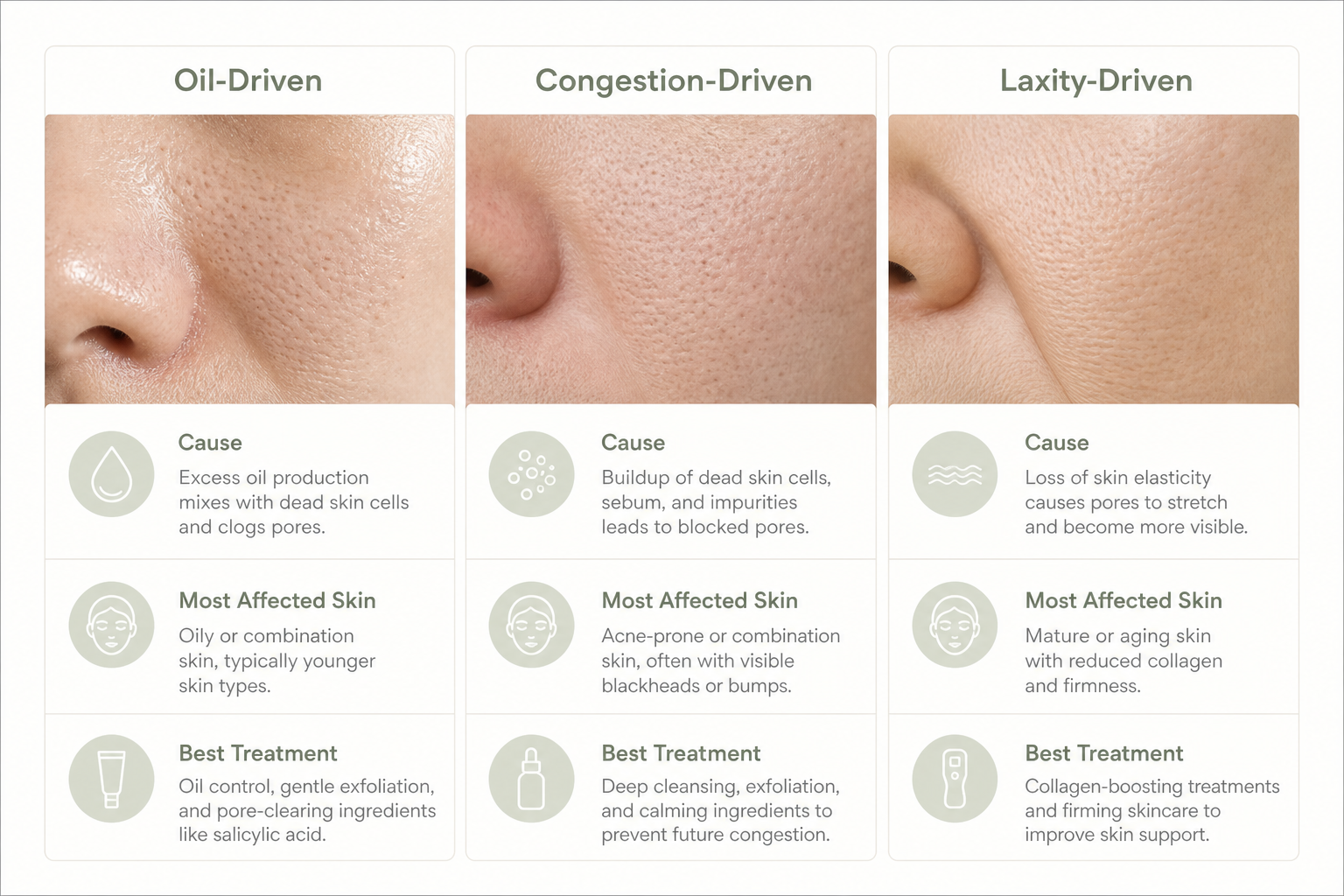
Oil-driven pores are most common in oily and combination skin types. The follicle is stretched by continuous excess sebum production, and pores are most visible across the nose, forehead, and chin. These respond well to oil-regulating ingredients such as salicylic acid and niacinamide, and to consistent cleansing routines.
Congestion-driven pores occur when dead skin cells and sebum accumulate inside the follicle, physically widening the opening. Blackheads are the visible result. Chemical exfoliants — particularly BHA (beta hydroxy acid) such as salicylic acid, which is oil-soluble and can penetrate into the follicle — are the most effective at clearing this type of congestion. Physical scrubs are less effective and can cause micro-tears that worsen the skin barrier.
Age and laxity-driven pores result from the loss of perifollicular collagen and overall skin laxity. The follicle walls are no longer held tightly in place, so pores appear stretched even when oil production is normal. Topical retinoids can help by stimulating cell turnover and supporting collagen production, but professional treatments that trigger collagen induction therapy — such as microneedling or fractional laser resurfacing — tend to produce more noticeable results for this pore type.
Building a Skincare Routine for Open Pores
A consistent skincare routine is the foundation of any pore-minimising strategy. Results are gradual — most people notice meaningful improvement after four to eight weeks of daily use — and maintaining the routine is necessary to sustain them.
Morning Routine
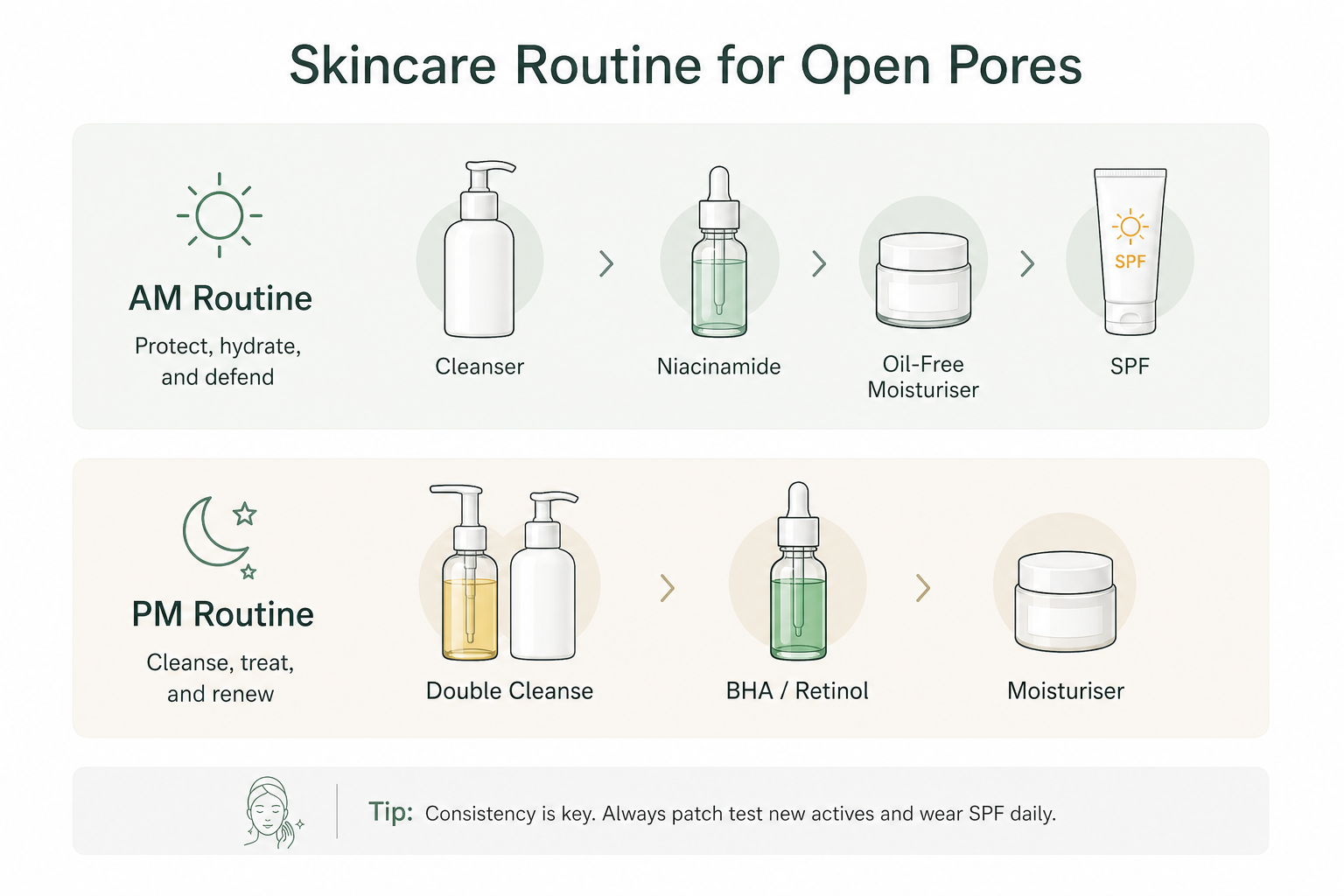
Start with a gentle gel-based or foam cleanser suited to your skin type. In the morning, a single cleanse is sufficient to remove overnight sebum without stripping the skin barrier. Follow with a niacinamide toner or serum: niacinamide (vitamin B3) regulates sebum production, visibly refines skin texture, and has a strong evidence base for reducing pore appearance with consistent use over four to six weeks. Apply a lightweight, oil-free moisturiser to maintain hydration without adding congestion — well-hydrated skin actually appears smoother, which reduces the visual contrast of pores. Finish with a broad-spectrum SPF 30 or higher sunscreen every morning without exception. UV exposure accelerates collagen breakdown and perifollicular collagen degradation, which worsens laxity-driven pores over time. Choosing a non-comedogenic sunscreen avoids adding to pore congestion.
Evening Routine
If you wear makeup or SPF, begin with a double cleanse: an oil-based cleanser or micellar water first to dissolve makeup and sunscreen, followed by your regular gel or foam cleanser. This step is important because sleeping in makeup is one of the most consistent contributors to clogged pores and congestion. Two to three evenings per week, apply a chemical exfoliant — a salicylic acid (BHA) product is particularly effective for oily and congestion-prone skin because it is oil-soluble and penetrates into the follicle to dissolve sebum and dead skin cell buildup. AHAs such as glycolic acid work on the skin surface and are useful for improving overall cell turnover and skin texture. PHAs are a gentler option for sensitive skin. On non-exfoliant evenings, a retinol or retinoid serum applied after cleansing can significantly improve pore appearance over eight to twelve weeks by accelerating cell turnover, regulating oil production, and stimulating collagen synthesis. Begin with a low-concentration retinol two nights per week to allow the skin to adjust, then increase frequency gradually. Finish with your oil-free moisturiser to support the skin barrier.
Weekly Additions
A clay mask used once or twice a week can absorb excess sebum and temporarily tighten the appearance of pores, particularly in the T-zone. Clay masks are not a long-term structural solution, but they are a useful addition to an oil-control routine. Avoid using clay masks daily, as over-drying the skin can trigger a compensatory increase in sebum production.
Key Ingredients That Actually Work
The skincare market contains hundreds of products claiming to minimise pores. The following ingredients have the most consistent evidence behind them.
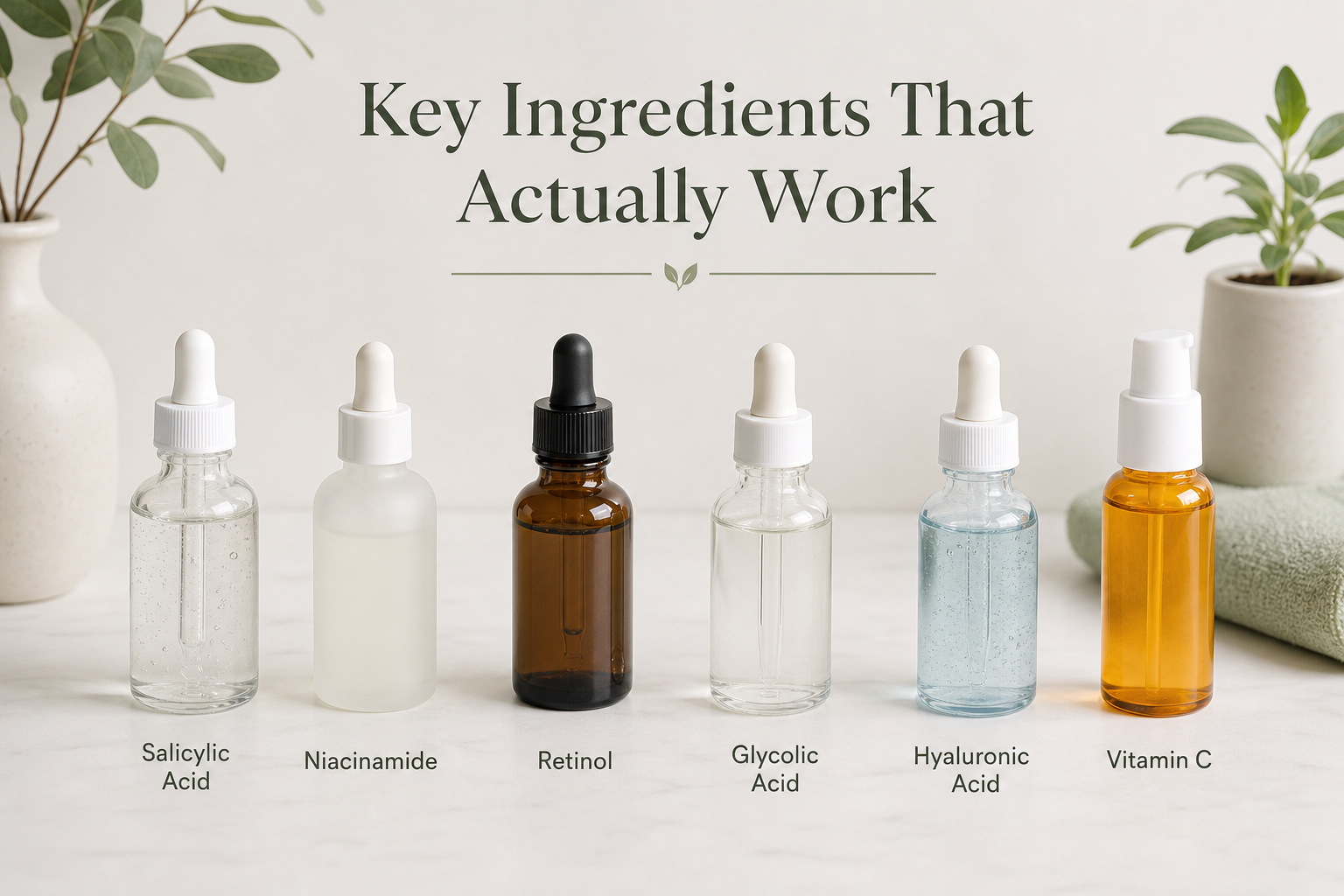
- Salicylic acid (BHA): Oil-soluble, meaning it penetrates into the follicle rather than working only on the surface. It dissolves the bonds between dead skin cells, clears pore-clogging debris, and reduces blackhead formation. Concentrations of 0.5–2% are effective for regular use.
- Niacinamide (vitamin B3): Regulates sebum production, strengthens the skin barrier, and visibly refines skin texture. Studies suggest consistent use over four to eight weeks produces a measurable reduction in pore appearance. It is well tolerated by most skin types, including sensitive skin.
- Retinol and retinoids: Increase cell turnover, regulate oil production, and stimulate collagen production — addressing both congestion-driven and laxity-driven pores. Prescription-strength retinoids (tretinoin) produce faster results than over-the-counter retinol but require medical supervision. Expect eight to twelve weeks before significant improvement is visible.
- AHAs (glycolic acid): Water-soluble exfoliants that work on the skin surface to remove dead skin cells and improve cell turnover. Useful for improving overall skin texture and brightness alongside BHA use.
- Hyaluronic acid: Does not directly reduce pore size, but by drawing moisture into the skin it plumps the surrounding tissue, which can make pores appear less prominent. Important for maintaining a healthy skin barrier alongside active ingredients.
- Vitamin C: An antioxidant that supports collagen production and protects against UV-related collagen breakdown. A vitamin C serum used in the morning can complement SPF in protecting the perifollicular collagen scaffold over time.
Common Mistakes That Make Pores Look Worse
Certain habits and product choices consistently undermine pore-minimising efforts and are worth addressing directly.
Over-exfoliating is one of the most frequent mistakes. Using a chemical exfoliant daily, or combining multiple exfoliating acids at high concentrations, damages the skin barrier, causes inflammation, and can paradoxically increase sebum production as the skin attempts to compensate. Two to three times per week is sufficient for most skin types.
Using alcohol-based astringent toners may temporarily tighten the skin’s appearance, but they strip the skin barrier and increase dryness, which triggers more oil production over time. Opt for a niacinamide or gentle hydrating toner instead.
Applying heavy, comedogenic creams — particularly those containing occlusive ingredients not suited to oily skin — can block follicles and worsen congestion. Always check that moisturisers and foundations are labelled non-comedogenic.
Overusing pore strips provides a satisfying short-term result but does not address the underlying cause of congestion and can damage the follicle walls with repeated use, potentially making pores appear larger over time.
Picking or squeezing spots causes trauma to the follicle wall and surrounding skin. Repeated picking can permanently stretch a pore and leave scarring that makes it appear larger.
Professional Treatments for Open Pores
When a consistent skincare routine produces insufficient improvement — or when laxity-driven pores are the primary concern — professional treatments can offer more significant results. The right treatment depends on pore type, skin tone, and individual goals.
Microneedling and RF Microneedling
Microneedling uses fine needles to create controlled micro-injuries in the skin, triggering collagen induction therapy — the skin’s natural wound-healing response, which produces new collagen and elastin. This rebuilds the perifollicular collagen scaffold, tightening the tissue around follicles and reducing pore visibility. RF (radiofrequency) microneedling adds thermal energy to the process, enhancing skin tightening and collagen remodelling. Microneedling is generally considered safe across a wider range of skin tones, including darker Fitzpatrick skin types, because it carries a lower risk of post-inflammatory hyperpigmentation compared to ablative laser treatments. A course of three to six sessions spaced four to six weeks apart is typically recommended, with gradual improvement continuing for several months after the final session. At-home microneedling rollers use much shallower needle depths than clinical devices and produce considerably more modest results; they also carry infection risks if not used and sterilised correctly.
Chemical Peels
Chemical peels use acids — including salicylic acid, glycolic acid, or trichloroacetic acid (TCA) at clinical concentrations — to remove the outer layers of skin, accelerate cell turnover, and stimulate collagen production. Superficial peels improve skin texture and reduce congestion-driven pores with minimal downtime. Medium-depth peels produce more significant collagen remodelling and are better suited to laxity-driven pores, but require several days of recovery. A series of treatments is usually needed for optimal results.
Laser Resurfacing
Fractional laser treatments — including fractional CO2 and Fraxel — deliver controlled thermal energy to columns of skin tissue, stimulating significant collagen remodelling and skin tightening. These treatments can produce noticeable improvements in pore size, skin texture, and skin laxity, particularly for age-related pore enlargement. Downtime ranges from a few days for non-ablative fractional lasers to one to two weeks for ablative fractional CO2. Laser resurfacing carries a higher risk of post-inflammatory hyperpigmentation in darker skin tones, so a thorough assessment of Fitzpatrick skin type is essential before treatment. Clear and Brilliant and Nd:YAG lasers are gentler options with less downtime and lower pigmentation risk, though results are more modest. Three to five sessions are typically required.
HydraFacial and Carbon Laser (Hollywood Peel)
HydraFacial combines cleansing, exfoliation, extraction, and hydration in a single treatment. It is effective for improving congestion-driven pores and skin texture with no downtime, though results are less dramatic than microneedling or laser for structural pore enlargement. The carbon laser peel (Hollywood Peel) applies a carbon lotion to the skin before using a laser to vaporise it, simultaneously exfoliating the surface and delivering heat to the sebaceous glands to reduce oil production. Both treatments are suitable for most skin types and can be used as maintenance between more intensive procedures.
Realistic Treatment Timelines
| Treatment | Sessions Typically Needed | When to Expect Results | Downtime |
|---|---|---|---|
| Niacinamide (topical) | Daily use | 4–6 weeks | None |
| Retinol (OTC) | 2–3x per week, building to nightly | 8–12 weeks | Initial dryness/flaking |
| Chemical peel (superficial) | 3–6 sessions | After 2–3 sessions | 1–3 days |
| Microneedling | 3–6 sessions | 4–8 weeks post-course | 1–3 days redness |
| RF microneedling | 3–4 sessions | 4–12 weeks post-course | 2–4 days |
| Fractional laser | 3–5 sessions | 4–12 weeks post-course | 3–14 days |
| HydraFacial | Monthly maintenance | Immediately after | None |
Skin Tone and Treatment Suitability
Skin tone is an important factor in choosing a professional treatment for enlarged pores. Ablative and high-energy laser treatments carry a higher risk of post-inflammatory hyperpigmentation — darkening of the skin following inflammation — in people with medium to dark skin tones (Fitzpatrick types IV–VI). For these patients, microneedling, RF microneedling, superficial chemical peels, and HydraFacial are generally considered safer first-line professional options. When laser treatment is appropriate for darker skin tones, non-ablative fractional lasers and Nd:YAG devices are typically preferred, and a practitioner experienced in treating diverse skin tones should always be consulted. A thorough skin assessment before any professional treatment is essential regardless of skin tone.
When to See a Dermatologist or Aesthetic Practitioner
Home skincare is a reasonable starting point for most people with visible pores, but professional assessment is worth considering in several situations. If a consistent skincare routine using evidence-based ingredients has produced no meaningful improvement after three months, a practitioner can assess whether a different approach or a professional treatment is appropriate. If enlarged pores are accompanied by persistent acne, significant blackhead congestion, or skin texture concerns that affect confidence, a dermatologist can offer prescription-strength options — including tretinoin or topical antibiotics — that are not available over the counter. If pore enlargement appears to be primarily driven by skin laxity rather than oil production, professional collagen-stimulating treatments are likely to produce better results than topical skincare alone, and a consultation will help identify the most suitable option for your skin type and tone.
Frequently Asked Questions
Can pores be permanently closed or eliminated?
No. Enlarged pores cannot be permanently closed or eliminated because pores are structural openings in the skin with no muscles to open or close them. What treatments and skincare can do is minimise the appearance of pores by reducing congestion, controlling oil, and rebuilding the collagen scaffold around the follicle. Results require ongoing maintenance.
Does cold water close pores?
Cold water does not permanently close pores. It may cause a very temporary reduction in visible pore size due to mild vasoconstriction, but this effect is short-lived and does not address any of the underlying causes of enlarged pores.
How do I reduce open pores on my nose specifically?
The nose is part of the T-zone and has a high concentration of sebaceous glands, making oil-driven and congestion-driven pores particularly common there. Salicylic acid cleansers or serums, regular use of a clay mask on the nose, and niacinamide are the most effective at-home approaches. Avoid pore strips as a long-term solution.
Can diet affect pore size?
Diet does not directly change pore size, but high-glycaemic foods and dairy have been associated with increased sebum production in some studies, which may worsen the appearance of oil-driven pores. An antioxidant-rich diet supports overall skin health and may help protect collagen over time, but dietary changes alone are unlikely to produce a noticeable reduction in pore appearance.
Is microneedling or laser better for large pores?
Both can be effective, but the best choice depends on your skin tone, pore type, and tolerance for downtime. Microneedling is generally safer across a wider range of skin tones and has less downtime than ablative laser. Fractional laser may produce more dramatic results for significant skin laxity but carries higher pigmentation risk in darker skin tones. A qualified practitioner should assess your skin before recommending either option.
How long does it take to see results from a pore-minimising skincare routine?
Most people notice a visible improvement after four to eight weeks of consistent use. Retinol typically requires eight to twelve weeks before significant changes are apparent. Results depend on the underlying cause of your enlarged pores and how consistently the routine is followed.
Building a Realistic Plan for Smaller-Looking Pores
Reducing the appearance of open pores is achievable, but it requires understanding what is driving them in your specific case. For oil-driven and congestion-driven pores, a consistent skincare routine built around salicylic acid, niacinamide, and a non-comedogenic SPF will produce meaningful improvement over weeks to months. For age and laxity-driven pores, retinoids are a useful topical option, but professional treatments that stimulate collagen induction therapy — particularly microneedling or fractional laser — are likely to deliver more noticeable structural improvement.
No single product or treatment eliminates pores permanently, and results from any approach require ongoing maintenance. The most effective strategy combines a well-chosen daily skincare routine with targeted professional treatments where appropriate, guided by an honest assessment of your skin type, tone, and the primary cause of your pore concerns. If you are unsure where to start or have not seen results from home care, a consultation with a qualified aesthetic practitioner or dermatologist can help you identify the most suitable and realistic path forward.