

Platysmal neck bands — the vertical cords or rope-like ridges that run down the front of the neck — are one of the most common concerns among people noticing changes in their neck appearance. They can appear gradually over years or seem to emerge quite suddenly, and understanding why they form is the first step toward knowing what, if anything, can be done about them. This article explains the anatomy behind vertical neck cords, the primary and contributing causes, and the factors that determine how early and how prominently they develop.
Key Takeaways
- Platysmal neck bands are caused by a combination of muscle separation, collagen and elastin loss, and the thinning of the skin and fat layer that normally conceals the platysma muscle.
- Bands can be dynamic (visible only during muscle contraction) or static (visible at rest), and the distinction matters for understanding both cause and treatment options.
- Genetics, sex, body composition, posture, UV exposure, and lifestyle factors all influence how early and how prominently bands develop — some people notice them as early as their late 30s.
- The counterintuitive role of submental fat as a natural cushion means that weight loss, even when otherwise healthy, can unmask or worsen the appearance of vertical neck cords.
- A qualified practitioner can assess whether bands are dynamic, static, or a combination, which guides any discussion of appropriate management options.
What Are Platysmal Neck Bands?
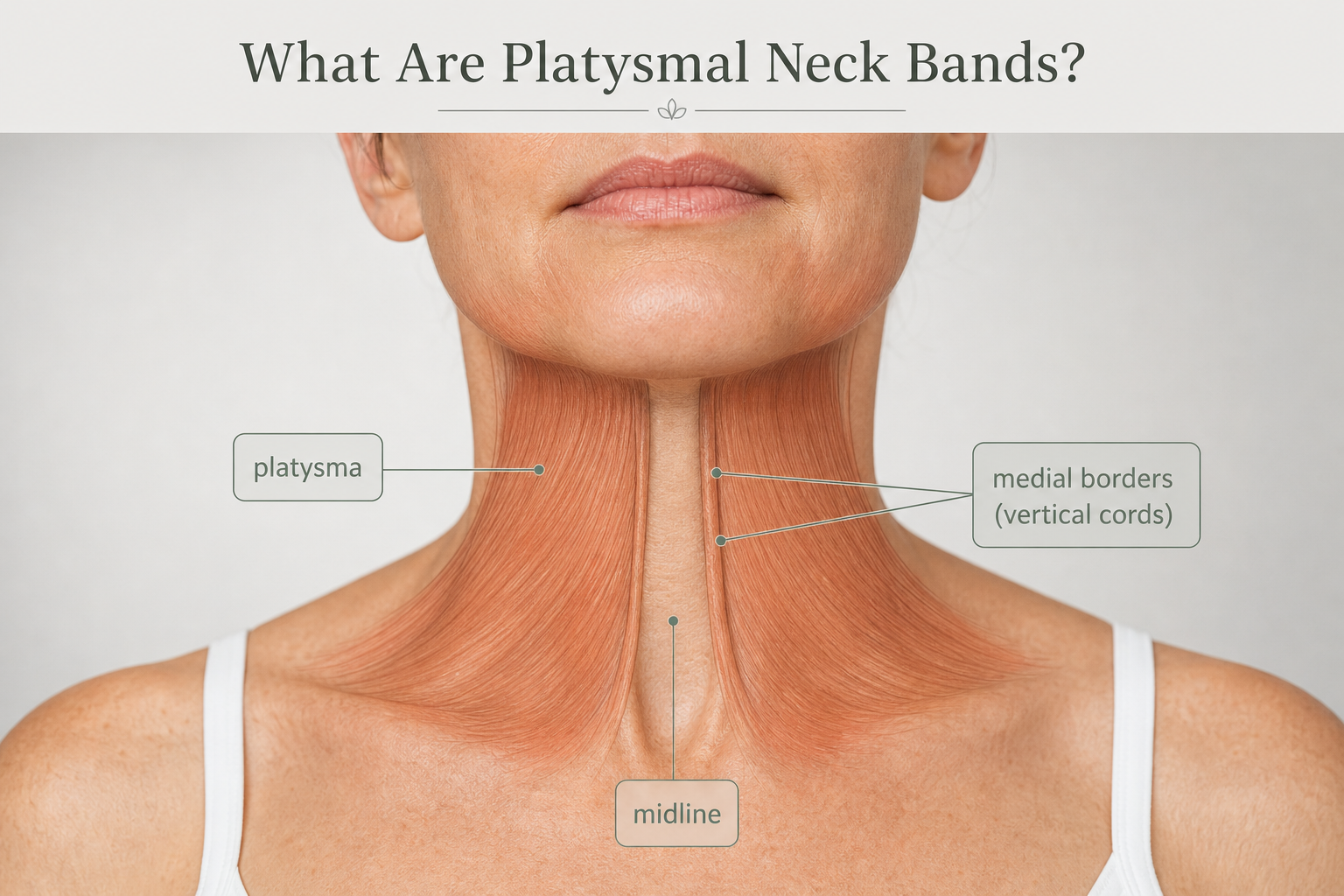
The platysma muscle is a broad, thin sheet of muscle that lies just beneath the skin of the neck. It originates from the fascia covering the upper chest and shoulder muscles, runs upward across the clavicle, and inserts into the lower jaw and the skin of the lower face. Unlike most muscles, the platysma sits within the superficial musculoaponeurotic system (SMAS) — the same fibromuscular layer relevant to facial aging — and it has direct attachments to the overlying skin, which is why its movement and shape are so visible at the surface.
In younger individuals with adequate skin thickness and subcutaneous fat, the platysma is largely hidden. Platysmal neck bands become visible when the medial borders of the muscle — the inner edges that run closest to the midline of the neck — become prominent. These medial borders are what most people see as vertical cords or ridges on either side of the central neck. In some individuals, a single midline band is also visible, depending on how the muscle fibres are arranged.
The Anatomy Behind Muscle Separation
One anatomical detail that is rarely explained in patient-facing resources is the concept of platysmal fiber decussation — the crossing and interdigitation of muscle fibres from the left and right sides of the platysma at the midline. In people where this decussation is robust, the two sides of the muscle are effectively tethered together at the front of the neck, which helps maintain a smoother contour. In people where decussation is minimal or absent, the medial borders of the platysma are essentially free edges, and they are more prone to separating and becoming visible as distinct cords.
This anatomical variation — which is largely determined by genetics — helps explain why some individuals develop prominent platysmal neck bands relatively early in life, while others with similar skin quality and body composition do not. Platysmal diastasis, the term used to describe the separation of these medial borders, is the structural basis for the visible cords. Once the medial edges separate and the overlying skin and fat thin with age, the bands become increasingly difficult to conceal.
Primary Causes of Platysmal Neck Bands
Natural Aging and Collagen Loss
The most fundamental cause of visible platysmal neck bands is the cumulative effect of neck aging on the tissues that normally conceal the platysma. Collagen and elastin — the structural proteins that give skin its firmness and resilience — decline progressively from the mid-20s onward. In the neck, where the skin is naturally thinner than on the face and receives less protective sebaceous activity, this loss of collagen and elastin accelerates the development of skin laxity and crepey skin texture. As the dermis thins, it loses its ability to drape smoothly over the underlying muscle, and the contours of the platysma become increasingly visible.
Alongside skin thinning, the subcutaneous fat layer between the skin and the platysma also diminishes with age. This fat acts as a natural cushion, softening the visual boundary between the skin surface and the muscle beneath. When this cushioning layer thins, even a platysma that has not significantly changed in size or position will appear more prominent. The combination of thinner skin and reduced subcutaneous fat is often what triggers the first noticeable appearance of vertical neck cords in a person’s late 30s or early 40s.
Muscle Separation and Platysmal Diastasis
As the supporting structures of the neck weaken with age, the medial borders of the platysma tend to drift apart. This muscle separation is driven partly by the loss of connective tissue support and partly by the ongoing pull of the muscle during everyday facial expressions and neck movements. Over time, the free medial edges of the platysma become more distinct, creating the rope-like appearance characteristic of vertical neck cords. In surgical literature, this separation is referred to as platysmal diastasis, and it is one of the primary targets of procedures such as platysmaplasty or corset platysmaplasty, where the medial borders are sutured back together.
Muscle Hyperactivity and Dynamic Band Formation
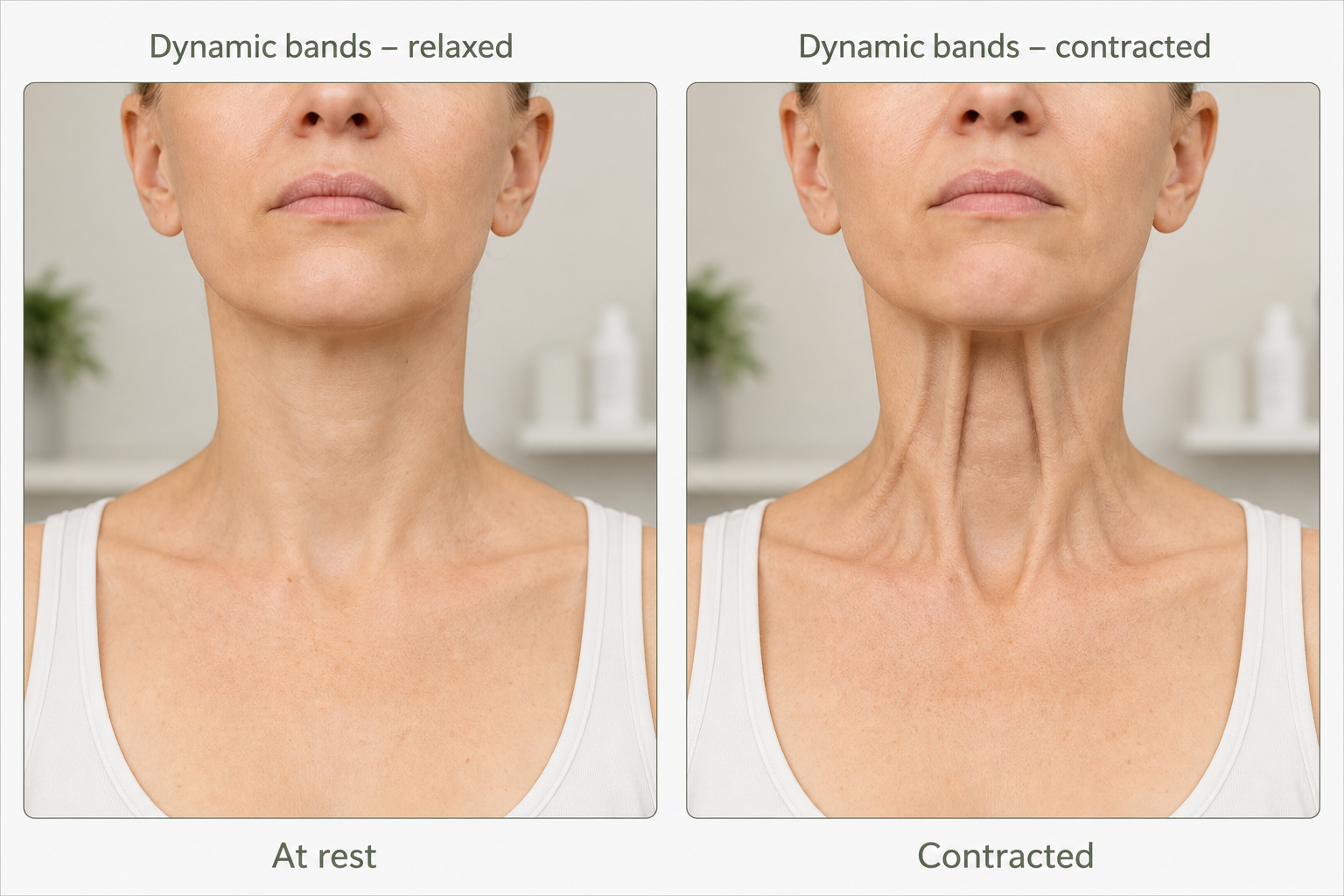
An important and often underappreciated cause of platysmal neck bands — particularly in younger patients — is muscle hyperactivity. The platysma contracts during a range of activities: speaking, swallowing, grimacing, straining, and certain facial expressions. In people with a naturally active or hypertonic platysma, repeated and forceful contractions can cause the medial borders to become visible even when the overlying skin and fat are still relatively intact. These are called dynamic bands, because they appear or worsen during muscle contraction and may be less visible or invisible at rest.
Older clinical thinking attributed most platysmal band formation to passive sagging of the skin and muscle. More recent understanding, supported by clinical observations and studies examining botulinum toxin treatment outcomes, suggests that active muscle contraction plays a more significant role than previously recognised — particularly in the early stages of band development. This distinction matters because dynamic bands in a younger patient may respond well to neuromodulator treatment, whereas static bands that are visible at rest typically reflect structural changes that require a different approach.
Dynamic Bands vs. Static Bands: Understanding the Difference
| Feature | Dynamic Bands | Static Bands |
|---|---|---|
| Visibility | Appear or worsen during muscle contraction; may be absent at rest | Visible at rest, regardless of muscle activity |
| Primary cause | Muscle hyperactivity; platysma contraction | Muscle separation, skin laxity, fat loss, structural aging |
| Typical age of onset | Can appear from the 30s onward, sometimes earlier | More common from the 40s onward; worsens progressively |
| Self-assessment | Tense the neck muscles firmly; bands appear or become more prominent | Bands visible without any muscle effort |
| Treatment considerations | May respond to botulinum toxin (neuromodulator) treatment | May require surgical or energy-based approaches; neuromodulators have limited effect on structural bands |
A practical self-assessment can help distinguish between the two types: stand in front of a mirror, relax the neck completely, and observe whether any cords are visible. Then tense the neck muscles firmly — as if bracing or grimacing — and note whether bands appear or become significantly more prominent. If bands are only visible during tension, they are predominantly dynamic. If they are visible at rest and simply worsen with tension, there is likely a structural component as well. A practitioner assessment is needed to confirm this and guide any treatment discussion.
Contributing and Accelerating Factors
Genetics and Family History
Genetics influence platysmal neck band development in several ways: the degree of platysmal fiber decussation at the midline, the natural thickness of the overlying skin, the rate of collagen loss, and the baseline level of platysma muscle activity are all partly heritable traits. People with a family history of prominent neck bands or early neck aging are more likely to develop similar changes, and may do so at a younger age. Skin type also plays a role — individuals with naturally thinner skin have less tissue to conceal the platysma, making bands more visible earlier.
Sex Differences
Clinical observations suggest that platysmal neck bands tend to appear earlier and more prominently in women than in men. This is likely related to the fact that women generally have thinner neck skin and a thinner subcutaneous fat layer in the anterior neck region, providing less natural cushioning over the platysma. Hormonal changes associated with perimenopause and menopause also accelerate collagen loss, which can cause a relatively rapid increase in skin laxity and band visibility during this period.
Weight Loss and Changes in Body Composition
Submental fat — the fat beneath the chin and in the upper neck — plays an important role in masking the platysma. When this fat is present in adequate amounts, it softens the visual boundary between the skin and the underlying muscle, making the medial borders of the platysma less distinct. Significant weight loss, particularly rapid weight loss, reduces this cushioning effect and can unmask platysmal neck bands that were previously hidden. This is sometimes described as the paradox of weight loss in the neck: a person may lose fat from the submental region and find that their neck appears more aged or cord-like as a result, even though their overall health has improved.
Weight fluctuations over time can also affect skin elasticity. Repeated cycles of weight gain and loss stretch and relax the skin, gradually reducing its ability to retract, which contributes to skin laxity in the neck and makes bands more visible.
UV Exposure and Photoaging
Chronic UV exposure accelerates the breakdown of collagen and elastin in the skin through a process called photoaging. The neck is frequently exposed to sunlight but is often neglected in daily sun protection routines compared to the face. Over years and decades, UV-induced collagen degradation thins the neck skin and reduces its elasticity, making the platysma more visible beneath the surface. The mechanism is the same as UV damage on the face — oxidative stress and matrix metalloproteinase activation degrade the structural proteins of the dermis — but the neck’s naturally thinner skin means the effects can become visible sooner.
Smoking
Smoking accelerates skin aging through multiple pathways, including reduced blood flow to the skin, increased oxidative stress, and direct impairment of collagen synthesis. These effects compound the natural age-related loss of collagen and elastin, thinning the skin more rapidly and reducing its ability to conceal the underlying platysma. Smokers may therefore develop visible platysmal neck bands earlier than non-smokers with otherwise similar anatomy and lifestyle.
Forward Head Posture and Tech Neck
Forward head posture — the habitual positioning of the head in front of the body’s centre of gravity, often associated with prolonged screen use — places the neck in a position that increases the mechanical load on the anterior neck muscles, including the platysma. Over time, this posture may contribute to increased muscle tone and activity in the platysma, potentially worsening dynamic band formation. The horizontal creases sometimes called tech neck lines are a separate concern from platysmal bands, but the two can coexist, and forward head posture may contribute to both. The evidence specifically linking posture to platysmal band severity is limited, but the mechanical rationale is plausible and the posture correction advice carries no meaningful risk.
Neck Exercise and the Exercise Paradox
It might seem intuitive that strengthening the neck muscles would improve the appearance of platysmal neck bands, but the opposite is often true for dynamic bands. Forceful or repetitive neck exercises — particularly those that involve straining, grimacing, or resisted neck flexion — can increase platysma muscle activity and make dynamic bands more prominent. The platysma is not a muscle that benefits aesthetically from hypertrophy; increasing its bulk or activity tends to make the medial borders more visible rather than less. This is why practitioners generally advise against targeted neck muscle exercises as a strategy for reducing the appearance of vertical neck cords.
Stress and Habitual Muscle Tension
Some sources note an association between chronic stress and premature neck aging, potentially mediated through habitual muscle tension — including clenching, jaw tightening, and neck straining — that increases platysma activity over time. The direct evidence linking psychological stress to platysmal band development is limited, and this should be understood as a plausible contributing factor rather than an established cause. However, the observation that people who habitually tense their neck and jaw muscles may develop more prominent dynamic bands is consistent with the broader understanding of muscle hyperactivity as a driver of band formation.
When Do Platysmal Neck Bands Typically Appear?
Most patient-facing resources describe platysmal neck bands as a feature of aging without specifying when they typically begin. In practice, dynamic bands can first become noticeable in the late 30s, particularly in people with thin skin, high platysma muscle activity, minimal submental fat, or a genetic predisposition. Static bands — those visible at rest — more commonly develop from the mid-40s onward, though they can appear earlier in people with multiple contributing factors. By the 50s and 60s, some degree of platysmal band visibility is common, and the cervicomental contour (the angle between the chin and the neck) is often noticeably affected.
The progression is generally gradual, but certain events can accelerate it: significant weight loss, menopause, a period of high sun exposure, or simply the cumulative effect of years of muscle activity on skin that has lost much of its structural support. Understanding this timeline helps set realistic expectations — bands that have developed over decades reflect structural changes that are unlikely to resolve without intervention, while early dynamic bands may be more amenable to non-surgical management.
What Platysmal Neck Bands Are Not
It is worth noting that not every visible structure in the neck is a platysmal band. The neck contains several other anatomical structures — including the sternocleidomastoid muscles on either side, the trachea, lymph nodes, and the thyroid gland — that can create visible or palpable contours. Platysmal neck bands are characteristically located at the front of the neck, run vertically, and become more prominent when the neck muscles are tensed. They are soft, flat, and cord-like rather than firm or nodular. Any neck lump that is firm, grows over time, is associated with pain, or does not change with muscle activity should be assessed by a medical professional, as it may represent a different and potentially more significant concern unrelated to the platysma.
Platysmal Bands vs. Horizontal Neck Lines
| Feature | Platysmal Neck Bands | Horizontal Neck Lines |
|---|---|---|
| Direction | Vertical (run up and down the neck) | Horizontal (run across the neck) |
| Underlying structure | Platysma muscle medial borders | Skin creases; may be worsened by forward head posture |
| Primary cause | Muscle separation, skin laxity, muscle hyperactivity | Skin folding, collagen loss, habitual neck flexion |
| Common name | Turkey neck, neck cords, vertical cords | Tech neck lines, necklace lines |
| Treatment response | Neuromodulators (dynamic), surgical options (static) | Skin boosters, resurfacing, neuromodulators, fillers |
Frequently Asked Questions
Can platysmal neck bands appear in your 30s?
Yes. Dynamic platysmal bands — those that appear during muscle contraction — can become noticeable in the late 30s, particularly in people with thin skin, high muscle activity, minimal submental fat, or a genetic predisposition. Static bands visible at rest are less common before the mid-40s but can occur earlier in people with multiple contributing factors.
Does losing weight cause neck bands to appear?
Weight loss, particularly significant or rapid weight loss, can reduce the submental fat that normally cushions and conceals the platysma. This can unmask or worsen the appearance of platysmal neck bands even when the bands themselves have not changed structurally. The effect is more pronounced in people who already have some degree of skin laxity or muscle separation.
Are platysmal neck bands the same as turkey neck?
The term turkey neck is used colloquially to describe a range of neck aging changes, including loose skin, jowls, and vertical cords. Platysmal neck bands specifically refer to the visible medial borders of the platysma muscle, which are one component of what is commonly called turkey neck. Loose or sagging skin without prominent muscle cords is a related but distinct concern.
Can exercise reduce the appearance of neck bands?
Targeted neck muscle exercises are unlikely to reduce platysmal neck bands and may worsen dynamic bands by increasing platysma muscle activity. General fitness and maintaining a stable, healthy body weight may help preserve the submental fat cushion, but specific neck exercises are not a recommended strategy for managing vertical neck cords.
Is there a way to tell at home whether my bands are dynamic or static?
A simple self-assessment involves relaxing the neck completely in front of a mirror and noting whether any cords are visible. Then tense the neck muscles firmly — as if straining or grimacing — and observe whether bands appear or become more prominent. Bands visible only during tension are predominantly dynamic; bands visible at rest have a structural component. A practitioner assessment is needed to confirm the type and discuss appropriate options.
Do platysmal neck bands indicate a medical problem?
Platysmal neck bands are a cosmetic concern related to normal anatomical and aging changes; they are not a sign of illness. However, any neck structure that is firm, nodular, painful, or growing should be assessed by a doctor to rule out unrelated conditions such as lymph node enlargement or thyroid changes.
Can sun protection help prevent neck bands from worsening?
Consistent sun protection on the neck may help slow UV-related collagen and elastin degradation, which is one of the factors that makes the platysma more visible over time. While it will not reverse existing muscle separation or structural changes, protecting the neck from UV exposure is a reasonable preventive measure that carries no meaningful risk.
Understanding Your Neck: When to Seek a Professional Assessment
Platysmal neck bands develop through a combination of factors — some structural and largely inevitable, others influenced by lifestyle and habits. The interplay between muscle anatomy, skin quality, subcutaneous fat, genetics, and daily behaviours means that no two people’s necks age in exactly the same way, and the relative contribution of each factor varies considerably between individuals. Recognising whether bands are dynamic, static, or a mixture of both is clinically important, because it shapes what interventions are likely to be useful and realistic.
If vertical neck cords are a concern, a consultation with a qualified aesthetic practitioner or plastic surgeon can provide a proper assessment of the underlying anatomy and the contributing factors in your specific case. Treatment options range from botulinum toxin injections for dynamic bands to surgical approaches such as platysmaplasty or neck lift for structural separation and skin laxity — but the right starting point is always an accurate understanding of what is causing the bands in the first place. Arriving at that consultation with a clear understanding of the anatomy and causes puts you in a much stronger position to ask informed questions and evaluate the options available to you.