

Vertical lip lines — sometimes called lipstick bleed lines, smoker’s lines, or perioral rhytids — are fine to moderate creases that radiate outward from the lip border. They develop gradually and can affect people who have never smoked, making them one of the more frustrating signs of facial ageing to address. This article explains what causes these lines, which natural and lifestyle-based approaches may offer modest improvement, and what clinical treatments are available when self-care is not enough.
Key Takeaways
- Vertical lip lines form due to repeated muscle movement, collagen loss, sun damage, and thinning skin around the mouth — not smoking alone.
- Natural approaches such as sun protection, hydration, and targeted skincare can slow progression but are unlikely to reverse established lines significantly.
- Clinical treatments including botulinum toxin, dermal fillers, skin resurfacing, and polynucleotides can offer more meaningful improvement, with results and suitability varying by individual.
- No single treatment eliminates perioral lines entirely; a combination approach is often most effective.
- A consultation with a qualified aesthetic practitioner is the most reliable way to identify which options suit your skin, anatomy, and goals.
What Causes Vertical Lip Lines?
The skin around the mouth is structurally different from skin elsewhere on the face. It is thinner, contains fewer sebaceous glands, and is attached directly to the orbicularis oris — the circular muscle responsible for pursing, puckering, and speaking. Every time this muscle contracts, the overlying skin folds. Over decades, those repeated folds etch themselves into the dermis as permanent creases.
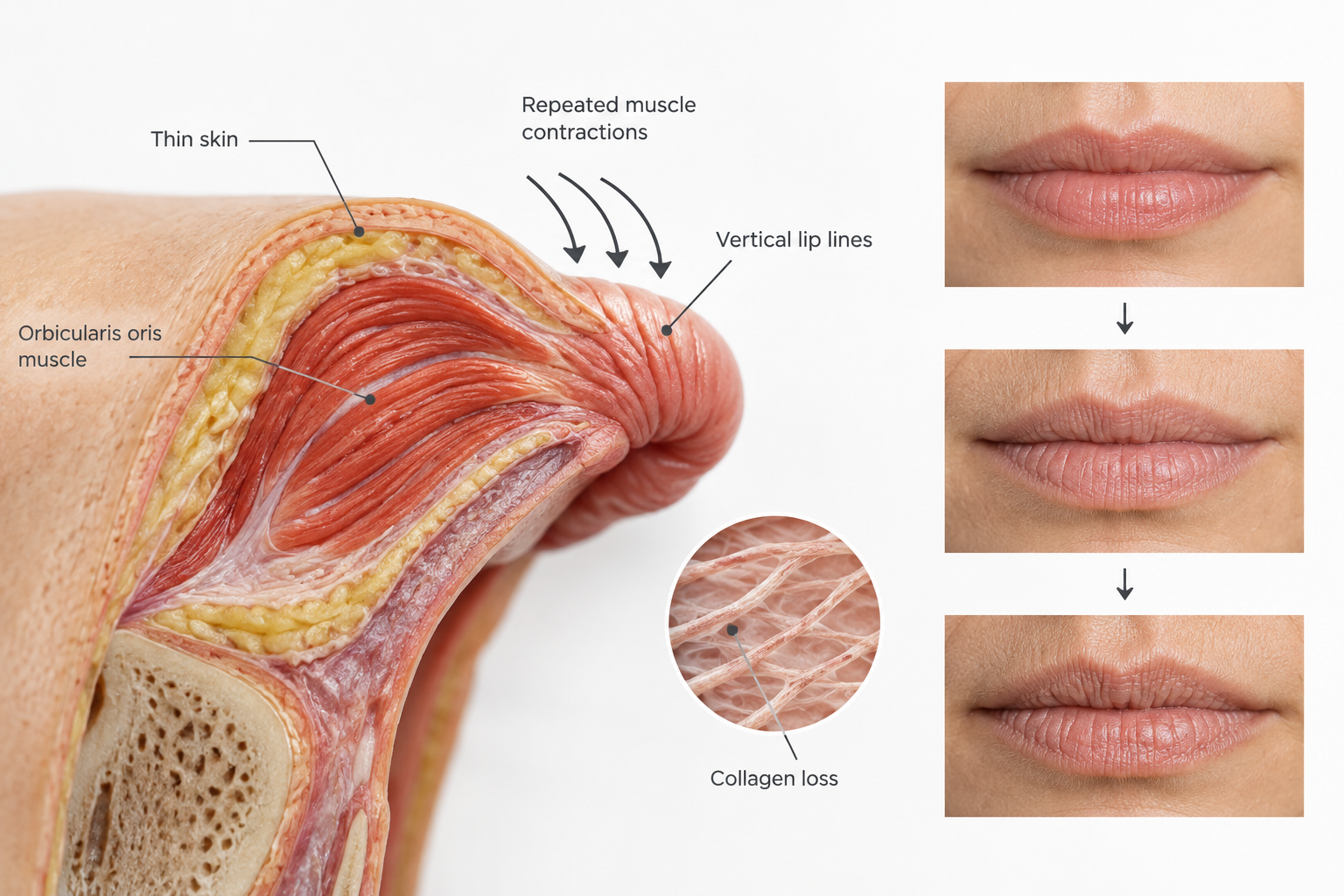
Several factors accelerate this process. Collagen and elastin — the proteins that keep skin firm and resilient — decline with age, reducing the skin’s ability to spring back after movement. Ultraviolet radiation from sun exposure degrades collagen further and impairs the skin’s repair mechanisms, which is why perioral lines often appear more pronounced in people with significant lifetime sun exposure. Volume loss in the lips and surrounding fat compartments also plays a role: as the lip border loses definition and the surrounding tissue deflates, the skin above it has less structural support and creases more easily.
Smoking does contribute — the repeated pursing action involved and the direct effect of tobacco smoke on collagen synthesis both accelerate line formation — but vertical lip lines are common in non-smokers too, particularly those with fair or thin skin, those who use straws frequently, or those who have experienced significant weight loss affecting facial volume.
Natural and Lifestyle Approaches That May Help
Natural approaches to vertical lip lines work best as prevention or as a way to slow further progression. They are unlikely to reverse lines that are already well established, but they can meaningfully reduce the rate at which new lines form and improve overall skin quality around the mouth.
Daily Sun Protection
Consistent use of a broad-spectrum SPF 30 or higher sunscreen applied to the perioral area is one of the most evidence-supported steps for slowing collagen degradation. UV-induced collagen breakdown is cumulative, so starting sun protection early and maintaining it daily — including on overcast days — has a meaningful long-term effect on skin quality. Lip balms with SPF can also protect the lip border itself.
Topical Retinoids
Retinoids — derivatives of vitamin A — are among the most studied topical ingredients for improving skin texture and stimulating collagen production. Over-the-counter retinol products applied carefully to the perioral area may gradually improve fine lines over several months of consistent use. Prescription-strength tretinoin tends to produce more noticeable results but can cause irritation, particularly on the sensitive skin around the mouth. Starting with a low concentration and applying every other night can help the skin adjust. Results from retinoids are gradual and require ongoing use to be maintained.
Hydration and Barrier Support
Well-hydrated skin appears plumper and lines appear less pronounced. Ingredients such as hyaluronic acid, glycerin, and ceramides in moisturisers help maintain the skin’s moisture barrier. While topical hyaluronic acid does not penetrate deeply enough to replace lost volume, it can temporarily improve the appearance of fine surface lines and support overall skin health. Drinking adequate water supports general skin function, though the direct effect on established lip lines is modest.
Antioxidant Skincare
Topical vitamin C serums applied in the morning may help protect against UV-induced oxidative damage and support collagen synthesis. The evidence for topical antioxidants is less robust than for retinoids, but vitamin C is generally well tolerated and may complement a broader skincare routine aimed at maintaining perioral skin quality.
Facial Muscle Awareness
Reducing habitual repetitive movements — such as drinking through straws, pursing lips during concentration, or smoking — may slow the formation of new lines. This is not a treatment for existing lines, but it is a practical preventive measure. Some practitioners mention facial exercises, though the evidence that these reduce rather than worsen dynamic lines is not well established.
Nutrition and Lifestyle
A diet adequate in protein, vitamin C, and zinc supports the body’s collagen synthesis pathways. Avoiding smoking is one of the most impactful lifestyle changes for perioral skin, given tobacco’s direct effect on collagen degradation and microcirculation. Adequate sleep and stress management support skin repair processes, though their specific effect on lip lines is difficult to quantify.
When Natural Approaches Are Not Enough
For many people, natural and skincare-based approaches provide a useful foundation but do not produce the visible improvement they are looking for — particularly when lines are moderate to deep, when there is associated volume loss, or when the lip border has lost definition. Clinical treatments address the underlying structural causes more directly and can produce more noticeable results, though each comes with its own profile of benefits, limitations, and risks.
Clinical Treatments for Vertical Lip Lines
Botulinum Toxin Injections
Botulinum toxin — commonly known by brand names such as Botox, Dysport, or Azzalure — can be injected in very small amounts into the orbicularis oris muscle to reduce the repetitive muscle contractions that create and deepen vertical lip lines. This approach is sometimes called a lip flip when used to subtly evert the upper lip border, but when used specifically for perioral lines, the goal is to soften dynamic creasing rather than to add volume.
The treatment requires precise placement by an experienced practitioner. The perioral area is functionally important — the orbicularis oris controls speech, eating, and drinking — so over-treatment can impair these functions. Results typically become visible within one to two weeks and may last three to four months, after which repeat treatment is needed to maintain the effect. Botulinum toxin for perioral lines works best on fine to moderate dynamic lines and is less effective for deep static lines that are present even at rest.
Dermal Fillers
Hyaluronic acid dermal fillers can be used to address vertical lip lines in two ways. Small amounts of a soft, low-viscosity filler can be placed directly into individual lines to fill them from below — a technique sometimes called linear threading or superficial filler placement. Alternatively, restoring volume to the lips and the surrounding perioral area can improve the structural support of the overlying skin, reducing the appearance of lines indirectly.
Results from hyaluronic acid fillers are typically visible immediately and may last six to twelve months depending on the product used, the area treated, and individual metabolism. Risks include bruising, swelling, asymmetry, and — in rare but serious cases — vascular occlusion, which requires prompt treatment. Choosing a practitioner with specific experience in perioral anatomy is important, as this area has a complex vascular supply. Hyaluronic acid fillers can be dissolved with hyaluronidase if needed, which provides a degree of reversibility not available with some other filler types.
Skin Resurfacing Treatments
Resurfacing treatments work by removing or remodelling the outer layers of skin to stimulate collagen production and improve skin texture. Several modalities are used for perioral lines:
- Laser resurfacing — ablative lasers such as CO2 or erbium remove the outer skin layers and stimulate significant collagen remodelling. They can produce meaningful improvement in perioral lines but involve several days to weeks of downtime, redness, and careful aftercare. Non-ablative and fractional laser options offer a more gradual improvement with less downtime.
- Chemical peels — medium to deep chemical peels applied to the perioral area can improve fine lines and skin texture by promoting controlled exfoliation and collagen stimulation. Superficial peels have minimal downtime but more limited effect on established lines. Medium-depth peels require more recovery time but may produce more noticeable improvement.
- Microneedling — fine needles create controlled micro-injuries in the skin, stimulating collagen and elastin production. Microneedling is generally well tolerated with a few days of redness and is often used as part of a combination approach. Results develop gradually over several weeks and multiple sessions are usually recommended.
- Radiofrequency microneedling — combines microneedling with radiofrequency energy to deliver deeper collagen stimulation. This may be particularly useful for skin laxity contributing to perioral lines.
Polynucleotides
Polynucleotide (PDRN) treatments involve injecting highly purified DNA fragments — typically derived from salmon or trout sperm — into the skin to stimulate fibroblast activity, improve hydration, and support tissue regeneration. In the perioral area, polynucleotides may improve overall skin quality, fine line appearance, and hydration over a course of treatments. Evidence for polynucleotides in aesthetic medicine is still developing, and results tend to be more subtle than those from resurfacing or filler treatments. They are often used as part of a combination approach rather than as a standalone treatment for established lip lines.
Profhilo and Skin Boosters
Profhilo and similar injectable skin boosters use high concentrations of hyaluronic acid to improve skin hydration, elasticity, and overall quality rather than to add volume directly. When used in the perioral area, they may improve the appearance of fine lines and skin texture over a course of two to three sessions. These treatments are generally well tolerated and have a low downtime profile, though they are unlikely to significantly improve deeper established lines on their own.
Combination Approaches
Perioral lines rarely have a single cause, and the most effective treatment plans often combine approaches that address different contributing factors. A practitioner might recommend botulinum toxin to reduce dynamic muscle activity, a small amount of filler to restore lip border definition and support the overlying skin, and a resurfacing treatment to improve skin texture — each targeting a different aspect of the problem. Combining treatments requires careful planning to avoid over-correction and to sequence treatments appropriately, as some combinations work better when performed in a specific order.
A thorough consultation with a qualified aesthetic practitioner is the starting point for identifying which combination, if any, is appropriate for a given individual. Factors including skin type, depth of lines, degree of volume loss, medical history, and personal goals all influence which treatments may be suitable.
Risks, Limitations, and Realistic Expectations
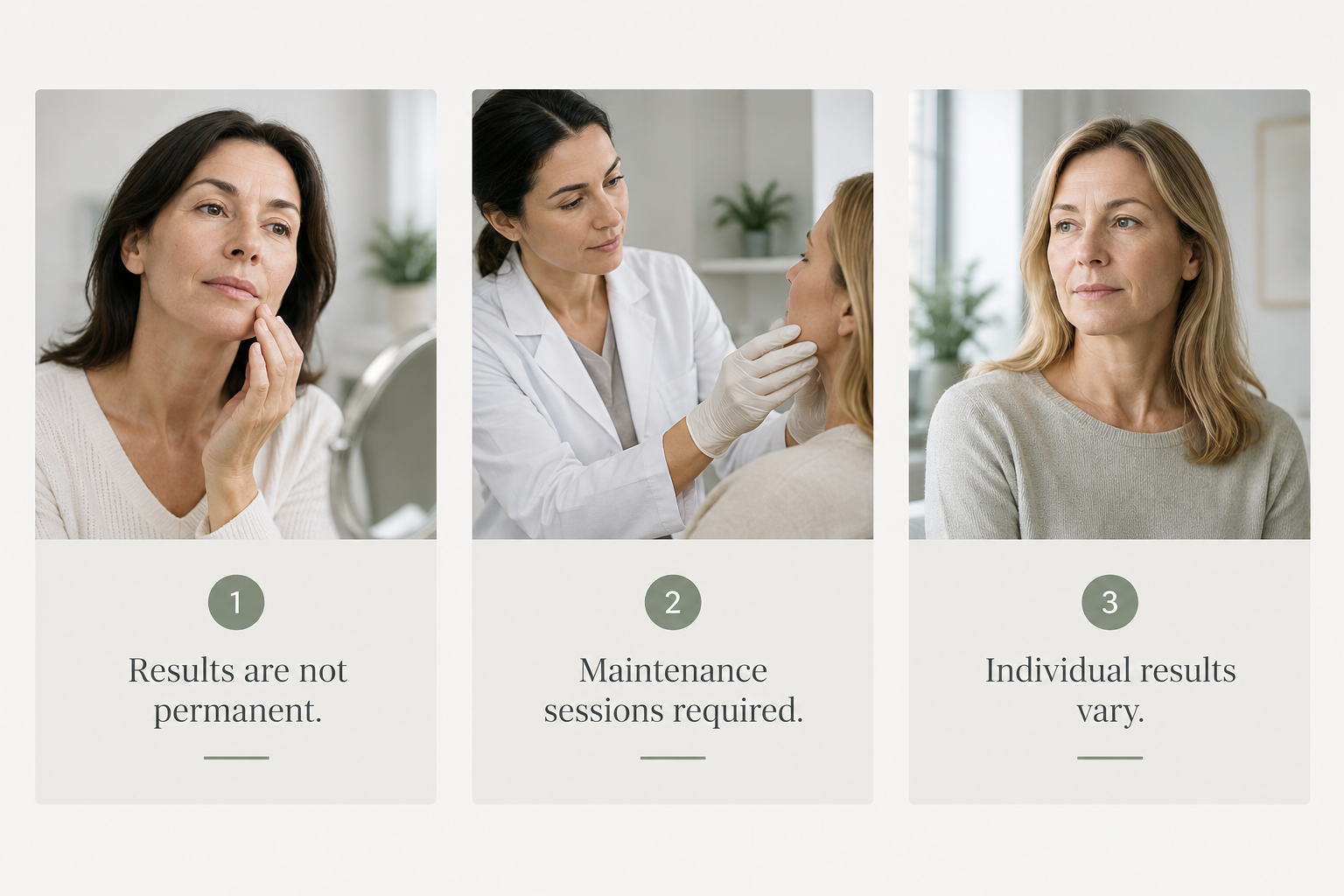
No treatment for vertical lip lines produces permanent results, and none eliminates lines entirely. The perioral area continues to age, and the underlying muscle activity that creates dynamic lines continues throughout life. Maintenance treatments are typically needed to sustain results from botulinum toxin and fillers, and the skin’s response to resurfacing treatments diminishes with repeated use over time.
Common side effects across perioral treatments include temporary bruising, swelling, and redness. More specific risks depend on the treatment: botulinum toxin in the perioral area carries a risk of functional impairment if placed incorrectly; fillers carry a small but serious risk of vascular complications; resurfacing treatments carry risks of post-inflammatory hyperpigmentation, particularly in darker skin tones, and infection if aftercare is not followed carefully.
Suitability for clinical treatments may be affected by pregnancy or breastfeeding, active skin infections or cold sores in the treatment area, certain autoimmune conditions, blood-thinning medications, and previous procedures in the area. A full medical history review before any treatment is essential.
Who May Be a Suitable Candidate
People who may benefit from discussing clinical treatment options with a practitioner include those with fine to moderate perioral lines that are bothering them cosmetically, those who have already optimised their skincare routine without achieving the improvement they were hoping for, and those in generally good health without contraindications to the relevant treatments. Realistic expectations are important: the goal of treatment is meaningful improvement rather than complete elimination of lines, and individual results vary depending on skin type, line depth, and the treatments chosen.
Those with very deep, long-established lines may find that improvement is more limited and that a combination of treatments over time produces the best outcome. Younger patients with early fine lines may find that preventive measures — particularly sun protection and retinoids — combined with a single treatment modality are sufficient.
Frequently Asked Questions
Can vertical lip lines be prevented entirely?
Complete prevention is not realistic because the muscle movement that creates perioral lines is a normal part of facial expression and speech. However, consistent sun protection, avoiding smoking, and maintaining good skin hydration and collagen support through retinoids can meaningfully slow the rate at which lines develop and deepen.
How long does it take to see results from natural approaches?
Retinoids typically require three to six months of consistent use before visible improvement in skin texture becomes apparent. Sun protection and hydration work cumulatively over years rather than producing rapid visible change. Natural approaches are most effective as long-term habits rather than short-term fixes.
Is botulinum toxin safe around the mouth?
Botulinum toxin can be used safely in the perioral area when administered by an experienced practitioner in appropriate doses. Because the orbicularis oris muscle is functionally important, precise placement is essential. Side effects such as temporary difficulty with certain lip movements, speech changes, or asymmetry can occur, particularly if too much product is used or placement is imprecise. These effects are temporary as the toxin wears off.
Will filler make my lips look unnatural?
Filler used specifically for perioral lines is typically placed in very small amounts in or around the lines themselves rather than in the lip body. When used conservatively and by an experienced practitioner, the goal is a natural improvement in line appearance rather than a change in lip size or shape. Discussing your goals clearly during consultation helps ensure the approach matches your expectations.
How many treatment sessions will I need?
This depends on the treatment chosen and the severity of the lines. Botulinum toxin and fillers typically produce results after a single session, with maintenance sessions required every few months. Resurfacing treatments such as microneedling or chemical peels are often recommended as a course of three to six sessions spaced several weeks apart. Polynucleotides and skin boosters are usually given as a course of two to three sessions initially.
Can I combine natural approaches with clinical treatments?
Yes, and this is generally recommended. Maintaining a good skincare routine — including sun protection and retinoids — supports and prolongs the results of clinical treatments. Some practitioners advise pausing retinoids for a short period before and after certain resurfacing treatments to reduce irritation risk, so it is worth discussing your current skincare routine during your consultation.
Are there any treatments I should avoid for perioral lines?
Treatments that are not well matched to the cause of your lines are unlikely to produce meaningful results and may carry unnecessary risk. For example, a treatment focused purely on skin hydration will not address deep dynamic lines caused by muscle activity. This is why a proper assessment of the contributing factors — muscle movement, volume loss, skin quality, line depth — is important before choosing a treatment approach.
Deciding on the Right Approach for Your Lip Lines
Vertical lip lines develop through a combination of muscle activity, collagen loss, volume depletion, and cumulative sun damage — which means that addressing them effectively usually requires more than one strategy. For those in the early stages of line formation, a consistent skincare routine built around broad-spectrum sun protection, a retinoid, and good hydration may be sufficient to slow progression and maintain skin quality. For those with established lines who are looking for more visible improvement, clinical treatments offer options that natural approaches cannot replicate.
The most appropriate path depends on the depth and nature of your lines, your skin type, your medical history, and what level of improvement you are realistically hoping to achieve. A consultation with a qualified aesthetic practitioner — ideally one with specific experience in perioral treatments — is the most reliable way to assess which options are suitable for you, what results you might reasonably expect, and how to sequence or combine treatments for the best outcome. Approaching the decision with realistic expectations and a clear understanding of both the benefits and the limitations of each option will help you make a choice that is genuinely right for you.