

The nose sits at the centre of the face and plays a significant role in overall facial balance and proportion. Understanding the different nose types — from the shape of the bridge and tip to the width of the nostrils and the angle of the nasal profile — can help patients communicate more clearly with practitioners and set realistic expectations before any aesthetic consultation. This article explains the main nasal shapes, the anatomical features that define them, and the non-surgical and surgical options that may be relevant depending on individual goals.
Key Takeaways
- Nose shape is determined by a combination of bone, cartilage, and soft tissue, and varies considerably between individuals and ethnic backgrounds.
- Common nose types include the straight, bulbous, hooked, upturned, wide, narrow, and crooked nose, each defined by specific anatomical characteristics.
- Non-surgical rhinoplasty using dermal filler may address certain concerns such as a dorsal hump or asymmetry, but has meaningful limitations and is not suitable for everyone.
- Surgical rhinoplasty remains the most comprehensive option for structural changes, though it carries greater risk and requires significant recovery time.
- A thorough consultation with a qualified practitioner is essential before pursuing any nasal aesthetic treatment.
What Defines a Nose Type?
Nasal shape is determined by the underlying skeletal and cartilaginous framework, the thickness and quality of the overlying skin, and the distribution of soft tissue. The nose is composed of nasal bones at the upper third, upper lateral cartilages in the middle third, and lower lateral cartilages — also called alar cartilages — at the lower third, which form the tip and nostrils. Variations in the size, angle, and projection of each of these structures produce the wide range of nose shapes seen across the population.
Ethnicity, genetics, age, and previous trauma or surgery all influence nasal anatomy. Skin thickness is particularly relevant in aesthetic assessment: thicker skin can obscure tip definition, while thinner skin may reveal subtle irregularities more readily. Practitioners typically evaluate the nose from multiple angles — frontal, lateral, and base views — to understand the full three-dimensional structure before recommending any treatment.
Common Nose Types and Their Defining Features
While no two noses are identical, certain recurring shapes are widely recognised in both clinical and aesthetic contexts. The following descriptions cover the most commonly identified nose types and the anatomical features that characterise each one.
The Straight Nose
A straight nose, sometimes called a Greek nose, is characterised by a smooth, uninterrupted nasal bridge that runs in a relatively straight line from the radix — the point between the eyes where the nose begins — to the tip. The profile shows minimal deviation, and the tip is generally well-defined without excessive projection or rotation. This shape is often considered a reference point in aesthetic proportion assessments, though it is not inherently superior to other nasal forms.
The Dorsal Hump Nose
A dorsal hump, also referred to as a Roman nose or aquiline nose, features a visible convexity along the nasal bridge when viewed from the side. This prominence is caused by excess bone, cartilage, or a combination of both in the upper and middle thirds of the nose. The degree of the hump varies considerably — from a subtle bump to a pronounced curve. Some individuals find this characteristic a defining feature of their appearance and have no desire to change it; others seek aesthetic options to smooth the profile. Non-surgical rhinoplasty with hyaluronic acid filler may be used to camouflage a mild hump by adding volume above and below it, though this approach does not reduce the hump itself and is not appropriate for larger prominences.
The Bulbous Nose
A bulbous nasal tip appears rounded, wide, or poorly defined, often due to the shape and spacing of the lower lateral cartilages combined with thicker overlying skin. The tip may lack projection — meaning it does not extend sufficiently forward from the face — or it may project adequately but appear broad when viewed from the front or base. Tip refinement is one of the more technically demanding aspects of rhinoplasty, and results from non-surgical approaches are generally limited in this area, particularly when thick skin is a contributing factor.
The Upturned Nose
An upturned nose, sometimes described as a celestial or retroussé nose, has a tip that rotates upward, creating a shorter-looking nose with more visible nostrils when viewed from the front. The nasolabial angle — the angle between the upper lip and the base of the nose — is greater than average. A mild upward rotation is common and considered within normal variation; a more pronounced rotation may be a natural characteristic or the result of previous surgery. Aesthetic concerns related to an upturned nose are generally addressed surgically rather than with non-surgical techniques.
The Wide or Broad Nose
Nasal width is assessed in relation to the overall facial width and the distance between the inner corners of the eyes, known as the intercanthal distance. A nose is generally considered wide when the alar base — the width across the nostrils — exceeds the intercanthal distance. Wide nasal anatomy is common across many ethnic backgrounds and is a normal anatomical variant rather than a flaw. Patients who wish to address nasal width for aesthetic reasons typically require surgical intervention, as non-surgical rhinoplasty cannot reduce the physical width of the alar base.
The Narrow or Pinched Nose
A narrow nose may have a high, thin bridge or a pinched tip where the alar cartilages are close together, sometimes restricting airflow through the nostrils. A pinched tip can occur naturally or may develop following overly aggressive rhinoplasty. Functionally, a narrow internal nasal valve can contribute to breathing difficulties, which may require surgical correction. Aesthetic narrowness of the bridge alone is sometimes addressed with filler to add subtle width and improve proportion, though this is a less common application.
The Crooked or Deviated Nose
A crooked nose deviates from the midline of the face, either along the bridge, the tip, or both. Deviation may result from genetics, nasal trauma, or a deviated nasal septum — the internal cartilage and bone partition that divides the nasal cavity. When a deviated septum is present, breathing difficulties may accompany the cosmetic concern. Mild asymmetry can sometimes be improved with strategically placed dermal filler to create a more balanced appearance from the front, but this is a camouflage technique rather than a structural correction. Significant deviation generally requires surgical assessment.
The Snub Nose
A snub nose is short and slightly upturned with a small, rounded tip. It differs from a pronounced upturned nose in that the overall nasal length is shorter and the tip is less dramatically rotated. This shape is more common in certain ethnic groups and is a normal anatomical variant. Patients who wish to lengthen the appearance of a snub nose may discuss options with a practitioner, though the structural limitations of non-surgical approaches mean that surgical rhinoplasty is usually the more effective route for meaningful change.
The Hawk Nose
A hawk nose combines a pronounced dorsal hump with a downward-pointing tip, creating a curved, beak-like profile. Both the convex bridge and the drooping tip contribute to the overall appearance. Tip ptosis — the downward rotation of the nasal tip — can become more noticeable with age as soft tissue support weakens. Botulinum toxin injected into the depressor septi nasi muscle, which pulls the tip downward, is sometimes used to provide a subtle lift to a drooping tip, though the effect is modest and temporary. More significant changes require surgical correction.
Ethnic Nasal Anatomy and Aesthetic Considerations
Nasal anatomy varies meaningfully across ethnic backgrounds, and this variation is clinically important in aesthetic assessment. Patients of East Asian, South Asian, African, Middle Eastern, and Latin American heritage may have nasal characteristics — such as a lower radix, wider alar base, thicker skin, or less tip projection — that differ from the nasal proportions historically used as reference standards in Western aesthetic medicine. Responsible aesthetic practice recognises these differences and avoids applying a single idealised nasal shape as a universal goal.
Ethnic rhinoplasty is a term used to describe surgical approaches that address individual aesthetic goals while preserving or respecting ethnic nasal characteristics. Non-surgical rhinoplasty can also be adapted to different nasal anatomies, for example by adding projection to a flat bridge. Any aesthetic assessment should be guided by the patient’s own goals and the practitioner’s understanding of their specific anatomy, rather than by a standardised template.
Non-Surgical Rhinoplasty: What It Can and Cannot Do
Non-surgical rhinoplasty — also called a liquid nose job or non-surgical nose job — involves the precise injection of dermal filler, most commonly hyaluronic acid, to alter the appearance of the nose without surgery. The procedure is performed in a clinic setting, typically takes between 15 and 30 minutes, and requires no general anaesthetic. Results are visible immediately, though some swelling is expected in the first few days.
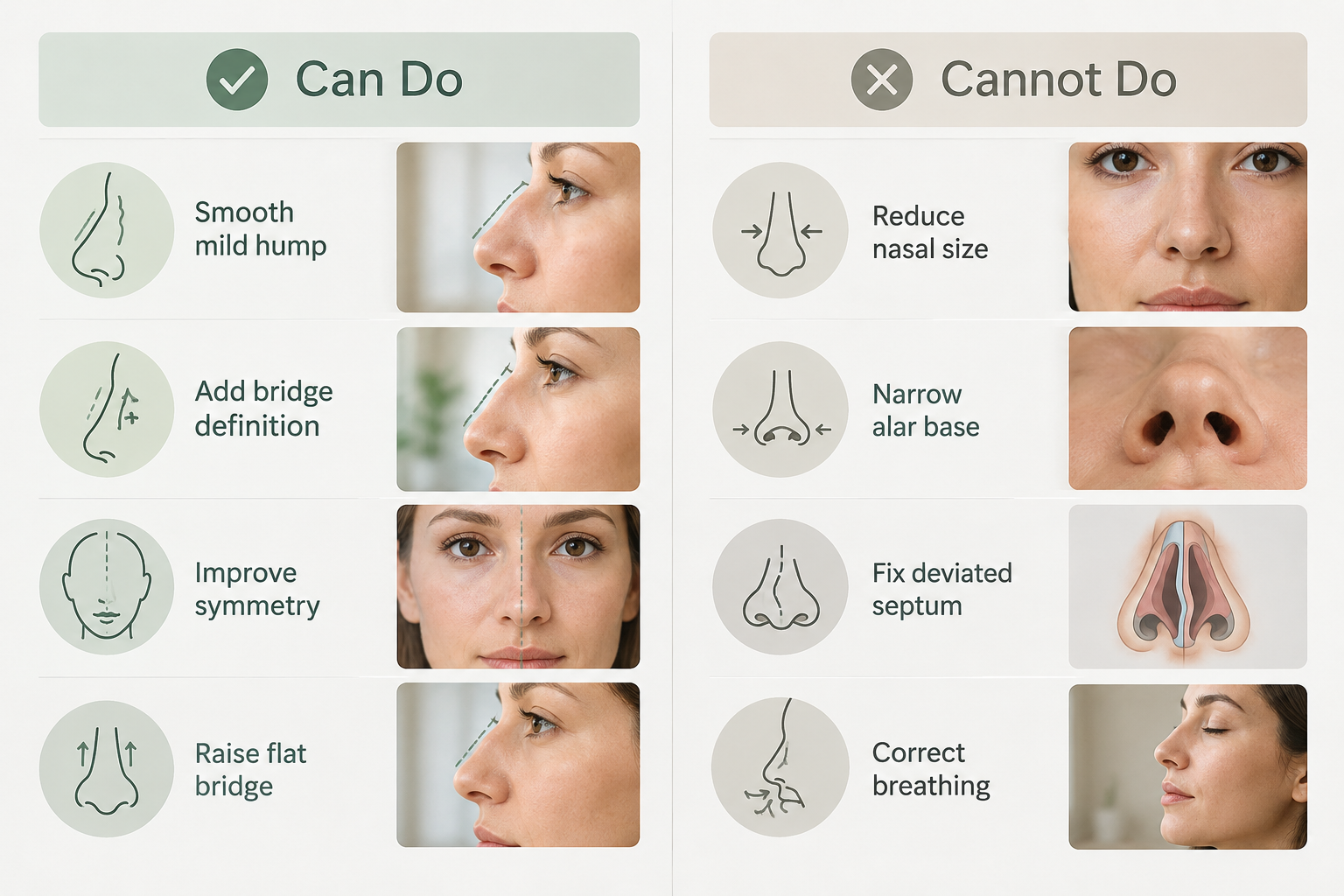
Non-surgical rhinoplasty may be suitable for patients who want to smooth a mild dorsal hump, improve nasal symmetry, add definition to the tip, raise a flat bridge, or refine the overall nasal profile. However, it cannot reduce the size of the nose, narrow the alar base, correct a significantly deviated septum, or address functional breathing concerns. Adding volume to a nose that is already large may worsen rather than improve the appearance, so careful patient selection is essential.
Hyaluronic acid filler in the nose is considered a high-risk injection area due to the proximity of nasal blood vessels. Vascular complications, including skin necrosis or, in rare cases, vision changes, have been reported following nasal filler injections. These risks, while uncommon, are serious and underline the importance of choosing a practitioner with specific training and experience in nasal anatomy and vascular management. Hyaluronidase — an enzyme that dissolves hyaluronic acid filler — should be immediately available in any clinic offering this treatment.
Results from hyaluronic acid nasal filler typically last between 9 and 18 months, depending on the product used, the volume injected, and individual metabolism. Maintenance treatments are required to sustain the effect. Some patients choose non-surgical rhinoplasty as a temporary measure to assess how a change might look before committing to surgery.
Surgical Rhinoplasty: When It May Be the More Appropriate Option
Surgical rhinoplasty is the most comprehensive approach to changing nasal shape and is the only option capable of making structural changes such as reducing a large dorsal hump, narrowing the alar base, correcting a deviated septum, or significantly altering tip shape. Rhinoplasty is performed under general anaesthetic and may use either an open approach — with a small incision across the columella, the strip of tissue between the nostrils — or a closed approach, with incisions placed entirely inside the nostrils.
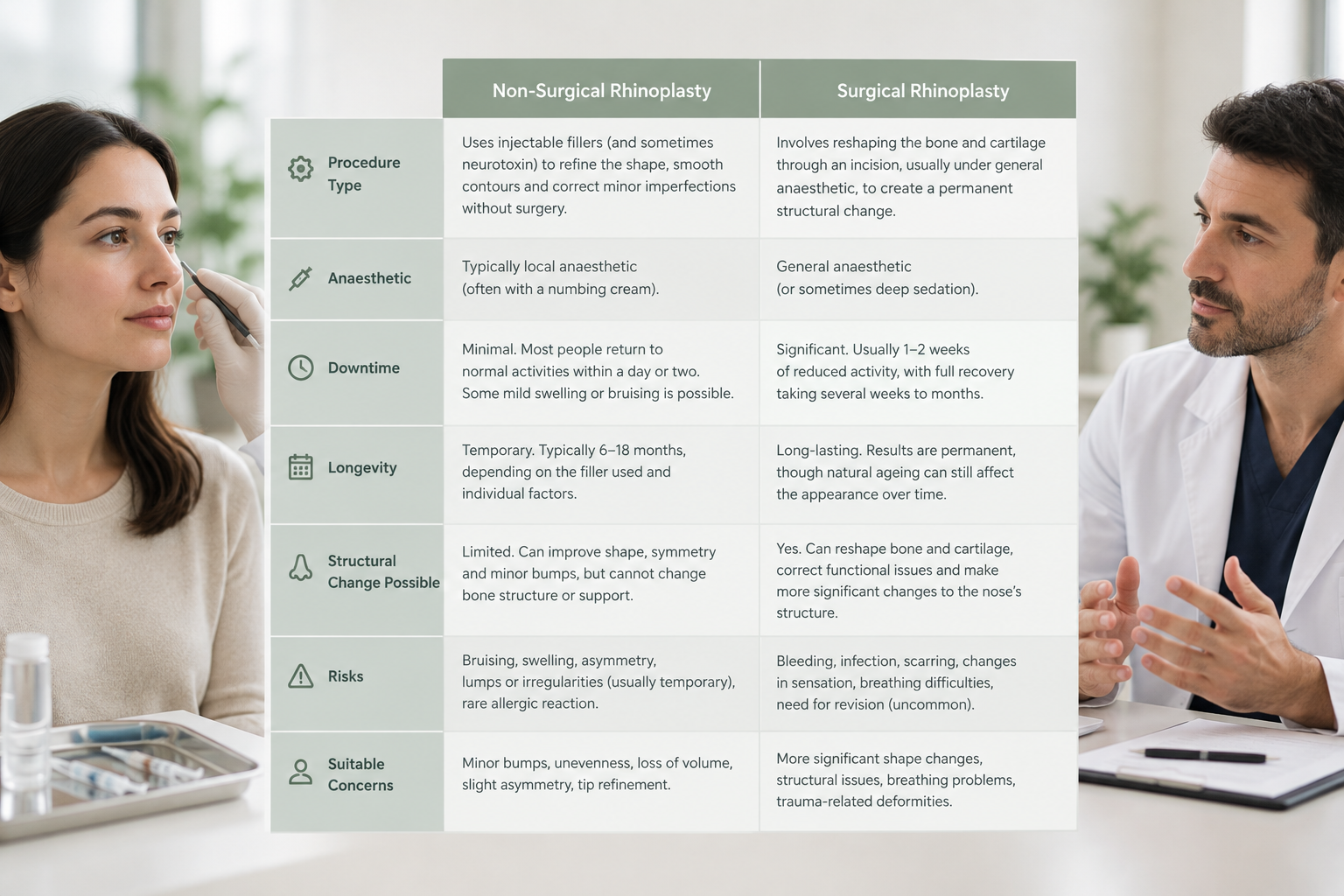
Recovery from rhinoplasty typically involves swelling and bruising for two to four weeks, with a splint worn for approximately one week. Final results may take up to 12 months or longer to fully emerge as swelling resolves gradually. Risks include infection, bleeding, anaesthetic complications, asymmetry, breathing changes, and the possibility of revision surgery. Rhinoplasty is a complex procedure and outcomes depend significantly on the surgeon’s skill, the patient’s anatomy, and realistic expectation-setting before the operation.
Septoplasty — surgery to correct a deviated septum — may be performed alongside rhinoplasty when both functional and cosmetic concerns are present. In some healthcare systems, septoplasty for functional breathing improvement may be covered by insurance or public funding, while the cosmetic component is self-funded.
Assessing Nasal Proportion and Facial Balance
Aesthetic practitioners often use established facial proportion guidelines to assess nasal shape in relation to the rest of the face. The face is commonly divided into horizontal thirds — forehead to brow, brow to nasal base, and nasal base to chin — and the nose is expected to occupy approximately one-third of the facial height. Vertically, the nasal width is often compared to the intercanthal distance. The nasolabial angle, tip projection, and radix height are also assessed as part of a thorough nasal analysis.
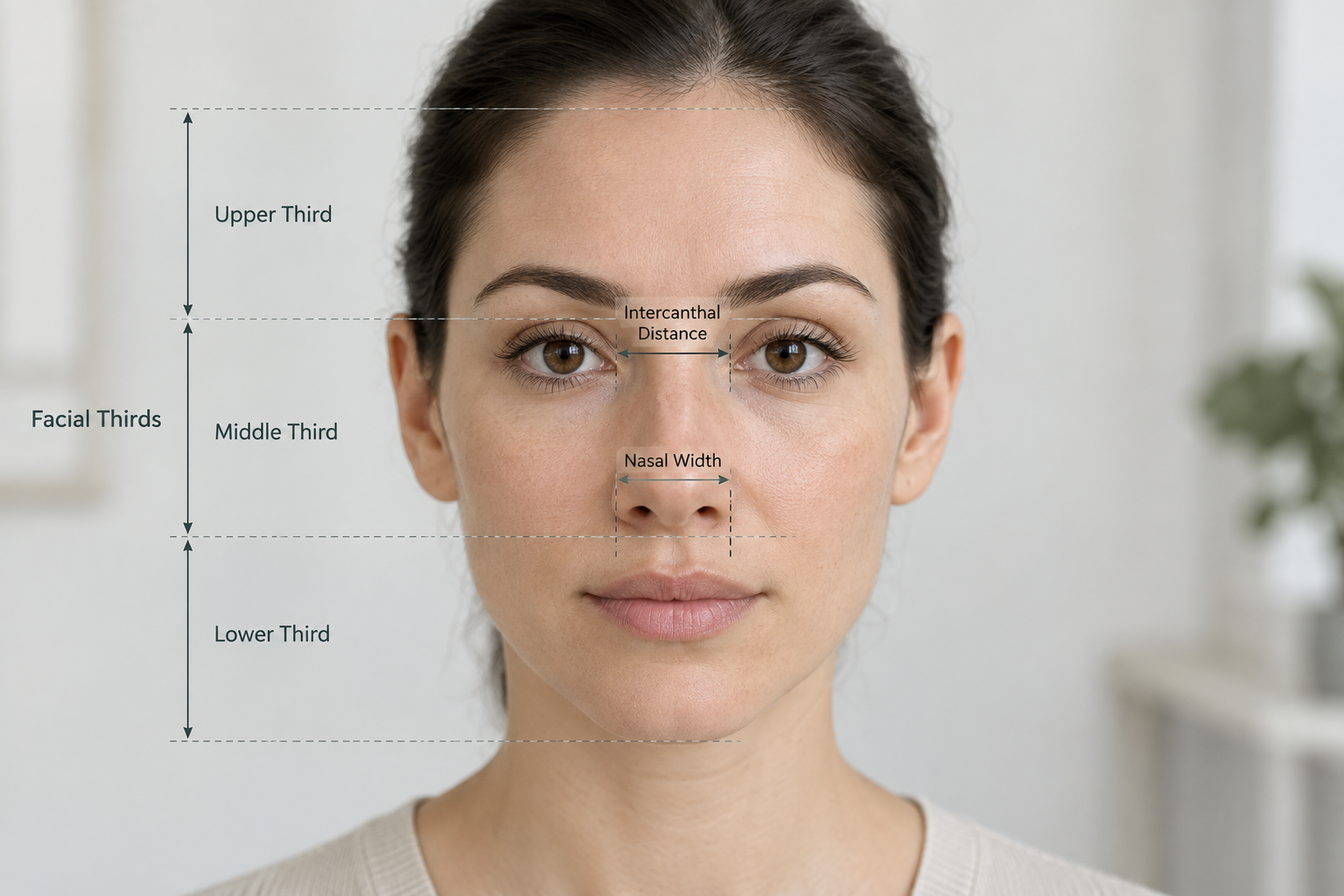
These proportional guidelines are useful reference points, but they are not rigid rules. Individual facial features, bone structure, and personal aesthetic preferences all influence what constitutes a harmonious result for a specific patient. A practitioner who takes a one-size-fits-all approach to nasal aesthetics is unlikely to achieve results that suit the individual. Patients are encouraged to bring reference images to consultations and to discuss their specific concerns clearly, while remaining open to the practitioner’s clinical assessment of what is achievable.
Who May Be Suitable for Nasal Aesthetic Treatment
Suitability for any nasal aesthetic treatment depends on a range of individual factors. For non-surgical rhinoplasty, suitable candidates are generally adults with mild to moderate nasal concerns — such as a small dorsal hump, minor asymmetry, or a flat bridge — who have realistic expectations about what filler can achieve. Patients with very thick nasal skin, a large nose, significant structural deviation, or breathing difficulties are unlikely to achieve satisfactory results from a non-surgical approach.
Contraindications to nasal filler include active skin infection or inflammation in the treatment area, known allergy to hyaluronic acid or filler components, pregnancy and breastfeeding, certain bleeding disorders, and the use of blood-thinning medications that cannot be paused. Previous nasal surgery or existing filler in the area requires careful assessment before additional treatment is considered.
For surgical rhinoplasty, candidates should be in good general health, non-smokers or willing to stop smoking before and after surgery, and have fully developed nasal anatomy — typically from the mid-to-late teenage years onward. Psychological readiness and realistic expectations are also important factors that a responsible surgeon will assess during consultation.
Frequently Asked Questions
Can I change my nose type without surgery?
Non-surgical rhinoplasty using dermal filler can alter the appearance of the nose in specific ways — such as smoothing a mild hump, improving symmetry, or adding bridge definition — without surgery. However, it cannot reduce nasal size, narrow the alar base, or correct structural issues. The changes are temporary and require maintenance. Surgery remains the only option for significant or permanent structural change.
How do I know which nose type I have?
Nasal shape is best assessed by a qualified practitioner who can evaluate the nose from multiple angles and in the context of overall facial proportions. General characteristics such as bridge shape, tip definition, alar width, and nasal length can help identify the broad category, but individual anatomy is always more nuanced than a simple label suggests.
Is non-surgical rhinoplasty safe?
Non-surgical rhinoplasty carries real risks, including bruising, swelling, asymmetry, and — more seriously — vascular complications that can cause skin damage or, in rare cases, vision changes. These risks are related to the proximity of nasal blood vessels. The procedure should only be performed by a practitioner with specific training in nasal anatomy and vascular emergency management, with hyaluronidase immediately available.
How long does non-surgical rhinoplasty last?
Results from hyaluronic acid nasal filler typically last between 9 and 18 months, though this varies depending on the product, the volume used, and individual factors such as metabolism. Maintenance appointments are needed to sustain the effect over time.
Can makeup change the appearance of my nose type?
Contouring techniques using makeup — such as applying a darker shade along the sides of the bridge or a lighter shade along the centre — can create the visual impression of a slimmer or more defined nose. These effects are temporary and surface-level, but they can be a useful way to explore how a different nasal appearance might look before considering any aesthetic treatment.
Does nose shape change with age?
Yes, nasal appearance can change with age. The nasal tip may droop as soft tissue support weakens, the skin may thin or thicken depending on the individual, and the nose may appear to lengthen as the face loses volume in surrounding areas. These age-related changes are gradual and vary between individuals.
Understanding Your Nose Type Before Seeking Aesthetic Advice
Identifying your nose type is a useful starting point, but it is only the beginning of a meaningful aesthetic conversation. The nose is a three-dimensional structure that interacts with every other facial feature, and what appears as a concern in isolation may look quite different when assessed in the context of the whole face. A practitioner who takes time to understand your anatomy, your goals, and your medical history is far better placed to recommend an appropriate approach than one who offers a standard treatment without thorough assessment.
If you are considering non-surgical rhinoplasty, research the practitioner’s qualifications, ask specifically about their experience with nasal filler, and confirm that emergency protocols are in place. If you are considering surgical rhinoplasty, seek a consultation with a board-certified or equivalent plastic or ENT surgeon who specialises in nasal surgery, and allow adequate time to consider the risks and recovery involved before making a decision. In both cases, realistic expectations and open communication are the most important factors in achieving a result you are satisfied with.