

A lip flip is a minimally invasive cosmetic treatment that uses small amounts of botulinum toxin injected into the muscles around the upper lip to create the appearance of a fuller, more defined lip — without adding volume through filler. It has become increasingly popular among people who want a subtle enhancement rather than a noticeably augmented look, but it is not suitable for everyone, and understanding how it works is essential before deciding whether to pursue it.
Key Takeaways
- A lip flip uses botulinum toxin — not dermal filler — to relax the muscle around the upper lip, allowing it to roll slightly outward and appear fuller.
- Results are subtle and temporary, typically lasting six to eight weeks, which is shorter than most other botulinum toxin treatments.
- The treatment may suit people who want a natural-looking enhancement, but it is not appropriate for those seeking significant volume or projection.
- Suitability depends on lip anatomy, muscle activity, skin quality, and individual goals — a clinical assessment is always required before treatment.
- Risks are generally mild but include temporary difficulty with certain mouth movements, asymmetry, and variable results depending on technique and individual response.
How a Lip Flip Works
The lip flip targets the orbicularis oris, the circular muscle that surrounds the mouth and controls lip movement. When small amounts of botulinum toxin are injected into specific points along the upper lip border — typically the cupid’s bow area and the corners of the mouth — the muscle relaxes partially. This relaxation allows the upper lip to roll slightly outward and upward, revealing more of the pink mucosal tissue (the vermilion) and creating the visual impression of a fuller lip without adding any physical volume.
It is important to understand that a lip flip does not increase the actual size or projection of the lip. The change is positional rather than volumetric. The lip appears more visible because its natural shape is displayed more prominently, not because tissue has been added. This distinction matters when setting realistic expectations, because patients hoping for a dramatic increase in lip size are unlikely to be satisfied with a lip flip alone.
Botulinum toxin works by temporarily blocking the nerve signals that cause muscle contraction. The effect is not permanent — the nerve signals gradually return as the toxin is metabolised, which is why results from a lip flip typically last a shorter time than treatments in areas with less active muscles, such as the forehead.
What Does a Lip Flip Appointment Involve?
A lip flip appointment is generally brief. After a consultation to assess suitability and discuss goals, the practitioner will cleanse the treatment area and may apply a topical numbing cream, though many patients find the injections tolerable without anaesthesia given the small number of injection points involved.
The botulinum toxin is administered using a very fine needle at several points along the upper lip border. The number of injection sites and the amount of product used will vary depending on the individual’s anatomy and the practitioner’s clinical judgement. The appointment itself typically takes around fifteen to thirty minutes from start to finish, including the consultation component.
After the injections, patients are usually advised to avoid pressing or massaging the treated area, to remain upright for a short period, and to avoid strenuous exercise for the remainder of the day. Specific aftercare instructions will vary by clinic and practitioner.
When Results Appear and How Long They Last
Botulinum toxin does not produce immediate results. Following a lip flip, most patients begin to notice a change within two to five days as the muscle starts to relax, with the full effect typically visible at around ten to fourteen days. Some practitioners recommend a review appointment at this point to assess the outcome and determine whether any refinement is appropriate.
The results of a lip flip are temporary. Because the orbicularis oris is a highly active muscle — used constantly for speaking, eating, drinking, and facial expression — the botulinum toxin tends to be metabolised more quickly than in less mobile areas. Most patients find that the effect lasts approximately six to eight weeks, though individual variation is significant. Factors including the specific botulinum toxin product used, the dose administered, individual metabolism, and muscle activity all influence how long results persist.
For patients who find the results satisfactory, repeat treatments are required to maintain the effect. This relatively short duration is one of the most important practical considerations when deciding whether a lip flip is appropriate, particularly when weighing it against the cost and frequency of appointments.
Who May Be Suitable for a Lip Flip
Suitability for a lip flip depends on a combination of anatomical, medical, and personal factors. A thorough clinical assessment by a qualified practitioner is essential before treatment, as no two patients present with identical anatomy or goals.
The lip flip may be worth discussing with a practitioner if you:
- have a thin or flat upper lip that disappears or rolls inward when you smile;
- want a subtle, natural-looking enhancement rather than a noticeably fuller lip;
- are concerned about a gummy smile, where a significant amount of gum is visible when smiling;
- prefer to avoid dermal filler or are not yet ready to commit to a filler treatment;
- have previously had lip filler and want to enhance the definition of the lip border without adding more volume;
- are looking for a lower-commitment, reversible-in-time option to assess how a lip enhancement might look on your face.
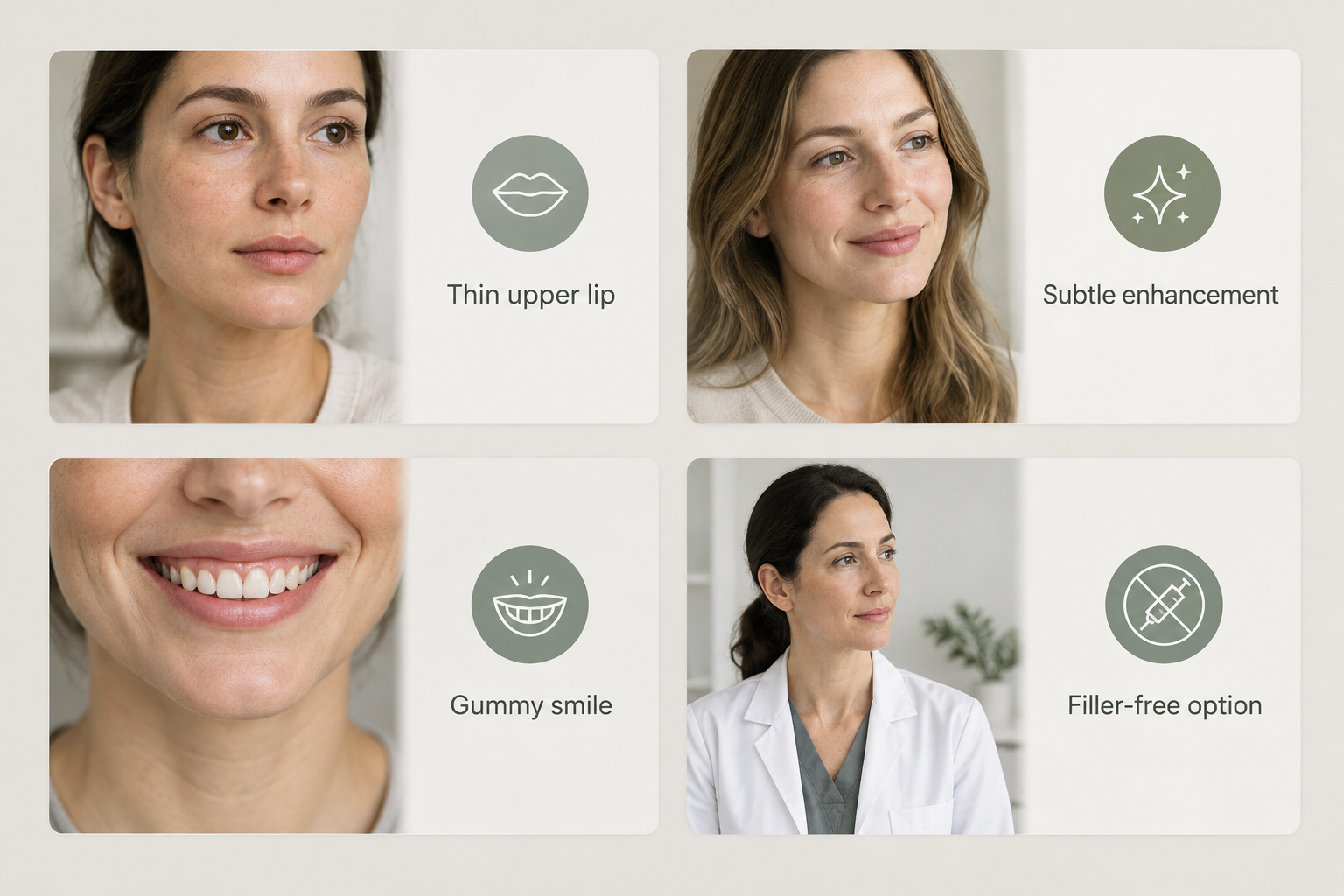
Patients with naturally thin lips who have limited vermilion show — meaning very little of the pink lip tissue is visible — may see a meaningful improvement in lip definition from a lip flip. Those with already prominent lips may notice less visible change, and the treatment may not be the most appropriate option for their goals.
Who May Not Be Suitable
A lip flip is not appropriate for everyone. Certain medical conditions, medications, and anatomical factors may make the treatment unsuitable or increase the risk of complications. A qualified practitioner will review your medical history carefully before proceeding.
The lip flip is generally not recommended for people who:
- are pregnant or breastfeeding;
- have a known allergy or sensitivity to botulinum toxin or any of its components;
- have an active infection, cold sore, or skin condition affecting the treatment area;
- have a neuromuscular condition such as myasthenia gravis or Lambert-Eaton syndrome, which can be affected by botulinum toxin;
- are taking certain medications, including some antibiotics and blood-thinning agents, that may interact with the treatment or increase bruising risk;
- have unrealistic expectations about the degree of change achievable — the lip flip produces subtle results and is not a substitute for filler in patients seeking significant volume;
- rely heavily on precise lip and mouth control for professional reasons, such as playing a wind instrument or public speaking, as temporary changes to muscle function may be disruptive.
Anatomy also plays a role in suitability. Patients with a very short distance between the base of the nose and the upper lip border (a short philtrum) may find that a lip flip creates an undesirable appearance by further reducing the visible philtrum length. This is an important anatomical consideration that a skilled practitioner will assess during consultation.
Risks and Side Effects
The lip flip is generally considered a low-risk procedure when performed by a qualified and experienced practitioner, but it is not without potential side effects. Patients should be aware of both common and less common outcomes before consenting to treatment.
Common and usually temporary side effects include:
- mild swelling, redness, or bruising at the injection sites, which typically resolves within a few days;
- temporary difficulty with certain mouth movements, including pursing the lips, drinking through a straw, whistling, or pronouncing certain sounds — this is a direct consequence of the muscle relaxation and usually resolves as the product wears off;
- a feeling of heaviness or altered sensation around the upper lip;
- asymmetry, where one side of the lip relaxes more than the other, which may improve as the product settles or may require a small corrective injection.
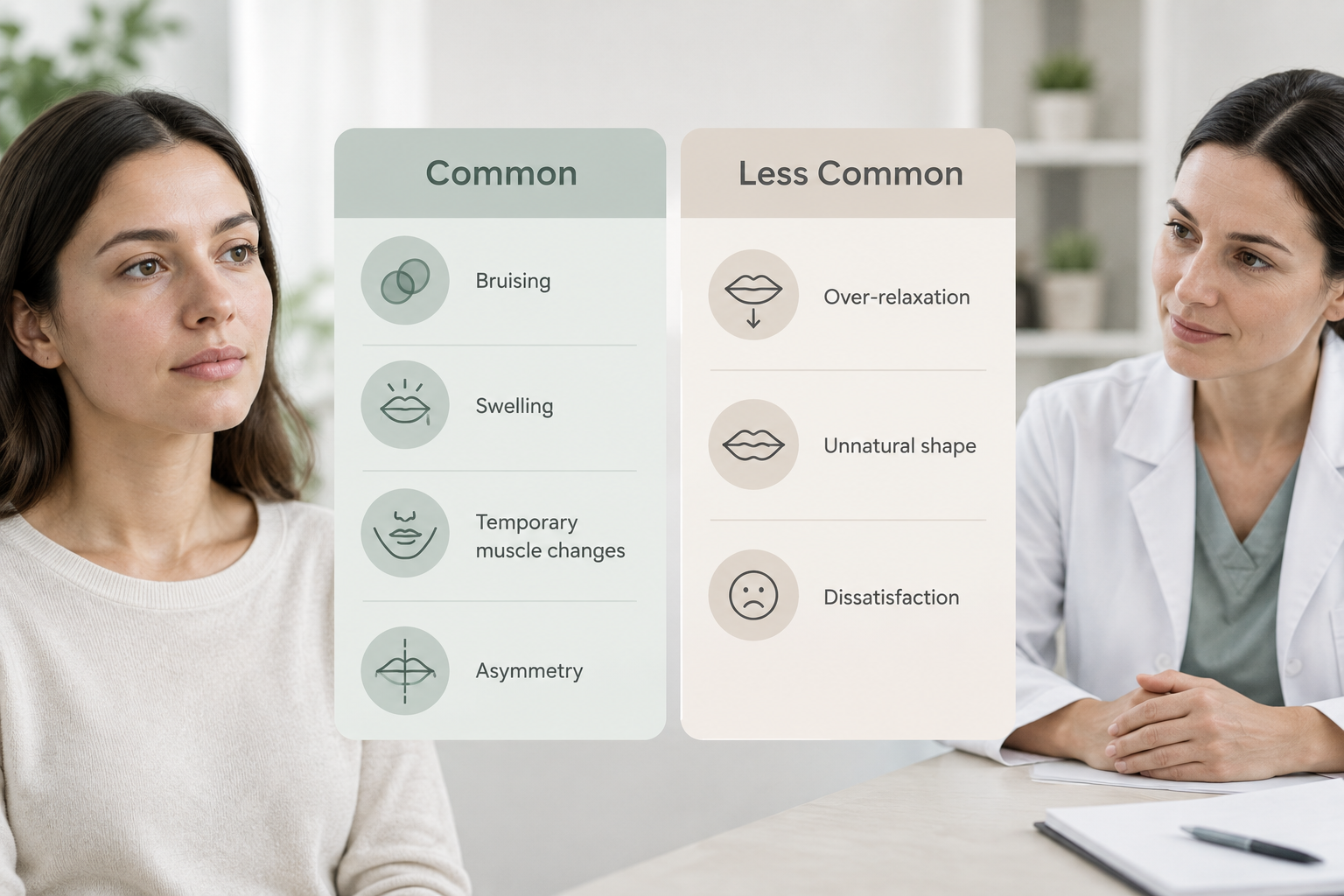
Less common concerns include:
- over-relaxation of the muscle, which can cause the lip to appear droopy or affect the ability to form a seal when drinking — this is more likely if too much product is used or if placement is not precise;
- an unnatural or unflattering lip shape if the treatment is not well-matched to the patient’s anatomy;
- dissatisfaction with results that are either too subtle to notice or that alter the lip shape in an unexpected way.
Serious complications from botulinum toxin injections in this area are rare but can occur, particularly when treatment is performed by an inadequately trained provider. Choosing a qualified medical professional with specific experience in lip treatments significantly reduces the risk of adverse outcomes. If you experience any unexpected symptoms following treatment, you should contact your treating practitioner promptly.
Lip Flip vs Lip Filler: Understanding the Difference
The lip flip and lip filler are frequently compared because both aim to improve the appearance of the lips, but they work through entirely different mechanisms and are suited to different goals. Understanding this distinction is central to making an informed decision.
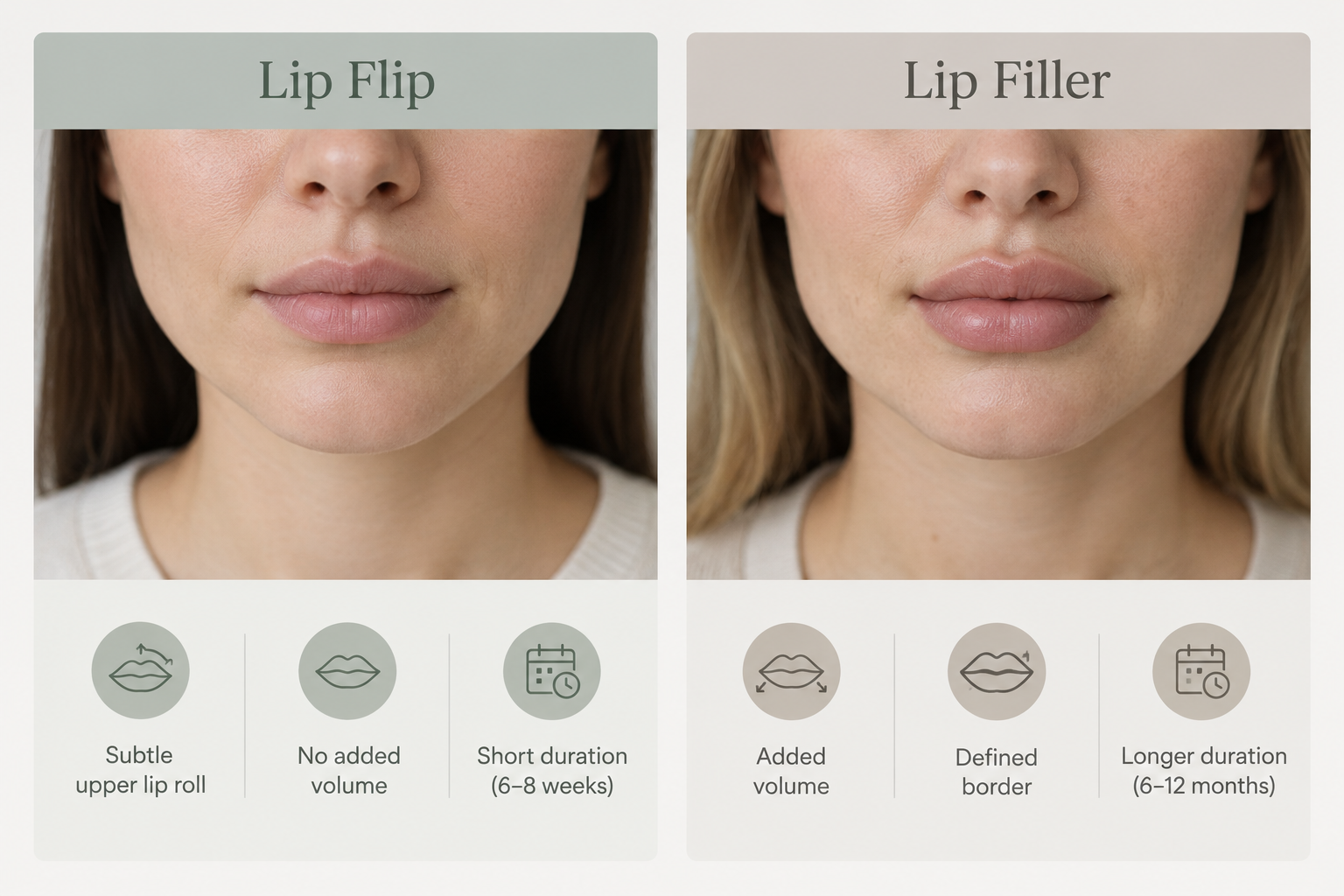
Lip filler uses hyaluronic acid — a substance that occurs naturally in the body — injected directly into the lip tissue to add physical volume, shape, and projection. Hyaluronic acid filler can increase the size of both the upper and lower lips, define the lip border, enhance the cupid’s bow, and add projection. Results from lip filler typically last six to twelve months or longer depending on the product used, the amount injected, and individual factors. Hyaluronic acid filler can also be dissolved with an enzyme called hyaluronidase if the patient is unhappy with the result.
The lip flip, by contrast, adds no physical volume. It works by relaxing the muscle to reveal more of the existing lip tissue. It cannot increase lip projection, add fullness to the lower lip, or create the kind of defined, sculpted border that filler can achieve. Its results last a fraction of the time that filler does.
Some patients choose to combine both treatments — using a small amount of filler for volume and a lip flip to enhance the upper lip border and reduce a gummy smile — but this combination approach should be discussed carefully with a practitioner who can assess whether it is appropriate for the individual’s anatomy and goals.
For patients who are new to lip treatments and uncertain about committing to filler, a lip flip can serve as a lower-stakes introduction to lip enhancement. However, it is worth being clear-eyed about the fact that the results are genuinely subtle and short-lived, and that the experience of a lip flip does not necessarily predict how lip filler would look or feel.
Alternatives to a Lip Flip
If a lip flip does not seem like the right option, or if you are exploring the full range of treatments available for lip enhancement and definition, several alternatives are worth understanding.
Hyaluronic acid lip filler remains the most widely used treatment for lip augmentation. It offers greater control over volume, shape, and projection than a lip flip, with longer-lasting results and the option of reversal if needed. It is appropriate for patients who want a more noticeable or lasting change.
Botulinum toxin for a gummy smile is closely related to the lip flip but targets the levator labii superioris alaeque nasi muscle — the muscle responsible for lifting the upper lip when smiling — rather than the orbicularis oris. This approach specifically addresses excessive gum show when smiling and may be more appropriate than a standard lip flip for patients whose primary concern is gum visibility rather than lip definition.
Lip liner and makeup techniques can create the visual impression of a fuller, more defined lip without any medical intervention. While not a clinical treatment, they are worth acknowledging as a zero-risk option for patients who are uncertain about injectable treatments.
Skin booster injections around the lip area may improve hydration and skin quality in the perioral region, which can subtly improve the appearance of fine lines around the mouth, though they do not directly augment the lip itself.
Surgical lip augmentation, including lip lift procedures, offers permanent or long-lasting structural changes to the lip and philtrum. These are more invasive options with longer recovery times and are generally considered when non-surgical treatments have not achieved the desired outcome or when a patient is seeking a permanent solution.
Choosing a Practitioner for a Lip Flip
The outcome of a lip flip is highly dependent on the skill, training, and anatomical knowledge of the practitioner performing it. The orbicularis oris is a complex muscle with significant individual variation, and the margin between a natural-looking result and an over-treated or asymmetric outcome can be narrow.
When considering a lip flip, it is reasonable to ask a prospective practitioner about their medical qualifications, their specific training in facial anatomy and botulinum toxin injections, their experience with lip treatments, and what their approach would be if you were unhappy with the result. A practitioner who conducts a thorough consultation, assesses your anatomy carefully, discusses realistic outcomes, and explains the risks clearly is more likely to deliver a safe and satisfactory result than one who offers a rapid, one-size-fits-all approach.
In many countries, botulinum toxin is a prescription-only medicine, meaning it should only be prescribed and administered by appropriately qualified healthcare professionals. Regulations vary by country, so it is worth verifying the regulatory framework in your location and ensuring that any practitioner you consult meets the relevant professional standards.
Frequently Asked Questions
Does a lip flip hurt?
Most patients describe the lip flip as mildly uncomfortable rather than painful. The injections are made with a very fine needle, and the number of injection points is small. A topical numbing cream can be applied beforehand if preferred. Discomfort during the procedure is usually brief and resolves quickly.
Can a lip flip go wrong?
Like any injectable treatment, a lip flip carries the risk of an unsatisfactory outcome. The most common issues include asymmetry, over-relaxation of the muscle causing difficulty with mouth movements, and results that are either too subtle or that alter the lip shape in an unexpected way. Serious complications are uncommon when treatment is performed by a qualified practitioner. Because the effect is temporary, most unwanted outcomes resolve on their own as the botulinum toxin wears off.
Will a lip flip make my lips look bigger?
A lip flip does not add volume or make the lips physically larger. It creates the visual impression of a fuller upper lip by allowing more of the existing lip tissue to be visible. The change is subtle. Patients seeking a significant increase in lip size are more likely to achieve their goal with hyaluronic acid lip filler.
Can I have a lip flip if I already have lip filler?
In many cases, yes — a lip flip can be performed alongside or after lip filler treatment. Some patients use a lip flip to enhance the upper lip border or address a gummy smile while maintaining existing filler volume. However, the combination should be assessed individually by a qualified practitioner, as the presence of filler may influence the approach and the expected outcome.
How soon can I wear lipstick after a lip flip?
Most practitioners advise avoiding pressure on the treated area, including applying makeup, for at least a few hours after the injections. Specific guidance will vary by clinic. It is generally advisable to follow your practitioner’s aftercare instructions rather than applying makeup immediately after treatment.
Is a lip flip suitable for older patients?
Age alone does not determine suitability. However, older patients may have different anatomical considerations, including changes in lip volume, skin laxity, and perioral lines, that influence whether a lip flip is the most appropriate treatment. A clinical assessment will help determine whether a lip flip, lip filler, skin booster treatment, or a combination approach is better suited to the individual’s concerns and goals.
What happens when the lip flip wears off?
As the botulinum toxin is gradually metabolised, the orbicularis oris muscle regains its normal tone and the lip returns to its pre-treatment appearance. There is no rebound effect — the lips do not become thinner or change shape beyond their natural baseline. Patients who wish to maintain the result will need repeat treatments approximately every six to eight weeks.
Is a Lip Flip the Right Choice for Your Goals?
A lip flip can be a well-suited option for patients who want a subtle, natural-looking improvement in upper lip definition, who are not ready to commit to filler, or who want to address mild gummy smile concerns. Its appeal lies in its simplicity, its relatively low risk profile when performed correctly, and the fact that its effects are temporary — meaning that patients who are uncertain about lip enhancement can try it without a long-term commitment.
At the same time, the lip flip has meaningful limitations that are important to weigh honestly. Results are genuinely subtle and short-lived. The treatment cannot add volume, increase lip projection, or create the kind of defined, sculpted appearance that dermal filler can achieve. The temporary changes to muscle function — including potential difficulty with drinking through a straw or pronouncing certain sounds — may be inconvenient for some patients, even if they resolve on their own.
Suitability is individual. Factors including lip anatomy, the distance between the nose and the lip border, existing lip volume, skin quality, and personal goals all influence whether a lip flip is likely to deliver a result that meets your expectations. A consultation with a qualified and experienced practitioner is the most reliable way to assess whether this treatment is appropriate for you, and to explore whether alternatives such as lip filler or a gummy smile treatment might better address your specific concerns.