

Understanding the different types of eyes is more than a beauty exercise. Eye shape influences how light falls across the face, how makeup techniques are applied, and how aesthetic practitioners approach treatments around the eye area. Whether you are curious about your own features, exploring cosmetic options, or simply want to understand the terminology used in aesthetic consultations, knowing how to identify eye shapes provides a useful foundation.
Key Takeaways
- Eye shape is determined by the position of the eyelid crease, the visibility of the orbital bone, the angle of the outer corner, and the amount of lid space visible when the eyes are open.
- The most commonly described eye shapes include almond, round, hooded, monolid, downturned, upturned, deep-set, and protruding — though many people have features from more than one category.
- Eye shape can change over time due to ageing, volume loss, skin laxity, and changes in the surrounding facial structure.
- Identifying your eye shape accurately can help inform decisions about makeup application, aesthetic treatments, and consultations with qualified practitioners.
- No eye shape is medically superior to another; variation is normal and reflects the natural diversity of human facial anatomy.
What Determines Eye Shape?
Eye shape is not defined by the eyeball itself, which is roughly spherical in all people, but by the surrounding anatomy. The key structural factors include the position and depth of the orbital socket, the height and visibility of the upper eyelid crease, the angle formed between the inner corner (medial canthus) and outer corner (lateral canthus) of the eye, and the amount of eyelid skin visible when the eye is open and relaxed. Soft tissue factors such as fat distribution beneath the brow, the thickness of the eyelid skin, and the prominence of the brow bone all contribute to how an eye appears from the front.
Genetics play the primary role in determining these features, and significant variation exists across different ethnic backgrounds. For example, the presence or absence of an epicanthal fold — a skin fold that covers the inner corner of the eye — is a defining characteristic in many East Asian, Central Asian, and some Indigenous populations, and directly influences whether an eye is described as having a monolid or a double eyelid. Age also modifies eye shape over time, as the skin around the eyes is among the thinnest on the face and is particularly susceptible to laxity, volume loss, and changes in the underlying fat compartments.
The Main Types of Eyes Explained
Most classification systems used in aesthetics and makeup artistry describe between six and ten distinct eye shapes, though in practice many individuals display characteristics of more than one type. The descriptions below reflect the most widely used terminology in aesthetic medicine and professional makeup contexts.
Almond Eyes
Almond-shaped eyes are often used as a reference point in aesthetic discussions because the proportions are considered balanced in many Western and global beauty frameworks. The defining feature is a visible upper eyelid crease with an iris that is partially covered by both the upper and lower eyelids when the eye is open, creating an elongated oval shape that tapers toward both corners. The outer corner typically sits at a similar height to the inner corner or angles very slightly upward. The white of the eye (sclera) is not visible above or below the iris in a neutral gaze. Many people with almond eyes have a clearly defined lid space — the area between the lash line and the crease — which makes this shape versatile for a wide range of makeup techniques.
Round Eyes
Round eyes appear more circular than almond eyes, with a greater proportion of the iris visible when the eye is open. A key distinguishing feature is that the sclera is often visible below the iris, giving the eye a more open, wide appearance. The upper eyelid crease is usually present and may be quite pronounced. The inner and outer corners tend to be more level with each other rather than angled. Round eyes are often associated with a youthful appearance because the wide-open quality mimics the proportions seen in younger faces. From an aesthetic standpoint, round eyes can appear more prominent, which influences both makeup choices and the approach taken when considering treatments around the eye area.
Hooded Eyes
Hooded eyes are characterised by a fold of skin that descends from the brow bone and partially or fully covers the upper eyelid crease when the eye is open. This means that the visible lid space — the area between the lash line and the crease — is reduced or not visible at all in a neutral forward gaze. Hooded eyes can be a natural anatomical feature present from early adulthood, or they can develop or become more pronounced with age as the skin above the eye loses elasticity and the brow position descends. It is important to distinguish between congenital hooding, which is simply a structural characteristic, and age-related hooding, which may involve skin laxity, brow ptosis (drooping of the brow), or changes in the upper eyelid fat pad. This distinction matters in aesthetic consultations because the underlying cause influences which treatments, if any, may be appropriate.
Monolid Eyes
Monolid eyes, also described as single eyelid eyes, are characterised by the absence of a visible crease in the upper eyelid. The eyelid surface appears smooth and relatively flat from the lash line upward, without the fold that creates a double eyelid. Monolid eyes are common among people of East Asian, Southeast Asian, and some Central Asian heritage, and are also seen in other populations. An epicanthal fold — the skin fold covering the inner corner — frequently accompanies a monolid but is a separate anatomical feature. Monolid eyes are not a medical concern; they represent a normal anatomical variation. In aesthetic contexts, monolid eyes require specific makeup techniques because the absence of a crease changes how eyeshadow, liner, and other products interact with the lid surface.
Downturned Eyes
Downturned eyes are identified by the angle of the outer corner of the eye, which sits lower than the inner corner. This gives the eye a gentle downward slope toward the temples. The degree of downturn varies considerably between individuals. Downturned eyes can be a natural feature or can become more apparent with age as the lateral soft tissues descend. In aesthetic practice, the angle of the lateral canthus is a relevant consideration when planning treatments such as brow lifting, thread lifts, or procedures targeting the outer eye area, because altering the brow position or surrounding tissue can influence the apparent angle of the eye.
Upturned Eyes
Upturned eyes, sometimes described as cat eyes, have an outer corner that sits higher than the inner corner, creating an upward angle at the lateral canthus. This gives the eye a lifted, elongated appearance. The degree of upturn varies, and the feature is often considered to contribute to a more angular or striking facial appearance. Upturned eyes are a natural anatomical variation and are not associated with any medical concern. In aesthetic consultations, the existing angle of the eye is taken into account when planning treatments that might affect the lateral brow or the outer corner of the eye, since procedures that alter the surrounding tissue can either complement or work against the natural eye angle.
Deep-Set Eyes
Deep-set eyes are positioned further back within the orbital socket, which means the brow bone is more prominent and the eyes appear to sit deeper in the face. This creates a natural shadow over the upper eyelid, which can make the lid space appear smaller or darker. Deep-set eyes are a structural feature related to the depth and shape of the orbital socket and the prominence of the supraorbital ridge (the brow bone). They are not a medical condition. In aesthetic assessments, deep-set eyes are relevant when considering treatments around the brow and upper face, because the existing shadow and depth of the socket influence how changes to the brow position or surrounding volume will appear.
Protruding or Prominent Eyes
Protruding eyes, also described as prominent eyes, sit forward in the orbital socket rather than being recessed. The eyelids appear to project outward, and there is often a greater visible surface area of the eyelid. This can be a natural anatomical feature, or in some cases it may be associated with medical conditions such as thyroid eye disease (Graves’ ophthalmopathy), which causes the eyes to appear more prominent due to inflammation and swelling of the orbital tissues. It is important to note that if a change in eye prominence develops over a short period, or is accompanied by other symptoms such as eye discomfort, double vision, or changes in vision, a medical assessment is appropriate. In the context of this article, protruding eyes as a natural anatomical variation are simply one of the recognised types of eye shapes.
Close-Set and Wide-Set Eyes
While not strictly eye shapes in the same sense as the categories above, the horizontal spacing between the eyes is another characteristic that practitioners and makeup artists consider. Close-set eyes have a shorter distance between the inner corners relative to the width of the eye itself, while wide-set eyes have a greater distance between the inner corners. The standard reference point used in many aesthetic assessments is that the distance between the inner corners of the eyes should roughly equal the width of one eye, though this is a guideline rather than a fixed rule, and significant natural variation exists. Spacing influences how symmetry is perceived across the face and is relevant in aesthetic consultations involving the nose, brows, and periorbital area.
How to Identify Your Own Eye Shape
Identifying your eye shape accurately requires looking at the eye in a relaxed, neutral position — not squinting, raising the brows, or tilting the head. The following approach is commonly used in aesthetic and makeup contexts.
- Check for a visible crease. Look straight ahead in a mirror with a relaxed expression. If you can see a fold of skin creating a crease across the upper eyelid, you have a double eyelid. If the eyelid surface is smooth without a visible crease, you likely have a monolid.
- Assess how much of the iris is covered. With the eye open and relaxed, observe whether the upper and lower eyelids cover the top and bottom of the iris slightly (almond shape), whether the full iris is visible with sclera showing below (round shape), or whether the upper lid covers a significant portion of the iris (which may suggest hooding or deep-set positioning).
- Check the angle of the outer corner. Draw an imaginary horizontal line from the inner corner of the eye outward. If the outer corner sits above this line, the eye is upturned. If it sits below, the eye is downturned. If it sits on or very close to the line, the eye is relatively level.
- Assess the depth of the eye. Look at your profile or have someone photograph your face from the side. If the brow bone projects noticeably forward of the eye, the eyes are likely deep-set. If the eyelid appears to project forward of the orbital rim, the eyes may be more prominent.
- Look for hooding. With the eye open and relaxed, check whether the skin from the brow descends to cover or partially cover the upper eyelid crease. If the crease is hidden by overhanging skin, hooding is present.
Many people find that their eyes do not fit neatly into a single category. A combination of features — for example, almond-shaped eyes that are also deep-set, or round eyes with a slight downturn — is common and entirely normal.
How Eye Shape Changes with Age
Eye shape is not fixed throughout life. Several age-related changes affect the appearance of the eye area, and understanding these changes is relevant for anyone considering aesthetic treatments in this region.
The skin around the eyes is thinner than elsewhere on the face and has relatively few sebaceous glands, making it more susceptible to the effects of UV exposure, repeated muscle movement, and the gradual loss of structural proteins such as collagen and elastin. Over time, the upper eyelid skin may become looser and begin to descend, which can cause previously visible lid space to become partially covered — effectively making eyes appear more hooded even if they were not hooded in younger years. The brow position also tends to descend with age, which compounds this effect.
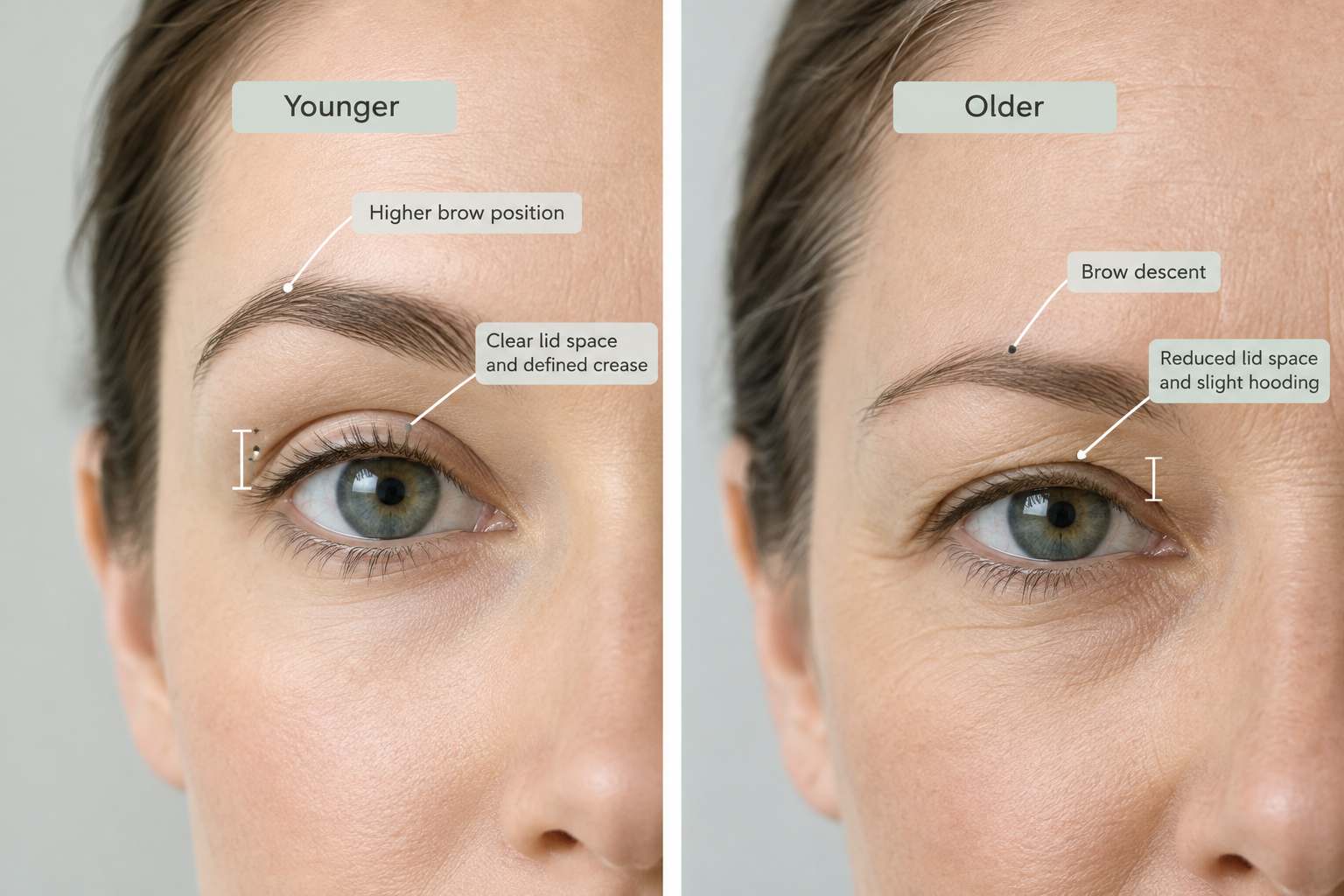
Volume changes in the periorbital fat compartments — the pockets of fat that cushion the eye within the socket — can alter the apparent depth and shape of the eye. Loss of fat in the upper eyelid can make the eye appear more deep-set or hollow, while changes in the lower eyelid fat can contribute to the appearance of under-eye hollows or bags. The tear trough — the groove that runs from the inner corner of the eye downward along the cheek — often becomes more pronounced with age as volume is lost in the mid-face.
These changes are gradual and vary considerably between individuals depending on genetics, lifestyle factors, sun exposure history, and overall health. They are relevant in aesthetic consultations because treatments targeting the eye area need to account for the current anatomy, which may differ significantly from the person’s natural eye shape in earlier life.
Eye Shape and Aesthetic Treatments
Eye shape is a relevant consideration in a range of aesthetic treatments, and a qualified practitioner will assess the existing anatomy carefully before recommending any intervention. The following overview describes how eye shape may be relevant in common aesthetic contexts — it is not a recommendation for any specific treatment.
Brow lifting procedures, whether surgical or non-surgical, alter the position of the brow relative to the eye and can change the apparent shape of the eye. Lifting a descended brow may reveal more lid space and reduce the appearance of hooding, but the effect depends on the individual’s anatomy and the degree of brow descent. Non-surgical options such as botulinum toxin injections can be used to subtly elevate the brow tail, which may influence the apparent angle of the outer eye corner. These effects are modest and temporary, and results vary between individuals.
Dermal filler treatments in the periorbital area — including tear trough filler — address volume loss rather than changing the fundamental shape of the eye. Restoring volume in the tear trough or upper eyelid hollow may make the eye appear less tired or sunken, but filler does not lift the eyelid or remove excess skin. The periorbital area is considered a higher-risk region for filler treatments due to the proximity of important vascular structures, and treatment should only be performed by a practitioner with appropriate training and experience in this area.
Surgical options such as blepharoplasty (eyelid surgery) can address excess upper eyelid skin, lower eyelid bags, or both. Upper blepharoplasty removes redundant skin and, where appropriate, fat from the upper eyelid, which can restore visible lid space in individuals with significant hooding or skin laxity. Lower blepharoplasty addresses under-eye bags and hollows. These are surgical procedures with associated recovery periods and risks, and suitability requires a thorough assessment by a qualified surgeon.
It is important to approach any aesthetic treatment around the eye area with realistic expectations. Eye shape is largely determined by bone structure and genetics, and most non-surgical treatments address soft tissue changes rather than altering the fundamental anatomy. A qualified practitioner will discuss what is and is not achievable based on your individual anatomy and goals.
Frequently Asked Questions
Can eye shape change naturally over time?
Yes. While the underlying bone structure remains stable, the soft tissues around the eye — including the skin, fat compartments, and muscles — change with age. Skin laxity, brow descent, and volume loss can all alter the apparent shape of the eye over time, often making eyes appear more hooded or deep-set than they were in earlier life.
Is a monolid the same as an epicanthal fold?
No, though the two features often appear together. A monolid refers to the absence of a visible crease in the upper eyelid. An epicanthal fold is a separate feature — a fold of skin that covers the inner corner of the eye. It is possible to have a monolid without a prominent epicanthal fold, and vice versa.
Are hooded eyes a medical problem?
Hooded eyes as a natural anatomical feature are not a medical concern. However, in some cases significant upper eyelid skin laxity can descend to the point where it affects the upper visual field, which may be considered a functional issue. If you are concerned that excess upper eyelid skin is affecting your vision, a consultation with an ophthalmologist or oculoplastic surgeon is appropriate.
Does eye shape affect which aesthetic treatments are suitable?
Eye shape and the surrounding anatomy are relevant factors in aesthetic treatment planning. For example, the degree of hooding, the position of the brow, the depth of the orbital socket, and the presence of volume loss all influence which treatments may be appropriate and what results may be achievable. A thorough assessment by a qualified practitioner is necessary before any treatment in the periorbital area.
Can makeup change the appearance of eye shape?
Makeup techniques can create the optical illusion of a different eye shape by altering where light and shadow fall on the eyelid and surrounding area. For example, specific liner placement can make eyes appear more elongated, lifted, or open. However, makeup does not change the underlying anatomy and its effects are temporary.
Is one eye shape considered more aesthetically ideal?
Aesthetic ideals vary across cultures and change over time. Almond-shaped eyes are frequently cited as a reference point in Western aesthetic frameworks, but this reflects cultural convention rather than any objective standard. All eye shapes are normal anatomical variations, and aesthetic practitioners are trained to work with each individual’s unique features rather than applying a universal template.
Understanding Your Eye Shape Before an Aesthetic Consultation
Knowing the terminology used to describe different types of eyes can make aesthetic consultations more productive. When you understand whether your eyes are hooded, deep-set, downturned, or have another characteristic, you can communicate more clearly with a practitioner about what you are hoping to address and why. This also helps set realistic expectations, because some concerns — such as the appearance of hooding caused by bone structure rather than skin laxity — may not be significantly improved by non-surgical treatments.
If you are considering any aesthetic treatment around the eye area, seek a consultation with a qualified and experienced practitioner who can assess your individual anatomy, discuss the realistic outcomes of any proposed treatment, and explain the relevant risks. The periorbital region is anatomically complex, and treatment outcomes depend heavily on accurate assessment and appropriate technique. Eye shape is one piece of that assessment, and understanding your own features is a useful starting point for an informed conversation.