

The Russian lip technique has become one of the most requested approaches to lip filler treatment, largely because it aims for a specific aesthetic that differs noticeably from conventional lip augmentation. Rather than simply adding volume, the technique focuses on lifting the centre of the upper lip and creating a heart-shaped, defined result with a flatter profile when viewed from the side. Understanding what the technique actually involves, who it may suit, and what its realistic limitations are can help you decide whether it is worth discussing with a qualified practitioner.
Key Takeaways
- The Russian lip technique uses a specific injection method to lift and define the lip rather than primarily adding forward projection or overall volume.
- Results depend heavily on practitioner skill, individual lip anatomy, and the type of hyaluronic acid filler used.
- The technique carries the same core risks as any lip filler treatment, including bruising, swelling, asymmetry, and rare but serious vascular complications.
- Russian lip filler is not universally suitable; thin lips, certain anatomical features, and previous filler may affect candidacy and outcome.
- Results typically last six to twelve months, though this varies between individuals and depends on the product used.
What Is the Russian Lip Technique?
The Russian lip technique is an injection approach to lip augmentation that prioritises vertical height and central definition over forward projection. The name refers to the aesthetic goal — a cupid’s bow that is sharply defined and elevated, with the body of the lip appearing taller and flatter rather than fuller and more projected. When viewed from the front, the result is often described as resembling a heart shape, with the peaks of the upper lip more pronounced and the centre lifted.
In conventional lip filler treatment, hyaluronic acid filler is typically placed along the vermilion border and within the body of the lip to add volume and projection. The Russian technique modifies where and how the filler is deposited. Practitioners generally work from the base of the lip upward, placing small amounts of filler in multiple precise points to build vertical lift rather than horizontal fullness. The injections are typically made at or near the base of the lip, with the filler distributed in a way that encourages the lip to lift rather than push forward.
It is important to understand that the Russian lip technique is a method of injection, not a specific product. Any suitable hyaluronic acid dermal filler can be used, though practitioners tend to select products with particular rheological properties — meaning the way the filler flows and holds its shape — that support the defined, structured result the technique aims to achieve.
How the Russian Lip Technique Differs from Classic Lip Augmentation
Classic lip augmentation and the Russian technique share the same fundamental material — hyaluronic acid filler — but differ in their injection pattern, depth, and aesthetic goal. Understanding these differences helps set realistic expectations before a consultation.
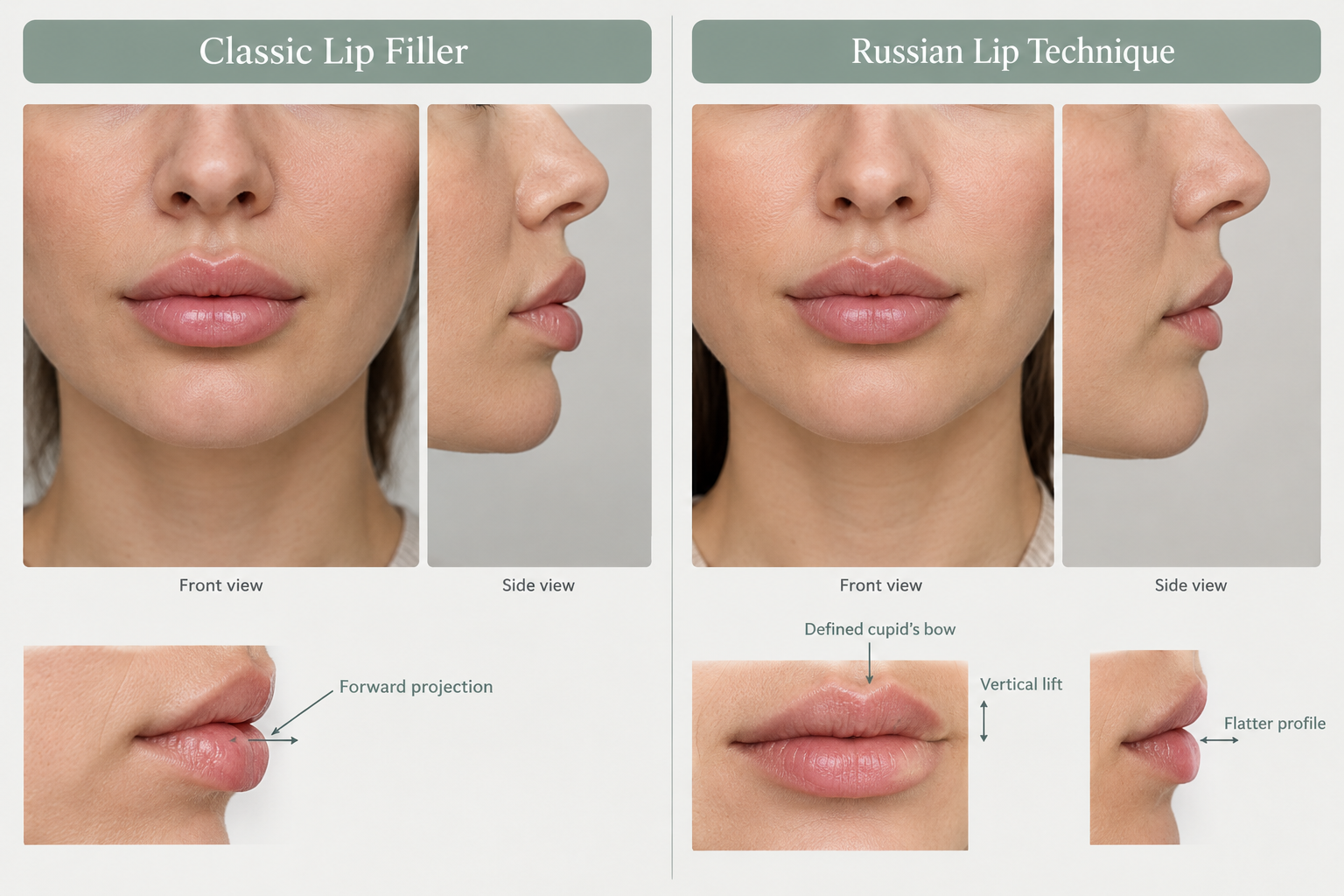
In a standard lip filler treatment, the primary aim is often to increase the overall size of the lips, smooth fine lines around the mouth, or improve symmetry. Filler is commonly placed along the border to define the edge and within the body of the lip to add volume. The result tends to increase the lip’s forward projection and overall fullness, which suits patients who want noticeably larger lips.
The Russian technique, by contrast, is designed to increase the vertical height of the lip — particularly the upper lip — while keeping the profile relatively flat. The cupid’s bow becomes more defined and elevated, and the philtrum columns (the two ridges running from the nose to the upper lip) may appear more prominent. The overall effect is often described as more structured and less obviously augmented, though this depends on how much product is used and the patient’s starting anatomy.
Because the injection points and depths differ, the Russian technique generally requires more injection sites and a higher level of technical precision. This is one reason why practitioner experience and training are particularly important when considering this approach.
What Results May Look Like
Realistic expectations are essential before any lip filler treatment. The Russian lip technique can produce a more defined cupid’s bow, increased vertical height in the upper lip, and a heart-shaped appearance when viewed from the front. For patients whose primary concern is a flat or undefined upper lip rather than overall size, this approach may be more appropriate than conventional augmentation.
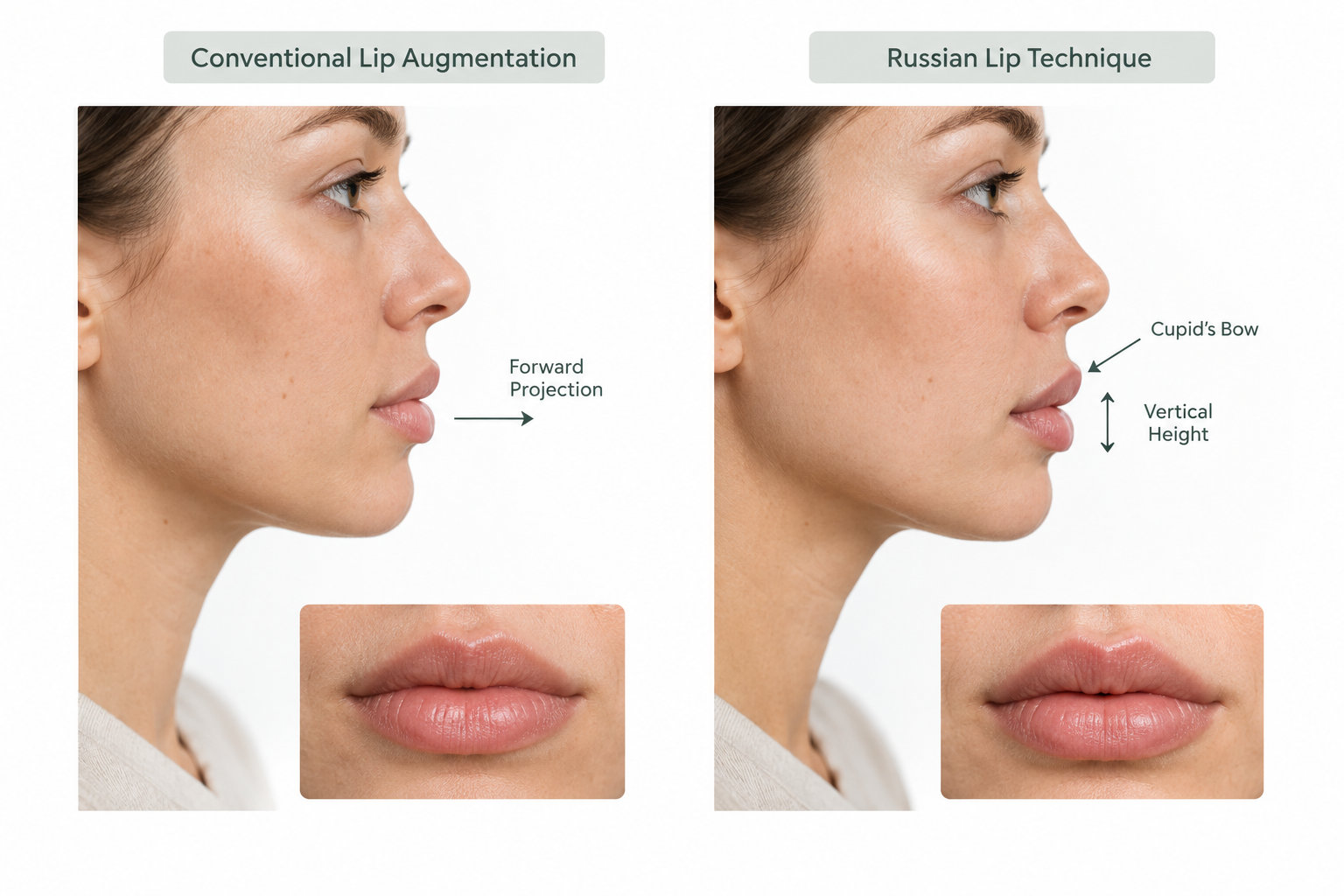
However, the degree of change achievable depends significantly on the patient’s existing lip anatomy. Patients with very thin lips may not achieve the same dramatic definition as those with moderate natural lip volume, because there is less tissue to work with. Patients with a naturally flat philtrum or a long distance between the nose and the upper lip may find that the technique produces a subtler result than they anticipated.
The technique does not dramatically increase the overall size of the lips in the way that a high-volume conventional treatment might. Patients seeking significantly larger lips may find that a combination approach — or a different injection strategy — better matches their goals. A thorough consultation with a practitioner who can assess your anatomy and discuss your expectations is the most reliable way to determine what outcome is realistic for you.
The Treatment Experience
A Russian lip filler appointment follows a broadly similar structure to any lip filler treatment, though the injection process itself takes longer due to the number of precise injection points involved.
Before the Appointment
Most practitioners will conduct a consultation before treatment, either at the same appointment or separately. During this discussion, your medical history, any previous lip filler treatments, medications, allergies, and aesthetic goals will be reviewed. It is important to disclose any previous filler in the lips, as existing product can affect how the new filler distributes and may influence the technique used. Patients are generally advised to avoid blood-thinning medications and supplements such as aspirin, ibuprofen, and high-dose fish oil in the days before treatment, though you should always follow the specific guidance of your practitioner and prescribing clinician.
During the Appointment
A topical anaesthetic cream is typically applied to the lips before treatment to reduce discomfort. Many hyaluronic acid fillers also contain lidocaine, a local anaesthetic, which helps manage pain during the injection process. The Russian technique involves multiple small injections across the lip, which some patients find more uncomfortable than a conventional treatment with fewer injection points. Discomfort levels vary between individuals, and most patients describe the experience as tolerable rather than painful.
The appointment itself usually takes between thirty and sixty minutes, depending on the amount of product used and the complexity of the treatment. Swelling begins almost immediately after injection, which means the lips will look larger and less defined directly after treatment than they will once the swelling has resolved.
After the Appointment
Swelling and bruising are common after Russian lip filler and may be more pronounced than after conventional lip augmentation due to the higher number of injection sites. Most swelling resolves within five to seven days, though some patients experience residual swelling for up to two weeks. Bruising, if it occurs, typically fades within one to two weeks. Practitioners generally advise avoiding strenuous exercise, alcohol, and excessive heat — such as saunas or hot baths — for the first twenty-four to forty-eight hours after treatment.
The final result becomes visible once the swelling has fully settled, which is usually around two weeks after treatment. Some practitioners schedule a review appointment at this point to assess the outcome and determine whether any refinement is needed.
How Long Russian Lip Filler Lasts
Hyaluronic acid lip filler is not permanent. The body gradually breaks down the filler over time through natural enzymatic processes. For most patients, Russian lip filler results last approximately six to twelve months, though this range varies depending on several factors.
The specific hyaluronic acid product used influences longevity, as different formulations have different cross-linking densities and degradation rates. Individual metabolism also plays a role — patients with faster metabolic rates may find that filler breaks down more quickly. The amount of product used, the injection depth, and the degree of lip movement (lips are highly mobile structures) all affect how long the result is maintained.
Maintenance treatments are typically needed to sustain the result. Some practitioners recommend a top-up appointment before the filler has fully dissolved to maintain continuity of the aesthetic outcome, though the appropriate interval depends on the individual patient and the product used.
Risks and Side Effects
Russian lip filler carries the same core risks as any lip filler treatment. Understanding these risks before proceeding is an important part of informed consent.
Common Side Effects
- Swelling: Expected after treatment and usually resolves within one to two weeks. The Russian technique may produce more pronounced swelling due to the number of injection points.
- Bruising: Common and typically resolves within one to two weeks. The risk is higher in patients taking blood-thinning medications or supplements.
- Tenderness: The lips may feel sore or sensitive for several days after treatment.
- Asymmetry: Minor asymmetry is common in the immediate post-treatment period due to uneven swelling. Persistent asymmetry after swelling resolves may require assessment and possible correction.
- Lumps or irregularities: Small lumps can occur, particularly with the precise, layered injection approach used in the Russian technique. Many resolve as swelling settles; persistent lumps may require massage or, in some cases, dissolution with hyaluronidase.
Less Common but Serious Risks
Vascular occlusion is a rare but serious complication of any dermal filler treatment, including lip filler. This occurs when filler is inadvertently injected into or compresses a blood vessel, potentially restricting blood flow to surrounding tissue. In the lips and perioral area, vascular occlusion can cause tissue damage if not recognised and treated promptly. Symptoms may include blanching (whitening) of the skin, pain disproportionate to the injection, or a bluish discolouration. This is a medical emergency that requires immediate treatment with hyaluronidase to dissolve the filler.
The risk of vascular complications underscores the importance of choosing a practitioner with appropriate medical training, a thorough understanding of facial anatomy, and access to hyaluronidase for emergency use. The Russian technique’s multiple injection points and specific injection depths mean that anatomical knowledge is particularly critical.
Other less common risks include infection, allergic reaction, and, with repeated treatments over time, changes to the natural tissue of the lip. Filler migration — where product moves away from the intended area — can also occur, particularly if large volumes are used or if the product is not well-suited to the technique.
Who May Be Suitable for Russian Lip Filler
Russian lip filler may be worth discussing with a practitioner if your primary concern is the shape and definition of your lips rather than overall size. Patients who may be suitable include those who:
- want a more defined cupid’s bow without significantly increasing lip volume;
- have a naturally flat or undefined upper lip profile;
- are looking for a structured, lifted appearance rather than a fuller, more projected result;
- have realistic expectations about the degree of change achievable;
- are in good general health with no contraindications to hyaluronic acid filler.
Patients with moderate natural lip volume tend to achieve more visible definition with the Russian technique than those with very thin lips, though individual anatomy varies and a clinical assessment is necessary to determine suitability.
Who May Not Be Suitable
Russian lip filler is not appropriate for everyone. A practitioner may advise against the technique or recommend an alternative approach for patients who:
- have significant existing filler in the lips that has not fully dissolved, as this can affect the distribution and outcome of new product;
- have a history of cold sores (herpes simplex), as lip injections can trigger an outbreak — antiviral prophylaxis is often recommended in these cases;
- are pregnant or breastfeeding;
- have active infection, inflammation, or skin conditions affecting the treatment area;
- have a known allergy to hyaluronic acid filler or lidocaine;
- have certain autoimmune conditions or are taking medications that significantly affect healing or immune response;
- have unrealistic expectations about the degree of change the technique can achieve.
Patients who primarily want significantly larger lips may find that the Russian technique does not fully meet their goals, and a conventional augmentation approach or a combination strategy may be more appropriate.
Alternatives to the Russian Lip Technique
Several alternative approaches to lip enhancement exist, and the most appropriate option depends on the patient’s anatomy, goals, and medical history.
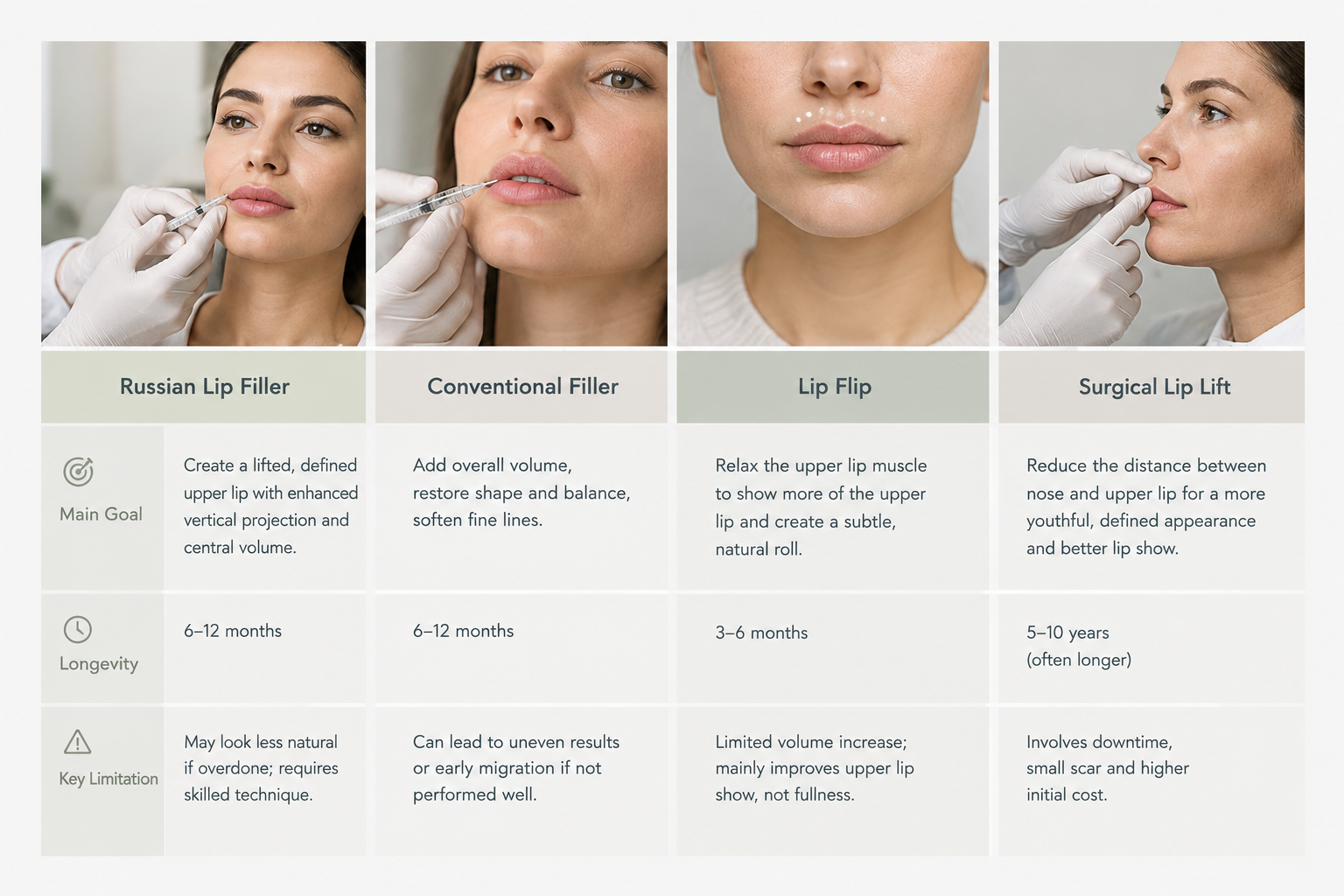
Conventional lip filler remains the most widely used approach and is well-suited to patients who want to increase overall lip volume, improve symmetry, or address fine lines around the mouth. It typically involves fewer injection points than the Russian technique and may produce less post-treatment swelling.
Lip flip with botulinum toxin is a non-filler option that involves injecting a small amount of botulinum toxin into the orbicularis oris muscle around the upper lip. This causes the muscle to relax slightly, allowing the upper lip to roll outward and appear slightly fuller. The effect is subtle and temporary — typically lasting two to three months — and does not add volume. It may suit patients who want a minimal change without filler.
Combination treatments — using both filler and botulinum toxin — are sometimes used to address both volume and lip position simultaneously. The appropriateness of a combination approach depends on individual anatomy and goals.
Surgical lip lift is a permanent surgical procedure that shortens the philtrum and lifts the upper lip. It produces a lasting result but carries the risks associated with surgery, including scarring. It may be considered by patients who want a permanent change in lip position and are not suited to or interested in repeated filler treatments.
Choosing a Practitioner for Russian Lip Filler
The Russian lip technique requires a higher level of technical precision than many conventional lip filler approaches. The number of injection points, the specific depths involved, and the importance of symmetry mean that practitioner skill and anatomical knowledge are particularly important factors in the outcome and safety of the treatment.
When selecting a practitioner, it is reasonable to ask about their specific training in the Russian lip technique, how many treatments of this type they have performed, and whether they have access to hyaluronidase for emergency use. Reviewing before-and-after photographs of their previous work — with appropriate patient consent — can also help you assess whether their aesthetic style aligns with your goals.
In the United Kingdom, aesthetic injectable treatments are subject to regulatory requirements, and from 2024 certain procedures including lip filler require a prescription from a registered healthcare professional. Ensuring that your practitioner meets the relevant regulatory requirements in your country is an important part of choosing safely.
Frequently Asked Questions
Is the Russian lip technique more painful than standard lip filler?
Many patients report that the Russian technique involves more discomfort than conventional lip filler, primarily because it uses a greater number of injection points. Topical anaesthetic cream and lidocaine-containing filler help manage pain, but individual tolerance varies. If you are concerned about discomfort, discuss pain management options with your practitioner before the appointment.
Can the Russian lip technique be reversed?
Yes. Because the technique uses hyaluronic acid filler, the result can be partially or fully reversed using hyaluronidase, an enzyme that dissolves hyaluronic acid. Dissolution is not always complete in a single session and may require more than one treatment. Hyaluronidase is also used as an emergency treatment for vascular complications.
How much filler is typically used in the Russian technique?
The amount of filler used varies depending on the patient’s anatomy, the degree of change desired, and the practitioner’s assessment. The Russian technique does not necessarily use more filler than conventional augmentation — in some cases, less product is used because the goal is definition rather than volume. Your practitioner will advise on the appropriate amount during consultation.
Will my lips look natural after Russian lip filler?
The Russian technique is often chosen by patients who want a defined but not obviously augmented result. Whether the outcome looks natural depends on the amount of product used, the patient’s anatomy, and the practitioner’s skill. Using excessive filler with any technique can produce an unnatural appearance. Discussing your aesthetic preferences clearly during consultation helps the practitioner tailor the treatment to your goals.
Can I have the Russian technique if I already have lip filler?
Existing filler in the lips can affect how new product distributes and may influence the outcome of the Russian technique. Some practitioners prefer to allow previous filler to dissolve fully — or dissolve it with hyaluronidase — before proceeding. Others may be able to work with existing product depending on its type, location, and volume. A thorough assessment at consultation is necessary to determine the best approach.
How soon can I wear lipstick after Russian lip filler?
Most practitioners advise avoiding makeup on the lips for at least twenty-four hours after treatment to reduce the risk of infection at the injection sites. After this period, lipstick and other lip products can generally be used, though you should follow your practitioner’s specific aftercare instructions.
Is Russian Lip Filler the Right Choice for Your Goals?
The Russian lip technique offers a genuinely different aesthetic outcome compared to conventional lip augmentation — one that prioritises definition, vertical height, and a structured cupid’s bow over overall volume and projection. For patients whose primary concern is the shape and lift of their lips rather than their size, the technique may be a more appropriate option than standard filler placement.
However, the technique is not universally superior to other approaches, and it is not suitable for every patient or every aesthetic goal. The outcome depends significantly on individual anatomy, the amount of product used, and the skill and experience of the practitioner. The risks associated with Russian lip filler are the same as those of any lip filler treatment, with vascular complications representing the most serious concern — one that reinforces the importance of choosing a practitioner with appropriate medical training and emergency protocols in place.
If you are considering Russian lip filler, a detailed consultation with a qualified and experienced practitioner is the most important first step. A thorough assessment of your lip anatomy, a clear discussion of your goals, and an honest conversation about realistic outcomes and risks will help you make an informed decision about whether this technique is the right approach for you.