

Lip filler has a reputation problem. Many people associate it with overfilled, disproportionate results — yet the majority of patients who seek lip enhancement are specifically looking for the opposite: subtle volume, improved definition, and lips that look like a better version of their own. Achieving a natural result with lip filler is entirely possible, but it depends heavily on the injector’s technique, the product selected, the amount used, and how well the treatment is matched to the individual’s anatomy and goals.
Key Takeaways
- Natural-looking lip filler results depend on injector technique, product choice, and the volume used — not simply on the filler itself.
- Hyaluronic acid fillers are the most commonly used products for lip enhancement and can be partially or fully reversed with hyaluronidase if needed.
- Subtle, staged treatment — starting conservatively and building gradually — is generally the most reliable approach for patients who want understated results.
- Swelling in the first few days after treatment can make results look more dramatic than the final outcome; most patients see their settled result within one to two weeks.
- Lip filler is not permanent; results typically last between six and eighteen months depending on the product, volume, and individual metabolism.
What Is Lip Filler and How Does It Work?
Lip filler refers to injectable dermal filler placed into or around the lips to add volume, improve shape, define the border, or restore lost fullness. The vast majority of lip fillers used in aesthetic practice today are based on hyaluronic acid (HA), a naturally occurring substance found in skin and connective tissue. Hyaluronic acid attracts and retains water molecules, which is what gives it its volumising effect when injected into tissue.
HA fillers are manufactured through a process called cross-linking, which determines how firm or soft the gel is, how long it lasts, and how it behaves in tissue. Products intended for the lips are typically formulated to be softer and more pliable than those used for deeper structural work such as cheek augmentation, because the lips are a highly mobile area that requires a filler capable of moving naturally with facial expression. Stiffer products placed in the lips can create an unnatural, rigid appearance — one of the more common causes of results that look artificial.
When injected, hyaluronic acid filler integrates into the surrounding tissue and creates volume by physically occupying space and drawing in water. The result is immediate, though initial swelling means the final settled appearance takes one to two weeks to become visible. Unlike some other cosmetic injectables, hyaluronic acid lip filler can be dissolved using an enzyme called hyaluronidase, which breaks down the HA and reverses the effect. This reversibility is one reason HA fillers remain the preferred choice for lip enhancement in most clinical settings.
What Makes Lip Filler Look Natural?
The difference between a natural result and an overdone one is rarely about the filler product alone. Several factors interact to determine whether the outcome looks proportionate and believable.
Injector Technique and Anatomical Knowledge
Technique is arguably the most important variable. An experienced injector understands lip anatomy in detail — including the position of the vermilion border, the Cupid’s bow, the philtral columns, the oral commissures, and the underlying muscle structure. Placing filler in the right anatomical layers, in the right locations, and in the right quantities requires both training and clinical judgement. Poor technique — such as placing too much product in the body of the lip rather than distributing it appropriately — is a common cause of the swollen, sausage-like appearance that patients specifically want to avoid.
The injection technique itself also matters. Cannulas (blunt-tipped flexible needles) are sometimes preferred over sharp needles for certain areas because they may reduce bruising and allow smoother product distribution, though both approaches are used by experienced practitioners depending on the area being treated and the product being used.
Product Selection
Not all hyaluronic acid fillers behave the same way in the lips. Products vary in their viscosity, elasticity, and degree of cross-linking. Softer, lower-viscosity HA fillers tend to integrate more naturally into lip tissue and move more fluidly with expression. Choosing a product that is too firm for the lips can result in visible lumps, stiffness, or an unnatural feel. A qualified practitioner will select a product appropriate for the specific goal — whether that is adding subtle volume, defining the border, or addressing asymmetry.
Volume and Proportionality
The amount of filler used has a direct bearing on how natural the result looks. A conservative approach — typically starting with 0.5 ml to 1 ml for most patients — allows the injector to assess how the lips respond before adding more. Patients who want a very subtle enhancement may find that even 0.5 ml produces a noticeable but believable change. Larger volumes increase the risk of a disproportionate result, particularly if the patient’s natural lip size is small. Maintaining the natural ratio between the upper and lower lip — where the lower lip is generally slightly fuller than the upper — is an important principle in achieving results that look harmonious with the rest of the face.
Individual Anatomy
Every patient’s lips are different. Factors such as the natural lip size, the degree of existing asymmetry, the position of the teeth, the depth of the philtrum, and the overall facial proportions all influence what a natural result looks like for that individual. A good outcome for one patient may look entirely different from a good outcome for another, even if the same product and volume are used. This is why a thorough consultation — including an assessment of facial anatomy and a discussion of realistic goals — is an essential part of the process.
Common Goals for Natural Lip Enhancement
Patients seeking natural-looking lip filler typically have one or more of the following goals, and understanding which applies helps guide the treatment plan.
- Subtle volume increase: Adding modest fullness to lips that are naturally thin without making them look dramatically larger.
- Border definition: Sharpening the vermilion border or Cupid’s bow to give the lips a more defined edge without adding significant volume.
- Symmetry correction: Addressing mild asymmetry between the upper and lower lip, or between the left and right sides.
- Hydration and texture: Some patients use small amounts of a very soft HA product to improve the surface quality and hydration of the lips rather than to add structural volume.
- Age-related volume restoration: Lips naturally lose volume and definition with age. Filler can be used to restore some of what has been lost, rather than to create a look the patient never had.
The Treatment Experience
A lip filler appointment typically begins with a consultation, during which the practitioner assesses the lips, discusses the patient’s goals, reviews medical history, and explains what is realistic. Photographs are often taken before treatment for reference and comparison.
A topical anaesthetic cream is usually applied to the lips for around fifteen to thirty minutes before the injections begin, which significantly reduces discomfort. Many HA lip fillers also contain lidocaine — a local anaesthetic — within the gel itself, which further reduces sensation during the procedure. Most patients describe the injections as mildly uncomfortable rather than painful, though individual pain tolerance varies.
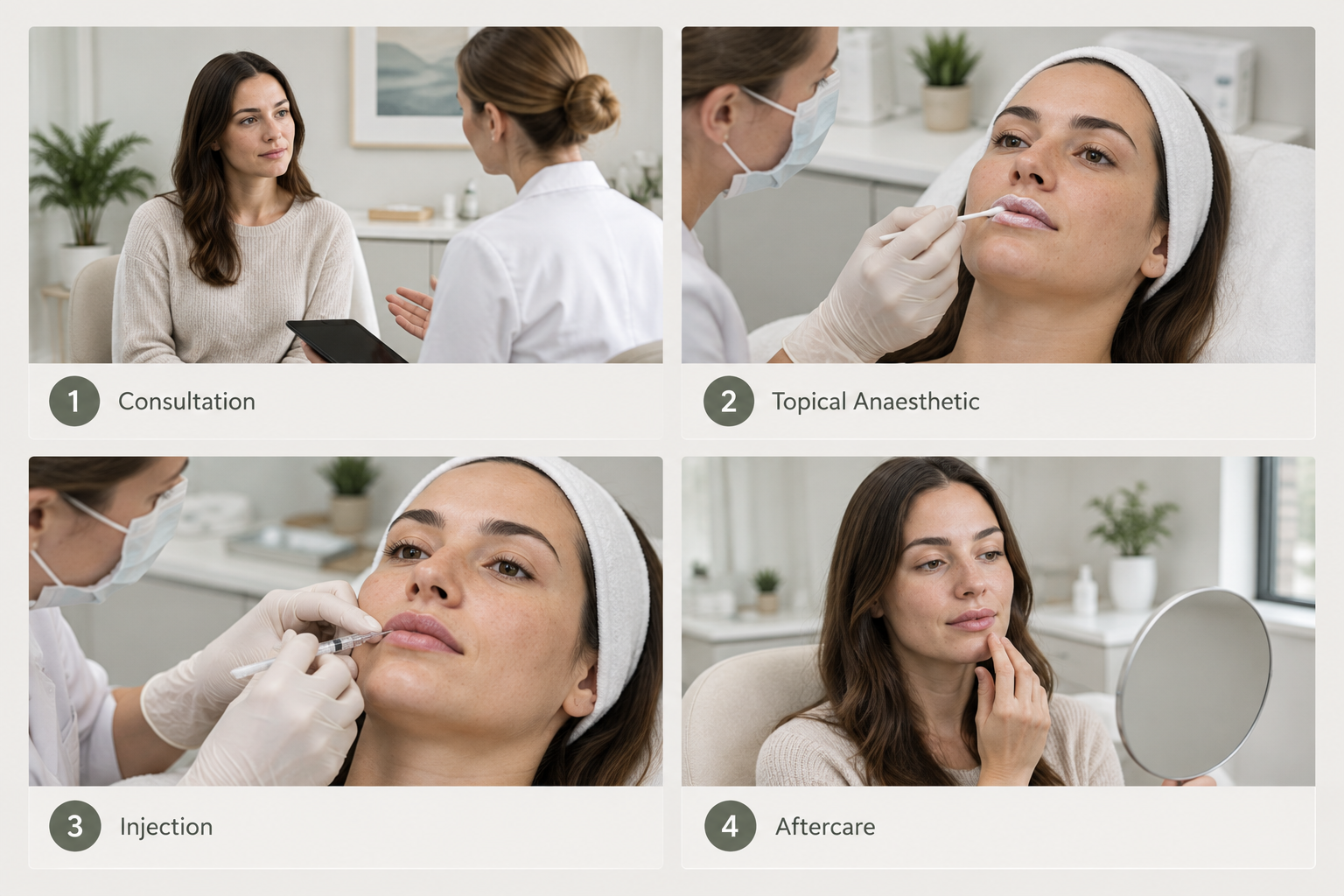
The injection process itself typically takes between fifteen and thirty minutes. The practitioner may inject at multiple points around and within the lips, massaging the product gently between injections to ensure even distribution. The total appointment, including preparation and aftercare advice, usually takes around forty-five minutes to an hour.
Immediately after treatment, the lips will appear swollen and may feel tender. Bruising is possible, particularly around injection sites. Patients are generally advised to avoid strenuous exercise, alcohol, and excessive heat for the first twenty-four to forty-eight hours, and to avoid pressing or massaging the lips unless specifically instructed to do so by their practitioner.
Swelling, Recovery, and Seeing the Final Result
Swelling after lip filler is normal and expected. In the first twenty-four to forty-eight hours, the lips may look significantly more voluminous than intended — this is largely due to post-injection swelling rather than the filler itself. Patients who are not prepared for this can find the initial appearance alarming, but it is important to understand that this is temporary.
Most of the swelling resolves within three to five days. By the end of the first week, the lips will look considerably more settled. The final result — the true reflection of what the filler has achieved — is generally visible at around ten to fourteen days post-treatment. It is at this point that any review appointment, if needed, should ideally take place.
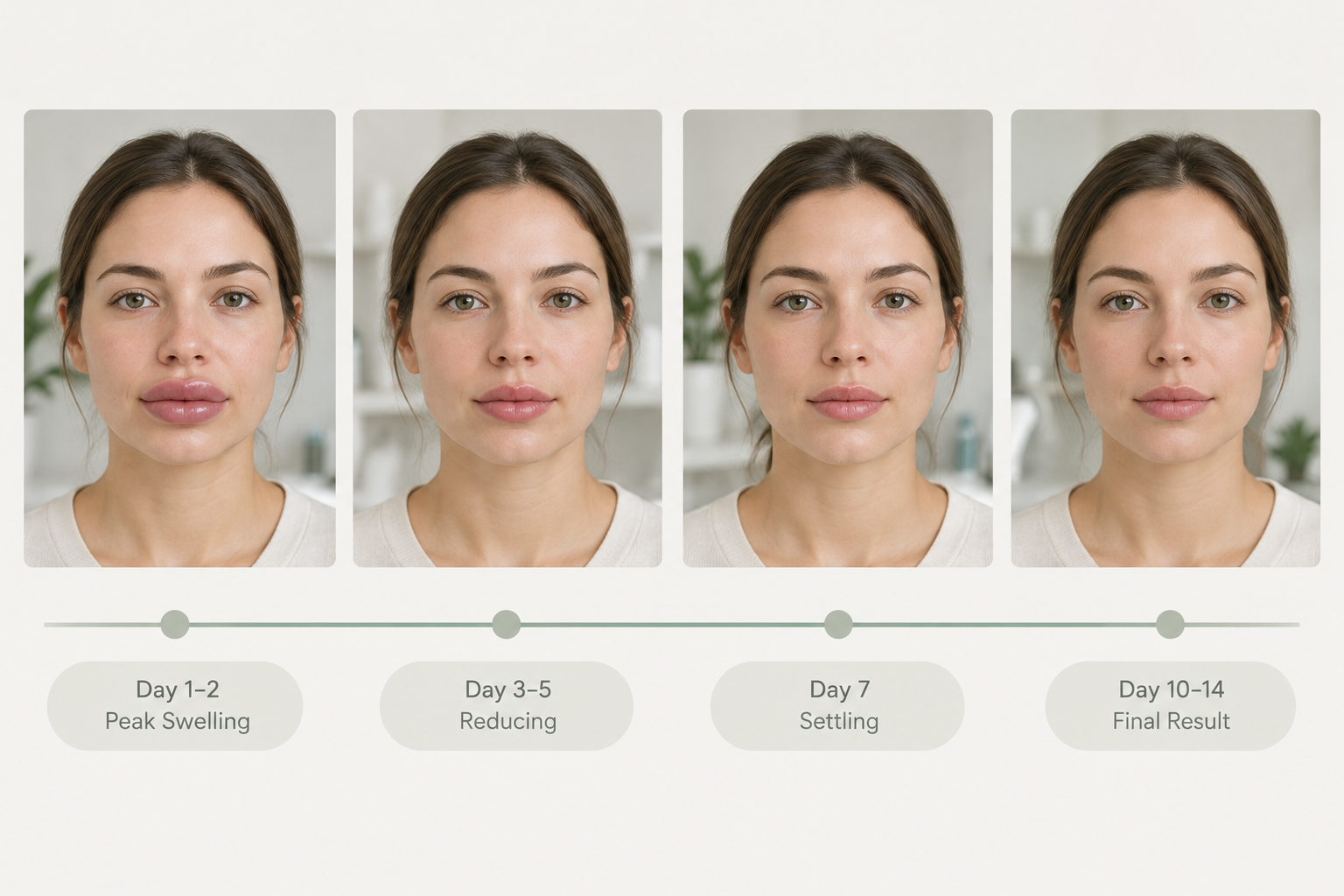
Bruising, if it occurs, typically fades within five to ten days. Applying a cold compress in the first few hours after treatment may help reduce both swelling and bruising. Arnica gel or supplements are sometimes used by patients to help with bruising, though evidence for their effectiveness in this context is limited.
How Long Does Natural Lip Filler Last?
Hyaluronic acid lip filler is not permanent. The body gradually breaks down the HA over time through natural enzymatic processes. How long the results last depends on several factors, including the specific product used, the volume injected, the individual’s metabolism, and lifestyle factors such as sun exposure and smoking.
In general, lip filler results last between six and eighteen months for most patients. Softer, lower-density products used for subtle enhancement may metabolise more quickly than firmer products used for more significant volume. Some patients find their results last closer to the lower end of this range; others retain their results for longer. Repeat treatment is required to maintain the effect.
It is worth noting that repeated treatments over time do not necessarily mean continuously increasing volume. Many patients maintain a consistent, natural-looking result by having top-up treatments before the filler has fully dissolved, which can sometimes require less product than the initial treatment.
Risks and Side Effects
Lip filler is a medical procedure and carries risks that patients should understand before proceeding. Common side effects are generally mild and temporary, while serious complications are less frequent but require prompt attention.
Common Side Effects
- Swelling: Expected and normal; typically resolves within one to two weeks.
- Bruising: Common at injection sites; usually fades within a week to ten days.
- Tenderness: The lips may feel sore or sensitive for a few days after treatment.
- Lumps or irregularities: Small lumps can occur, particularly in the first week. Many resolve on their own; persistent lumps may require massage or, in some cases, dissolution with hyaluronidase.
- Asymmetry: Minor asymmetry immediately after treatment is common due to uneven swelling and usually resolves as swelling settles.
Less Common but Serious Risks
Vascular occlusion — where filler is inadvertently injected into or compresses a blood vessel — is a rare but serious complication that can compromise blood supply to the surrounding tissue. Symptoms may include blanching (whitening) of the skin, severe pain, or skin discolouration. This requires immediate treatment and is one of the reasons lip filler should only be performed by a qualified practitioner with appropriate training and access to hyaluronidase for emergency use.
Other less common risks include infection, allergic reaction, cold sore reactivation in patients with a history of herpes simplex (antiviral prophylaxis may be recommended in such cases), and delayed inflammatory reactions. Patients with a history of cold sores should inform their practitioner before treatment.
The risk of complications is meaningfully reduced — though not eliminated — when treatment is performed by an experienced, qualified practitioner in an appropriate clinical setting using licensed products.
Who May Be Suitable for Lip Filler
Lip filler may be appropriate for adults who are in good general health, have realistic expectations, and have specific aesthetic goals that filler can reasonably address. Suitable candidates often include those who want to add modest volume to naturally thin lips, restore age-related volume loss, improve lip symmetry, or enhance definition without surgery.
Patients who may not be suitable, or who require careful assessment before treatment, include those who are pregnant or breastfeeding, have active infection or inflammation in or around the lips, have certain autoimmune conditions, are taking blood-thinning medications (which may increase bruising risk), have a history of severe allergic reactions, or have previously experienced complications with filler. A thorough medical history review at consultation is essential.
Patients with very thin lips who want a dramatic size increase should be counselled carefully about what is achievable while maintaining a natural appearance. In some cases, the anatomy may limit how much volume can be added without the result looking disproportionate.
Alternatives to Lip Filler
Lip filler is not the only option for patients interested in lip enhancement. Understanding the alternatives helps patients make an informed choice.
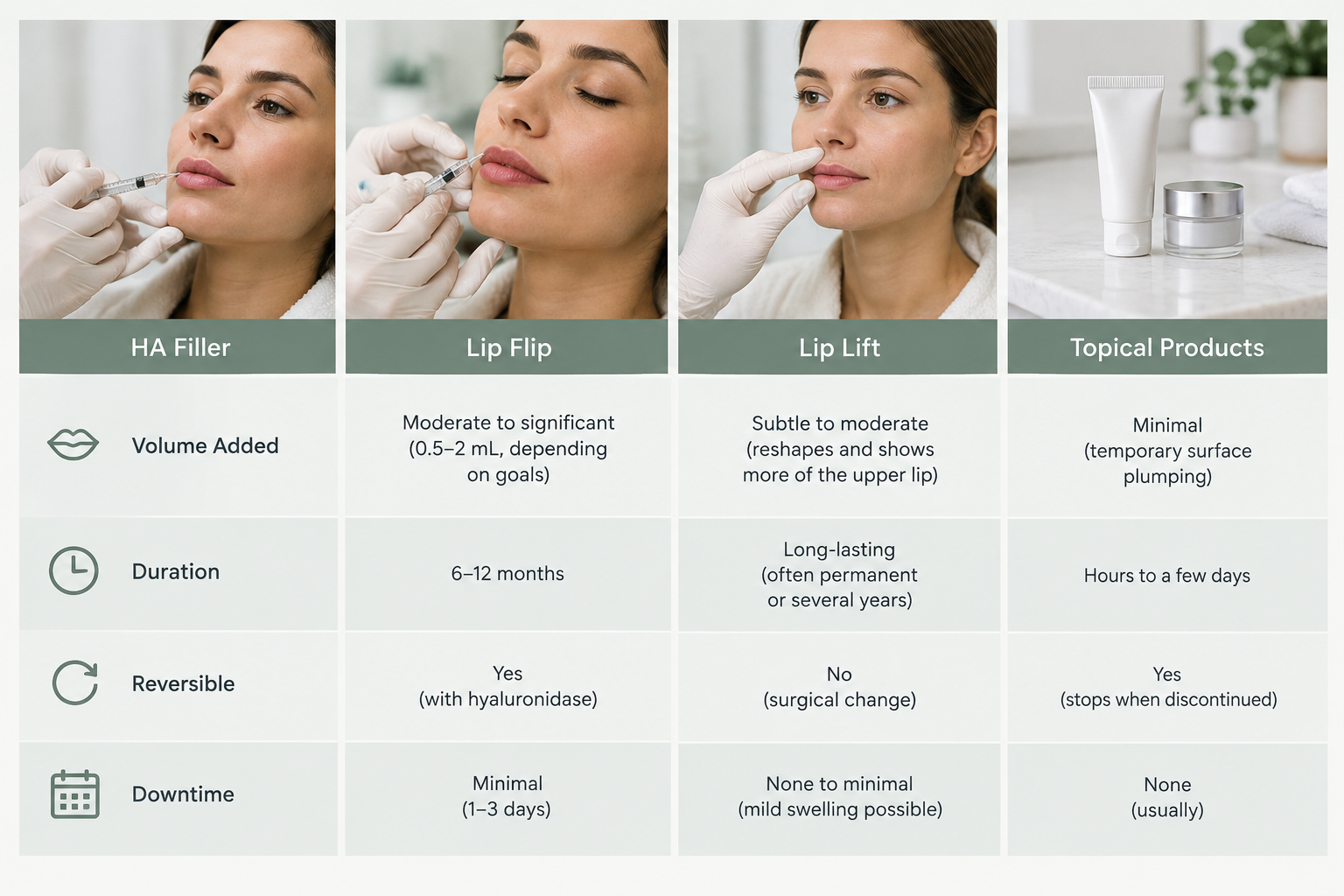
- Lip flip with botulinum toxin: A small amount of botulinum toxin injected into the orbicularis oris muscle above the upper lip causes the lip to relax and roll slightly outward, creating the appearance of a fuller upper lip without adding volume. This is a subtle effect and does not add actual volume, but it can be useful for patients who want a very minimal change or who are not ready for filler.
- Lip threading: Dissolvable threads can be placed in the lips to add subtle structure and definition. Evidence for this approach in the lips specifically is more limited than for filler, and it is less widely used.
- Surgical lip augmentation: Procedures such as a lip lift (which shortens the distance between the nose and the upper lip) or fat transfer to the lips offer more permanent results but involve surgical risks, recovery time, and greater cost. These may be more appropriate for patients seeking a lasting structural change.
- Skincare and topical products: Lip plumping glosses and serums containing ingredients such as peptides or mild irritants can create a temporary appearance of fullness, but the effect is cosmetic rather than structural and does not compare to injectable treatment in terms of magnitude or duration.
Questions to Ask Your Practitioner
Before proceeding with lip filler, it is reasonable to ask your practitioner the following questions to help you make an informed decision and assess whether the clinic and practitioner are appropriate for your needs.
- What qualifications and training do you have in aesthetic injectables and lip anatomy?
- Which filler product do you recommend for my goals, and why?
- How much product do you suggest for my first treatment, and what is your approach if I want to add more later?
- Do you have hyaluronidase available on-site in case of a vascular complication?
- What does the aftercare involve, and when should I expect to see my final result?
- What happens if I am unhappy with the result or experience a complication?
- Can I see examples of your previous lip filler work, particularly results that look natural?
Frequently Asked Questions
Will lip filler make my lips look obviously done?
Not necessarily. Whether lip filler looks obvious depends on the volume used, the technique, and the product. Starting with a conservative amount and working with an experienced injector significantly reduces the likelihood of an unnatural result. Many patients have lip filler that is not noticeable to others as a cosmetic procedure.
Can I dissolve lip filler if I don’t like the result?
Yes. Hyaluronic acid lip filler can be dissolved using hyaluronidase, an enzyme that breaks down HA. Dissolution is not always complete in a single session and may require more than one treatment, but it is generally effective. This reversibility is one of the key advantages of HA-based fillers over permanent or semi-permanent alternatives.
How soon after treatment can I wear lipstick?
Most practitioners advise waiting at least twenty-four hours before applying lipstick or other lip products to reduce the risk of introducing bacteria to the injection sites. Your practitioner will give you specific aftercare guidance.
Does lip filler hurt?
Topical anaesthetic cream applied before treatment and lidocaine within the filler itself mean that most patients find the procedure manageable. Discomfort varies between individuals, and the lips are a sensitive area, but significant pain during a well-performed treatment is uncommon.
Will my lips look worse than before if the filler dissolves?
When hyaluronic acid filler naturally dissolves over time, the lips generally return to their pre-treatment appearance. There is no reliable evidence that HA lip filler causes permanent stretching or worsening of the lips when used in appropriate volumes, though this is a concern some patients raise. Very large volumes used repeatedly over many years may theoretically affect tissue, which is another reason conservative treatment is generally recommended.
How do I find a qualified practitioner for lip filler?
Look for a practitioner with a recognised medical, dental, or nursing qualification and specific training in aesthetic injectables and facial anatomy. In the UK, for example, regulatory guidance recommends that aesthetic procedures involving prescription medicines are performed by or under the supervision of a regulated healthcare professional. Checking professional registration, reviewing before-and-after portfolios, and attending a thorough consultation before committing to treatment are all sensible steps.
Making an Informed Decision About Natural Lip Filler
Natural-looking lip filler is achievable for most patients when the treatment is approached conservatively, performed by a qualified and experienced injector, and tailored to the individual’s anatomy and goals. The key factors — product selection, technique, volume, and proportionality — are all within the control of a skilled practitioner, which makes choosing the right person to perform the treatment one of the most important decisions a patient can make.
Lip filler is not without risk, and it is not permanent. Patients should go into treatment with a clear understanding of what the procedure can and cannot achieve, what the recovery involves, and what options exist if the result is not as expected. A thorough consultation with a qualified practitioner — one who takes time to assess your anatomy, listen to your goals, and explain the realistic range of outcomes — is the foundation of a good experience.
If you are considering lip filler and want results that look natural rather than obvious, the most useful first step is to book a consultation with a qualified aesthetic practitioner who can assess your individual anatomy and discuss a treatment plan tailored specifically to you.