

Searching for ways to remove acne scars naturally in a week is understandable — scars can affect confidence and many people want a fast, accessible solution. The honest answer is that true acne scars, which involve structural changes to the skin, cannot be fully removed in seven days by any method, natural or clinical. However, understanding the difference between active post-acne marks and genuine scar tissue, knowing which approaches may offer gradual improvement, and recognising when a clinical treatment is worth considering can help you make a genuinely informed decision rather than wasting time on ineffective remedies.
Key Takeaways
- True acne scars involve changes to the skin’s structure and cannot be fully removed in one week, regardless of the method used.
- Post-inflammatory hyperpigmentation (dark marks left after spots) is not the same as scarring and may fade more readily with consistent skincare.
- Some natural ingredients have limited evidence for improving skin tone and texture over weeks to months, but none erase established scar tissue quickly.
- Clinical treatments such as chemical peels, microneedling, and laser resurfacing offer more meaningful improvement for true acne scars, though multiple sessions are typically required.
- A consultation with a qualified practitioner is the most reliable way to identify your scar type and choose an appropriate treatment plan.
Understanding Acne Scars: Why the Type Matters
Before evaluating any treatment, it is important to distinguish between different types of post-acne skin changes, because each responds differently to treatment. Many people use the term “acne scar” to describe any mark left after a breakout, but clinically these marks fall into distinct categories.
Post-inflammatory hyperpigmentation (PIH) refers to flat, discoloured patches — typically pink, red, or brown — that remain after inflammation resolves. PIH is not true scarring; it is a pigmentation response and can fade over time with sun protection and appropriate skincare. In people with darker skin tones, PIH may be more pronounced and take longer to resolve.
Post-inflammatory erythema (PIE) describes the persistent redness or pink marks common in lighter skin tones after acne. Like PIH, PIE is not structural scarring, though it can persist for months without targeted treatment.
Atrophic scars are the most common form of true acne scarring. They result from a loss of collagen during the healing process and appear as depressions in the skin. The three main subtypes are icepick scars (narrow, deep channels), boxcar scars (wider depressions with defined edges), and rolling scars (broad, wave-like undulations). Each subtype responds differently to treatment.
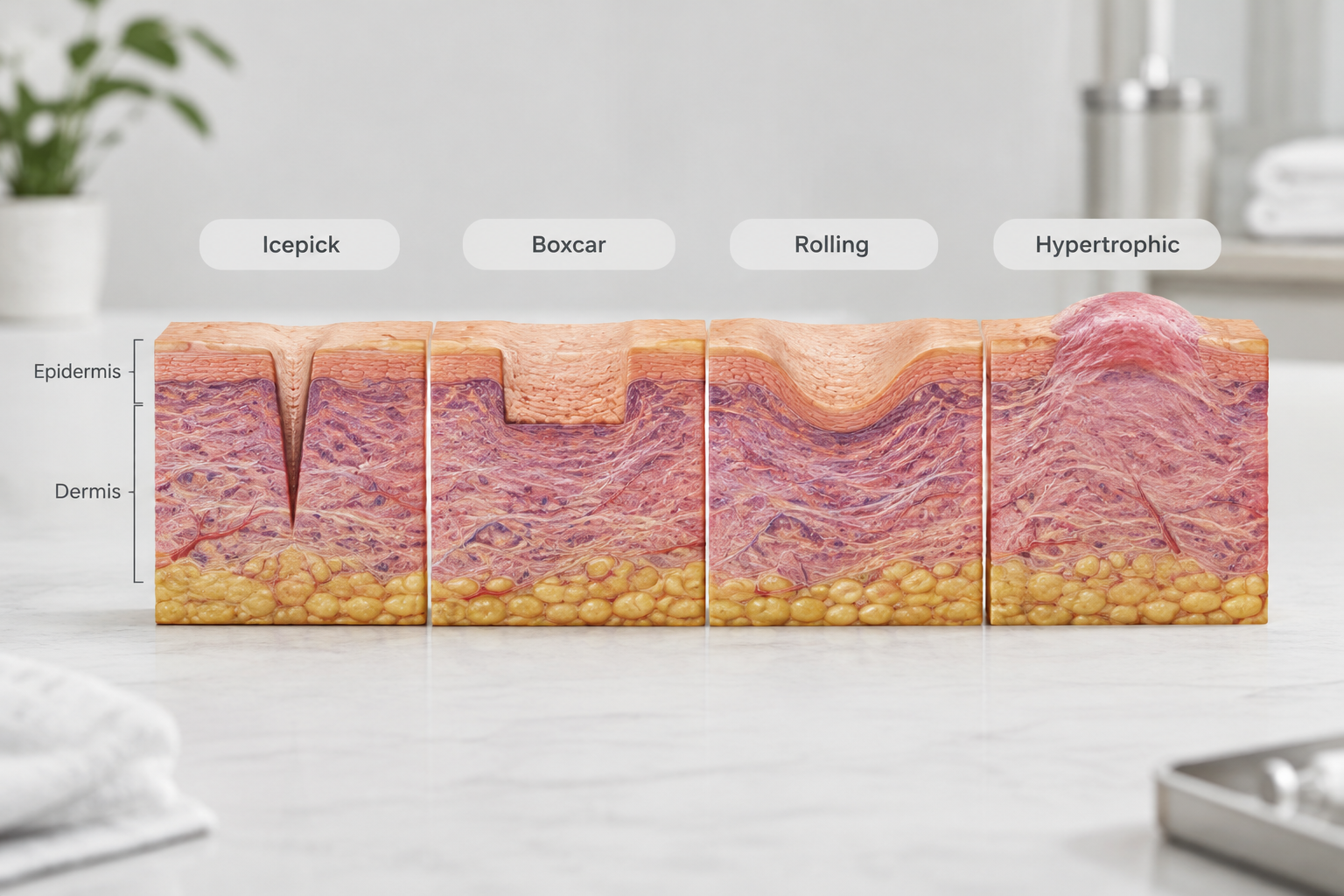
Hypertrophic and keloid scars are raised scars caused by excess collagen production. These are less common with acne but do occur, particularly on the chest, back, and jawline.
Knowing which type of post-acne change you are dealing with is the single most important factor in choosing an appropriate approach. A flat pigmentation mark and a deep icepick scar require entirely different strategies.
What Natural Remedies Can and Cannot Do
A wide range of natural ingredients are promoted for acne scar removal, including aloe vera, rosehip oil, vitamin C serums, honey, lemon juice, turmeric, and apple cider vinegar. It is worth examining what the evidence actually shows for these, rather than relying on anecdotal claims.
Ingredients with Some Supporting Evidence
Vitamin C (ascorbic acid) is one of the better-studied topical ingredients for post-acne pigmentation. As an antioxidant, vitamin C inhibits melanin synthesis and may help fade hyperpigmentation over several weeks of consistent use. It does not rebuild lost collagen in a clinically meaningful way when applied topically, and it has no established effect on atrophic scar depth. Formulation stability matters significantly — vitamin C degrades quickly when exposed to light and air, so product quality affects results.
Niacinamide (vitamin B3) has reasonable evidence for reducing hyperpigmentation and improving skin barrier function. Studies suggest it may help fade PIH with regular use over eight to twelve weeks. Niacinamide is generally well tolerated and is found in many over-the-counter serums and moisturisers.
Aloe vera contains compounds including aloesin, which has shown some melanin-inhibiting activity in laboratory studies. Evidence in human clinical trials is limited, but aloe vera is unlikely to cause harm and may support skin hydration and soothing during healing.
Rosehip oil contains trans-retinoic acid and essential fatty acids. Some small studies suggest it may improve the appearance of scars over time, though the evidence base is not robust enough to draw firm conclusions.
Ingredients to Approach with Caution
Lemon juice is frequently recommended online for skin brightening due to its citric acid content. However, undiluted lemon juice is highly acidic and can cause irritation, chemical burns, and photosensitivity, particularly in people with sensitive skin. It is not recommended by dermatologists as a safe home treatment for acne scars.
Apple cider vinegar carries similar risks. Its acidity can disrupt the skin’s natural pH and cause irritation or damage, and there is no reliable clinical evidence supporting its use for scar treatment.
Toothpaste, baking soda, and similar abrasive or alkaline home remedies are not supported by evidence and carry a real risk of skin irritation and barrier disruption.
The One-Week Reality
Even the most evidence-supported topical ingredients require consistent use over weeks to months to produce visible changes in pigmentation. They do not alter the physical structure of atrophic scars. Expecting complete scar removal in seven days from any natural remedy is not realistic, and pursuing aggressive home treatments in the hope of faster results can cause additional skin damage that worsens the appearance of scars.
Skincare Habits That Support Gradual Improvement
While no skincare routine removes established acne scars quickly, certain consistent habits can meaningfully support the skin’s natural repair processes and prevent existing marks from worsening.
Daily broad-spectrum sun protection is arguably the single most important step for anyone with post-acne marks. UV exposure significantly darkens hyperpigmentation and slows its natural fading. Using a broad-spectrum SPF 30 or higher every morning — regardless of weather — can prevent PIH from deepening and allows existing marks to fade more efficiently over time.

Gentle cleansing and moisturising support a healthy skin barrier. A compromised barrier prolongs inflammation and can make post-acne marks more visible. Avoiding harsh scrubs, over-cleansing, and irritating ingredients helps maintain the barrier integrity needed for skin repair.
Retinoids (including over-the-counter retinol and prescription tretinoin) are among the most evidence-supported topical ingredients for improving skin texture, stimulating collagen production, and fading hyperpigmentation over time. Prescription-strength tretinoin has a stronger evidence base than cosmetic retinol. Retinoids require gradual introduction to avoid irritation and must be used with sun protection, as they increase photosensitivity.
Alpha hydroxy acids (AHAs) such as glycolic acid and lactic acid promote cell turnover and may help fade superficial pigmentation over time. They are available in various concentrations in over-the-counter products and professional treatments. Higher concentrations carry a greater risk of irritation and should be introduced carefully.
These approaches work gradually. Realistic timelines for visible improvement in PIH with consistent skincare are typically eight to sixteen weeks, not seven days.
Clinical Treatments That Offer More Meaningful Results
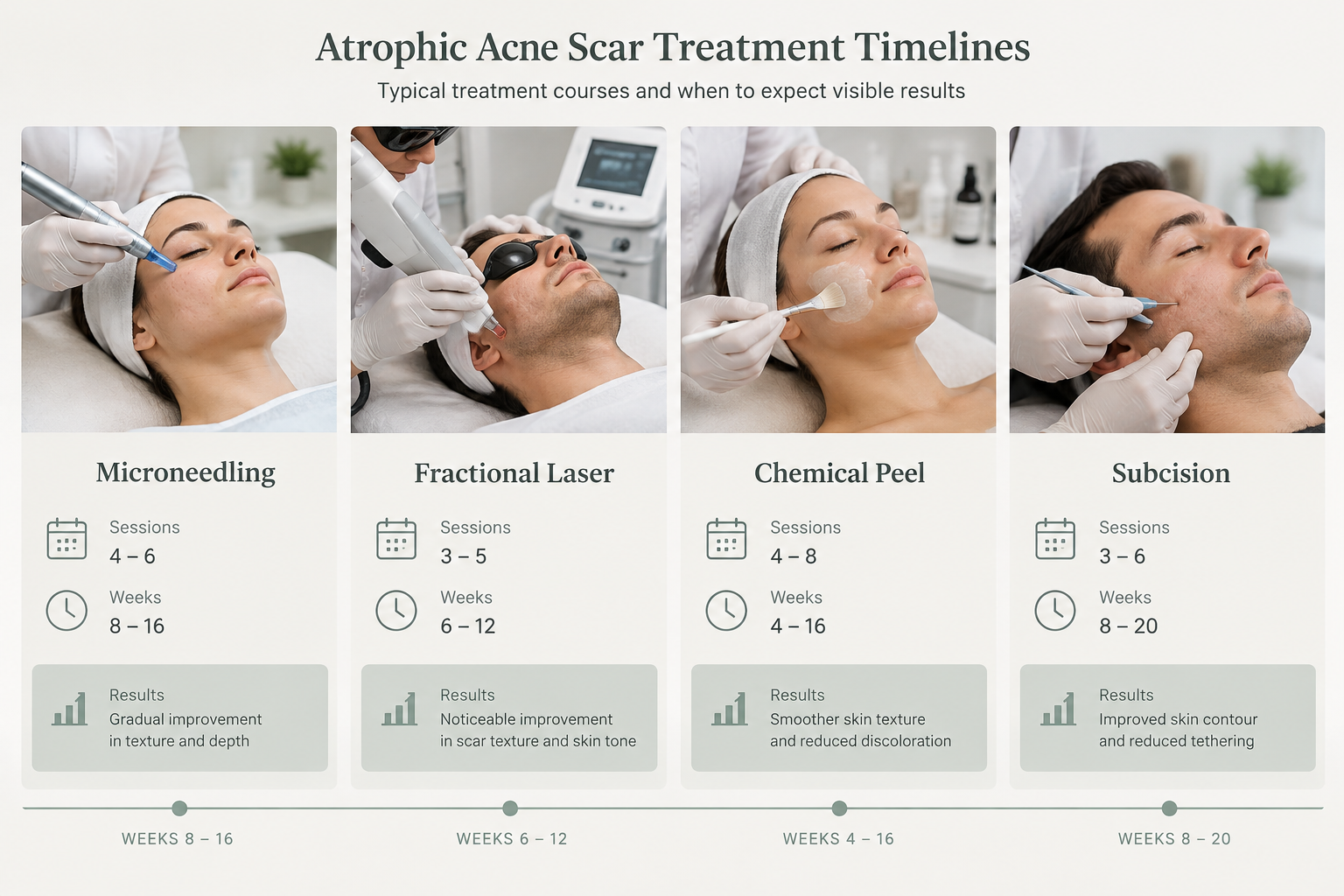
For people with true atrophic acne scars — particularly icepick, boxcar, or rolling scars — clinical treatments offer significantly more meaningful improvement than topical products alone. These treatments work by stimulating collagen remodelling, resurfacing the skin, or physically altering scar tissue. Multiple sessions are typically required, and results develop gradually over weeks to months after treatment.
Chemical Peels
Professional chemical peels use controlled concentrations of acids — such as glycolic acid, salicylic acid, trichloroacetic acid (TCA), or mandelic acid — to remove damaged outer skin layers and stimulate renewal. Superficial peels may help with PIH and mild textural irregularities. Medium-depth peels, such as TCA peels, can address more significant pigmentation and mild atrophic scarring. Deep peels offer more substantial resurfacing but carry greater downtime and risk. A qualified practitioner will assess which peel depth is appropriate for your skin type and scar severity. Chemical peels are not suitable for all skin tones without careful selection, as some formulations carry a risk of post-inflammatory hyperpigmentation in darker skin.
Microneedling
Microneedling (also called collagen induction therapy) uses fine needles to create controlled micro-injuries in the skin, triggering the body’s wound-healing response and stimulating new collagen and elastin production. Clinical studies support microneedling as an effective treatment for atrophic acne scars, particularly rolling and boxcar subtypes. Results develop gradually over several months as new collagen matures. A course of three to six sessions spaced four to six weeks apart is typically recommended. Microneedling is generally considered suitable for a wider range of skin tones than some laser treatments, though individual assessment is essential.
Laser Resurfacing
Laser treatments for acne scars include ablative lasers (such as CO2 and erbium lasers, which remove the outer skin layer) and non-ablative fractional lasers (which create controlled thermal injury within the skin without removing the surface). Fractional laser resurfacing, including fractional CO2 and fractional non-ablative devices, has a substantial evidence base for improving atrophic acne scars. Ablative treatments typically offer more dramatic results but involve more significant downtime — often one to two weeks of redness, swelling, and peeling. Non-ablative fractional treatments involve less downtime but may require more sessions. Laser suitability depends heavily on skin tone; certain laser wavelengths carry a higher risk of pigmentation changes in darker skin types, and practitioner experience with diverse skin tones is an important consideration.
Subcision
Subcision is a minor surgical procedure in which a fine needle is inserted beneath a depressed scar to release the fibrous bands tethering it to deeper tissue. It is particularly effective for rolling scars. Subcision is often combined with other treatments such as microneedling or filler for enhanced results. The procedure is performed under local anaesthetic and typically causes temporary bruising.
Dermal Fillers for Scars
Injectable dermal fillers — most commonly hyaluronic acid — can be used to temporarily lift depressed atrophic scars, improving their appearance. This approach provides immediate visual improvement but is not a permanent solution, as fillers are gradually absorbed by the body. Filler for acne scars is a specialist technique and should only be performed by a qualified and experienced practitioner.
Topical Prescription Treatments
Prescription-strength tretinoin, azelaic acid, and hydroquinone (where available and appropriate) are used by dermatologists to address post-acne pigmentation. These are more potent than over-the-counter alternatives and are prescribed based on individual skin assessment. They do not remove structural scar tissue but can meaningfully improve PIH over a treatment course.
Scar Type and Treatment Matching
No single treatment is universally effective for all acne scar types. The table below summarises which clinical approaches are generally considered most relevant for each scar category, based on established clinical practice. Individual suitability always requires professional assessment.
| Scar Type | Characteristics | Commonly Used Clinical Approaches |
|---|---|---|
| Post-inflammatory hyperpigmentation (PIH) | Flat, discoloured marks; not structural scarring | Topical brightening agents, chemical peels, sun protection, prescription retinoids |
| Rolling scars | Broad, wave-like depressions | Subcision, microneedling, fractional laser, filler |
| Boxcar scars | Wider depressions with defined edges | Fractional laser, microneedling, TCA cross (for shallow boxcar), filler |
| Icepick scars | Narrow, deep channels | TCA cross technique, punch excision, fractional ablative laser |
| Hypertrophic / keloid scars | Raised, thickened scar tissue | Corticosteroid injections, silicone sheeting, laser, specialist referral |
Risks of Aggressive Home Treatments
The desire for fast results can lead some people to attempt aggressive home treatments — high-concentration acid peels purchased online, dermaplaning with unsuitable tools, or prolonged use of irritating ingredients. These approaches carry real risks that can worsen the appearance of acne scars rather than improve them.
Applying high-concentration acids without professional training can cause chemical burns, permanent pigmentation changes, and new scarring. Mechanical trauma from aggressive scrubbing or improper needling devices can trigger further inflammation and PIH. In people with darker skin tones, any form of skin trauma carries a heightened risk of post-inflammatory hyperpigmentation, which may be more difficult to treat than the original scars.
If you experience significant irritation, burning, blistering, or unexpected skin changes from any home treatment, discontinue use and seek advice from a qualified healthcare professional or dermatologist.
Who May Benefit from a Clinical Consultation
A consultation with a qualified aesthetic practitioner or dermatologist is worth considering if:
- You have visible atrophic scars (icepick, boxcar, or rolling) that have not responded to consistent skincare over several months.
- Post-acne pigmentation is significantly affecting your confidence and has persisted for more than three to six months despite sun protection and topical treatment.
- You are unsure which type of post-acne change you have and want an accurate assessment before investing in products or treatments.
- You have darker skin and want to ensure any treatment chosen is appropriate and safe for your skin tone.
- You have tried multiple over-the-counter products without meaningful improvement.
A clinical assessment allows a practitioner to identify scar types accurately, assess skin tone and sensitivity, review your medical history and any medications, and recommend a treatment plan with realistic expectations. This is more reliable than self-diagnosing from online descriptions and selecting treatments without professional guidance.
Frequently Asked Questions
Can any treatment remove acne scars in one week?
No treatment — natural or clinical — can fully remove established acne scars in seven days. Structural changes to the skin require time to remodel. Some clinical treatments can produce visible improvement over a course of sessions spanning weeks to months, but one week is not a realistic timeframe for meaningful scar reduction.
Is post-acne redness the same as a scar?
Not necessarily. Persistent redness after acne (post-inflammatory erythema) and dark marks (post-inflammatory hyperpigmentation) are pigmentation responses, not structural scars. They may fade over time with appropriate skincare and sun protection, though the timeline varies. True atrophic scars involve a physical depression in the skin and do not fade on their own.
Does vitamin C remove acne scars?
Topical vitamin C may help fade post-inflammatory hyperpigmentation over several weeks of consistent use. It does not remove atrophic scar tissue or alter the physical depth of depressed scars. It is a useful addition to a skincare routine for PIH but should not be expected to erase structural scarring.
Is microneedling safe for all skin tones?
Microneedling is generally considered suitable for a broader range of skin tones than some laser treatments, but individual assessment is still essential. In any skin tone, improper technique or inadequate aftercare can trigger post-inflammatory hyperpigmentation. Treatment should be performed by a qualified practitioner experienced with diverse skin types.
How many sessions of clinical treatment are typically needed for acne scars?
This depends on the treatment type, scar severity, and individual response. Microneedling courses typically involve three to six sessions. Fractional laser treatments may require two to five sessions. Chemical peels may be performed as a series. Results continue to develop for weeks to months after each session as collagen remodelling progresses. A practitioner will provide a more specific estimate after assessing your scars.
Can I prevent acne scars from forming?
Effective acne management is the most reliable way to reduce the risk of scarring. Treating active breakouts promptly, avoiding picking or squeezing spots (which significantly increases scarring risk), using daily sun protection, and seeking professional acne treatment when over-the-counter options are insufficient can all help minimise the likelihood of permanent scarring.
What to Realistically Expect on Your Acne Scar Journey
Managing acne scars effectively requires accurate expectations. Post-inflammatory hyperpigmentation — the flat dark or red marks many people mistake for scars — can improve meaningfully with consistent sun protection, appropriate topical ingredients such as niacinamide or vitamin C, and time. Visible fading over eight to sixteen weeks is a realistic goal for PIH with a well-chosen skincare routine.
True atrophic acne scars, which involve a physical loss of skin tissue, respond to clinical treatments but not to natural remedies or standard skincare products alone. Treatments such as microneedling, fractional laser resurfacing, subcision, and chemical peels can produce meaningful improvement in scar depth and texture, but results develop gradually and multiple sessions are typically needed. Significant improvement — rather than complete removal — is the realistic outcome for most established atrophic scars.
The most productive first step is understanding exactly what type of post-acne change you are dealing with. If you are uncertain, a consultation with a qualified aesthetic practitioner or dermatologist provides an accurate assessment and a treatment plan matched to your specific skin concerns, tone, and goals. Pursuing aggressive home treatments in the hope of a one-week result is unlikely to deliver meaningful improvement and carries a real risk of making the situation worse.