

Age spots are a common skin concern, particularly for people over 40, and it is entirely understandable to want to address them without immediately turning to clinical procedures. A range of natural and over-the-counter approaches are widely discussed, but the evidence behind them varies considerably. This article explains what age spots are, which natural methods have some scientific support, what their realistic limitations are, and when a professional assessment may be worth considering.
Key Takeaways
- Age spots are caused by localised overproduction of melanin, typically triggered by cumulative sun exposure, and are not harmful but can be cosmetically bothersome.
- Some natural ingredients such as vitamin C, niacinamide, and azelaic acid have reasonable evidence for gradually fading hyperpigmentation, though results are modest and slow.
- Home remedies like lemon juice, apple cider vinegar, and onion extract are frequently cited online but lack robust clinical evidence and carry a risk of skin irritation.
- Consistent daily sun protection is the single most important step in both preventing new age spots and stopping existing ones from darkening further.
- For more pronounced or persistent pigmentation, professional treatments such as chemical peels, laser therapy, or prescription topicals may offer more reliable results than natural approaches alone.
What Are Age Spots and Why Do They Form?
Age spots — also called solar lentigines, liver spots, or sun spots — are flat, well-defined areas of increased pigmentation that typically appear on skin that has received the most sun exposure over a lifetime: the face, hands, shoulders, forearms, and décolletage. Despite the name, age itself is not the direct cause. The primary driver is cumulative ultraviolet (UV) radiation, which stimulates melanocytes (the pigment-producing cells in the skin) to produce excess melanin. Over time, this melanin clusters unevenly, creating the characteristic brown, tan, or grey patches.
Age spots are benign and do not require medical treatment for health reasons. However, it is important to distinguish them from other pigmented lesions. Any spot that changes in size, shape, or colour, develops irregular borders, bleeds, or appears suddenly should be assessed by a dermatologist or qualified clinician to rule out conditions such as melanoma or seborrhoeic keratosis. A professional evaluation before beginning any self-treatment is always a sensible first step.
The Role of Sun Protection in Managing Age Spots
Before exploring any active ingredient or remedy, it is worth emphasising that daily broad-spectrum sun protection is the foundation of any age spot management strategy. UV exposure is the primary cause of solar lentigines, and without consistent sun protection, any fading achieved through natural or professional means is likely to be reversed or undermined. Dermatological guidance consistently recommends using a broad-spectrum sunscreen with SPF 30 or higher every day, reapplying every two hours during outdoor activity, and wearing protective clothing and hats when sun exposure is prolonged.
Sun protection does not remove existing age spots, but it prevents them from darkening further and reduces the formation of new ones. For many people, diligent sun avoidance alone leads to a gradual, modest lightening of existing spots over months, as the skin naturally turns over and replaces pigmented cells. This process is slow and incomplete, but it is the most evidence-supported non-interventional approach available.
Natural and Evidence-Supported Topical Ingredients
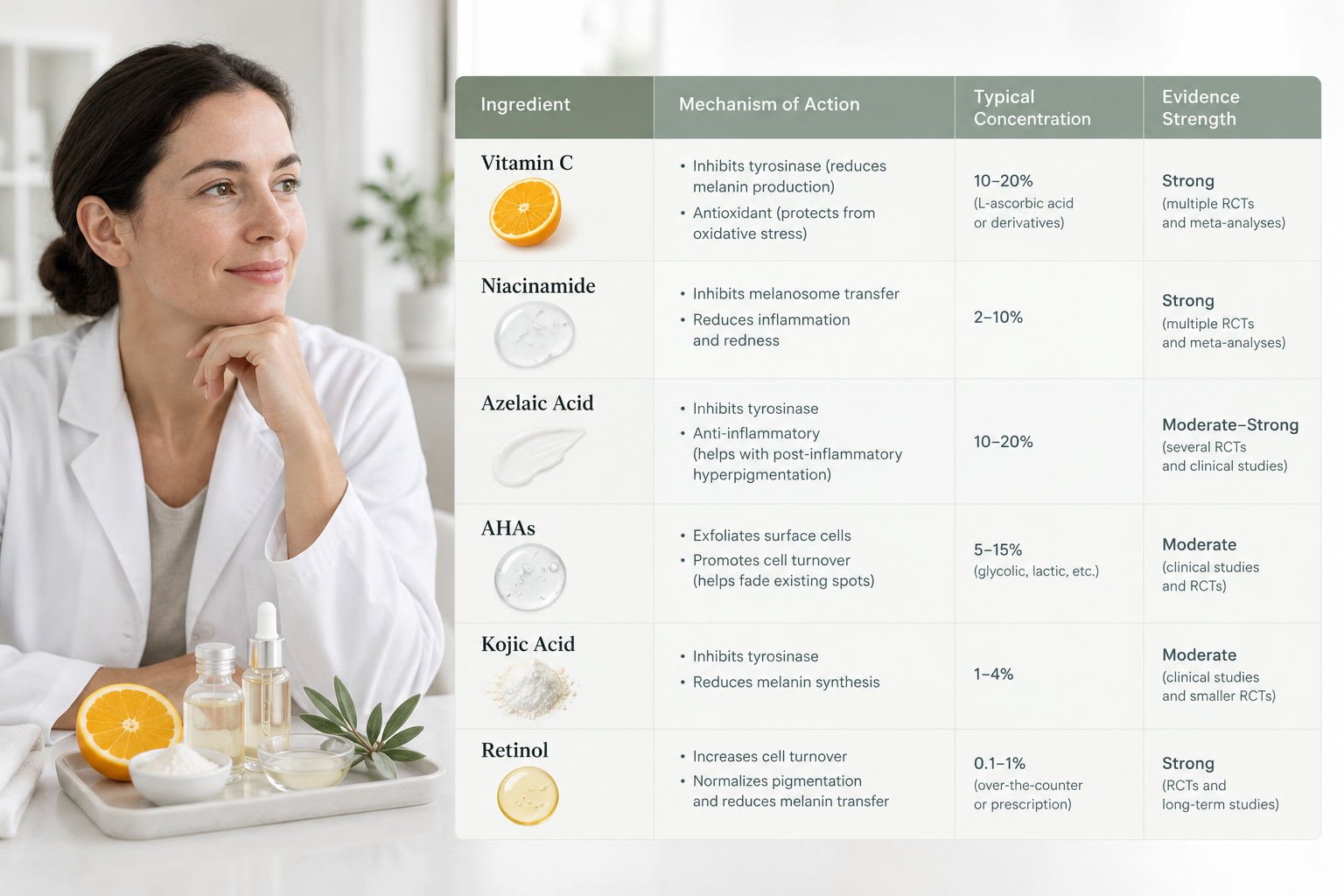
Several ingredients derived from natural sources or available in over-the-counter formulations have been studied for their ability to inhibit melanin production or accelerate the shedding of pigmented skin cells. The evidence behind each varies in quality and strength.
Vitamin C (Ascorbic Acid)
Vitamin C is one of the most studied topical ingredients for hyperpigmentation. It works primarily by inhibiting tyrosinase, the enzyme responsible for melanin synthesis, and also provides antioxidant protection against UV-induced oxidative stress. Topical vitamin C formulations, particularly L-ascorbic acid at concentrations of 10–20%, have shown modest but meaningful reductions in pigmentation in several clinical studies. Results typically require consistent use over eight to twelve weeks or longer. Vitamin C is also unstable and degrades quickly when exposed to air and light, so formulation quality matters significantly. Serums stored in opaque, airtight packaging tend to be more effective.
Niacinamide
Niacinamide (vitamin B3) is a well-tolerated ingredient that reduces the transfer of melanin from melanocytes to surrounding skin cells, a process called melanosome transfer inhibition. Clinical studies have found that topical niacinamide at concentrations of 2–5% can produce a visible reduction in hyperpigmentation with regular use over several weeks. Niacinamide is generally suitable for most skin types, including sensitive skin, and is often found in combination with other brightening agents. It does not carry the irritation risk associated with some other actives.
Azelaic Acid
Azelaic acid is a naturally occurring dicarboxylic acid found in grains such as wheat, rye, and barley. It inhibits tyrosinase activity and has mild exfoliating properties. Azelaic acid is available in over-the-counter concentrations (typically 10%) and in higher-strength prescription formulations (15–20%). It has a reasonable evidence base for treating post-inflammatory hyperpigmentation and melasma, and may also help with solar lentigines. It is generally well tolerated, though some users experience mild tingling or redness initially.
Alpha Hydroxy Acids (AHAs)
Alpha hydroxy acids such as glycolic acid and lactic acid are chemical exfoliants derived from natural sources — glycolic acid from sugar cane, lactic acid from milk. They work by loosening the bonds between dead skin cells, accelerating surface cell turnover and helping to shed pigmented cells more quickly. Regular use of AHA-containing products can contribute to a more even skin tone over time. However, AHAs also increase photosensitivity, making diligent sun protection even more important during use. Starting with lower concentrations and gradually increasing helps minimise irritation.
Kojic Acid
Kojic acid is a by-product of the fermentation process used to produce sake and soy sauce. It inhibits tyrosinase and has been used in cosmetic formulations for skin brightening. Some clinical studies support its effectiveness for hyperpigmentation, though it can cause contact dermatitis in some individuals, particularly at higher concentrations. It is often combined with other brightening agents in commercial products.
Retinoids (Retinol)
Retinol and other retinoids (vitamin A derivatives) promote skin cell turnover and can gradually fade pigmentation by accelerating the shedding of melanin-containing cells. Over-the-counter retinol is weaker than prescription tretinoin but can still produce noticeable improvements with consistent use over several months. Retinoids commonly cause initial dryness, flaking, and sensitivity, particularly in the first few weeks of use. Introducing retinol slowly — starting two to three nights per week — and using a good moisturiser helps manage these effects. Retinoids are not recommended during pregnancy.
Popular Home Remedies: What the Evidence Actually Shows
A wide range of home remedies for age spots circulate online, including lemon juice, apple cider vinegar, onion extract, aloe vera, green tea extract, and turmeric. It is worth examining these honestly, because the gap between popular claims and clinical evidence is often significant.
Lemon Juice
Lemon juice is frequently cited as a natural skin lightener due to its citric acid content and vitamin C. While citric acid is a mild AHA and vitamin C does have evidence for pigmentation reduction, the concentration of these compounds in fresh lemon juice is inconsistent and generally low. More importantly, applying undiluted lemon juice to the skin carries a real risk of irritation, phototoxic reactions (particularly when skin is then exposed to sunlight), and paradoxical post-inflammatory hyperpigmentation — meaning it could make pigmentation worse. There is no robust clinical evidence that lemon juice reliably fades age spots, and dermatologists generally advise against applying it directly to the skin.
Apple Cider Vinegar
Apple cider vinegar contains acetic acid and is sometimes promoted as a skin brightener. The evidence for its effectiveness on age spots is essentially anecdotal. Acetic acid can be irritating to skin, and there is a risk of chemical burns with undiluted application. No well-designed clinical studies support its use for solar lentigines.
Aloe Vera
Aloe vera gel contains aloesin, a compound that has shown some tyrosinase-inhibiting activity in laboratory studies. However, the concentrations found in typical aloe vera gel are low, and clinical evidence in humans for meaningful pigmentation reduction is limited. Aloe vera is well tolerated and unlikely to cause harm, but expectations should be modest. It may be more useful as a soothing, hydrating ingredient alongside other actives than as a standalone treatment for age spots.
Turmeric
Curcumin, the active compound in turmeric, has demonstrated antioxidant and anti-inflammatory properties in laboratory research, and some small studies suggest it may have mild skin-brightening effects. However, the evidence in humans for treating solar lentigines specifically is limited, and topical turmeric can stain the skin yellow. Oral curcumin supplements are sometimes discussed, but there is insufficient clinical evidence to recommend them for age spot reduction.
Green Tea Extract
Green tea contains polyphenols, particularly epigallocatechin gallate (EGCG), which have antioxidant properties and some evidence of mild melanin-inhibiting activity in laboratory settings. Clinical evidence for topical green tea extract reducing age spots in humans remains limited, though it is generally well tolerated and may offer some antioxidant benefit as part of a broader skincare routine.
Realistic Expectations for Natural Approaches
Natural and over-the-counter approaches to fading age spots can produce gradual improvements, but it is important to set realistic expectations. Even the best-evidenced ingredients — vitamin C, niacinamide, azelaic acid, retinol — typically produce modest rather than dramatic results, and they require consistent daily use over months rather than weeks. Age spots that are deeply pigmented, long-established, or located on areas with significant cumulative sun damage tend to respond more slowly and less completely than newer, lighter spots.
Results also depend heavily on skin type, the depth of pigmentation, and how consistently the product is used alongside sun protection. Stopping sun protection while using brightening ingredients will largely negate any progress made. It is also worth noting that many over-the-counter products contain active ingredients at concentrations lower than those used in clinical studies, which can further limit their effectiveness.
When Natural Methods May Not Be Enough
For people with pronounced, numerous, or persistent age spots, natural and over-the-counter approaches may not deliver satisfactory results within a reasonable timeframe. In these situations, professional treatments offer more targeted and often more effective options. A qualified dermatologist or aesthetic practitioner can assess the nature and depth of the pigmentation and recommend an appropriate treatment plan.
Professional options for age spot removal include:
- Prescription topicals: Higher-strength formulations such as tretinoin (prescription-strength retinoid) or hydroquinone (where legally available) are more potent than over-the-counter alternatives and have a stronger evidence base for hyperpigmentation treatment.
- Chemical peels: Medium-depth chemical peels using trichloroacetic acid (TCA) or superficial peels with higher-concentration AHAs can accelerate pigment removal by exfoliating the outer layers of skin more effectively than home products.
- Laser treatments: Q-switched Nd:YAG lasers and intense pulsed light (IPL) devices target melanin specifically and can produce significant lightening of solar lentigines, often in fewer sessions than topical treatments require. Results vary depending on skin type and the depth of pigmentation.
- Cryotherapy: Controlled application of liquid nitrogen can destroy pigmented cells in individual age spots. It is a relatively quick procedure but carries a risk of temporary or permanent changes in skin colour, particularly in darker skin tones.
- Microdermabrasion and microneedling: These physical resurfacing techniques can improve overall skin tone and texture and may contribute to pigmentation reduction, though they are generally considered less targeted for age spots than laser or chemical approaches.
Each professional treatment carries its own risk profile, downtime, and suitability considerations. A thorough consultation with a qualified practitioner is essential before proceeding with any clinical intervention.
Who May Be Suitable for Natural Approaches
Natural and over-the-counter methods may be a reasonable starting point for people with mild to moderate age spots who prefer a gradual, lower-risk approach, have no history of significant skin sensitivity or allergy to common skincare ingredients, are willing to commit to consistent daily use over several months, and understand that results will be modest rather than dramatic. People with darker skin tones should be particularly cautious with any approach that risks irritation, as post-inflammatory hyperpigmentation — darkening of the skin in response to inflammation — can be a significant concern.
Building an Effective Natural Skincare Routine for Age Spots
Rather than applying multiple active ingredients simultaneously, which increases the risk of irritation and makes it difficult to identify what is working, a structured approach tends to be more effective. A practical routine might include a gentle cleanser, a vitamin C serum in the morning followed by broad-spectrum SPF 30 or higher, and a niacinamide or azelaic acid product in the evening, with retinol introduced gradually two to three nights per week once the skin has adjusted. Patch testing any new product on a small area of skin before full application is advisable, particularly for those with sensitive skin.
Introducing one new active ingredient at a time, waiting four to six weeks before assessing its effect, and maintaining consistent sun protection throughout gives the best chance of seeing genuine improvement while minimising the risk of adverse reactions.
Frequently Asked Questions
How long does it take to see results from natural age spot treatments?
Most evidence-supported topical ingredients require at least eight to twelve weeks of consistent daily use before any meaningful change in pigmentation becomes visible. Some people may need to continue for six months or longer to see the full benefit. Results are gradual and may be subtle, particularly for deeper or long-established spots.
Can age spots be removed completely at home?
Complete removal of age spots using home methods alone is unlikely for most people. Natural and over-the-counter approaches can fade pigmentation and improve overall skin tone, but they rarely eliminate age spots entirely. Professional treatments such as laser therapy or chemical peels are generally more effective for significant or complete reduction.
Is it safe to use multiple brightening ingredients at the same time?
Combining multiple active ingredients increases the risk of irritation, particularly for sensitive skin. Some combinations — such as vitamin C in the morning and retinol at night — are commonly used and generally well tolerated when introduced gradually. However, layering several strong actives simultaneously is not recommended without guidance. Introducing one ingredient at a time and monitoring the skin’s response is the safer approach.
Do age spots come back after fading?
Age spots can return or darken again if sun protection is not maintained consistently. UV exposure is the primary cause of solar lentigines, so ongoing sun protection is essential to preserve any improvement achieved through natural or professional treatment. New age spots may also develop over time with continued sun exposure.
Are age spots the same as freckles or melasma?
No. Freckles (ephelides) are smaller, lighter, and more evenly distributed, and they tend to fade in winter. Melasma is a different form of hyperpigmentation that is often hormonally influenced, typically appears in larger patches on the face, and can be more difficult to treat. Age spots (solar lentigines) are distinct from both and are primarily caused by cumulative UV exposure. Treatment approaches differ between these conditions, which is one reason a professional assessment is valuable before beginning treatment.
Can diet or supplements help fade age spots?
There is limited clinical evidence that dietary changes or oral supplements reliably fade existing age spots. A diet rich in antioxidants — from fruits, vegetables, and foods containing vitamins C and E — may support overall skin health and provide some protection against UV-induced oxidative damage, but it is unlikely to produce visible lightening of established pigmentation. Oral supplements marketed specifically for skin brightening generally lack robust clinical evidence.
When should I see a doctor about a pigmented spot?
Any pigmented lesion that changes in size, shape, or colour, has irregular or poorly defined borders, is raised, bleeds, itches persistently, or appears suddenly should be assessed by a dermatologist promptly. These features can be associated with conditions that require medical evaluation. Age spots are typically flat, evenly pigmented, and stable over time — if a spot does not match this description, professional assessment is important before attempting any self-treatment.
Deciding Whether Natural Methods Are Right for Your Age Spots
Natural approaches to fading age spots are a reasonable starting point for mild pigmentation, and several ingredients — particularly vitamin C, niacinamide, azelaic acid, and retinol — have meaningful evidence supporting their use. However, it is important to approach them with realistic expectations: results are gradual, modest, and dependent on consistent use and rigorous sun protection. Home remedies such as lemon juice and apple cider vinegar carry more risk than benefit and are not supported by clinical evidence.
For people with more pronounced, numerous, or treatment-resistant age spots, professional options including prescription topicals, chemical peels, and laser treatments are likely to offer more reliable and faster results. The right approach depends on the severity of the pigmentation, skin type, individual goals, and tolerance for the time and commitment involved in a home-based routine.
If you are uncertain about the nature of a pigmented lesion, or if over-the-counter approaches have not produced satisfactory results after several months of consistent use, a consultation with a qualified dermatologist or aesthetic practitioner is a sensible next step. A professional can confirm the diagnosis, assess the depth and type of pigmentation, and recommend a treatment plan tailored to your skin and goals.