

A well-defined jawline is one of the most commonly requested aesthetic goals, yet the path to achieving it depends heavily on individual anatomy, skin quality, and the underlying cause of a soft or undefined jaw. Whether the concern is excess submental fat, skin laxity, loss of bone projection, or muscle imbalance, the right approach varies from person to person. This article explains the realistic options available — from lifestyle adjustments to non-surgical clinic treatments — so you can make an informed decision before seeking a professional consultation.
Key Takeaways
- A defined jawline can be influenced by genetics, body composition, skin laxity, submental fat, and bone structure — and the most effective approach depends on which factor is dominant for you.
- Lifestyle changes such as reducing body fat percentage and improving posture can make a modest but meaningful difference for some people.
- Non-surgical clinic treatments including botulinum toxin, dermal fillers, fat-dissolving injections, and skin-tightening devices may improve jaw definition without surgery, though results vary and are not permanent.
- Surgical options such as liposuction, neck lift, or jaw implants offer more significant and longer-lasting changes but carry greater risks and recovery time.
- A qualified practitioner assessment is essential before choosing any treatment, as the wrong approach for your anatomy can produce unsatisfactory or unsafe results.
Why Jaw Definition Varies Between People
The appearance of the jawline is shaped by several overlapping factors, and understanding which applies to you is the first step toward choosing an effective strategy. Bone structure sets the underlying framework — a naturally recessed chin or a less prominent mandible will create a softer jaw profile regardless of body fat or skin quality. Genetics play a significant role here, and no lifestyle change or non-surgical treatment can fundamentally alter bone architecture.
Subcutaneous fat beneath the chin and along the lower face — sometimes called a double chin or submental fat — is one of the most common reasons the jawline appears undefined. This fat can be resistant to diet and exercise in some individuals, even when overall body composition is lean. Skin laxity is another contributing factor, particularly as collagen and elastin production decline with age, causing the skin along the jaw and neck to lose firmness. Finally, the masseter muscles — the large chewing muscles at the sides of the jaw — can affect jaw width and shape, with enlarged masseters sometimes creating a squarer or bulkier lower face rather than a tapered, defined appearance.
Identifying which of these factors is most relevant to your concern will determine whether lifestyle changes, non-surgical treatments, or surgical intervention is the most appropriate starting point.
Lifestyle Approaches That May Help
For people whose undefined jawline is primarily related to overall body fat or mild submental fullness, lifestyle adjustments can produce a noticeable improvement — though the degree of change depends on individual anatomy and starting point.
Body Composition and Diet
Reducing overall body fat percentage through a sustained caloric deficit and regular physical activity can reduce fat deposits throughout the face and neck, including the submental area. The face is often one of the areas where fat loss becomes visible relatively early. However, spot reduction — losing fat from one specific area through targeted exercise — is not supported by evidence. General fat loss through diet and cardiovascular exercise is the mechanism, not facial exercises alone.
A diet that minimises excess sodium and processed foods may also reduce facial puffiness caused by fluid retention, which can temporarily soften the appearance of the jawline. Staying well hydrated supports skin quality over time, though hydration alone will not create structural jaw definition.
Posture and Neck Positioning
Chronic forward head posture — common among people who spend long hours looking at screens — can contribute to the appearance of a less defined jaw and neck. Improving posture by strengthening the deep neck flexors and upper back muscles may help the jaw and neck appear more elongated and defined. This is a modest effect and will not compensate for significant submental fat or skin laxity, but it is a low-risk, cost-free adjustment worth considering.
Facial Exercises: What the Evidence Says
Facial exercises and so-called jaw-toning devices are widely promoted online, but the clinical evidence supporting their effectiveness for jaw definition is limited. A small number of studies suggest that facial exercises may improve facial muscle tone and potentially create a modest lifting effect over several months of consistent practice, but the research is not robust enough to draw firm conclusions. Facial exercises are unlikely to reduce submental fat or address skin laxity, and they carry a low risk of harm when performed correctly. They should not be considered a substitute for clinical assessment if the concern is significant.
Non-Surgical Clinic Treatments for Jaw Definition
For people whose jawline concerns go beyond what lifestyle changes can address, a range of non-surgical aesthetic treatments may be appropriate depending on the underlying cause. Each treatment targets a different aspect of jaw appearance, and combining approaches is sometimes considered when multiple factors are present.
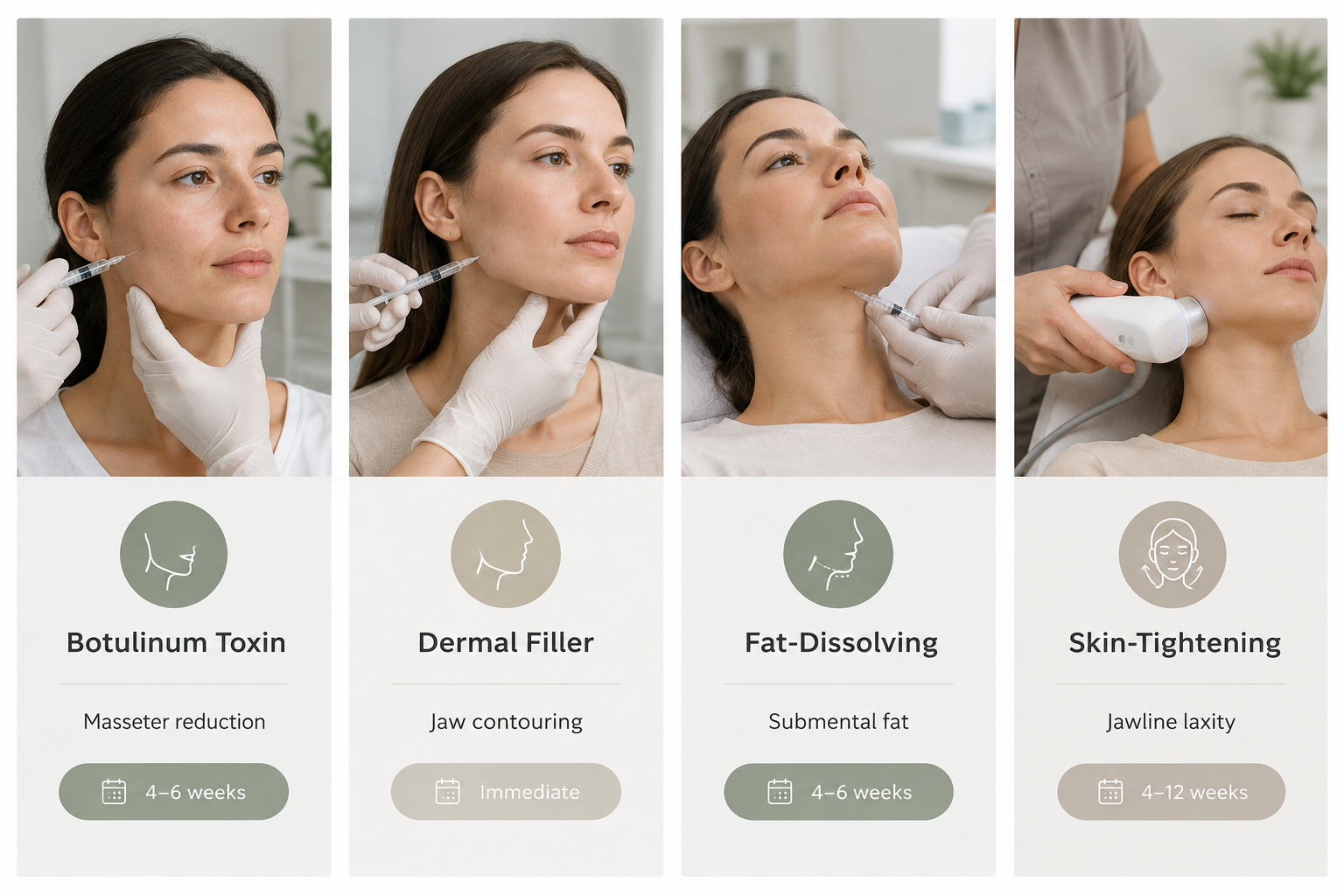
Botulinum Toxin for Masseter Reduction
Botulinum toxin injections into the masseter muscles — a treatment sometimes called masseter reduction or jaw slimming — can reduce the bulk of these muscles over time, creating a narrower, more tapered lower face. The botulinum toxin temporarily reduces the muscle’s activity, which causes the masseter to gradually decrease in size with repeated treatments. Results typically become visible over four to six weeks and may last approximately four to six months before the muscle gradually returns to its previous size. Repeated treatments are usually required to maintain the effect, and over time some patients find that less frequent maintenance is needed as the muscle adapts.
This treatment is most appropriate for people whose wide or square jaw is primarily due to masseter hypertrophy (enlarged chewing muscles) rather than bone structure. It will not improve submental fat, skin laxity, or chin projection. Side effects can include temporary difficulty chewing, asymmetry, or bruising at the injection site. A thorough assessment by a qualified practitioner is important to confirm that masseter hypertrophy is the relevant concern and that the treatment is appropriate for your anatomy.
Dermal Fillers for Chin and Jaw Contouring
Hyaluronic acid dermal fillers can be used to add projection to the chin, define the jawline angle, or create the appearance of a more structured lower face. By strategically placing filler along the mandibular border or at the chin point, a practitioner can improve the visual transition between the face and neck and create a more defined profile. Results are typically visible immediately and may last between twelve and twenty-four months depending on the product used, the area treated, and individual metabolism.
Dermal filler treatment in the jaw and chin area carries risks that require careful consideration. The lower face contains important vascular structures, and filler placed incorrectly can cause vascular occlusion — a serious complication that can lead to tissue damage. Treatment should only be performed by a qualified and experienced practitioner who understands facial anatomy and has access to hyaluronidase (an enzyme that can dissolve hyaluronic acid filler in an emergency). Swelling and bruising are common after treatment and usually resolve within one to two weeks. Filler is not appropriate for people who want to address submental fat or skin laxity as the primary concern.
Fat-Dissolving Injections for Submental Fat
Injectable treatments containing deoxycholic acid — a bile acid that disrupts fat cell membranes — can be used to reduce submental fat beneath the chin, improving the definition of the jaw and neck contour. Deoxycholic acid injections are a licensed treatment for submental fat reduction in several countries, though availability and regulatory status vary by region. Multiple treatment sessions are typically required, usually spaced four to six weeks apart, and results develop gradually over several months as the body processes the disrupted fat cells.
Common side effects include swelling, bruising, numbness, and discomfort in the treated area, which can be significant after each session. Swelling in particular can be pronounced and may last several weeks. The treatment is not suitable for people with excess skin laxity as the primary concern, as reducing fat without addressing skin quality can sometimes make laxity more apparent. A clinical assessment is essential to determine whether submental fat or skin laxity is the dominant issue before proceeding.
Other injectable fat-dissolving products are available in some markets, but the evidence base and regulatory status for these alternatives varies considerably. Discuss the specific product, its evidence, and its approval status with your practitioner before treatment.
Skin-Tightening Treatments
For people whose undefined jawline is primarily related to skin laxity rather than fat or muscle, energy-based skin-tightening treatments may be worth discussing with a practitioner. Technologies including radiofrequency, high-intensity focused ultrasound (HIFU), and microneedling with radiofrequency work by stimulating collagen and elastin production in the deeper layers of the skin, which can gradually improve firmness and lift along the jaw and neck over several months.
Results from skin-tightening treatments are generally modest compared to surgical options and are most appropriate for mild to moderate laxity. They are not effective for significant skin excess or for reducing submental fat. Multiple sessions may be required, and the improvement develops gradually rather than immediately. Evidence for these treatments varies between technologies and individual devices, and results are not guaranteed. Downtime is typically minimal, though some treatments may cause temporary redness, swelling, or sensitivity.
Thread Lifts
Absorbable thread lifts involve inserting fine threads beneath the skin to mechanically lift and reposition tissue along the jaw and lower face. The threads also stimulate some collagen production as they dissolve over time. Thread lifts can provide a more immediate lifting effect than energy-based treatments, but results are generally less dramatic and less durable than surgical lifting procedures. Longevity is typically one to two years. Risks include thread visibility, asymmetry, infection, and the possibility that threads may need to be removed if complications arise. Thread lifts are most appropriate for mild to moderate laxity and are not suitable for significant skin excess.
Surgical Options for a More Defined Jawline
When non-surgical treatments are unlikely to achieve the desired result — particularly for significant submental fat, marked skin laxity, or a desire for more substantial structural change — surgical options may be considered. These carry greater risks, longer recovery periods, and higher costs, but can produce more significant and longer-lasting outcomes.
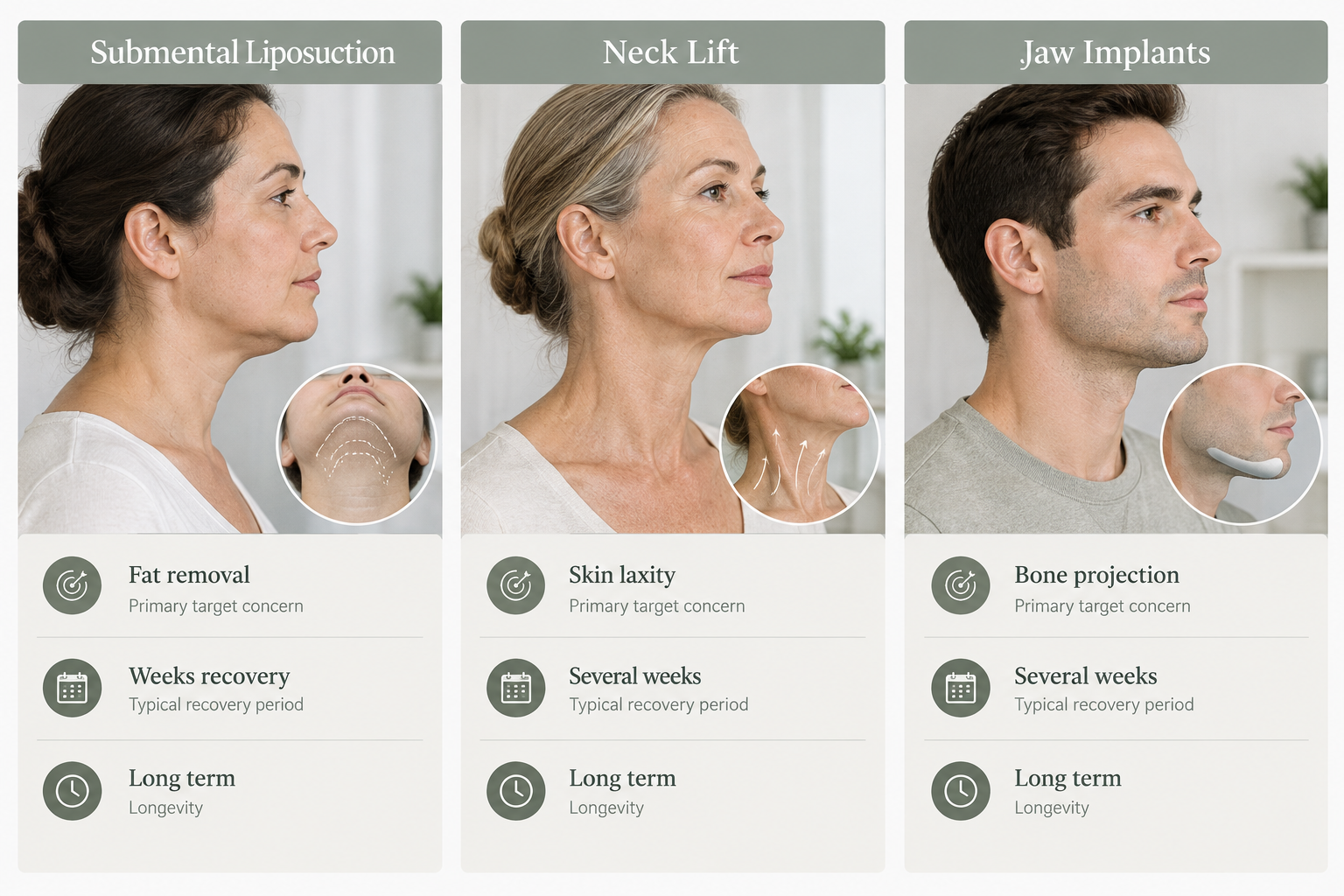
Liposuction and Submental Liposuction
Submental liposuction removes fat from beneath the chin through small incisions, producing a more defined jaw and neck contour. It is generally considered appropriate for people with good skin elasticity, as the skin needs to retract after fat removal. In people with reduced skin elasticity, liposuction alone may not produce a satisfactory result and may need to be combined with a skin-tightening procedure. Recovery typically involves swelling and bruising for several weeks, with final results becoming apparent over several months.
Neck Lift and Lower Face Lift
A neck lift or lower face lift surgically removes excess skin and tightens the underlying muscles, producing a more defined jaw and neck profile. These procedures are generally more appropriate for people with significant skin laxity or jowling that cannot be adequately addressed with non-surgical treatments. Recovery involves a longer downtime than non-surgical options, typically several weeks, and carries the risks associated with general or local anaesthesia, scarring, nerve injury, and infection. Results can be long-lasting but are not permanent, as the ageing process continues after surgery.
Chin and Jaw Implants
Surgical implants can augment the chin or jaw angle to create greater structural definition. These are most appropriate for people whose concern is primarily related to bone projection rather than soft tissue. Implants are a permanent addition and carry risks including infection, implant displacement, nerve damage, and the possibility of revision surgery. A thorough consultation with a qualified maxillofacial or plastic surgeon is essential before considering implants.
Choosing the Right Approach for Your Anatomy
The most important step in pursuing a more defined jawline is identifying the primary cause of the concern. A qualified aesthetic practitioner or surgeon will assess your facial anatomy, skin quality, fat distribution, muscle bulk, and bone structure before recommending any treatment. Choosing a treatment based on what worked for someone else — or on social media content — without a proper assessment can lead to disappointing results or, in some cases, complications.
It is also worth having realistic expectations. Non-surgical treatments can produce meaningful improvements for the right candidate, but they will not replicate the results of surgery, and no treatment can fundamentally alter bone structure without surgical intervention. Combining treatments — for example, addressing submental fat and then improving skin quality — may produce a more comprehensive result than a single approach, but this should be guided by a practitioner who has assessed your specific anatomy.
Cost, downtime, maintenance requirements, and personal risk tolerance are all relevant factors in the decision. Non-surgical treatments generally require ongoing maintenance to sustain results, while surgical options may offer longer-lasting outcomes at the cost of greater initial risk and recovery.
Who May Not Be Suitable for Certain Treatments
Suitability for any jaw-defining treatment depends on individual health history and anatomy. Some general considerations include:
- Pregnancy and breastfeeding: Most injectable and energy-based treatments are not recommended during pregnancy or breastfeeding.
- Active skin infections or inflammation: Injections should not be performed in areas with active infection.
- Certain medical conditions or medications: Conditions affecting the immune system, blood clotting, or nerve function may affect suitability for specific treatments. Some medications, including blood thinners, may increase bruising risk.
- Unrealistic expectations: People expecting surgical-level results from non-surgical treatments may not be suitable candidates, and a good practitioner will discuss this honestly.
- Significant skin laxity with submental fat: Removing fat without addressing laxity can worsen the appearance of loose skin in some cases.
Always disclose your full medical history, current medications, and previous treatments to your practitioner before proceeding with any aesthetic procedure.
Frequently Asked Questions
Can you get a more defined jawline without any clinical treatment?
For some people, reducing overall body fat, improving posture, and reducing sodium intake can make a noticeable difference to jaw definition. However, if the concern is primarily related to genetics, bone structure, significant submental fat, or skin laxity, lifestyle changes alone are unlikely to produce a substantial result. A practitioner assessment can help clarify which factors are most relevant for you.
How long does it take to see results from jaw-defining treatments?
This depends on the treatment. Dermal filler results are visible almost immediately, though swelling takes one to two weeks to settle. Botulinum toxin for masseter reduction typically takes four to six weeks to show its full effect. Fat-dissolving injections and skin-tightening treatments produce gradual results over several months as the body responds to treatment.
Are the results from non-surgical jaw treatments permanent?
Non-surgical treatments are not permanent. Dermal fillers typically last twelve to twenty-four months. Botulinum toxin effects last approximately four to six months before the muscle gradually returns to its previous size. Fat-dissolving injections can produce longer-lasting fat reduction, but skin quality and overall facial ageing continue to change over time. Maintenance treatments are usually required to sustain results.
Is masseter botulinum toxin treatment painful?
Most patients describe the injections as mildly uncomfortable rather than significantly painful. A topical anaesthetic cream can be applied beforehand to reduce discomfort. Some temporary soreness or tenderness in the jaw area may occur after treatment, but this usually resolves within a few days.
Can dermal filler alone create a defined jawline?
Dermal filler can improve jaw definition by adding projection and structure along the mandibular border and chin, but it cannot reduce submental fat, tighten loose skin, or slim a wide jaw caused by masseter hypertrophy. For many people, a combination of approaches addresses different aspects of jaw appearance more effectively than filler alone.
What is the difference between jaw slimming and jaw defining?
Jaw slimming typically refers to reducing the width of the lower face, most commonly by using botulinum toxin to reduce masseter muscle bulk. Jaw defining refers to improving the sharpness, projection, or contour of the jaw, which may involve dermal filler, fat reduction, or skin tightening. The appropriate approach depends on whether the goal is to narrow, sharpen, or lift the jaw — or a combination of these.
How do I know which treatment is right for me?
A face-to-face assessment with a qualified aesthetic practitioner is the most reliable way to determine which treatment — or combination of treatments — is appropriate for your anatomy and goals. Photographs and online consultations can provide some guidance, but they cannot replace a thorough in-person evaluation of skin quality, fat distribution, muscle bulk, and bone structure.
Making an Informed Decision About Jaw Definition
Achieving a more defined jawline is a realistic goal for many people, but the most effective route depends entirely on the underlying cause of the concern. Lifestyle changes offer a low-risk starting point for those whose jaw appearance is influenced by body composition or posture. Non-surgical clinic treatments — including botulinum toxin for masseter reduction, dermal fillers for structural contouring, fat-dissolving injections for submental fat, and skin-tightening technologies for laxity — can each address specific aspects of jaw definition with varying degrees of improvement, maintenance requirements, and risk profiles. Surgical options remain the most significant intervention and are best suited to people for whom non-surgical approaches are unlikely to achieve the desired outcome.
No single treatment suits every person, and combining approaches without proper assessment can lead to results that do not match your goals. The most important step is a thorough consultation with a qualified and experienced practitioner who can assess your anatomy honestly, explain the realistic outcomes for your specific situation, and recommend a treatment plan that is proportionate to your concern. If you are considering any of the treatments discussed here, seek a practitioner who is transparent about limitations, risks, and alternatives — not just the potential benefits.